Lochindorb hare snare trial to continue in October

The long-running Lochindorb Estate hare-snaring trial is set to drag on until October (see here, here and here for background to this case).

An important point of law was established during deliberations at Inverness Sheriff Court yesterday – whether a snare could be considered to be a trap. Although this question might sound ridiculous to us (of course a snare is a type of trap – they’re used for the sole purpose of trapping animals, aren’t they?), it was important to establish the legalĀ definition of a snareĀ in this particular case because if a snare wasn’t considered to be a trap, then there would be no case for gamekeeper David Taylor to answer. Anyway, the Sheriff apparently decided that a snare is a trap, and that there was sufficient evidence for the case to be continued in October (the defence had argued that there was insufficient evidence against Taylor).

Northern Times article reporting on yesterday’s court hearing here

Predictable shite as grouse season approaches

Yes, it’s that time of year again. The opening of the grouse-shooting season is upon us (although this year it’ll start on August 13th as the traditional opening day of the 12th falls on a Sunday) and the usual suspects are out in force to tell us all how great grouse moors are and how we should all be grateful for the conservation and economic benefits they provide. Not forgetting the predictable swipe at the RSPB along the way.

Shooting Times has an article suggesting that it’s time to sever ties with the RSPB due to their ‘bullying’ ways (see here). The best line has to be this: “For too long we have acted as gentlemen, only for our big-heartedness to be thrown back in our faces“. That’s priceless! Have a look here at an earlier blog we wrote about how the RSPB has been treated by these ‘gentlemen’!

An STV news article (here) has SGA Chairman Alex Hogg telling us how grouse shooting can save the world…or at least the rural economy, calling it a “modern industry” (ahem) and laughably explaining how “People admire Scotland’s diversity of landscape, its well-managed moorlands teeming with wildlife being a huge part of that attraction“!!!

An alternative view of grouse moor management can be found in The Guardian blog (here), where a national campaign against moorland bog-burning is due to be launched with a protest walk over the now infamous Walshaw Grouse Moor this Sunday.

Latest poisoning figures are just a smokescreen

So, SGA Chairman Alex Hogg is “hugely encouraged” by the forthcoming 2012 poisoning statistics, due to be released by the government agency SASA in the next few days (see here for STV news story and here for SGA press release). The figures are expected to show just two confirmed raptor poisonings in the first half of 2012, a considerable drop from the figures of previous years.

Unfortunately, these figues are just a small part of the story, as many regular readers will already be aware. We’ve blogged about this before, back in March when the poisoning figures forĀ 2011 were published (see here for our previous post). As we said then, these figures look promising on a superficial level but doĀ they reallyĀ reflect the true extent of illegal persecution?

The lower poisoning figures may well be a true indicator that fewer people are still poisoning raptors. That’s what the SGA and friends clearly think and would like the rest of us to think. However,Ā another equally plausible explanation is that the poisoners are just getting better at hiding the evidence. We’ve always known that the published poisoning figures just show a tiny fraction of actual poisoning incidents; these poisonings usually take place in vastly remote areas where few people are around toĀ find the evidence. The poisoned birds that have been discovered have usually been discovered by chance. More recently, they’ve been discovered because moreĀ raptors are nowĀ fitted with satellite tags so it’s easier to follow their movements and to find the locations where they die.

There is another plausible explanation, too. As we’ve also said before, poisoning is not the only method of illegally killing raptors. Perhaps the lower poisoning figures reflect a substantial shift in theĀ methods used to persecute raptors. Are more raptors being shot at the nest? Are more raptors being shot at roost sites? Are more nests and eggs being destroyed? AreĀ more raptors being caught in traps and beingĀ bludgeoned to death? The persecutorsĀ know very wellĀ that the government doesn’t record these types of incidents; only reported poisoningĀ incidents are published. What better way to make it look like you’ve cleaned up your act than by reducing the poisoning but increasing the other techniques that you know will never be officially reported? (Except by the RSPB who always publish these other persecution incidents in their annual reports, but which are then dismissed as being ‘unofficial’ and ‘exaggerated’ by the game-shooting lobby).

Is it plausible that other persecution methods have now taken precedence over poisoning?Ā Let’s look at the hen harrier situation. The UK’s hen harriers continue to spiral towards oblivion and the main cause has been identified as illegal persecution. Everyone knows it and evenĀ the government has acknowledged it. But how many hen harriers do you see listed in the annual poisoning figures? Very few indeed. Mainly because poison is rarely used to kill harriers – they’re not typically a scavenging species that depends on carrion so they’re harder to poison. But just because they don’t feature on the annual list of poisoned raptors doesn’t mean they’re not persecuted! Of course they are; the national hen harrier survey results say it all.

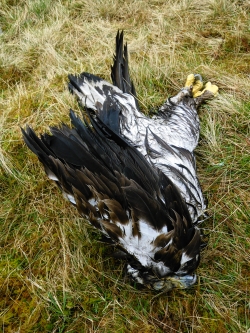
If anyone is still in any doubt about whether the latest poisoning figures are an accurate reflection of the extent of illegal raptor persecution, then consider this. Will the figures for Jan-June 2012Ā include this ‘missing’ satellite-tagged golden eagle (here), or this ‘missing’ satellite-tagged golden eagle (here), or this dead golden eagle found with substantial injuries (here), or this dead golden eagle found in what was described as ‘suspicious circumstances’ here? Or just the one confirmed poisoned golden eagle found dead in Lochaber (here)?

Pheasant poults killed by ruthless cyborgs

Jedi Knights, the protectors of the countryside, are warning of ruthless cyborgs disguised as red kites coming from the Death Star to kill pheasant poults. The Knights have called upon their Chosen One, Albert Hogburn, to help them neutralise the Dark Force.

Albert said: ā€œTeach me this at Yoda College they did. Uphold peace and justice will we. Evil red kites prevail shall not and lightsabre force feel will they. Stopped they must be; on this all depends. Carrion-eaters not they are and rural economy collapse it will if defeated they are not. Only a fully-trained Jedi Knight, with the Force as his ally, will conquer and save the pheasantsā€.

Donald Spewing-Moore of the Royal Bird Protection Society said: ā€œI’m sorry, I can’t talk right now, a kestrel just stole my car. These damn raptors are getting way out of hand. I wonder if Albert and his Jedi Knights will deploy their Imperial Star Destroyer to patrol my house?ā€

A totally unconnected story in theĀ Dumfries & Galloway StandardĀ here.

Lochindorb hare snare trial: charges dropped against one of the accused gamekeepers

The trial against two gamekeepers from the Lochindorb Estate, accused of setting snares to trap mountain hares (see hereĀ and hereĀ for background)Ā has had a dramatic turn today, according to the Forres Gazette.

It is reported that one of the accused gamekeepers, Kevin Begg, had the charge against him dropped. The reason for this has not yet been reported. The Gazette claims that the fiscal, Ian Smith (more about Mr SmithĀ after the trial)Ā says he now intends to call Begg as a witness against Lochindorb head gamekeeper David Taylor. Both Taylor and Begg had denied the charges.

A report on today’s events in court can be read in the Forres Gazette here.

The trial continues tomorrow.

Glen Orchy farce continues

The Glen Orchy case against Tom McKellar continued at Oban Sheriff Court last Friday (27 July) with yet more legal argument.

You won’t be surprised to learn thatĀ sentencingĀ has once again beenĀ deferred. Next court date is inĀ early September.

Court case updates

Two court case updates for you:

David Campbell, head gamekeeper at Edradynate Estate, Perthshire: an intermediate diet took place yesterday at Perth Sheriff Court at whichĀ the trial date was set for 31 August. See here and here for previous posts on this case.

David Taylor and Kevin Begg, gamekeepers at Lochindorb Estate, Morayshire: their trial, which began in March,Ā continues at Inverness Sheriff Court next Tuesday (31 July). See hereĀ and hereĀ for previous posts on this case. This is one to watch for several reasons, which willĀ become apparent in due course.

Glen Orchy gamekeeper tries to change his plea

Here’s some insight into what is causing the delay in the sentencing of Tom McKellarĀ in the Glen Orchy poison case.Ā From yesterday’s Press & Journal:

An Argyll farmer is attempting to take back his plea of guilty to having a deadly poison which has been banned after being linked to the killing of birds of prey.

Tom McKellar, 50, of Fir Park Cottage, Auch Estate, Bridge of Orchy, originally pleaded guilty at Oban Sheriff Court to possessing the pesticide Carbofuran, a pesticide outlawed for more than 10 years, at his home in June 2009.

At a hearing in May his defence solicitor David McKie, in his plea in mitigation, said that his client did not realise the poison was Carbofuran.

Sheriff Douglas Small then queried if McKellar should be pleading guilty, and he continued the case for legal debate until yesterday [Wednesday 25 July 2012].

But when the case called yesterday McKellar had new legal representation in the form of solicitor Cameron Tait who sought permission from Sheriff Small to withdraw the guilty plea and replace it with a not guilty one.

This motion was “strenuously opposed” by fiscal Kate Fleming and a day-long legal debate took place.

Mr Tait said: “He advised police that he thought the poison was Wetex. He said he didn’t know what Carbofuran was. He had been supplied with it by the estate”.

Miss Fleming argued that this was not a defence. She said there was an absence of language such as “knowingly” possessing Carbofuran in the charge.

Sheriff Small adjourned the case until tomorrow [today, Friday 27 July 2012] to hear more legal arguments from the Crown and the defence.

It emerged at previous court hearings that police were investigating the death of a golden eagle in Glen Orchy in June 2009 when they obtained a search warrant for McKellar’s house. They found granules of Carbofuran in a game bag in his porch. Police also found the carcases of a sheep and a fox laced with Carbofuran.

Miss Fleming previously told the court that since 1988, there have been 240 fatal poisonings of wildlife by Carbofuran, mostly birds of prey.

The case resumes today. If the Sheriff accepts McKellar’s not guilty plea then presumably this case could go to trial at a later date.

For background information on this case, click on the ‘Glen Orchy’ tag at the top of this post.

Thank you to the contributor who sent us the Press & Journal clipping.

Gamekeeper’s wildlife crime conviction(s) overturned

Shooting Times has an interesting article out today (see here), claiming that Leicestershire gamekeeper Ivan Crane has had three wildlife crime convictions overturnedĀ after theĀ appeal judge claimed the behaviour of the investigating police officer was “very underhand“.

Shooting Times reports that His Honour Judge Tony Mitchell went further with his scathing attack, saying: “I can’t think of a case which more fairly fits an abuse of power, an abuse of position, and therefore an abuse of process“.

It seems the police officer’s [supposed] mistake was not to inform Crane that he could no longer use the General Licence for trapping birds due to his twoĀ recent wildlife crime convictions. Instead, the officer took the initiative and covertly filmedĀ a LarsenĀ trap on Crane’s farm.

Crane’s previous wildlife crime convictions were for using an illegal pole trap and unsafe storage of pesticides (see here). He was then later convicted for unlawfully using a Larsen trap (see here), which seems to have been theĀ catalyst to launch his appeal.

Local newspapers (eg. Lutterworth Mail) also seem to be running the story but the actual article appears to be currently unavailable on the web (google it and see if you can find it). One of the headlines (that is accessible) suggests that the Judge has ordered the Crown Prosecution Service to pay Crane’s legal bill of Ā£35,000.

It’s not clear to us whether all three of Crane’s wildlife crime convictions have been overturned (as suggested by Shooting Times) or just the conviction for unlawfully using a Larsen trap.

It’s all a bit odd really. Isn’t it the General Licence user’s responsibility to understand the terms and conditions of General Licence use? It’s a specified requirement on the Scottish General Licences; perhaps not on the English ones? Since when has ignorance of the law been an acceptable defence? To put the situation in context….ifĀ someone had a driving conviction and was a disqualified driver, and thenĀ they droveĀ their car whilst disqualified and received a second conviction, couldĀ they get that conviction overturned and their legal costs paidĀ if they argued that theĀ police officer hadn’t advised them that it was illegal for them to drive and the police had used ‘covert’ surveillance to catch them?

Another fine example of the difficulties faced by those trying to investigate and prosecute alleged wildlife crime offences in the UK. Their chances of success get slimmer by the day.

Glen Orchy sentencing update #2

Another delay….adjourned, again. Next hearing will be Friday (27 July).

Tick tock.