Would you believe it, another guilty gamekeeper!

Another day, another location, another criminal gamekeeper, another wildlife crime conviction, another shit sentence.

This time it’s gamekeeper Shaun Leslie Allanson (37), convicted of crow cage trap misuse on the Blansby Park Estate, nr Pickering, North Yorkshire.

Today at Scarborough Magistrates Court, this ‘professional’ pleaded guilty to intentionally taking a buzzard using a live pigeon in a cage trap on 28 Aug 2012, and using a cage trap with a live pigeon decoy between 31 Aug and 19 Sept.

His punishment? 120 hours community service and £85 costs. Wonder if he’s a member of the National Gamekeepers’ Organisation? We’ll do some asking….

There’s a fuller story in the Telegraph here.

Well done North Yorkshire Police and well done to the Natural England employee who first recognised the crow trap was being used illegally and for releasing the buzzard to safety.

Update on case against 3 Morvich Estate gamekeepers

00143855Last November we blogged about three Scottish gamekeepers facing charges of alleged wildlife crime on Morvich Estate, Sutherland; charges which they all denied (see here).
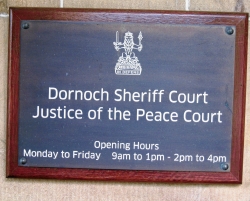
There was an interim diet heard today at Dornoch Sheriff Court in the case against Mathew Ian Johnston (20) of Morvich House, Morvich Estate, Rogart, Jamie Robert Neal (37) of The Bothy, Morvich Estate, Rogart and William Robert Docharty (57) of 10 Elizabeth Court, Dornoch.

Previously, a trial date had been set for 19th March. This has now changed. There will be a further diet (a procedural hearing where a number of things are checked) on 13th May, and based on the outcome of that hearing, the trial will begin on 9th July 2013.

SNH species action framework conference: presentations & podcasts

species action frameworkSNH have been under fire in recent weeks over their controversial decision to authorise the use of clam traps. (Thanks, by the way, to all of you who took the time to contact SNH on this issue – we await their latest response with interest).

However, sometimes SNH do things well and this blog entry reflects that. Last November (2012), SNH held a Species Action Framework Conference in Edinburgh to discuss the results of their five-year programme focusing on the conservation and management of 32 species (see website here). Kudos to them for recently publishing the presentations, both as downloadable PowerPoints as well as Podcasts.

The following presentations may be of particular interest to RPS readers:

Managing Species Conflicts (Steve Redpath, Aberdeen University). Powerpoint presentation here; podcast here.

Sea Eagle (Andrew Stevenson, SNH and Rhian Evans, RSPB). Powerpoint presentation appears to be unavailable; podcast here.

Hen Harrier (Des Thompson, SNH and Simon Lester, Langholm Moor Demonstration Project). Powerpoint presentation here; podcast here.

The hen harrier presentation and podcast is particularly amusing, with head gamekeeper Simon Lester brushing over the reasons why none of the 34 Langholm harrier chicks raised during the current Langholm project have ever returned to breed at Langholm (er, because they’re dead?). Can’t blame the hen harrier anymore for failing grouse stock so instead he concentrated on buzzards and ravens as the prime culprits, although without producing supporting evidence. He did say that 78% of tagged red grouse had been ‘killed or eaten by raptors’. That’s quite a misleading statement – there’s a massive difference between ‘killing’ and ‘eating’. Who’s to say that the ‘eating’ wasn’t the result of scavenging the dead grouse as carrion? Anyway, we look forward, hopefully in the near future, to seeing some hard data rather than having to rely upon Simon Lester’s ‘beliefs’.

We’ll be blogging more about the demonisation of buzzards at Langholm in a later post – we’re currently reviewing some fascinating data that show, fairly conclusively on first appraisal, that red grouse are not a major component of the buzzards’ diet at Langholm. Watch this space…

Implications of the Lochindorb hare snare verdict

The almost four-year long Lochindorb Estate hare snare trial concluded today at Inverness Sheriff Court. The accused, former head gamekeeper and long-time SGA committee member David Taylor was found not guilty of illegally using snares to catch mountain hares on the Lochindorb Estate in 2009.

This has been a lengthy and complex case, seen by many as an important ‘test’ case. For previous blog entries see here, here, here, here, here and here.

The ‘not guilty’ verdict, however, only applies to the particular circumstances of this specific case. On this occasion, at that specific location and at that specific time, the evidence was deemed insufficient to merit a conviction. Sheriff Abercrombie accepted that Taylor was operating within the law and in good faith. This verdict though, does not mean that a future case with a different set of specific circumstances, could not result in a conviction. The verdict does NOT mean that it is legal to snare mountain hares in general terms; only within the terms of this particular case.

One of the key issues was whether a snare could be described as a ‘trap’. The prosecution said yes, the defence argued no. Sheriff Abercrombie deemed that a snare could be described as a trap. This is important for future potential cases.

The defence had also argued that the snares in question (the w-shaped snare) were selective; i.e. that they only caught the target species. Several gamekeepers spoke as defence witnesses and stated that in all their (combined) years of snaring, they’d never caught a non-target species using this snare-type. Whether you believe that or not is up to you – the fact of the matter was that the prosecution could not provide evidence to show that the w-shaped snare was indiscriminate. This should hopefully be a moot point in future cases as the use of the w-shaped snare to trap mountain hares has since become prohibited. Under the Snares Scotland Order (2010), it is no longer legal to use a snare in a way that an animal could become partially or wholly suspended.

The other important issue highlighted by this case was the lack of current scientific understanding of mountain hare population ecology in Scotland. We hope SNH will get their act together and implement an appropriate research and monitoring strategy for what many believe is a keystone species; i.e. one that plays an important role in the survival of other species such as the golden eagle and probably the pine marten.

BBC news article here

SGA statement here

Defence agent’s statement here

Lochindorb hare snare verdict

Former Lochindorb Estate head gamekeeper and SGA Committee Member, David Taylor, has been found not guilty of setting illegal snares to catch mountain hares.

More to follow…

Gamekeeper charged with six offences

North Yorkshire police logoaA gamekeeper from Pickering, North Yorkshire, has been charged with six offences for the illegal use of cage traps to capture a buzzard.

This is the gamekeeper whose arrest was reported last October (see here). He has still not been named, and nor has the estate/shoot where the alleged offences took place. It is not yet known whether he is a member of the National Gamekeepers’ Organisation.

He has been charged with six offences under the Wildlife & Countryside Act and the Animal Welfare Act. He has been bailed to attend Scarborough Magistrates court next month. Article in the Ryedale Gazette & Herald here.

In other court news, the long-awaited verdict in the Lochindorb Estate hare snare trial is due tomorrow…..

Eagle persecution featured on the One Show

One-Show-smallYesterday evening, the BBC’s One Show ran a feature on golden eagle satellite-tracking in Scotland, featuring two legendary raptor fieldworkers from the RSPB, Stuart Benn and Brian Etheridge.

Thanks to these two, the message about illegal raptor persecution was heard by a mainstream tv audience (an estimated 5 million viewers) both during the film (when they were sat-tagging an eaglet) and then again when Stuart was interviewed in the studio.

Two top blokes doing a top, top job. Well done!

For anyone who missed it, catch it on BBC iPlayer here (20.37 min – 28.41 min) for a limited period.

Here is a link to Stuart’s blog about the filming day last summer.

“Why does a ‘keeper need an incinerator again?”

scotsman_logo_200The title for this blog entry is taken from a comment written in response to an article in the Scotsman this weekend.

The article, written by Alastair Robertson, is entitled: “Shooting and Fishing: It is relatively easy to whip up antagonism towards grouse moor owners” and discusses the precarious position of England’s hen harrier breeding population. Robertson mentions Mark Avery’s proposed campaign to ban driven grouse shooting if there isn’t a marked improvement in this year’s nesting pairs. Robertson suggests that the campaign would probably be unsuccessful, although he doesn’t write it off completely. He’s smart to not underestimate the public’s growing anger and frustration on this issue. The article can be read here.

There’s a good counter-argument to Robertson’s article, published today on the Scotsman’s letters page. Read it here.

The importance of the “vicious” gamekeeper’s conviction

Hebblewhite carbofuranFollowing on from yesterday’s blog about the conviction of “vicious” gamekeeper Robert William Hebblewhite (see here), more information has emerged about what happened in court.

We mentioned yesterday how unusual it was for a gamekeeper to be convicted of actually killing the dead raptor(s) found on their land; typically, in case after case, the gamekeeper is convicted for the lesser offence of “possession” (e.g. of poison) and the charge for the actual killing is dropped. This has caused an immense amount of frustration, not only for those investigators who often spend months working on getting a case to court, but also for us, the members of the public, who feel a massive sense of injustice every time it happens.

Well, not so in this case. If you read the article published here, you’ll notice that the judge (in this case District Judge John Stobard) was having none of it.

The prosecutor (Mark Holmes) contended that Hebblewhite’s motive was clear. He was the gamekeeper on this shoot, with responsibilities for pest control. The shoot had been losing birds because buzzards were in the area (his words, not ours!). Pheasant carcasses laced with Carbofuran had been found next to the Carbofuran-poisoned buzzards. A jar of Carbofuran was found in Hebblewhite’s van (see photo). Hebbelewhite’s van had been seen going to the scene on several occasions.

Hebblewhite had pleaded guilty to possession of Carbofuran (the lesser offence) but not for poisoning the buzzards.

The defence argued that the poisoner could have been anyone.

District Judge John Stobard wasn’t fooled. He is reported to have said this:

The birds died from Carbofuran and here in a van is the very stuff  that killed them. The defence says it could have been anyone. Well, could it? I’m not here to discuss the case as a philosophical argument. What is the reality of the matter?

This defendant is here to secure the presence of the shoots that take place by the way of being a gamekeeper. He must look after the pheasants and protect them from other animals.

I think he has done so in an old fashioned and particularly nasty way by lacing the pheasant with Carbofuran in the full knowledge the buzzards would be killed.

It can only point to one conclusion – he did it“.

So finally, here’s a judge who put two and two together and didn’t make five. It’s quite telling though, that this is such an unusual result that we need to highlight it here. What does that say about how our justice system deals with raptor persecution crimes? What does it tell us about our low expectations for these court cases?

In Scotland we’re so used to seeing ridiculous legal obstacles placed in the way of justice that we now expect the poisoner/trapper/killer to get off. “Did you see the defendant place the poison? Did you see the eagle/buzzard/goshawk/red kite actually eat from that very poisoned bait? Was it filmed? Did you have permission to film on that land? Can you forensically match the poison on the bait/inside the dead raptor with the big stash of illegal poison found in the defendant’s house /shed /garage /vehicle /porch /gamebag /jacket pocket? No? Well then he can’t be convicted”.

Well done again to the RSPB Investigations Team, to the CPS, and particularly to District Judge John Stobard for seeing the bleedin’ obvious and acting upon it.

UPDATE: There’s an excellent news piece on this conviction from BBC Look North. Decent coverage and explains that raptor poisoning is a national issue. Great stuff. Available on BBC iPlayer here for limited period (starts at 11.58 – ends at 14.40).

“Vicious” gamekeeper convicted of killing buzzards

A poisoned buzzard
A poisoned buzzard

The RSPB Investigations Team scored another victory today as a Lincolnshire gamekeeper was convicted of killing two buzzards and possessing the banned poison Carbofuran.

Robert William Hebblewhite, 71, of Appleby, Scunthorpe, was fined £1,950 at Lincoln Magistrates Court.

The two buzzards were found dead in Sept 2011 on land at Bonsall Lane in Blyton, near Gainsborough, where he works as a gamekeeper. Toxicology tests revealed the birds had died from Carbofuran poisoning from poison-laced pheasant carcasses. The RSPB said Hebblewhite was in possession of enough Carbofuran to destroy all the raptors in Lincolnshire.

It’s not known whether Hebblewhite is a member of the National Gamekeepers Organisation. Hopefully they will put out a statement to clarify his membership status and to condemn this disgusting, persistent practice.

Congratulations to the RSPB guys for a successful prosecution. Importantly, he was convicted for actually killing the birds and not just for the lesser offence of possession of poison, which is the result we usually see. Well done indeed.

RSPB press release here