Another gamekeeper in court for alleged poisoning of buzzard

Earlier this month I blogged about a gamekeeper in Nottinghamshire who is facing trial after he pleaded not guilty to the alleged killing of several buzzards (see here).

Now there’s another case to report. This time it’s a gamekeeper in Suffolk who is due in court on Thursday in relation to the alleged poisoning of a buzzard.

This latest prosecution relates to the joint raid undertaken by Suffolk Police, Natural England and the RSPB’s Investigations Team in January this year (see here).

[Police seized guns and pesticides during the multi-agency raid in January 2021. Photo via Suffolk Police]

Tomorrow’s court hearing will provide an opportunity for the defendant to enter a plea.

If he pleads not guilty, the case is expected to continue to go to trial at a later date.

If he pleads guilty, he may be sentenced tomorrow or the magistrate may ask for background reports before sentencing at a later date.

Please note, as this is a live case no further detail will be provided here until the case has concluded or there is official commentary from the court reporter. Comments on this particular blog also won’t be accepted until the case concludes so as not to prejudice proceedings. Thanks for your understanding.

UPDATE 26th August 2021: Trial date set for Suffolk gamekeeper accused of poisoning buzzard (here)

Golden eagles have been illegally killed on Scottish grouse moors for 40+ years but apparently we shouldn’t talk about it

In response to the news that Police Scotland are investigating the circumstances of five eagles found dead in the Western Isles earlier this month (see here), Scottish Land & Estates (SLE), the grouse moor owners’ lobby group has issued what I’d call a staggeringly disingenuous statement, where the blame for ongoing raptor persecution appears to be being projected on to those of us who dare to call out the shooting industry for its ongoing war against birds of prey.

Here’s SLE’s statement in full, dated 20 August 2021:

Response to raptor fatalities should not depend on location or landuse

Reports of five eagles being found dead on the Western Isles are very serious. 

Police Scotland has said that officers are investigating and it is to be hoped that the facts of these potentially shocking incidents are established as quickly as possible.

The birds – four golden eagles and a white-tailed sea eagle – were found at separate locations on Lewis and Harris and it is said that, at this stage, they are not linked.

No grouse shooting takes place on the Western Isles and we wholeheartedly support the police’s appeal for information and anyone who can help should call Police Scotland on 101, or make a call anonymously to the charity Crimestoppers on 0800 555 111.

It has been suggested that intraguild predation – where one species predates on another – may be one possible explanation in these cases but equally we accept there is the prospect that a terrible wildlife crime has been committed to protect livestock.

If that is the case, outright condemnation is the only rightful response.

That applies wherever raptor persecution takes place.

The response from some quarters thus far to the incidents on the Western Isles is in sharp contrast to what happens over alleged incidents that occur in areas where land is managed for grouse shooting. In these cases organisations and campaign groups are very quick off the mark to point fingers. If a wildlife crime takes place on land managed for shooting, livestock farming or any other land use (and such incidents are thankfully rare, becoming more so all the time) then it must be investigated and the culprits should face the full force of the law. It can be difficult to prosecute but Scotland now benefits from some of the most stringent laws against raptor persecution in Europe. A lot more could be achieved with less finger pointing and more constructive collaboration on the ground. Scotland is fortunate to have historically high numbers of golden eagles and we want to see even more of them.

ENDS

So SLE is unhappy that campaigners keep ‘pointing fingers’ at the grouse-shooting industry whenever an illegally shot / poisoned / trapped bird of prey is discovered dead or critically injured on, er, a driven grouse moor?!!!!!!!!!

Or when satellite-tagged hen harriers and golden eagles keep ‘disappearing’ in suspicious circumstances, on or close to driven grouse moors.

If these crimes were just a one-off, once-in-a-blue-moon occurrence then yes, perhaps SLE would have a point. However, the connection between the driven grouse shooting industry and the illegal persecution of birds of prey has been clear for decades, and backed up with endless scientific papers and Government-commissioned reviews (here are the latest for golden eagle and for hen harrier).

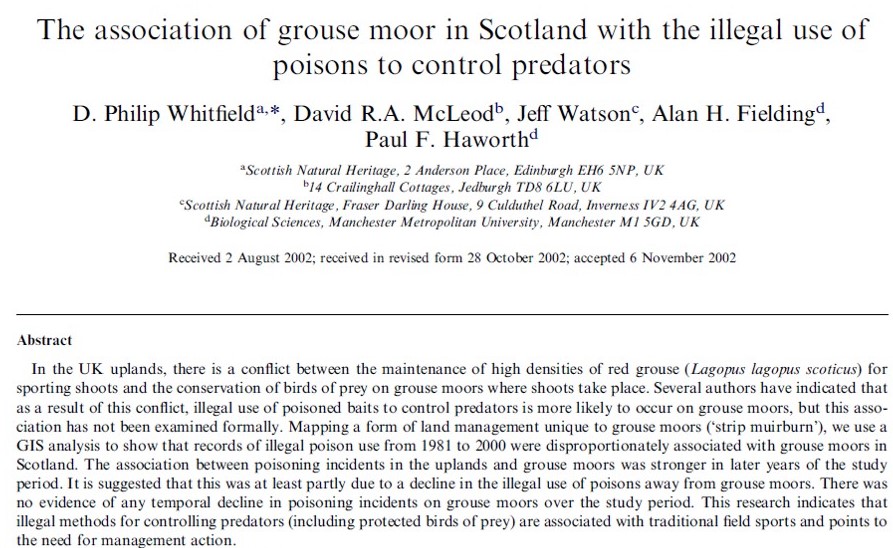
Here’s an example of how long this has been going on – a scientific paper published in 2002, using data from 1981-2000 – demonstrating an indisputable link between grouse moors and illegal poisoning:

1981 – that was 40 years ago!!

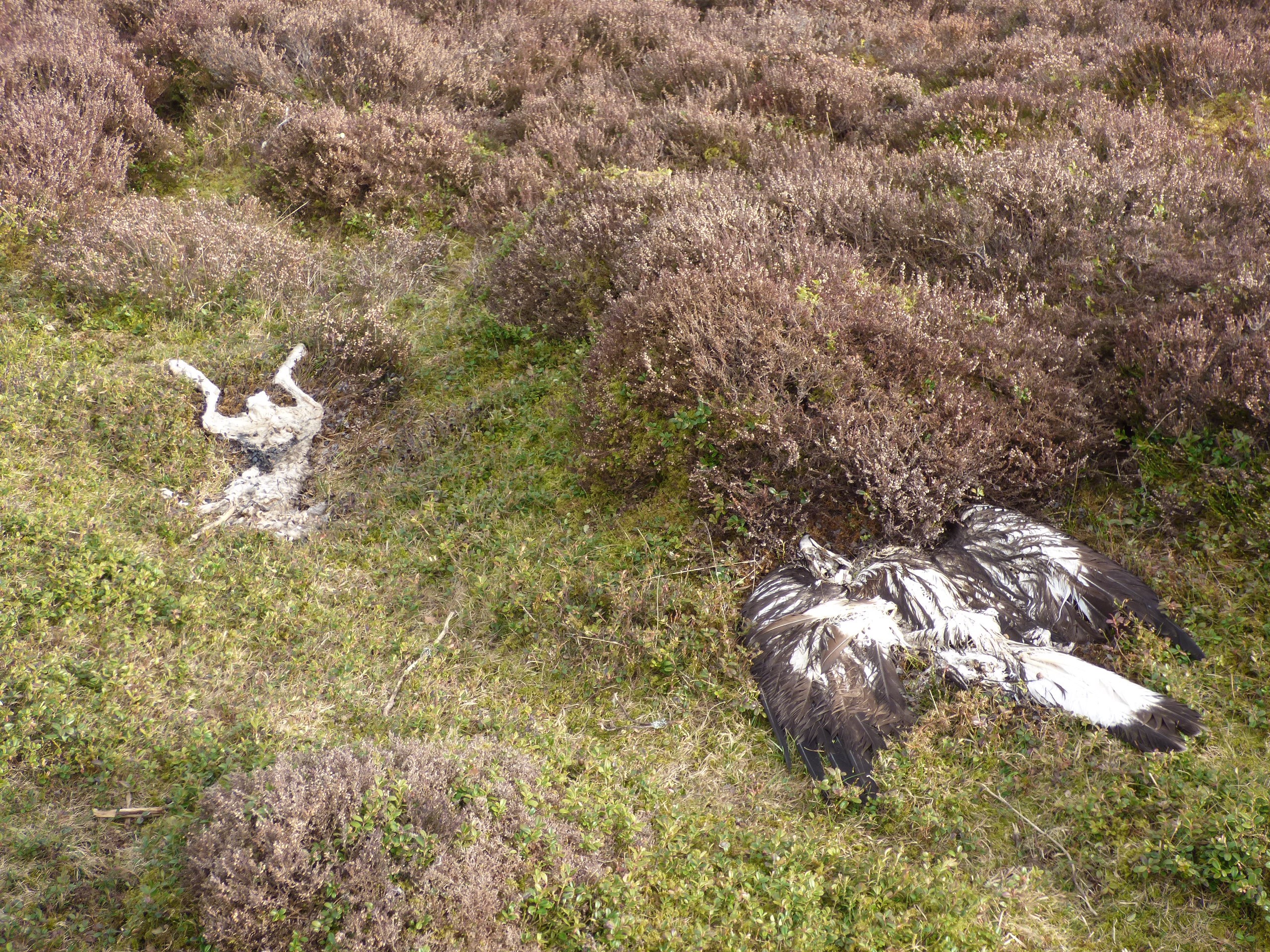
And yet here we are in 2021 and still illegally poisoned golden eagles are being found dead on grouse moors and still nobody has ever been successfully prosecuted in Scotland for killing a golden eagle. The most recently confirmed poisoned eagle was this one inside the Cairngorms National Park, right next door to the royal estate of Balmoral. In fact this eagle is believed to have fledged on Balmoral a few months before it flew to neighbouring Invercauld Estate (an SLE member, no less) where it consumed a hare that had been smothered in a banned pesticide and laid out as a poisoned bait. The person(s) responsible for laying this poisoned bait have not been identified.

[Poisoned golden eagle laying next to poisoned mountain hare bait, Invercauld Estate, Cairngorms National Park. Photo by RSPB Scotland]

Such is the extent of illegal persecution on some driven grouse moors, it is having (and continues to have) a population-level effect on some species, including golden eagles, hen harriers, red kites and peregrines.

And such is the extent and quality of this scientific evidence, the Scottish Government has committed to implementing a licensing scheme for grouse shooting in an attempt to try and rein in the criminal activity that underpins this so-called ‘sport’ because Ministers recognise the grouse-shooting industry is incapable of self-regulation.

I don’t know what SLE means when it says it wants ‘more constructive collaboration on the ground‘. Perhaps it means that gamekeepers will step forward and provide more than ‘no comment’ interviews when the police are investigating the latest crime on a grouse-shooting estate, instead of offering the usual wall of silence?

Perhaps it means the estate owners will refuse to employ the sporting agents and head gamekeepers whose methods are well known to include routine raptor persecution? (These individuals are well known – it’s no secret within the industry who they are).

Or perhaps it means that the shooting industry itself, including the game-shooting organisations, the shooting press etc will blacklist those estates known to still be killing birds of prey, instead of accepting funding donations from them and pretending that they don’t know what’s going on there?

That’d be useful, constructive collaboration, wouldn’t it?

Until all of that happens, SLE and the rest of the grouse shooting cabal can expect people like me and my colleagues in the conservation field to continue shining a bloody great big megawatt spotlight on this filthy industry.

Police to undertake social media checks for gun licence applicants after Plymouth mass shooting

The news that police forces in England and Wales will be checking the social media accounts of gun licence applicants is very welcome news, especially as abuse by gamekeepers and other gun holders against conservationists intensifies (e.g. see here, here, here, here, here).

According to an article in The Times this weekend, the Westminster Government will publish statutory guidance this autumn outlining how police forces handle firearm and shotgun licence applications. This is in the wake of the horrific mass shooting in Plymouth last week by a 22-year old, who despite having a history of posting violent and misogynistic abuse on social media, was still approved to have a weapon, which he went on to use with utterly tragic consequences.

In another article, Former Metropolitan Police Commissioner Lord Stevens told the Telegraph this weekend that UK police forces should perform thorough online checks into people applying for firearms licences following the shooting on Thursday. He called for a more in-depth ‘trawl’ of internet posts to try to establish whether people trying to get police approval for a gun have a history of making hateful comments online.

“The gunman was clearly a dangerous man – there is no doubt he was a threat. The videos he made should have been taken into account when he applied for a shotgun licence.

“There needs to be trawling of online content for an in-depth assessment of who these people are and what they think. We need to ensure that guns do not fall into the hands of dangerous people“.

Referring to the highly misogynistic posts made by incels [involuntary celibates] on forums and chat rooms, he said: “I would suggest people posting these kinds of comments clearly pose a concerning threat“.

According to the Telegraph, Jonathan Hall QC, the Government’s independent reviewer on terrorism legislation, also supported calls for considering the social media profiles of those looking to get hold of a gun.

“Obviously we don’t want to live in a society where what we do online is routinely looked at by the state, but I see the force of the point that social media may be a valuable source of information about risk in the context of firearm licensing“, he said.

Police Scotland are apparently ahead of the game. Three years ago a review by HM Inspectorate of Constabulary in Scotland (HMICS) concluded that online activity is a key source of information when deciding whether someone is suitable to own a gun.

In response to the report, Police Scotland Assistant Chief Constable Mark Williams said: “Where concerns are raised, we may use social media as one of a number of sources of information during our checks. Looking to the future, we are considering expanding this approach as part of the national licensing process.”

Hopefully the new statutory guidance of checking social media accounts won’t be restricted to just incidences ‘where concerns are raised’ [about an applicant] but rather this becomes a standard, routine examination for all applicants. The cost of this increased scrutiny should be placed firmly at the door of the gun licence applicants, and not be heavily subsidised by the tax payer as current gun licensing is.

It’ll also be interesting to see how the police deal with abusive and aggressive gun owners who maintain a hidden identity on social media. There are quite a few of those claiming to be from the game-shooting world, some of whom hide their identities quite successfully, others not so well, and none of whom are called out by the mainstream game-shooting organisations (indeed, some of those organisations even share the abuser’s posts!).

If you have any concerns about the suitability of someone who you believe is a firearms / shotgun certificate holder, whether they’re from the game-shooting world or not, please don’t hesitate to report him/her to the relevant police station.

‘Persistent intimidation’ – raptor conservationists face ongoing harassment from gamekeepers

Award-winning investigative journalism website The Ferret published an article last week with an account of how raptor conservationists are facing ongoing harassment from gamekeepers and supporters of the grouse-shooting industry.

Thanks to journalist Stuart Spray for the invitation to contribute to this piece.

It’s reproduced here in full:

Conservationists working to protect rare birds of prey claim they are being abused online and intimidated in the field by gamekeepers and supporters of the grouse shooting industry.

Logan Steele, communications secretary for the Scottish Raptor Study Group (SRSG), made up of conservationists working to protect rare birds of prey, told The Ferret that he is regularly contacted by workers who say they have been targeted in the line of their work.

Steele says members report incidents such as being surrounded by armed gamekeepers – often in 4x4s or on quad bikes – being followed for hours on end whilst out monitoring, being abused verbally, having tyres let down, having police called on them and even being spat at whilst drinking in the local pub.

He claims the intimidation is widespread, but most raptor workers are not prepared to go on record for fear of reprisals.

The SRSG, set up in 1980, has more than 350 voluntary members monitoring the vast majority of the 6,000 plus raptor territories checked annually as part of the Scottish Raptor Monitoring Scheme.

The scheme supplies data to organisations like the British Trust for Ornithology (BTO), RSPB and NatureScot – the Scottish Government’s wildlife watchdog – to help understand population dynamics and inform conservation priorities. Members of SRSG also gather information on raptor persecution.

Gamekeepers have also previously claimed to be subjected to abuse. In a survey last November by the BASC, Countryside Alliance, Game Farmers Association and National Gamekeepers Association 64 per cent of Scottish gamekeepers said they had experienced threatening behaviour or abuse from members of the public at least once every year.

The study, which surveyed 152 gamekeepers, also found the majority (79 per cent) felt ‘less optimistic’ due to ‘targeted anti-shooting campaigns and the negative portrayal of shooting in the public domain’.

But Steele said conservationists were suffering. He added: “Our members on some driven grouse moors continue to be subjected to persistent levels of intimidation and abuse from gamekeepers. It is patently clear that raptor workers and indeed the wider public are not always welcome on some driven grouse moors“.

Steele has himself been trolled online several times. “On one occasion an ex-gamekeeper boasted online that he had fitted a tracking device to my car and knew I was at home“, he said. Concerned that he was being followed he got the car checked over but no tracking devices were found.

An image Steele posted of himself online with a hen harrier chick in 2006 was allegedly downloaded and regularly reposted on two ex-gamekeeper’s social media pages along with claims accusing him of professional malpractice without evidence.

Consultant ecologist, Andrea Hudspeth – who along with Steele received an RSPB award in 2017 for raptor campaign work – claimed she also felt threatened on shooting estates.

She added: “I have been monitoring raptors on a grouse shooting estate for a number of years now and have always been made to feel unwelcome, so much so that I don’t feel safe going there on my own.

She claimed the experience could be intimidating. Of one estate she said: “Having phoned the day before to let the estate know I was coming, I was told where I could and couldn’t go as they were shooting foxes that day. He [the head gamekeeper] told me that if I strayed into the wrong area, it wouldn’t be his fault if I got shot. At the time, that sounded like a veiled threat“.

Dr Ruth Tingay, an award-winning conservationist and director of Wild Justice, a not-for-profit organisation set up with broadcaster Chris Packham and environmental campaigner Mark Avery to ‘fight for wildlife in the courts and in the media’, told The Ferret she was subjected to online abuse on an almost daily basis.

Tingay, who runs the Raptor Persecution UK blog, claimed she received comments online that were routinely misogynistic and homophobic and involved personal slurs on her appearance and character.

“My personal telephone number has been published online and folk have been incited to make abusive phone calls. I have also received abusive text messages,”, added Tingay.

“My home address has been published and shared on social media. Photographs of my home have been published and shared on social media. I have been followed and photographed on grouse moors and these have been published on social media with accompanying defamatory comments.

“I have been accused of fabricating evidence, of perverting the course of justice, of inflicting cruelty to wildlife, of killing eagles, of planting evidence, and conversely, and bizarrely, of withholding evidence from the police, of lying to the police, of lying to ministers, of lying to supporters, of lying in general“.

Tingay says the targeted harassment has been going on for the last six years and shows no signs of stopping. Earlier this week she was described by one shooter as “absolute poison” and another shooter opened a discussion titled: ‘Is Tingay a witch?’

“These individual comments are, of course, pathetic and laughable and are easy to shrug off, so obvious is the desperation behind them”, she said. “But it’s the accumulation of the comments, that’s when the problem starts.

“It’s relentless, and I think that’s very, very dangerous. That constant tide of abuse would take its toll on even the most resilient person. I’ve put measures in place to deal with it and I’m fortunate to be working with a world-class mental health coach. That’s not what I expected to need when I decided to work in the field of raptor conservation“.

However, Steele also insisted that most conservationists and grouse shooters, landowners, stalkers, ghillies and gamekeepers had a “very good working relationship”. He claimed those behind the abuse were trying to create a “false, them-and-us situation”.

“The issue really resides with a small number of driven grouse shooting businesses”, he added. “In recent years we have seen some estates beginning to moderate their attitudes to raptor persecution which is very encouraging“.

The Ferret contacted the Scottish Gamekeepers Association, the landowners’ representative group Scottish Land & Estates and the Countryside Alliance. None of the organisations replied to requests for comment.

However, Scottish Gamekeepers Association chairman Alex Hogg has previously said gamekeepers are currently being “undervalued” and called for action to be taken on the abuse they have faced.

ENDS

Trial date set for gamekeeper accused of killing buzzards

A gamekeeper appeared in court on 12th August 2021 accused of the alleged killing of a number of buzzards in Nottinghamshire in January 2021.

He was charged after a joint investigation by Nottinghamshire Police and the RSPB’s Investigations Team (see here).

The gamekeeper pleaded not guilty so this case will now progress to trial.

Trial dates have been set for 6th-7th January 2022.

Please note, as this is a live case no further detail will be provided here until the case has concluded or there is official commentary from the court reporter. Comments on this particular blog also won’t be accepted until the case concludes so as not to prejudice proceedings. Thanks for your understanding.

Gamekeeper on trial for alleged killing of buzzards

A gamekeeper is due in court tomorrow (12th August 2021) accused of the alleged killing of a number of buzzards.

This prosecution relates to the joint investigation undertaken by Nottinghamshire Police and the RSPB’s Investigations Team in January this year (see here). It’s a good example of what genuine partnership-working can achieve.

Tomorrow’s court hearing will provide an opportunity for the defendant to enter a plea.

If he pleads not guilty, the case is expected to continue to go to trial at a later date.

If he pleads guilty, he may be sentenced tomorrow or the magistrate may ask for background reports before sentencing at a later date.

Please note, as this is a live case no further detail will be provided here until the case has concluded or there is official commentary from the court reporter. Comments on this particular blog also won’t be accepted until the case concludes so as not to prejudice proceedings. Thanks for your understanding.

UPDATE 15th August 2021: Trial date set for gamekeeper accused of killing buzzards (here)

Poisoned golden eagle: will a General Licence restriction now be imposed on Invercauld Estate?

Earlier this month it was reported that police had conducted a raid, under warrant, on several properties on the Invercauld Estate following the discovery in March of a deliberately poisoned golden eagle and some poisoned bait (see here).

I’ve since blogged about why I think the golden eagle killer will evade criminal prosecution (see here) and a little bit about NatureScot making noises about considering a potential General Licence restriction on this estate (see here). A General Licence restriction is nowhere near as serious as a criminal prosecution but it is, in the words of former Environment Minister Paul Wheelhouse who worked hard to get this apparent sanction introduced, a ‘reputational driver’ (see here).

It’s my view that a General Licence restriction is long overdue here, given the history of alleged wildlife crime offences, and a blog that was published yesterday has further strengthened that view, of which more in a minute.

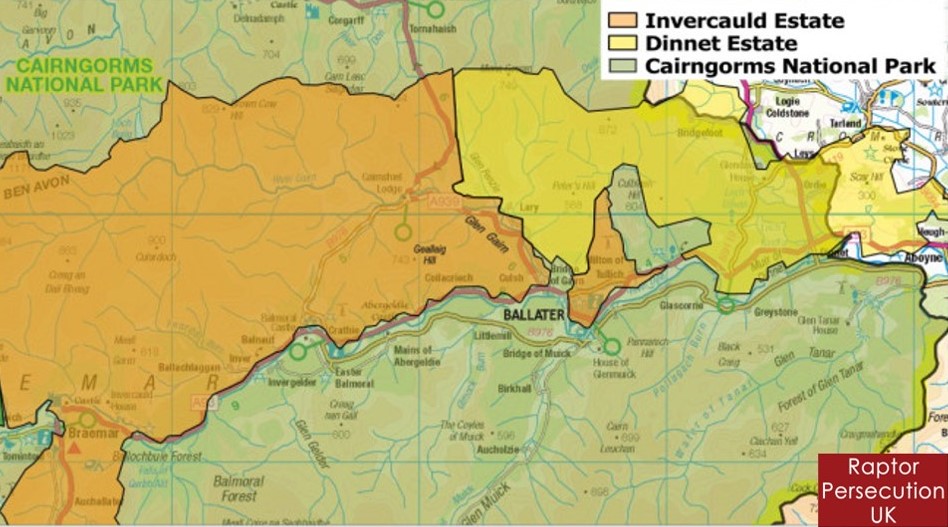
This area around Ballater in the Cairngorms National Park has been at the centre of a number of alleged wildlife crime offences over many years.

[Estate boundaries based on data from Andy Wightman’s Who Owns Scotland website]

There was the discovery of three poisoned buzzards on Invercauld Estate in 2005 (here), the discovery of an illegally shot peregrine at the Pass of Ballater in 2011, the reported coordinated hunt and subsequent shooting of an adult hen harrier at Glen Gairn on the border of Invercauld and Dinnet Estates in 2013, the illegally-set traps that were found near Geallaig Hill on Invercauld Estate in 2016, the suspicious disappearance of satellite-tagged hen harrier Calluna ‘on a grouse moor a few miles north of Ballater’ on 12 August 2017, the opening day of the grouse shooting season (here) although it’s not clear whether this was on Invercauld Estate or neighbouring Dinnet Estate, the suspicious disappearance of satellite-tagged white-tailed eagle ‘Blue T’ on Invercauld Estate in May 2018 (see here), the suspicious disappearance of satellite-tagged hen harrier Stelmaria ‘last recorded on grouse moor a few miles north west of Ballater, Aberdeenshire on 3rd September 2018 (see here), the suspicious disappearance of satellite-tagged hen harrier (Wildland 2) on Invercauld Estate on 24 September 2019 (here) and now the discovery of a deliberately poisoned golden eagle and poisonous baits on a grouse moor on Invercauld Estate in March 2021 (see here).

The suspicious disappearance of three satellite-tagged hen harriers and one white-tailed eagle in one small area managed for driven grouse shooting should raise lots of eyebrows given the unequivocal scientific pattern that has been identified for such occurrences (e.g. see here and here) and especially in an area where the alleged hunting and subsequent shooting of a hen harrier was witnessed and reported several years earlier.

However, according to NatureScot’s current Framework for how it makes decisions on whether to impose a General Licence restriction, the suspicious disappearance of a satellite-tagged raptor is not, in itself, considered sufficient evidence, even when there’s an emerging pattern in one particular area:

‘Unexplained ‘stopped no-malfunction’ satellite tags may be considered by NatureScot as supporting information in making a decision, particularly where multiple losses have occurred on the same land. However such instances will not be considered as evidence under the terms of this Framework unless recorded as a crime by Police Scotland‘.

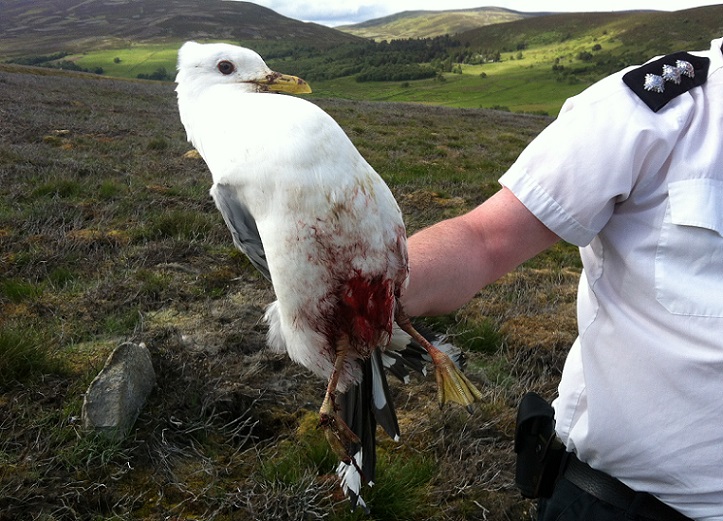
The most significant, and indeed tangible, wildlife crime incident that could be linked to Invercauld Estate was the discovery of illegally-set traps on the estate in 2016, which led to the horrific suffering of a Common Gull whose legs were caught in two of the traps (see here).

[Photo of the Common Gull after being released from the traps. Photo by Graeme Rose]

Long-term blog readers may recall this incident and the farcical non-existent enforcement measures that ensued. The SSPCA attended in the first instance and had to euthanise the gull due to the extent of its injuries but because of their ridiculously restricted investigatory powers, they were not permitted to search the area for more traps – this had to be done by the police, who conducted a search several days later where it was discovered that other traps (i.e. evidence of potential crime) had been recently removed prior to the police search (here).

Then there was an odd statement of denial from Invercauld Estate, bizarrely issued by the GWCT on behalf of the estate (a strange activity for a so-called independent wildlife conservation charity, see here) and incidentally, this denial is not that dissimilar to the one we saw recently from the estate in relation to the deliberately poisoned golden eagle – see here.

I challenged the estate’s claim that Police Scotland had not found any evidence of illegal activity back in 2016 and Police Scotland issued a statement in response (see here).

I then submitted a series of FoIs that revealed what looked like some very odd goings on between the estate, the Cairngorms National Park Authority and the Scottish Government, which resulted in ‘secret action‘ apparently being taken against a gamekeeper but no prosecution followed, and nor did NatureScot impose a General Licence restriction for this incident (and NatureScot has refused to discuss its decision saying ‘it’s not in the public interest‘ to tell us).

I did wonder whether NatureScot had not imposed a General Licence restriction due to a technical issue – the fact that the SSPCA, not the police, attended the scene and found the evidence of the illegally-trapped gull. If you look again at NatureScot’s Framework for decision-making on restrictions, it says that evidence must be provided by the police. It doesn’t say anything about evidence from the SSPCA being acceptable. I hope I’m wrong on that because as a statutory reporting agency, the SSPCA’s evidence should be considered just as robust as any evidence put forward by Police Scotland – I’ll check with NatureScot about it.

However, yesterday a blog was published on the excellent ParksWatchScotland blog, written by Graeme Rose, one of the guys who had actually found the critically-injured gull on Invercauld Estate in 2016. It’s a harrowing tale, but it’s incredibly enlightening in that he pursued the enforcement authorities for several years after the incident and by doing so uncovered all sorts of shenanigans. He says he received a text in July 2020 from the former Convenor of the Cairngorms National Park Authority who told him that a gamekeeper had indeed ‘been let go’ after the gull incident in 2016, despite the estate’s protestations at the time that any offence had even taken place. I believe this is the information that was deliberately redacted by the CNPA and the Scottish Government when I’d asked them about it in those FoIs.

What a pitiful state of affairs.

Will we see anything different in response to the discovery of the deliberately poisoned golden eagle? Well, we’ve already seen that Invercauld Estate has ‘left’ the Eastern Cairngorms Moorland Partnership, although there was absolutely zero indication whether the estate was expelled or left of its own accord (see here) so it looks like the Cairngorms National Park Authority is staying true to form and not wanting to be explicit about any action that may or may not have been taken. Why is that, do you think? Could it be anything to do with who sits on the CNPA’s Board? There are some interesting characters with some interesting connections to the grouse-shooting world, and even to Invercauld Estate itself.

And what about NatureScot and its deliberations about whether there is sufficient justification for a General Licence restriction on Invercauld Estate? That’s going to be VERY interesting and is something I’ll definitely be tracking. Watch this space.

Grouse moor-owning Lord Benyon appointed new DEFRA Minister

DEFRA press release (13 May 2021)

DEFRA welcomes new Minister

Lord Benyon has today been appointed as a Parliamentary Under Secretary of State for Defra. He will replace outgoing Defra minister Lord Gardiner, who will become Senior Deputy Speaker in the House of Lords.

The Environment Secretary today welcomed Lord Benyon, commenting on his passion and dedication to environmental causes.

Environment Secretary George Eustice said:

“I am pleased to welcome Richard back to Defra. He brings a wealth of experience, knowledge and passion for the environment, developed during his previous experience as a Defra Minister and during his work as Chair of our review in to Highly Protected Marine Areas.

“I look forward to working with him during this truly exciting time for Defra, with the Environment Bill returning to parliament, our agricultural reforms now starting to take root and the government leading the world on protecting nature and tackling climate change. Richard will be invaluable as we continue our ambitious work to ensure we leave our natural environment in a better state for future generations.

“I would also like to extend my congratulations to Lord Gardiner on his election as Senior Deputy Speaker in the House of Lords and to thank him for his work as Minister in Defra.”

Defra Minister Lord Benyon said:

“It’s both a privilege and a pleasure to be returning to Defra as a Minister in the House of Lords. I have fond memories from my time as Parliamentary Under Secretary of State.

“From the flagship Environment Bill and tackling climate change to helping our farmers through the agricultural transition and supporting our fishing industry, Defra is at the heart of this Government’s work to build back greener. It’s an exciting time to be back at Defra.

“I look forward to working with everyone as Defra tackles some of the greatest challenges of our time.”

Lord Benyon’s portfolio will be confirmed in due course.

ENDS

Grouse moor and pheasant-shoot – owner Richard Benyon is a former Trustee of GWCT and is no stranger to the pages of this blog.

In 2013, as Wildlife Minister under David Cameron, Richard Benyon refused to make possession of Carbofuran a criminal offence in England, despite other MPs calling for such a move, and despite it being an offence in Scotland, and despite it being well known that Carbofuran is the gamekeepers’ poison of choice for killing birds of prey.

In response, Caroline Lucas MP (Green Party) said:

“The minister’s shocking refusal to outlaw the possession of a poison used only by rogue gamekeepers to illegally kill birds of prey would be inexplicable were it not for his own cosy links to the shooting lobby“.

Also while Mr Benyon was in post at DEFRA, the government sanctioned the controversial buzzard ‘management’ trial and committed £375k of taxpayers money to help support it (see here), although they swiftly backtracked after a huge public outcry against the plan (see here). However, the following year Natural England, acting on behalf of DEFRA, decided to go ahead and issue a licence (to a gamekeeper with a past conviction for wildlife crime) to destroy buzzard eggs and nests to protect pheasants (see here).

Mr Benyon also decided there was no need to introduce vicarious liability to England because “there are very good laws in place to punish the illegal killing of any animal. If they are not being effectively enforced, they must be and we will take steps to make sure that happens. However, this is a good opportunity to applaud gamekeepers for the wonderful work they do in providing excellent biodiversity across our countryside” (see here and here).

In 2016 he spoke at the Westminster Hall debate on driven grouse shooting where, along with other grouse-shooting pals and supporters, he claimed that a ban on driven grouse shooting would be ‘a catastrophe for the biodiversity of the uplands‘.

It’s probably safe to assume that this latest appointment to DEFRA’s ministerial team will have significant influence on campaigning efforts to rid the English uplands of the wildlife crime and environmental damage continually associated with driven grouse shooting.

It doesn’t mean we’ll stop trying, though.

NatureScot Chair Mike Cantlay writes puff piece for Scottish Gamekeepers’ rag

How come, if Scottish gamekeepers feel so downtrodden, unheard, overlooked, side-lined etc (e.g. see here), the Chair of Naturescot is writing puff pieces for their quarterly rag?

In the Spring 2021 edition of the Scottish Gamekeepers Association’s newsletter, Mike Cantlay blows some serious amounts of smoke up the SGA’s backside. It’s a shame his organisation isn’t as enthusiastic about revoking General Licences on shooting estates where there is strong evidence that raptor persecution continues.

Mike Cantlay isn’t the SGA’s only friend at NatureScot.

The recently-updated list of Board Members includes one David Johnstone, former CEO of Scottish Land & Estates whose responses to raptor persecution incidents leave a lot to be desired (e.g. see here and here) as does his view on vicarious liability (see here) and grouse moor licensing (e.g. see here and here).

Ah, nothing like a modernising, forward-thinking progressive to join the NatureScot Board, eh? Which Scottish Government Ministers approved the current intake of Board Members and how many candidates with expertise in wildlife, science and nature conservation were overlooked in favour of landowning Lord Johnstone?

This ‘downtrodden gamekeeper’ act is fooling no-one

As campaigning for the forthcoming Scottish election gets in to full swing, I’ve been reading more and more about poor ‘downtrodden’ gamekeepers, how they’re not listened to, how hard done by they are, how they’ve been ‘vilified’ etc etc.

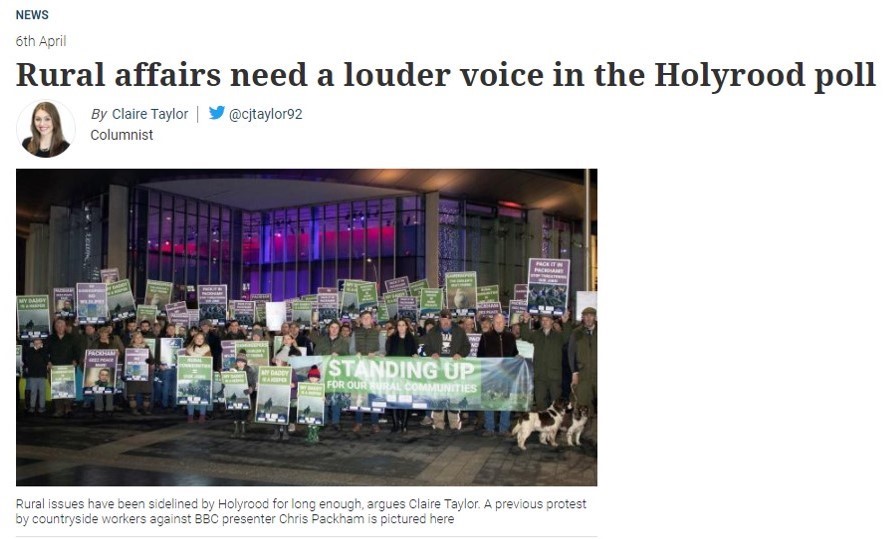
This article in last week’s Herald is a classic example, although pay close attention to who wrote it – Clare Taylor, Political Affairs Editor at The Scottish Farmer – her reference to farmers being “plagued” by the return of White-tailed eagles and commentary about “a growing obsession with rewilding” gives you a good idea about her environmental aspirations.

The truth is, rural affairs already have a very loud voice in the Scottish Parliament, in the shape of Fergus Ewing, Minister for Tourism and the Rural Economy who called himself “a friend in Government” to the Scottish Gamekeepers Association recently. Such a good friend in fact that he’s auctioning off a Holyrood tour (that should be free) to help the SGA’s fundraising activities (see here).

Clare Taylor’s tweet, promoting her biased article in the Herald, made me laugh:

After proclaiming that the Scottish Government ‘must stamp out the vilifying of individuals’, what does she think the accompanying photograph shows? Er, could it be a bunch of Scottish gamekeepers vilifying Chris Packham outside Perth Concert Hall, protesting about him having a job?

And are these the same gamekeepers who routinely vilify and abuse those of us campaigning against environmentally-damaging, unlawful and unsustainable grouse moor management (see here and here)?

And are these the same gamekeepers who continue to shoot, trap and poison birds of prey in the Scottish countryside?

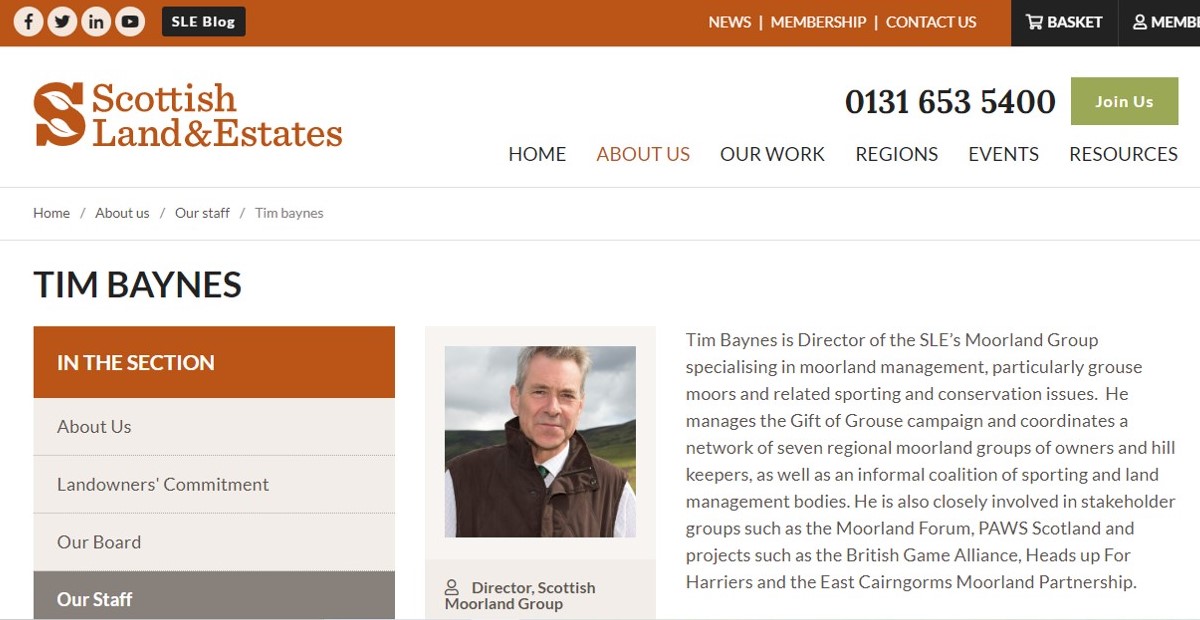
Clare’s article includes a quote from the co-ordinator of Scotland’s Moorland Groups. That’ll be Tim (Kim) Baynes then, a Director of the landowners’ lobby group Scottish Land & Estates – hardly someone without connections to politicians and civil servants, is he? Yet another influential voice speaking to power on behalf of gamekeepers.

Although Scottish Land & Estates’ CEO, Sarah-Jane Laing, was on here last week in the comments section claiming that ‘The Regional Moorland Groups which exist across Scotland are not part of the SLE structure‘.

Really? Well why then does Tim Baynes’s job description, on the SLE website, say that he’s the co-ordinator of those seven moorland groups??

And what about those seven regional moorland groups? They’re an interesting bunch. Grouse moors in five of those seven regions have been in the last three years, or currently are, under police investigation for alleged raptor persecution crimes (grouse moors in the regions covered by the Angus Glens Moorland Group, Grampian Moorland Group, Tomatin Moorland Group, Tayside & Central Moorland Group and the Southern Uplands Moorland Group).

And there are more ongoing police investigations linked to grouse moor management and raptor persecution that are yet to be publicised. Believe me, the public will be appalled when the news comes out and it’ll be a bloody brave (or desperate) politician that puts their name down to support this continued criminality.