The RSPB’s Investigations Team has joined forces with a leading wildlife vet, Mark Naguib BVMS(Hons) CertAVP(ZooMed) MRCVS, to create a free, two-hour online course for veterinary professionals to help increase awareness and understanding of crimes against birds of prey.
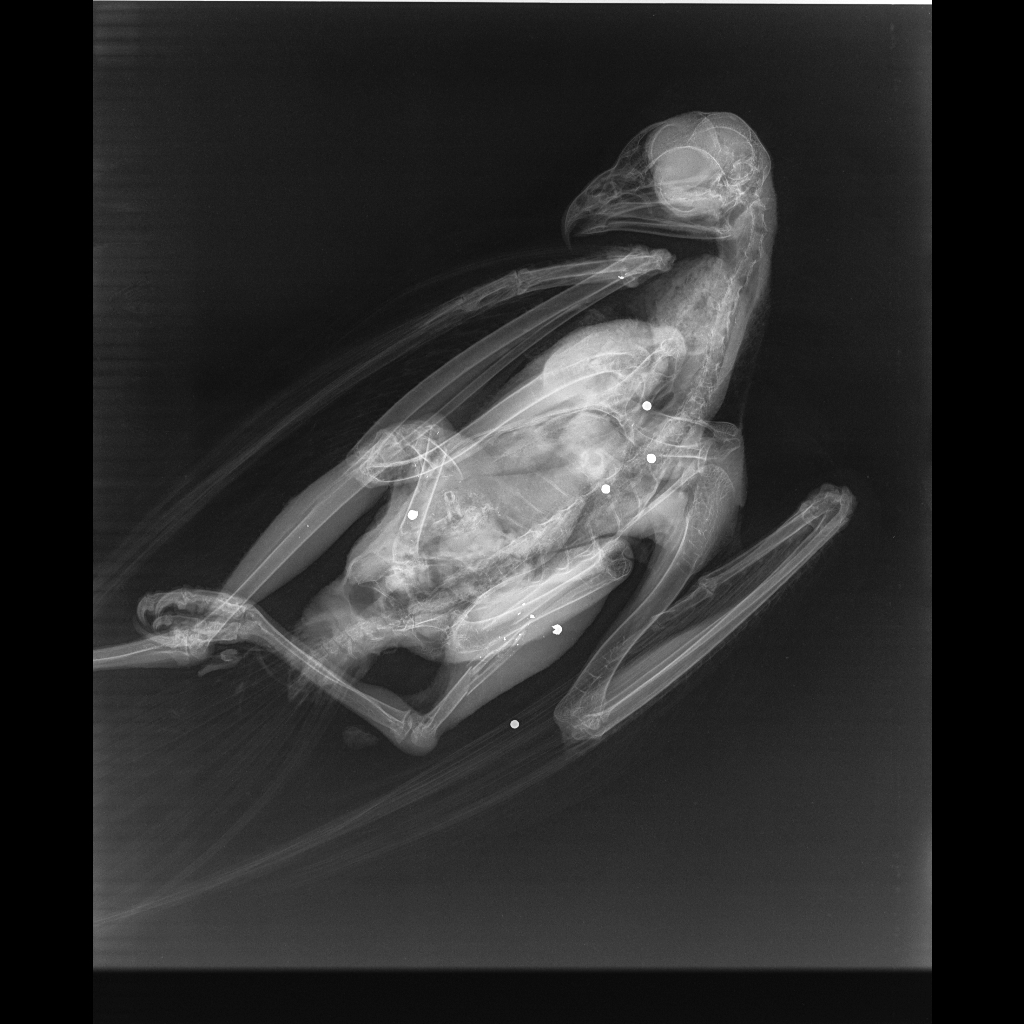
An x-ray of a raptor containing shotgun pellets. Photo: Mark Naguib
The course, Birds of prey in veterinary practice: Clinical presentations of poisoning, shooting and trapping, includes the following modules
Introduction to birds of prey and identification
Overview of legislation (specific to each UK country)
Clinical presentations of shooting, trapping and poisoning
Guidance on appropriate agencies to contact
Free downloads to keep and use in the veterinary practice
The course is only available to veterinary professionals (i.e. veterinary surgeons and Registered Veterinary Nurses) and can contribute to the individual’s Continued Professional Development record.
For further information please read this RSPB blog (here) and to register for the free online course please visit here.
The Scottish Parliament’s ‘Citizen Participation and Public Petitions Committee’ is currently considering a petition that was first submitted in February 2021 by a falconer, Barry Blyther, calling on the Scottish Parliament to urge the Scottish Government to amend the Animals and Wildlife (Penalties, Protections and Powers) (Scotland) Act 2020 to allow mountain hares to be hunted for the purposes of falconry (Petition PE1859, here).
The basic premise of the petition (and I’m simply summarising here – if you want the full details please read the petition details) is that Barry wants to be able to hunt mountain hares with his golden eagle for ‘sport’. Barry argues that since the mountain hare received full legal protection in 2020 after a late amendment from Scottish Green’s MSP Alison Johnstone to the drafting of the Animals and Wildlife Bill (here and here), he can no longer legally hunt mountain hares for fun, and he wants the Scottish Government to amend the legislation to provide an exemption for falconers.
Some of you may recall the furore that erupted amongst the shooting industry after the mountain hare was given full legal protection, because it meant an end to the grotesque annual slaughter of thousands of mountain hares on some driven grouse moors. For example, the Scottish Gamekeepers Association said it was thinking of setting up a new political party “to ensure the working countryside is represented better” (here) and landowners’ lobby group Scottish Land & Estates wasn’t happy either (here).
The raw fury when their sense of entitlement had been so adeptly overridden was palpable, and that contempt was very much still in evidence by several pro-fieldsports MSPs during a Petitions Committee hearing on 21st December 2022, held to further consider Mr Blyther’s petition on ‘upland falconry’ and his desire to hunt mountain hares for ‘sport’.
I watched the archived video of that hearing this afternoon and would encourage you to do the same, if you have time (it’s here and it’s the first item on the agenda).
If you’d prefer to read the transcript, that’s here:
Environment Minister Mairi McAllan had been invited to this committee hearing to answer questions on this petition. She was accompanied by her senior civil servant Hugh Dignon and Stan Whittaker from NatureScot.
The rude, disrespectful and frankly unpleasant manner of some of the Petitions Committee members towards Mairi McAllan is quite shocking. I’ve seen behaviour like this, first hand, from the pro-grouse shooting MPs in Westminster (here) but I haven’t previously seen this in the Scottish Parliament. Convenor Jackson Carlaw MSP (Conservative), Fergus Ewing MSP (SNP) and Alexander Stewart MSP (Conservative) deserve particular rebuke for their style of questioning. Jackson Carlaw told the Minister the committee was “quite exercised” by the Government’s response to the petition – that’s one way of describing it.
Mairi McAllan handled it brilliantly, calling them out a few times and delivered a well-considered response, superbly supported by Hugh Dignon, explaining that the mountain hare is protected because there are concerns for its conservation status, that falconers could still practice falconry without the threat of prosecution if they take care to hunt in areas with a low density of mountain hare, and in a nature emergency, the conservation status of the mountain hare is of greater importance than sporting or recreational activity.
I particularly enjoyed her wry smile when the Convenor spoke over her (again) and instead turned his attention to Hugh Dignon for an answer:
I think the considered explanations from Mairi and Hugh fell on deaf ears though because at the next hearing of the Petitions Committee, held on 18th January 2023, the Committee decided to go back to the Minister for further clarification on a few points (they seem to have missed the main point about the conservation status of the mountain hare being the primary priority) and Fergus Ewing, who likes to get his own way, says:
“I forgot to say that, at the very end of the letter to the minister, we could perhaps politely indicate that all members of the committee feel particularly exercised and concerned about this matter, and it is therefore our intention to pursue it. We should indicate that we are treating it very seriously indeed, and perhaps thereby inject a little bit of lead into the ministerial pencil“.
Here is the transcript from the hearing on 18th January 2023:
We’re all well aware of Fergus Ewing’s strong support for the fieldsports industry – I’ve blogged about it many times before (e.g. see here) so his position on this particular pro-fieldsports petition is no surprise whatsoever.
The other two, Jackson Carlaw MSP and Alexander Stewart MSP are both Scottish Conservatives so their positions shouldn’t come as a surprise either, although the evident vitriol in their questioning style is a bit more perplexing.
I note with interest that Alexander Stewart MSP attended this BASC lunch in November to celebrate Great British Game Week. Purely coincidental, I’m sure.
I’ve written many times about how the shooting industry is intent on manipulating the narrative surrounding the illegal killing of birds of prey. Whether that be by publishing blatant propaganda about the extent of these crimes, so distorted the truth is barely recognisable (e.g. here, here, here, here), or by simply choosing not to mention, let alone condemn, the ongoing criminal attacks on raptors by gamekeepers (e.g. see here, here, here). Sometimes there will be a condemnation but often it is quickly overridden by a sneering attempt to undermine the integrity and credibility of the investigators, usually the RSPB (e.g. see here and here).
Recently, this manipulation of the narrative around raptor persecution has manifested in attacks by the shooting industry on the police forces issuing appeals for information about suspected crimes (e.g. see here and here for two very recent examples).
Less obvious is the behind-the-scenes manipulation; the conversations that go on behind closed doors that the public rarely gets to see, usually within the so-called ‘partnerships’ such as the Peak District Bird of Prey Initiative (e.g. see here and here) or the national Raptor Persecution Priority Delivery Group (RPPDG – see here). This sly under-handedness only comes to light after freedom of information requests by those of us who are unwilling to believe a word the shooting industry says when it comes to illegal raptor persecution.
And this leads me to the latest example of how the narrative is being manipulated. This time it relates to the media put out by the Yorkshire Dales Bird of Prey Partnership (another sham group) about the brutal stamping to death of a nest of hen harrier chicks last summer on a grouse moor on Whernside in the Yorkshire Dales National Park. To recap the details of that horrific story, which for some strange reason only emerged six months later in December 2022, please see here.
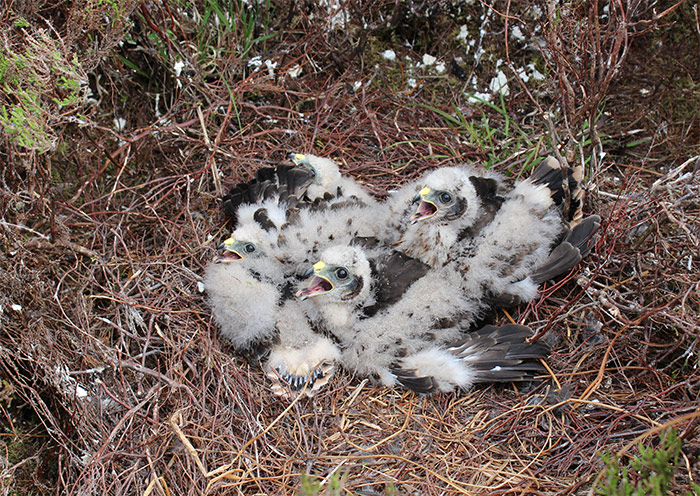
Hen harrier chicks in a nest (not the nest at Whernside where the chicks were stamped on). Photo: Ian Newton
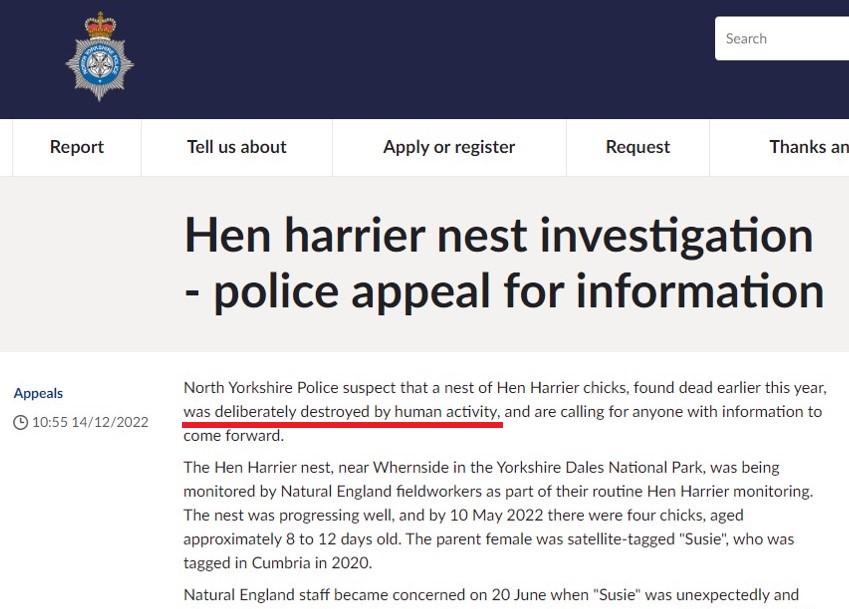
North Yorkshire Police issued an appeal for information about this crime on 14th December 2022 (see here). I want you to pay attention to the unequivocal words used by the police to describe this incident (underlined in red, below): that they suspected the nest of hen harrier chicks had been “deliberately destroyed by human activity“:
Prior to this appeal for information being published, the previous week North Yorkshire Police had sent a final draft to the Yorkshire Dales National Park Authority (YDNPA) so they wouldn’t be unsighted by the news when it was published. We know this because a Yorkshire Dales resident, who also follows this blog, submitted a freedom of information request to the YDNPA in December to ask about internal comms within the Yorkshire Dales Bird of Prey Partnership about this crime. Everything that follows is a result of that FoI (thank you to the blog reader!).
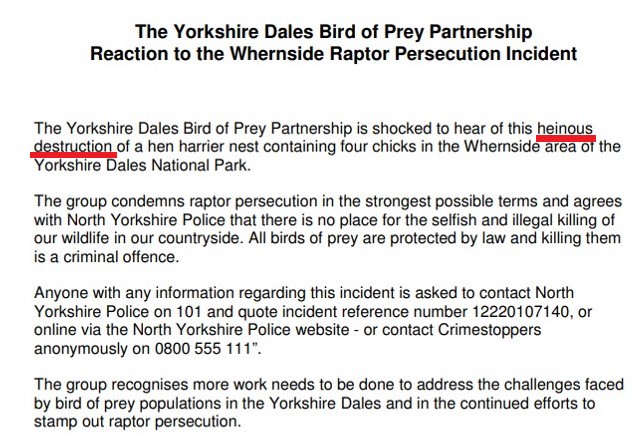
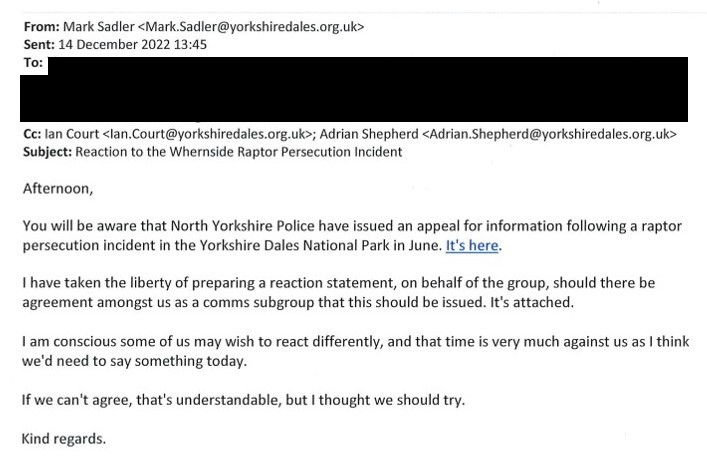
On 14th December 2022, just after North Yorkshire Police had published its appeal for information, Mark Sadler, Communications Manager at the YDNPA sent around a draft press release to the Yorkshire Dales Bird of Prey Partnership’s communications sub-group and asked if all the partners would sign up to it. Here is his draft press release (please pay close attention to the words I’ve underlined in red):
It’s a strong statement, unequivocal in its condemnation, just as North Yorkshire Police’s statement was.
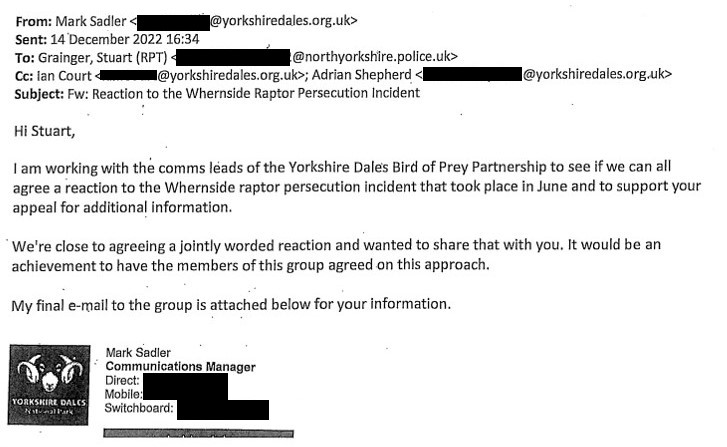
Here is the email Mark sent around to the ‘Partnership’ sub-group:
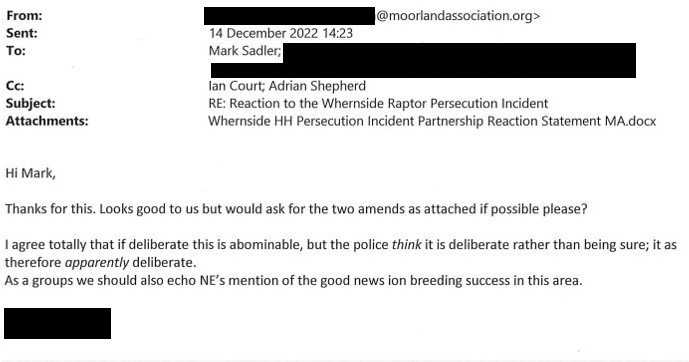
The first ‘partner’ to respond to Mark’s draft statement was the Moorland Association (the grouse moor owners’ lobby group in England). Here’s its response:
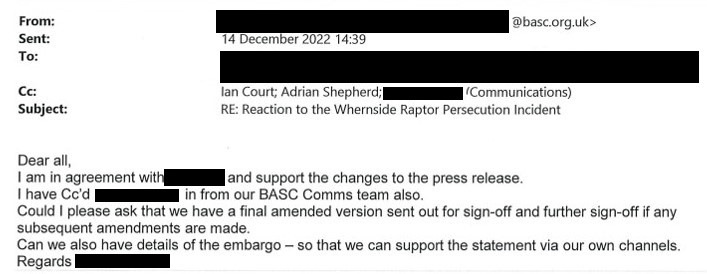
The next partner to respond, shortly afterwards, was BASC:
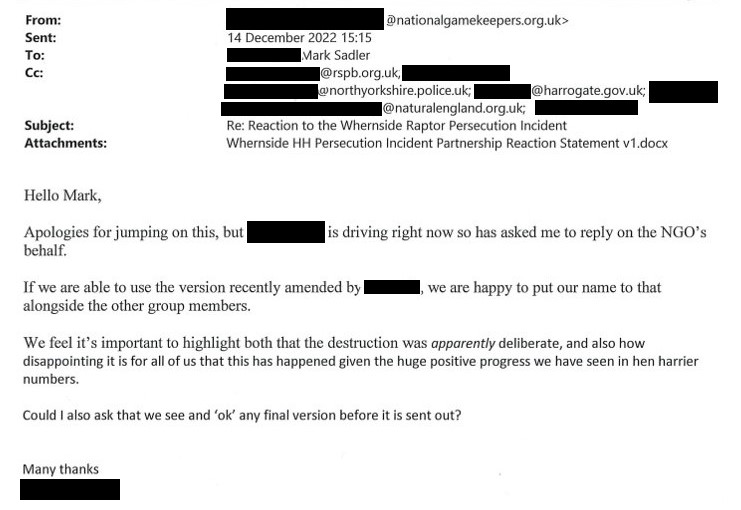
Right on cue, the next ‘partner’ to respond was the National Gamekeepers Organisation, as follows:
You’ll note that all three ‘partners’ from the shooting industry are intent on watering down North Yorkshire Police’s statement, moving the focus away from the police’s assertion that the stamping and killing of the hen harrier chicks in their nest was “deliberate“, and instead suggesting that it was “apparently deliberate“. They also want to big up the increase in the number of breeding hen harriers in the Yorkshire Dales/Nidderdale area that has happened as a result of the ludicrous brood meddling trial, carefully omitting to mention the ongoing persecution of hen harriers (77 illegally killed or ‘missing’ since the brood meddling trial began in 2018, a number of them in the Yorkshire Dales/Nidderdale area – see here).
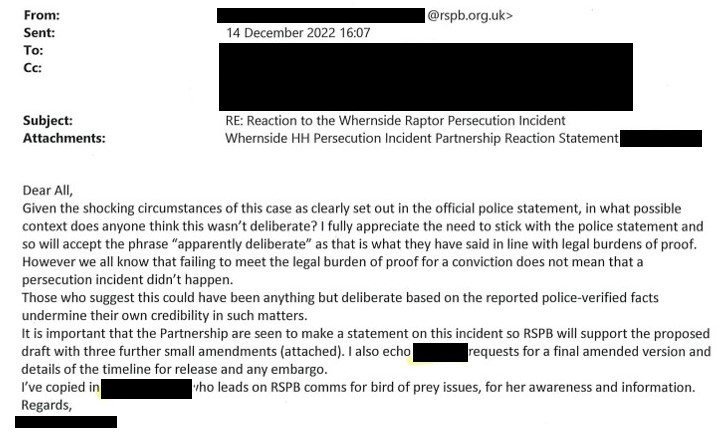
The fourth ‘partner’ to respond was the RSPB, as follows:
The RSPB’s response starts strongly but then caves in and accepts the ‘apparently deliberate‘ narrative because it thinks its more important that the Partnership issues a statement and it knows that without a conviction, the police’s assertion that it was a deliberate act is contestable, even though the police’s view is based on having full sight of all the evidence. The RSPB asks for ‘three further small amendments’ to the draft text but I don’t know what those entailed because they weren’t included in the FoI response.
Mark Sadler from the YDNP adjusts the draft statement to incorporate the manipulations requested by the shooting industry ‘partners’ and he sends the final version to North Yorkshire Police:
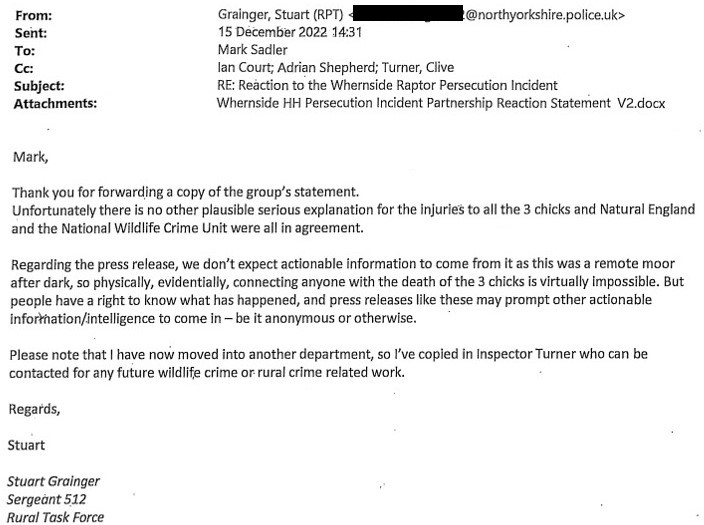
North Yorkshire Police responds to this with a very, very clear message, reinforcing the view that whoever disabled the nest camera and then inflicted horrific injuries to those young hen harriers by stamping them to death, did so deliberately:
“Unfortunately there is no other plausible serious explanation for the injuries to all the 3 chicks and Natural England and the National Wildlife Crime Unit were all in agreement“:
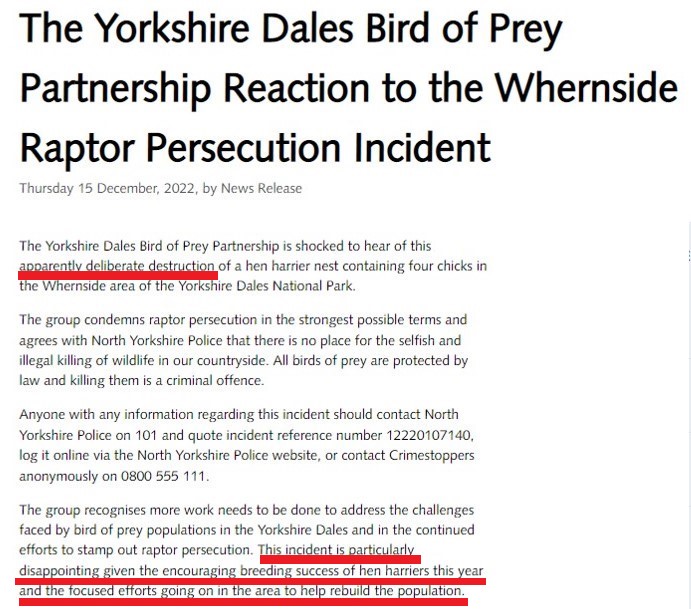
Here is the Partnership’s final statement, which was published on the Yorkshire Dales National Park Authority’s website on 15th December 2022. The parts I’ve underlined in red are the changes made between this final version and the original draft version:
As you can see, the changes are subtle, but are significant. The shooting industry representatives have introduced an element of doubt about the intention of whoever stamped on those chicks, despite North Yorkshire Police’s position (and that of Natural England and the National Wildlife Crime Unit) that the stamping was deliberate with the intention of killing the hen harrier chicks.
The insertion of a statement about increased breeding success for hen harriers and ‘focused efforts in the area to rebuild the population‘ leave the uninformed reader non the wiser about the ongoing illegal persecution of this species on grouse moors in the Yorkshire Dales, Nidderdale and beyond.
What does this charade tell us about the Yorkshire Dales Bird of Prey Partnership? Nothing we didn’t already know – despite a few earnest members, it’s another sham overrun by ‘partners’ with a vested interest in playing down the extent of raptor persecution in the area. It’s quite obvious that publicity about these crimes is bad news for the shooting industry – it damages their reputation and will, sooner rather than later, lead to statutory reform of game shooting as is now happening in Scotland, in large part because the public has been made aware of what’s going on and has demanded the Government takes action.
Last week I blogged about how a major shooting industry organisation, BASC, had attacked Suffolk Police for what BASC perceived to be an ‘offensive’ police appeal for information about the shooting of five young goshawks found dead at the edge of woodland near Thetford (here).
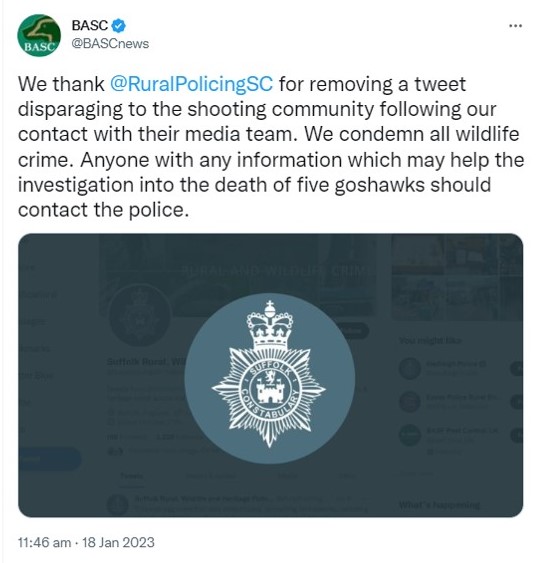
BASC complained that the police’s appeal was “disparaging to the shooting community” simply because the police had asked the shooting community for help to identify the shot gun-wielding criminal(!). Astonishingly, BASC’s complaint resulted in the police’s tweet/appeal for information being deleted.
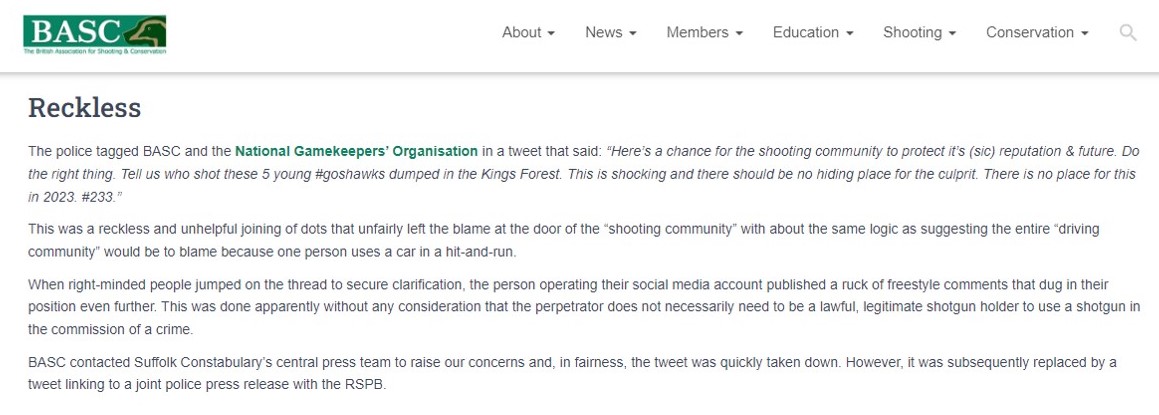
Later, Suffolk Police released a joint press release with the RSPB, which seemed to enrage BASC even further. Bizarrely, BASC wrote on a blog:
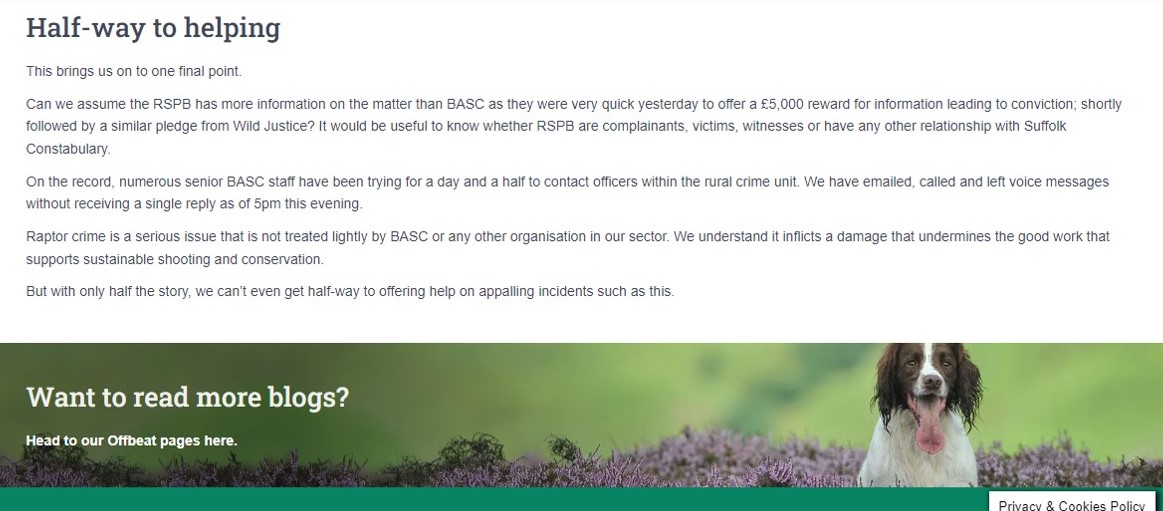
“Can we assume the RSPB has more information on the matter than BASC as they were very quick yesterday to offer a £5,000 reward for information leading to conviction; shortly followed by a similar pledge from Wild Justice? It would be useful to know whether RSPB are complainants, victims, witnesses or have any other relationship with Suffolk Constabulary“.
I would argue that this is a cack-handed but sinister attempt by BASC to try and influence the narrative on raptor persecution crimes. If the police are too scared to publicise a raptor persecution incident or appeal for information about it, because they’re scared of a backlash from the industry who are, let’s not forget, responsible for 73% of convictions for raptor persecution crimes, then it’s job done for the shooting industry. No reports = no publicity = no bad press = no public pressure on politicians to tackle these relentless, systemic crimes.
And it’s not just BASC that appears to be at it. The National Gamekeepers Organisation (NGO) has recently written on its website its dissatisfaction with Lincolnshire Police and the RSPB about the reporting of raptor persecution offences in that county. It’s mostly about a recent incident where the remains of three barn owls, one tawny owl and one red kite were found dumped in a ditch (here), and the NGO incorrectly accuses RSPB Investigations Officer Howard Jones of ‘insinuating that a gamekeeper might be to blame for the Lincolnshire incident‘ in a BBC news article.
Actually, Howard Jones did no such thing, he was talking about raptor persecution crimes in general and he was simply stating facts – the “vast majority” of raptor persecution cases being dealt with by the courts involve gamekeepers. That is a factually accurate statement from Howard, however unpalatable/embarrassing that may be to the NGO. Neither the RSPB or Lincolnshire Police laid any blame on anybody after the discovery of those bird of prey remains in Lincolnshire – they simply said it was an ‘unusual’ case and were appealing for information (here).
The ridiculous NGO, though, has written on its website:
“The NGO are in contact with DC Flint of Lincolnshire Police and are hoping to meet with him in the near future to discuss both this case and to highlight our concerns about the reporting surrounding this case“.
Meanwhile, the NGO has failed (refused?) to publicise the recent conviction of Dorset gamekeeper Paul Allen, who pleaded guilty to multiple wildlife, poisons and firearms offences after the discovery of six shot buzzards, the burnt remains of three more buzzards, and three different types of banned poisons on his pheasant shoot and a loaded shotgun found propped up behind his kitchen door with rounds of unlicensed ammunition in an out-building.
The NGO has also remained silent about the discovery of the five shot goshawks found dumped in Suffolk last week.
Like BASC, you’ll know that the NGO is a member of the Raptor Persecution Priority Delivery Group (RPPDG), a so-called partnership (it’s a sham) whose main objective is to help eradicate raptor persecution by highlighting these crimes and publicly condemning the criminals involved.
Long-term blog readers will know this attempted manipulation of the narrative by the game-shooting industry is nothing new and has been going on for years, mostly behind the scenes and only uncovered via Freedom of Information requests (e.g. see here and here).
I’ve just been sent yet another example of it, this time in the Yorkshire Dales National Park. More on that shortly…
Press release from League Against Cruel Sports (24th January 2023):
The Scottish Parliament has today (Tuesday) voted to pass the new Hunting with Dogs (Scotland) Bill. The vote was passed by 90 for and 30 against, with no abstentions.
The new legislation was introduced last year, two decades after a failed attempt by the Scottish Parliament to ban hunting with the Protection of Wild Mammals (Scotland) Act, back in 2002.
The new Bill will bring into force a number of measures which significantly curtail mounted hunting activity, including reducing the number of dogs which can be used to hunt a wild mammal to just two, instead of a full pack, and reducing the number of dogs which can be used below ground to just one.
The Bill also includes a pre-emptive ban on trail hunting. Trail hunting is a sport which was created after hunting was banned in England and Wales following the passing of the Hunting Act in 2004. Its inclusion in the Bill means trail hunting can not be established north of the border.
Video footage from the League Against Cruel Sports shows a hunter throwing a fox to a baying pack of hounds (Credit: here)
The League Against Cruel Sports Scotland, has welcomed the new legislation. Director Robbie Marsland said:
“As of today, Scotland has the most robust law anywhere in the UK to prevent the cruelty of chasing and killing wild mammals for sport – and this is something to celebrate. Despite a persistent campaign from those resolute to keep hunting alive in the Scottish countryside, the Scottish Government has been determined to end the sport of hunting, a sentiment which has today been supported by the Parliament.
“The passing of the Hunting with Dogs (Scotland) Bill now provides an opportunity to right the wrongs of the last two decades and close the loopholes which allowed hunters to continue with hunting as though the law didn’t exist.
“The inclusion of a ban on trail hunting is a significant victory for Scotland, meaning hunts will not be able to use this so-called sport as a smokescreen for traditional hunting.”
The new Bill also includes a licensing system which will allow for a full pack of hounds to be used in certain circumstances. The detail of the scheme has yet to be developed but animal welfare campaigners have concerns this has the potential to be exploited.
Robbie Marsland added:
“After twenty years of flawed legislation it is critical that this Bill is not simply a way of creating new loopholes for hunters to exploit, and the League is yet to be convinced the licensing scheme won’t do this.
“Despite the best of intentions to ban hunting, the determination and deep rooted defiance among those who wish to chase and kill foxes should not be underestimated. The League will work closely with Nature Scot and other stakeholders to ensure the licensing system is robust, effective and fit for purpose.”
The Hunting with Dogs Bill is expected to receive royal assent in the next few weeks and come into force in the autumn.
ENDS
This is a significant win for campaigners in Scotland, including REVIVE coalition members the League Against Cruel Sports and OneKind, and will increase pressure on the Westminster Government to follow suit.
The proposed licensing scheme, which will allow the use of more than two dogs in “certain limited circumstances” has undoubtedly been brought in to help fend off any legal challenges but the details and effectiveness of the licences remain to be seen.
For example, will the licensing authority NatureScot think that footpacks running amok in public forests, killing foxes to protect gamebirds on grouse moors (e.g. see here) is an appropriate and licensable activity? We’ll see.
There’s plenty of media coverage of this story today:
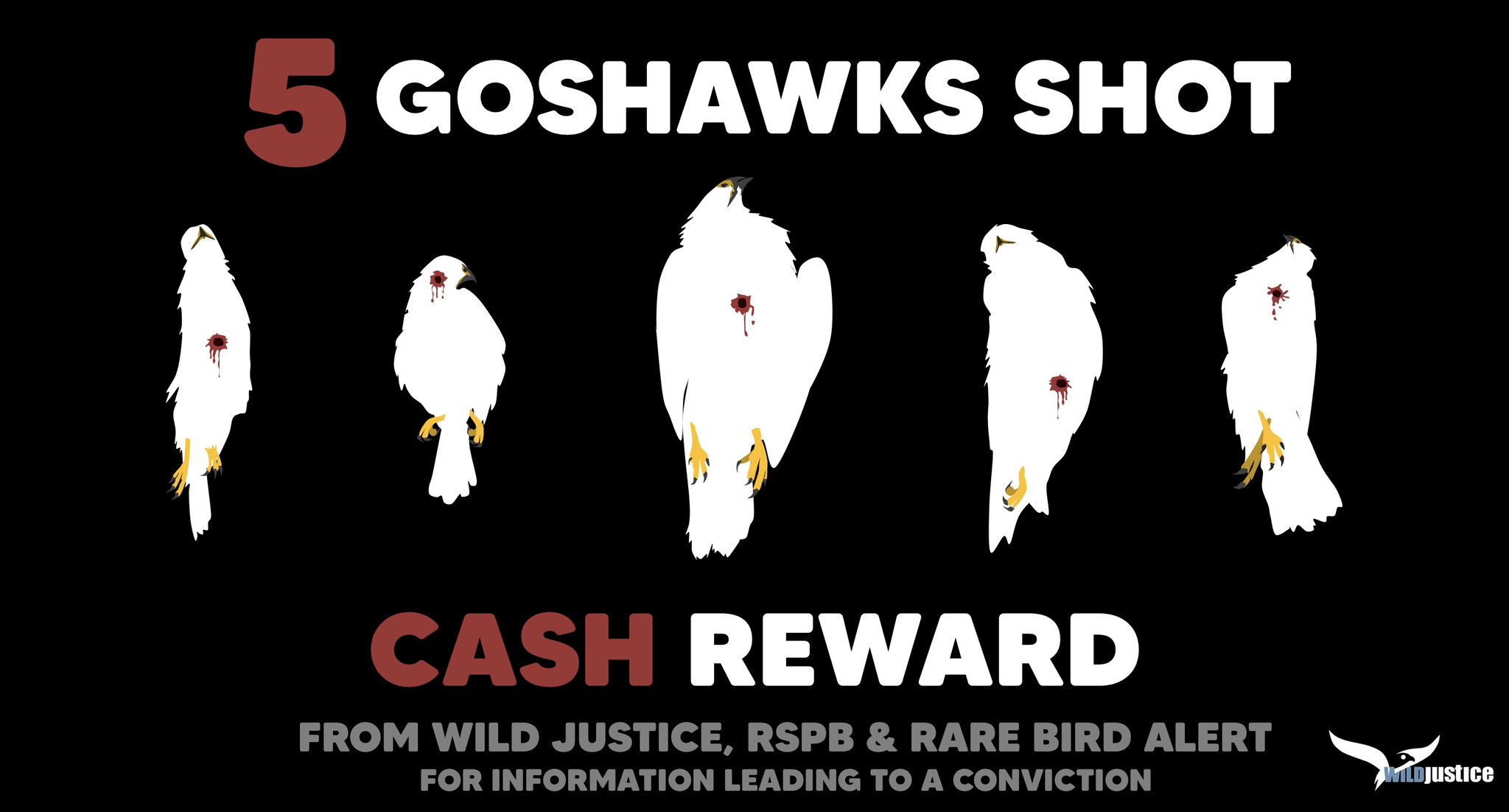
The reward for information leading to the conviction of whoever shot five goshawks and dumped them in Suffolk last week (see here) has now passed £14,000.
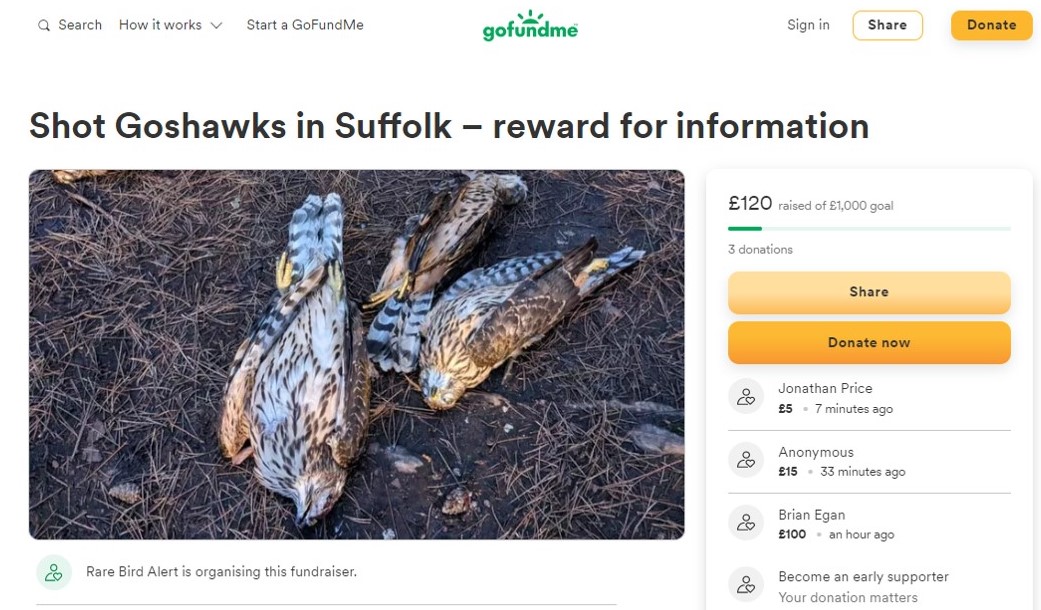
The RSPB has provided £5,000, Wild Justice has provided £5,000, and Rare Bird Alert’s crowdfunder appeal has so far accrued over £4,000.
I haven’t seen any effort by any of the game-shooting organisations to contribute to the reward; most of them haven’t even drawn to their members’ attention the police appeal for information, let alone told them about the reward (apart from BASC, whose response was to wail, loudly, about how offensive it was for the police to ask the shooting community for help to identify a criminal with a shotgun, here)!
There may be coverage of BASC’s histrionics in The Guardian tomorrow.
If you’d like to contribute to the reward, please visit the crowdfunder here.
If you have any information about this appalling crime, please call Suffolk Police on 101 and quote crime reference 37/3027/23. Alternatively, you can provide anonymous information via the RSPB’s dedicated Raptor Crime Hotline on 0300 999 0101.
UPDATE 7th June 2023: Man charged in relation to five shot goshawks found dumped in a forest car park in January (here)
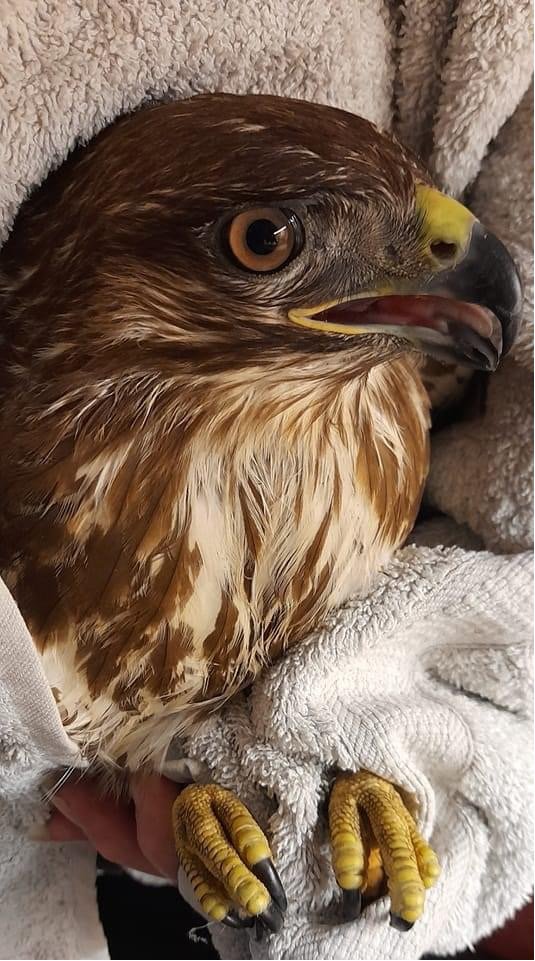
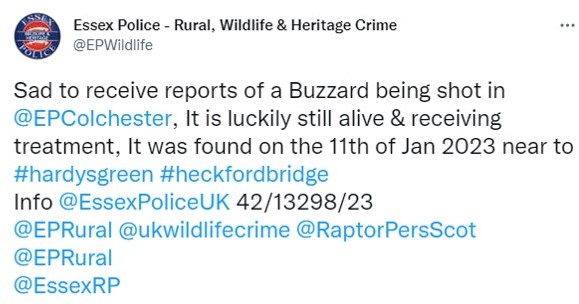
A buzzard has been found shot in Colchester, Essex. It is still alive and is undergoing treatment for its injuries.
It was found on 11th January 2023 near to Hardy’s Green and Heckford Bridge. Essex Police’s Rural, Wildlife & Heritage Crime Team has put out an appeal for information on Twitter:
The shot buzzard. Photo: Essex Police Wildlife Team & Colchester Owl Rescue
X-ray showing at least 3 shotgun pellets (highlighted by RPUK). Photo: Essex Police Wildlife Team & Colchester Owl Rescue
This isn’t the first raptor persecution crime in Essex and certainly won’t be the last. Previous crimes against birds of prey in this county in recent years include the shooting of red kites (e.g. here and here), the shooting of a hobby (here) and the shooting of buzzards (e.g. here, here and here).
If anyone has any information about this latest shot buzzard, please contact Essex Police on Tel: 101, quoting incident reference # 42/13298/23.
UPDATE 31st January 2023: Shot buzzard in Essex succumbs to its injuries (here)
A young white-tailed eagle, released into the wild as part of a conservation reintroduction project, has been found poisoned with the banned pesticide Carbofuran.
The National Parks & Wildlife Service in Ireland is appealing for information after the discovery of the dead eagle in November 2022 on land between counties Cavan and Westmeath.
The juvenile male white-tailed eagle who was just over a year old had been brought in as a chick in 2021 from Norway under phase two of a national re-introduction programme (e.g. see here and here).
It had been fitted with a satellite tag prior to its release on Lough Derg in 2021 and subsequent monitoring showed the eagle had been spending time around Lough Sheelin in Co Westmeath with two other white-tailed eagles, but tag data indicated the eagle had become stationary in November.
The corpse was retrieved and toxicology tests undertaken at the State Laboratory confirmed the eagle had been poisoned with Carbofuran, a deadly pesticide so dangerous it was withdrawn for use in Ireland over a decade ago.
NPWS regional manager, Maurice Eakin, said white-tailed eagles were a protected species under the Wildlife Acts. The death of the bird last November highlighted “once again” the extent of the illegal practice of using poisonous material as pest control.
“In this instance, it is particularly disturbing that the reckless laying of poison has resulted in the death of a white-tailed eagle, one of our largest and most majestic bird species, which had been persecuted to extinction by the early 1900s,” he said.
The NPWS is seeking any information from the public in the Westmeath/Cavan region, particularly anyone who may have seen anyone or any vehicles acting suspiciously in recent weeks in the area between Lough Sheelin and Lough Ramor.
Over 100 white-tailed eagles, donated by Norway, have been reintroduced to the Irish Republic since 2007, with the first successful breeding taking place in 2012 and there have been many successes over the last decade, bringing biodiversity and ecosystem benefits as well as a boost to local economies via ecotourism.
However, a scientific review of the reintroduction project in 2019 indicated that the small population was still vulnerable to illegal poisoning events so additional eagles have been reintroduced as part of phase two of the reintroduction to help bolster the population. It’s sadly ironic that one of those eagles has become the latest poisoning victim.
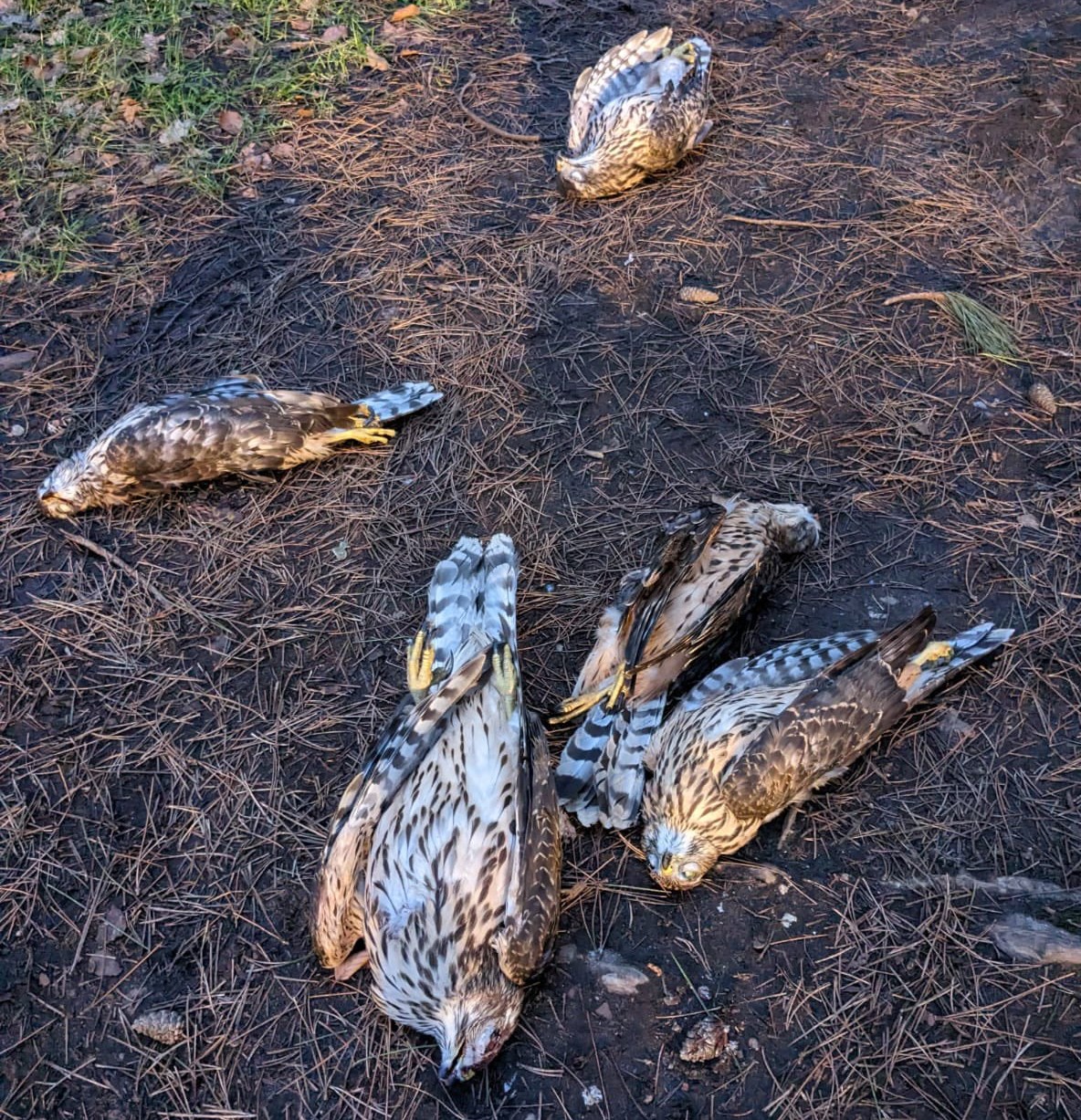
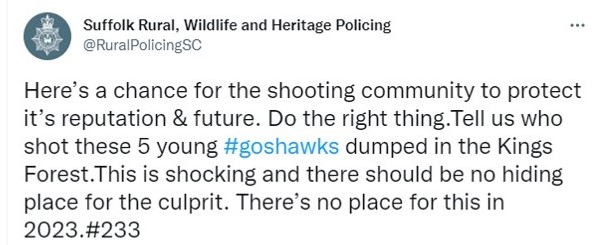
At the beginning of this week, Suffolk Police put out an appeal on Twitter asking the shooting community to help identify the person who shot dead five young goshawks, which had been dumped at the edge of the King’s Forest near Thetford on Monday (see here).
The following day, Suffolk Police’s tweet was deleted without explanation. It soon became clear why – BASC, a prominent shooting organisation, had demanded it be removed because apparently it was offensive to ask the shooting community to help identify someone who had committed a crime with a shotgun! In a misjudged PR move, BASC even bragged about getting the police tweet removed:
I don’t think it’s disparaging in any way to ask the shooting community for help to solve a wildlife crime committed by someone with a shotgun. And let’s be honest, given the long history of goshawk persecution in the UK by members of the game-shooting industry, it’s perfectly logical to suspect that a member of that industry might be the perpetrator.
At this stage, Suffolk Police, quite rightly, hasn’t drawn any conclusions other than all five goshawks contained shotgun pellets (as revealed by x-ray).
My own view, for what it’s worth at this early stage of the investigation, is that the x-ray provided by the police shows that at least one of the dead goshawks had an enlarged crop, indicating that it had eaten recently. It’s not beyond the realms of possibly, or indeed probability, that these young goshawks had been enticed into a trap, over a period of time, by a decoy bird and then shot by whoever was operating the trap.
We know that goshawks are easily enticed into such traps (e.g. see here, here, here and here). We also know that many gamekeepers generally despise goshawks, due to their perceived threat to gamebirds; a view not helped by idiotic and inaccurate commentary about the species by senior members of the gamekeeping community including Alex Hogg, the Chairman of the Scottish Gamekeepers Association, who once wrote, “I strongly believe the goshawk never was indigenous to the United Kingdom and there is absolutely no hard evidence to suggest otherwise” (see here). Goshawk persecution is so rife in the UK, even inside some of our National Parks (e.g. see here and here) that the species has been identified as a ‘national wildlife crime priority’ by the National Wildlife Crime Unit.
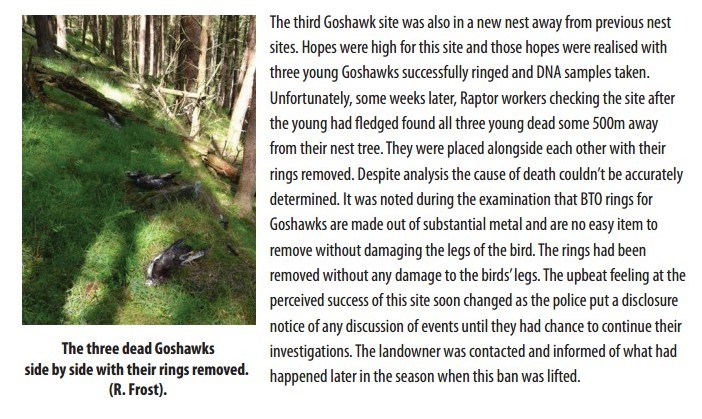
Why were the dead goshawks dumped in a car park next to a public wood? Only the person who dumped them there can answer that, but again, it’s not the first time that illegally-killed goshawks have been placed to await discovery, as some kind of two-fingered salute by the killer(s).
For example, here is what happened to three young fledged goshawks from a nest in the Peak District National Park . The image below is an excerpt from the Peak Nest Watch 2010 end of season report, which can be downloaded here: peak_nestwatch_2010
Were the five shot goshawks found in Suffolk this week all from the same brood? DNA analysis can answer that. When were they shot and had the carcasses been frozen prior to being dumped? Again, forensic analyses will help. Until then, all we know is that a wildlife crime has been committed and Suffolk Police are to be congratulated for putting out an appeal for information within 24 hours of the shot birds being discovered.
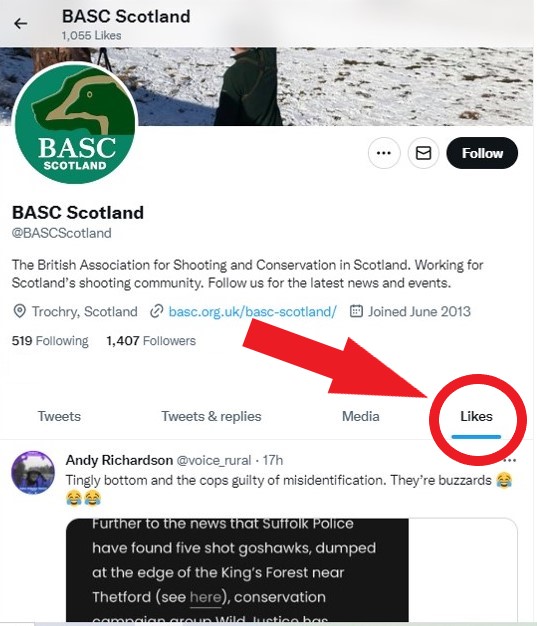
I’ve seen other members of the shooting community make some ridiculous claims about this case over the last few days. One suggests that shotgun pellets ‘can easily be introduced into a carcass’, inferring that these birds weren’t shot at all but are the result of some kind of ‘set up’. He’s bonkers if he thinks anyone will believe that. Another former Head Gamekeeper, who routinely brags on social media about his supposed superior expertise on natural history, concluded that these were buzzards, not goshawks (he’s wrong, as usual) but even if he was right, it would still be a wildlife crime to shoot them. Bizarrely, the BASC Scotland twitter account ‘liked’ this post (thanks to blog reader Dr Rob Thomas @RobThomas14 for pointing this out):
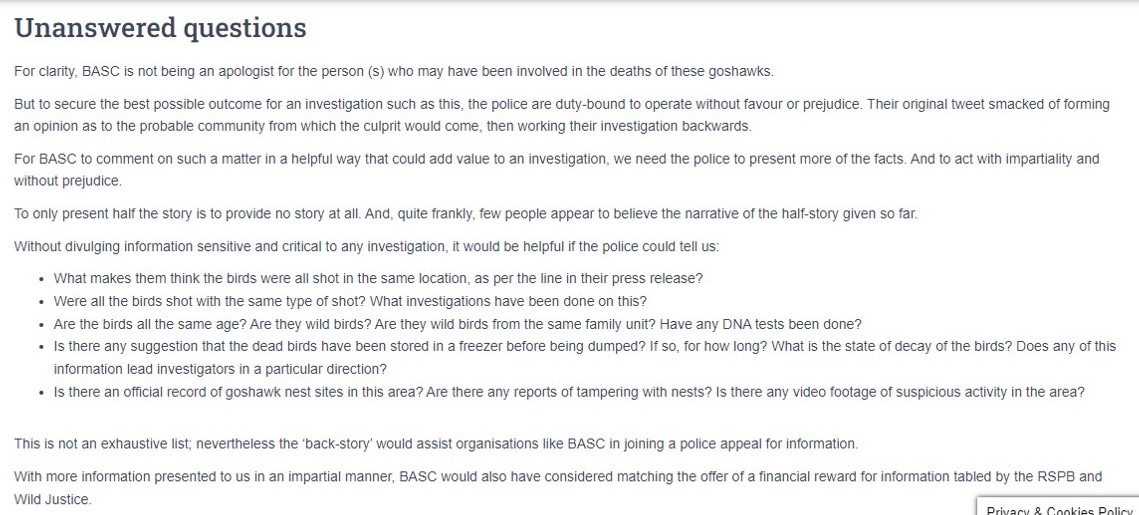
Not content with forcing Suffolk Police to remove its original appeal for information on this case, BASC has now published an astonishing article on its website in an attempt to justify its action and also seems to be very cross about the £10,000 reward offered by the RSPB and Wild Justice. You can read the BASC article here.
[UPDATE: It appears that BASC’s blog is no longer available on its website. Fortunately it was screen-grabbed before it vanished, see below]
In my opinion, it’s staggering that BASC can so easily influence the narrative about raptor persecution crimes as it has done here, and it’s not the first time. I’ll be blogging shortly about another example that has recently come to light.
It’s also a little bit strange that BASC should feel offended about being asked to help find the criminal who shot these goshawks. BASC, you’ll recall, is a member of the Raptor Persecution Priority Delivery Group (RPPDG), the police-led ‘partnership’ designed to help tackle illegal bird of prey persecution in England & Wales. If BASC is so offended about the shooting industry being linked to raptor persecution, why on earth is it a member of the RPPDG?
Meanwhile, the crowdfunder to increase the £10,000 reward for information, launched by those decent people at Rare Bird Alert, is doing well. If you’d like to contribute, the crowdfunder page can be found here.
If you have any information about this appalling crime, please call Suffolk Police on 101 and quote crime reference 37/3027/23. Alternatively, to get in touch anonymously, call the RSPB’s dedicated Raptor Crime Hotline on 0300 999 0101.
UPDATE 7th June 2023: Man charged in relation to five shot goshawks found dumped in a forest car park in January (here)
UPDATE 29th June 2023: Gamekeeper Francis Addison receives suspended jail sentence in relation to five shot goshawks (here)
Further to the news that the RSPB and Wild Justice have put up a £10,000 reward for information leading to the conviction of the person who shot five young goshawks and dumped their bodies at the edge of The King’s Wood in Suffolk on Monday (see here), the bird news service Rare Bird Alert has launched a crowdfunder to increase the reward.
Here’s the wording of the crowdfunder, that went live earlier this morning:
On Monday 16th January 2023 officers from Suffolk Constabulary discovered the bodies of five dead Goshawks in Kings Forest, Suffolk.
Police have revealed that x-ray examination has shown all five birds had been shot. Further investigations are on-going.
A reward of £10,000 has been offered by the RSPB and Wild Justice for information leading to a conviction in connection with the birds.
Rare Bird Alert is setting up this appeal to increase that reward. If the reward is not paid out after a determinate period of time then it will be donated to the RSPB Investigations team for their continuing fight against raptor persecution.
We will not be silenced by those who kill birds of prey.
ENDS
Rare Bird Alert launched a similar fundraising appeal in 2015 after a rare Red-footed falcon was shot in Cambridgeshire (here), and that appeal raised over £2,700. It is hoped that this latest fundraiser provides the birding community with a constructive outlet for its anger at yet another appalling case of raptor persecution.
If you’d like to contribute, the crowdfunder page can be found here.