Further to the news that 20 hen harriers have gone ‘missing’ in the last year (many of them on grouse moors in the Yorkshire Dales National Park), as well as the discovery of a mutilated hen harrier corpse, whose head and leg was ripped off whilst the harrier was still alive, also in the National Park (see here and here), the Yorkshire Dales National Park Authority has published a statement:
Photo: Ruth Tingay
RESPONSE TO THE DEATH OF ‘FREE’, A NATURAL ENGLAND TAGGED HARRIER
Friday, 5th May 2023
David Butterworth, Chief Executive of the Yorkshire Dales National Park Authority, said:
“It’s astonishing that 21 Hen Harriers have disappeared across Northern England in 12-months, and sickening to hear that ‘Free’, a Natural England tagged hen harrier has been found dead, headless and missing a leg in an area of moorland in the National Park.
“After so many years of illegal bird of prey persecution in the area you might think we would become more immune to this pathetic criminality. We never should.
“Locally, we have seen some tentatively encouraging results in recent years in terms of successful breeding of hen harriers, with the strong support of some land owners. However, that progress will be rendered utterly worthless if these attacks are allowed to continue.
“It is shameful that we still have individuals among our local communities who take part in these atrocities. I would strongly urge anyone with any information on this incident to come forward. This has to stop”.
Killing birds of prey is illegal. Anyone with concerns about a possible wildlife crime should call 101, and anyone witnessing a suspected wildlife crime should call 999 and ask for the Police.
Yesterday, the RSPB announced the shocking news that 20 hen harriers had gone ‘missing’ on grouse moors in northern England between April 2022 – April 2023, and that the mutilated corpse of a further hen harrier, named ‘Free’, had been found dead on moorland in the Yorkshire Dales National Park (see here).
Hen harrier ‘Free’ was a satellite-tagged bird that was being tracked by Natural England. Natural England has published a blog about the grisly circumstances of Free’s death. I’m reproducing it here, in case the original blog vanishes at some future point.
THE DEATH OF FREE, A NATURAL ENGLAND TAGGED HEN HARRIER
By Stephanie Bird-Halton, Director, National Delivery, Natural England (May 5th 2023).
Hen harriers are currently extremely rare in England due to illegal persecution and nest disturbance, primarily in areas associated with grouse shooting. Natural England satellite-tracks hen harriers in order to investigate patterns of dispersal and survival, and the causes of any deaths. This blog is about Free, one of our tagged hen harriers, that died due to human persecution.
Free was hatched in 2020 from a nest in Cumbria, and in April 2022 he was two years old. At around this time, he had apparently settled in an area of moorland around Birkdale, near the border of Yorkshire and Cumbria. Our staff raised concerns when Free’s tag transmitted a signal late at night on 11 April 2022, indicating he was away from his normal roosting area.
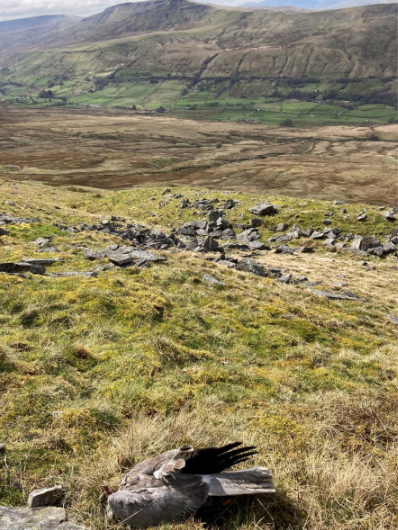
As always, the police were immediately informed. It is not always possible to accurately identify the location of a satellite tag, as they do not transmit constantly, but in this case the tag was swiftly tracked down to a rocky slope above Outhgill. Free was found dead, headless and missing a leg, but showing no other sign of being eaten or scavenged by an animal predator, and still fitted with his satellite tag.
Hen harrier ‘Free’ as found. Photo: Natural England
Hen Harrier ‘Free’ as found. Photo: Natural England
Free’s body was recovered and sent for post-mortem examination to diagnose signs of death. Shockingly and upsettingly, the post-mortem examination concluded that Free’s leg had been torn off while he was alive, and that the cause of death was the head being twisted and pulled off while the body was held tightly. These injuries would be consistent with Free being killed by human hands. There were no other signs of damage from any animal, and Free had not been shot.
Hen harrier ‘Free’ under post-mortem examination showing the signs of bleeding where the leg had been removed. Photo: ZSL
The police and National Wildlife Crime Unit were kept informed, and no information has been shared publicly while enforcement action has been ongoing. Unfortunately, the police investigation did not gather sufficient information to identify a suspect. We are appalled and upset by this horrible death of a beautiful bird, but without further evidence the police and Natural England have no basis for further action. Any requests for more details about this case, or new evidence, should be directed to Cumbria police.
What next?
We are sickened by this evidence of persecution, which remains a serious issue and needs more focus and action from the police, businesses, landowners, and game management interests. We will continue our work tracking hen harriers and will make every effort to track down tags that stop transmitting, and to support the police in their role of bringing the perpetrators of these crimes to justice.
Natural England remains committed to working with our partners on hen harrier recovery. We are encouraged by the possibilities demonstrated by the recent increase in nesting hen harrier numbers overall, and will continue to work to turn the tide on the illegal persecution of these at-risk birds.
We regularly share the status of all our satellite-tracked Hen Harriers (every few months) on this page.
ENDS
I applaud Natural England for publishing this detailed account, but that’s as far as my applause goes.
Why has it taken 13 months, from the discovery of Free’s mutilated corpse in April 2022, for this information to be published? This isn’t the first case where this has happened either (e.g. see here).
The police have said absolutely nothing about this investigation. No statements, no public appeals for information, nothing. I don’t accept that issuing a statement or appeal, no matter how generalised, would have compromised the investigation.
Natural England’s standard response is that it won’t say anything whilst a police investigation is ongoing. I understand that position, and it’s a fair position to take during the early stages of an investigation when evidence-gathering may still be taking place. But to wait for 13 months? That’s ridiculous, and in my view is just NE hiding behind the police as a convenient excuse. And I suspect the news has only emerged now because NE knew that if it didn’t say something, someone else would.
Natural England is using public funds to pay for these satellite tags and staff time to monitor the data. It could easily have made a statement about this case, which is very much in the public interest, without compromising the police investigation.
As long as NE remained silent, it provided an opportunity for both NE and the grouse-shooting industry to flood the media last year, and this year, with propaganda designed to demonstrate that ‘real‘ and ‘great‘ progress was being made by the ludicrous hen harrier brood meddling scheme.
As for the sadistic bastard(s) who tore Free’s leg off whilst he was still alive and then held Free’s body tightly and twisted and pulled his head off (reported in the post mortem as the official cause of death), leaving his body (and sat tag) in place knowing that he’d be found by researchers, if that isn’t an intentional act of defiance and sticking up two fingers to the law then I don’t know what is.
Natural England may well be ‘sickened’ by the evidence – anybody in their right mind would be – but Natural England isn’t just ‘anybody’. It’s the statutory regulator and has a duty to protect this species. When will it accept that decades of so-called ‘partnership-working’ with the grouse shooting industry hasn’t worked, and won’t ever work as long as the criminals are allowed to keep getting away with it?
A couple of weeks ago I blogged about the ‘disappearance’ of five more satellite-tagged hen harriers that had all vanished, in suspicious circumstances, on moorland in northern England between August and December 2022 (see here).
A week later I blogged about how Natural England and the Moorland Association had remained silent about those latest disappearances (see here).
Hen harrier. Photo: Ian Poxton
This morning, the RSPB has issued a press statement about a further 21 hen harriers, as follows:
RARE BIRD OF PREY FOUND MUTLILATED AS 20 OTHER INDIVIDUALS GO MISSING
One of the UK’s rarest birds of prey, a Hen Harrier, has been found dead and its body mutilated. Twenty other harriers, including 15 birds that were part of satellite-tagged tracking projects, have also disappeared across Northern England in the past year.
Hen Harriers are on the red list of birds of conservation concern in the UK, with the last national survey in 2016 recording 545 pairs in the UK – a decline of 13% since 2010. In England there were 34 successful nests in 2022, despite enough habitat and food to support over 300 pairs. In 2019, the Government’s own study found illegal killing to be the main factor limiting the recovery of the UK Hen Harrier population.
The story began in April 2022 when an RSPB satellite-tagged Hen Harrier named Pegasus vanished whilst on Birkdale – an area of driven grouse moor in the Yorkshire Dales National Park on the North Yorkshire/Cumbria border. This was followed shortly after by the discovery of a dead Hen Harrier in the same area – a Natural England tagged bird called Free. The bird was missing its head and leg, which had held a metal ring for identification. Expert veterinary assessment concluded the bird has been killed through traumatic removal of its head and leg, whilst alive – consistent with persecution. A month later, another hen harrier, NE tagged bird Harvey, vanished in this area. The police carried out a search warrant in connection with the incidents, but the ensuing investigation has failed to lead to charges.
However, since the investigation ended a further four satellite-tagged Hen Harriers (one from a RSPB project and three from a Natural England one) have disappeared in this same area, managed for driven grouse shooting.
During autumn 2022, two additional RSPB tagged birds vanished in Cumbria and Durham, both also on grouse moors.
These nine birds are separate to another seven Natural England satellite-tagged Hen Harriers recorded as missing, fate unknown, over the past year.
Finally, also in the past year, five (un-tagged) breeding male Hen Harriers have vanished, including two in the Peak District National Park in 2022 and, in April this year, one in Durham and two from the RSPB’s Geltsdale Nature Reserve in Cumbria: both these birds had active nests which have now been abandoned, one containing three cold eggs. Male harriers are known to hunt away from their nest sites, and this is not the first time that adult male harriers with active nests have vanished from Geltsdale in recent years.
All 21 birds were reported at the time by the RSPB and Natural England to the Police and the National Wildlife Crime Unit.
Commenting on the situation, the RSPB’s conservation director Katie-Jo Luxton said,“These 21 birds represent a significant proportion of the existing English Hen Harrier population. The Government’s own study found illegal killing to be the main reason preventing the recovery of this species, and these recent events indicate that the situation has yet to improve for this rare and beautiful bird.”
Natural England Strategy Director John Holmes said: “We are sickened by this evidence of persecution, which remains a serious issue and needs more focus and action from the police, businesses, landowners, and game management interests. Natural England will continue to work with partners on Hen Harrier recovery, and direct our resources towards science, monitoring, enforcement, and conservation management. We will continue all efforts to track down tags that stop transmitting, as our dedicated staff did in the case of Free, and to support the police in their role of bringing the perpetrators of these crimes to justice“
ENDS
There’s quite a lot to digest in this press release and I’m short on time today, but what is immediately obvious is the clear escalation in persecution incidents, and that they are all linked to driven grouse moors. North Yorkshire, and particularly the Yorkshire Dales National Park, is once again at the centre of the criminality.
The unspeakable barbarity inflicted on Hen Harrier ‘Free’, whose head and leg was ripped off while the bird was still alive, is shocking, but not at all surprising, especially given what we know happened to hen harrier ‘Asta’ (see here). I’ll write more about ‘Free’ shortly.
The RSPB has helpfully provided the following table showing the hen harriers confirmed as persecuted or missing between April 2022-April 2023:
I will need to go through this table and work out which of these harriers are already included in the 82 that we know have been confirmed as illegally killed or missing in suspicious circumstances since 2018 – see here. There will definitely be more to add to that shameful running total.
With this blatant, ongoing, and widespread criminal persecution, Natural England’s recent decision to extend its ‘partnership’ with the grouse shooting industry as part of the ludicrous hen harrier brood meddling scheme, warrants further scrutiny. I’ll come back to that.
UPDATE 6th May 2023: Post mortem reveals hen harrier’s cause of death was ‘head being twisted and pulled off while the body was held tightly’ (here)
Chris Packham’s libel case continued yesterday at the Royal Courts of Justice, against three individuals who are accused of a number of alleged defamatory actions against him.
On day one the court heard from Chris’s barrister, Jonathan Price, as he laid out the main arguments of Chris’s case. He told the Judge, the Honourable Mr Justice Saini, that Chris had been the target of ‘puerile and offensive’ material (see here).
Yesterday, Chris gave evidence and was cross-examined by Nicholas O’Brien, the barrister for defendants 1 & 2. As part of that process, Chris’s witness statement was referred to and as such it can now be considered a public document.
I’ll post a copy of the full statement below and I’d encourage you to read it all (50 pages). But I’d particularly encourage you to read from page 31 onwards, under the heading, ‘The effect of the Defendants’ publications and subsequent conduct‘.
Dog food being sold in the UK has been found to contain high levels of toxic lead.
Over three quarters of samples from three raw Pheasant-based dog foods tested for lead exceeded the maximum level recommended for animal feed.
The use of lead shot in shooting means pet owners are unwittingly feeding their dogs levels of lead that may harm their health.
Wild Justice’s Chris Packham says ”That people might be unwittingly poisoning their beloved companion animals is outrageous. It’s clearly a failure of our regulatory systems when products like raw Pheasant-based dog foods can be sold containing such high lead levels. No animals should be exposed to these levels of lead in their food. Wild Justice is taking legal advice on these shocking findings.”
Dog owners are unwittingly feeding their beloved companions food that contains levels of lead that may harm their health, according to new research published in the journal Ambio. Researchers analysed samples from raw, air-dried and wet dog food products purchased in the UK that contained Pheasant meat. They found that about three quarters of samples from raw Pheasant-based dog food packs exceeded the EU maximum lead levels permitted in animal feed. Across three different products being sold in the UK, lead levels were found to be an average of 245, 135 and 49 times above the maximum permitted levels. Every sample of raw dog food containing Pheasant exceeded the permitted lead threshold in the meat of domestic stock destined for human consumption.
Consumption of lead is detrimental to human health, being especially harmful to developing brains and the nervous system. Other animals are affected in similar ways; lead ingestion can affect the gut, nervous system, heart, kidneys and blood of companion animals.
Pheasants and Red-legged Partridges are released in their millions into the British Countryside each year to serve as targets for recreational shooting. Some go into the human food chain, and others end up in products such as dog and cat food. Lead shot is the type of ammunition normally used for shooting Pheasants, partridges and grouse. When shot into an animal the small lead pellets leave behind tiny lead fragments dispersed through the animal’s flesh. These tiny fragments cannot readily be removed, leading to lead contamination of the meat.
Smaller lead particles are thought to be more readily dissolved and absorbed through the gut than larger particles. The study highlights the potentially increased risk of lead absorption by dogs, due to the mechanical mincing processes often used to prepare dog food which may break up lead shot into smaller pieces.
Chris Packham, Co-Director of Wild Justice said“That people might be unwittingly poisoning their beloved companion animals is outrageous. It’s clearly a failure of our regulatory systems when products like raw Pheasant-based dog foods can be sold containing such high lead levels. No animals should be exposed to these levels of lead in their food, under the guise of being healthy, when they in fact contain levels of lead that would be illegal to feed to cows or chickens or indeed, if it was in your own beefburgers or pork sausages.
Like us, our dogs are vulnerable to toxic lead and we must ask; would you feed your dog something deemed too toxic to eat yourself? These results show the repercussions of lead ammunition use by the shooting industry reach wider than just those who eat game out of free choice. Wild Justice is taking legal advice on these shocking findings.”
Similar recent analysis, also funded by Wild Justice, looked at game meat being sold by British supermarkets for human consumption. This research found elevated lead levels in Pheasant, Partridge and Venison products, which were significantly higher than the legal limit set for other meats from livestock. Whilst increased lead levels might also have been anticipated in dog food products, the concentrations found were surprisingly high.
“We were already aware that lead concentrations in pheasant meat sold for human consumption are often far higher than would be permitted in other meats like chicken, beef or pork” said lead author Professor Debbie Pain of Cambridge’s Zoology Department.“However, we were surprised to find that lead concentrations in raw pheasant dog food products were so much higher”.
Raw meat diets for pets are on the increase in the UK, and products containing raw pheasant are widely available online. Over a third of fifty raw pet food suppliers checked by researchers offered pheasant-based products. Of these, 71% warned consumers that the product may contain shot. Wild Justice are encouraging pet owners who purchase products containing raw pheasant to ask retailers about the sourcing of their pheasant, and any use of lead shot.
Today was the opening day of Chris Packham’s libel case at the Royal Courts of Justice against three individuals who are accused of a number of alleged defamatory actions against Chris.
There’s a pretty good write up of today’s events in the Guardian – here.
The court heard a small sample of that ‘puerile and offensive’ material as Chris’s barrister laid out the basis for the case. I suspect there may be much more of that to come given the appalling vitriol towards Chris, so obviously on public display over the two years this case has been in preparation.
The judge, the Honourable Mr Justice Saini, was scrupulously fair and reasonable today, clearly setting out, amongst other things, what he would and wouldn’t tolerate in the cross-examination phase, which begins tomorrow. The barrister for defendants 1 & 2, Nicholas O’Brien, was given a very clear direction from the judge about a particular line of questioning he intended to take when cross-examining Chris. Mr Justice Saini reminded Mr O’Brien to consider his ‘professional responsibilities’ when choosing his questions.
Fascinating!
UPDATE 4th May 2023: Chris Packham’s witness statement reveals devastating impact of the hate campaign against him (here)
The Welsh Government has confirmed an outbreak of highly pathogenic Avian Influenza H5N1 at a farm in Powys, mid-Wales.
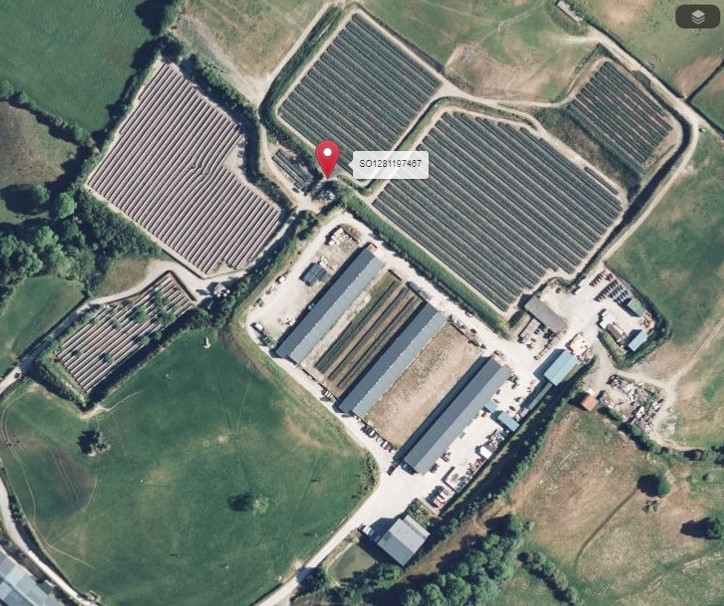
Stringent movement restrictions have been put in place and according to the Government’s declaration notice, the incident centres on grid reference SO12811 97467, which is at Bettws Hall, which describes itself as ‘Europe’s leading game hatchery’, producing pheasant, red-legged partridge and duck chicks for the gamebird shooting industry.
The Welsh Government has imposed a protection zone (blue circle) and a surveillance zone (black circle) around Bettws Hall Game Hatchery in Powys, mid-Wales.
An aerial view of the rows of pheasant and red legged partridge laying cages at Bettws Hall at the centre of the avian flu outbreak (via Google)
Some of the raised laying cages at Bettws Hall. Photo: Animal Aid
The Chief Veterinary Officer for Wales has written a declaration notice, which defines the protection and surveillance zones and details the restrictions now in place (from 27th April 2023 until further notice). The declaration notice can be read here:
This latest outbreak will be a blow, not only to Bettws, who are now unable to release gamebirds on their own shoot, but also to the wider game-shooting industry because Bettws Hall is a significant gamebird producer. Each year, according to its own promotional brochure, Bettws produces ‘in excess’ of 1.7 million pheasants, 35,000 ducks and an unknown quantity of red-legged partridges for gamebird shoots across the UK and the Irish Republic.
At a time when the UK shooting industry is looking to UK-based producers for its gamebird supply, rather than remaining reliant upon the big suppliers in France (and a few other European countries) where bird flu has recently disrupted the supply/delivery chain and caused a huge reduction in the number of shoots and the number of birds available to kill, this news from Bettws will be met with angst and fear from an industry under increasing pressure to survive.
Incidents involve species snares are intended to catch, such as foxes, and non-target species such as dogs, deer and badgers.
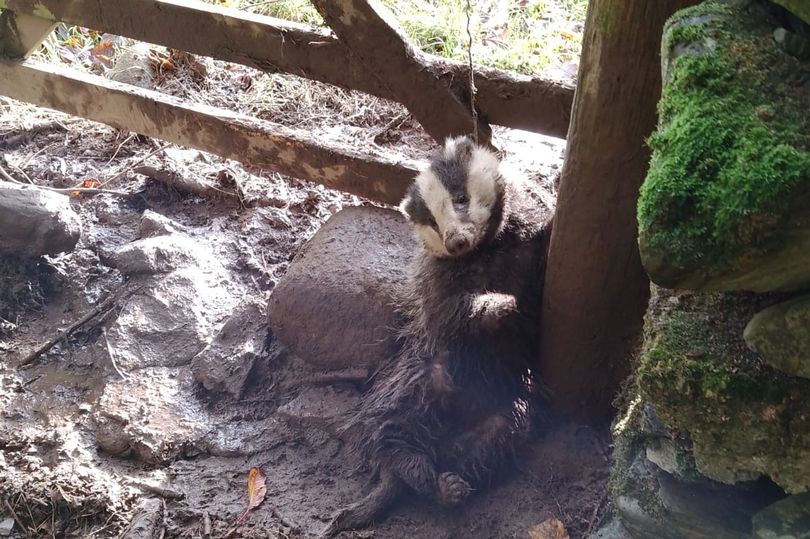
This young badger was left hanging by its neck for at least a day in an illegally-set snare in Dumfries & Galloway in November 2022. Fortunately it was rescued.
Snares are archaic traps used primarily to protect birds such as grouse and pheasants from foxes, so there is a surplus of these birds for people to shoot for ‘leisure’. They can cause considerable physical and emotional suffering to the animals trapped in them, and yet these cruel devices are still perfectly legal across Scotland and the rest of the UK, though a Bill currently going through the Senedd will soon ban them in Wales.
OneKind Campaigner, Eve Massie, said:
“Our latest snaring report, ‘SnareWatch Annual Report 2022: Case studies of snare use in the UK’, highlights the suffering inflicted upon animals by snares and why a ban on these outdated and cruel traps is crucial.
“Snares can cause the animals trapped in them considerable physical and mental suffering and yet unbelievably, these cruel devices are still legal in Scotland. Animals may suffer from deep wounds, internal organ damage or even death due to being trapped in snares. Death may be slow, as snares frequently become twisted or frayed as the animal struggles, leading to strangulation, or the animal succumbing to their injuries. They may also suffer from hunger, thirst, exposure and attacks from other animals.
“Snares also inflict emotional suffering, with trapped animals likely to become fearful and distressed“.
Eve commented on two of the incidents:
“In a particularly worrying case, a local discovered her 15-month-old Border Terrier, 2.5 hours after he had gone missing on his walk, trapped by his neck in a snare, choking in distress. Thankfully, the dog recovered.
“We also heard from a couple who found a distressed deer trapped with a snare around her neck. She was naturally panicking, causing the snare to tighten. She sadly died.
“As these reports show, snares are not only cruel, but indiscriminate to the species that they catch. Indeed, up to 70% of all animals caught in snares are not of the species snares are set for“.
On the Scottish Government’s current consideration of snaring, Eve continues:
“The Scottish Government is planning to introduce provisions on snaring at Stage 2 of the Wildlife Management and Muirburn (Scotland) Bill and a ban on the use of these archaic traps could be a real possibility.
“OneKind believes that there should be a complete ban on the use and sale of snares in Scotland. Thousands of our supporters wrote to the former Minister for Environment and Land Reform, Màiri McAllan, in favour of a ban and are responding to the Rural Affairs and Islands Committee’s call to views on the Bill, urging for a snaring ban.
“You cannot regulate cruelty“.
ENDS
OneKind is a partner in REVIVE, the coalition for grouse moor reform.
OneKind has published an excellent short (2 min 20 sec) film about snares on grouse moors. You can watch it in the link below:
In February this year it was reported that a young golden eagle, named ‘Sula’, had been found dead on the Queensberry Estate, an estate within the Buccleuch portfolio in Dumfriesshire (see here).
She was from the South Scotland Golden Eagle Project, where eagles are being translocated from other Scottish regions in an effort to boost the declining population in the south. Sula had been translocated in 2022.
Photo: South Scotland Golden Eagle Project
The Veterinary Investigation Centre at Scotland’s Rural College (SRUC) in Dumfries conducted a variety of tests (toxicology, histopathology, virology, bacteriology and parasitology) and have now reported that the investigation did not find a definitive cause of death, but did conclude that Sula had been in “very fit condition” before her death. Avian flu was ruled out.
The South Scotland Golden Eagle Project website can be found here.
Last week I blogged about the suspicious disappearance of five more young hen harriers, who all vanished on moorlands in northern England between 17th August – 15th December 2022 (see here).
All five were from Natural England’s ludicrous hen harrier brood meddling scheme. Four ‘disappeared’ on moorlands in the Yorkshire Dales National Park and one ‘disappeared’ on moorland in the North Pennines AONB.
Hen harrier. Photo: Peter Christian
This news was picked up and published yesterday in The i by journalist Daniel Capurro – see here.
I’ve reproduced it here:
Five of Britain’s rarest birds of prey went missing last year, despite being part of an official scheme to reduce conflict with grouse moor managers, data quietly published by the Government shows.
Between August and December 2022, five hen harriers, which were satellite tagged and part of a pilot “brood management” scheme, disappeared.
Four of them went missing in the Yorkshire Dales National Park while one was lost in the North Pennines Area of Outstanding Beauty, both protected areas.
The data was released on the Government website in February without any accompanying announcement.
Campaigners have criticised brood management, which they say concedes too much to grouse moor managers, who see the raptors as a threat to their game, and does little to protect hen harriers. The birds are frequently the targets of illegal persecution.
In June last year, a camera-monitored hen harrier nest in the Dales was attacked and four healthy chicks killed. The camera appeared to have been deactivated and North Yorkshire police said the evidence pointed to human responsibility.
Earlier this week a programme aimed at ending conflict between land managers and raptors in the Peak District was abandoned after a decade following a failure to boost bird numbers or end persecution.
Dr Ruth Tingay, a campaigner who first spotted the disappearances, told i that the scheme was “a conservation sham”.
“The main objective of the trial was to assess whether grouse moor managers would stop illegally killing hen harriers if nesting attempts on grouse moors were disrupted and young birds released elsewhere.
“It’s pretty evident that they haven’t – at least 82 hen harriers have either been killed or have ‘disappeared’ in suspicious circumstances since the brood meddling trial began in 2018.”
She called for Natural England to “come down hard on the criminals in the grouse moor industry”.
Hen harriers, which are commonplace in Eurasia but threatened in the UK, have been the subject of extensive conservation work. They are best known for their delicate and elegant mating dances performed in the air over Britain’s upland areas, which featured in the BBC’s Wild Isles series.
However, they prey on red grouse, which are central to the moorland shooting economy. Brood management was drawn up as part of Natural England’s Hen Harrier Action Plan, alongside conservation and game groups, to boost hen harrier numbers without unduly impacting on grouse moors.
The idea is to remove some eggs from wild nests on grouse moors, raise the birds in captivity and then release them into the wild. This is intended to reduce the so-called predation pressure on red grouse.
According to Natural England it “should lead to changes in some of the negative perceptions and behaviours within moorland communities and reduce illegal persecution of hen harriers”.
Its own data for 2019, the first year of the trial showed a 45 per cent survival rate for brood managed birds, compared to just 24 per cent for tagged birds outside the programme.
Nevertheless, major conservation groups including the RSPB have rejected the idea for various reasons, including that hen harrier numbers are not yet high enough to justify the practice.
They insist that efforts should focus on halting illegal persecution first and foremost, with the level of persecution too high both inside and outside the scheme.
A spokesperson for the RSPB told i: “We’ve made our objections on scientific and ethical grounds to brood management clear for many years. We believe the first step in hen harrier recovery should be the end of illegal persecution, as the evidence is clear that this is the main reason driving the decline of this bird of prey.”
That sentiment was echoed by Jono Leadley, regional manager for Yorkshire Wildlife Trust in North Yorkshire, who told i: “We are absolutely horrified that hen harriers continue to disappear across northern England. Action plans and interventions seem to make little difference – the big issue affecting these birds is illegal persecution and, until this is addressed, the future for hen harriers looks bleak.”
The Moorland Association, which takes part in the trial, referred questions about the tagged harriers to Natural England. Natural England was approached for comment.
ENDS
Those last two sentences are quite telling, aren’t they? The Moorland Association (basically the grouse moor owners’ lobby group in England) and Natural England were both quick to publicise the so-called ‘success’ of the brood meddling scheme after an increase in the number of breeding hen harriers last year (see here), and yet when it’s revealed that five more of their brood meddled hen harriers have ‘disappeared’ in suspicious circumstances, they’ve got nothing to say!
I was also interested in this paragraph from The i article:
‘Its own data for 2019, the first year of the trial showed a 45 per cent survival rate for brood managed birds, compared to just 24 per cent for tagged birds outside the programme’.
I’m not sure from where Daniel sourced this information – presumably from an NE article somewhere. However, it’s inaccurate. The five hen harrier chicks that were brood meddled in summer 2019 had all ‘disappeared’ by May 2020, according to NE (see here), although one of them (Tag ID 183703) may be an unidentified harrier that was breeding in 2021 and 2022, according to NE’s latest satellite tag database. But even if that bird is still alive, the other four are still listed as ‘missing’ which means the first-year survival rate for brood meddled birds in 2019 was 20%, not 45%.
The latest five hen harriers to ‘disappear’ (between Aug-Dec 2022) are not the only ones that NE (and the Moorland Association) is keeping quiet about. A large number of satellite-tagged hen harriers are rumoured to have been bumped off this spring (awaiting official confirmation – how long will it take for the news to emerge this time?).
We’re also waiting for NE to comment on two other satellite-tagged hen harriers that have both been the subjects of police investigations for about a year:
Hen Harrier ‘Free’ (hatched 2020) whose corpse was found on moorland in the Yorkshire Dales National Park on 12th April 2022 (grid ref: NY795013)
and
Hen Harrier ‘Harvey’ (hatched 2021) who went ‘missing’ on a grouse moor in the Yorkshire Dales National Park on 14th May 2022 (grid ref: NY918019).
I look forward to imminent news from NE on these two harriers. And if NE won’t publish the details, then I will.