A court hearing was adjourned this week in the case of a man accused of shooting and killing a goshawk at his pheasant-rearing farm in Wales.
Photo: Mike Warburton
Thomas Edward Jones, 38, is alleged to have shot and killed a goshawk at Pentre Farm in northern Powys in July 2022 where tens of thousands of pheasants are reportedly reared for the game shooting industry.
Appearing at Welshpool Magistrates Court on Tuesday 5th September, Jones confirmed his name, age and address but did not enter a plea.
The case will continue on 19th September 2023.
PLEASE NOTE: As this is a live court case comments won’t be accepted until criminal proceedings have concluded. Thanks for your understanding.
UPDATE 21 September 2023: Trial date set for man charged with killing goshawk at pheasant-rearing farm (here)
UPDATE 23 November 2023: New trial date for man accused of shooting & killing goshawk at pheasant-rearing farm (here)
UPDATE 7 December 2023: Trial discontinued for man accused of killing goshawk at pheasant-rearing farm in Wales (here)
In July I published a photo of a vegetation-free mud pit, ridiculously over-stocked with semi-tame reared ducks that were being fed with sack loads of barley to keep them at the pond so that paying clients can turn up from 1st September and blast them to smithereens for a bit of a laugh (here).
An over-stocked duck pond in the Scottish Borders. Photo supplied by a blog reader
I argued that the shooting of semi-tame ducks for ‘fun’ in the UK hasn’t attracted as much attention as pheasant and partridge shooting, probably due to the numbers (and thus environmental impact) involved (i.e. an estimated 60+ million non-native pheasants & partridges released annually in the UK compared with a vaguely estimated 3 million native mallards) but that it definitely deserves more scrutiny, especially in this avian-flu era.
Many thanks to Green Peer Natalie Bennett who read the blog and submitted a Parliamentary Question on this issue:
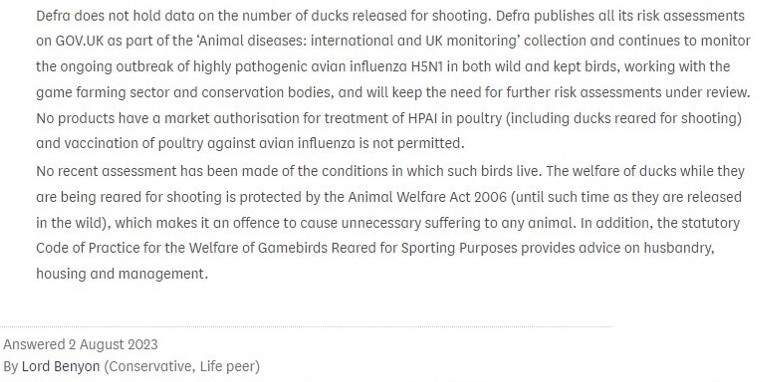
It was answered by DEFRA Minister (and gamebird shooter) Richard Benyon as follows:
What a surprise (not) to learn that DEFRA doesn’t have a clue how many ducks are reared and released for shooting, nor the conditions in which they live before being shot to pieces.
It doesn’t look like he has any plans to recommend a review, either.
Marvellous. There’s nothing quite like having a Minister with vested interests, is there?
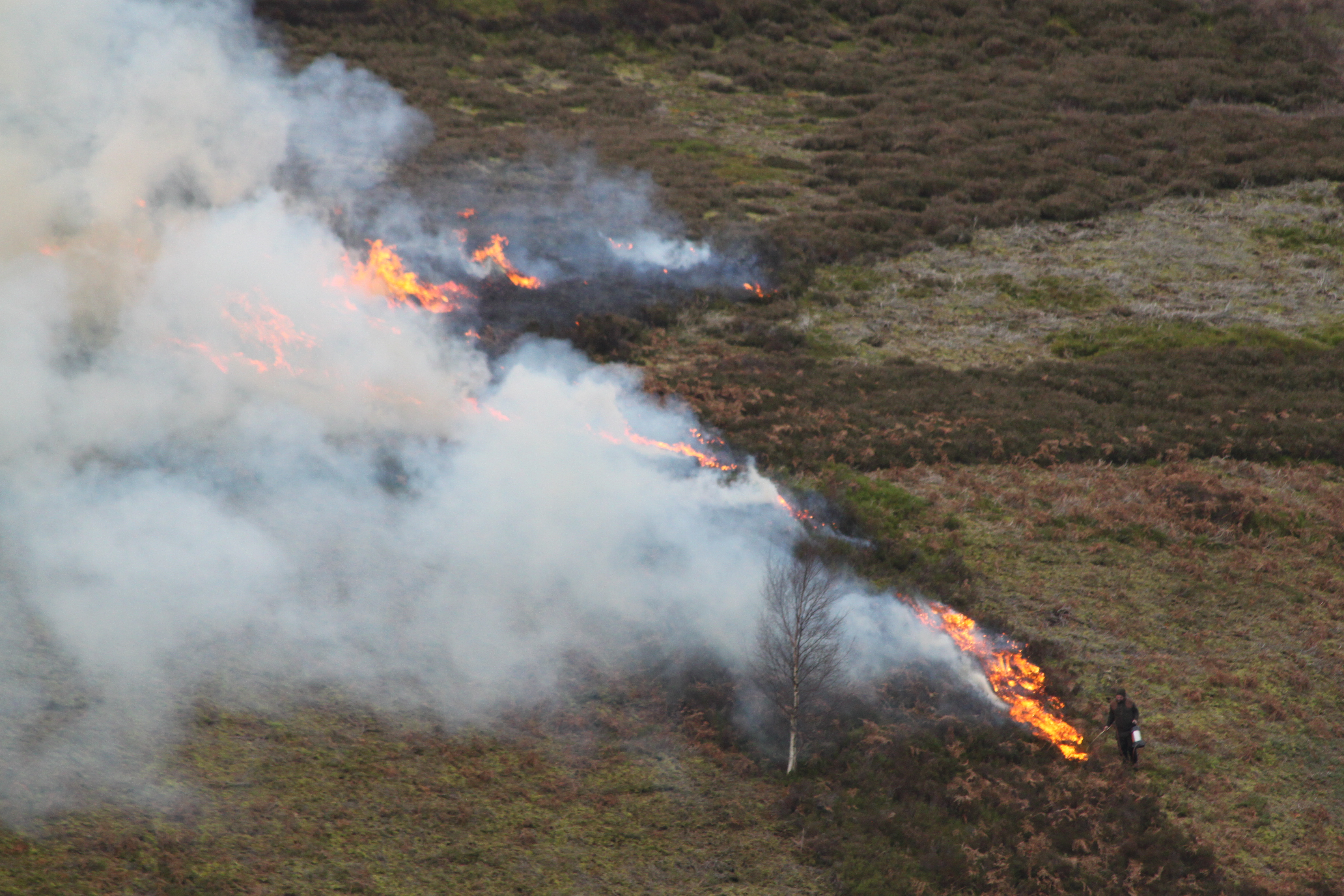
A couple of weeks ago I received an invitation to attend the launch of a new report on ‘controlled burning’ in the uplands, by a group I’d never heard of – the Future Landscapes Forum. By ‘controlled burning’ I assumed they meant muirburn, the deliberate setting fire to heather moorland to boost the number of red grouse available for shooting.
Gamekeepers setting fire to a grouse moor to increase red grouse stocks for shooting. Photo: Ruth Tingay
I didn’t attend the launch (and I’ll explain why below) but I was curious about this newly-formed group – who are they, what are they doing, who funds them, and what links, if any, do they have to driven grouse shooting?
The name of the new group, the Future Landscapes Forum (FLF), is pretty benign and pretty vague; it doesn’t provide much of a clue about who might be involved. So I googled it and found the FLF website, which helpfully names the five individuals involved, all of whom have played a role, of varying degrees, in defending various elements of grouse moor management but particularly muirburn:
Professor Andreas Heinemeyer (Associate Professor, York University)
Dr Mark Ashby (Ecology & Conservation Teaching Fellow, Keele University)
Professor James Crabbe (Professor of Biochemistry, University of Bedfordshire; Supernumerary Fellow of Wolfson College, Oxford University; Visiting Professor at the University of Reading and at Beijing Normal University at Zhuhai in China)
Professor Simon Denny (formerly Director of Enterprise, Development and Social Impact, University of Northampton [retired])
Professor Rob Marrs (Emeritus Professor of Applied Plant Biology, University of Liverpool & Past President of the Heather Trust)
The FLF website states that ‘many‘ of the five have ‘conducted key research and published a considerable body of recent peer-reviewed science and assessments pertaining to this important habitat‘ [heather dominated landscapes]. Some of them have, for sure, and some of that has been funded by the grouse shooting industry.
The FLF website goes on to include a section called, ‘Why are we speaking out?‘ which states the following:
“As a group of leading scientists and practitioners in upland management and socio-ecological impacts, we have growing concerns that the public and policy debate about managing heather moorland is neither properly informed nor evidence-based.
Indeed, there seems to be a concerted effort to derail an evidence-based approach and sound future policy by certain influential organisations and individuals who ignore or distort evidence, often present unevidenced arguments, or deploy arguments based on selective elements of scientific papers and reports that support their position.
Such arguments are often reductive, lack context and are presented wrongly as the scientific consensus.
We believe that debate and, increasingly, decisions about upland management have become polarised and overly focused on a single issue: driven grouse shooting. Our view is that this focus is wrong and dangerous.
Our concerns are not related to habitat management for grouse; indeed, we would be making this position statement if grouse, and grouse shooting, did not exist“.
It’s interesting that the FLF criticises some of the debate about upland management because it ‘lacks context‘ as some of the FLF team’s own work has received similar criticism (e.g. see here, here, here, here, here, here) but has often been used by the grouse shooting lobbyists as showing ‘scientific consensus‘. The scientists can’t be held responsible for how the grouse shooting lobby interprets their scientific research, but it seems unlikely that they’d be unaware of how it was being presented.
Even Natural England describes a recent piece of work by Heinemeyer comparing heather burning with mowing or uncut management approaches (published in early 2023) as being “widely reported as justifying the ongoing use of burning management” but that it is “best seen as an outlier in the range of scientific studies relevant to management of blanket bog“. (I’ll write a separate blog about that because it’s too much to include here).
It’s also worth noting that two of the FLF team (Prof Heinemeyer and Prof Marrs) have both featured in videos pushed out by the various Regional Moorland Groups as part of their propaganda campaigns to promote grouse moor management. They’re entitled to contribute to such output, of course, but visitors to the FLF website may not be aware of this, given FLF’s efforts to distance itself from driven grouse shooting interests.
It’s also worth noting that two other members of the FLF team (grouse-shooter Prof Denny & Prof Crabbe) only recently published a report (a hopelessly biased one, in my view) on so-called sustainable driven grouse shooting, a report described as ‘truly objective’ and timed to make the headlines during the Inglorious 12th. The report was commissioned (and presumably funded?) by the Regional Moorland Groups. Say no more.
Incidentally, that Denny & Crabbe report was reportedly ‘peer reviewed by three academics from UK universities‘ but strangely, they weren’t named. It wasn’t Heinemeyer, Ashby & Marrs, by any chance?
I think it’s disingenuous of the FLF to distance itself from the driven grouse shooting debate, for all the reasons I’ve provided above but also because upland management for driven grouse shooting (specifically, muirburn) lies at the very heart of the climate emergency and the UK’s response to it. We’re not talking about the odd little fire here and there – we’re talking about the widespread, deliberate burning of heather on the UK’s carbon-storing peatlands across vast areas of the British uplands -let’s not pretend that there’s nothing to see here.
The focus is very much on driven grouse shooting and for very good reason. Indeed, it’s why the Scottish Government is about to licence muirburn as part of its Wildlife Management & Muirburn (Scotland) Bill, designed to regulate grouse moor management after years of inertia. I see the FLF’s position statement on controlled burning has featured in The Scotsman today, no doubt timed to coincide with the Scottish Parliament’s ongoing scrutiny of the Bill.
I couldn’t find any information on the FLF website about who is funding this group. The five members may be funding it themselves of course, but I do wonder about the Moorland Communities Tradition Ltd, who incidentally appear to have a new Director, one Andrew Gilruth, formerly of GWCT (and ironically, given FLF’s statement, well known for cherry picking and distorting evidence) and now working as the Chair of the Regional Moorland Groups.
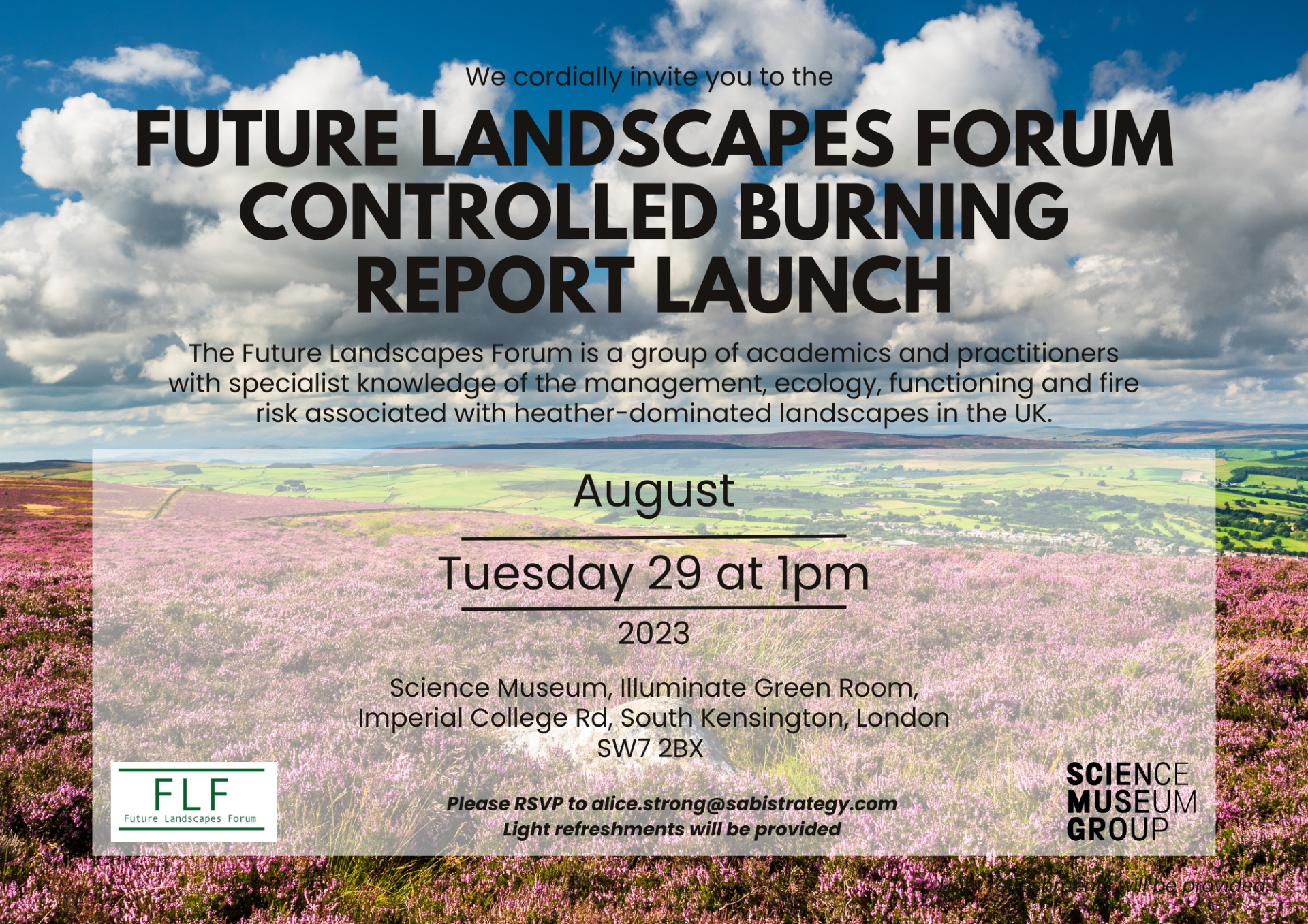
I said at the beginning of this piece that I decided not to accept the invitation from FLF to their launch event last week. And here’s why. Take a look at the invitation they sent out and pay attention to the RSVP address:
Sabi Strategy. Hmm. Where have we heard that name before? Ah yes, the slick London PR agency that’s been linked to promoting the foul and aggressive output of the pro-grouse shooting astroturfing group, C4PMC (here).
Is it a coincidence that this PR agency is also working for FLF? Perhaps, but of all the PR agencies available that FLF could have hired, it strikes me as being an unlikely coincidence.
In writing this piece I’m not advocating that the upland research undertaken by the FLF team be simply dismissed – some (but not all) members of this group are indeed experts in this field and their findings are of interest to the ongoing debate on upland management – but let’s not pretend that there aren’t also links to the driven grouse shooting industry.
42 badgers have been found killed (baited, mauled, snared, shot, trapped, dug) on or next to grouse shooting estates between 2018-2022, according to the charity Scottish Badgers.
This figure, considered to be an under-estimate relying on accidental discoveries, was revealed in correspondence to the Rural Affairs & Islands Committee, written by the charity to correct information that had previously been given to the Committee by a representative of BASC (British Association for Shooting & Conservation) during an evidence session on the Wildlife Management & Muirburn (Scotland) Bill in June 2023.
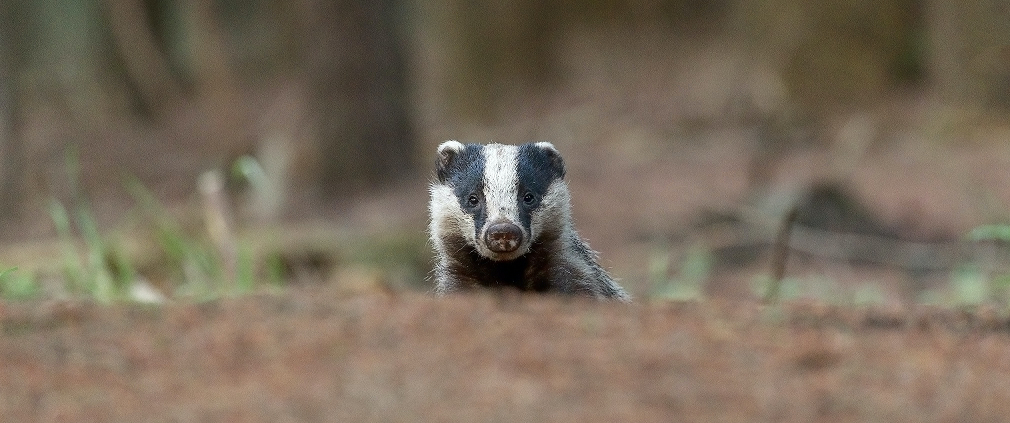
Badger. Photo: Chris Packham
During the third evidence session on 21st June 2023, Rural Affairs Committee member Rachael Hamilton MSP asked the witnesses whether there was evidence linking grouse moor ‘operators’ with the illegal persecution of badgers.
Dr Marnie Lovejoy, Head of Environmental Law Research at BASC told the Committee, “Badgers do not tend to live on grouse moors…They are simply not there“.
The Scottish Badgers charity wasn’t represented at the oral evidence session so it has now written to the Committee to provide expert evidence on this issue.
In its letter addressing the claim made by BASC, Scottish Badgers wrote:
“On the contrary, there is documented evidence that relentless criminal persecution of badgers on grouse moors takes place linked to estate employees and is carried out by the same persons who kill raptors“.
The letter goes on to provide examples, including the recent cases of the sadist gamekeeper employed by Millden Estate in the Angus Glens (currently sanctioned after evidence of raptor persecution) who was jailed for his role in a badger-baiting gang (here), and the gamekeeper employed by Longformacus Estate in the Scottish Borders who was convicted for multiple wildlife crime offences, including the illegal killing of badgers and raptors (here).
You can read the letter from Scottish Badgers to the Rural Affairs & Islands Committee here:
TEENAGER PLEADS GUILTY TO CAUSING NESTON MARSHLAND FIRE
A 15-year-old boy has pleaded guilty to deliberately causing a large fire on marshland in Neston.
The teenager, who can’t be named for legal reasons, appeared at Chester Magistrates on 25 August for trial. He pleaded guilty on the first day to arson and damage of a site of special scientific interest. He was handed a nine-month referral order and ordered to pay £200 court fees and £22 victim surcharge.
Two other 15-year-old boys, who also can’t be named for legal reasons, pleaded guilty to arson and damage at an earlier hearing. They were also handed a nine-month referral order and ordered to pay £120 court costs and £22 victim surcharge.
The fire occurred, at around 6.15pm on Saturday 19 March 2022 in Parkgate Marshlands. Four young suspects were seen fleeing the scene not long after the fire started.
The three boys admitted they were at the scene but not who set the fire.
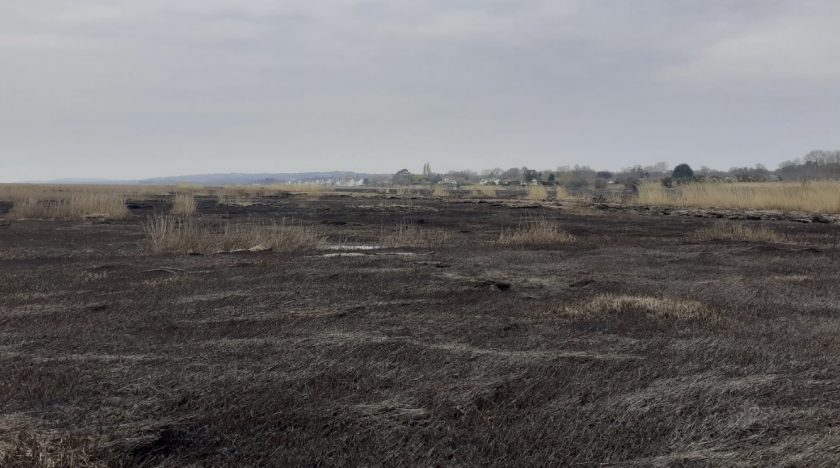
The fire damaged an extensive area of tall well-established reedbed vegetation. The most significant impact of the fire is likely to be the loss of breeding habitat for specialist bird species as well as wintering roost sites. The implication of the damage to the site and the wildlife was significant.
Fire damage at Parkgate. Photo: RSPB
DC Adam Spencer said:
“What these boys did devastated the breeding grounds for protected species under the 1981 Wildlife and Countryside Act.
While all of them admitted to being present at the site, none of them would admit who started fire, leaving us with no option but to prosecute all three teenagers, meaning that they will all now be tarred with criminal records which will have lifelong implications.
The impact of their actions that day cannot be underestimated; the fire caused significant damage to the marshes which is likely to have a significant impact on local wildlife for years to come.
The message here is think before you act“.
Ginny Hinton, Deputy Director, Natural England Cheshire to Lancashire Team, said:
“Natural England assisted in investigating this crime and in assessing the damage to this important nature site. Our survey showed the fire had devastated a large area of reedbed and saltmarsh, destroying habitat for endangered birds like the Hen Harrier and Bittern. It will take a long time for the site to recover.
This incident highlights the need to follow the Countryside Code and respect, protect and enjoy the great outdoors. This also provides a reminder of the far reaching impact of fire on our well-loved natural spaces“.
ENDS
The vast saltmarsh at Parkgate on the Dee Estuary is a familiar site to many birders, particularly in the winter when this important site attracts Hen harriers, Peregrines, Short-eared owls, Barn owls, Merlin, Kestrels, wildfowl and wading birds, but it’s also an important breeding site for Marsh harriers, Bearded tits, Cetti’s warbler and others.
The RSPB conducted an assessment of the fire damage in 2022 and said that about ten hectares of the marsh was burnt during the arson attack, including all the reedbed vegetation and some areas of saltmarsh vegetation.
I’d argue that a nine-month referral order and pitiful court costs is unlikely to deter other would-be arsonists and doesn’t, in my view, reflect the seriousness of the damage they deliberately caused.
A buzzard was found with shotgun injuries in a field off Birch Grove Road near Chelwood Gate in East Sussex on 23rd July 2023, according to an article on the SussexWorld website.
It was collected by the East Sussex Wildlife Rescue and Ambulance Service (WRAS) and an x-ray revealed two shotgun pellets, one causing a wing fracture and the other one lodged in the buzzard’s leg.
Buzzard x-ray. Image via East Sussex Wildlife Rescue & Ambulance Service
Vets were able to remove both pellets and after a month of expert care and rehabilitation, the buzzard has been released back into the wild.
It’s not clear to me whether the shooting of this buzzard was reported to the police. There’s an odd quote in the article from the founder and operations director of East Sussex WRAS, Trevor Weeks, who apparently said this:
“Shooting and injuring any wild animal or bird is generally an offence unless they are dispatched swiftly after injury. We regularly see wildlife coming into our centre after being shot and not killed out right – swans, badgers, foxes, gulls and many more”.
Whilst Trevor’s work, and that of his colleagues at East Sussex WRAS, is fantastic and greatly appreciated, his knowledge about wildlife crime appears to be sorely lacking. That he seems to be unaware that it’s an offence to shoot a buzzard (and any other protected species), whether it dies swiftly or not after being hit, is just staggering. I’m hoping he’s just been misquoted.
If he hasn’t, then hopefully the RSPB’s investigations team will be able to offer some training (similar to this) to help this valuable rescue team to recognise the signs of a wildlife crime and submit appropriate reports to the police.
I’ve been passed some very worrying correspondence, sent to Moorland Association members in early August by Moorland Association Director Amanda Anderson, which signals that there may be more trouble brewing for hen harriers beyond the trouble already caused to them by brood meddling.
Male hen harrier. Photo: Pete Morris (RSPB Images)
It appears that the Moorland Association, the grouse moor owners’ lobby group, isn’t content with just brood meddling (removing entire broods of hen harrier chicks from grouse moors, keeping them in captivity hundreds of miles away and then releasing them again several weeks later back in the uplands, supposedly to reduce the number of red grouse that the parent hen harriers might take to feed their young because the grouse moor owners want to be able to shoot the grouse for fun/profit instead).
The Moorland Association is now turning its attention to the alleged ‘disturbance’ caused to driven grouse shoots by hen harriers (and other raptors) flying around during a grouse shoot ‘drive’ which causes the grouse to scatter instead of being forced (‘driven’) by the beating line towards the waiting guns in the grouse butts.
Here’s what Amanda Anderson sent to Moorland Association members just before the opening of the grouse-shooting season this year:
Listening to feedback from the moors last year, early packing up as well as difficulties controlling the grouse were noted. We are therefore encouraging reporting of disturbance in the line from Hen Harriers (and other birds of prey) to inform the Hen Harrier Recovery Plan. A simple to use form will be circulated next week and GWCT will do the analysis. It is our intention to capture the extent of this disturbance and subsequent economic loss. Please look out for this form and do fill it in for each drive on every day that you are affected. The Hen Harrier brood management scheme is to help find a mechanism for co-existence with hen harriers. If the conflict has shifted from predation of grouse chicks to harvesting grouse, we need to measure it and present the evidence.
It’s not clear from this what sort of ‘remedy’ the Moorland Association might be looking for when they’ve ‘presented the evidence’ to DEFRA and/or Natural England (‘evidence’ collected by the grouse shooters and analysed by the GWCT – hmm, that’ll be convincing then!). Amanda’s message mentions “subsequent economic loss” so it may be that they’re gearing up to ask for financial compensation for the perceived economic loss from their over-stocked grouse moors.
Or maybe they’re conspiring to ask for licences to remove those troublesome hen harriers (and other raptors). It wouldn’t surprise me – that is after all what’s going on with the hen harrier brood meddling trial, and there was previously discussion from the Moorland Association about lethal control in relation to Marsh harriers on grouse moors, although Amanda denied the discussion ever took place (see here) but meeting notes later revealed that some others in the room did recall the discussion taking place (see here).
Whatever it is they’re planning, they can expect a strong response from those of us who think, apart from anything else, that if a business can’t operate without damaging protected species then it’s not a viable/sustainable business, and in the case of driven grouse shooting the business certainly shouldn’t be receiving tax payers’ money as compensation whilst the illegal killing continues – that’d be like robbing the public with both hands instead of just one.
The irony of this latest revelation is of course linked to the hen harrier brood meddling sham. Brood meddling results in a (temporary) increase of hen harriers, which surprise, surprise, the grouse moor owners don’t want because they disrupt their grouse shooting drives (now admitted by Amanda).
This is presumably why, since brood meddling began in 2018, at least 101 hen harriers have been killed/gone missing, mostly on driven grouse moors (see here).
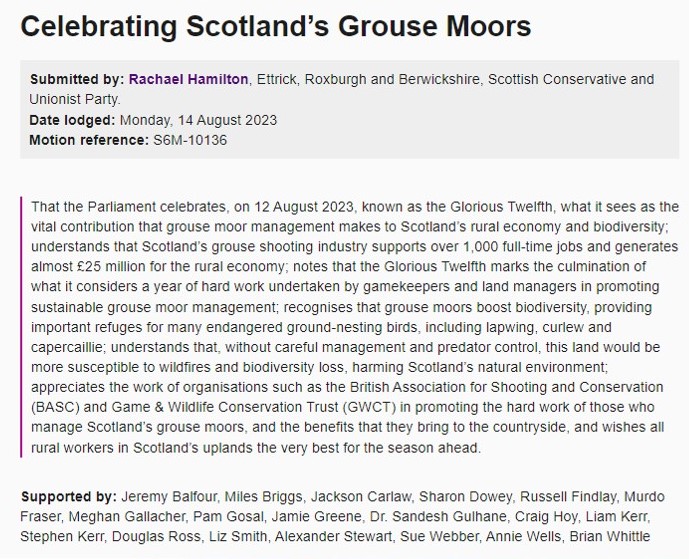
In the same week that the Scottish Greens branded the so-called Glorious 12th (the opening of the grouse-shooting season) as a ‘Festival of Violence’ (here), a Conservative MSP launched a Parliamentary motion to ‘celebrate the glorious 12th’.
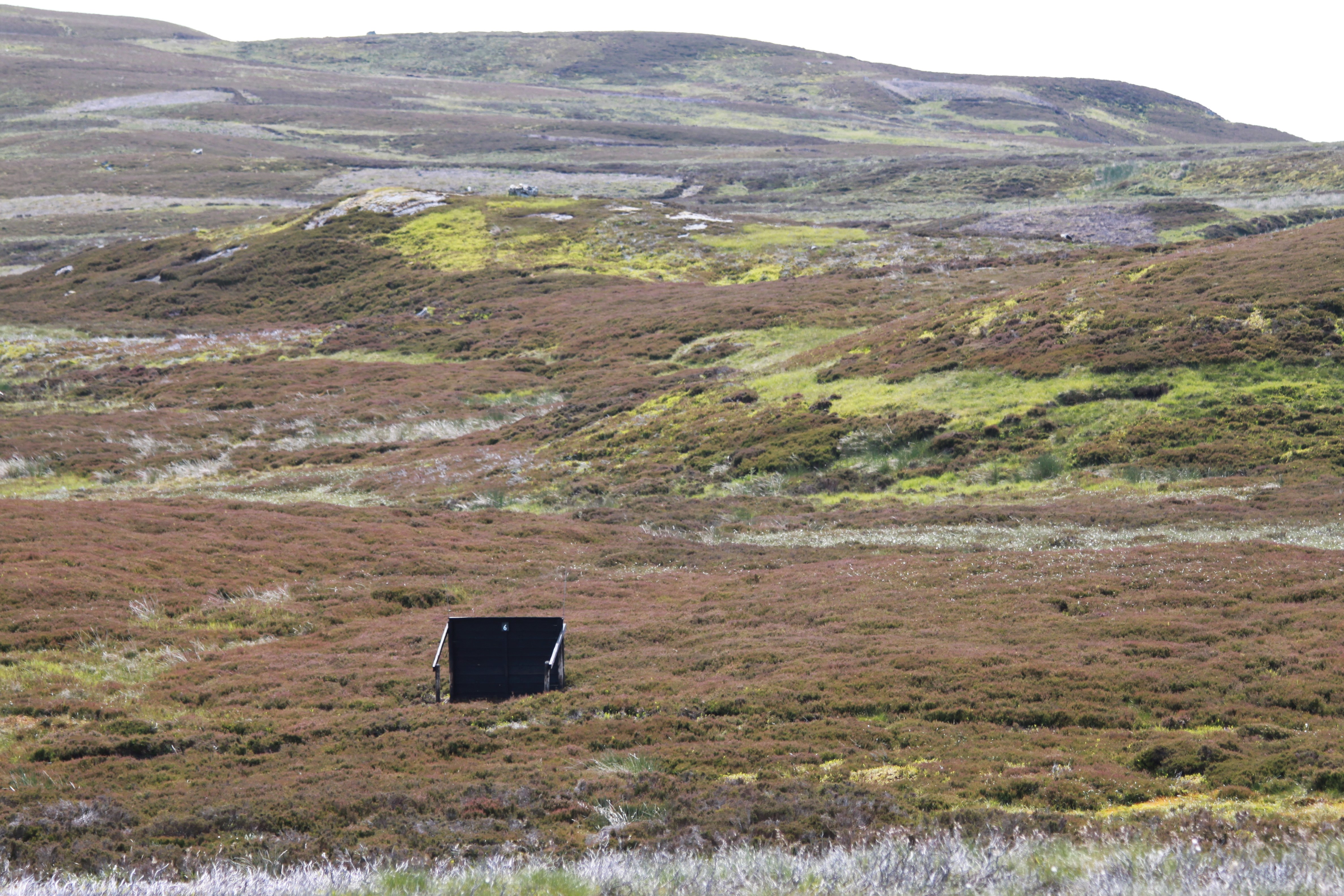
Grouse-shooting butt in Perthshire. Photo: Ruth Tingay
A Parliamentary motion is a simple way that MSPs can make statements to raise issues, recognise individuals, businesses etc and suggest topics for debate. MSPs from all parties can register their support for the motion.
This particular motion was raised by Scottish Conservative MSP Rachael Hamilton:
The motion has received the support of 19 MSPs, all of them Conservatives, which is quite telling.
This is the third year in a row that a Conservative MSP has raised a motion asking the Parliament to ‘celebrate’ the grouse shooting industry, and it’s also the third year in a row that only Conservative MSPs have lent it their support (Rachael Hamilton’s motion in 2022 received the support of 21 fellow Conservatives and Jamie Halcrow Johnston’s motion in 2021 received the support of just 4 fellow Conservatives).
It’s hardly a surprise, and nor is it a surprise that Rachael Hamilton has led the call again this year. Her support of grouse moor management has been plain to see during the evidence sessions heard by the Rural Affairs & Islands Committee that’s currently scrutinising the Wildlife Management & Muirburn (Scotland) Bill at Stage 1 of its passage through Parliament (e.g. see here and here), and she’s a well known supporter (and apparent beneficiary of) blood sports (e.g. see here).
The Rural Affairs Committee will be considering a draft report of its scrutiny of the general principles (not the finer details) of the Bill when Parliament reconvenes in September (unfortunately this will apparently be undertaken in private, not public, meetings). The Committee’s report will then be used as the basis for a Stage 1 debate of the general principles of the Bill by the entire Parliament and this will be held in public. This is expected to happen in early October, before the Bill moves on to Stage 2, which is where it gets interesting as any member of the Scottish Parliament can then lodge proposed amendments to the Bill.
WHITE-TAILED EAGLE CHICKS SPREAD THEIR WINGS FURTHER INTO IRISH SKIES
24 white-tailed eagle chicks were released in August around the country, as part of an ongoing National Parks and Wildlife Service (NPWS) programme to reintroduce this once extinct species
A total of 171 white-tailed eagles have now been released through the programme to date
A small, established population of eagles is now fledging chicks around the country and has even produced triplets
Over the past week, twenty-four white-tailed eagle chicks have been released in locations around Lough Derg, the Shannon Estuary and the west of Ireland, as part of a long term reintroduction programme managed by the NPWS.
White-tailed eagles are predators who play an important role in nature and the ecosystem.
Once native to Ireland, they became extinct in the nineteenth century. Since 2007, the NPWS has been working with partners in Norway along with farmers and communities around the country to reintroduce the white-tailed eagle to Ireland.
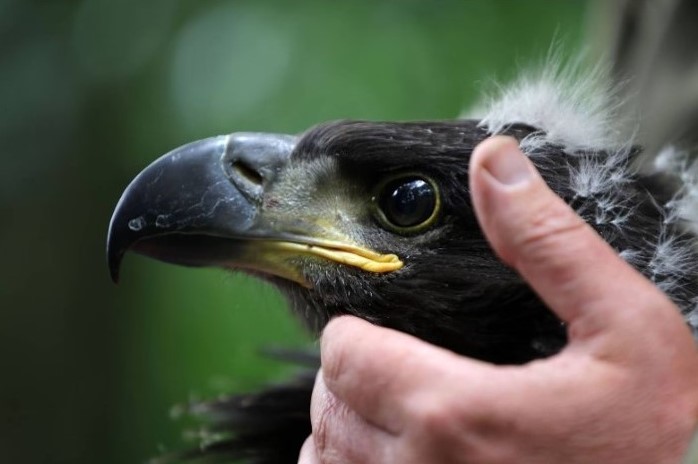
Young White-tailed eagle. Photo: Valerie O’Sullivan
Minister of State for Heritage and Electoral Reform, Malcolm Noonan TD, who released four chicks at Killarney National Park as part of the release programme, said:
“The juvenile white-tailed eagles we have released this week are joining a growing population across our island. This incredible endeavour is the result of 16 years’ work and collaboration, not just on the reintroduction programme, but also on habitat restoration and engagement with landowners to secure their ongoing protection.
These apex predators perform a vital role in our ecosystems and the sight of them soaring in the thermals is a privilege that everyone who lives in or visits Ireland will now have the opportunity to enjoy. I would like to pay tribute to NPWS staff for their commitment and dedication to this initiative, our international partners from Norway, and the communities around the country who are embracing the return of the white-tailed eagle to our landscapes.”
A comprehensive satellite tagging system is now in place so that the birds can be monitored as they disperse around the country.
Minister for Housing, Local Government and Heritage, Darragh O’Brien who also participated in the release of chicks at in the vicinity of Lough Derg added:
“This reintroduction programme is the result of a combined effort by my Department’s National Parks and Wildlife Service, participating landowners and communities and endangered species experts. I commend each of them for the role they are playing in protecting these iconic birds of prey“.
Niall Ó Donnchú, Director General with the NPWS said:
“This programme is one of several initiatives underway in the NPWS to protect endangered species in Ireland and prevent their decline. This work takes time, and calls for a partnership approach if it is to be sustainable in the long term. Collaboration with the science community and international partners, along with the involvement of our expert staff and communities around the country has been key to the success we have seen so far“.
Eamonn Meskell, Divisional Manager NPWS, Killarney National Park who heads up the white-tailed eagle reintroduction Programme added:
“There is huge interest from the public in the white-tailed eagle programme. Locations where they are spotted attract many visitors and local interest and we love to hear about sightings of the birds around Ireland and further afield. There are great stories to tell about the project. For example, the first Irish bred female to breed in over a hundred years has fledged seven chicks in three years! In Lough Derg this year for the second time a nesting pair fledged triplets. This is incredibly unusual – even in the wilds of Norway, and it shows how well suited Ireland really is for the white-tailed eagle from both a habitat and a feeding perspective. We’ll be watching this year’s chicks with interest as they mature and hopefully go on to fledge more chicks“.
Bente Lyngstad, chargé d’affaires at the Norwegian Embassy in Ireland said:
“Watching the release of the white-tailed sea eagles is a truly extraordinary and mighty experience. Over the years more than 150 eagle chicks have been collected in Norway and released in Ireland. Today’s stock in Ireland is the result of a long-term collaboration between Norway and Ireland, which again stems from our deep friendship and our shared values. I would like to acknowledge all volunteers whose efforts have been imperative to make this happen“.
The retention of species is essential for maintaining the intricate web of life and the functioning of ecosystems. It contributes to the sustainable use of natural resources and the well-being of both present and future generations. Yet we now see a rapid loss of species world-wide. This development must be halted. The reintroduction of white-tailed sea eagles into their natural habitat is a great example of how we can work together against biodiversity loss.”
ENDS
These releases form part of phase two of the reintroduction project. Phase one involved releasing 100 White-tailed eagles into Killarney National Park in County Kerry, between 2007-2011. A scientific review of the project in 2019 suggested that the small population was still vulnerable to issues such as Avian Influenza, extreme weather events and illegal poisoning so phase two began in 2020, to reintroduce more young birds and release them in different parts of the country.
Unfortunately some of the eagles released in phase two have already been killed illegally after consuming poisoned bait (see here and here).
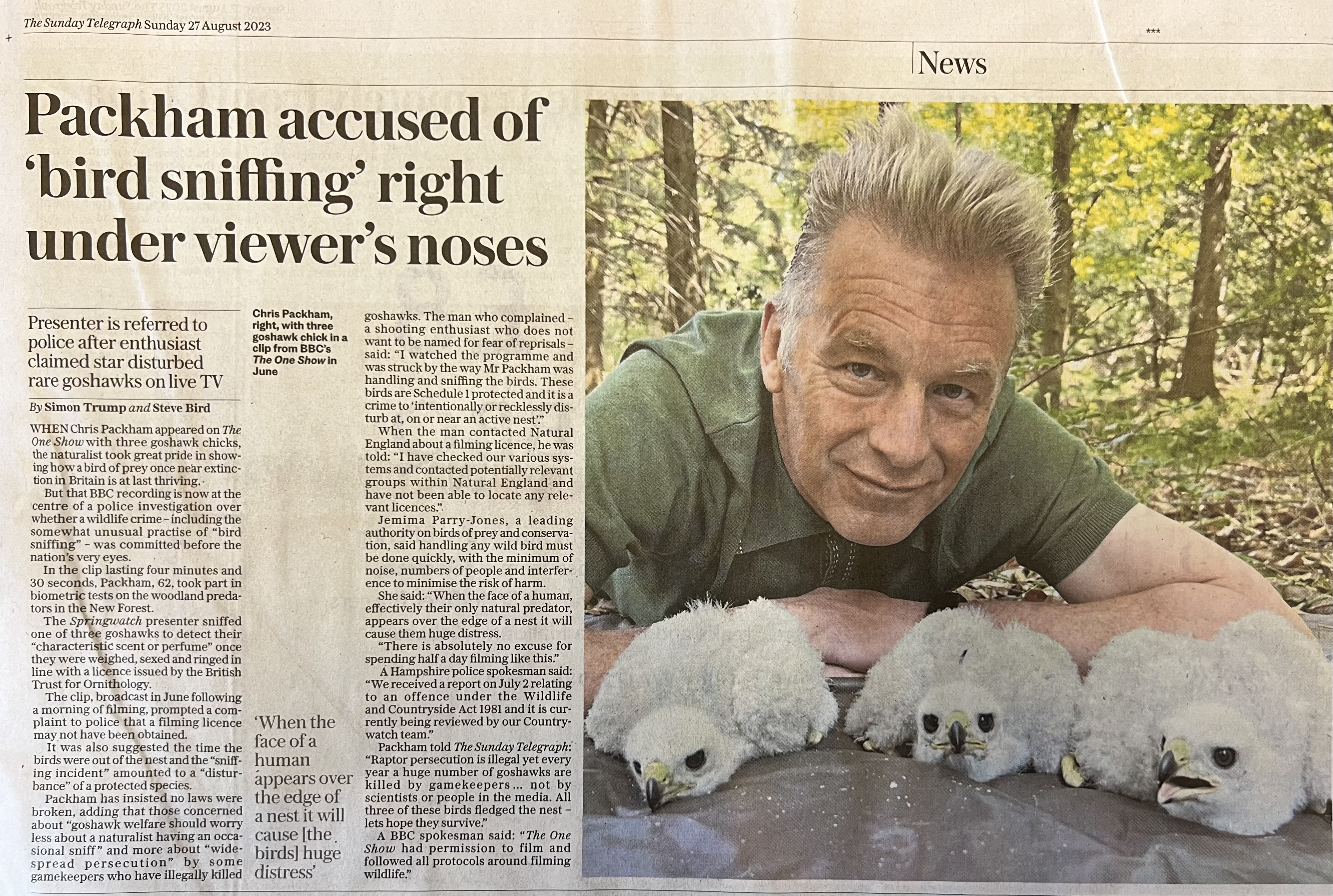
Further to the blog I wrote three days ago about a journalist digging around for a story on Chris Packham sniffing goshawks (yes, really – see here), well surprise, surprise, the Sunday Telegraph has published this pathetic piece today:
Here’s the text:
Presenter is referred to police after enthusiast claimed star disturbed rare goshawks on live TV
When Chris Packham appeared on The One Show with three goshawk chicks, the naturalist took great pride in showing how a bird of prey once near extinction in Britain is at last thriving.
But, that BBC recording is now at the centre of a police investigation over whether a wildlife crime – including the somewhat unusual practice of bird sniffing – was committed before the nation’s very eyes.
In the four minute and 30-second clip, Mr Packham, 62, took part in biometric tests on the woodland predators in the New Forest.
The Springwatch presenter sniffed one of three goshawks to detect their “characteristic scent or perfume” once they were weighed, sexed and ringed in line with a licence issued by the British Trust for Ornithology (BTO).
The clip, broadcast in June following a morning of filming, prompted a complaint to police that a filming licence may not have been obtained.
It was also suggested the time the birds were out of the nest and the “sniffing incident” amounted to a “disturbance” of a protected species.
Mr Packham has insisted no laws were broken, adding that those concerned about “goshawk welfare should worry less about a naturalist having an occasional sniff” and more about “widespread persecution” by some gamekeepers who have illegally killed goshawks.
The man who complained – a shooting enthusiast who does not want to be named for fear of reprisals – said: “I watched the programme and was struck by the way Mr Packham was handling and sniffing the birds. These birds are Schedule 1 protected and it is a crime to ‘intentionally or recklessly disturb at, on or near an active nest’.”
When the man contacted Natural England about a filming licence he was told: “I have checked our various systems and contacted potentially relevant groups within Natural England and have not been able to locate any relevant licences.”
Jemima Parry-Jones, a leading authority on birds of prey and conservation, said handling any wild bird must be done quickly, with the minimum of noise, numbers of people and interference to minimise the risk of harm.
“When the face of a human, effectively their only natural predator, appears over the edge of a nest it will cause them huge distress.
“There is absolutely no excuse for spending half a day filming like this.”
A Hampshire Police spokesman said: “We received a report on July 2 relating to an alleged offence under the Wildlife and Countryside Act 1981 and it is currently being reviewed by our Countrywatch team.”
Mr Packham told The Telegraph: “Raptor persecution is illegal yet every year a huge number of goshawks are killed by gamekeepers … not by scientists or people in the media. All three of these birds fledged the nest – lets hope they survive.”
A BBC spokesman said: “The One Show had permission to film and followed all protocols around filming wildlife.”
ENDS
It’s amusing that they used a quote from Jemima Parry Jones, instead of the response they received from a licensed goshawk ringer who they’d first approached for comment. You can imagine what he told them. It presumably didn’t fit the narrative so they went with Parry Jones – the woman who is running the hen harrier brood meddling trial in cahoots with the Moorland Association and who was quite happy to be filmed with the brood meddled hen harrier chicks for a Moorland Association propaganda video. Hypocritical? Yes, I think so.
I’d argue that there is “absolutely no excuse” for permanently removing entire broods of hen harrier chicks from their parents and holding them in captivity for several weeks and then releasing them back into the wild to be shot and killed by grouse moor gamekeepers, but that’s just my view. The irony of asking the brood-meddler-in-chief to comment on ‘disturbance’ to raptors won’t be lost on anyone.
The Sunday Telegraph article identifies the complainant as a ‘shooting enthusiast’, and that’s what’s key here. As I wrote a few days ago (here), if the shooting industry had the tiniest concern about goshawk welfare then they’d stop shooting, trapping and bludgeoning them to death.
Have they stopped? No, of course they haven’t. There’s even a forthcoming court case, in the next fortnight, of yet another gamekeeper accused of killing a goshawk.
It’s so obvious what the agenda is here – that this complaint was made by a member of the shooting industry as part of a long-running smear campaign against Chris Packham, in yet another feeble attempt to discredit him and/or have him sacked by the BBC. It’s no secret that the shooting industry despises Chris because he’s outspoken about their environmentally-damaging practices and also about their crimes, especially the continued illegal killing of birds of prey.
The shooting industry has taken a lot of hits recently and is floundering under the pressure, so its chosen course of action is to lash out. Chris Packham is an obvious target given his high profile and popularity amongst the British public, and his relentless campaigning for wildlife and the environment.
My interpretation is backed up by comments made on social media today by other ‘shooting enthusiasts’ in response to the article being published in the Sunday Telegraph:
This comment by Sarah Sullivan is particularly telling – I assume she’s referring to Chris winning his recent libel action but being left with mammoth costs as the two individuals he took action against immediately declared themselves bankrupt (although more on that in due course).
Even the main shooting organisations are brazenly encouraging their members to complain about Chris (and other high profile individuals, as well as the RSPB), as demonstrated in this excerpt from a BASC blog written by Dr Conor O’Gorman and published this week:
It’s nothing new – the shooting industry has been aggressively attacking Chris for years (e.g. see here, here). The irony of it is, is that it’s actually more damaging to their own reputation than it is to Chris’s but they’re mostly too stupid to see it. Although I did watch Patrick Galbraith, editor of Shooting Times, trying to make this point at the recent Game Fair – sadly without much success.
UPDATE 29th August 2023: ‘No case to answer’ – Hampshire Police close ridiculous ‘Chris Packham sniffed a goshawk’ investigation (here)