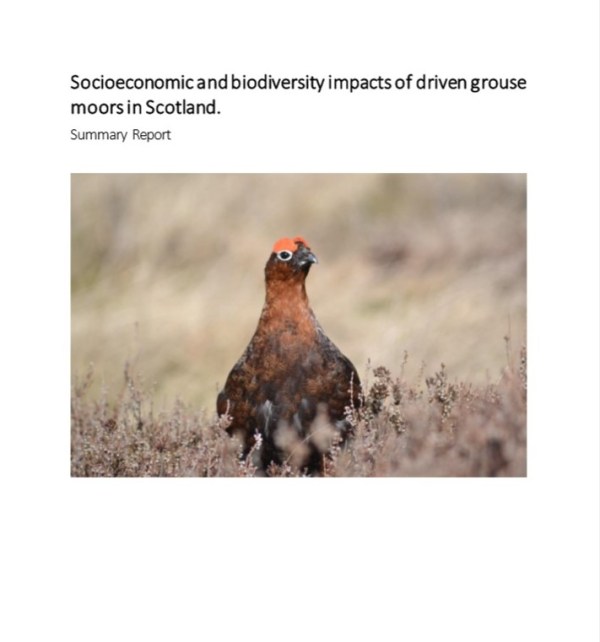
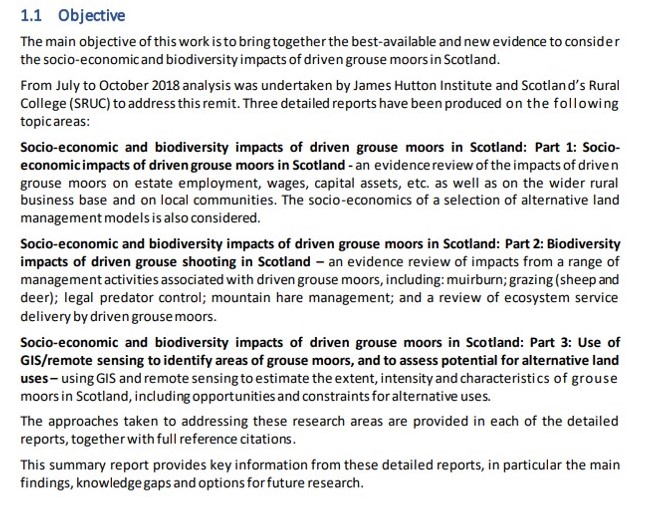
Following the publication last week of a number of reports on the socio-economic and biodiversity impacts of driven grouse shooting in Scotland (see here), a number of news articles are now appearing.
The National published the following article yesterday:
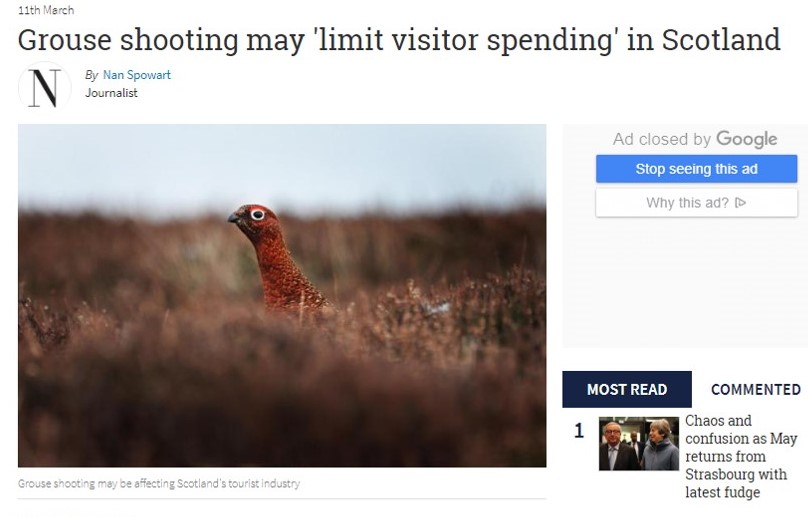
GROUSE shooting in Scotland could be negatively affecting Scotland’s tourist industry, according to a new report.
Populations of mountain hare may also be at risk as a result of the controversial culls by gaming estates, with “potential cascading effects” on predators.
The report – which was drawn up by the James Hutton Institute and Scotland’s Rural College, and commissioned by the Scottish Government– estimates that 2500 equivalent full-time jobs are supported by grouse moors, but emphasises that existing data on their benefits is inadequate.
The authors say the figures on grouse moors’ socio-economic impact “come from a very narrow base of industry-sponsored studies that have self-reporting biases and do not consider counterfactual scenarios”.
The authors go on to point out that the research base has a lack of “robust” evidence on which to base policy decisions.
However, they say the existing evidence highlights that driven grouse moor management and grouse shooting are part of a myriad of wider sporting activities.
The report explains the negative aspects of driven grouse moors – such as raptor persecution, the impact of heather burning on soils and certain birds, and perceived negative landscape – which may be affecting the areas they are based in.
The authors continue: “Negative impacts (perceived or actual) may limit visitor spending within an area from the estimated half million domestic visits, 2.7m accommodation nights and £187m spend on visits that included watching wildlife/bird watching in 2015.”
In examining the impact of muirburn and legal culls, the report identifies “major knowledge gaps” and calls for further research and data collection on both the environmental impacts and the socio-economic impacts of grouse shooting.
With regard to mountain hares the reports states: “Evidence suggests that hare populations in Scotland show limited dispersal capacity and may therefore be prone to local extinction, though hare spatial ecology is not well understood. Changes in mountain hare numbers could have potential cascading effects on predators, although the effects are not well researched.”
Responding to the report, Alex Hogg, chair of the Scottish Gamekeepers’ Association, agreed there were “clearly some knowledge gaps” but welcomed the work done so far.
“The jobs created by grouse shooting, like gamekeepers’ roles, are important because they keep people in some of the most fragile and remote parts of Scotland where opportunities can be very hard to come by,” he said.
ENDS
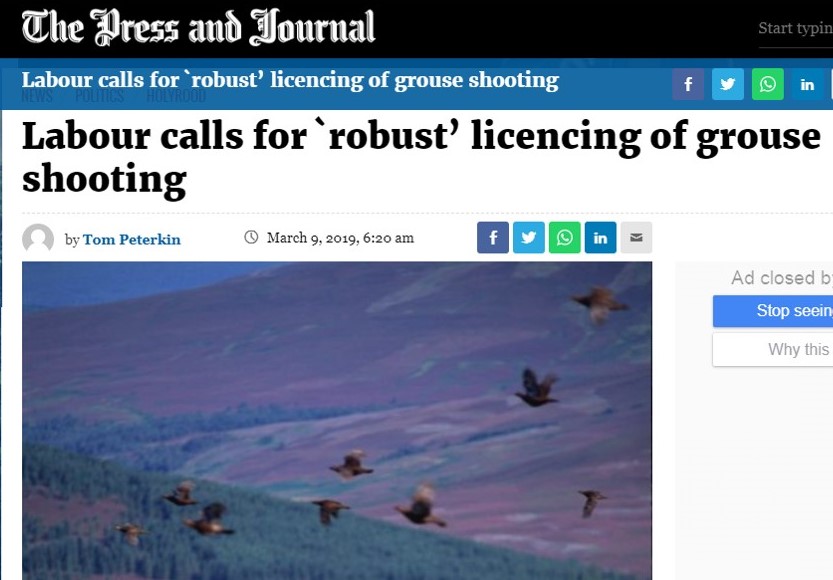
Of course, the grouse shooting industry has a different interpretation of the reports’ findings, leading to other headlines yesterday such as these:
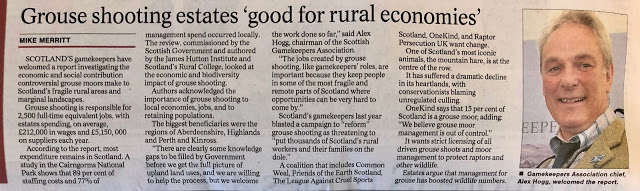

Naturally, the grouse shooting industry fails to mention that these findings are based on previously published reports, commissioned by the grouse shooting industry itself, and therefore suffering from inherent bias, as noted in the more recent reports from the James Hutton Institute and the SRUC.
This media circus will continue, no doubt, until the publication of Professor Werritty’s grouse moor management review later this year, and perhaps more importantly, when we find out how the Scottish Government plans to respond to Prof Werritty’s recommendations for grouse moor reform.