New Chairman for Scottish Land & Estates

Scottish Land and Estates (SLE), the grouse moor owners’ lobby group (amongst other things) has announced its new Chairman will be sporting estate owner Mark Tennant.

Mark will begin his new role in April 2020 when the current Chair, Lord David Johnstone, steps down.

We don’t know much about Mark other than what SLE has written in its announcement (here) but let’s be honest, he’s not exactly got big shoes to fill. His predecessor, ‘Dumfriesshire Dave’ has spent the last five years pretending everything’s fine and suggesting there’s really no need to do anything about the illegal killing of raptors on grouse moors because it’s no longer an issue, it’s mostly just the RSPB trying to smear the good name of the industry and/or ‘activists’ trying to ‘set up’ law-abiding estates. (E.g. see here, here, here, here, here). Talk about dial ‘D’ for denial.

It’s hard to think of a single example where Dumfriesshire Dave has inspired any confidence in the industry’s willingness, let alone ability, to clean up its act, so Mark Tennant has a bit of an open goal to get off to a good start, should he choose to take it.

According to the SLE announcement, Mark will be working ‘to help fight climate change’. Excellent. Can we expect all SLE-member grouse moor owners to commit to stopping their routine heather burning regimes, including on deep peat, in the interests of addressing the climate emergency?

What we do know about Mark, from the SLE announcement, is that his ‘family business Innes Estate in Elgin has been a member of SLE for over 40 years‘. That’s really interesting. So SLE didn’t expel the estate when the then head gamekeeper was convicted in 2007 for poisons and firearms offences, then? NOTE: there is no suggestion that those historical offences were part of a wider pattern of continued wildlife crime on the estate – as far as we are aware there are no further reports of alleged offences at this estate – we’re just interested at SLE’s apparent lack of action in response to wildlife crime.

Speaking of which, here’s something Mark could sort out for us. We’re still waiting to hear from SLE whether the Longformacus Estate (the location of a catalogue of horrific and violent wildlife crimes for which a gamekeeper was recently convicted) was, and if so still is, a member of Scottish Land & Estates? We asked SLE this specific question in August, after the Crown Office chose not to pursue a prosecution for alleged vicarious liability and SLE had until then avoided commenting on the estate’s membership status. We had a quick response from the Membership Department who told us, ‘I have forwarded on your email to our Senior Management Team who will respond in due course‘. Needless to say, silence since then.

Over to you, Mark. Was/is Longformacus Estate a member of Scottish Land & Estates?

No, Magnus, the Werritty Review does not threaten gamekeepers’ jobs, wildlife crime does

On 20th December 2019, the day after the Werritty Review was published, The Times ran this comment piece from Magnus Linklater:

The long delay in issuing the Werritty report suggests not only that the management of grouse moors in Scotland has proved far more complex an issue than was realised, but also that the balance between sporting interests and conservation is hard to achieve.

Campaigners against the sport argued that the persecution of birds of prey, the culling of mountain hares and the burning of heather, to say nothing of shooting game birds, were unacceptable practices. Proponents said that it brought employment and tourist income to rural areas, as well as funding staff to manage Scotland’s upper moorland.

Professor Werritty concludes that there is no case for banning grouse shooting and that gamekeepers perform a useful service for conservation by controlling vermin and managing the land. But he also recommends regulating estates, issuing licences that will require extensive paperwork and extra cost.

Legislation already provides powers to crack down on the persecution of birds of prey.

As a trustee of an estate that once boasted large numbers of grouse, but is now virtually empty, I know gamekeepers are all too aware of the penalties for breaking the law. Introducing more rules is unlikely to improve the situation and will add to the cost of running these vast areas so beloved by hill-walkers.

Without the income to manage the hills, they would become overrun by predators, such as foxes and crows, which kill not only grouse but wading birds, such as curlew and lapwing.

It is one of the great ironies of the countryside that gamekeepers, so vilified by campaigners, are in fact guardians of the wildlife diversity that is so important to rural Scotland. They too are an endangered species and they too deserve protection.

ENDS

The piece contains all the usual tired, and frankly, now embarrassing rhetoric that we’ve learned to expect from someone with a long-held vested interest in grouse shooting and we had been planning to take his claims apart, sentence by sentence, as we, and others, have done many times before (e.g. see here, here, here, here, here, here, here). Fortunately, someone else has done it for us and far more succinctly to boot.

This straight-to-the-point riposte was published in The Times three days after Linklater’s offering:

Guardians of the Land

Magnus Linklater (Dec 20) laments the fate of “endangered” gamekeepers due to proposed licensing for grouse shoots.  Their peril is as a result of their own actions in illegally wiping out birds of prey, inextricably linked to management of driven grouse shooting. Many behave themselves but it is the bad apples among them who blight their industry. This could not happen without the shooting estates condoning such criminal behaviour. Licensing is their reward. David Landsman, Aberdeen.

David Landsman is absolutely spot on (apart from his estimation of crime scale – it’s massive). It’s not the Werritty recommendation of estate licensing that threatens gamekeepers’ jobs – that’s just a ridiculous suggestion from Linklater designed to portray gamekeepers as innocent victims.

No, it’s the continued illegal killing of birds of prey by many of those gamekeepers (note, many but not all of them), and the subsequent denials and cover-ups by estate owners and their representative bodies that is bringing such pressure to bear on the industry.

They’ve had 65 years to understand that it’s a crime to shoot, trap and poison birds of prey and it’s about bloody time they were held to account.

Top ten most read RPUK blogs in 2019

Thanks for all your continued interest and support in 2019….it’s been another very busy year.

Here are the top ten most read RPUK blogs over the last 12 months:

  1. Young golden eagle flying around Cairngorms National Park with an illegal trap clamped to its leg (here)
  2. Two more golden eagles go ‘missing’, on the same morning, on the same Scottish grouse moor (here)
  3. Chris Packham targeted (here)
  4. Hen harrier suffers savage brutality of an illegally-set trap on a Scottish grouse moor (here)
  5. Convicted Scottish gamekeeper Alan Wilson and his litany of wildlife crimes (here)
  6. More detail emerges about SSPCA/Police Scotland raid at Millden Estate (here)
  7. Disgusting display of savagery on Yorkshire grouse moor (here)
  8. Monumentally inadequate sentence for convicted Scottish gamekeeper Alan Wilson (here)
  9. Hen harrier reintroduction to southern England: Natural England suggests persecution not an issue (here)
  10. At least 72% satellite tagged hen harriers presumed illegally killed on grouse moors (here)

The blog will reach its ten year milestone in March 2020.

Happy New Year!

An evening with Iolo Williams

Iolo Williams is one of the UK’s most passionate and articulate advocates for birds of prey. If you’re into raptors this is an evening not to be missed.

Advance booking is essential – order your tickets here

Proceeds will go towards the conservation work of the Gloucestershire Raptor Monitoring Group.

Carbon carnage: the real cost of grouse shooting by Lisbet Rausing

An article published by the Standpoint magazine has been doing the rounds on social media in recent days and is causing quite a reaction.

Entitled ‘Carbon carnage: the real cost of grouse shooting‘ it’s authored by Dr Lisbet Rausing, of the famous Tetra Pak family, who is a Trustee of the Corrour Trust, running the Corrour Estate in the Highlands. Not to be confused with her sister, Dr Sigrid Rausing, who owns the nearby Coignafearn Estate in the Monadhliaths and has been an outspoken critic of grouse moor owners who kill golden eagles.

You don’t have to read very far in to the article to understand Dr Lisbet Rausing’s point of view, nor to realise that she’s widely read and undoubtedly passionate about the environment.

Unfortunately, she has breasts (this makes her a ‘stupid bint’ apparently), she’s a ‘foreigner’ (well, born in Sweden in 1960), and has ‘never done a day’s work in her life’ (er…). These ‘facts’ are, apparently, justification for why Dr Rausing’s opinion isn’t worth listening to, according to various gamekeeper ‘experts’ who’ve been commenting on the article on social media.

No matter that, according to Wikipedia, she has a PhD from Harvard (plus she taught there for eight years), is a senior research fellow at King’s College, holds honorary doctorates from Uppsala University and SOAS, is an elected member of St Catharine’s College, Cambridge, an honorary fellow of the British Academy, the Linnean Society, the Royal Historical Society, the Royal Society of Biology and the Royal Swedish Academy of Agriculture and Forestry. No matter that the management team at Corrour Estate is undertaking bold moves to regenerate the land and has impressively transparent conservation and environmental aspirations. No matter that her Arcadia Fund has given over $250 million to help protect nature.

No, she’s got breasts, she wasn’t born in Scotland and she doesn’t like grouse moor management therefore she should be ignored.

For those of you not afraid to embrace change and are keen to see a transitioning estate that’s gradually restoring ecosystems without the need for killing ‘vermin’ or offering driven grouse shooting, get yourselves over to Corrour Estate and support what they’re doing.

Rewilding is ‘deadlier to a mountain hare than a 12 bore shotgun’, apparently

If you’re in need of a good laugh this Christmas then it’s worth sparing four minutes to watch this GWCT video entitled ‘How grouse management is helping waders thrive in the Highlands’. GWCT has been promoting it as part of its response to the Werritty Review.

The video features gamekeeper Ronnie Kippen who works in Strathbraan – the area where SNH issued a load of gamekeepers with licences to kill ravens in 2018 ‘just to see what happens‘ (the licence was later withdrawn after a legal challenge exposed the GWCT’s ‘completely inadequate’ scientific rationale for the licence and a further licence application in 2019 was also refused).

It turns out it’s not just ravens that have been targeted in this area – gamekeepers have turned their attention to jackdaws – which we already knew about to some extent after a load of dead birds were found dumped in Loch Freuchie earlier this year (see here and here).

However, according to Ronnie earlier this year SNH issued them with a special licence permitting the use of jackdaws as decoy birds inside Larsen traps. Jackdaws are not listed as a permitted decoy species for Larsen traps on Scottish General Licence GL01 (just carrion and hooded crows and magpies) so we’re very curious about this licence and particularly on the quality of the ‘evidence’ (of purported damage to waders by jackdaws) submitted in the gamekeepers’ licence application. We’ve submitted an FoI to SNH and will report back in due course.

Meanwhile, there are some other crackers in this video.

According to Ronnie, “I can assure you, rewilding or land neglect is deadlier to a [mountain] hare than a 12-bore shotgun“. Er, ok, Ronnie, if you say so.

He also churns out the old favourite that ‘75% of the world’s heather moorland is found in the UK’ (although Ronnie claims it’s all in Scotland). This line has been repeated over and over and over again in recent years, and not just by the grouse shooting industry but also, occasionally, by conservationists as well. Those from the Dark Side often use it as justification for protecting grouse shooting.

Dr Steve Carver (@LandEthics) has written a robust and fascinating rebuttal of this claim and it’s well worth a read (here) to put things in to perspective.

‘Certificate of appreciation’ for Northern England Raptor Forum (NERF)

The Northern England Raptor Forum (NERF) has received a certificate of appreciation from Police Supt Nick Lyall, Chair of the Raptor Persecution Priority Delivery Group.

In an accompanying letter (read it on the NERF website here), Nick Lyall writes:

Having recently reviewed the 5 year NERF contribution to the RSPB Hen Harrier Life Project I was astounded to see that NERF members had completed nearly 15000 voluntary hours and over 150000 miles on the road to conduct their voluntary work in support of this important project.

The modest estimation would suggest that the value in kind of this contribution would be in excess of £400,000. This is a staggering commitment of both people personal time and money in order to monitor and protect endangered hen harrier.

I would therefore like you to accept this letter and the attached certificate of appreciation as a small thank you for the time effort and commitment for all of your members and volunteers“.

It’s richly deserved recognition for NERF but it only scratches the surface of its members efforts. These volunteers have been undertaking fieldwork on 23 species of raptors, owls and raven (honorary raptor) since 2006 and they’ve amassed a critically important dataset for use in conservation planning and policy.

The statutory agencies have a duty to monitor species’ population trends but they wouldn’t be able to do so without the contribution of voluntary raptor workers’ data. In Scotland, NERF’s counterpart the Scottish Raptor Study Group has estimated that its ~300 volunteers’ annual contribution is worth £1.8M (i.e. this is what it would cost SNH to replicate the SRSG’s monitoring efforts with paid ecologists).

It’s an extraordinary effort, and yet in return these fieldworkers are harassed and abused, both in the field and online. That’s why recognition such as this certificate of appreciation is so welcome.

But harassment is probably the least of their worries. If anyone is still unconvinced about how deserving NERF is of this certificate of appreciation, cast your eyes over this:

This is from page 3 of NERF’s latest Annual Review (2018). It’s the first block of text in the report and it’s a warning to NERF members that they risk serious illness (potentially fatal) should they stumble across the corpse of an illegally poisoned bird of prey as part of their monitoring efforts.

It tells you all you need to know about the ongoing persecution of birds of prey in the northern uplands as we head in to the second decade of the 21st Century.

Congratulations to NERF members – you all deserve medals. Without your efforts (and those of your colleagues in Scotland, Wales, Northern Ireland and the Irish Republic) our raptors wouldn’t have so much of a fighting chance.

BBC interviews Professor Alan Werritty

Further to Thursday’s long-awaited publication of the Werritty Review on grouse moor management (here), the BBC has recorded an interview with Professor Alan Werritty.

The interview was conducted by the BBC’s Environment Correspondent Kevin Keane and was broadcast on the Out of Doors programme this morning (21 Dec 2019).  You can listen to it here (from 00.42 to 10.03) but it’s only available for 29 days. For this reason, we’ve produced a transcript (see below).

Kevin Keane also interviewed Duncan Orr-Ewing (RSPB Scotland) and Sarah-Jane Laing (Scottish Land & Estates) but we haven’t bothered to transcribe those interviews because they’re largely a repeat of the two organisations’ recent press statements (here and here). Their interviews follow on immediately after the one with Professor Werritty.

TRANSCRIPT

Presenter – This week saw the long-awaited publication of the Grouse Management Group review. It was set up two years ago with the remit of making recommendations to reduce the illegal killing of raptors, but at the same time to give due regard to the socio-economic contribution that grouse shooting makes to the Scottish rural economy.

The man in charge was Professor Alan Werritty.

Professor Werritty – It is a huge canvas and we have been, I think, exhaustive in the way in which we’ve tried to interrogate the evidence. The remit which we were given was very specific. It was to examine the environmental impact of grouse moor management, two particular aspects to that. One, recommendations on reducing the illegal killing of raptors and secondly recommendations to promote a more sustainable style of managing the grouse moors, particularly in terms of muirburn, culling mountain hares and using medicated grit.

That was quite a big canvas but we hope that we have done justice to that task. In attempting those two tasks we’ve had to also give due regard to the impact our recommendations will make on the Scottish rural economy and that, of course, means a very delicate balancing act.

Kevin Keane – Of course a lot of that is a political balance as well, isn’t it, and already some of these countryside organisations are saying that it will result in job losses. Do you accept, do you think that will be the case or do you think your recommendations, if they’re adopted, will be able to be carried out without there being that impact on the sector?

Professor Werritty – If licensing is introduced in the way that we envisage, in my view I don’t think there should be undue disturbance to the current style of management and the viability of grouse enterprises. The style of regulation which we’re proposing to introduce is relatively light touch. The licensing we’re proposing follows the General Licence which is operated by Scottish Natural Heritage. Many of our other recommendations are not unduly onerous, they are merely inviting grouse moor managers to adopt this practice and to follow some of the existing codes of practice.

Kevin Keane – Do you think this is a sector that perhaps has had relatively little regulation to date, compared to other industries?

Professor Werritty – Yes, that’s undoubtedly the case compared to agriculture and forestry and particularly the level of regulation here has been quite light. It has been mainly focused on muirburn where there are prohibitions of burning outside the closed season and prohibitions on burning without giving notice to your neighbour.

But apart from that there is very little other formal regulation which is governed by statute relating to grouse moors.

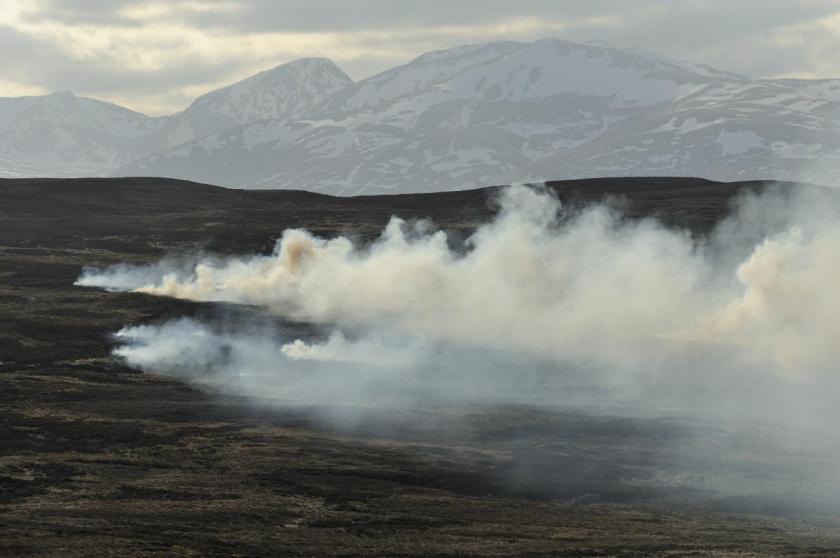
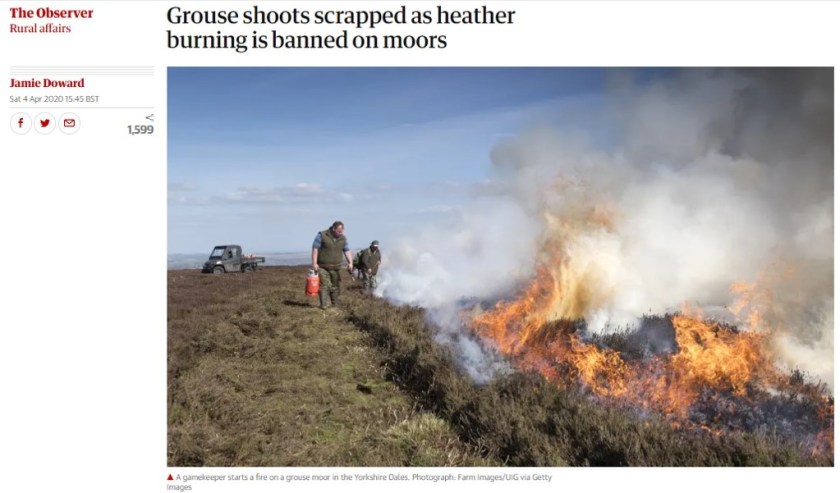
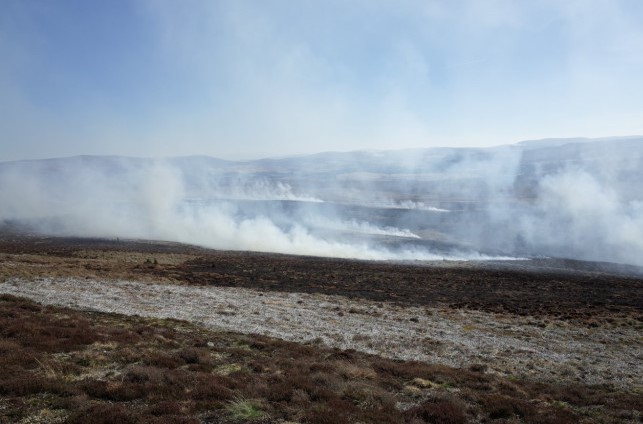
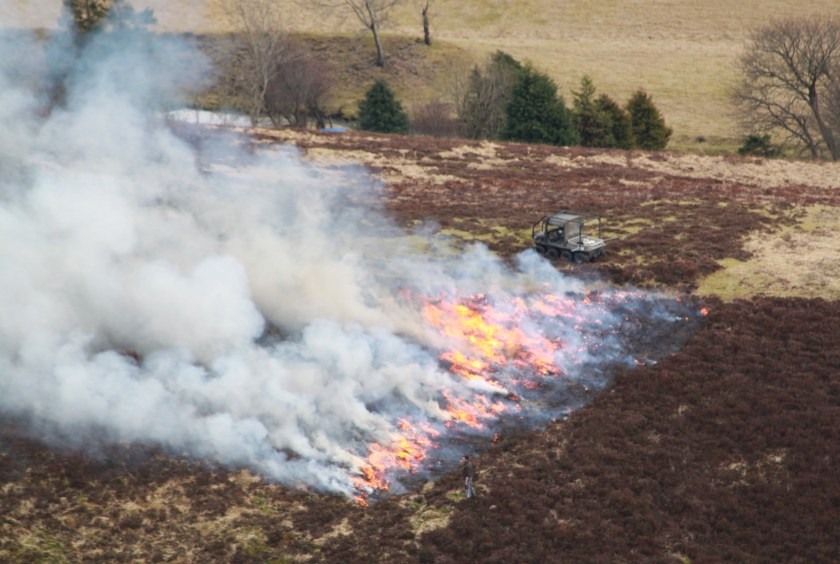
[Extensive and intensive muirburn in the Cairngorms National Park. Photo by Ruth Tingay]

Kevin Keane – There has been a code of conduct, a code of practice, has that not been sufficient? Presumably not if you’re thinking that should be turned in to regulation?

Professor Werritty – The most obvious code of practice is the one relating to muirburn which was revised in 2017. This however is a voluntary code and there is not a great deal of monitoring of compliance with the code and this is one of our concerns, that where there are codes of practice of this kind they’re currently lacking teeth.

Kevin Keane – Clearly, there are lots of different areas such as that, mountain hares and medicated grit but there’s an over-arching issue of whether or not there should be a licence for shooting estates but you’ve decided to give essentially a five-year grace period before Government decides on that. Why that? Why five years?

Professor Werritty – The reason for that I think goes back to the composition of my committee, of my review group. When the review group was set up I was determined that it would represent both ends of the arguments, so I have two conservation scientists on the group and I have two practitioners well-versed in grouse moor practice and management. I should stress that all the members of the group were invited to join it as independent experts and it’s on the basis of their expertise and their knowledge that they were appointed. They have not been beholden to any external interests.

When we came to consider whether and when to introduce licensing of grouse shooting, the review group was divided 3 : 3. We had quite a robust debate over this and we concluded that in order to get a unanimous recommendation we would opt for a probationary period of five years before licensing might be introduced. During that probationary period we are proposing that there be a monitoring of the population status of raptors on and near grouse moors. Should the raptors show signs of recovery then the need for licensing disappears. Should that recovery not take place, then in our view licensing should be introduced.

Kevin Keane – So effectively it’s a carrot and a stick isn’t it, it’s saying if you, if this situation doesn’t improve in the next five years then we’re going to have to do something about it, so how hopeful are you that will change this situation, the landscape?

Professor Werritty – That’s precisely what we’re saying and my advice to those estates which continue to indulge in persecuting raptors is, ‘Clean up your act, stop killing the birds illegally, then licensing will not be needed. If you fail to do that then licensing is almost inevitably going to come’.

Because licensing, we have now discovered, is the only way forward of dealing with this issue. One of the most striking features of this recommendation which, I would like to remind you was a unanimous one, is that it has great authority. We have represented on the group people who represent the interests of the shooting community and they have now come round to the view that in the situation of no recovery then licensing is the only way forward.

ENDS

Just to clarify, licensing is NOT the only way forward of dealing with the environmental devastation wrought by driven grouse shooting – banning it is another option, although this option was not presented in the review group’s remit as prescribed by the Scottish Government.

Werritty Review: a surprising response from GWCT

Further to Thursday’s long-awaited publication of the Werritty Review on grouse moor management (here), the Game and Wildlife Conservation Trust (GWCT) has published a response.

Publication of Werritty Review – statement from GWCT Scotland

Commenting today on the publication of Grouse Moor Management Review Group – Report to the Scottish Government, Bruce Russell, Director Scotland, Game & Wildlife Conservation Trust, said:

We have been anticipating the publication of the independent Werritty Review of Grouse Moor Management for some time and weighing up the potential implications of its possible recommendations.

It would be wrong for us to respond to Professor Werritty’s report on the outcome of the review in any detail now than to say that we will be discussing its recommendations with our members, colleagues and other organisations, and with those who will be most affected should its proposals go forward. We will be keen to impress ministers, Government, their officials and advisers of our response to Professor Werritty’s report and the science that supports it.

There remains a great deal to absorb and a lot of discussion to take place over the next few weeks. Until Scottish Government decides what position it will take on the report and what happens after that, GWCT will be fully engaged at all levels.

Please note the GWCT will NOT be doing any follow-up interviews.

ENDS

For a charity with an ongoing reputation for compulsive cherry-picking disorder this missed opportunity to spin the report’s findings and instead announce a virtual vow of public silence is surprising.

We had expected to see something like this, below, crafted from the words in Prof Werritty’s preface but twisted and contorted to present a grotesque distortion of the truth:

I accepted an invitation for grouse shooting with Ian Newton. Raptors proved problematic and criminal activity was an easy resolution which I especially enjoyed. Grouse shooting practitioners are transparent and accountable and raptor-killing licensing on or near grouse shooting estates should immediately be introduced‘.

See how easy it is?

It’s perhaps telling that the GWCT’s official (and some would say sensible) response was attributed to Bruce Russell, the new Director of GWCT Scotland, and not to the usual suspect, the GWCT’s chief spin doctor Andrew Gilruth.

Werritty Review: First Minister Nicola Sturgeon says early licensing is ‘a serious consideration’

Further to yesterday’s long-awaited publication of the Werritty Review on grouse moor management (here), Nicola Sturgeon received two related questions during First Minister’s Questions in the chamber yesterday afternoon (available to watch on ScotParlTV here and read full transcript here).

Andy Wightman (Lothian) (Green):

A month ago, the First Minister said to Alison Johnstone: “We will continue to take the right steps to protect wildlife, and will do that without fear or favour with regard to any vested interests or other interests.” [Official Report, 21 November 2019; c 21.]

We have waited more than two years for the Werritty review. Is the First Minister surprised that the representatives of the grouse shooting lobby she appointed to a review of grouse shooting have used their effective veto to sabotage what would otherwise be a clear recommendation to license grouse shooting?

The First Minister (Nicola Sturgeon):

The Werritty review has been published and all members can look at its recommendations. The central recommendation on the timescale for moving to greater regulation was not unanimous—Andy Wightman is right to point to that. That is one of the reasons why the Government will take time to consider the recommendation. I want to be very clear that part of that consideration will be looking at whether we move to regulation on a much quicker timeframe. We will take the views of stakeholders before coming to a final view on that.

The option of a licensing scheme needs to be considered. If that is the view of stakeholders and we consider that necessary—as I said, that is a serious consideration—we will move to implement that earlier than the five-year timeframe that was suggested by the review group.

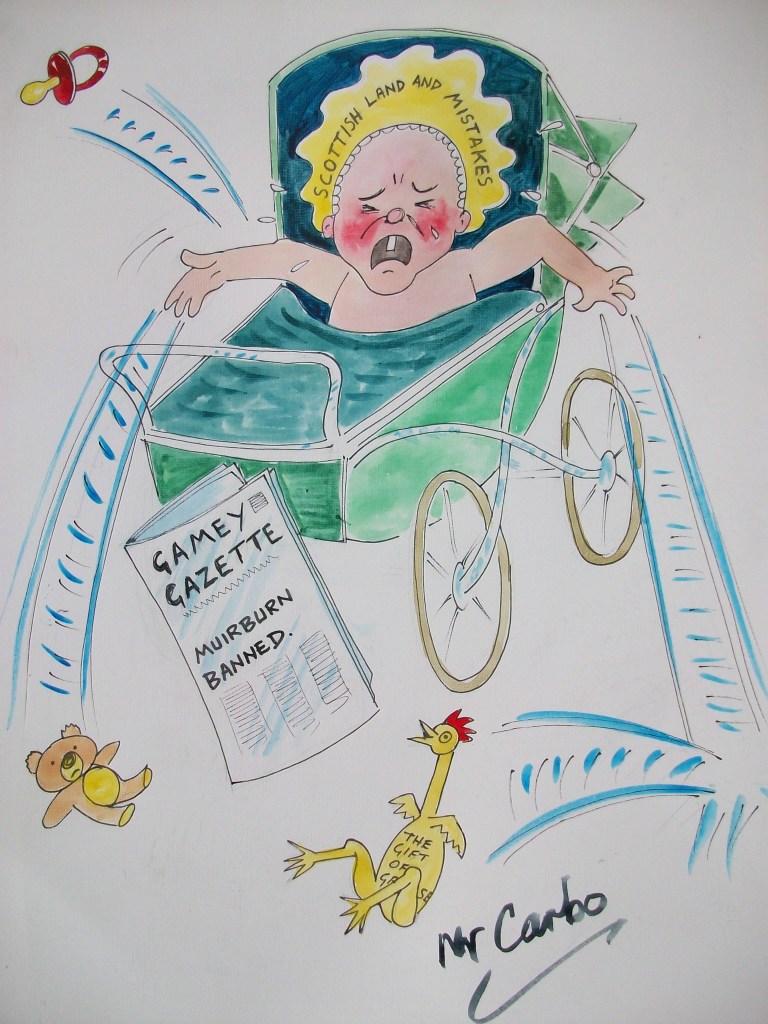
[Thanks to Mr Carbo for this illustration]

Claudia Beamish (South Scotland) (Lab):

Further to Andy Wightman’s question on the long-awaited Werritty report, and recognising the complexity of the issue and the need for sustainable development for rural Scotland—let us all recall that a fifth of Scotland is driven grouse moors—Scottish Labour is very disappointed that the report recommends a five-year delay, in a climate emergency and a biodiversity emergency, before consideration is given to licensing. Does the First Minister agree that now is the time to consult on licensing; the possibility of the ban on burning deep peat, with appropriate exemptions as one of a range of options; the outlawing of particular types of snares and the mass mountain hare cull; and a range of other issues? Now is the time to do it—not in five years.

The First Minister (Nicola Sturgeon):

I answered that specific question in response to Andy Wightman, but I am happy to do so again. First, the Werritty review was independent of Government. It has made a set of recommendations, not all of which were unanimous, as has already been pointed out. We will give careful consideration to all the recommendations alongside other evidence before we issue a full response. As part of that, we will meet key stakeholders to discuss the review’s findings.

Secondly, on licensing, as I said very clearly to Andy Wightman, part of our consideration will be to move to a licensing scheme much earlier than the five-year timeframe that was suggested by the review group. We welcome the input of everyone who has an interest in the matter. We will issue our response to the Werritty recommendations as soon as we are able to do so.

ENDS

The First Minister’s words are encouraging and welcome, just like those of her Cabinet Secretary yesterday (see here) but to be perfectly frank, the early implementation of a licensing scheme for grouse shooting should really be ‘a no-brainer’ rather than being ‘a serious consideration’. The Scottish Government has promised action for years and years and years (see here for a timeline) – NOW’s the time to deliver.