RSPB wants ‘action & delivery’ from Scottish Government on grouse moor licensing scheme

RSPB Scotland has published a blog today calling for ‘action and delivery’ from the Scottish Government on its promised grouse moor licensing scheme.

The Government announced in November 2020 that grouse shooting businesses in Scotland will need to be licensed to operate, under new proposals to tackle raptor persecution.

It also announced that muirburn will also only be permitted under licence, in order to protect wildlife and habitats, regardless of the time of year it is undertaken and whether or not it is for grouse moor management or improving grazing.

The Government stated there will also be a statutory ban on burning on peatland, except under licence for strictly limited purposes, such as approved habitat restoration projects.

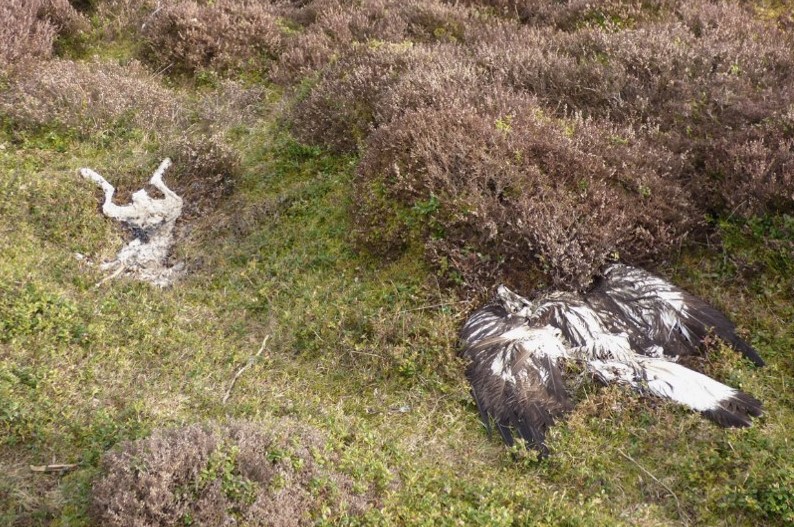
Since that announcement in November 2020, there hasn’t been any further action, but there has been plenty more evidence of illegal raptor persecution, including the poisoning of this golden eagle on a grouse moor at Invercauld Estate in the Cairngorms National Park:

RSPB Scotland writes:

We have been very patient, but nearly 20 months on from this announcement, we want to see some action and delivery on these promises by the Scottish Government. Proposals must be brought forward in the forthcoming Programme for Government in autumn 2022 for the introduction of grouse moor and muirburn licensing legislation in the next Parliamentary year“. 

You can read the full RSPB blog here.

Sparrowhawk shot and another suspected shot – Police & SSPCA investigate

Police Scotland and the Scottish SPCA have launched an investigation after the confirmed shooting of a sparrowhawk and the suspected shooting of another, found in the same area of Renfrewshire in April, one week apart.

The following article is from the Daily Record (dated 15th July 2022):

Two birds of prey ‘shot dead’ in Renfrewshire as probe launched.

Animal welfare chiefs say they suspect that two birds of prey have been shot dead in the space of a week.

The Scottish SPCA is working with Police Scotland as they look into the incidents after a firearm was confirmed as being used in one of the Sparrowhawk’s death.

One bird had to be put to sleep, while another was found dying with suspicious injuries which the SSPCA believe may be linked. A bird initially thought to have been stunned was found on Lochwinnoch Golf Course, Renfrewshire, on April 5 but its injuries were unsurvivable.

An undercover Scottish SPCA special investigations unit inspector said: “It was initially thought that the bird had been stunned but upon examination at the Scottish SPCA National Wildlife Rescue Centre in Fishcross, it was discovered that they had been shot.

This caused a catastrophic shoulder injury and sadly resulted in the bird having to be put to sleep.

Another member of the public also reported finding another sparrowhawk the week before, which was bleeding from the wing. Unfortunately, that bird died before help could be called for.

It is unknown if they had also been shot but it’s certainly very suspicious that two sparrowhawks with similar injuries were found in the same area only a week apart.

We are working closely with Police Scotland to establish the circumstances around the bird’s injuries due to the use of a firearm in the incident.

We would like to find out what happened to this sparrowhawk.

If anyone witnessed anything or has any information they feel may be relevant they can contact our confidential animal helpline on 03000 999 999 or Police Scotland on 101, quoting incident number KB01540722 of 5 April 2022.”

ENDS

Farmer receives pathetic fine for poisoning two buzzards & a raven

This article appeared in The Journal today:

Farmer fined €500 for poisoning protected bird species in Co Wicklow

By Lauren Boland

A FARMER HAS been fined for poisoning protected birds in Co Wicklow after pleading guilty to what a judge described as a “serious crime”.

Christopher Thomas Noel Doyle, also known as Noel Doyle Senior, with an address at Crehelp in Co Wicklow, came before the Carlow District Court over a breach of restrictions on the use of poisoned bait.

The judge imposed a €500 fine and €1,500 in expenses that he must pay within four months.

A conservation ranger told the court he had discovered two dead buzzards, a dead raven, and a sheep carcass on lands at Athgreaney, Co Wicklow.

[Buzzard, photographer unknown]

The court heard that the ranger first found a dead buzzard and after further investigation identified a second dead buzzard, a dead raven, and a sheep carcass placed near a fox den.

Post-mortems by the Department of Agriculture and testing by Dublin Regional Veterinary Laboratory and the State Laboratory found that the birds died due to high levels of poison (carbofuran) in their systems.

The sheep had been cut open and the wound was laced with large amounts of carbofuran.

The ranger said that the levels of poison were extremely hazardous to all forms of life and that it was very fortunate that no humans had been accidentally poisoned.

He said it was likely that other wild animals had scavenged the carcasses and died from poisoning but were never found. 

Judge Marie Keane said there was an “astonishing amount of poison” used in what she described as a “serious crime” and “a deliberate enterprise” to try to persecute the local wildlife.

In a statement, Minister of State for Heritage Malcolm Noonan called it a “particularly heinous and disturbing wildlife crime”.

Buzzards are a protected species and deliberate poisoning of them is an offence under the Birds and Natural Habitats (Restrictions on the Use of Poisoned Bait) Regulations 2010.

Carbofuran was previously used as a pesticide in agriculture but is now banned because of its toxicity to wildlife, especially to birds.

Approval for the use of carbofuran products was withdrawn throughout the EU in 2007, including in Ireland in December of that year.

After an 18-month period to use up remaining stock, it was banned fully from 2009.

ENDS

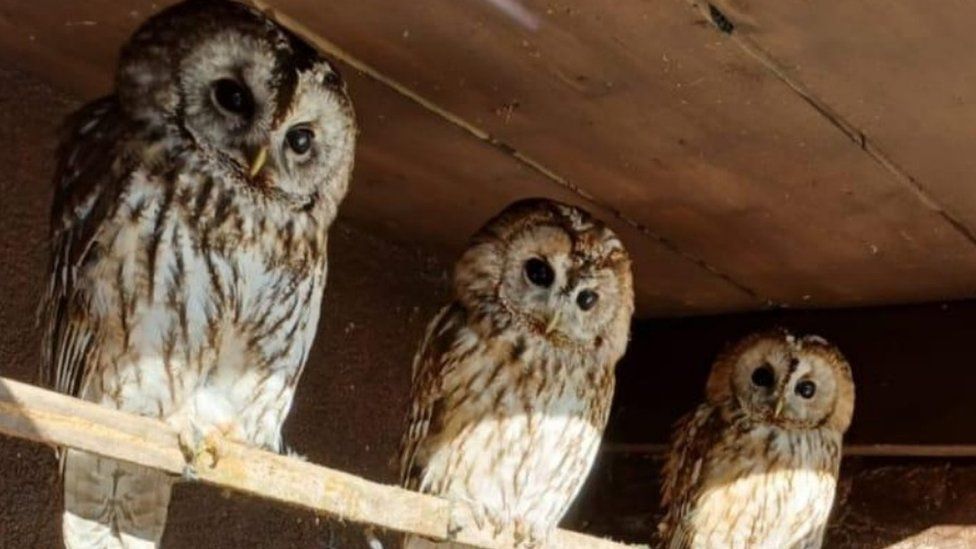
Police seize three tawny owls during raid on Cheshire home

Three tawny owls have been seized at a house in St Helens as police carried out a raid as part of an investigation into an alleged wild bird disturbance in Cheshire.

[Photo of the seized owls, by Cheshire Police Rural Crime Team]

Officers in St Helens joined Cheshire Police Rural Crime Team to execute the warrant at an address in Newton-le-Willows on 20th June 2022.

The owls were reportedly found in poor conditions with a lack of documentation and they’ve been passed in to the care of the RSPCA.

The raid was in connection with allegations of possible offences at an unnamed Site of Special Scientific Interest (SSSI) in Cheshire.

In a statement police said: “A number of partner agencies joined us, including Natural England, RSPCA (England & Wales) and the National Wildlife Crime Unit.

At present Cheshire Police are still investigating. During the warrant three tawny owls were seized due to poor conditions and no relevant records being located, along with other related evidence and a quantity of class B drugs.

Wildlife Crime is a growing issue and it is important to tackle it with our partner agencies.

Cheshire Police Rural Crime Team confirmed a warrant was executed under the Wildlife and Countryside Act but added that limited details could be released because it is an ongoing investigation.

In a statement, the team said: “We executed a warrant in the Merseyside area. This was in relation to (possible) offences committed with regard to scheduled and wild bird disturbance at a Site of Special Scientific Interest (SSSI) in Cheshire.

This is now a joint investigation with Natural England and Cheshire Rural Crime Team. We will keep you updated with this investigation, as soon as we are able to release further information.”

Suffolk police remove peregrine from falconer for return to the wild

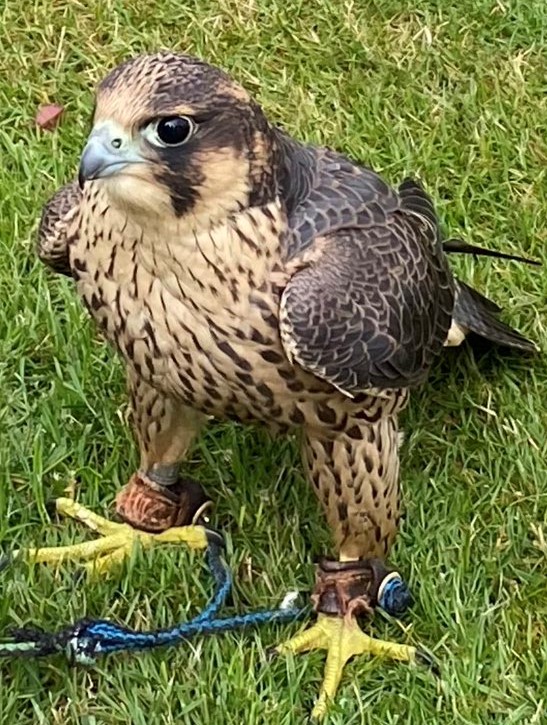
On Friday, Suffolk Police’s wildlife crime team posted a photo on Twitter of a young tethered peregrine wearing falconry jesses. The photo was accompanied by a statement about how a multi-agency team had executed a search warrant at an unknown address and removed the peregrine with the intention of releasing it back to the wild.

No information was provided about the circumstances of how the falconer came to be in possession of a wild peregrine or whether the falconer would face charges for unlawful possession.

After a bit of digging it turns out that the young peregrine had hatched at a monitored site and had crash-landed in to a lake post-fledging. It had been rescued and sent to a wildlife hospital for assessment and rehabilitation.

Somehow (it’s not clear to me how) two falconers became involved and one of them took the peregrine, perhaps also with the intention of rehabilitation before release, but perhaps not. The falconer had removed the plastic colour ring from the peregrine’s leg (why would you do that if you intended to release the peregrine?) although the metal BTO leg ring was still in place on the other leg (as you can see from the photo).

Somebody obviously had concerns about the falconer’s intentions because a tip-off led to the multi-agency search led by Suffolk Police and assisted by Norfolk Constabulary, RSPB Investigations and the National Wildlife Crime Unit. Search warrants aren’t usually granted without the police being able to show reasonable grounds to suspect a crime has been committed. The peregrine was seized, presumably to ensure it was returned to the wild.

Apparently the police dealt with the falconer by way of a community resolution order, probably because it would have been too difficult (virtually impossible) to prove criminal intent in this case.

Well done to the police and agencies involved in retrieving this peregrine and getting it back where it belongs.

UPDATE 14th December 2022: Stolen peregrine rehabbed and released back to the wild in Suffolk (here)

Dorset Police continues its damage limitation exercise re: its botched investigation into the poisoned eagle

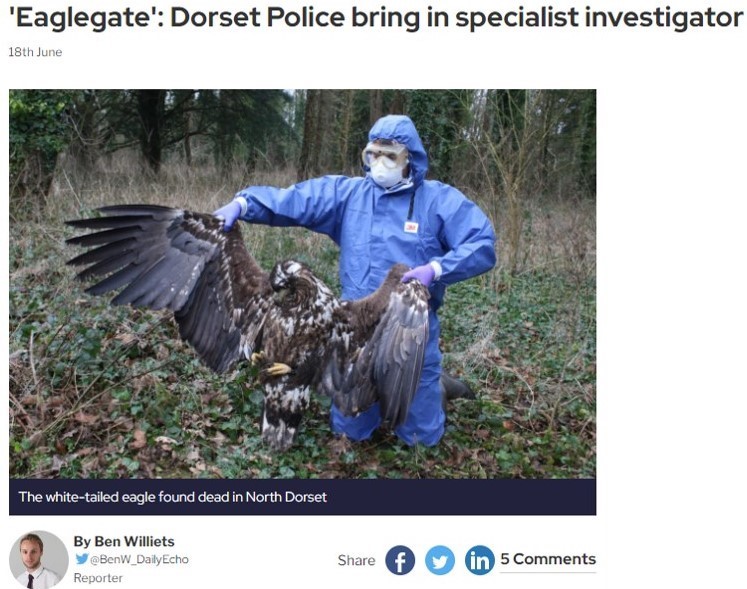
Dorset Police is still desperately undertaking a damage limitation exercise in relation to its botched investigation into the poisoning of a white-tailed eagle found dead on an unnamed shooting estate in January.

The following article appeared in the Dorset Echo yesterday, reproduced here:

DORSET Police said it has “never been in any doubt” the poisoning of an “extremely rare” white tailed eagle is a “serious offence”.

An investigation was launched in February after the bird had been found dead in North Dorset.

Despite finding high levels of rat poison brodifacoum in the eagle, named G461, Dorset Police dropped the investigation, a decision which “baffled” the RSPB.

Dorset Police said tests were “inconclusive” and it was not possible to confirm if a criminal offence had been committed.

Now, after large criticism and a Freedom of Information request revealed correspondence between West Dorset MP Chris Loder, who reportedly said the investigation should not be a priority, and Police and Crime Commissioner David Sidwick, a specialist investigator has been brought in by police.

A spokesperson for Dorset Police said: “We understand that concern has been expressed as to whether more could have been done in respect of the investigation into the death of the white-tailed sea eagle.

“Therefore, in the interests of transparency, it was important for a senior detective to review the investigation, seeking expertise from the Wildlife Incident Investigation Scheme and liaising with a specialist prosecutor from the CPS to ascertain if the evidential threshold for prosecution is met. We hope this will give confidence in decisions made.

“It has never been in any doubt for Dorset Police that if poisoned deliberately, this is a serious offence as the sea eagle is protected by the law.

“We have always been keen to secure a prosecution if at all possible and have been working with a range of partners to try and achieve this.

“We have increased the number of officers with knowledge of wildlife crime offences and are working with our partners to ensure we are able to utilise our different powers, expertise and resources to their best effect.

“We will of course reflect on any learning in respect of the initial or future investigations.”

The spokesperson added the force was always open to new information and hoped it could give “further transparency” to future decisions.

Correspondence between Mr Loder and Mr Sidwick showed the latter saying the pair needed to get their “ducks in the row on this one”.

In a statement on the PCC’s website, he said suggestions the investigation was politically impeded were “bizarre and entirely without merit”.

He added: “It is a plain and simple fact that the team continues to do what they have always done, which is to tackle all aspects of rural, wildlife and heritage-related crime in Dorset.”

Answering what was meant by getting “ducks in a row”, Mr Sidwick said: “All this meant was that was there was a need a for a mutual understanding about the independence of Dorset Police to carry out investigations as they see fit.”

The eagle was released as part of a reintroduction project by Forestry England in a bid to bring the breed back to the country after an absence of over 240 years, by releasing up to 60 birds over five years.

ENDS

It’s a nice try by Dorset Police, but, as I’ve said previously, asking a senior officer from the same police force to review the investigation is effectively just Dorset Police marking its own homework. Had it been a review undertaken by a senior officer from another force it might have been more credible, although of course that would depend on the integrity of that force/officer. As regular blog readers will be only too aware, there is huge disparity between how different police forces and different officers tackle wildlife crime investigations. Some are fantastic, some are not.

But anyway, the ‘review’ undertaken by the senior officer from Dorset Police has already been done according to comments made by Dorset Police Chief Scott Chilton in a Facebook live chat almost three weeks ago, and that officer had determined that there was ‘insufficient evidence’ and ‘no outstanding lines of enquiry’ to progress the case. Well of course, if you fail to conduct a search you’re not going to find any evidence, are you? It’s simply bonkers.

And increasing the size of the force’s rural crime team is utterly pointless if investigations are going to be closed down prematurely. Dorset Police could employ 3,000 wildlife crime officers but if they’re not allowed to undertake a search to look for evidence when an eagle has been found poisoned with 7 x the lethal dose, then what’s the point?

Besides, they don’t need 3,000 wildlife crime officers – they had one (Claire Dinsdale) who was brilliantly committed and effective and who was leading on the poisoned eagle investigation until senior officers pulled the plug and Claire left on long-term sick leave. They only need to employ a few like Claire (and Dorset Police does have some good officers in its rural crime team), and then support them in their investigations, and they’d get results.

And as for claiming ‘transparency’, good grief. Dorset Police continues to refuse to respond to Freedom of Information requests and has now been reported to the Information Commissioner for multiple breaches of the Freedom of Information Act.

If it wants to regain public trust and confidence, Dorset Police can start by explaining the real reason the poisoned eagle investigation was dropped (because this fundamental question still hasn’t been answered). And then it could highlight the ongoing investigation (running since 2021) into alleged raptor poisoning, on the very same estate where the poisoned white-tailed eagle was found(!!) and tell us whether anyone is being charged.

It can also provide an update on the toxicology results of the dead buzzard and red kite, picked up on another shooting estate in early March (see here), and the dead buzzard found on another estate in late April (here).

There is clearly a raptor persecution problem in Dorset, and Dorset Police needs the public onside to help detect these incidents, and we need Dorset Police to do its job properly and try and bring these criminals to the courts. Nobody is suggesting this is easy – we’re all well aware of the difficulties involved, but the least we should expect is that the police will take every opportunity to undertake a robust and thorough investigation, and not to drop it when a local MP kicks off on social media with ridiculous and outdated anti-eagle hysteria.

Well done to local Dorset Echo reporter Ben Williets for tracking this case and keeping it in the news.

Red kite shot in Wiltshire: Police appeal for information

A public appeal for information from Wiltshire Police Rural Crime Team (14th June 2022):

Information appeal

A dead kite was recovered from a public footpath close to Hens wood, Axford, Wiltshire on the 20/04/2022 following a report from the public. Further forensic work into the cause of death has found that the bird had been shot.

We are appealing for any information around the shooting of the Red kite or any person who may have been in the area on the 16/04/2022 who saw anything suspicious to contact the Wiltshire Rural crime team via 101 – quote crime report 54220038890

Watch Dorset’s poisoned eagle fiasco on BBC’s Countryfile

Well done to the BBC’s Countryfile programme last Sunday for doing a 12-minute feature about the poisoning of the white-tailed eagle on an unnamed shooting estate in Dorset in January, and Dorset Police’s fiasco of an investigation which was brought to an abrupt halt when the police decided, astonishingly, that they ‘didn’t have sufficient evidence’ to execute a search warrant on the estate. This decision was made shortly after local MP Chris Loder argued on Twitter that the Police shouldn’t be investigating it and that eagles weren’t welcome in Dorset anyway.

Countryfile isn’t generally renowned for its hard-hitting investigations but I’ve got to say I was pleased with what they produced. Sure, a lot of material was left on the cutting room floor and they studiously removed all the discussion about the scale of illegal raptor persecution in the UK and the ingrained raptor-killing culture amongst some of the game-shooting industry, who still refer to these protected species as ‘vermin’, but I think for millions of viewers, who generally aren’t a specialised audience, this piece would still have been an eye-opener.

I’ve spoken to a few people since it aired who didn’t even know that eagles could now be found in southern England, let alone that they were being poisoned. They do now.

I was also impressed that they managed to get Chris Loder MP in front of a camera and the Assistant Chief Constable of Dorset Police, Rachel Farrell. Remember this is the police force that has repeatedly refused to respond to Freedom of Information requests on this matter. Personally, I don’t think either of them gave convincing explanations that there wasn’t any undue political pressure placed on the police to close down the investigation (asking a senior officer from the same force to effectively ‘mark the Police’s own homework’ doesn’t cut much ice with me), but you can draw your own conclusions.

I think a lot of credit needs to go to Countryfile’s researcher James Agyepong-Parsons, a former journalist from the ENDS Report and the instigator for Countryfile running this piece. He was meticulous in ensuring that the facts of this case were accurately presented, and Charlotte Smith did a brilliant job in pressing for answers.

It’s now available to watch on BBC iPlayer for the next 11 months (here – starts at 09.50 min).

There’s still much more to come out about this case, including the name of the estate where the eagle was found poisoned. It hasn’t yet been made public because there is another, separate, ongoing investigation into alleged raptor persecution that I understand is nearing a charging decision. Nobody wants to name the estate for fear of giving Dorset Police any excuse to drop this other case. We shouldn’t have to be concerned about that but such is the loss of confidence in Dorset Police that nobody is taking any chances.

Gloucestershire Police appeal for info after goshawk found shot in Forest of Dean

Press release from Gloucestershire Constabulary (13th June 2022)

Appeal for information after birds of prey are found dead in the Forest of Dean

Officers are appealing for information after two birds of prey were found dead in the Forest of Dean.

A Goshawk and Sparrowhawk were found next to a bus stop just south of Aylburton near Lydney on the A48 by a member of the public on Monday 25 April.

The male Goshawk was just under 17-years-old and X-rays show that the bird had been shot with a shotgun.

The cause of death has not yet been established for the male Sparrowhawk however post mortems will take place for both birds. 

[The shot goshawk. Photos via Gloucestershire Constabulary]

PC Cath McDay said: “This is an awful crime under the Countryside and Wildlife Act 1981, to truly special birds

The Goshawk had managed to live to an exceptional age only for his life to be ended like this.”

Enquiries are ongoing and investigating officers are asking anyone with information on the incident to please get in contact.

Information can be submitted by completing the following form online and quoting incident number 130 of 25 April: https://www.gloucestershire.police.uk/tua/tell-us-about/cor/tell-us-about-existing-case-report/    

Alternatively, you can call 101 and quote the same incident number or speak to Crimestoppers anonymously on 0800 555 111.

ENDS

BBC’s Countryfile to feature #EagleGate

Tomorrow’s edition of Countryfile will include a feature on the continued illegal killing of birds of prey in the UK, focusing on the recent poisonings of at least two white-tailed eagles in southern England (the one in Dorset and the one in West Sussex).

Filming took place last week and lovely presenter Charlotte Smith interviewed a number of people including Paul Morton (representing Birds of Poole Harbour) and me (representing Wild Justice) as we enjoyed a boat trip along the Wareham Channel looking for eagles, ospreys, marsh harriers and peregrines.

They also managed to bag an interview with Chris Loder MP, the local politician who didn’t want Dorset Police to investigate the eagle poisoning and I believe there’ll be contributions (probably denials and abuse) from Tim Bonner (Countryside Alliance) and perhaps statements from Dorset Police and the Dorset Police & Crime Commissioner, David Sidwick.

I’m hoping they asked Chris Loder MP what he thought David Sidwick meant when he told Loder: ‘You and I need to get our ducks in the row on this one‘ while discussing the murky police investigation into the poisoned eagle in Dorset.

I’ve no idea how the final edit will be presented, this is the BBC after all and they’ll want to be seen as being scrupulously impartial, which is fair enough.

I’m just delighted that they’ve chosen to feature the raptor persecution issue at all, and that six million viewers will learn that even though this is the 21st Century, eagles and many other raptor species are still being deliberately poisoned/trapped/shot in this country, predominantly by members of the game-shooting industry. No matter which part of the interviews the editors choose to show in the final cut, that is the message that the viewers will remember and it’s the most important message of all.

Countryfile airs on Sunday 12th June 2022 on BBC 1 at 7pm and will be available on iPlayer for 12 months.