How to discuss an illegally shot hen harrier, without mentioning that it’s been illegally shot

Yesterday we blogged that a young satellite-tagged hen harrier called ‘River’ had been found dead on a grouse moor on the Swinton Estate in Yorkshire with two pieces of shot in her body (see here).

Surprisingly, the grouse moor owner’s lobby group the Moorland Association has made a statement (more often than not any raptor persecution crimes are simply ignored by this group). Perhaps, with the newly reformed Raptor Persecution Priority Delivery Group (RPPDG), the Moorland Association is feeling under pressure to respond?

However, reading the Moorland Association’s statement is akin to watching a contortionist and wondering how the hell they got themselves in to such a twisted position.

The first we saw of the Moorland Association’s contortion was this, on Twitter, posted by the Moorland Association’s Director, Amanda Anderson, talking about the ‘recent incident in Yorkshire’:

‘The recent incident in Yorkshire’? Good grief. Do you mean ‘the recent illegal shooting of a hen harrier found dead on a Yorkshire grouse moor’, Amanda?

Then we read the actual statement:

Read this statement closely. You will not find the words ‘illegally shot hen harrier’ anywhere. Even the two pieces of lead shot in the bird’s body (as revealed by an x-ray) have been transformed in to “two metallic objects”!

How on earth do you expect an appeal for information about an illegally shot hen harrier to be seen as credible without actually saying it’s been illegally shot?!

There’s also a fascinating claim, attributed to North Yorkshire Police, that the estate has been informed by the police ‘that they are taking the matter no further due to lack of evidence and stressed that there was no suspicion of any wrongdoing by the Swinton Estate or its staff’.

Eh?

Is that an actual statement from North Yorkshire Police, or is it an interpretation by Swinton Estate and/or the Moorland Association? Of course there’s going to be suspicion – how can there possibly not be when an illegally shot hen harrier has been found on the estate?! That doesn’t necessarily mean that anyone at Swinton Estate was responsible for this crime, of course – there is simply no evidence to identify ANYONE as the culprit, especially when we don’t even know where or when the bird was shot – but to say ‘there was no suspicion of any wrongdoing’ seems to be stretching credulity a little bit too far.

It would be useful to see the x-ray of the dead hen harrier. We’ve been told it showed up two pieces of lead shot but no further detail than that. Had the lead shot smashed the harrier’s wing bones, rendering it unable to fly, then it might suggest the bird was indeed shot close to where its corpse was found. However, had the lead shot simply nicked, say, a leg bone, without breaking or fracturing it, then it would be supportive evidence to a theory that the harrier may have been shot elsewhere and was able to fly several miles before collapsing on this moor. North Yorkshire Police has not published the x-ray as far as we’re aware.

We’re also interested in the claim that the hen harrier’s body was “too decomposed to perform a post mortem“. Really? And who made that decision? Was it a pathologist? If you look at the photograph of the harrier’s body being collected from the moor by North Yorkshire Police, it looks to be in a condition that would permit a post mortem.

And if a post mortem wasn’t carried out, under what circumstances did North Yorkshire Police ‘later retrieve’ one of the two pieces of shot, as mentioned in yesterday’s blog?

There’s a lot about this crime and the subsequent investigation that just doesn’t add up. The situation isn’t helped by the PR contortions of the Moorland Association, whose appalling track record in tackling illegal raptor persecution on grouse moors renders them an organisation with zero integrity or credibility, in our opinion.

Let’s hope Police Superintendent Nick Lyall can use his position as Chair of the RPPDG to investigate the details of this case and report, as much as he is able, to what is fast becoming a disenchanted and angry public.
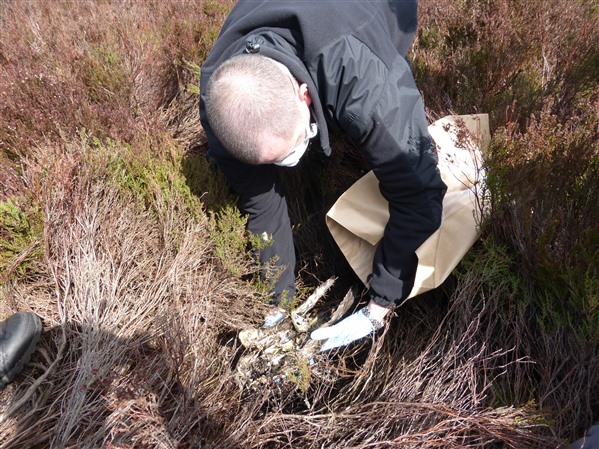
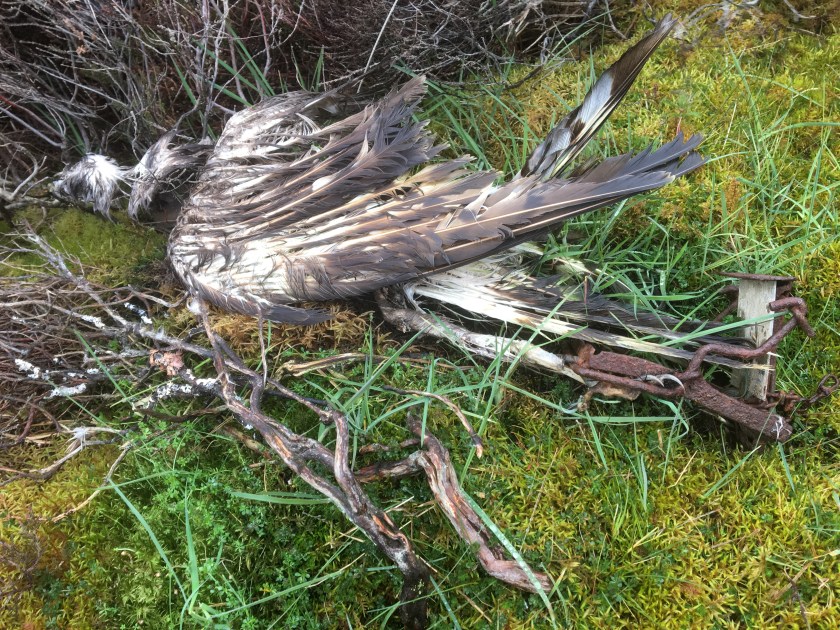
Shot hen harrier’s corpse found on Swinton Estate, a grouse moor in North Yorkshire

In January this year, the RSPB reported that a satellite-tagged hen harrier called ‘River’ had disappeared in suspicious circumstances in November 2018 on an unnamed grouse moor in the Nidderdale Area of Outstanding Natural Beauty (AONB) (see here).

This was an area where the day before River ‘disappeared’, the RSPB had filmed an unidentified gunman with two dogs at a known hen harrier roost (see here).

Nothing more was heard from River’s tag until the end of March 2019. What happened next is recounted in an RSPB blog published this afternoon:

SHOT HEN HARRIER FOUND ON NORTH YORKSHIRE GROUSE MOOR

By Mark Thomas, Head of Investigations, RSPB

Another satellite-tagged hen harrier, found dead on a grouse moor in North Yorkshire, has been confirmed as shot.

You may remember River, the young female hen harrier who suddenly disappeared in November 2018 in suspicious circumstances. We wrote about it here. Now, further information has emerged – and it’s not good news.

River was satellite tagged in Lancashire in 2018 as part of the RSPB EU Hen Harrier LIFE project. In November 2018 she sent out her last transmission from a roost location on a driven grouse moor in North Yorkshire, within the Nidderdale Area of Outstanding Natural Beauty. My staff and North Yorkshire Police searched the area but found no trace of the bird or the tag.

Then surprisingly at the end of March 2019, River’s tag gave off another signal confirming that she was dead and giving a precise location. These satellite tags are solar powered, and it’s possible that the bird’s body was disturbed, allowing the tag to ‘wake up’ and get back in touch with us. The longer, brighter days might have had their effect too.

This latest ‘ping’ gave us an exact location of River’s body, and again my staff and the police officers set out to recover her. They found her dead on Ilton Moor on the Swinton Estate on 5 April 2019. She was just 3.7km away from where her last transmission in November had come from, both on the same estate.

[Hen harrier River’s corpse being retrieved from a grouse moor on Swinton Estate. Photo by RSPB]

River’s decomposed body was recovered and taken to be X-rayed by the Police. Yesterday I received confirmation from North Yorkshire Police that her body contained two pieces of shot, one of which had later been retrieved and confirmed as such by the Police.

We don’t know precisely when or where River was shot, or who did it, but clearly she has been the subject of illegal persecution.

All birds of prey are protected by the Wildlife and Countryside Act 1981. To kill or injure one is a criminal offence and could result in an unlimited fine or up to six months in jail. However, hen harriers like River continue to suffer at the hands of people clearly breaking these laws, and clearly undeterred by the consequences.

River is the latest hen harrier to be shot, adding to the evidence that these birds are being routinely illegally killed, often on land being used for driven grouse shooting.

The RSPB is calling for the licensing of driven grouse moors. With just a handful of breeding hen harrier pairs left in England, this is a species with everything to lose if the status quo continues.

If you have any information which might help identify who shot River, or if you know anything about birds of prey being killed in your area, you can contact my team in confidence on our hotline: 0300 999 0101.

ENDS

This news has a certain amount of inevitability about it. A hen harrier has been shot and her corpse has been found on a grouse moor in North Yorkshire.

According to Mark’s blog, River’s corpse was retrieved from the Swinton Estate. Mark quite rightly states that it’s not possible to identify when, exactly, she was shot, or where or by whom. However, River’s demise mirrors that of so many other young satellite-tracked hen harriers – in fact 72% of them according to this recent scientific research.

The Swinton Estate may be a familiar name to some blog readers – it’s where the shot corpse of hen harrier Bowland Betty was discovered in 2012 (see here). Again, it was not possible to identify who had shot her, or where (she may have been shot elsewhere and managed to fly some distance before collapsing and dying on Swinton) and so nobody was charged or prosecuted for killing her.

The Swinton Estate may be a familiar name to other blog readers because we’ve previously reported on an estate gamekeeper who was convicted in 2014 for illegally setting a pole trap, twice, in 2013 (see here). He told the court the pole trap was nothing to do with targeting protected raptor species, but had been set with the intention of catching squirrels. No matter, he was still convicted because, quite rightly, barbaric pole traps have been illegal for decades.

The Swinton Estate name has cropped up in recent weeks as it’s rumoured to be hosting at least two hen harrier breeding attempts, and we believe one of those nests has since been ‘brood meddled’ by Natural England with either the hen harrier eggs or chicks removed and taken in to captivity (see here).

Please note: the location of this brood meddled nest is as yet unconfirmed because Natural England is refusing to publish further details, laughably ‘in the interest of the welfare of the harriers’.

We expect to learn these details later in the year so we’ll certainly be returning to this story. If the brood meddling has taken place on Swinton, we’ll be wanting to know whether Natural England knew about the discovery of River’s shot corpse before the decision to brood meddle was taken.

There’s something else that stood out in Mark’s blog. This statement:

River’s decomposed body was recovered and taken to be X-rayed by the Police. Yesterday I received confirmation from North Yorkshire Police that her body contained two pieces of shot, one of which had later been retrieved and confirmed as such by the Police‘.

Question 1:

Why did it take North Yorkshire Police over three months to notify the RSPB of the x-ray results?

Question 2:

Under what circumstances did North Yorkshire Police ‘later retrieve’ one of the two pieces of shot found in River’s body? WTF?!

There’s something very, very odd going on here.

UPDATE 12 July 2019: How to discuss an illegally shot hen harrier, without mentioning that it’s been illegally shot (here)

Young hen harrier suffers horrific death in illegal trap on Strathbraan grouse moor

RSPB press release (27 June 2019)

YOUNG HEN HARRIER KILLED BY ILLEGAL TRAP ON PERTHSHIRE GROUSE MOOR

A satellite tagged hen harrier has been illegally killed on a Perthshire grouse moor. The remains of the young female, named Rannoch, were found by RSPB Scotland in May caught in a spring trap which had been set in the open, not permitted by law.

The post mortem report from SRUC veterinary laboratory said: “The bird was trapped by the left leg in a spring trap at time of death. Death will have been due to a combination of shock and blood loss if it died quickly or to exposure and dehydration/starvation if it died slowly. Either way the bird will have experienced significant unnecessary suffering.”

[Hen harrier Rannoch’s remains in an illegal trap on a Strathbraan grouse moor. Photos by RSPB Scotland]

Rannoch was satellite tagged by RSPB’s Hen Harrier LIFE project in July 2017. Her tag data movements were followed closely by RSPB Scotland until 10th November 2018 when she stopped moving in an area of moorland between Aberfeldy and Crieff. The solar powered tag battery drained before accurate location data could be gathered allowing her to be found, but after coming online again in May 2019 enough information was provided to locate her remains. A recent study showed that 72% of tagged British hen harriers are confirmed or considered very likely to have been illegally killed.

Dr Cathleen Thomas, Project Manager for the RSPB’s Hen Harrier LIFE project, said: “We are absolutely devastated that Rannoch has been a victim of crime; the life of this beautiful bird was cut short in the most horrific way due to human actions. Satellite tagging has revealed the amazing journeys made by hen harriers but also uncovers how their journeys end.

Often the birds disappear with their tags suddenly ceasing to function as perpetrators go to great lengths to hide the evidence of their crimes; Rannoch’s death in a spring trap is evidence of one way in which these birds are being killed. In terms of their population size, hen harriers are the most persecuted bird of prey in the UK, and their population is now perilously low, so every loss we suffer impacts the continued survival of the species.”

Ian Thomson, Head of Investigations Scotland, said: “This latest killing of a hen harrier is truly appalling. The actions of the individual who set this trap were both reckless and indiscriminate, and showed a complete disregard for both the law and the welfare of local wildlife. Sadly, the catalogue of criminal killing of tagged hen harriers and other birds of prey continues unabated; we know many others are illegally killed and going undetected, so her death is part of the tip of the iceberg of the true level of criminality.

At a time when our hen harrier population is in sharp decline, we repeat our call on the Scottish Government to take urgent action to regulate driven grouse shooting through a licensing scheme, with sanctions to remove licences to shoot on land where the public authorities are satisfied that illegal activities are occurring”.

Rannoch was one of two chicks who fledged from a Perthshire nest in an area owned and managed by Forestry and Land Scotland in July 2017. Her tag was fitted in partnership with local members of the Tayside Raptor Study Group and Forestry and Land Scotland, who monitored the nest together.

[Hen harrier ‘Rannoch’ being fitted with her satellite tag in 2017. Photo by Brian Etheridge]

The tag data showed Rannoch spent most of her time in Perthshire before she stopped moving on 10th November 2018. As the tag had continued to function after she stopped moving, rather than coming to an abrupt halt, it was assumed that she had died of natural causes. The tag briefly transmitted more data in January this year, and again in May for longer, as the battery recharged in the spring sunlight. The second time more accurate location data was transmitted, allowing RSPB Scotland to finally recover Rannoch’s remains. When RSPB Scotland found Rannoch her leg was caught in a spring trap. Her body was recovered and delivered to the SRUC veterinary laboratory for a post mortem, and Police Scotland were notified.

Logan Steele, a member of the Tayside Raptor Study Group, which monitors hen harriers in the area said: “Rannoch and her sibling were the first birds to fledge from this site in ten years so I was very angry to hear she had died caught in an illegal trap. With so few hen harriers left in this part of Perthshire it is particularly worrying that this bird will not return to breed.”

Anyone with information about this crime or other bird of prey illegal persecution is urged to contact Police Scotland on 101, or the RSPB’s confidential raptor crime hotline on 0300 999 0101.

ENDS

The RSPB press release does not name the grouse moor where Rannoch’s remains were found but just says it was ‘in an area of moorland between Aberfeldy and Crieff’.

This is clearly within the boundary of the Strathbraan raven cull area, where in 2018 SNH issued a licence to local gamekeepers permitting them to kill 69 ravens ‘just to see what happened’. A legal challenge to that licensing decision was successfully made by the Scottish Raptor Study Group and one of their concerns had been that the Strathbraan raven cull area was a known raptor persecution hotspot with a long history of poisonings, illegally-trapped birds and the suspicious disappearances of at least six satellite-tagged eagles.

[RPUK map showing boundary of Strathbraan raven cull area (yellow line) and significant areas of moorland managed for driven grouse shooting (outlined in white). Hen Harrier Rannoch’s corpse was found on one of these moorlands]

Hen Harrier Rannoch’s name will now be added to the ever-increasing list of persecuted satellite tagged hen harriers on British grouse moors, although unusually this time we’re not dealing with a missing corpse and a missing tag that has suddenly and inexplicably stopped working.

No, this time there is no escaping the brutal, barbaric reality of her miserable death. The criminality is writ large, for all to see.

How will the authorities respond this time? Complete silence, as we’ve come to expect every time a raptor persecution crime is reported in the press? We won’t let the Scottish Government off the hook so easily this time.

Wilful blindness will no longer be tolerated.

This weekend, the Scottish Parliament will be celebrating its 20 year anniversary. Twenty years ago, the then Secretary of State Donald Dewar famously described illegal raptor persecution as “a national disgrace” and committed the Scottish Parliament to take “all possible steps to eliminate [raptor] persecution“.

It’s time for the Scottish Government to honour that commitment.

Please send an email of protest to Cabinet Secretary Roseanna Cunningham: cabsececclr@gov.scot Your email needs to be firm but polite. There can be no more prevarication on dealing with these crimes and the Scottish Government needs to understand the strength of feeling about its continued failure to bring the criminals to justice and end these vile actions.

Thank you.

UPDATE 26th January 2022: Lochan Estate penalised after discovery of illegally-killed hen harrier on grouse moor (here)

Scottish Environment Minister visits hen harrier nest with Raptor Study Group fieldworkers

Mairi Gougeon is the Scottish Government’s Minister for Rural Affairs and the Natural Environment, and she also happens to be the Species Champion for the Hen Harrier (Species Champions are roles devised to help politicians raise awareness of species conservation).

Mairi has been one of the more active Species Champions in the Scottish Parliament, enthusiastically offering her support for this species by way of a parliamentary debate, speaking at Hen Harrier Day, and going on field visits to see hen harriers in the wild.

Earlier this week she was out again with experts from the Scottish Raptor Study Group and the National Trust for Scotland’s Mar Lodge Estate in the Cairngorms National Park, to watch (from a distance, obviously) a male hen harrier food passing to a female who had four chicks in the nest.

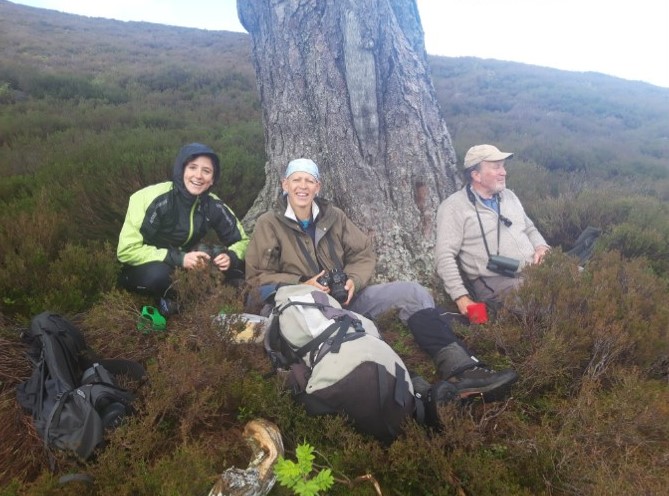
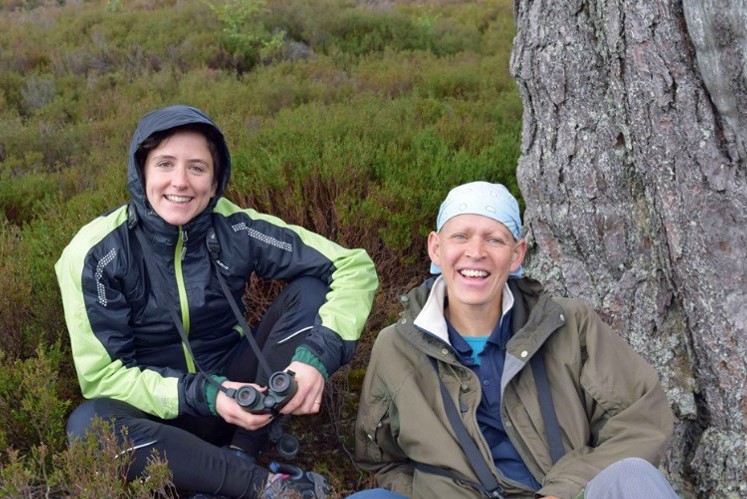
Photos from Kelvin Thomson (@thomsok) of Tayside Raptor Study Group.

That’s the smile of a Minister who’s enjoyed seeing hen harriers.

And although the Scottish Government needs to do much much more to combat the illegal killing of this species on grouse moors (remember Scotland has lost more than a quarter of its hen harrier population in just 12 years), Scotland is fortunate to have a Minister who is so engaged and supportive of the species.

Compare and contrast with Mairi’s Westminster counterpart, Dr Therese Coffey – she’s been in post since 2016 and hasn’t said or done anything of significance in support of hen harriers, even after recent Government-commissioned research showed that 72% of tagged hen harriers were presumed to have been killed illegally on grouse moors.

The Westminster Hen Harrier Species Champion is Angela Smith MP, who appears to have been about as productive as Dr Coffey.

Let’s hope the four chicks that Mairi Gougeon saw being carefully looked after on Mar Lodge Estate all survive and fledge. They’ll need plenty of luck though – four of the five hen harriers tagged here in the last few years have all vanished in suspicious circumstances on other grouse moors in the Cairngorms National Park, presumed to have been illegally killed (Calluna, Margot, Stelmaria and Marci).

And they’re not the only satellite tagged hen harriers to have come to harm inside this National Park. In August 2016 satellite-tagged hen harrier Brian ‘disappeared’ here (see here) and in August 2015 satellite-tagged hen harrier Lad was found dead, suspected shot, inside the Park (see here).

And it’s not just satellite-tagged hen harriers. At least 15 satellite-tagged golden eagles have also ‘disappeared’ in suspicious circumstances in recent years inside the Cairngorms National Park (see here). In 2014 the first white-tailed eagle chick to fledge in East Scotland in approx 200 years also ‘disappeared’ in suspicious circumstances (see here) and last year year another white-tailed eagle also ‘disappeared’ in suspicious circumstances inside the Park (see here).

The political silence on the recent losses of hen harriers Calluna, Margot, Stelmaria and Marci has been noted. We’ll be revisiting this topic soon.

Raven found poisoned on Ruabon Moor, the ‘grouse capital’ of North Wales

RSPB press release (31/5/19)

(Links have been added by RPUK)

RAVEN FOUND POISONED ON RUABON MOOR

  • The dead bird was found on the same estate near Wrexham, where two satellite-tagged hen harriers recently vanished.
  • Police are now appealing for information from the public. 

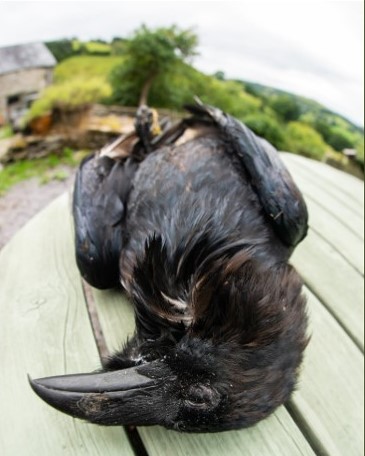
A dead raven found on Ruabon Moor, near World’s End, North Wales, has been confirmed as deliberately poisoned – triggering a police investigation.

The bird was found dead on 28 August 2018 by a man who had been out photographing birds.

He said: “I was coming home from Wrexham when I noticed the bird on the ground, away from the road in a little clearing of grass. It was upside down, its eyes sunken, and its feet in the air. It didn’t look like it had been dead for long.”

Thinking it may have been shot, he contacted the RSPB’s Investigations Unit. Following liaison with the North Wales Police, Welsh Government arranged for toxicology tests on the bird. This revealed that the raven had been deliberately poisoned with the highly toxic insecticide bendiocarb which had been most likely been applied to a bait. Police enquiries in the area have failed to identify anyone responsible.

[The illegally poisoned raven, photo from @RSPBBirders]

Ravens are protected under the Wildlife and Countryside Act 1981. Killing one is a criminal offence and could result in an unlimited fine or up to six months in jail.

Ruabon Moor holds a significant proportion of the Welsh black grouse population and is an area managed for red grouse shooting. In 2018, two rare hen harriers named Heulwen and Aalin went off the radar in this general area. The birds had been fitted with satellite-tracking devices as part of the EU-funded Hen Harrier LIFE project.

Jenny Shelton, RSPB Investigations, says: “It would seem that ravens and birds of prey are not welcome in this area, and naturally people will be asking why. There is a history throughout the UK of birds of prey and ravens being targeted on areas managed for intensive grouse shooting, due to the perceived threat these natural predators pose to the grouse. However, the law is plain: killing birds of prey and ravens is illegal.

On top of this, placing poison in a public area is hugely irresponsible. Many people will be bringing their families to places like this as the weather warms up. To think that a child or a family pet could have found this bird is outrageous. These crimes must stop before someone is seriously harmed.

Jenny continues: “Ravens are beginning to recover in the UK after decades of persecution, and Wales is a key stronghold for these impressive birds. Spring – the start of the bird breeding season – is sadly a key time for the illegal killing of birds of prey and ravens. If you notice a bird of prey dead on the ground in suspicious circumstances, call the police right away.”

North Wales Police are now appealing for information.

Rob Taylor, North Wales Police Rural Crime Team manager said “The deliberate killing of a bird by poisoning is a serious risk to humans and other animals such as certain birds of prey who frequent the area. We are continuing our investigation and we ask members of the public who have information to contact us or ring Crimestoppers anonymously.”

If you have any information relating to this incident, call North Wales Police on 101.

If you find a wild bird of prey which you suspect has been illegally killed, contact RSPB investigations on 01767 680551 or fill in the online form.

Or, to speak in confidence about bird of prey persecution taking place in your area, call the confidential Raptor Crime Hotline: 0300 999 0101. This number is for bird of prey-related matters only.

ENDS

It’s not clear why it’s taken nine months for this news to emerge. Hopefully North Wales Police were more vocal in the local community at the time, warning the public about the presence of this deadly poison.

Let’s hope they’re also alerting locals and visitors alike that this part of North Wales is earning the reputation of being a wildlife crime hotspot, just like so many other grouse shooting areas across the UK.

The placement of warning signs at these locations is the very least we should be expecting from the authorities.

Case against Scottish gamekeeper accused of 12 wildlife crimes proceeds to trial

The case against a south Scotland gamekeeper has continued this week with an intermediate diet (a type of court hearing) and he has pleaded not guilty to a number of alleged offences.

Alan Wilson, 60, is accused of shooting two goshawks, four buzzards, a peregrine falcon, three badgers and an otter at Henlaw Wood, Longformacus, between March 2016 and May 2017.

He also faces charges of using a snare likely to cause partial suspension of an animal or drowning, failing to produce snaring records within 21 days when requested to do so by police and no certificate for an air weapon.

We also believe he is accused of the alleged possession of the banned pesticide, Carbofuran.

Due to Mr Wilson’s not guilty plea, this case will now proceed to trial at Jedburgh Sheriff Court on 13 June 2019.

Previous blogs about this case: see herehere here  here here and here.

Please note: we will not be accepting comments on this news item until legal proceedings have concluded. Thanks.

Former Edradynate Estate head gamekeeper cleared of crop poisoning charges

David Campbell, the former head gamekeeper of Edradynate Estate in Perthshire, has been cleared of all charges relating to the poisoning of game crops on the estate in April 2017.

It had been alleged that David Campbell had maliciously damaged game crops by spraying them with an unknown substance which caused them to rot and perish. At the time of the alleged offences, Campbell was no longer an employee of the estate, having worked there since 1983 but after falling out with the landowner, millionaire city financier Michael Campbell (no relation), his employment was terminated in February 2017.

[Edradynate Estate, photo by Ruth Tingay]

Michael Campbell had told the court that he believed his former employee had caused the damage ‘in revenge’ and said he could identify David Campbell on CCTV by his distinctive “mutton chop” facial hair. Various witnesses had told the court that David Campbell had been “upset” at having to leave his long-term employment at Edradynate Estate.

Last week, David Campbell’s defence solicitor had argued that the case against his client should be dropped because there was a lack of evidence to show his client was the person caught on the covertly-filmed CCTV. Sheriff Gillian Wade had rejected the argument and said the court had been presented with sufficient evidence for the case to proceed.

However, at Tuesday’s court hearing Sheriff Wade cleared David Campbell after ruling the case against him had not been proved beyond reasonable doubt.

This latest failed prosecution is one of several linked to the Edradynate Estate, although the majority of the previous allegations have related to the alleged illegal poisoning of birds of prey, rather than alleged crop poisoning. Despite at least 22 police investigations over several decades (according to former Tayside wildlife crime officer Alan Stewart), nobody from Edradynate Estate has ever been successfully prosecuted for any of these alleged wildlife crimes.

[A poisoned buzzard at Edradynate in 2015, photo RPUK]

We’ve blogged about this estate a lot over the years (see links here), and most recently in relation to the alleged poisoning of two buzzards in 2015 and the Crown Office’s decision in 2017 not to prosecute one of the Edradynate gamekeepers (un-named), despite Police Scotland urging otherwise (see here).

Edradynate Estate is currently serving a three year General Licence restriction, imposed in Sept 2017 and which we believe relates to the alleged buzzard poisonings in March 2015.

Last year three dogs and two more buzzards were reported to have been “deliberately poisoned” in the area but nobody has been charged (see here) and we are not aware of any suggested link between these poisonings and any current employee of Edradynate Estate.

Don’t laugh, but gamekeepers claim to “care deeply” about protecting hen harriers!

It’s not quite April Fools’ Day but the National Gamekeepers’ Organisation thought it’d get in there early this year.

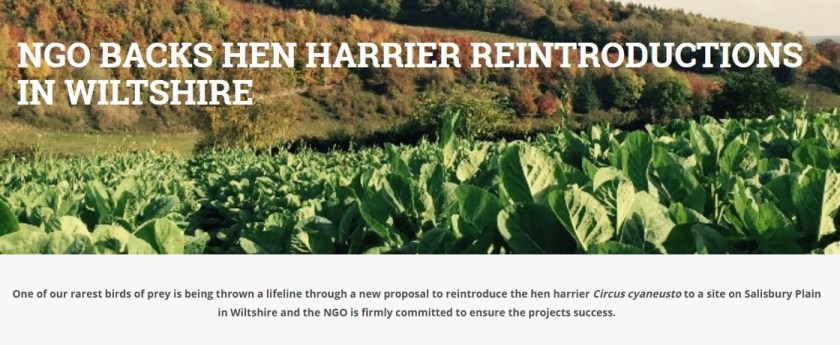
Just a week on from the publication of a scientific paper that demonstrated the catastrophic loss of satellite-tagged hen harriers was undeniably linked to land managed by gamekeepers for grouse shooting (see here), the National Gamekeepers’ Organisation (NGO) published this on its website:

Amazing, eh?

Remind us again, NGO – where was the last known location of the latest hen harrier to ‘disappear’ in suspicious circumstances? Ah yes, in Wiltshire, close to the proposed hen harrier reintroduction site and in an area heavily managed for pheasant and partridge shooting. And what did the NGO say about this bird’s disappearance? Ah yes, that it was “a set up” by the RSPB.

And remind us again, NGO – what examples do you have of the NGO “living in harmony with buzzards“? Ah yes, you supported a gamekeeper (who had a prior poison-related conviction) to get licences to kill buzzards to ‘protect’ his pheasants.

And remind us again, NGO – what was your most recent action on the RPPDG, the group that’s supposed to tackle illegal raptor persecution? Ah yes, it was to resign.

And please could you tell us, NGO, what is “Circus cyaneusto“?! Is this an imaginary harrier species, to match the gamekeepers’ imaginary devotion to hen harriers that we’re supposed to believe?

Not so much April Fools, more like deluded fools.

Responses to hen harrier satellite tag paper: GWCT

The publication of the hen harrier satellite tag paper on Tuesday (here) that provided compelling evidence to highlight, yet again, the link between grouse moors and the illegal killing of hen harriers, has resulted in a flurry of responses from various individuals and organisations.

We’ve be looking at these responses in turn.

So far we’ve discussed the responses of Supt Nick Lyall (Chair, RPPDG) (here), BASC (here), Dr Therese Coffey (DEFRA Wildlife Minister) (here), Northern England Raptor Forum (here) and the Moorland Association (here).

This time we’re examining the response of the Game and Wildlife Conservation Trust (GWCT), a supposedly ‘independent’ charity that seems to attract a good deal of funding from, er, the grouse shooting industry.

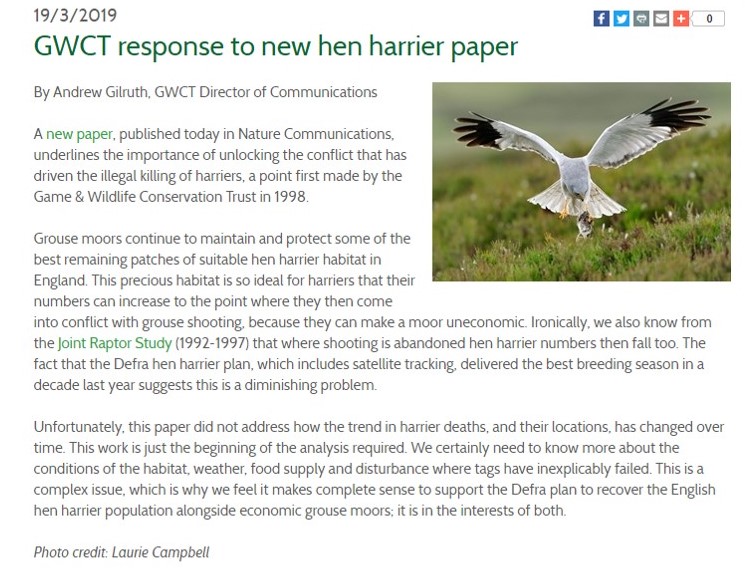
GWCT posted a statement on its website in response to the devastating findings of the hen harrier satellite tag paper. Here it is:

You’ll notice that this GWCT response carefully avoids mentioning the headline figures from the paper – hen harriers are ten times more likely to be killed on grouse moors than any other habitat, and at least 72% of the hen harriers tagged by Natural England between 2006 – 2017 have either been confirmed to have been illegally killed on grouse moors or are highly likely to have been killed on grouse moors, with the researchers saying they can find no alternative, plausible, explanation.

We’re then told by GWCT that the illegal killing of hen harriers on grouse moors is “a diminishing problem” based on last year’s breeding results. Let’s just remind ourselves of those 2018 breeding results – only nine successful nests in England (where there is suitable habitat to support over 300 nests) and not one of those nine nests was situated on a privately-owned grouse moor (see here).

And what happened to the hen harrier chicks that did manage to fledge in 2018? A lot of them ‘disappeared’ in suspicious circumstances on, er, grouse moors:

The final paragraph of GWCT’s statement implies that habitat condition, weather, food supply and disturbance may explain the pattern of hen harriers deaths and disappearances on grouse moors. You’ll note that criminal gamekeepers armed with shotguns and illegal traps are not mentioned.

There was a time, long ago, when the GWCT was a respected, credible, science-based organisation. What happened?

Responses to hen harrier satellite tag paper: Moorland Association

The publication of the hen harrier satellite tag paper on Tuesday (here) that provided compelling evidence to highlight, yet again, the link between grouse moors and the illegal killing of hen harriers, has resulted in a flurry of responses from various individuals and organisations.

We’ll be looking at these responses in turn.

So far we’ve discussed the responses of Supt Nick Lyall (Chair, RPPDG) (here), BASC (here), Dr Therese Coffey (DEFRA Wildlife Minister) (here) and the Northern England Raptor Forum (here).

This time we’re examining the response of the Moorland Association, the lobby group for grouse moor owners in northern England.

The Moorland Association couldn’t be arsed to publish a statement on its website, nor to tweet about this important scientific publication nor to mention it on its Facebook page. Blimey, anyone would think that grouse moor owners aren’t at all bothered that hen harriers are ten times more likely to be killed on a grouse moor than anywhere else, or that 72% of satellite tagged hen harriers had either been confirmed or suspected of being illegally killed on grouse moors.

And let’s not forget, the Moorland Association is supposedly a willing ‘partner’ on the Raptor Persecution Priority Delivery Group (RPPDG), where it’s supposed to be using every opportunity to raise awareness about the illegal killing of birds of prey and stopping these crimes from being committed. Really impressive partnership work, eh?

We did find a quote from the Moorland Association’s Director, Amanda Anderson, in this brilliantly headlined article in The Independent (“Massive wildlife crime scene” is a Mark Avery quote from a couple of years ago).

Here’s Amanda quoted in The Independent article:

Amanda Anderson, director of the Moorland Association, which represents grouse moor owners and managers in England and Wales, said the study data, gathered between 2006 and 2017, was before a management scheme put in place as part of Defra’s hen harrier recovery plan.

She said keepers had engaged with tactics such as reporting and monitoring nests and roost sites, as well as reducing conflicts between the birds via feeding strategies.

Ms Anderson said that 2018, the first year of the brood management scheme, was “the most successful hen harrier breeding season in England for over a decade”, continuing: “We know from evidence gathered on the ground there are many areas on grouse moors where hen harriers – with or without satellite tags – are currently thriving.”

But she added: “We want to see more hen harriers on grouse moors. Persecution should not occur and must cease in order to give hen harriers the best chance of survival. Seventy per cent of hen harriers perish in their first year from natural causes. However, when a satellite tag fails unexpectedly, persecution may be a factor.

END

Wow. What’s that saying? More front than Blackpool?

It’s all ok, folks, no need to worry about the extraordinarily high percentage of ‘missing’ (presumed killed) hen harriers on grouse moors, because all that took place before DEFRA’s Hen Harrier Action Plan was put in place. Er, except that in the year after the paper’s data were gathered and the so-called Action Plan was in place (2018), at least 11 satellite-tagged hen harriers all ‘disappeared’ in suspicious circumstances, most of them either on or near a grouse moor, between the months of August and November. How do you explain that, Amanda?

[RPUK map showing the last known locations of 11 satellite-tagged hen harriers that ‘disappeared’ in suspicious circumstances between August – November 2018]

Also according to Amanda, ‘keepers had engaged with tactics such as reporting and monitoring nests and roost sites’. Ah, would that ‘monitoring’ of nest sites include the tactic of repeatedly driving up towards a nesting attempt on a quad bike, disturbing the birds so much that the nesting attempt was abandoned? There are certainly reports of that happening on one particular grouse moor (which was reported to the police).

And would that ‘monitoring’ of roost sites include the tactic of turning up with a gun and a couple of dogs at dusk, to walk around a roost site where three hen harriers had just gone to ground (see here)?

And where is this “evidence gathered on the ground” that shows “there are many areas on grouse moors where hen harriers – with or without satellite tags – are currently thriving”? Have those sites been reported to raptor fieldworkers from NERF, or the RSPB, or Natural England (all partners in the RPPDG), or is this yet another imaginary scene that Amanda’s viewed through her magical kitchen window?

Unfortunately for the Moorland Association, Amanda’s latest episode of propagandist nonsense is looking a lot like a rapidly disintegrating sand castle crumbling in the face of an overwhelming rising tide of evidence.