Are you sitting comfortably children? Then I’ll begin…
Once upon a time there was a girl called Alice, who fell down a rabbit hole and entered a fantasy world (‘Wonderland’) where everyone spoke gibberish and nothing made sense. In Wonderland, (also known as the Countryside Alliance HQ), Alice thought it was “absurd” that those evil-doers at the RSPB could claim that there were only four breeding pairs of hen harrier in England in 2011. Everybody in Wonderland knew that even though all the scientific studies proved otherwise, the hen harrier in England was not on the verge of extinction as an English breeding bird, that over 2,000 harriers were not ‘missing’ from the UK countryside, and in no way was anyone connected with game shooting responsible for the supposed decline.
To back up her theory, Alice suggested that “the hen harrier is more numerate than 7 out of the 15 species of birds of prey in this country“. Of course, everyone in Wonderland knew that the hen harrier is able to think and express itself effectively in quantitative terms (or, put more simply, the hen harrier is able to use numbers, i.e. it is “numerate”). How absurd to think otherwise! It’s those fools at the RSPB who are innumerate – they think two and two makes four, when clearly it makes 330 (which coincidentally is the predicted number of breeding hen harrier pairs that the scientist boffins clowns say are ‘missing’ from the oh-so wildlife-friendly grouse moors of northern England).
That’s the end of this fairytale – tune in next time to find out why the holocaust never happened. Night night, children, and beware of falling down rabbit holes! Although to be honest, there’s not much chance of that as most of them are stuffed with the corpses of illegally killed raptors.
For those of us living in the real world and not some kind of fantastical Wonderland like Alice and her chums, you might be interested in this newsblast that was written by Alice Barnard, Chief Exec of the Countryside Alliance (although not for much longer – see here) that arrived in my inbox this morning:
“The RSPB’s bird of prey officer has recently been claiming that the status of the hen harrier in England is so precarious due to illegal killing that he believes one wet spring or a fire at the wrong time of year could result in it becoming extinct. However, as the RSPB knows only too well, the term extinction is defined by the death of the very last of a kind, and its use to describe the future of the hen harrier is therefore nothing short of absurd; as is its claim that there are only 4 breeding pairs left in England.
In addition to Britain, the hen harrier occurs in a multitude of countries across the northern hemisphere, including North America, Europe and Asia. It has an extremely large population which is currently thought to be 167,000 breeding females, with no significant decline in that population globally. Internationally it is classified as a species of “Least Conservation Concern”, and with 663 pairs in the UK, the hen harrier is more numerate than 7 out of the 15 species of birds of prey in this country. Although only 4 pairs may have bred successfully in England in 2011, many hen harriers can be observed moving around the country throughout the year. The issue, therefore, is that of poor breeding success; not extinction.
There are numerous factors that can result in the poor breeding success of hen harriers, and in 2009 the RSPB and Natural England reported that it was entirely due to natural causes; not illegal persecution as all too frequently claimed by the RSPB. Indeed there have been no confirmed cases of persecution against the species for the last 5 years.
The fact is that hen harriers are vulnerable to predation by foxes and other birds of prey, lack of available prey, unintentional disturbance and by weather and accidental fires; or a combination of any of these. It also appears that there are other factors at play of which we are currently unaware, such as on the Isle of Man, where the RSPB’s 2010 survey found that the population of hen harriers had halved, for reasons still unknown.
We will continue to challenge the RSPB’s assertions of persecution against birds of prey as part of our promotion and defence of the shooting community and the valuable conservation work they do.
Alice Barnard, Chief Executive, Countryside Alliance”.
Here is a link to the RSPB press release to which Alice may be referring (see here). Let’s hope that in her new position as Chief Exec of “a leading Education charity“, Alice does not need to use comprehension skills (the RSPB press release clearly states that they are referring to an ENGLISH hen harrier extinction, not a global one as Alice tries to infer), nor literacy skills (look up the word ‘numerate’, love). Maybe she’d be better sticking to fairytales – she does those quite well.
So who is set to replace Alice in Wonderland? Step forward some military guru, former head of the UK field army, the amusingly named Lieutenant General Sir Barney White-Spunner (see here). Are they expecting a war?

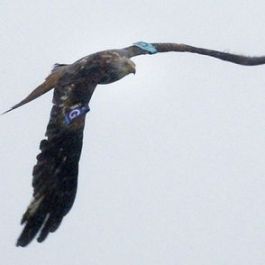 The Belfast Telegraph is reporting that another red kite has been confirmed illegally poisoned – the ninth kite to be killed this way in County Wicklow, Ireland. According to the report, the breeding female (known as Blue Purple G – her wing tag code) was found by Brittas Bay late last year.
 Following the report that convicted gamekeeper Glenn Brown lost his appeal yesterday (see
 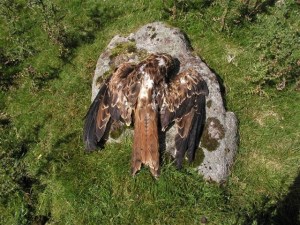 Following the blog post on 6 December 2011 (see
 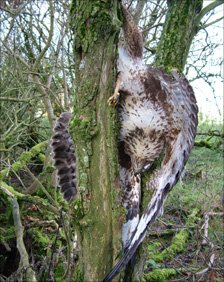 David Alexander Whitefield, the former gamekeeper at Culter Allers Estate in South Lanarkshire, was today sentenced following his December 2011 conviction for illegally poisoning four buzzards (see
