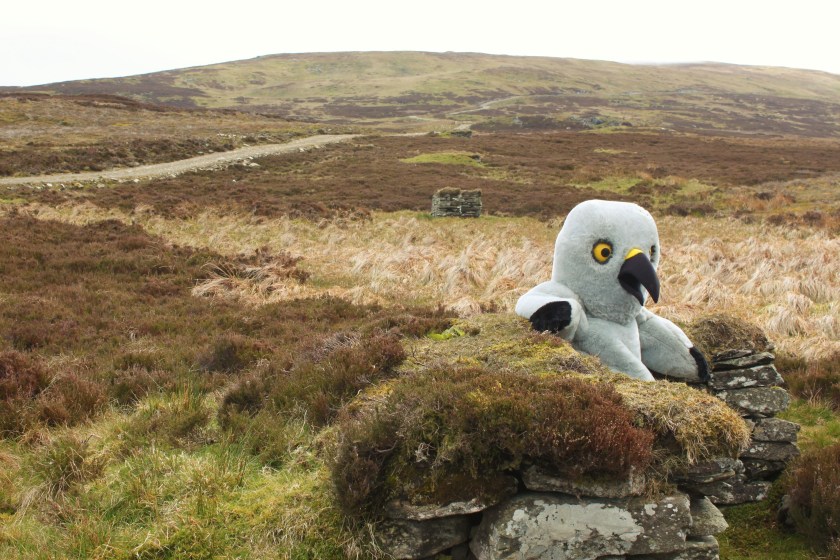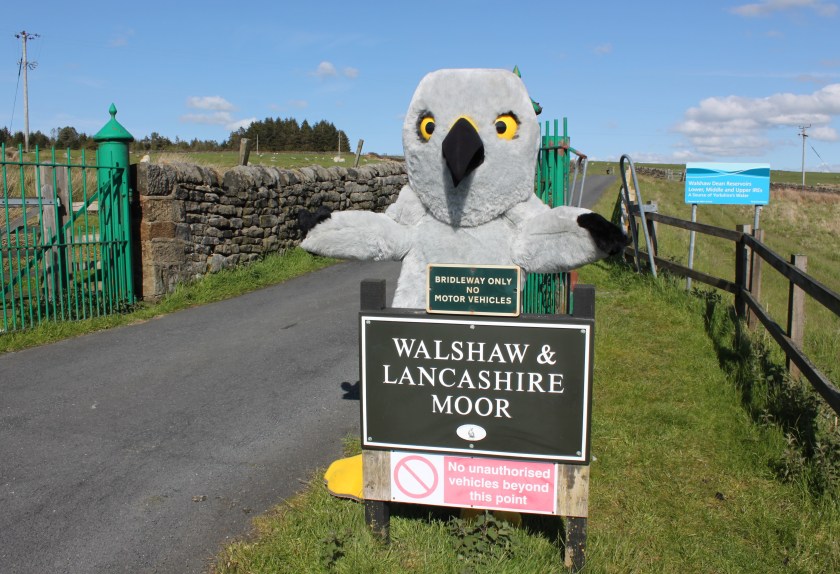
It was a beautiful day for kicking around on Walshaw Moor.
Not such a beautiful moor, though – see here.
Didn’t see any other hen harriers either.
Keep up to date with plans for Hen Harrier Day 2015 here.

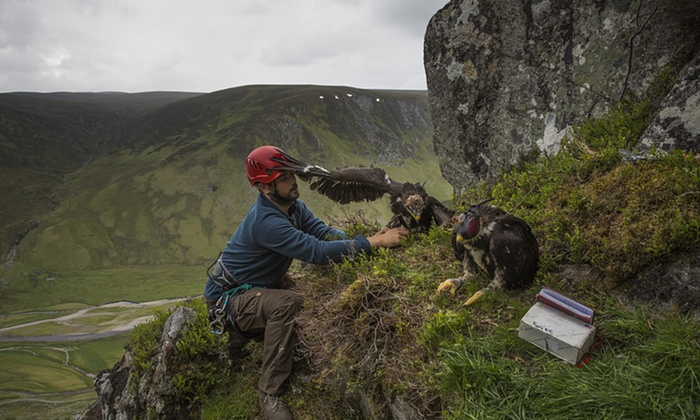
There is a series of absolutely stunning photographs in the Guardian (photographer Dan Kitwood/Getty Images) of golden eagles being satellite-tagged in the Scottish Highlands – see here.
They feature the work of some of the top class fieldworkers from the Scottish Raptor Study Group, notably Justin Grant and Dr Ewan Weston. These two, along with a handful of others, are among the best in the world – they have spent years monitoring, ringing and sat-tagging white-tailed and golden eagles (as well as many other species!), all under licence, and it’s thanks to their expertise and dedication that not only have we learned a lot about the dispersal movements of these iconic species, but we’re also now able to see where many of them are being poisoned, trapped, shot, or simply ‘disappearing’ – see here.
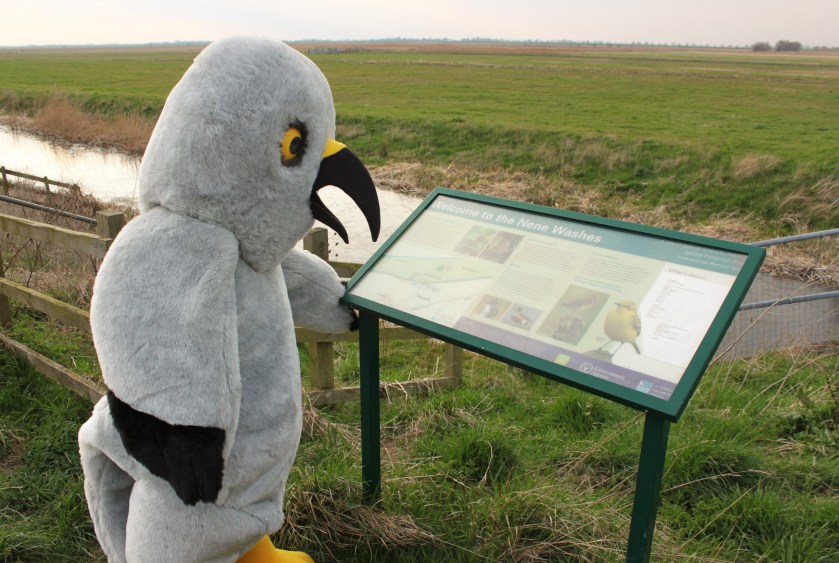
Henry took a break from the barren grouse moors of the north and headed to the RSPB’s Nene Washes Reserve in Cambridgeshire.
He watched a marsh harrier and a short-eared owl and met a photographer who was looking for a chocolate-coloured barn owl. It was good to be at a site where the raptors you expect to see in that habitat are actually there.
Tomorrow he heads back north.
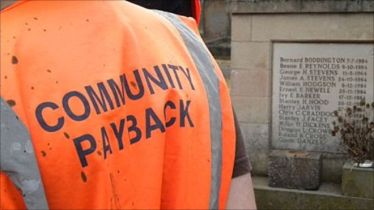 It’s not been an impressive week for Scotland’s Environment Minister’s office, and the poor performance continues…
Do you remember back in May this year, when Scottish gamekeeper James O’Reilly was convicted of committing four wildlife crime offences on the Cardross Estate in Stirlingshire, including the setting of gin traps, one of which caused such injury to a buzzard that the bird had to be euthanised? See here for a recap.
O’Reilly received what we consider a typically pathetic sentence – a 240 hour Community Payback Order – and we encouraged blog readers to contact Environment Minister Dr Aileen McLeod to ask when the Government-commissioned Wildlife Crime Penalties Review report would be published.
Here’s the response received by one of our readers:
Dear XXXXXX
Thank you for your letter of 21 May 2015, to the Minister for Environment, Climate Change and Land Reform, Dr Aileen McLeod. I have been asked to respond on the Minister’s behalf.
Your letter, headed “Wildlife Crime Penalties Review”, asks when the review of the penalties for wildlife crime will be published. The review has taken longer than anticipated due to the volume of material considered and the range of issues which has arisen. The group are currently working on the draft report and we expect this to be with the Minister before the summer recess. The Minister will wish to consider the report carefully and at this juncture we are not able to provide details of when any of the recommendations might be implemented.
You also raise a concern about the recent conviction of a gamekeeper who received a 240 hour Community Payback Order (CPO). Sentencing is a matter for the Scottish Courts, however CPOs are not intended to be a “soft option”, they are an effective alternative to custody – individuals released from a custodial sentence of six months or less are reconvicted more than twice as often as those given a CPO. There are also penalties for breaching a CPO, including an electronic monitoring sanction for non-compliance, so offenders cannot simply ignore the court’s punishment.
I hope that you find this response helpful.
Yours faithfully,
Karen Hunter Wildlife Crime Policy Officer
END
The third paragraph of this response is astounding. “CPOs….are an effective alternative to custody – individuals released from custodial sentences of six months or less are reconvicted more than twice as often as those given a CPO“. From where has this statement been lifted? It may well be applicable to easily-detectable crimes such as theft but the statement is entirely out of context and cannot possibly be applicable to assessing the reconviction rates of offenders involved in wildlife crime because there’s only ever been one custodial sentence for a raptor-killing criminal and that was only handed out in January this year (to gamekeeper George Mutch). That means that there aren’t any data on the deterrent effect of CPOs vs custody for wildlife crime offenders so making a statement to suggest that CPOs are more effective is disingenuous at best, and that’s being generous.
In addition, it’s well established that conviction rates (let alone reconviction rates) of wildlife crime offenders in no way reflect the actual offending rate – see the recently published LINK report for the low rate of prosecutions, let alone convictions, for reported wildlife crimes in Scotland. So to suggest that CPOs are an effective deterrent for addressing wildlife crime is absolute nonsense.
For all we know, a high percentage of convicted wildlife crime offenders are reoffending left right and centre – they’re just not being caught! Equally, of course, they may not be reoffending. Or, given the lengthy delays involved in bringing criminal prosecutions, they may have reoffended but the cases are still going through the system (remember that CPOs only came in to force in 2011, and we’re still waiting for some trials relating to offences that were alleged to have occurred several years ago). The point is, the limited data available do not provide for a robust assessment of the effectiveness of CPOs vs custodial sentences for wildlife crime offenders, so officials in the Environment Minister’s office would do well not to try and fob us off with such glib tosh.
Meanwhile, in a parallel universe, the North Wales Police and Crime Commissioner, Winston Roddick, is calling for tougher sentencing powers to allow the courts to deal with convicted raptor killers. His efforts are being supported by wildlife presenter Iolo Williams – see here.
A Shropshire gamekeeper has been cleared of charges relating to the alleged illegal use of a trap after the District Judge pronounced the RSPB’s use of covert surveillance “disproportionate”.
Neil Wainwright had been accused of using a Larsen trap, illegally baited with two live quails, to trap birds of prey. The trap, set near to a pheasant pen, had been seen by an RSPB investigator (whilst walking on a public right of way), who had returned the following day to install covert video (on private land) to determine the identity of the trap user.
Footage from the camera had identified Wainwright, who was also reportedly seen carrying a dead buzzard. The RSPB then alerted the police who began an investigation, resulting in the Crown Prosecution Service taking the case to court.
This case featured several court hearings, and during one of these Wainwright had admitted using the trap baited with live quail but had claimed he was targeting mink, not birds of prey. So his use of the trap wasn’t in question (because he hadn’t denied using it); just his purpose for using it (which was the basis for some of the charges against him).
It’s very strange then, that the District Judge, Kevin Grego, should then exclude the video evidence and claim its use to be “disproportionate” because the RSPB didn’t have the landowner’s permission to film there. This implies that the RSPB should have sought the landowner’s permission, which would have been a complete non-starter because for all they knew, the landowner and/or the agent may have been complicit with any alleged offences so asking for permission to film would have defeated the objective of filming. It may also imply that the judge thought that the RSPB should have approached the police before setting the camera. However, for the police to have been involved they would have needed to seek authority to film under the Regulation of Investigatory Powers Act 2000. The chances of them getting that authority for what may be considered a minor offence (in terms of the scale used to categorize the seriousness of all crimes, not just wildlife crimes) on private land would be pretty slim.
In which case, any trap user intent on illegal activity to trap and kill birds of prey on private land can be assured that the chance of being prosecuted is virtually non-existent. In other words, they’re untouchable.
This is the second time this year that RSPB video footage in relation to the alleged mis-use of a trap by a gamekeeper has been ruled inadmissible in England – see here for earlier case. These are interesting developments because covert video footage has long been accepted as admissible in the English courts, as opposed to the difficulty of having it accepted by the Scottish courts. And although neither of these two recent cases set a legal precedent, you can bet your house that defence lawyers in future English cases will be pointing to these findings as they try to justify having similar evidence dismissed.
These examples serve to demonstrate, once again, just how high the odds are stacked against securing a conviction for wildlife crimes that take place in relatively remote areas where direct witnesses are few and far between.
Wainwright’s case wasn’t a complete failure though. He was convicted of three other offences which wouldn’t have come to light without this investigation in to the alleged mis-use of the trap: failure to properly store ammunition (two offences, for which he was fined a total of £300) and failure to store a dangerous chemical securely (Phostoxin, a highly toxic fumigant used to gas moles, rabbits etc) which was found in his vehicle (one offence, for which he was fined £200). He was also ordered to pay £85 costs and a £30 surcharge.
Previous blogs on this case here, here and here.
BBC news article on Wainwright’s trial here
The world’s gone bonkers.
A few days ago we had Scottish Natural Heritage, the Government’s statutory nature conservation body, promoting Scotland’s dead wildlife pantry and the grouse shooting industry, claiming that red grouse are ‘healthy’, natural’ and harvested ‘sustainably’ when actually they’re anything but (see here).
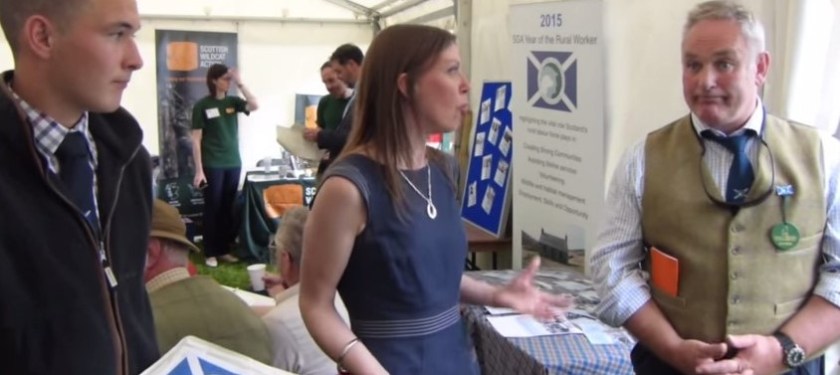
And now we have Scotland’s Environment Minister, Dr Aileen McLeod, praising “the significant and valuable contribution” of the Scottish Gamekeepers’ Association as she presented the SGA’s Young Gamekeeper of the Year Award 2015 at the Scottish Game Fair yesterday. Here’s what she had to say:
“I just want to say, obviously, thank you very much, Alex [Hogg], and I’m absolutely delighted to be invited here this afternoon, this is obviously my first time I’ve ever been to the game fair as well so I’m really delighted to be here, the opportunity to be next to Alex and this young man as well [Duncan Seaton, the recipient of the award], so also I just thought it’d be a good opportunity just to thank the Scottish Gamekeepers’ Association for all the long term support which you have provided to Scottish Government in various areas of policy, development and implementation and making sure we are implementing best practices of conservation and wildlife and wildlife management and I think to be really honest without your guys significant and valuable contribution to the management of Scotland’s countryside, we really wouldn’t have the world famous landscapes which many people from home and abroad enjoy which makes such a valuable contribution to Scotland’s rural economy“.
You can watch the video here.
No mention, then, of the hundreds of thousands of native animals that are snared, trapped and shot on an industrial scale every year by gamekeepers to ensure that an artificially high surplus of game birds (some non-native) is available to be, er, shot? And that’s just the legal killing. No mention either of the illegal poisoning, trapping, shooting and beating to death of protected wildlife, particularly birds of prey, which we know takes place on a significant scale because it affects the population range of a number of species; that doesn’t happen on that scale if it’s ‘just a few rogues at it’.
We’ve been waiting for Dr McLeod to show her hand since she first took office last November. It looks like she just has.
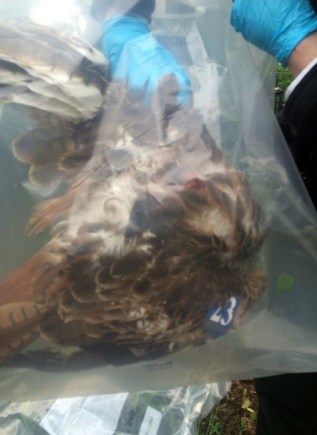 A female red kite, born in Wales and released in Northern Ireland as part of the reintroduction project there, has been found shot dead.
The bird, named ‘Fawkes’, hatched in Wales in 2010 and was donated to the Northern Ireland Red Kite Reintroduction Project – she had been adopted by the Ballyclare High School in 2011 and staff and pupils from the school had been following the bird’s progress over the last few years.
Her corpse was discovered on 20th May 2015 near Katesbridge. She was discovered in a breeding territory belonging to two known breeders, both of whom have ‘disappeared’ in recent weeks.
News article on UTV here
The loss of this bird is a big blow to the reintroduction project. With an estimated 14 breeding pairs of red kites in Northern Ireland, and no plans for further release of additional birds to boost the numbers, this tiny population looks set for certain demise.
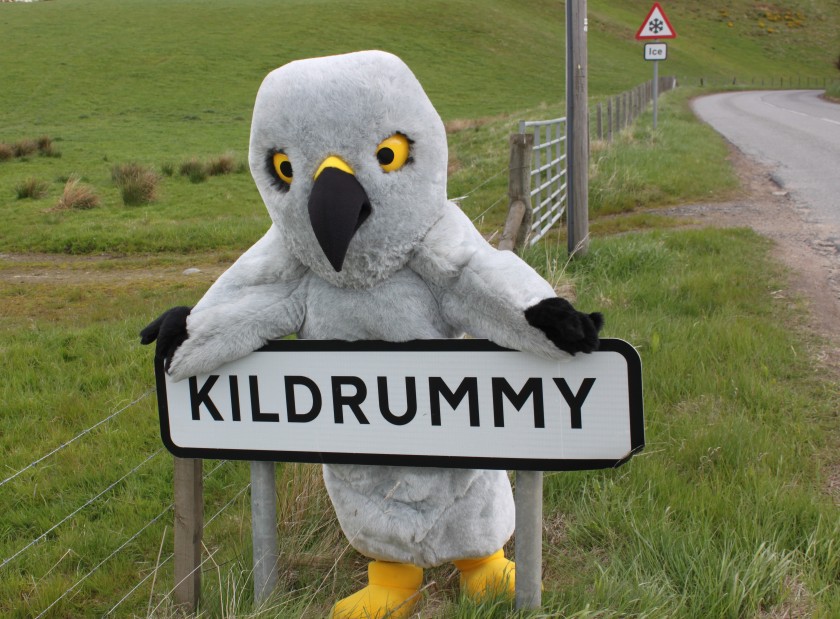 Henry called in at Kildrummy – the location of some pretty obscene ‘raptor management techniques’ recently- see here.
Rumour has it there’s a new keeper at Kildrummy Estate, following the incarceration of Scottish gamekeeper (and SGA member) George Mutch, (formerly of Kildrummy Estate), for his disgusting crimes.
The new keeper’s name? Local rumour suggests something quite incredible, but that can’t surely be true.
Here’s an anagram: Hmm crust
 The Police and the RSPB are appealing for information following the discovery of a shot peregrine last month.
The bird was found, still alive, on 4th June at Castle Lake, Bishop Middleham, a local nature reserve managed by Durham Bird Club.
After a veterinary examination the male’s injuries were considered so severe it was decided to put him to sleep.
The RSPB is offering a £1,000 reward for information that leads to a successful conviction.
RSPB press release here
Photo of shot peregrine by John Olley