CLICK HERE FOR A VIDEO MASH UP OF HENRY’S TOUR: https://www.youtube.com/watch?v=qSc2faNGdJo&feature=youtu.be

CLICK HERE FOR A VIDEO MASH UP OF HENRY’S TOUR: https://www.youtube.com/watch?v=qSc2faNGdJo&feature=youtu.be

There’s an article on the BBC News website today about a proposal to take golden eagle chicks from the Highlands and release them in southern Scotland in an attempt to boost the tiny, depleted population currently clinging on by its talons (BBC report here).
The timing of this news is suspicious, especially when you learn that the project hasn’t yet been formally approved and thus may or may not happen. The cynical amongst us might view it as yet another piece of spin aimed at portraying the grouse-shooting industry in a favourable light so close to the start of the Inglorious 12th, especially when you see who is involved with the project – more on that later.
There’s no doubt that the southern Scotland golden eagle population is in serious trouble, and has been for many years. We’ve blogged about this previously (here, here). On the face of it then, any attempt to increase the population to its former status should be welcome news. But…..
A basic tenet of any restocking / translocation / restoration / reinforcement / reintroduction (whatever they choose to call this project) is that there should be strong evidence that the threat(s) that caused any previous decline has been identified and removed or sufficiently reduced. This is a standard guideline issued by the IUCN and is part of the criteria used to assess whether such projects can proceed.
One of the biggest constraints on golden eagle population recovery in southern Scotland is persecution. Raptor persecution in southern Scotland has definitely not been removed, nor sufficiently reduced. In the last ten years alone there have been more than 150 confirmed persecution incidents (that figure doesn’t include the ‘probable’ or ‘possible’ cases, nor those that went undiscovered). Just three days ago we were given a sharp reminder of just how current this problem still is when it was announced that a young hen harrier had been found shot dead on a grouse moor in South Lanarkshire (see here). The 2014 SNH-commissioned report on the status of golden eagles in southern Scotland also identified several areas where persecution is an ongoing concern, including the Lowther Hills, the Lammermuirs and the Moorfoots (all driven grouse moor areas – what a surprise), and stated that persecution needed to be brought under control in those regions if golden eagles were to thrive in southern Scotland once again (see SNH report here).
Environment Minister Dr Aileen McLeod acknowledges the persecution issue and in an earlier version of the BBC article this morning she said she will “work hard” to ensure the project is a success. In the latest version of the article, this has been updated with her saying that the persecution of raptors would “not be tolerated under any circumstances“. We’re sure she has good intentions but to be frank, this is just more rhetoric. She (and her predecessors) has been unable to bring persecution under control in other parts of the golden eagle’s range (notably the driven grouse moor regions of central and eastern Scotland – see report here from 2011 and report here from 2014) so why should we think she’ll be able to bring it under control in southern Scotland without bringing in new sanctions?
Having said all that, other high risk projects of a similar nature have been very successful on the whole (think reintroduction of red kites and white-tailed eagles). It’s also abundantly clear that if we wait for the southern Scotland golden eagle population to rebound of its own accord (by natural recruitment of individuals from the more northerly populations) then we’re likely to see the demise of the southern Scotland golden eagle population within a few years. It’s a definite trade off situation.
The one big thing in the project’s favour is that, if it does go ahead, it is likely to be a high profile project. There will be plenty of public interest and, assuming the released birds will be satellite-tracked (and their movements made publicly available and not kept secret), the unlawful killing or ‘mysterious disappearance’ of any of those birds will cause public uproar. This will put a lot of pressure on landowners and their gamekeepers to behave themselves and leave those eagles alone. If they don’t, it may well be the final nail in the coffin for their industry. There have been two very high profile killings of golden eagles in southern Scotland in recent years: an adult female was poisoned in 2007 (see here) and an adult male was shot in 2012 (see here). Ironically, that shot golden eagle was found on Buccleuch Estate, one of the listed project supporters. This is also where hen harrier Annie’s corpse was found.
As well as Buccleuch Estates, another project supporter is Scottish Land and Estates. Their CEO Doug McAdam is quoted as follows in the BBC article:
“Landowners value golden eagles, they are one of our most iconic birds and I think people will work hard with us to make this project a success. Often landowners are portrayed as the villain here and against golden eagles and nothing could be further from the truth“.
It’s actually very close to the truth. Yes, there are a handful of landowners who cherish having breeding golden eagles on their land (not least the landowner who provides a home for the one remaining pair in the Borders) but that handful is greatly outnumbered by the vast majority of driven grouse moor owners who employ a zero tolerance policy for golden eagles (and many other raptor species) on their ground. Why else does McAdam think there is a need for conservation intervention to rescue the southern Scotland golden eagle population? How else does McAdam explain the large number of vacant golden eagle territories on grouse moors in central and eastern Scotland? How else can McAdam explain the disproportionate number of satellite-tagged eagles that ‘vanish’ on driven grouse moors? How else does McAdam explain the disproportionate number of poisoned, shot and trapped golden eagles that are found on driven grouse moors?
Let’s hope this restoration project does go ahead and we see an increasingly viable golden eagle population in southern Scotland. We’ll be watching with interest and McAdam and his industry mates can rest assured that if any of those young eagles are illegally killed, we and others will go to town on exposing it to the public.
The image above is of the poisoned golden eagle found underneath her nest tree in the Borders in 2007. Nobody has ever been prosecuted for this.
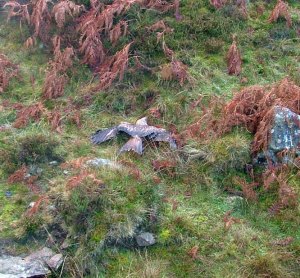
The image below is of the shot golden eagle found on Buccleuch Estate in 2012. He didn’t survive. Nobody has ever been prosecuted for this.

Police are appealing for information following the discovery of a shot dead buzzard in the Loch Lomond and the Trossachs National Park.
The corpse was discovered by a member of the public about half a kilometre east of Ward’s Cottage, Gartocharn at around 2.15pm on Wednesday 5th August. It was found with a bullet wound in its chest.
Anyone with information is asked to contact the police on 101.
Yesterday we blogged about the illegal shooting of Langholm hen harrier ‘Annie’, whose wretched corpse had been found, inevitably, on a Scottish grouse moor in South Lanarkshire (here).

We asked blog readers to contact Environment Minister Dr Aileen McLeod to demand further action against the seemingly untouchable raptor killers. The response to that request was overwhelming – many thanks to all of you who took the time to email her and send her tweets. Within a few hours, an official statement was posted on the Scot Gov website: that’s testament to the bombardment of correspondence sent to the Minister: usually it’s met with silence for the maximum 20 working days in which the Gov has to respond.
So what did the Minister have to say? Here’s the statement in full:
Minister comments on bird of prey shooting.
Commenting on the shooting of a satellite tagged hen harrier, Minister for Environment, Climate Change and Land Reform Dr Aileen McLeod said:
“It is extremely disappointing to hear the news that Annie, one of the satellite tagged hen harriers from the Langholm Moor Demonstration Project, has been shot.
“The Scottish Government remains absolutely committed to working with law enforcement and others to bring an end to this outdated criminal activity. I expect all right minded people involved in the countryside, including with shooting, to agree that wildlife crime has no place in a modern Scotland. I would urge anyone with any information on the latest incident to contact Police Scotland as soon as possible.
“We have been taking action, including seeing the first successful vicarious liability prosecution, and the review of penalties will be reporting in the near future. We have committed to an examination of the regulation of the game shooting industry sector elsewhere and have made clear that, though it would be complex and require primary legislation, the licensing of shooting businesses in Scotland remains one of the options that could be adopted.
“The news about Annie is in stark contrast to recent examples of successful PAW Scotland partnership working to actively improve the chances of this magnificent bird which has been in decline in Scotland.”
END
Now, to those who are new to this game, her response might seem satisfactory. For those of us who are not so new to this game, it was anything but. Here’s why…..
Over two years ago (July 2013), the then Environment Minister, Paul Wheelhouse, announced a series of new measures to tackle raptor persecution (see here).
One of those measures was to conduct a review of wildlife crime penalties. Two years on, that review is yet to be completed.
Another measure was to introduce a system of General Licence restriction orders on estates where raptor persecution was suspected (civil burden of proof as opposed to the more difficult-to-achieve criminal burden of proof). Two years on, SNH has yet to announce the implementation of any restriction order, despite there being a number of suitable candidate estates.
Three and a half years ago (1 January 2012), the new law on vicarious liability came in to force. Three and a half years later, there has only been one prosecution (although a second one is due to begin this month – even so, two prosecutions in 3.5 years is hardly impressive).
Four and a half years ago (February 2011), the now former MSP Peter Peacock suggested a public consultation on whether the SSPCA should be given increased investigatory powers. It took just over three years for the Government to actually launch the consultation (March 2014). The consultation closed on 1st September 2014. Almost one year later, we’re still waiting for the Environment Minister to comment, let alone implement any changes.
Meanwhile, the raptor killing continues.
So, sorry, Minister, if we’re not bowled over by your claim that you ‘have been taking action’. Yes, action is being taken, and that is most welcome, but it’s not nearly enough and it’s not being taken nearly fast enough. Yesterday’s news, of yet another illegally persecuted raptor, is clear testimony to that.
You’re the Environment Minister. It’s your job to deal with this issue. If you can’t handle it, then step aside and let someone else have a go.

A young hen harrier called ‘Annie’ from the 2014 Langholm cohort has been found shot dead on a Scottish grouse moor.
You may recall we blogged about her satellite tag going off the radar in March this year in an area of South Lanarkshire (see here).
Her corpse was retrieved at the end of April after an intensive search by RSPB Scotland Investigations staff and her remains were sent to the SAC Veterinary Lab for post mortem.
The post mortem results have now confirmed that she had been shot.
Stuart Housden, RSPB Scotland Director said: “This case shows very clearly what happens to some of our hen harriers when they leave protected nesting areas and move around the UK’s uplands. This is just the latest incident of criminal persecution of this species, following the confirmed shooting of birds in Aberdeenshire, Moray and Ayrshire in the last two years. It is little wonder these magnificent raptors continue to be absent from large areas of our uplands“.
This news won’t be a surprise to anybody. The chances of bringing anyone to justice for shooting her are nil. She’s yet another victim of the disgusting, vile driven grouse shooting industry. And they will get away with it. Again.
If you share our anger, then turn that anger in to action. Here are two positive things you can do in response:

UPDATE 13.30hrs: Police Scotland has issued a press statement that identifies the location as ‘remote moorland near to Daer Reservior’ (see here). Where’s Daer Reservoir? Why, it’s right here
There was an article in the Daily Record on Saturday about the forthcoming grouse shooting season (the Inglorious 12th) which outlined many of the reasons that have triggered a call to ban the ‘sport’. The piece included extensive quotes from Mark Avery (see here).
SGA Committee Member Bert Burnett has obviously thought long and hard about the arguments against driven grouse shooting and he presented them on his Facebook page on Saturday night. Watch out for a new SGA fund-raising drive to purchase some new crayons for Bert.

On a related issue, he also shared his considered views on the Hen Harrier Day protesters who were due to gather in Perthshire the following day:

On a more serious and sinister note, when one of his Facebook acquaintances suggests that Bert should attend the protest demo, he said this:

It’s a perfectly illustrated example of why so-called ‘partnership working’ is nothing but a sham. It would also be interesting to know how Police Scotland view his comments when they assess his suitability to hold firearms and shotgun certificates. Threat to public safety springs to mind.
‘In public relations, spin is a form of propaganda, achieved through providing a biased interpretation of an event or campaigning to persuade public opinion in favour or against some organisation of public figure. While traditional public relations may also rely on creative presentation of the facts, “spin” often implies the use of disingenuous, deceptive, and highly manipulative tactics” [Wikipedia].
Yesterday (Hen Harrier Day 2015), at 10:03hrs (3 seconds after over 5.6 million thunderclap messages about missing hen harriers were beamed around the world), the SGA posted this image on their Facebook page.
Here’s the text:
Hen Harriers – The Facts
END
Here are some missing facts from a government report that they forgot to include:
Now, this claim of the species being classified as ‘Least Concern’ is often trotted out by those trying to downplay the seriousness of the species’ conservation status in the UK. It is an accurate statement in as much as this is what is written on the species’ IUCN Red List entry (from where the quote is taken), with the addition of one important statement conveniently left out by the SGA – under the heading ‘Major Threats’:
“Persecution is an important threat locally, notably on game preserves in Scotland (del Hoyo et al. 1994)”.
The species’ IUCN listing is fine to use if you want to stick to a species’ global conservation status and ignore its European and UK conservation status. If you look at the IUCN global status for the three wader species for which the grouse shooting industry is often claiming to be the one and only saviour, the IUCN listings also give little cause for concern:
Lapwing – listed as Least Concern. Estimated population c. 5,200,000-10,000,000 individuals. Major threats include land use intensification, pollution and hunting. [Note, no mention of raptors being a major threat].
Curlew – listed as Near Threatened. Estimated population c. 77,000-1,065,000 individuals. Major threats include afforestation, agricultural intensification and hunting. [Note, no mention of raptors being a major threat].
Golden Plover – listed as Least Concern. No population estimate given. Major threats include cultivation and afforestation, severe weather conditions and hunting. [Note, no mention of raptors being a major threat].
So, on the basis of suggesting that the hen harrier’s conservation status is of ‘least concern’ on a global scale [and therefore why all the fuss of losing an almost entire breeding population in England and between 66-72% of the Scottish breeding population?], the statement is equally as applicable to those three wader species, right? We shouldn’t be concerned about any of them because on a global scale they’re all doing just fine, right?
Wrong.
Fortunately, government and non-governmental organisations are a lot more clued in and understand the concept, and importance, of national, regional and local biodiversity. Indeed, the Westminster and Scottish Governments have a statutory responsibility for ensuring that national biodiversity targets are met and maintained (although you wouldn’t know it by their continuing failure to address illegal raptor persecution). Rather than use the broad-based IUCN Red List as guidance, they look to more detailed and relevant assessments such as the UK ‘Birds of Conservation Concern’ scientific review. In this document, the hen harrier and lapwing are red listed, and the golden plover and curlew are amber listed.
It’s quite telling, isn’t it, that those with a vested interest in driven grouse-shooting should continue to not only deny their involvement in the catastrophic loss of hen harriers across the UK, but also continue to downplay its conservation significance.
Please sign the petition to ban driven grouse shooting HERE
‘In public relations, spin is a form of propaganda, achieved through providing a biased interpretation of an event or campaigning to persuade public opinion in favour or against some organisation of public figure. While traditional public relations may also rely on creative presentation of the facts, “spin” often implies the use of disingenuous, deceptive, and highly manipulative tactics” [Wikipedia].
The Scottish Gamekeepers’ Association issued the following press release yesterday lunchtime. Here it is in full:
Estate hope Harriers on their moor are fine after Harrier Protest.
A Perthshire estate hopes a Hen Harrier protest staged next to their ground yesterday (sun) will not have bothered the Hen Harriers which have fledged on their grouse moor.
Campaign groups gathered at Glen Turret reservoir near Crieff to highlight the plight of the birds, three days before the start of the grouse shooting season.
The lobby groups believe some of the birds of prey are being killed on grouse moors because they feed on wild red grouse and their chicks.
However, the estate adjoining the site where the protest was staged has successfully fledged Hen Harrier chicks on its grouse moor this year and are hopeful the protest will not have disturbed the young birds which are just beginning to hunt independently.
An estate spokesperson said: “It was great to see people that share the same interest as ourselves in Hen Harrier conservation. The future definitely lies in co-operation between land managers who produce birds such as Hen Harriers and those who wish to see and enjoy them.
“We regularly have Harriers here on our grouse moor and we are lucky to have had successes this year, despite the weather. Naturally, our concern is for the birds because we have had nests of differing species abandoned, due to members of the public or photographers visiting the nests.
“We have restricted the activities of the estate around the nests so the birds get the best chance they can to grow and hunt in peace. Obviously, the gamekeepers will be checking the area to make sure the young birds are fine, but we are hopeful everything has gone off, well.”
The estate bordering the protest was audited recently, with RSPB counts in 2012 showing 9 raptor species on the grouse moor, 6 of which are known to have bred.
The estate is also a haven for other birds with two species of eagle recorded.
END
It’s fascinating that the SGA is attempting to infer that a group of peaceful protesters might ‘disturb’ some birds on an adjacent site by standing in the rain for a couple of hours, chatting, miles from any nests. No mention then of the start of the grouse shooting season in three days time where large groups of beaters will be marching across the moor waving flags, shouting and whistling as they scare (‘drive’) any bird in their path (but notably red grouse) towards a line of grouse butts where another load of people will be standing with guns to blast the birds to bits. Which activity do you think is likely to cause the most ‘disturbance’?
But what’s particularly interesting about this press release is the claim that there was a successful hen harrier breeding attempt on this driven grouse moor this year. Why is this interesting? Well, because the one known hen harrier breeding attempt on this site actually failed about a month ago [cause of failure unknown].
Now, of course, it’s possible that there was a second hen harrier breeding attempt on this estate, and that the raptor workers who closely monitor this site just missed it, and that the breeding attempt was successful and that there are indeed now young hen harriers “which are just beginning to hunt successfully”. If that is the case, then presumably the estate will have notified SNH’s ‘Heads up for Hen Harriers Project’ because, like all good Scottish sporting estates, this one will be keen to cooperate (we’ll be blogging more about the Heads up for Hen Harriers project in a separate ‘spin’ blog, to be posted later).
Up until a few years ago, this estate was part of the Operation Countrywatch Partnership – we blogged about it here and applauded their efforts. Funny thing is, this estate pulled out of the project shortly after it was suggested that nest cameras could be installed at hen harrier nests to better understand the causes of breeding failure regularly being recorded in this area. However, it was probably just a complete coincidence that the estate pulled out at that time and there will undoubtedly be an unrelated and perfectly reasonable explanation for their withdrawal.
Also interesting to note the final sentence of the press statement. Two species of eagle have indeed been ‘recorded’ on this estate (note the ambiguous choice of word – ‘recorded’ can mean a breeding attempt but it can also mean something was simply observed flying over/passing through). Just for the record, there aren’t any officially recorded white-tailed eagle breeding attempts on this estate, but golden eagles have certainly bred there in the past. Funny thing is, this year the golden eagle nest site was burnt out and the eagles moved to another estate for their breeding attempt. Those spontaneously combusting nests are a real problem on driven grouse moors, it seems.
The photograph shows some of the people who attended the Hen Harrier rally in Perthshire yesterday. Well done to those who organised it and also to those who turned out to support it.


Well done Mark Avery and Susan Cross for organising an extraordinary Hen Harrier Evening in Buxton last night. More on this later, but special mention to the Wilde family for their brilliant props including a massive gin trap, poison bottle and a life-size grouse butt. They must have spent many many hours creating these.
The grouse butt will be relocated to the Goyt Valley this morning for the Peak District Hen Harrier Day rally.
Good luck to everybody organising or attending a Hen Harrier Day event today – the fight back is really on.
Marks and Spencer has announced it won’t be selling red grouse in its stores for the second year running. Excellent!
Read their statement here.
It’s quite interesting that the reason given is “because of the cold wet spring and the toll this took on red grouse on our single estate in the Scottish Borders, we won’t be selling grouse this year – as a responsible retailer, we believe that conserving the birds this year is the right thing to do. We intend to stock grouse next year, assuming the weather allows us too! [sic]”.
It’s hard to imagine that if M&S really wanted to sell red grouse they wouldn’t be able to find another stockist – there are over 400 grouse moors in the UK. Do they really only source their grouse from one (as yet unnamed) estate in the Borders? Are they saying that the other 400+ grouse moors don’t meet the requirements of their (as yet un-described) Responsible Sourcing Code? Or is what they really mean that they can’t find any grouse moor in the UK that meets the requirements of their Responsible Sourcing Code but they don’t want to say that for fear of a customer backlash/possible boycott by those who support grouse shooting? If so, using the ‘poor weather’ as a reason is quite clever as it keeps all customers happy: ‘we’ are happy because they’re not selling red grouse and ‘they’ [grouse industry supporters] are happy because M&S isn’t publicly saying that red grouse is an unethical, unhealthy and unsustainable product (which it is).
Whatever, we’re delighted that M&S won’t be stocking red grouse this year and we also applaud them for trying to develop a new Responsible Sourcing Code – we look forward to finding out just what that code entails in due course.