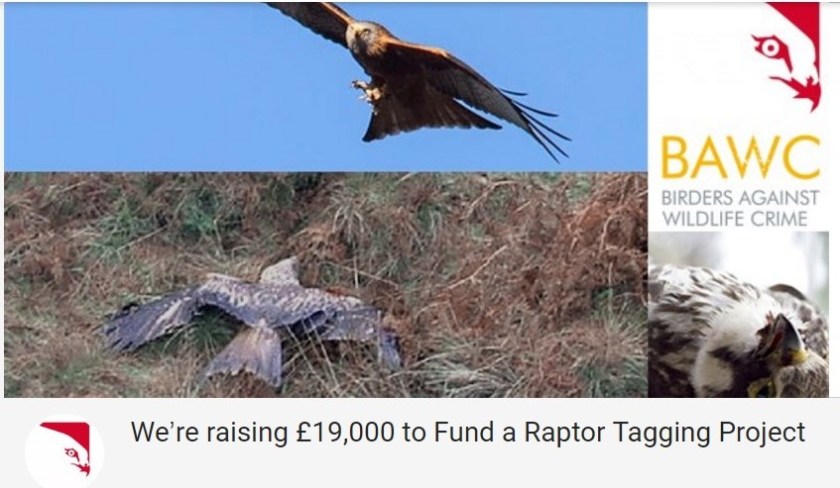
Crowdfunding appeal to help support Hen Harrier Day 2017 in Scotland

Hen Harrier Day, now in its fourth year, has quickly become established as THE day to raise awareness about the illegal persecution of hen harriers in the UK.

The idea was first mooted by Mark Avery, who suggested using the anniversary of the shot hen harriers at Sandringham to ‘stir things up’ each October  with a ‘Harrier Day’ (see page 203 in his book Fighting for Birds).

The idea was later developed by Alan Tilmouth who was working with Birders Against Wildlife Crime (BAWC), and he suggested having a Hen Harrier Day in August, just prior to the start of the grouse shooting season. This made perfect sense given that hen harrier persecution is so closely associated with driven grouse shooting.

From humble beginnings in 2014, Hen Harrier Day has grown and draws wide media attention across the country, much to the consternation of the grouse shooting industry. Last year, BAWC helped coordinate 12 events in England, Scotland and Northern Ireland (see here for an overview) and preparations are now underway for 2017.

In Scotland, Tayside and Central Raptor Study Groups are planning another Hen Harrier Day event and they need your help. They would like to be able to hire a marquee to provide a more robust venue and offer a bit of protection from inclement weather. A crowdfunding page has been set up to raise £500 to cover this cost.

If you’d like to donate, please visit the donations page HERE

If you’re unable to donate but would still like to offer support, please spread the word amongst your friends, family and colleagues.

Thanks!

UPDATE 16 January 2017: The target of £500 has been met! Many thanks to all who helped with this.

Public funds to promote wildlife criminals in Scotland?

In December 2016 we blogged about the ‘Game for Growth’ strategy, which is a plan to promote Scottish country sports and boost its value to the economy. The strategy, which was launched at a parliamentary reception on 20th December 2016 (here) is being led by the Scottish Country Sports Tourism Group (SCSTG) and is being part-funded by VisitScotland using tax payers’ money (see here).

You may recall that Scottish Greens MSP Andy Wightman lodged a parliamentary question about the use of these public funds, as follows:

Question S5W-05930: Andy Wightman (Lothian, Scottish Green Party). Date lodged: 22/12/2016

To ask the Scottish Government whether it will provide a breakdown of the recipients of financial contributions from VisitScotland to the strategy, Game for Growth Strategy – Country Sports Tourism in Scotland 2016; what information it has regarding how each recipient will use this; what action it has taken to ensure that no money was provided to the owners or managers of landholdings on which crimes against wildlife have been committed; whether it will publish the strategy on its website, and what aspects of this it is supporting or plans to support with public money.

This question has now been answered:

Answered by Fiona Hyslop MSP (Cabinet Secretary for Culture, Tourism & External Affairs) on 11/1/2017:

VisitScotland has approved a grant of £17,925 to the Scottish Country Sports Tourism Group to promote Scotland as the destination of choice for all country sports. The Group will use this to develop content and supporting digital activity to attract visitors from across the UK and Scandinavia. As this money is for a specific project, no funding will be provided to individual estates or land owners. There is no intention to publish the strategy on VisitScotland’s website and so there will be no funding support for this.

It’s an interesting response. It does clarify that public funds (at least these public funds) will not be given directly to individual estates or landowners, but it is also clear that individual estates will still benefit from this public funding, albeit indirectly, because the SCSTG will use the funds to promote these individual estates as part of an online PR campaign.

In our December blog, we noted that the SCSTG website was promoting the Dunmhor Sporting Agency as a provider of country sports activities in Scotland:

We were surprised to see Dunmhor Sporting being promoted on the SCSTG website because Graham Christie of Dunmhor Sporting was convicted in December 2015 of being vicariously liable for the criminal actions of his gamekeeper, who had used an illegal gin trap to catch and injure a buzzard on the Cardross Estate. We just looked at the SCSTG’s website again and Dunmhor Sporting is still being promoted as a country sports provider.

So much for the game shooting industry ousting its criminal members.

We wonder whether the Cabinet Secretary for Culture, Tourism & External Affairs, Fiona Hyslop, is aware that a now (part) publicly funded organisation (the Scottish Country Sports Tourism Group) is promoting a convicted wildlife criminal and if so, whether she thinks this is an appropriate use of public funds?

Emails to: scottish.ministers@gov.scot and mark it FAO Fiona Hyslop

Where’s that SNH review of European gamebird licensing systems?

Pressure is mounting for the publication of SNH’s review of the systems used to regulate gamebird hunting in other European countries.

This review was first commissioned over two and a half years ago by former Environment Minister Paul Wheelhouse, during a parliamentary debate on wildlife crime / raptor persecution, way back in May 2014 (see here).

Nothing happened.

Seventeen months later in December 2015, Claudia Beamish MSP lodged a parliamentary question about the lack of progress:

Question S4W-28992 (date lodged: 16/12/15):

To ask the Scottish Government when it will carry out the review of gamebird licensing and legislation agreed by Paul Wheelhouse in May 2014; who has been appointed to conduct the review, and when it expects the report to be published.

Answered by Aileen McLeod MSP (the then Environment Minister) 11/1/2016:

Tender documents were issued by Scottish Natural Heritage (SNH) on 11 December 2015, inviting bids from contractors to carry out the review of gamebird licensing and legislation in other European countries. The deadline for quotes to be submitted to SNH is 20 January 2016. We expect work on the review to commence in early 2016 and for the report to be published in autumn 2016.

Nothing appeared in the public domain so in August 2016 Claudia Beamish MSP submitted another parliamentary question:

Question S5W-02043 (date lodged: 18/8/16):

To ask the Scottish Government, further to the answer to question S4W-28992 by Aileen McLeod on 11 January 2016, on what date the gamebird licensing and legislation report will be published.

Answered by Roseanna Cunningham MSP (current Cabinet Secretary on Environment) 25/8/16:

Further to the answer to question S4W-28992 by Aileen McLeod on 11 January 2016, the review of gamebird licensing and legislation is currently being finalised and will be published in Autumn 2016.

Still nothing, so in October Mark Ruskell MSP lodged a parliamentary question:

Question S5W-04342 (date lodged 31/10/16):

To ask the Scottish Government when the Scottish Natural Heritage review of gamebird licensing systems in other European countries will be published.

Answered by Roseanna Cunningham MSP (Cabinet Secretary on Environment) 8/11/16:

The Scottish Government commissioned Scottish Natural Heritage to carry out a review of gamebird hunting in selected other countries. This is currently being finalised for submission to Scottish Ministers and we anticipate that it will be published shortly.

It’s now January 2017 and still no sign of the report that was promised “in Autumn 2016”, so Mark Ruskell MSP (Scottish Green Party) has submitted another parliamentary question:

Question S5W-06033 (date lodged 10/1/2017):

To ask the Scottish Government, further to the answer to question S5W-04342 by Roseanna Cunningham on 8 November 2016, on what date the SNH review of gamebird licensing systems in other European countries will be published.

Expected answer date: 24/1/2017.

It is our understanding that the authors of this report submitted their findings to SNH eight months ago, in May 2016. According to the parliamentary answers above, the report was being ‘finalised’ in August and was still being ‘finalised’ in November!

There is great anticipation amongst conservationists to see this report published. The findings are expected to demonstrate just how poorly regulated gamebird hunting is in Scotland in comparison to the more progressive policies implemented in other European countries. If that is what the report’s findings show, this will add considerable pressure on the Scottish Government to introduce a licensing scheme.

Photo by RPUK

Satellite-tagged hen harrier ‘Highlander’ is probably still alive

Last spring, a satellite-tagged hen harrier called ‘Highlander’ joined the ranks of the ‘missing’ as her sat tag suddenly stopped transmitting over a grouse moor in Co Durham (see here).

When you consider the extraordinarily high disappearance rate of young, tagged hen harriers (78.7% as of 2014) and the absence of breeding hen harriers on almost every driven grouse moor in the country, it wasn’t unreasonable to conclude that she’d been illegally killed.

But in Highlander’s case, she just may be the one who got away and against all the odds, survived past her second birthday. According to the RSPB’s Skydancer blog (see here), Highlander may still be alive and the cause of her ‘disappearance’ is likely to have been a satellite tag technical failure.

Predictably, the usual suspects from within the grouse shooting industry have already taken to social media to use today’s news as an opportunity to pretend that hen harriers are not routinely killed on grouse moors but that the many hen harriers that have been reported as ‘missing’ over the last ten years have suffered from satellite tag technical faults. That may be plausible for one or two ‘missing’ birds, but unfortunately for the grouse shooting propagandists, these technical failures don’t happen very often, and nor do sat tag technical failures explain the absence of breeding hen harriers on most driven grouse moors.

We know from a study of Montagu’s harriers, fitted with exactly the same type of tag as the UK hen harriers, that technical failures amount to just 6% (n = 67 tagged birds). Highlander’s failed tag is the first technical failure the RSPB has recorded (n = 23 tagged birds) so this failure rate is well within the expected range.

Satellite tag failure rates will be further scrutinised in the forthcoming review of satellite tag data from hen harriers, golden eagles and red kites in Scotland, which is expected to be completed by March. We know the grouse shooting industry is extremely twitchy about this review because they know as well as we do what the results are likely to show, and it won’t be good news for them. So it’s unsurprising that they’ll use every opportunity presented in the run up to that report being published to discredit the data, discredit the researchers who fit the tags, and discredit the tag-fitting techniques. Interestingly, you don’t see them trying to discredit the data, researchers or techniques associated with the satellite-tracking of woodcock (GWCT) or cuckoos (BTO) – it’s only the upland raptors. Funny that.

Photograph of Highlander (right) and her sister Sky being satellite tagged at their nest in Bowland in 2014 (photo by Mick Demain).

Hen Harrier ‘reintroduction’ to southern England: Wiltshire

As part of DEFRA’s Hen Harrier Inaction Plan, we know that a ‘reintroduction’ of hen harriers is planned for southern England.

We know that a (flawed) feasibility study funded by Natural England had identified two main areas of interest: Wiltshire and Exmoor (see here). We discussed the bonkers plan for Exmoor a few days ago (here). This blog is all about the proposed reintroduction of hen harriers to Wiltshire.

In May 2016, the Reintroduction project team discussed their early communications with stakeholders in potential reintroduction areas in Wiltshire. The following notes were recorded:

TD [Teresa Dent, GWCT] has had some early conversations with people likely to be helpful/key in helping communicate the proposals in southern England in particular [redacted] who is closely involved in the Marlborough Downs NIA [Nature Improvement Area] and has an application in for the Facilitation Fund to develop a farmer cluster in the Salisbury Plain area. There may already be an opportunity to raise the subject of the reintroduction via a raptor group meeting associated with the NIA in September‘.

Here’s a general map of the area:

In July 2016 the Reintroduction project team was updated with this:

AJ [Adrian Jowitt, Natural England] and Stephen Murphy [Natural England] down to talk to a group of farmers in early October but will try to make some further proactive engagement with key people before then‘.

In October 2016, the Reintroduction project team was updated with this:

A meeting proposed for the Marlborough Downs was cancelled due to fears that it would prove unproductive due to concerns raised by some of the shoots in the area.

A meeting was held with the MoD at Salisbury Plain which was positive; they are happy to continue to work with us.

AJ [Adrian Jowitt] and [redacted] meet with the “Delta Group”; a group of MoD tenants who farm around the Plain. Although poorly attended the proposals were positively received. The farmers there are already use [sic] to Montagues [sic] Harriers. There was acknowledgement that there were some shooting interests, not present, who may have concerns and it was agreed to try and have 1-2-1 meetings with those land managers. Further AJ will look to attend the Delta Group’s AGM so that farmers could discuss the proposals with him there‘.

An action point from this October meeting was: ‘CP [Christopher Price, CLA] to have some 1-2-1 conversations with CLA members involved in the proposed reintroduction areas‘.

We were fascinated to read about the lack of support from shooting interests in the Marlborough Downs area. This area is pretty close to Salisbury Plain (the apparently favoured reintroduction area) – a distance of approx 11.5km. Do you think the IUCN guidelines would be met if hen harriers were released on Salisbury Plain, in full knowledge that known hostile shoots are in such close proximity? Seems pretty doubtful to us.

Galloway Red Kite Trail worth £8.2 million to local economy

A good news story!

RSPB Press Release, 10 January 2017

Wildlife Trail Generates Millions for Economy

Tourists spend £8.2 million in Dumfries & Galloway after travelling to see red kites

People visiting Dumfries and Galloway to see the region’s red kites have contributed over £8.2m to the local economy, a new report has found.

These birds of prey were re-introduced to an area north of Castle Douglas from 2001 and two years later the Galloway Kite Trail – a self guided tour circling Loch Ken – was launched as a partnership project led by RSPB Scotland.

An economic survey carried out by the conservation organisation found that between 2004 and 2015 the trail attracted over 100,000 visitors to the area and that £8.2m of spending was directly attributable to people who came to the region to see red kites. On average, the trail also supported the equivalent of 19 full-time jobs each year – however that figure rose to 21 in 2015.

Calum Murray, RSPB Scotland Community Liaison Officer, said: “The re-introduction of red kites has been a massive conservation success story and we now have over 100 pairs breeding in Dumfries and Galloway, but this survey clearly demonstrates how nature can bring economic benefits to areas as well.

Tourists are visiting the Galloway Kite Trail from all over the UK and many are coming here especially to see our amazing red kites. The report also shows the fantastic support that is being given to the trail by local businesses and many of our visitors are now making repeat trips!

The Galloway Kite Trail is a community based project facilitated by RSPB Scotland, in partnership with Forestry Commission Scotland and Bellymack Hill Farm, which takes visitors to some of the best locations in the region to see red kites – as well as promoting activities and services provided by local businesses.

Overall visitors to the Galloway Kite Trail spent an estimated £54.6million in the region.

Doug Wilson, VisitScotland Regional Director, said: “The Galloway Kite Trail has been a fabulous success story, in many more ways than one. As an ambitious nature conservation project, it has achieved outstanding results in terms of increasing red kite numbers, educating the public about these spectacular birds of prey and raising awareness of RSPB Scotland’s superb efforts to protect them and their habitat and encourage breeding.

The Kite Trail has also become an outstanding asset in Dumfries and Galloway’s incredible portfolio of outdoors activity attractions, giving visitors another great reason to come to the beautiful Galloway Forest Park and explore the stunning Loch Ken area. Having attracted well over 100,000 visitors, the trail has delivered significant benefits to tourism within the region and the impact on our local economy has been tremendous.”

Red kites were persecuted to extinction in Scotland in the 19th century but have now made a comeback in many parts of the country. These graceful birds, which are slightly longer-winged than buzzards, feed mainly on carrion and small mammals and often come together in groups during the winter to roost.

Kites are now breeding in all three vice-counties in Dumfries and Galloway with a nesting pair discovered near Stranraer in Wigtownshire last year. A total of 105 breeding pairs were counted in surveys in summer 2016, with at least 120 young fledged.

ENDS

For more information about the Galloway Kite Trail visit this website here or download a Trail leaflet here.

A fantastic success story, both in terms of the conservation of the red kite and as a demonstration of the value of these birds to the local and regional economy. Great stuff, and in sharp contrast to the fortunes of red kites in northern Scotland, where a report published in October 2016 revealed that the high rate of red kite persecution in that area is just as bad as it was 25 years ago.

General Licence restriction on Raeshaw Estate: judicial review this week

The long-awaited judicial review of SNH’s decision to impose a General Licence restriction order on Raeshaw Estate finally gets properly underway this week.

SNH imposed the General Licence restriction on Raeshaw Estate (a grouse moor estate near Heriot in the Scottish Borders) in November 2015. The restriction was implemented due to alleged raptor persecution incidents reportedly taking place on the estate (according to evidence provided by Police Scotland), even though nobody has been charged with any criminal offence and the estate has denied any responsibility.

In April 2016 Raeshaw Estate petitioned for a judicial review of SNH’s action. Since then there have been a number of preliminary hearings but now the case has reached the final stage – a two day substantive hearing will take place tomorrow and Friday (Thurs 12 & Fri 13 Jan 2017) at the Court of Session.

We have no idea when the legal ruling will be made public; it could be a matter of days or it could be months.

This judicial review is an important test case with potentially far-reaching consequences. If the court decides that SNH acted fairly, then presumably SNH will get on with issuing other General Licence restrictions to other estates where Police Scotland has evidence of raptor persecution incidents having taken place since 1 January 2014. There are several of which we’re aware. Although it could be argued that if SNH continues to subsequently issue ‘individual’ licences to those penalised estates, the purpose and effectiveness of the original General Licence restriction order is lost (e.g. see here, here).

If the court decides that SNH acted unfairly in imposing a General Licence restriction, then either the process for implementing a General Licence restriction will have to be revised or the scheme scrapped altogether. If it’s scrapped, that’ll leave the Scottish Government in an interesting position. The Government often points to the use of General Licence restrictions as an indication of its commitment to addressing raptor persecution. If the ability to impose a General Licence restriction is removed by the outcome of the judicial review, what other sanction could the Government introduce? Shoot licencing is looming large on the horizon….

Withheld raptor crime data: some info for DCS Scott of Police Scotland

This morning the Scottish Parliament’s Environment, Climate Change & Land Reform (ECCLR) Committee heard evidence on the Scottish Government’s 2015 annual wildlife crime report.

The archived video can be viewed here.

The official transcript can be read here: ecclr-transcript-wildlife-crime-10-jan-2017

The session was dynamite and there are many things to discuss – we’ll be blogging a lot more about this in the coming days but we wanted to start with the issue of withheld raptor crime data.

As some of you may remember, we criticised the Government’s annual wildlife crime report when it was published in November, precisely because we knew that several confirmed raptor crimes had not been included in the data presented to the Government by Police Scotland (see here). At the time, we didn’t elaborate on which specific crimes had been withheld from the report but we argued that the withholding of data completely undermined the public’s confidence in the report’s findings.

We were delighted to see this issue raised at this morning’s evidence session by Mark Ruskell MSP (Scottish Greens), and with devastating aplomb.

In the video link above, the discussion starts at 1:06:31.

Mark asked the Police Scotland representatives (ACC Steve Johnson and DCS Sean Scott) why some raptor crimes that had been recorded by RSPB Scotland had been excluded from the Government’s report. DCS Scott looked blank, and then mumbled something about perhaps the crimes weren’t actually crimes at all so they wouldn’t have been recorded. Mark pressed on and gave DCS Scott specific details about the crimes in question and even showed him a photograph of one of the illegally set traps involved, to check that it was indeed an illegally-set trap and thus a confirmed crime. DCS Scott maintained he didn’t know about these specific crimes, even when Mark gave him more detailed information about the location. This went on for some time and it was excellent to see Mark’s persistence and his unwillingness to be fobbed off. Eventually, DCS Scott committed to finding out about these specific crimes and gave assurance that he would later write to the ECCLR Committee to explain why these data had been withheld from the Government’s report.

To help DCS Scott, here’s some background about these specific crimes:

If you look at Table 19 in the Scottish Government’s 2015 annual wildlife crime report, there is a list of raptor persecution crimes and the data are attributed to Police Scotland. Listed under Lothian & Borders, Police Scotland recorded the following incidents between April 2014-March 2015:

Peregrine shooting (Sept 2014)

Attempted trapping (species not identified) (Sept 2014)

Buzzard shooting (October 2014)

Tawny owl shooting (Dec 2014)

Now, compare the Police Scotland data with the data published in Table 4 in the RSPB’s annual report – ‘The Illegal Killing of Birds of Prey in Scotland, 1994-2014, A Review‘. In that report, listed under Scottish Borders, the RSPB has recorded the following additional confirmed crimes for the same time period, that were excluded from the Police Scotland data in the Government’s annual report:

Crow trap baited with 2 live pigeons, surrounded by 4 set spring traps, nr Heriot (May 2014) – there is even a photograph of this illegally-set trap on page 16)

and

4 x shot buzzards, nr Heriot (May 2014).

pigeon-in-trap-heriot-2014

rspb-table-4

It was later revealed during the second part of the ECCLR Committee evidence session this morning, in evidence given by Ian Thomson (Head of Investigations, RSPB Scotland) that the above offences were uncovered during a Police Scotland-led multi-agency raid on this estate ‘nr Heriot’, so it is somewhat surprising that DCS Scott claimed to have no knowledge about them.

In due course we look forward to reading DCS Scott’s written explanation about why these data were withheld from the Government’s 2015 annual wildlife crime report.

In the meantime, kudos and thanks to Mark Ruskell MSP, who was one of several MSPs who performed exceptionally well at this morning’s evidence session. More on that in later blogs…..

Scottish Environment Committee takes evidence on wildlife crime: Tuesday 10th January

As we blogged last week (here), this morning the Environment, Climate Change & Land Reform (ECCLR) Committee will take evidence on the Scottish Government’s 2015 annual wildlife crime report.

This should be a fascinating session as for the first time, rather than just hearing from Police Scotland and the Crown Office, the Committee will also take evidence from a number of other experts and stakeholders, including RSPB Scotland, Scottish Badgers, Scottish Gamekeepers’ Association and the Bat Conservation Trust. We consider this to be important progress that will help the Committee hold the statutory enforcement authorities to account and we very much welcome it.

As a warm-up to the main event you can read the fairly hard-hitting written evidence submitted to the ECCLR Committee by RSPB Scotland: rspb_written_evidence_ecclr-committee_jan2017

There are a number of extremely well-informed cross-party MSPs on this ECCLR Committee so we anticipate some strong questioning.

The session starts at 09.30hrs and can be watched live on Scottish Parliament TV here.

UPDATE 8pm: For those were unable to watch the live session, the archive video can be watched here. The official transcript can be read here: ecclr-transcript-wildlife-crime-10-jan-2017

ecclr-agenda-2

Hen Harrier ‘reintroduction’ to southern England: a bonkers proposal for Exmoor National Park

As part of DEFRA’s Hen Harrier Inaction Plan, we know that a ‘reintroduction’ of hen harriers is planned for southern England.

We know that a (flawed) feasibility study funded by Natural England had identified two main areas of interest: Wiltshire and Exmoor (see here). We’ll discuss Wiltshire in a separate blog. This blog is all about the proposed reintroduction of Hen Harriers to Exmoor National Park.

enpa

We’ve gleaned the following information from a series of FoIs:

At a Hen Harrier reintroduction project team meeting in July 2016, Adrian Jowitt (from Natural England) reported to the group that he had started conversations with Exmoor National Park Authority (ENPA), the Greater Exmoor Shoot Association (GESA), the National Farmers Union (NFU) and the National Trust (NT). Adrian told the project team that he had a further meeting planned in September but that so far ‘generally feedback has been positive although some concerns about what was in a project of this kind for the land managers, and worries over potential to have to change land management practices in the future should the birds become established. National Trust very positive at both a national and local level. It was agreed that we should invite NT to join this group‘.

The following month (10 August 2016) a ‘Hen Harrier’ meeting was held between Natural England, GESA, Exmoor National Park Authority and an unnamed consultant. What happened at this meeting is simply unbelievable.

Here are the notes from that meeting: brief-note-of-hen-harrier-meeting-aug-10_redacted

The meeting participants felt that ‘it would not be easy to reintroduce hen harriers‘ (although the rationale behind this view wasn’t given) ‘but not impossible‘.

According to the notes from this meeting, ‘the group’s main concern was around sufficient food supplies. Harriers had attempted to nest in recent years but not settled. Lack of food may have been an issue. GESA was keen to trial the reintroduction of red grouse to help secure a reliable food supply. This could have the added benefit of encouraging heathland management‘.

What a brilliant idea. Introduce some red grouse (on the pretence that reintroduced hen harriers will starve without them) and thus pave the way for the development of driven grouse shooting in Exmoor National Park. Yep, that’ll work a treat because everyone knows how well hen harriers do on driven grouse moors. It’s not like there’s ever been a conflict of interest between grouse moor managers and hen harriers. It’s not like grouse moor managers have ever killed so many hen harriers that the HH breeding population is on the point of extinction in England.

WTAF?!

Later on in this meeting, it was decided that rather than just focus solely on hen harriers, the project should be seen as ‘bringing moorland birds back to Exmoor – e.g. red (and potentially) black grouse, merlin, ring ouzel etc as well as hen harrier‘.

It was agreed that this idea would be discussed further at GESA’s annual meeting at the end of August. And it was. Here is the agenda for that GESA meeting: greater-exmoor-game-shoots-draft-agenda-aug-31_redacted

We don’t know exactly what was said at that GESA annual meeting at the end of August but we know a little bit. Adrian Jowitt reported back to the HH reintroduction project team in October 2016 and this is what was recorded in the meeting notes:

AJ and [redacted] attended a meeting with Exmoor National Park and GESA. A number of views were expressed, some very positive but one, from the shooting perspective, clearly against the idea of reintroduction. The fears raised were that a reintroduction would lead to increased scrutiny of their legal activities and if the project was unsuccessful the shoots would be blamed. They did not see Harriers as being a direct issue for the shoots‘.

Increased scrutiny of legal activities, eh? What a shocker. Although not a shocker when you start to look at some of the names involved with shoots on Exmoor….some of those names are quite familiar to us and have strong connections to certain grouse moors in northern England and Scotland. It’s no surprise that those individuals would not want increased scrutiny on Exmoor if their activities in the northern uplands are a measure of their attitude to the law.

So what next for the bonkers proposal for Exmoor National Park? Well, it looks like they’re still going for it. Here is some email correspondence from Sept 2016 between Adrian Jowitt and Sarah Bryan of Exmoor National Park Authority (she was Head of Conservation & Access at ENPA at the time these emails were written, but she’s recently been promoted to Chief Exec of ENPA): email-correspondence-sarah-bryan_adrian-jowitt-re-moorland-bird-project-exmoor

An FoI has been submitted to ENPA to find out more details about the planned ‘moorland bird project’.