
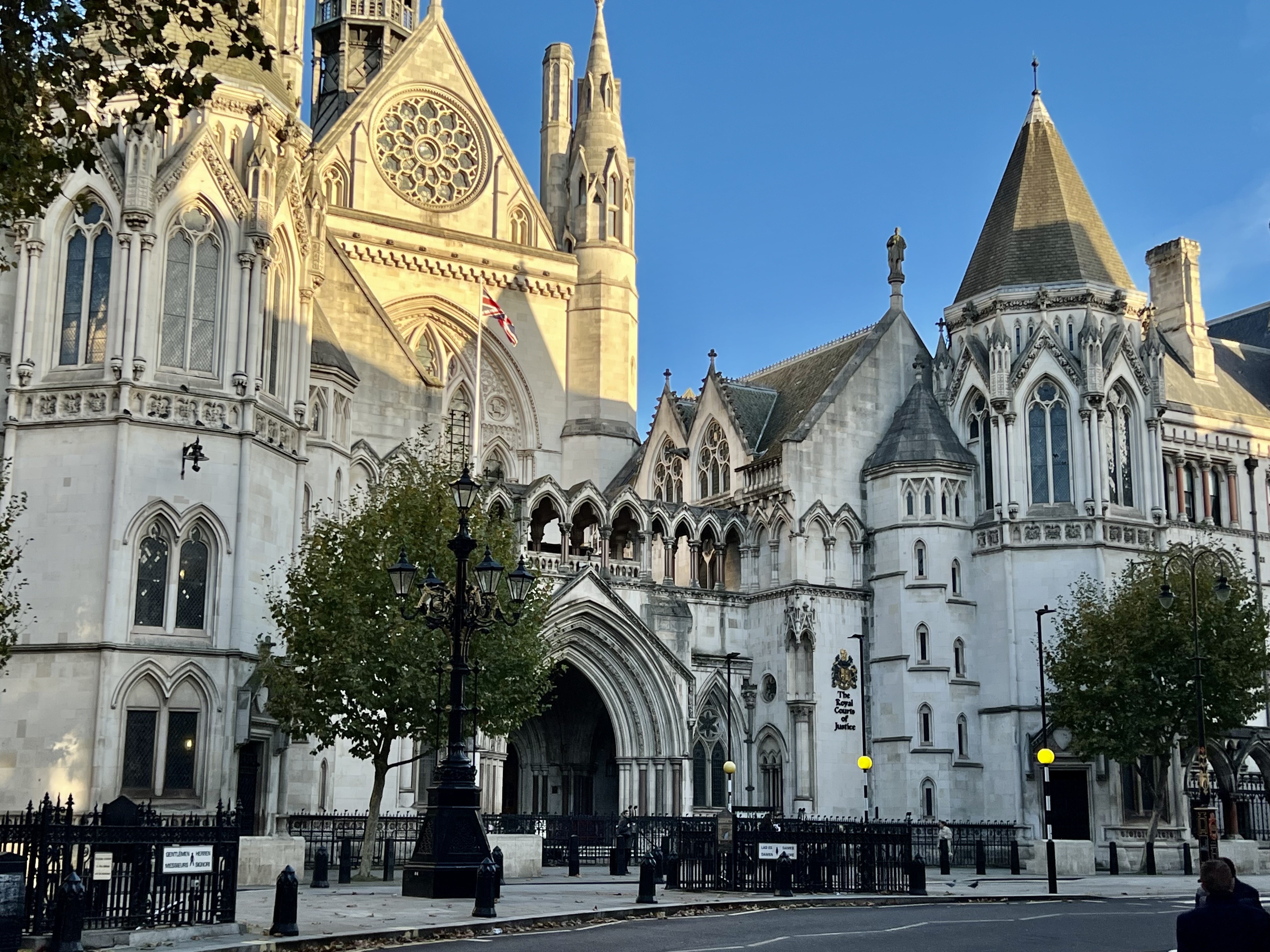
On Thursday this week, the High Court issued its judgement on a legal challenge, brought by the British Association for Shooting & Conservation (BASC) against Natural England, concerning the licensing of gamebirds on internationally important sites in England (Special Protection Areas).
If you’ve been reading the subsequent press coverage, and the reaction of many gamebird shooters on social media, you’d be forgiven for thinking that the court has just overturned the recent gamebird licensing rules on Special Protection Areas and that gamebird releases can once again be undertaken anywhere, at any time, without restriction.
But that is far from being accurate.
Here, I will try to clarify the actual situation, with the caveat that this is my own personal interpretation, and I’m not a lawyer, but have been closely involved with the gamebird licensing issue for several years through my work with Wild Justice, and, with colleagues, attended BASC’s judicial review hearing in London on 1st July 2026 to listen to the evidence in this particular case.
First, some background.
In 2020, Wild Justice won a significant legal challenge against Defra, forcing it to introduce a licensing scheme for the release of gamebirds (Pheasants & Red-legged Partridges) on or near Natura 2000 sites to control ecological damage (see here). General Licences 45 and 43 were now required for gamebird releases on or within 500m of Special Protection Areas (SPAs) and Special Areas of Conservation (SACs) respectively, regulating and restricting release densities on, or close to, these sensitive sites.
On 21 March 2025, Defra announced that it would not be issuing General Licence 45 for the 2025/26 shooting season, but instead applicants could apply for an individual licence, on a site-by site basis, because:
“It is currently not possible to rule out the risk of highly pathogenic avian influenza (HPAI) (which is currently very high) spreading to the bird features present on SPAs”.
Natural England (responsible for individual licences) went further, and on 14 April 2025 it advised the gamebird shooting industry that although they could still apply for individual licences for 2025 gamebird releases on or close to SPAs, some licences would only be permitted with a delayed release date for the poults, whereas licences for many other SPAs would be unlikely to be issued at all.
On 9 March 2026, Natural England announced the continued withdrawal of GL45 for the 2026/7 shooting season, and this year, for the first time, stated that individual licences would likely not be issued for the large Breckland SPA in Norfolk and Suffolk, due to the continuing very high risk of spreading Highly Pathogenic Avian Influenza (Bird Flu). Individual licences for restricted gamebird releases on certain other SPAs would still be issued, again with a delayed release date, to minimise the risk of transmitting HPAI and to protect wild birds of high conservation value for which the SPAs had been designated.
Importantly, the conditions of the individual licences in both years included a provision to not only prevent the release of gamebirds on/close to the SPA before a specified date, but also to prevent the keeping of those gamebirds on the site, prior to the specified release date. It’s crucial to understand this context, to be able to interpret the court’s recent ruling.
BASC’s legal challenge
In autumn 2025, BASC submitted an application for judicial review of Natural England’s licensing condition preventing the keeping of gamebirds inside pens on, or within 500m of, the SPA, arguing that this condition was ultra vires, i.e. it went beyond the scope of Natural England’s powers, because the keeping of gamebirds in pens is not the same as releasing gamebirds from pens, and was thus unlawful.
Although, if you’d read some of BASC’s media output about the legal challenge, this distinction wasn’t made. BASC had framed the legal challenge as follows:
“At the heart of the case is Natural England’s decision to impose a licensing regime for the release of pheasants and red-legged partridges on or near Special Protection Areas (SPAs).
“BASC believes this approach is legally flawed, unnecessary and disproportionate — particularly for shoots that have operated responsibly for generations under established codes of practice.
“The High Court has agreed there is a case to answer. A full hearing is expected later this year” (from a BASC press release, 2 March 2026).
I would argue that this framing by BASC was misleading, because it implied (to its members) that BASC was challenging the fundamental principle of licensing for gamebird releases on/near SPAs, when actually it was only challenging a condition of that licensing – that of preventing the keeping of gamebirds on site (in pens) prior to actual release, rather than the licensing of gamebird release.
BASC’s legal challenge also included an argument that release pens that straddled an SPA’s 500m buffer zone should not be subject to licensing.
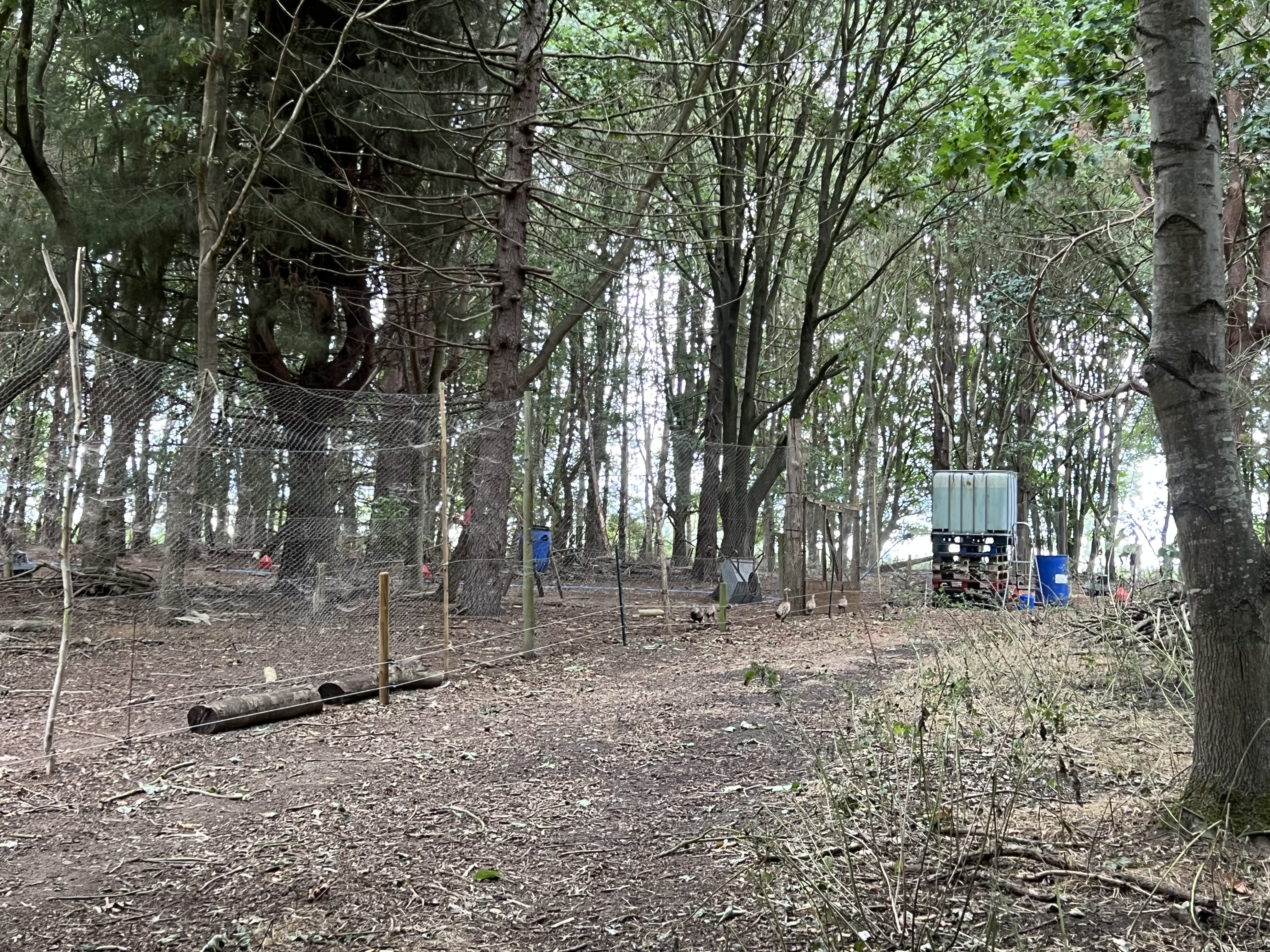
Natural England defended its position that the licensing condition was lawful, and argued that the restriction on the “release [of gamebirds] into the wild” also covered the keeping of gamebirds in enclosures/pens prior to release, to protect the integrity of the protected site on which the enclosures/pens were situated, and to minimise the very high risk of transmitting HPAI between the penned gamebirds and any wild birds that could access the pens.
I’ve not included the specific, technical legal arguments here because they are long and detailed. They reminded me a lot of the absurdity of Schrodinger’s Pheasant, although instead of debating when is a Pheasant ‘wild’ and when is it ‘livestock’, this time the debate was about when is a Pheasant (and RLP) considered ‘released’. For those interested, the legal arguments can be found at the foot of this blog post.
The High Court’s ruling
Judgement was reserved after the substantive hearing on 1 and 2 July 2026, which meant the judge, Mr Justice Ritchie, would consider the evidence heard in court and provide a written judgement at a later date.
That judgement came remarkably quickly, just over two weeks after the hearing (often it can take months, and sometimes, over a year) and was handed down on Thursday 16 July 2026. It’s not lost on me that the timing is very helpful to BASC, because the judgement affects licence conditions that are currently in use, preventing gamekeepers from tipping out hundreds of young birds into pens on or close to SPAs, prior to release later in the year.
The full 47-page judgement is provided further down this page. In summary, Mr Justice Ritchie ruled that Natural England’s imposition of a licence condition preventing the keeping of gamebirds within protected sites was unlawful. He did not rule on the issue of licensing pens that are partly in, partly out of a protected site, because BASC had not provided specific evidence on this so it was ruled a hypothetical argument.
The judgement also ruled that ‘relief should not be withheld’, which I understand to mean that the licence condition preventing the keeping of gamebirds on site prior to release will be immediately overturned.
Importantly, the licence condition that prevents the release of gamebirds on or close to SPAs before a specified date (as determined by Natural England) remains intact, and was never part of this legal challenge.
So in essence, BASC appears to have won a technical victory, in that gamebirds can now be kept in pens on site prior to release, but they still cannot be released on site prior to the delayed release dates (1 September or 1 October depending on the specific SPA). And, according to the Code of Good Shooting Practice, promoted and endorsed by BASC and all the other prominent gamebird shooting organisations,
‘Under normal circumstances, all birds should be released before the start of their shooting season. Shooting must not commence until the birds are mature and fully adapted to the wild – a minimum of one month from release‘.
So the implications of this judgement mean that gamebirds can be ‘imprisoned‘ (a word that appears frequently within Mr Justice Ritchie’s ruling) in pens on site without requiring a licence, and can be placed there at any time of the gamekeeper’s choosing, but once released on the specified date (either 1 Sept or 1 Oct), the shooters still can’t shoot them for at least another month anyway, so it seems a somewhat hollow victory.
BASC’s response to the judgement
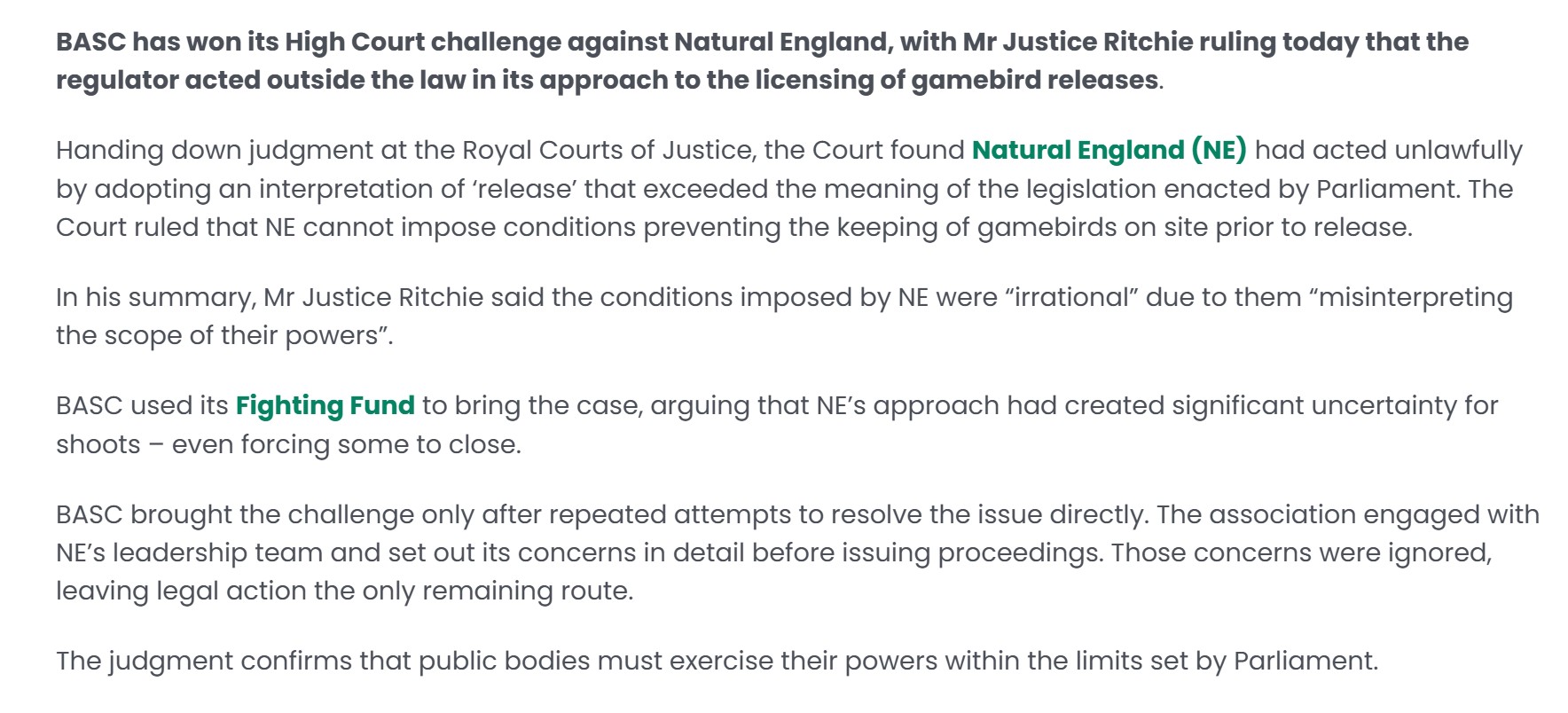
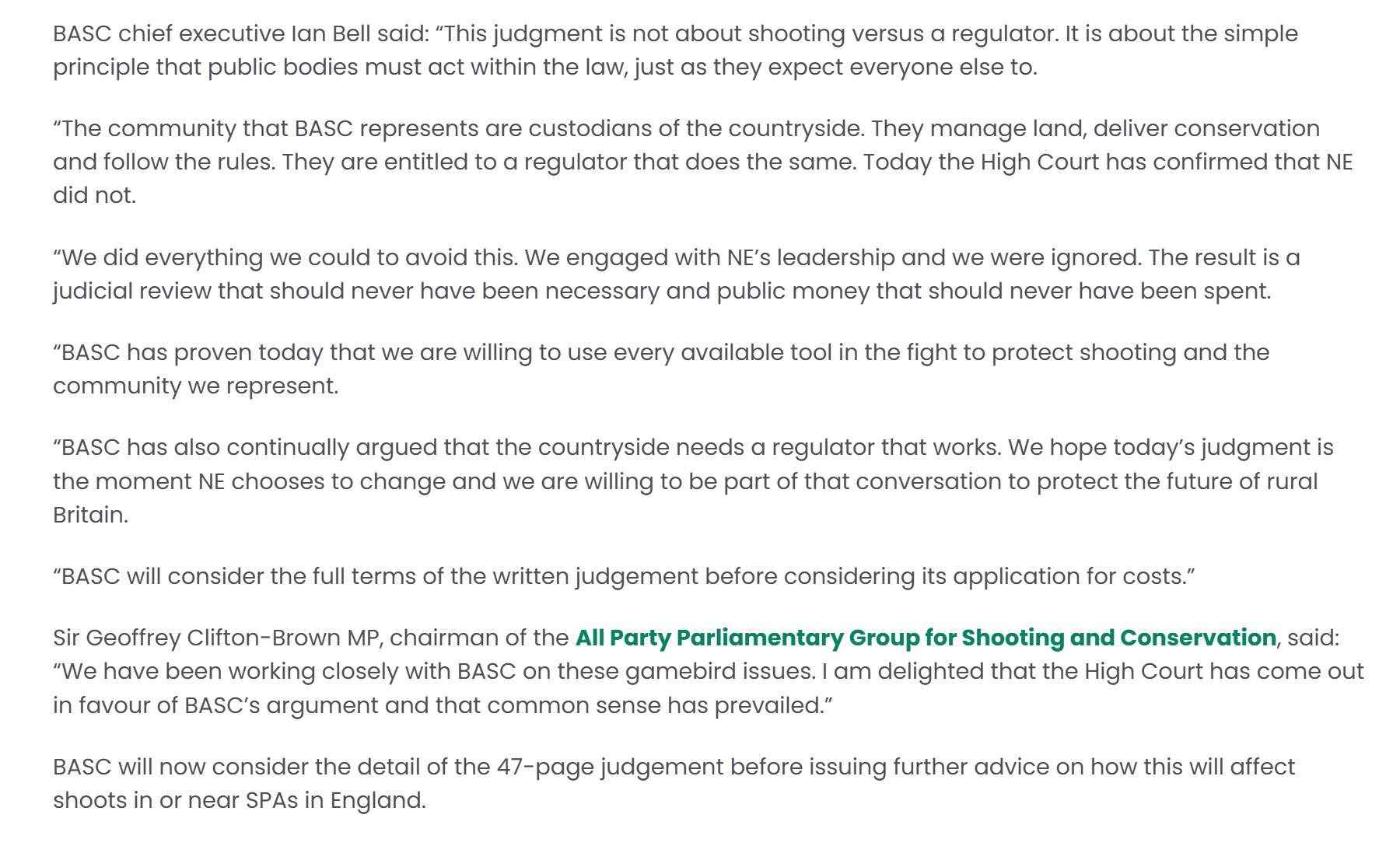
BASC published a media response to the judgement on Thursday afternoon. It’s remarkable for its grandstanding, with very little detail about the substantive issues of the case or the implications of the judgement for BASC members.
Tellingly, BASC didn’t publish a copy of the judgement, which means that BASC members, and others, had to rely upon BASC’s interpretation of the judgement, rather than being able to read it for themselves and draw their own conclusions.
Given that BASC will likely have had a draft copy of the judgement for a week prior to it being formally handed down by the court, I’m amazed at the shallowness of its response:
More grandstanding by The Telegraph
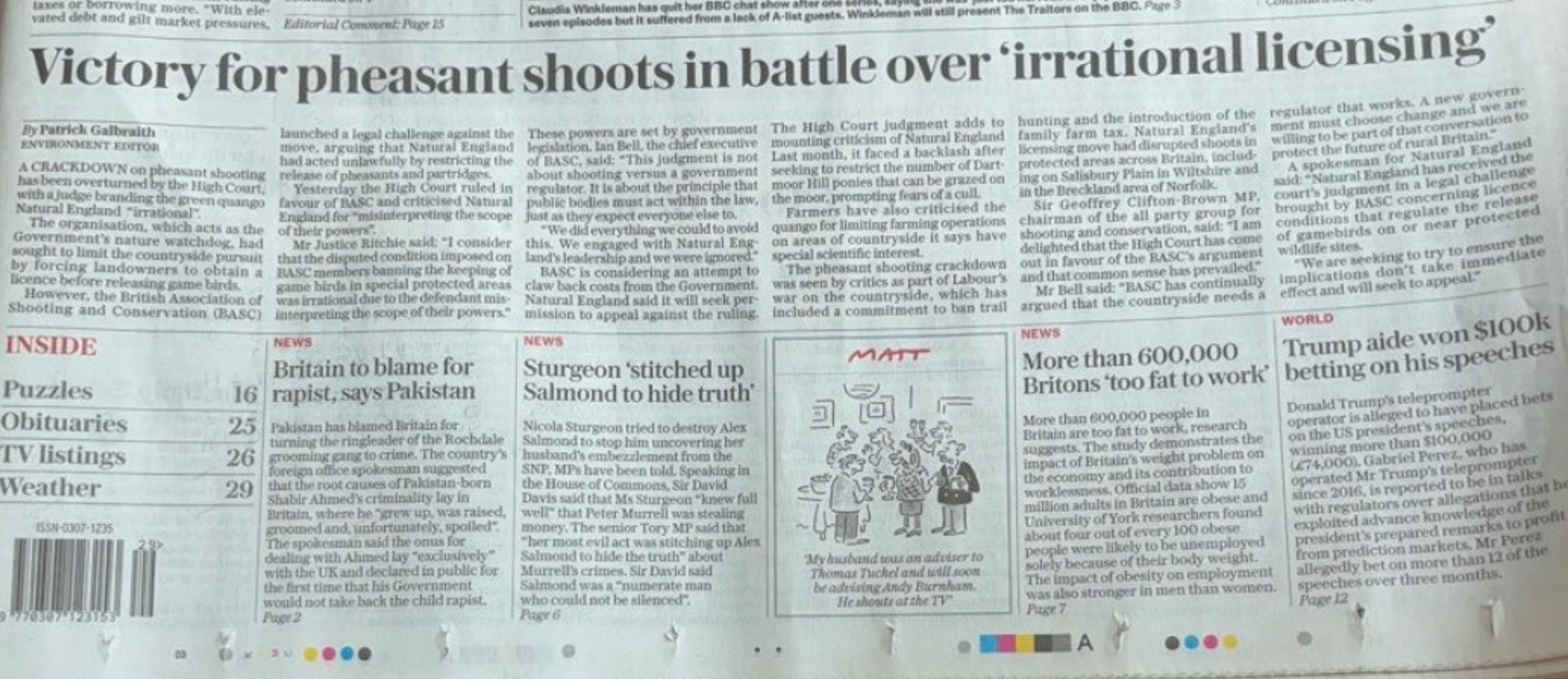
Yesterday, The Telegraph featured the news about the judgement on its front page. It’s quite clear to me, after reading the opening paragraphs, why gamebird shooters on social media are thinking that gamebird licensing has been completely overturned:
‘By Patrick Galbraith, Environment Editor [former editor of Shooting Times!]: A CRACKDOWN on pheasant shooting has been overturned by the High Court, with a judge branding the green quango Natural England “irrational”.
The organisation, which acts as the Government’s nature watchdog, had sought to limit the countryside pursuit by forcing landowners to obtain a licence before releasing gamebirds.
However, the British Association of Shooting and Conservation (BASC) launched a legal challenge against the move, arguing that Natural England had acted unlawfully by restricting the release of pheasants and partridges.
Yesterday the High Court ruled in favour of BASC and criticised Natural England for “misinterpreting the scope of their powers“‘.
Natural England’s response to the judgement
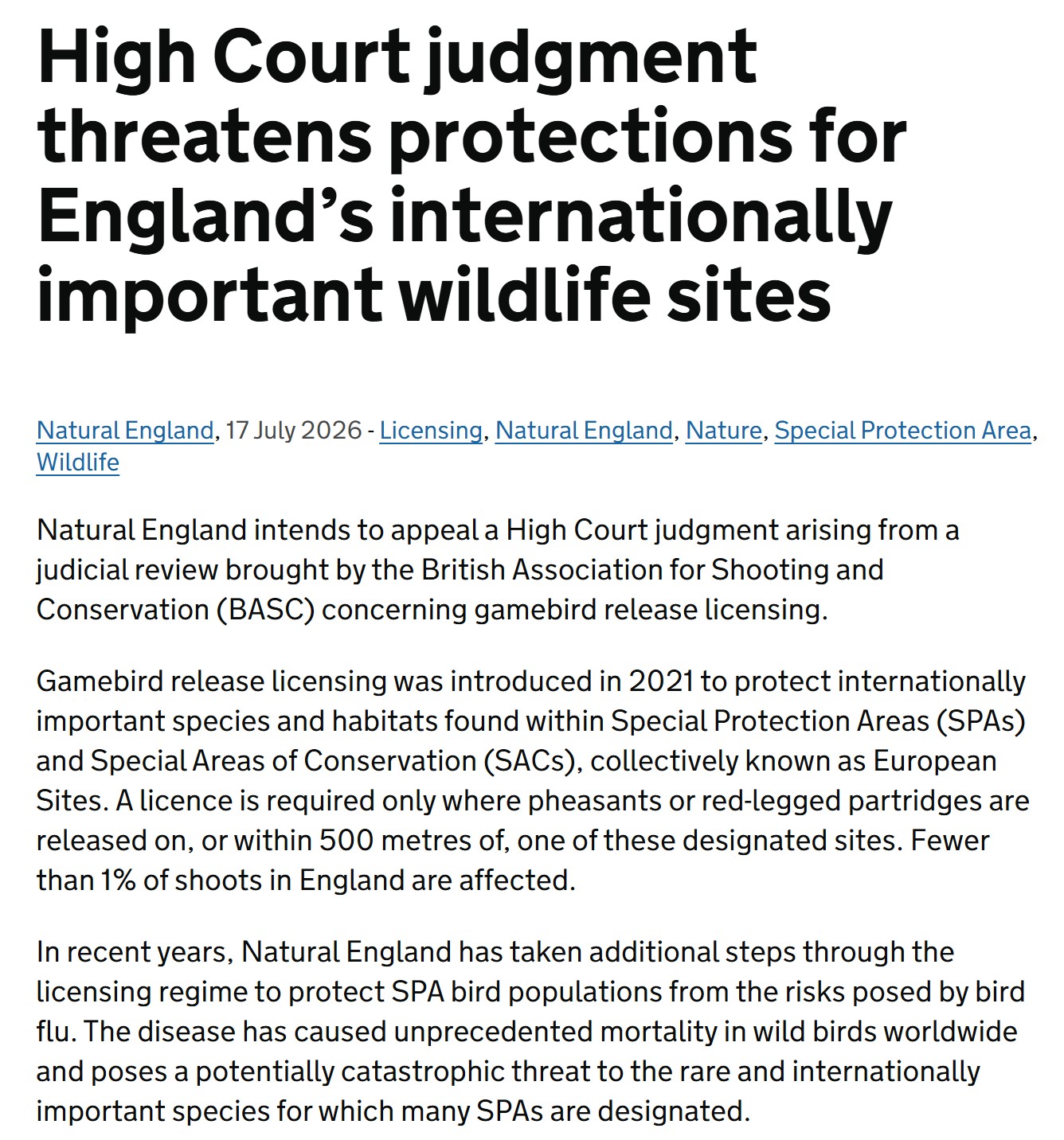
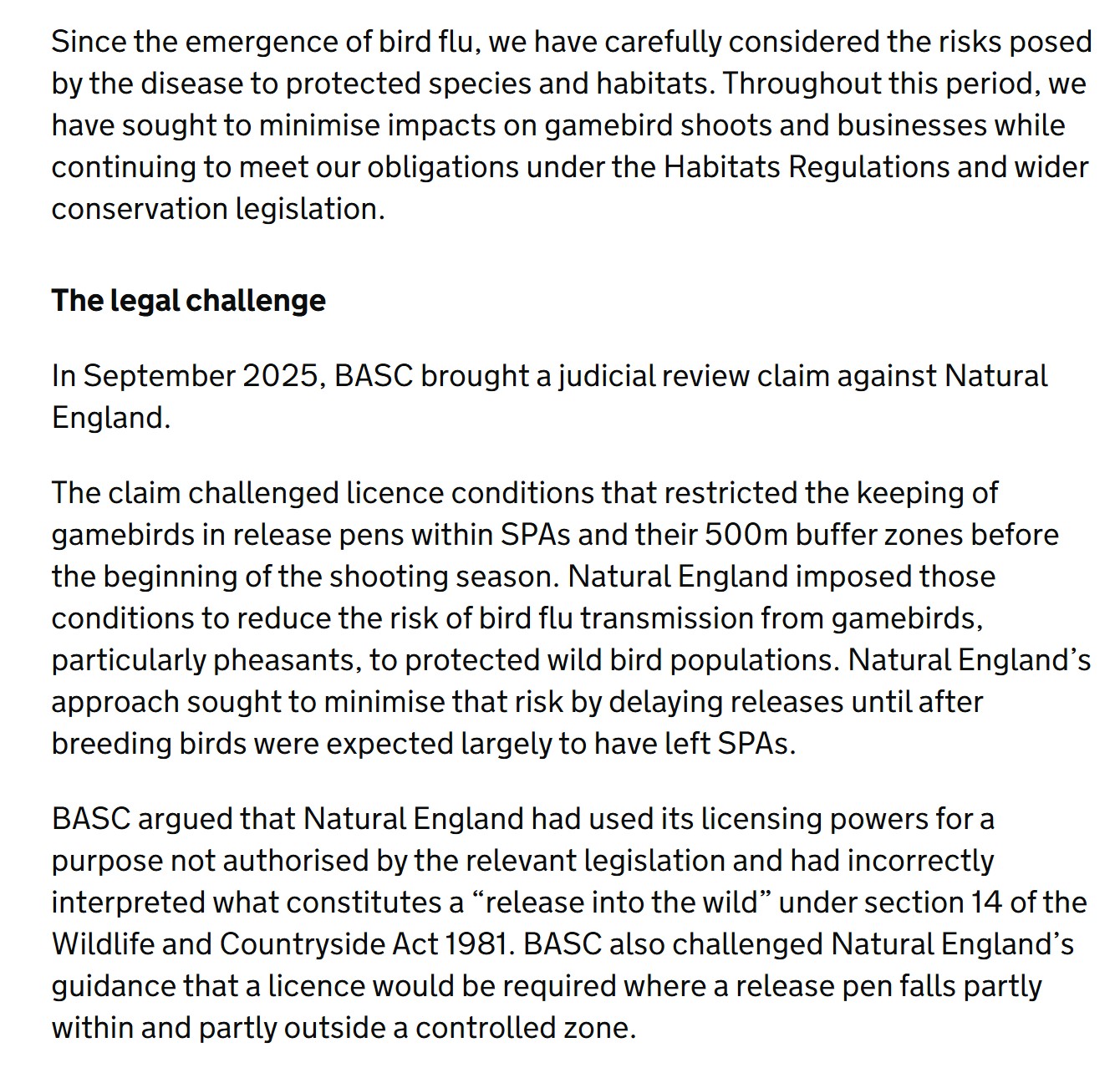
Natural England is probably as unimpressed as I am with the way the shooting industry has framed the outcome of this legal challenge. NE published a blog in response, yesterday, laying out considerably more detail about the case than BASC has, and has stated its intention to apply to the court for permission to appeal the ruling. Quite rightly, NE’s focus is on the potential consequential threat to protected sites:
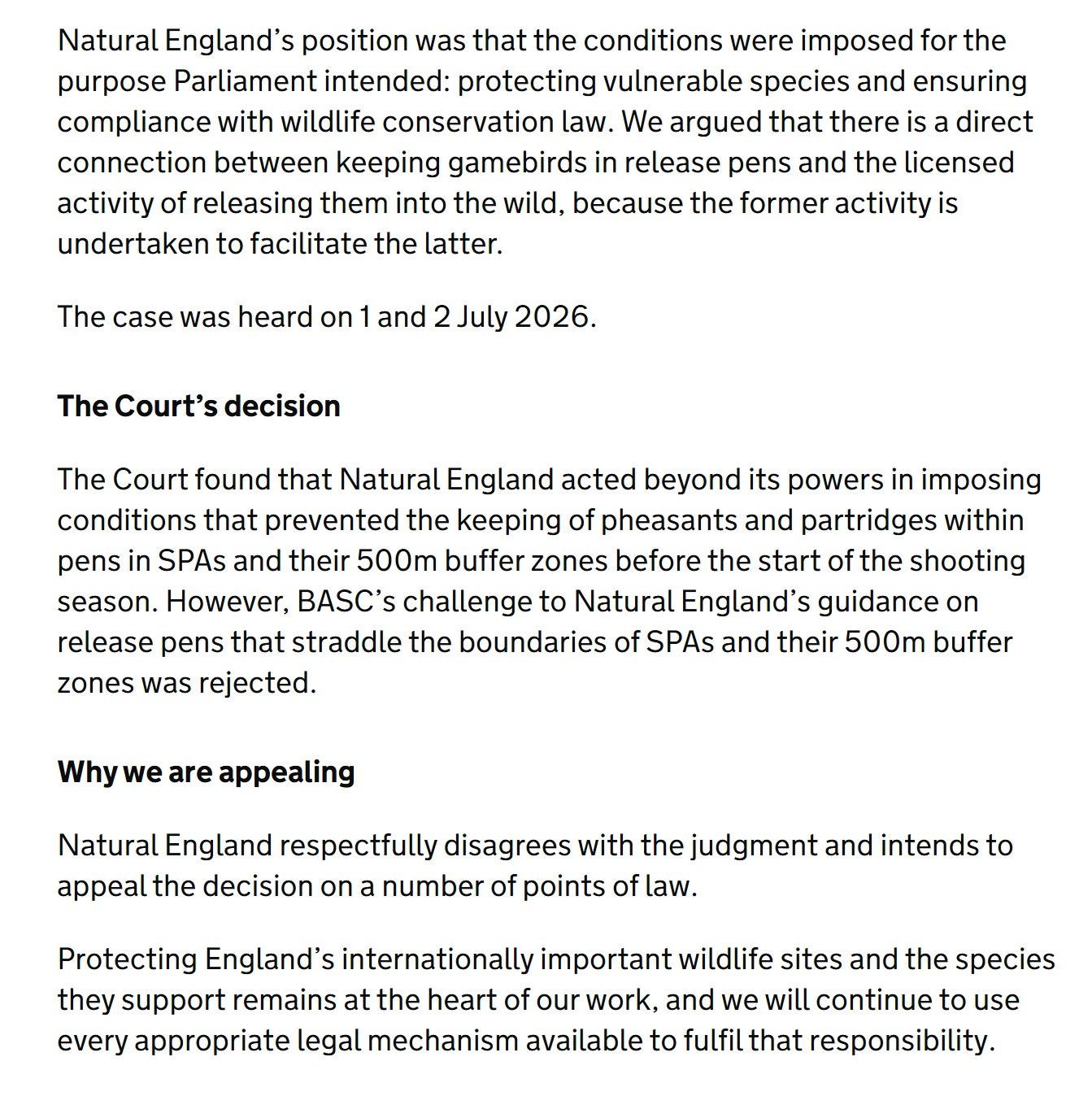
The 47-page judgement
The full judgement is published below so that everyone has an opportunity to scrutinise it.
For non-lawyers, which I guess most of us are, it’s very dry and turgid – that’s not a criticism, it’s just the way it is. And it’s clear that Mr Justice Ritchie is no ornithologist (there are a few howlers in there!) but ornithological qualifications aren’t necessary to interpret the law. It was also apparent, during the substantive hearing, that the judge was not familiar with the gamebird shooting sector – I say this to kill off any suggestion that the ruling was an establishment ‘set-up’ – a common accusation by some when legal arguments don’t go their way.
There are a few quotes from the judge, in reference to Partridge release pens, that will probably come back to haunt the gamebird shooting industry, such as:
“In my judgement, there is very little wild about a cage in a man planted corn field”
and
“It is clearly not released, it is fully imprisoned“
and
“They are imprisoned and not free“.
This is not quite the ‘wild’ and ‘natural’ image of gamebirds that the industry tries to portray!
Anyway, here’s the judgement, and I look forward to hearing further detail about Natural England’s application to appeal:
UPDATE 3 August 2026: More information about BASC’s legal challenge on keeping gamebirds on Special Protection Areas prior to release (here)


Well done for sitting through all this and analysing and explaining the salient points in such a turgid process…
Once again, it seems to me to be a failure of precise wording and definitions in the relevant legislation – grep through the judgement for ‘pen(s)’ and study the surrounding clauses – but I wonder on which grounds Natural England will appeal?
Unfortunately, common sense sometimes isn’t enough:-( Birds are still dying from HPAI:-(
with the way shooting is behaving these days we can be sure of – oh dear – accidental escapes just when it happens to suit the shoot – which will no doubt blame it on animal rights activists
I’m not sure whether I’m missing something somewhere along the line but, regarding the ‘release’ of pheasants, it is my experience that they are not released in any formal process at any particular time. Rather they simply use their wings and fly out of the roofless pens, under their own steam, as soon as they are able. I don’t know what shoots can do if the birds are ready to go before a permitted date. I have very little experience of RLP releases, though from what I do know I would suspect that the ‘imprisonment’ analogy might be more applicable in this context.
If issues such as these are likely to become more prevalent in future years, shoots might be tempted to use smaller release pens which incorporate a roof. This could, however, risk overcrowding with negative welfare effects. This provides another good reason for banning the pastime entirely and leaving the countryside to largely indigenous species.
Thanks Ruth Bring on the appeal…….
Sent from my Galaxy