
The charity Restoring Upland Nature (RUN), now home to the South Scotland Golden Eagle Project, is recruiting for the new position of North of England Golden Eagle Project Manager.
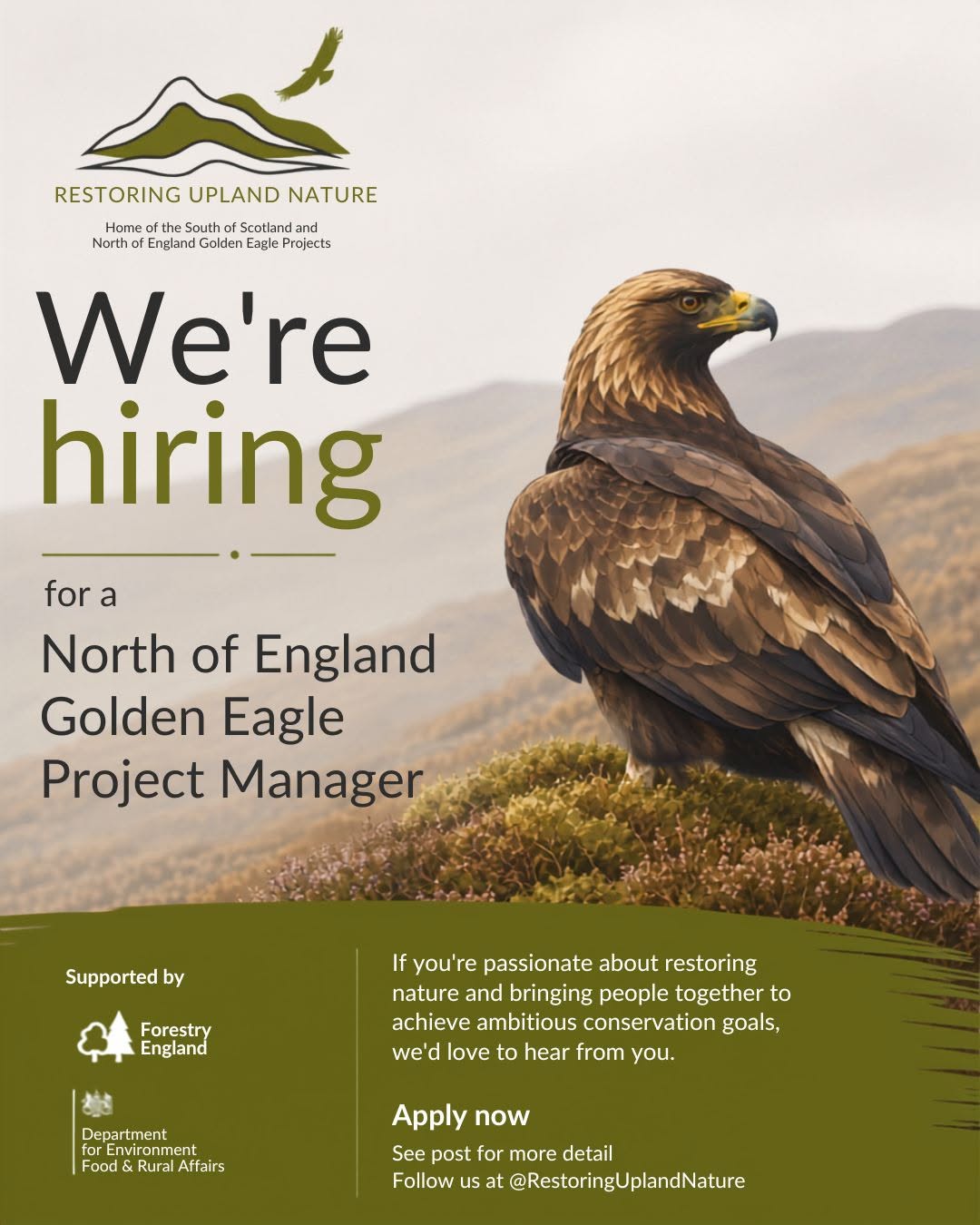
This position has been created following a Government announcement earlier this year that funding of £1 million would be made available to explore the feasibility of re-establishing Golden Eagles in England.
Here’s an overview of the job spec:
Location – Home based, ideally in Northern England, or potentially based in a partnership agency hub office.
Contract – full time to end of March 2029 with likely extension to 2032.
Salary – £35,000 – 40,000 depending on experience
Role – The role will focus on exploring, developing, and, subject to formal approval, supporting the potential reintroduction of Golden Eagles to Northern England. You will help shape the project from planning through to delivery, ensuring strong partnership working, effective community and stakeholder engagement, and high standards of project management throughout.
Closing date – 21 August 2026.
Interview date – first interview 31 Aug; second interview 4 Sept.
Full job spec can be read / downloaded here:
This is a controversial project, as discussed previously. There is an urgent need to restore long-lost native species to England (and the rest of the British Isles) but in this case, the cause of this particular species’ demise – illegal persecution – has not, and is not, being addressed with sufficient effectiveness to bring it to an end.
Many will argue that it’s ethically questionable to release Golden Eagles in to a landscape where they are undoubtedly going to be killed by gamekeepers on many of the intensively-managed driven grouse moors in the region. Large parts of the north of England have long been recognised as raptor persecution hotspots, most notably for Hen Harriers, Red Kites, Peregrines and Buzzards, and it won’t be any different for Golden Eagles, as demonstrated by the recent shooting of a young eagle that travelled down on its own from south Scotland. There’s also been the recent suspicious disappearance of a satellite-tagged White-tailed Eagle in the same region.
However, others will argue that the same issues faced the South Scotland Golden Eagle Project when it started to release translocated Golden Eagles in 2018, and even though some of those eagles have inevitably fallen victim to illegal persecution, and more are expected to, other individuals are now thriving and have paired up, are holding territories and are either attempting to breed or have bred successfully, some of them on nest platforms provided by supportive land managers.
Eagle conservation is a slow game. They generally have to survive for four or five years before they’re mature enough to attempt to reproduce, and they generally only produce one or two offspring at a time, uncommonly three. The biology of the species means that population restoration takes many, many years, and that’s even with the support of local landowners. If you add in the seemingly intractable culture of illegal persecution, along with the very low chance of being caught and so offending continues because the risk is seen to be worth it, then releasing Golden Eagles in to northern England to restore the population is not going to be quick and it certainly won’t be easy.
Applicants for the job would do well to read this authoritative feasibility report on Golden Eagle Recovery in England, authored by Dr Phil Whitfield and Dr Alan Fielding:


A very interesting and challenging job for someone! The passing reference to Squeagle begs the question as to wherher there are any updates on her post-release progress.
Is there any detail out there somewhere on what the £1 million for the “feasibility study” is actually for / who or what it has been spent on? I’ve looked at the Restoring Upland Nature site, and done a bit of googling but this information hasn’t popped out to my eyes yet.