Welcome to the inglorious twelfth!

Today is the inglorious 12th, the start of the four-month grouse shooting season in the uplands of northern England and Scotland. Today, and for many days to come, ridiculously rich people will dress up in clownish outfits and head for the moors in the hope of shooting dead some birds. Many will pay an estimated average of £15,000 for the experience. I wonder how many of them will enjoy the sight of a hunting hen harrier or a golden eagle quartering across the moor? Very few, infact probably none of them because scientific evidence shows that hen harriers and golden eagles have been exterminated on most grouse moors in the UK, with just a few notable exceptions. Has anyone been convicted? One person was once convicted for killing a hen harrier, and that’s it. Nobody has ever been convicted for killing a golden eagle (someone was once taken to court a few years back but the case was dropped). Even though several dead eagles and the UK’s biggest stash of the poison they died from were all found on a sporting estate last year, still nobody has ever been convicted.

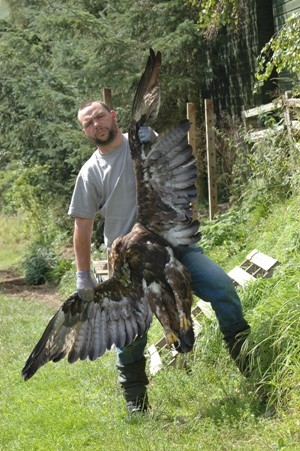
Four years ago today, this golden eagle (pictured) was found dead in Peebleshire. She was one half of the last breeding pair of golden eagles in the Borders. She had been poisoned by the banned pesticide Carbofuran and was found dead under her nest tree. Her death caused outrage and triggered the thematic inspection into the prevention, investigation and prosecution of wildlife crime in Scotland (read the resulting 2008 ‘Natural Justice’ report here). This report highlighted the problems that stand in the way of effective wildlife crime law enforcement in Scotland. Four years later, many of the same problems still exist. Nobody has been charged with the illegal killing of that female golden eagle in Peebleshire and according to a report by the Wildlife Incident Investigation Scheme, the case is now closed.

Since the year she was killed (2007), how many other protected raptors have suffered the same fate? The following have all been confirmed poisoned in Scotland over the last four years – the vast majority of them were found dead on grouse moors:

8 golden eagles, 3 sea eagles, 63 buzzards, 25 red kites and 8 peregrines.

These numbers do not account for birds that were trapped, shot, or had their heads smashed in with a shinty stick while their broken legs were pinned in an illegal spring trap. Nor do they account for the ‘missing’ birds – including over 2,000 hen harriers.

Today, the grouse-shooting industry will have filled the media with stories about how ‘great’ grouse moors are for conservation, how ‘great’ grouse shooting is for the economy, how ‘great’ grouse-shooting is for biodiversity. Fortunately, the general public are becoming wise to the propaganda.

More on the Moy case

According to an article published in The Scotsman (view here), a post mortem carried out on the dead red kite discovered in the vehicle used by gamekeeper James Rolfe on Moy Estate last June, revealed it had broken legs and had died as a result of a blow to the head. Rolfe was convicted for being in possession of the dead kite. Why weren’t charges brought against anyone for the unlawful killing of this bird?

In the same article, it is reported that over a five-week period, the remains of a further two dead red kites, six illegal baited spring traps, a trapped hen harrier, and a poison bait laced with a banned agricultural pesticide (poison) were also recovered from the estate. No arrests or charges have been made in connection with these incidents.

Why not?

In an article in Birdwatch Magazine, further gruesome details are revealed about the discovery of a severed red kite leg and wing tags belonging to a red kite that was being followed by satellite tracking, all hidden in holes covered by moss. The article also reports that four golden eagle leg rings were discovered in Rolfe’s possession. No arrests or charges have been made in connection with these incidents.

Why not?

You may wish to ask the following people:

Crown Office and Procurator Fiscal Service: pn_copfs@scotland.gsi.gov.uk

Northern Constabulary Force Wildlife Crime Co-ordinator, Chief Inspector Matthew Reiss: matthew.reiss@northern.pnn.police.uk

Environment Minister for Scotland, Stewart Stevenson MSP: msp@stewartstevenson.net

Moy Estate results

Today at Inverness Sheriff Court, gamekeeper James Roderick Rolfe, 20, was convicted of being in possession of a dead red kite which was found in his vehicle during a police raid on the Moy Estate in June last year. Rolfe said he had found the kite caught in a trap set for stoats. It had not been poisoned. Rolfe was fined £1,500 for possession of the dead bird.

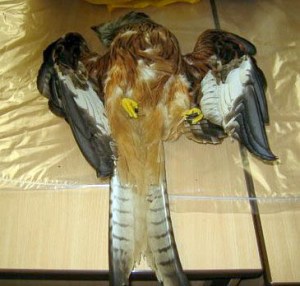
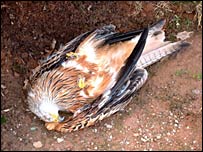
The images here show the dead kite in the back of his vehicle. No explanation has been given to account for the obvious injury this bird suffered to its head area. According to the Inverness Courier, Rolfe claimed the bird was already dead when he found it.
Another gamekeeper working on Moy Estate was accused of being in possession of 56 gull eggs. The court accepted his plea of not guilty.

Northern Constabulary press statement

Inverness Courier news report

Case against Inverinate Estate gamekeeper to continue in October

The case against Andrew Malcom Slaughter, gamekeeper on the Inverinate Estate, Lochalsh, will continue at Inverness Sheriff Court on 12 October 2011 for a debate. This is an intermediate step in procedure when legal points are considered.

Slaughter is charged with offences under the Wildlife & Countryside Act 1981 and the Agriculture (Scotland) Act 1948. Background info on this case can be found in blog posts on 23 March 2011, 8 April 2011 and 28 April 2011.

Inverinate Estate gamekeeper trial continues without plea

Further to blog posts 23 March and 8 April 2011…

The trial of Andrew Malcom Slaughter, gamekeeper on the Inverinate Estate, was continued without plea at Inverness Sheriff Court today. It is now due to continue on 19 May 2011.

Press & Journal article here

Latest on Inverinate Estate case

Another case adjournment….

Gamekeeper Andrew Malcom Slaughter from Inverinate Estate, Lochalsh, is facing charges under the Wildlife & Countryside Act 1981 and the Agriculture (Scotland) Act 1948. He did not attend his court hearing yesterday at Inverness Sheriff Court and he did not enter a plea. His case has been adjourned until 28 April 2011, back at Inverness Sheriff Court.

See blog entry 23 March 2011 for background to this case.

Gamekeeper charged with wildlife crime offences on Inverinate Estate

The case against a gamekeeper accused of wildlife crime offences began at Inverness Sheriff Court last week. Andrew Slaughter, 34, of Faddock, Killialan, Kyle, faces two charges under the Wildlife & Countryside Act 1981 in connection with setting a spring trap at Glen Elchaig on Inverinate Estate on 22 September 2010.

He also faces a charge under the Animal Health & Welfare (Scotland) Act 2006 that he failed to ensure that a crow which was caught in a trap was “provided with adequate shelter and protection from adverse weather”. A fourth charge states that he “set a spring trap which was capable of catching birds, pine martins, badgers and otters”, contrary to the Agriculture (Scotland) Act 1948.

Slaughter, who did not appear in court, had his case continued without plea until 7 April 2011.

Thank you to the contributor who sent us a copy of the newspaper report about this article (published in Press & Journal, 18 March 2011). We could not find an on-line link to this article.

Inverinate Estate, close to the Isle of Skye, is believed to be owned by Sheikh Mohammed Bin Rashid al-Maktoum, crown prince and ruler of Dubai. He is thought to have bought the 63,000 acre estate for £2 million 25 years ago. The Sheikh, worth an estimated £12 billion, is believed to visit the estate with his family for a few weeks every year in the summer.

gamekeeper claims poisoned red kite was “planted”

poisoned red kite

An un-named gamekeeper from the estate in Tayside where a poisoned red kite was found in July 2010 has denied all involvement and claims the dead bird was “planted“.

The self-proclaimed SGA member said: “There is something funny about this and I think someone else has killed this bird and planted it on my estate. Why they have done that, I don’t know“.  This view will come as no surprise to the regular readers of this blog – it is the standard line that is heard so often from the SGA.

He went on: “Anybody who does this should be jailed because it’s not on and I have never done anything like this in my life“.

Interesting that over the last 15 years, the following have all been found dead, confirmed poisoned, on this estate: 9 buzzards, 2 sparrowhawks, 2 crows, 1 gull, 1 tawny owl, 1 pole cat, 1 domestic cat, and now 1 red kite. In addition, 12 poisoned baits have been discovered there (see blog post Aug 27 2010). Whoever is doing the “planting” is managing to maintain a long-term campaign of illegal killing.

Full article about the un-named gamekeeper in The Courier here: http://www.thecourier.co.uk/Living/Outdoors/article/4416/gamekeeper-claims-poisoned-red-kite-was-planted.html

Is Edradynate Estate the place where the red kite was found poisoned?

The location where the dead red kite was found in July (now confirmed to have been poisoned – see earlier blog below) was given by Tayside Police as “Strathtay, near Aberfeldy”, Perthshire. I mentioned a number of sporting estates in my earlier post that have their addresses in this area. I’ve since investigated further and look what I’ve found –

According to Tayside Police’s press release about the latest dead red kite, over the last 15 years the following have been found poisoned in the same area where the recent red kite was found dead – 9 buzzards, 2 sparrowhawks, 2 crows, 1 common gull, 1 tawny owl, 1 pole cat and 1 domestic cat. In addition, they say 12 poisoned baits have also been found.

Compare the above list of dead animals & poisoned baits with the following list of dead animals & poisoned baits, which was reported in the RSPB’s Legal Eagle newsletter (January 2005, #43, page 3) – “In 14 separate incidents since 1998, 16 poisoned victims (9 buzzards, a cat, a tawny owl, 2 sparrowhawks, a common gull, a pole cat and a crow and 12 poisoned baits [rabbits, woodpigeons and a pheasant]) have been found, with traces of the pesticides mevinphos, carbofuran and alphachloralose“.

The 2005 RSPB report relates to the Edradynate Estate, which is situated in Strathtay, near Aberfeldy. Coincidence? You decide.

Nobody was convicted for the earlier alleged offences at Edradynate Estate  thanks to the apparent chronic mishandling of the prosecution case. The Edradynate Estate head gamekeeper (aged 55) and underkeeper (22), both of Aberfeldy, were arrested in 2002 and charged with nine offences relating to the use of poisoned baits and also bird cruelty, including the use of spring traps. On 22 July 2004, two years after the original arrests and 13 court hearings later, the Fiscal dropped the case against them at Perth Sheriff Court. A spokeswoman for the Crown Office admitted the time taken to prepare the case for a trial had been a major factor in the decision to scrap it.

Link to RSPB Legal Eagle #43 here: legal_eagle_43_Jan2005

News report about the failed 2004 court case here: http://www.thefreelibrary.com/Fury+after+’bird+killers’+walk+free.-a0119726014

and here: http://scotlandonsunday.scotsman.com/nature/RSPB-Fury-as-gamekeepers-escape.2548762.jp

Record Year for Raptor Poisoning

Published on Friday an annual RSPB Scotland report confirmed that 2009 marked the highest number of raptor poisoning incidents for 2 decades. “The Illegal Killing of Birds of Prey in Scotland in 2009”  indicates that human persecution continues to have a serious impact on the populations of some of the country’s most vulnerable species.

Last year, 21 buzzards, 4 red kites, 2 golden eagles and 1 white-tailed eagle, the latter gifted to Scotland from Norway as part of a reintroduction programme, were among the victims in 46 poisoning cases confirmed by Scottish Government testing.

Illegal killing, through shooting, nest destruction or the use of spring traps, were also confirmed in nine incidents. As many raptors are long-lived and have slow reproduction rates the killing of these species, particularly adult breeding birds, has dire consequences for their populations as a whole. This illegal persecution is affecting the conservation status of raptors such as hen harriers, golden eagles and red kites.

The vast majority of poisoning incidents were associated with shooting estates and in particular grouse moors. Predictably, various pro-shooting bodies have attempted to discredit the RSPB Scotland figures and  fudge the issue.  Notably, the landowners’ organisation, the Scottish Rural Property and Business Association (SRPBA) said the figures were misleading.

A spokesman said: “The official government report on the illegal poisoning of birds of prey for 2009, published in March 2010, shows the level has stayed the same for the last three years with the exception of 2008 when there were 16 incidents. There is ample legislation in existence to deal with this problem and we support the full weight of the law being brought to bear on those using illegal poisons.”

As these crimes are mainly committed in extremely remote areas and discovered by hill walkers and similar outdoor enthusiasts stumbling upon dead birds, it must be remembered that these “confirmed” cases must represent only a fraction of the true number of raptors illegally killed each year.

The increase in these incidents proves beyond reasonable doubt that the perpetrators of these crimes have little  fear of the Scottish judiciary system. Perhaps if the penalties for killing our birds of prey were more of a deterrent we would see this disgraceful trend reverse.

Press and Journal report. http://www.pressandjournal.co.uk/Article.aspx/1838869

BBC News Report. http://www.bbc.co.uk/news/uk-scotland-10730222

RSPB Report. http://www.rspb.org.uk/Images/illegalkillingscotland_tcm9-256571.pdf

Duncan Orr-Ewing, RSPB Scotland discusses the report on Radio 4’s Today http://news.bbc.co.uk/today/hi/today/newsid_8847000/8847745.stm