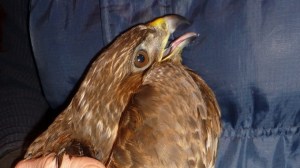
Horrifically injured buzzard found on grouse moor in North Yorkshire

The following words and images are from Jean Thorpe, a lady who runs Ryedale Wildlife Rehabilitation in North Yorkshire:

“Juvenile buzzard found at Westerdale, North Yorkshire grouse moors [in the North York Moors National Park], with a leg missing. Put to sleep, x-rayed, shotgun shot in the leg. This young bird barely out of the nest was targeted and maimed by shooting and caught in a Fenn trap. The bird had frantically tried to get free, badly abrading its flight and tail feathers, the leg was trapped at the joint and the bird was freed after severing its leg from the trap at the joint. This is the reality of grouse shooting in North Yorkshire”.

Westerdale BZ2

Westerdale BZ1

It’s not just the reality of grouse shooting in North Yorkshire. This is the reality of driven grouse shooting across northern England and Scotland. Inside the ‘safety’ of a National Park? It doesn’t matter. Remove all predators, by whatever means, and at any cost.

Its barbaric.

The grouse shooting industry is out of control. It needs closing down.

Please, sign the e-petition to ban driven grouse shooting HERE

Statement from Invercauld Estate re: illegal traps

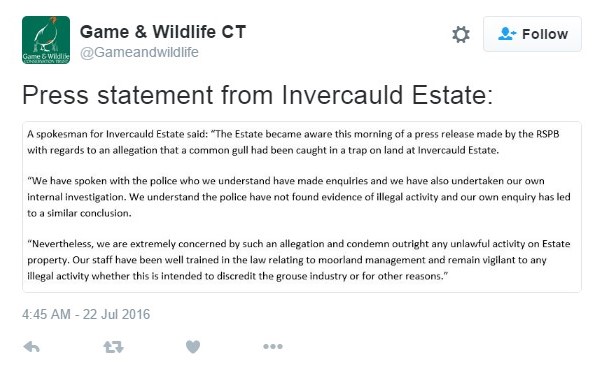
In relation to this morning’s news (here) that illegally-set traps have been discovered on a grouse moor on Invercauld Estate in the Cairngorms National Park, the following statement from Invercauld Estate has just appeared on GWCT’s twitter feed:

Invercauld statement

This is staggering! In one paragraph the estate is denying that this crime ever happened, but then in the next paragraph suggests that if it did happen the evidence was probably planted by someone trying to discredit the grouse shooting industry. Really? Really? Seven hours to think about it and that’s the response? Really?

The RSPB, the SSPCA, and two witnesses (the hill walkers) say it happened (full statement here).

Cabinet Secretary for the Environment Roseanna Cunningham believes it happened and has said, “It is difficult to see their use [the illegally-set spring traps] as anything other than a blatant and criminal attempt to target protected birds of prey” (full statement here).

Grant Moir, CEO of the Cairngorms National Park Authority also believes it happened and has asked for a meeting with the Head Trustee of Invercauld Estate, the Sporting Partner on Invercauld Estate, and Police Scotland to improve enforcement measures (full statement here).

So, Police Scotland, over to you. Was evidence of illegal activity found on Invercauld Estate? Emails please to Assistant Chief Constable Malcolm Graham who leads on wildlife crime for Police Scotland: ACC.CrimeMCPP@scotland.pnn.police.uk

When you’ve sent your email, please consider signing THIS PETITION calling for the licensing of all gamebird hunting in Scotland.

When you’ve done that, please consider signing THIS PETITION calling for a ban on driven grouse shooting.

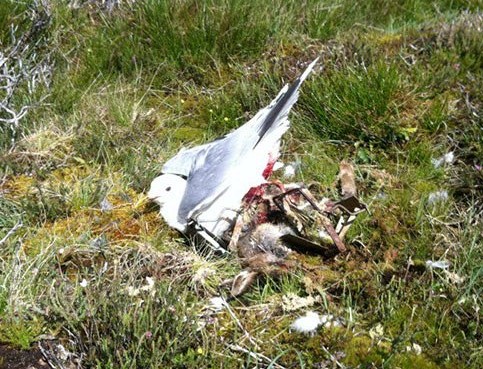
Invercauld gull

Illegal traps on Invercauld Estate: part 2

Further to today’s news that illegally-set traps have been found on a grouse moor on Invercauld Estate in the Cairngorms National Park (see here), we are interested in the SSPCA’s role in this investigation.

As you’ll recall, RSPB Scotland notified the SSPCA about the severely injured gull caught by both legs in two spring traps. An SSPCA Inspector attended the scene (utilising powers under the Animal Health & Welfare (Scotland) Act) and was able to put the poor suffering bird out of its misery. However, the SSPCA Inspector did not conduct a wider search of the area for evidence because their current powers do not permit that.

Invercauld gull

Instead, the wider search was delayed until Police Scotland could attend (Police Scotland does have the authority to undertake searches of land to look for evidence of offences committed contrary to the Wildlife & Countryside Act). Now, this delay is NOT a criticism of Police Scotland’s actions in this case (they were on site relatively swiftly and invited both the SSPCA and RSPB Scotland Investigations to assist with the search. That’s a big improvement on some previous cases).

But, the problem of the SSPCA’s limited powers are clear in this case.

When the multi-agency search did take place ‘a few days later’, ‘clear evidence was found that eight similar traps had been deployed, attached to stakes and baited with dead rabbits, in a line stretching two hundred metres across the moor. It was also evident that these traps had been removed very recently’.

Whichever criminal had set these two traps that caught the gull was given the time to remove those further eight traps before the Police turned up.

How ridiculous is it that the SSPCA Inspector wasn’t allowed to walk two hundred metres across the grouse moor to retrieve those eight additional traps (and any other evidence that the criminal may have left lying around)? It’s plainly bonkers! Instead, there was an inevitable delay while the Police sorted themselves out (again, not a criticism in this case), allowing the criminal to distance him/herself from the crimes.

As many of you will know, on 1 Sept 2016 it will be two years since the closure of the Scottish Government’s public consultation on increased investigatory powers for the SSPCA. Three Environment Ministers later and we’re still waiting for a decision (see here). It’s pathetic.

More on this Invercauld case shortly…..

Illegally-set traps found on Invercauld Estate grouse moor, Cairngorms National Park

RSPB Scotland has today issued a press statement about the discovery of illegally-set traps found on a Royal Deeside grouse moor in the Cairngorms National Park (see here).

On 27 June 2016, two members of the public found a Common Gull that had been caught by the legs in two spring traps that had been positioned next to a dead rabbit that had been used as bait. The gull was distressed and bleeding profusely. The hill walkers called RSPB Scotland, who immediately alerted Police Scotland and the SSPCA. An SSPCA Inspector quickly attended the scene and the gull was found to have two broken legs. The bird’s injuries were so extensive it had to be euthanised.

Several days later, a multi-agency (Police Scotland, SSPCA, RSPB Scotland) search was undertaken on the grouse moor, ‘where clear evidence was found that eight similar traps had been deployed, attached to stakes and baited with dead rabbits, in a line stretching two hundred metres across the moor. It was also evident that these traps had been removed very recently’.

The press statement continues, ‘Police Scotland officers later spoke to a number of people involved with the management of the land on which the traps were found, but the identity of who had set the traps could not be established‘.

According to the press statement, the two hill walkers had found the distressed gull on “the northern slopes of Geallaig Hill, a few miles north west of Ballater“.

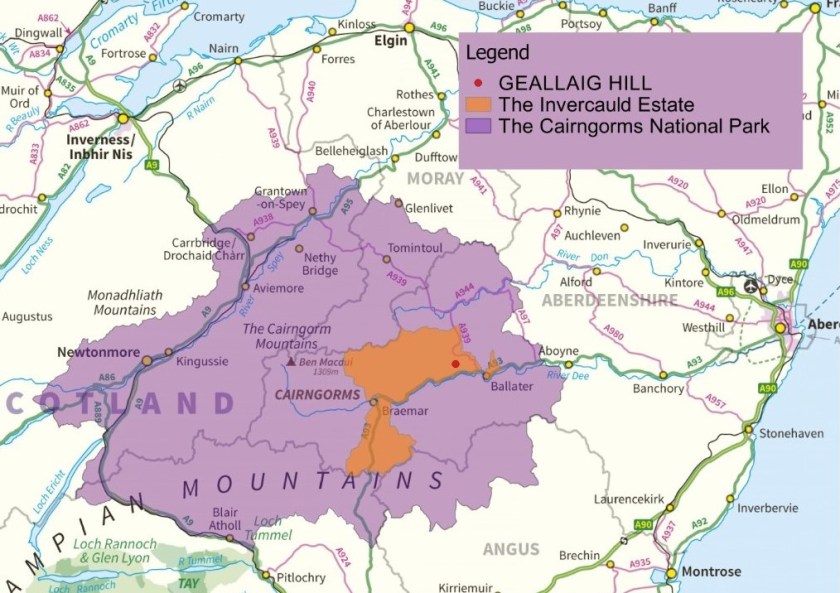
According to Andy Wightman’s fantastic website Who Owns Scotland, Geallaig Hill lies within the boundary of the Invercauld Estate. Using Andy’s data, we’ve created this map to show the position of Invercauld Estate within the Cairngorms National Park and the location of Geallaig Hill within the boundary of Invercauld Estate.

Cairngorms Invercauld - Copy

This is not the first time illegally-set spring traps have been found on Invercauld Estate. In 1997, a gamekeeper was fined £120 after admitting to illegally setting a spring trap to catch a rook (see here).

Spring traps can (currently) be used legally to catch stoats, weasels, rats etc BUT ONLY if they are placed inside a natural or artificial tunnel with a restricted entrance to minimise the risk of catching a non-target species. There are frequent reports of their illegal use on some shooting estates to trap birds of prey (e.g. set in the open next to a bait, or attached to the top of a post to turn them in to pole traps) – some recent examples can be found here, herehere, here, here, here, here, and of course the recent and now infamous Mossdale Estate traps here.

There’s a lot to discuss about this latest crime, and we’ll be doing just that in a series of blogs later this afternoon.

In the meantime, well done to the two hill walkers who reported this crime, well done to the SSPCA Inspector for a quick response, well done to the Police Scotland wildlife crime officers for a quick, multi-agency follow up and search, and well done to RSPB Scotland for a timely press release.

More shortly…..

UPDATE 2.30pm: Illegal traps on Invercauld Estate part 2 here

UPDATE 4.45pm: An astonishing statement from Invercauld Estate here

UPDATE 23 July 2016: SGA statement re: illegal traps found on Invercauld Estate here

The ‘secrets of the Angus Glens’ that Countryfile forgot to mention

On Sunday evening, Countryfile included a piece about the grouse moors of Invermark Estate in the Angus Glens and how it was “a haven for wildlife”.

It can be viewed on iPlayer here for the next 28 days (starts at 22 mins in).

Inane, vacuous and unquestioning, this piece was heralded in previews as ‘uncovering the secrets of the glen’.

Invermark is only one of several grouse moor estates in the Angus Glens. Here are some secrets of the wider Angus Glens that weren’t mentioned on Countryfile:

2004 May, near Edzell: long-eared owl and two short-eared owls starved to death in crow cage trap.  No prosecution.

2004 May, Invermark Estate: peregrine nest destroyed. No prosecution.

2006 March, Glenogil Estate: poisoned rabbit bait (Carbofuran). No prosecution.

2006 April, Easter Ogil: poisoned buzzard (Alphachloralose). No prosecution.

2006 April, Easter Ogil: poisoned tawny owl (Alphachloralose). No prosecution.

2006 May, Glenogil Estate: poisoned rabbit bait (Carbofuran). No prosecution.

2006 June, Glenogil Estate: poisoned woodpigeon bait (Carbofuran). No prosecution.

2006 June, Glenogil Estate: Traces of Carbofuran found in estate vehicles & on equipment during police search. No prosecution. Estate owner had £107k withdrawn from his farm subsidy payments. This was being appealed, but it is not known how this was resolved.

2006 July, Millden Estate; poisoned sheepdog (Lindane). No prosecution.

2007 November, Glenogil Estate: Disappearance of radio-tagged white-tailed eagle ‘Bird N’ coincides with tip off to police that bird allegedly been shot. No further transmissions or sightings of the bird.

2008 May, ‘Nr Noranside’: poisoned white-tailed eagle ‘White G’ (Carbofuran, Isophenfos, Bendiocarb). No prosecution.

2008 May, ‘Nr Noranside’: poisoned buzzard (Bendiocarb). No prosecution.

2008 May, ‘Nr Noranside’: poisoned mountain hare bait (Carbofuran, Isophenfos, Bendiocarb). No prosecution.

2008 May, Glenogil Estate: 32 x poisoned meat baits on fenceposts (Carbofuran, Isophenfos, Bendiocarb). No prosecution.

2008 October, ‘Glenogil Estate: poisoned meat bait on fencepost (Carbofuran). No prosecution.

2009 March, Glenogil Estate: poisoned buzzard (Carbofuran). No prosecution.

2009 March, Glenogil Estate: poisoned buzzard (Carbofuran). No prosecution.

2009 April, Millden Estate: poisoned buzzard (Alphachloralose). No prosecution.

2009 July, Millden Estate: poisoned golden eagle ‘Alma’ (Carbofuran). No prosecution.

2009 August, Glenogil Estate: poisoned white-tailed eagle “89” (Carbofuran). No prosecution.

2010 May, ‘Nr Noranside’: poisoned red kite (Carbofuran). No prosecution.

2010 September, Glenogil Estate: poisoned buzzard (Chloralose). No prosecution.

2010 October, Glenogil Estate: poisoned buzzard (Carbofuran). No prosecution.

2010 October, Glenogil Estate: poisoned pigeon bait (Carbofuran). No prosecution.

2010 October, Glenogil Estate: poisoned pigeon bait (Carbofuran). No prosecution.

2011 February, Airlie Estate: buzzard caught in illegal crow trap. (see below)

2011 March, Airlie Estate: 3 x buzzard caught in illegal crow trap. Prosecution (!) but dropped after statement from suspect given to SSPCA deemed inadmissible.

2011 April, Millden Estate: shot buzzard. No prosecution.

2012 April, ‘Nr Noranside’: Remains of buzzard found beside pheasant pen. Suspicious death.

2011 June, Rottal & Tarabuckle Estate: dead kestrel inside crow cage trap. No prosecution.

2012 February, ‘Nr Edzell’: spring-trapped buzzard. No prosecution.

2012 February, ‘Nr Bridgend’: remains of buzzard found under a rock. Suspicious death.

2012 May, Millden Estate: satellite-tagged golden eagle seemingly caught in spring trap, then apparently uplifted overnight and dumped on Deeside with two broken legs & left to die. No prosecution.

2012 May, Glen Esk: disappearance of sat-tagged red kite. No further transmissions or sightings of bird.

2013 January, Invermark Estate: white-tailed eagle nest tree felled. No prosecution.

2013 June, Glen Ogil: shot buzzard. No prosecution.

2013 July, Glen Moy: illegal hawk trap. No prosecution.

2013 September, nr Edzell: unset spring trap next to bait. No prosecution.

2013 November, Glen Lethnot: poisoned golden eagle ‘Fearnan’. No prosecution.

2014 August & September, Glenogil Estate: alleged snare offences. Prosecution of gamekeeper underway (currently ongoing).

2014 October, Nathro: shot buzzard. Prosecution? Unknown.

And some more secrets of the Angus Glens that weren’t mentioned:

No breeding hen harriers on the grouse moors of the Angus Glens since 2006 (see here).

Mountain hare massacre on the grouse moors of the Angus Glens (see here).

Angus Glens gamekeeper facing trial for alleged pole-trapping offences (see here).

Mark Avery has written an alternative and more accurate Countryfile script (see here) than the one that was aired on Sunday evening.

Plenty of people on social media have been asking when Countryfile will do a piece on illegal raptor persecution. To be fair, they did one in 2014 (we blogged about it here) and it was fairly well balanced, but this then begs the question why Countryfile researchers hadn’t done their homework for this latest episode.

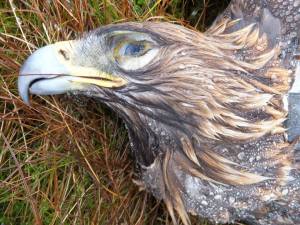
Had they done so, here are some of the images they would have found from those ‘wildlife haven’ grouse moors of the Angus Glens. From the top down, an illegally poisoned golden eagle, another illegally poisoned golden eagle, an illegally poisoned white-tailed eagle, an illegally trapped golden eagle that was then dumped in a layby with two broken legs and left to die, the nest tree of a white-tailed eagle that was illegally chainsawed to the ground, and a pile of rotting shot mountain hares. The grouse moors of the Angus Glens a wildlife haven? Hardly. They’re notorious wildlife crime scenes.

Petition to ban driven grouse shooting here
Fearnan

alma

whiteg

deeside eagle

wtenesttree

mountain-hare-cull-angus-glens-large-copy

More raptor persecution in North Yorkshire

Over the last few years North Yorkshire has emerged as one of the worst raptor persecution hot spots in the UK (see here). It’s a county where much of the landscape is dominated by grouse moors, particularly in the two National Parks: the North York Moors NP and the Yorkshire Dales NP, as well as a large number of pheasant and partridge shoots.

It’s only March and already this year there’s been an illegally shot red kite and a suspected illegally spring-trapped buzzard.

The critically-injured buzzard was found in February at Wykeham, North Yorkshire. It had a broken, crushed ankle and a broken thigh bone; injuries consistent with being caught in a spring trap, says local Police Wildlife Crime Officer Graham Bilton. Local expert raptor and wildlife rehabilitator Jean Thorpe was once again called to the scene to assist but the buzzard’s injuries were considered too serious and it was euthanised by a vet. Article in Yorkshire Post here. Anyone with information please call Police WCO Graham Bilton on 101.

Photographs of the buzzard by Jean Thorpe:

buzzard spring trapped Jean Thorpe Feb 2016

buzzard spring trapped Jean Thorpe Feb 2016 b

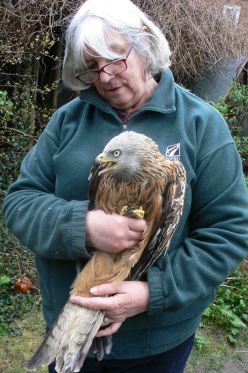
Yesterday, Jean posted the following photographs showing an injured red kite that had been found at Low Marishes, Malton. An x-ray revealed it had been shot. This kite is currently being cared for but whether it survives remains to be seen. Anyone with information please call Police WCO Jez Walmsley on 101.

Red kite shot March 2016 Jean Thorpe

Red kite shot March 2016 Jean Thorpe 2

Jean Thorpe (pictured above with the shot red kite) runs Ryedale Wildlife Rehabilitation. She works closely with the RSPB and local Police Wildlife Crime Officers and has her work cut out, living where she does. In 2014 she was awarded an MBE for her tireless voluntary work. If you’d like to make a donation towards her efforts, please click here.

The e-petition to ban driven grouse shooting can be found HERE.

More raptors illegally killed in Peak District National Park: police appeal 5 months later

Derbyshire Constabulary has today issued a press release appealing for information following the illegal killing of an Osprey (caught in a spring trap) and a buzzard (shot) that were discovered in the Peak District National Park last September. The RSPB is offering a £1,000 reward for information that leads to a conviction.

Here’s the press release:

Derbyshire Police and the RSPB are appealing for information following the illegal killing of two birds of prey near to Glossop, Derbyshire. A £1000 reward has been offered by the RSPB for information leading to a conviction.

On September 09, 2015, a dead osprey was found to the west of Derbyshire Level. A post mortem on the bird revealed that both its legs had been recently broken, injuries which were consistent with it being caught in a spring trap prior to its death. Ospreys are rare visitors to the Peak District and this one would have been on migration to West Africa.

On September 30, a buzzard was found shot dead close to Hurst Reservoir, only a short distance from where the osprey was found. This follows the shooting of another buzzard in the same area in March 2014.

Sergeant Darren Belfield from Derbyshire police said: “I would appeal to anyone who might have any information as to who may be responsible for these cruel acts to contact the police on 101. The continued persecution of birds of prey in the Peak District is totally unacceptable. If you suspect someone of committing any crimes against wildlife, act now. Your call will be dealt with in confidence. If you don’t feel you can talk to the police, pass the information to us through Crimestoppers by ringing 0800 555 111.”

RSPB Investigations Officer Alan Firth said: “Yet again, we are seeing the senseless killing of fantastic birds of prey in the National Park.”

Last year, the RSPB published its annual Birdcrime Report 2014, which revealed Derbyshire as one of the worst places in the UK for bird of prey persecution. In 2014, the RSPB received 16 reports of bird of prey incidents in the county including a shot buzzard, a shot sparrowhawk and an illegally trapped goshawk.

END

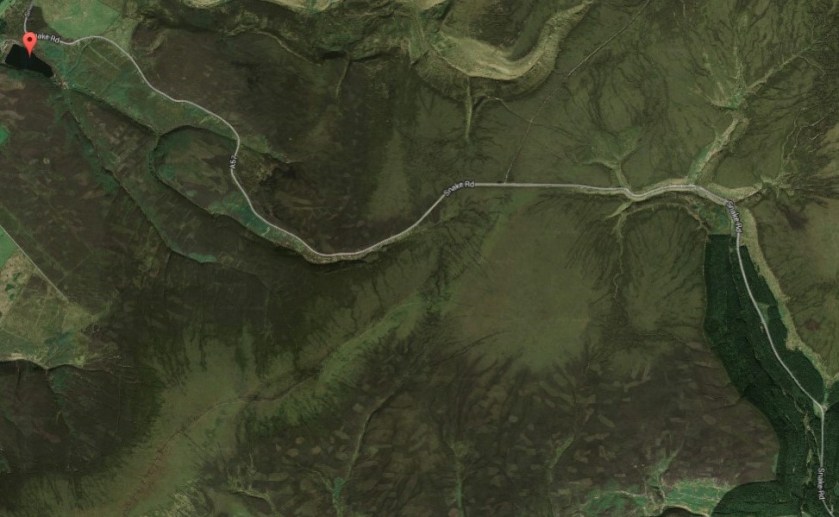
So these birds were found “close to Hurst Reservoir”. Have a look at this map and see what else is “close to Hurst Reservoir” (reservoir marked with the red pin). See those tell-tale rectangular strips of burnt heather to the south and south-east of the marker? Quelle surprise, it’s driven grouse moor country.

Hurst Reservoir - Copy

You may remember back in November we blogged about the failed ‘Bird of Prey Initiative’ in the Dark Peak region of this National Park. It was a five-year project aimed at restoring the populations of several raptor species in the area and involved various organisations: The Moorland Association, The National Trust, Natural England, Peak District National Park Authority, and the RSPB. None of the targets were met (see here). In response, the Moorland Association and the Peak District National Park Authority said they’d make ‘renewed commitment’ to protect raptors in the National Park (see here). Riiiiiight, that’s working well then.

Interestingly, the failed initiative was widely reported in the local press, including the Derbyshire Times, whose article on 26th November was entitled ‘Birds of prey killed and abused in Derbyshire’. In reponse to that article, Robert Benson, Chairman of the Moorland Association, penned the following letter:

I would like to emphatically state in response to your story, ‘Birds of prey killed and abused in Derbyshire’, on November 26th, that one single bird of prey killed illegally is one too many.

However, the Moorland Association was heartened to see RSPB’s latest bird crime figures show a dramatic cut across the UK. Significant reductions in the illegal trapping of birds of prey represent a 78 per cent drop since 2013, with just four confirmed incidents last year.

Of the 19 prosecutions for wild bird offences, three involved gamekeepers, but none were employed on moorland managed for grouse shooting.

Our members spend £52.5 million a year maintaining and conserving habitats which benefit all moorland wildlife. This year, grouse moor managers in England were praised for their part in the most successful hen harrier breeding season for five years.

Many other threatened species, such as lapwing, curlew, and golden plover – in serious decline elsewhere – are doing well on managed moorland. Not birds of prey, but wild, endangered and important nonetheless.

Wildlife crime is being successfully tackled. We already have a robust wildlife licensing system which needs to be used fairly to manage conflict between rapidly increasing bird of prey populations and legitimate and beneficial land use“. Robert Benson, Chairman, Moorland Association.

END

So there we have it. According to Robert, everything’s just rosy, grouse moors are great, and there are too many raptors so gamekeepers should be given licences to kill them legally.

The thing is, Robert Benson is not telling the whole story. He’s right to say that there were four confirmed illegal trapping incidents recorded in 2014, but what he ‘forgot’ to mention was that those four incidents were just a fraction of the 478 incidents of illegal raptor persecution recorded in 2014, including 179 reports of illegal shooting and destruction (of which 46 raptors were confirmed victims) and a further 53 confirmed victims of illegal poisoning. Doesn’t sound quite so rosy now, does it, Robert? He also ‘forgot’ to mention that Derbyshire was the 4th worst region in the UK for raptor persecution crimes in 2014. Oh, and he also ‘forgot’ to mention the quote from the National Wildlife Crime Unit:

Intelligence continues to indicate a strong association between raptor persecution and grouse moor management“.

One for you anagram fans: Moorland Association = A sad morons’ coalition.

Here are some photos of the latest victims (photos by RSPB)

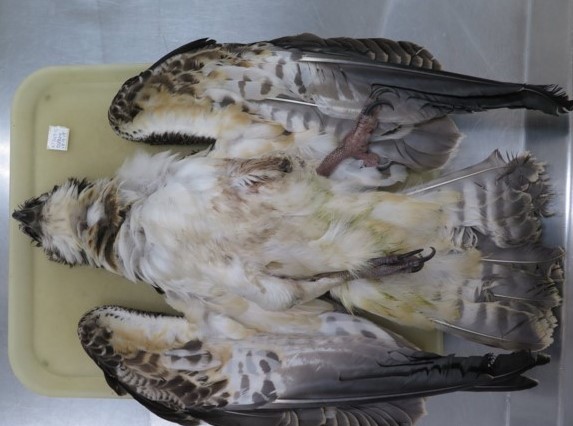
An x-ray of the shot buzzard:

shot BZ PDNP Sep 2015 - Copy

The osprey alive, with two smashed up legs:

osprey springtrapped PDNP Sep 2015 - Copy

The osprey dead, with two smashed up legs:

osprey springtrapped 2 - Copy

The osprey’s smashed up right leg:

osprey right leg - Copy

General licences suspended on four Scottish grouse moors in response to raptor persecution crimes

Yesterday, SNH published the following press release:

General licences restricted in wildlife crime hotspots

Scottish Natural Heritage (SNH) has restricted the use of general licences on four properties in two wildlife crime hotspots – one in Stirlingshire and one in the Borders – this week. The decision was made on the basis of evidence provided by Police Scotland of wildlife crime against birds.

Nick Halfhide, SNH Director of Operations, said:

“There is clear evidence that wildlife crimes have been committed on these properties. Because of this, and the risk of more wildlife crimes taking place, we have suspended the general licences on these four properties for three years. They may though still apply for individual licences, but these will be closely monitored.

“This measure should help to protect wild birds in the area, while still allowing necessary land management activities to take place, albeit under tighter supervision. We consider that this is a proportionate response to protect wild birds in the area and prevent further wildlife crime.”

General licences allow landowners or land managers to carry out actions which would otherwise be illegal, including controlling common species of wild birds to protect crops or livestock.

The new measure complements other recent actions to reduce wildlife crime, including vicarious liability for offences against wild birds, which was introduced in 2011.

Restrictions will prevent people from using the general licences on the land in question for three years. This period will increase if more evidence of offences comes to light.

END

As promised in earlier correspondence with SNH about potential General Licence restrictions (e.g. see here), SNH has published ‘details’ of the current restrictions on its website. Although when we say ‘details’ we use the term loosely. The names of the estates have not been published (but see below) and the specific reasons (crimes) that triggered the restriction orders are also absent.

Instead, SNH has published two maps showing the areas where the three-year restriction orders will be in place.

Restriction order #1 can be viewed here: GL restriction order 1_ Nov 2015-2018

The map denoting the area relating to Restriction order #1 is here:

Raeshaw Corshope GL restriction map 2015

Having consulted Andy Wightman’s brilliant website Who Owns Scotland to check estate boundaries, we now know that the delineated area shown in Restriction order #1 includes parts of Raeshaw Estate and the neighbouring Corsehope Estate.

This is fascinating. Raeshaw Estate is well known to us and continues to be of interest. It is a mixed upland estate combining driven grouse shooting as well as pheasant and partridge shooting. We have documentary evidence that Mark Osborne’s company is involved in the estate management (more on that in the near future). Raeshaw Estate has been raided by the police at least twice (2004 and 2009 – poisoned and shot raptors and poisoned baits – see here) although nobody has ever been prosecuted for these crimes. However, the General Licence Restriction can only be applied for crimes that have been uncovered since 1st January 2014; it cannot be applied retrospectively for offences that took place prior to 1st January 2014. This means that further raptor crimes have been uncovered here but there has not been any publicity about them. Why not? There was news of a shot buzzard found in the nearby area on 24th July 2015 (see here), but this bird was found AFTER SNH had notified the estate of the intention to restrict the General Licence (see here) so this incident cannot be the one that triggered the General Licence Restriction.

Corsehope Estate has not been on our radar, although we’re told by local sources that gamekeepers from Raeshaw Estate are involved with ‘vermin control’ here so now we’re very interested.

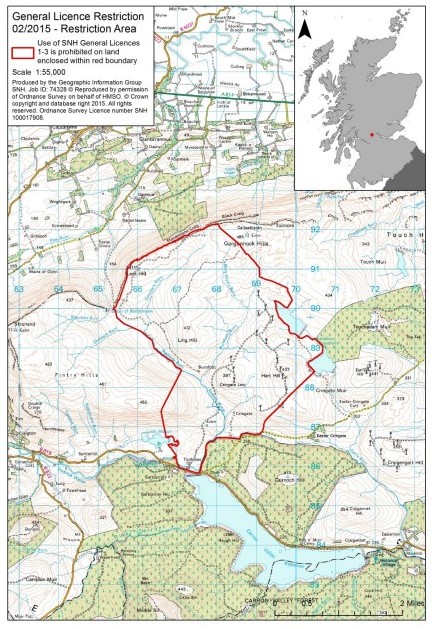
Restriction order #2 can be viewed here: GL retriction order 2_ Nov 2015-2018

The map denoting the area relating to Restriction order #2 is here:

Burnfoot Wester Cringate GL restriction map 2015

Again, consulting Andy Wightman’s excellent website Who Owns Scotland to check estate boundaries, we now know that the delineated area shown in Restriction order #2 includes parts of Burnfoot Estate and Wester Cringate Estate.

This is also interesting. We believe (although it must be stressed that this is educated speculation as SNH has not published the information) that this restriction order probably relates to a series of raptor persecution crimes including a poisoned red kite (July 2014), a poisoned peregrine (February 2015) and an illegally trapped red kite (May 2015) – see here.

So, what do these General Licence Restriction orders mean? Basically, it means that the following activities, usually permitted under General Licences 1, 2 and 3, are now not permitted in the areas shown on the two maps for three years, starting 13th November 2015 and ending 12th November 2018:

The killing or taking of the following species:

Great black-backed gull, carrion crow, hooded crow, jackdaw, jay, rook, ruddy duck, magpie, Canada goose, collared dove, feral pigeon, wood pigeon, lesser black-back gull, and herring gull.

The use of the following methods to kill/take these species are not permitted:

Pricking of eggs, oiling of eggs, destruction of eggs and nests, use of Larsen trap, use of Larsen Mate trap, use of Larsen Pod trap, use of multi-catch crow cage trap, shooting with any firearm, targeted falconry, and by hand.

That sounds great, doesn’t it? But it’s not quite as clear cut as that. As we’ve discussed before, and as is stated in the SNH press release at the top of this blog, although these activities can no longer be carried out in the two denoted areas under the cover of the three General Licences, individuals may still apply for an individual licence to permit these activities, although SNH claims that if granted, these will be “closely monitored”.

What does ‘closely monitored’ actually mean? Closely monitored by whom? Daily inspections by SNH? Police Scotland? That’s hardly going to happen, is it?

Let’s hope that members of the general public, exercising their right to visit these areas under open access legislation, pay close attention to what’s going on around them. If they see a Larsen trap in use, or a crow cage trap in use, or witness any of the above bird species being killed/taken by any of the methods mentioned above, they inform the Police straight away. Actually, let’s hope they forget the police and inform RSPB Scotland and/or the SSPCA instead – they’re more likely to get a quick response from them.

It’ll be interesting to see how this all pans out. On the one hand, we welcome these Restriction orders and applaud the Scottish Government (especially former Environment Minister Paul Wheelhouse for initiating them), SNH and Police Scotland for pursuing what we hope will be the first of many such Restriction orders. But on the other hand, will these restrictions be anything more than a minor inconvenience to the estates involved because they can simply apply for individual licences to continue their game-shooting activities? We’ll have to wait and see.

RSPB Scotland’s response to the two General Licence Restriction orders here

As yet no response from Scottish Land & Estates or the Scottish Gamekeepers’ Association but we’ll post them here if/when they comment.

UPDATE 11.50hrs: The SGA has issued the following statement on their website:

On November 4th 2015, SNH announced general licence restrictions to two areas encompassing four properties.
The SGA has issued the following statement in response to questions.

A Spokesman for The Scottish Gamekeepers Association said: “The SGA cannot condone wildlife crime and has a clear and consistent policy regarding this.
“As regards this case, it is our understanding that legal discussions are taking place regarding the areas affected and, therefore, it is not appropriate for us to comment further.”
END
UPDATE 13.20hrs: Statement from Environment Minister Dr Aileen McLeod:

“The announcement by SNH that the use of general licences has been restricted on specified areas of land in the Borders and in Stirlingshire is a result of work that the Scottish Government commissioned in July 2013 as part of a package of measures to combat wildlife crime.

We welcome the progress that has been made with this work. However we have not been involved in the decision-making and do not have any comment on the individual cases in question. The General Licence system is a light touch form of regulation. It is clearly sensible to apply closer scrutiny to areas where there is good evidence that wildlife crime has taken place, and we believe that this will prove a useful tool in the fight against bird of prey persecution.”

Henry’s tour day 39: Moy Estate

Mon 8 June 2015 - Copy

Henry paid a visit to Moy Estate in the Monadliaths.

Regular blog readers will probably remember what was found on Moy Estate in 2010:

  • A dead red kite in the back of a gamekeeper’s vehicle. It had two broken legs and had died as a result of a blow to the head.
  • The remains of a further two dead red kites.
  • A red kite’s severed leg, along with wing tags that had been fitted to a sateliite-tracked red kite, hidden in holes covered with moss.
  • Six illegal baited spring traps set in the open.
  • A trapped hen harrier (still alive) caught in an illegally set spring trap.
  • A poisoned bait.
  • Four leg rings previously fitted to golden eagle chicks found in the possession of a gamekeeper.

A 20-year-old gamekeeper (James Rolfe – straight out of game-keeping college) was charged with possession of the dead red kite and was fined £1,500. No charges were ever brought against anyone for any of the other offences.

Previous blogs on Moy: see here, herehere and here. It’s particularly worth having a look at this, especially in light of recent hen harrier ‘disappearances’ in England. They weren’t necessarily shot (as the grouse-shooting industry keeps telling us) – they could just as easily have been trapped like this (as the grouse-shooting industry keeps forgetting to mention).

The gamekeeper on Moy was convicted four years ago in 2011. Since then, several more satellite-tracked red kites have ‘disappeared’ since their last signals emitted from Moy, and several buzzard and goshawk nests seem to fail each year. It’s quite windy at Moy. It was probably the wind that blew off those rings from the young golden eagles’ legs and blew them straight in to a jar inside the gamekeeper’s house. It was probably the wind that severed the leg of the red kite and then blew it in to a hole on the moor and then blew moss over the hole to cover it. It was probably the wind that blew away the more recent ‘missing’ red kites. It was probably the same wind that blew holes in those buzzard and goshawk nests, too. Still no breeding hen harriers on this estate – yep, must have been blown away.

Word has it that the game management on Moy Estate is being taken over by a sporting agent with whom we’re very familiar. Cue hundreds of thousands of pounds worth of night vision equipment to carry out his particular style of grouse moor management.

Henry left the estate before darkness fell. He lives another day, although he’s still single.

£1K reward for info on buzzard found with horrific leg injuries

Sledmere buzzard1 Jan 2015A reward of £1,000 has been offered to anyone with information about a buzzard which was found with horrific leg injuries.

The bird was found, alive, on 21st January 2015 on the Sledmere Estate in Yorkshire. One of its feet was missing, causing Humberside Police and the RSPB to suspect it was a victim of illegal trapping.

The leg damage was so severe the buzzard had to be euthanised.

Bob Elliot, RSPB’s Head of Investigations said: “Setting spring traps in the open is a criminal practice, which harms birds of prey in the most horrible way. These devices are the raptor equivalent of a land mine – deadly and indiscriminate. I would urge anyone with information about this incident to contact the police immediately“.

This bird was initially taken to Jean Thorpe’s Ryedale Rescue facility – we recently blogged about Jean’s work (here) and mentioned that she was fundraising to help support her efforts in this raptor persecution blackspot – you can still donate HERE.

RSPB press release here

ITV news article here

Sledmere buzzard2 Jan 2015