
Landowners & gamekeepers claim ‘misrepresentation’ on BBC’s The One Show

One-Show-smallScottish Land and Estates and the Scottish Gamekeepers’ Association have written a letter of complaint to the BBC, claiming ‘misrepresentation’ on The One Show programme.
The programme (see here and here) included a feature on golden eagle persecution and during a studio interview, the RSPB’s Stuart Benn laid the blame firmly at the door of gamekeepers on Scottish grouse moors.

Doug McAdam, Chief Exec of Scottish Land & Estates, took great exception to that statement and wrote a hilarious letter of complaint, on behalf of SLE and SGA, to The One Show’s executive editor, Sandy Smith.

Here is his letter: SLE SGA complaint about BBC One Show

According to dear old Doug, there have only been four dead golden eagles found since 2010 and no charges [for these deaths] have been brought against anyone involved in grouse moor management. Conveniently, he failed to include the other known incidents of dead raptors turning up on grouse moors since 2010 (including white-tailed eagles, red kites, hen harriers, buzzards, short-eared owls, sparrowhawks, peregrines, kestrels), or the critically-injured golden eagle found shot and left to die on a grouse moor, or indeed the satellite-tagged raptors (particularly golden eagles and hen harriers) who have all gone ‘missing’ after their last known signal was received from, er, a grouse moor. There may well be more of these ‘missing’ birds but of course we’re no longer allowed to hear about them after the introduction of the new PAW Scotland ‘protocol’ that aims to keep these incidents away from the public’s gaze (see here).

Apart from trying to play down the extent of persecution incidents on grouse moors, and inferring that a lack of criminal convictions is a good indicator that gamekeepers are not involved with the illegal killing of golden eagles on grouse moors, Doug goes on to emphasise the SLE’s involvement with PAW Scotland, as though membership of that ‘partnership’ should be a measure of good behaviour. We’ve all seen how effective these ‘partnerships’ can be, following the near-extinction of breeding hen harriers on English grouse moors during the six-year Hen Harrier Dialogue ‘partnership’ designed to resolve the conflict. Indeed, three raptor conservation organisations have now resigned from that particular ‘partnership’ because they recognised it could be used as a convenient political cover by certain organisations with grouse-shooting interests.

Doug makes an astonishing claim about the PAW Scotland partnership: “Our combined efforts with the police, rural communities, the RSPB and over 120 other relevant stakeholders have been universally acknowledged as a key factor in reducing the number of raptor persecution incidents“.

Talk about misleading! For a start, there are not 120 ‘relevant stakeholders’ in relation to addressing raptor persecution. Many of the stakeholders have absolutely no involvement in directly addressing raptor persecution – they are there to specifically address other types of wildlife crime such as poaching, theft of freshwater pearl mussels, bat persecution and badger persecution.

Secondly, where does this notion come from that work by PAW Scotland has been ‘universally acknowledged as a key factor in reducing the number of raptor persecution incidents’? Has it been ‘universally acknowledged’? We don’t think PAW Scotland has had any demonstrable impact whatsoever on the number of raptor persecution incidents – where’s the evidence? Perhaps by ‘universal’ he means those with a vested interest in having people think that illegal raptor persecution is being dealt with effectively (e.g. the police, SNH, Scottish Government, SLE, SGA etc etc).

Doug finishes by saying, “Owners of moorland estates all over Scotland look after golden eagles” (ahem) and he invites Sandy Smith to visit a grouse moor “to find out for yourself the valuable conservation measures being implemented“. Let’s hope Sandy takes him up on his offer. Ooh, which grouse moor to choose? We could give Sandy quite a few suggestions….

Sandy Smith responded with a letter of his own: One Show’s reply to SLE

He says he’s sent an email to all One Show staff and suppliers “asking them to ensure they don’t make assumptions about gamekeepers based on out of date or inaccurate assumptions“.

Interestingly, Sandy Smith was the former executive editor of Panorama – a programme recognised for its investigative journalism and an ability to differentiate between fact and PR. Let’s hope he’s taken those qualities with him to The One Show.

We’ve sent a letter to Sandy, giving him the URL of this blog, to ensure his staff are kept up to date and are not basing their work on inaccurate assumptions (spin). You may wish to do the same – send your email, marked for the attention of Sandy Smith, to: TheOneShowEmails@bbc.co.uk

If you think grouse moor owners and their gamekeepers need to be held to account for their activities, please sign this e-petition and share it with your friends and colleagues: SIGN HERE.

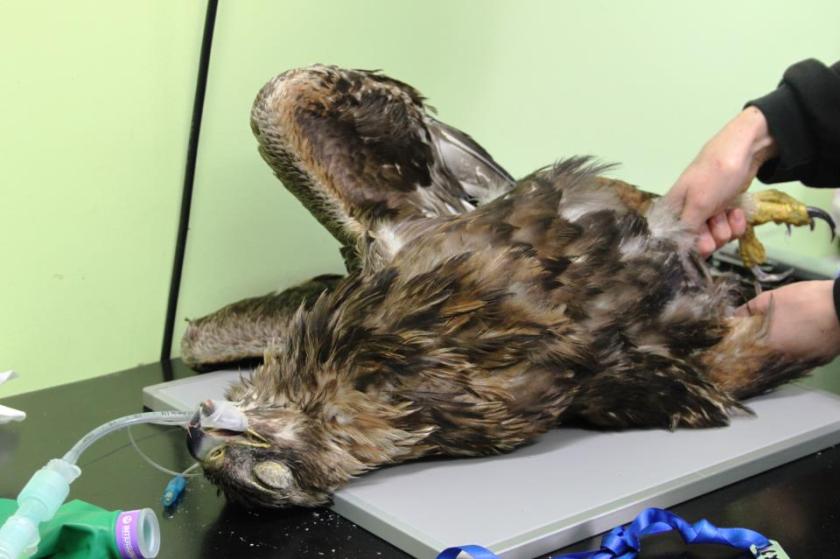
Here’s a photo showing how well golden eagles are looked after on some Scottish grouse moors. This one was found critically injured on Buccleuch Estate last aututmn – he had been shot and left to die, although it is not known on whose land he was shot. He is currently recuperating with the SSPCA after undergoing life-saving surgery. Needless to say, nobody has been charged for this crime.

The shot golden eagle undergoing emergency surgery

Deeside golden eagle fiasco rumbles on as SGA release their ‘report’

The shambolic investigation into the death of the Deeside golden eagle last year continues (see here, here, here, here, here, here, here for our previous blogs about this appalling case).

This morning, the Scottish Gamekeepers’ Association released a media statement and their investigatory ‘report’ into what they think happened to this eagle. It’s death was probably the result of a terrible accident, apparently. They say they only released their report because they became aware that it had been the subject of Freedom of Information requests to the Scottish Government.

At this stage, we are only posting their media statement, their ‘report’, and the RSPB’s response. We will be discussing the case as a whole, including the SGA’s conclusions, in a later blog, as we are awaiting responses from several FoI requests that potentially could be quite illuminating.

SGA media statement download: SGA RELEASE REPORT INTO EAGLE DEATH[1]

SGA investigatory report download: SGA Report, eagle death, Deeside[1]

RSPB media response:

RSPB Scotland responds to Scottish Gamekeepers Association eagle report

Responding to a statement released this morning by the Scottish Gamekeepers Association (SGA), Duncan Orr-Ewing, Head of Species and Land Management at RSPB Scotland, said:

“We reject absolutely these unprofessional assertions of the SGA in today’s press release concerning the case of the dead golden eagle found on Deeside in May 2012. Our previous media statement followed proper discussion and approval from the police, and was in full accordance with our joint working protocol. The official post mortem report concluded that the bird had suffered two broken legs due to trauma “that could be consistent with an injury caused by a spring type trap” and that the severity of these injuries “would prevent the bird from being able to take off.”

This is a rather desperate statement from the SGA, which seemingly does more to reveal their true nature as apologists for the worst types of wildlife crime, as they try to defend the indefensible. Indeed, it calls into question their very commitment to the aims and objectives of the Partnership for Action Against Wildlife Crime Scotland (PAWS).

The illegal killing of golden eagles in Scotland is still a serious conservation issue, undermining the health of their population, and bringing international shame to our country. Over the past few years there have been a number of appalling cases involving the criminal killing of golden eagles, some of which have only come to light following the use of satellite tag technology. Rather than seeking excuses, we believe that the Scottish Gamekeepers Association’s efforts would be better directed at tackling those within their sector who still encourage such outdated practices”.  

The dead golden eagle     

Scottish gamekeepers ‘striving to be the best in Europe’

Scottish Gamekeepers’ Association Chairman Alex Hogg has published his latest blog today. It’s a classic.

It gives me great pride to know that we, as professional wildlife managers, are striving to be the best in Europe. Nowhere else will you find such a rich diversity in such a small area. This is down to Keepers protecting Scotland’s flora and fauna“.

Unfortunately he doesn’t specify what they are striving to be the best at.

He also mentions a recent police wildlife conference held in Galashiels, and suggests that the large turn-out “showed that Keepers are keen to gather information and the take-up on courses such as snaring and deer competence is very high“.

That’s interesting, because according to a recent parliamentary question and answer session, less than one third of the snaring operators in Scotland have attended the compulsory two-hour snaring course required to comply with new regulations that begin on 1st April 2013. As Libby Anderson of OneKind put so succinctly:

“1,376 snare users have attended, out of a shooting industry estimate of 5,000 snare operators. Will the remaining 3,624 be trained by 1st April, given that it has taken over two years to train the first third?”

Sounds like the courts may be busy this year if visitors to the countryside notice any snares that do not have an ID tag attached (the ID tag is issued by the police to the individual snare user, but only if the user can produce a certificate to show completion of an approved snaring training course). If you spot a snare in use in Scotland after 1st April, check to see whether it’s got an ID tag attached. If it hasn’t, report it to the police!

He also mentions ‘the fact that Keepers must read the conditions of the General Licence before trapping any crows“. That’s not actually a true ‘fact’, Alex. SNH, in their wisdom, decided to drop the requirement that the GLs must be ‘read’ – instead, the user must simply ‘understand’. This change was the result of lobbying from a number of game-shooting organisations, who claimed that the old requirement (to read the conditions) was discriminatory against anyone who couldn’t read. We suspect the real reason was to exploit some sort of legal loophole to avoid a future conviction for misuse, but that remains to be seen.

Anyway, the latest Hogg blog can be read here – we only wish he’d write more frequently….

Implications of the Lochindorb hare snare verdict

The almost four-year long Lochindorb Estate hare snare trial concluded today at Inverness Sheriff Court. The accused, former head gamekeeper and long-time SGA committee member David Taylor was found not guilty of illegally using snares to catch mountain hares on the Lochindorb Estate in 2009.

This has been a lengthy and complex case, seen by many as an important ‘test’ case. For previous blog entries see here, here, here, here, here and here.

The ‘not guilty’ verdict, however, only applies to the particular circumstances of this specific case. On this occasion, at that specific location and at that specific time, the evidence was deemed insufficient to merit a conviction. Sheriff Abercrombie accepted that Taylor was operating within the law and in good faith. This verdict though, does not mean that a future case with a different set of specific circumstances, could not result in a conviction. The verdict does NOT mean that it is legal to snare mountain hares in general terms; only within the terms of this particular case.

One of the key issues was whether a snare could be described as a ‘trap’. The prosecution said yes, the defence argued no. Sheriff Abercrombie deemed that a snare could be described as a trap. This is important for future potential cases.

The defence had also argued that the snares in question (the w-shaped snare) were selective; i.e. that they only caught the target species. Several gamekeepers spoke as defence witnesses and stated that in all their (combined) years of snaring, they’d never caught a non-target species using this snare-type. Whether you believe that or not is up to you – the fact of the matter was that the prosecution could not provide evidence to show that the w-shaped snare was indiscriminate. This should hopefully be a moot point in future cases as the use of the w-shaped snare to trap mountain hares has since become prohibited. Under the Snares Scotland Order (2010), it is no longer legal to use a snare in a way that an animal could become partially or wholly suspended.

The other important issue highlighted by this case was the lack of current scientific understanding of mountain hare population ecology in Scotland. We hope SNH will get their act together and implement an appropriate research and monitoring strategy for what many believe is a keystone species; i.e. one that plays an important role in the survival of other species such as the golden eagle and probably the pine marten.

BBC news article here

SGA statement here

Defence agent’s statement here

Lochindorb hare snare verdict

Former Lochindorb Estate head gamekeeper and SGA Committee Member, David Taylor, has been found not guilty of setting illegal snares to catch mountain hares.

More to follow…

The buzzard blame game

There’s an interesting new paper just published in the scientific journal Conservation Letters, authored by Alexander Lees, Ian Newton & Andrew Balmford, called: “Pheasants, buzzards and trophic cascades”.

It was prompted by last year’s ‘buzzardgate’ scandal and makes for an interesting read. Here’s the abstract:

The partial recovery of large birds of prey in lowland Britain has reignited conflicts with game managers and prompted a controversial UK government proposal to investigate ways of limiting losses to pheasant shooting operations. Yet best estimates are that buzzards are only a minor source of pheasant mortality – road traffic, for example, is far more important. Moreover, because there are often large numbers of breeding buzzards, local control of breeding pairs may simply lead to their replacement by immigrant buzzards. Most significantly, consideration of the complexity of trophic interactions suggests that even if successful, lowering buzzard numbers may directly or indirectly increase the abundance of other medium-sized predators (such as foxes and corvids) which potentially have much greater impacts on pheasant numbers. To be effective, interventions need to be underpinned by far more rigorous understanding of the dynamics of ecosystems dominated by artificially reared, superabundant nonnative game species“.

Link to the journal here.

On a related topic, did anyone read the Xmas blog of Scottish Gamekeepers’ Association Chairman, Alex Hogg? If you did, you might have noticed this statement:

The day my [pheasant] poults arrived in July, the temperature dropped to 7 degrees that evening and it rained for 3 weeks. We lost 500 poults that night due to hypothermia“. (Read his blog entry here).

That high mortality seems to put the ‘buzzards are killing all my poults so give me a licence to kill them” argument into perspective, doesn’t it? It also raises some interesting concerns about welfare problems…

Sorry to disappoint you, Bert….

Ah Bert, sorry mate – try again next year?

http://blogue.centrenad.com/2012/12/19/centre-nad-reassures-montrealers-no-danger-of-being-snatched-by-a-royal-eagle/?lang=en

Fake video stokes anti-eagle rhetoric

article-2250416-1693BE92000005DC-649_634x423A YouTube video that purports to show a golden eagle attempting to carry off a small child in a semi-urban park in Montreal has gone viral on social media networks. Unfortunately, for the eagle-haters, the video is clearly a fake. It’s not even a golden eagle! Watch the video here.

Unsurprisingly, the Daily Mail pounced on the story, with the headline: “Kidnapper from the skies”  and described the golden eagle as “the feathered beast, one of the world’s deadliest birds of prey” (see here). They later updated their story, perhaps realising it was all an elaborate hoax.

Bert Burnett of the Scottish Gamekeepers’ Association was also on hand to offer his customary insightful analysis. Here’s what he posted on the SGA’s Facebook page:

I have no doubt that the usual idiots will brand this video as a fake but then again they probably don’t believe the holocaust took place either“.

No surprises there – last year the SGA wrote to the Scottish Government about the threat of reintroduced sea eagles eating children in Scotland (see here and here).

Another YouTube video of equal authenticity, showing a baby being carried to an eagle’s nest, can be watched here.

UPDATE ON THE HOAX VIDEO here

Lochindorb Estate hare snare trial: verdict expected today

The long-running hare snare trial is expected to end today if Sheriff Abercrombie has reached a verdict.

We’ve blogged a lot about this case as the verdict could have far-reaching consequences on the way our uplands are managed, with a particular impact on grouse moor management practices.

Earlier posts can be read here (and see links within).

Two weeks ago the court heard the final pieces of evidence from the defence team, which consisted of a string of gamekeepers insisting that the type of snare used in this case is ‘selective’ (i.e. it doesn’t trap any species other than the target species). It must be a magic snare.

Many thanks to the contributor who send us a copy of the Badenoch & Strathspey Herald, dated 22 November 2012, with a summary of the evidence heard in court:

Gamekeepers tell trial of ‘selective’ snares

THREE gamekeepers have given evidence at the trial of a colleague facing allegations of illegal snaring of mountain hares on Lochindorb Estate more than three years ago.

The keepers told Sheriff Ian Abercrombie they had used the type of snare set by David Taylor and caught nothing other than mountain hares.

Former Lochindorb keeper Alexander McConnachie (66), Stuart Kennedy (45), from Tomatin, and Alan Hodgson (54), head keeper at Dalmagarry and a committee member of the Scottish Gamekeepers’ Association with special responsibility for snaring issues, told the trial they had all used the “W”  shaped snare, also known as a bow snare, as a means of controlling mountain hares on high ground on their estates.

David Taylor (65), who recently retired from his role as head keeper at Lochindorb, was charged with setting snares on April 14, 2009 on land at Lochan-t-Sidhie which were indiscriminate in which animals they could catch, contrary to the Conservation (Natural Habitats) Regulations which became law in 1994.

The trial, which started in March, reached its sixth day on Friday [16 Nov 2012] when the evidence was concluded.

Sheriff Abercrombie has agreed to written submissions being provided by both the Crown depute fiscal Iain Smith and the defence agent David McKie.

In evidence, Mr McConnachie said he was head keeper on Lochindorb between 1972 and 1993 before the new legislation came into place. He told the trial that where the snares were set, 1,500 feet above sea level, there were very few other species to be found.

Wildlife expert Hugo Straker (57), a senior adviser with the Game and Wildlife Conservation Trust and an expert on snaring law in Scotland, had earlier told the trial that the snares could be selective depending on how and where they were set. He also differentiated between a trap and a snare. In his opinion he said a trap was a spring-loaded device which can kill or trap an animal live while the snare was a “restraining device” which can kill.

Mr McConnachie told the court snares are never referred to as traps. ‘A trap is a mechanical device’, he said. Often they were concealed in a box to trap the targeted species and for the protection of other mammals. Wire cage traps, known as Larsen traps, were also used to control crows.

He said he used the “bow” snare used by Taylor extensively between 1990 and 1993 on Lochindorb because of the increase in tick of the moor.

Asked if he had ever found other animals caught in the snares he replied: “No, never. They are very selective, very humane and highly visible. I never caught anything else in them”.

He said you would get the occasional fox or roe dear [sic] at that level but it was quite rare to see a golden eagle.

Asked by depute fiscal lain Smith if an animal broke a snare how he would know it was a hare that did this. He said there was always evidence of hare fur nearby if a snare broke.

Mr Hodgson said the snares were perfectly legal at the time but gamekeepers had stopped using them because of this court case. He commented: “I would use them again in a minute. They were a brilliant tool. Easy to carry, easy to set and highly visible”.

Mr Hodgson said foxes and deer avoid them because they have forward vision. However, he said: “Hares have blind spots because their eyes are on the side of their heads, unlike predators”. He said he used them for nine years and never once found another species in them.

The trial was told by Mr Straker that since the alleged offence there had been major changes in law governing the use of snares going through parliament and all snares must have stops so mammals caught are not throttled and can be put down humanely. Everyone using them will require to be trained and certificated by a Scottish Government approved body and, from April next year, every snare will carry the operators certification number.

Police Constable Eric Sharkey (45), a wildlife officer with Northern Constabulary, inspected the site after a tip-off from a member of the public.

Scottish gamekeeper convicted of using banned poison

A 78-year old gamekeeper has been convicted of several wildlife crimes, including using the highly toxic banned pesticide Sodium Cyanide.

William (Bill) Scobie appeared at Dumfries Sheriff Court on Monday 29th October and admitted obstructing access to a badger sett at Jardine Hall Estate, near Lockerbie, as well as possession of the banned poison. Earlier media coverage indicated the placing of Cymag at the entrance of a badger sett. This stuff releases lethal cyanide gas on contact with moisture, which is why it’s been banned for several years.

This case has been running for a while; it was first reported by the BBC in July 2010 (see here) but we believe it was held up after the Cadder ruling (see here for an explanation) and it took some time before the case was given the go-ahead to proceed.

Scobie was fined a pathetic £270. The maximum fine for each offence is £5,000 and/or a six-month prison term.

It’s not known whether Scobie is a member of the Scottish Gamekeepers’ Association. If he is, then we’ll be expecting to see a strong signal of zero tolerance from them, including a public statement to confirm that his membership has been terminated. But don’t hold your breath, we’re still waiting for them to issue public statements of condemnation about other Scottish gamekeepers who’ve been convicted of wildlife crimes this year (e.g. see here, here). Oh, and perhaps something about that shot golden eagle found on a grouse moor (here) and the results of their own ‘inquiry’ into the dead golden eagle found in Aberdeenshire (see here).

Excellent work by the SSPCA  once again. In their press release, the SSPCA also thank Dumfries & Galloway Police and Procurator Fiscal Pamela Rhodes (once again). She’s obviously very good at her job – wonder why she wasn’t offered that third specialist wildlife crime fiscal position…

SSPCA press release here