Further to last week’s news that Scottish gamekeeper and convicted sex offender Russell Mason had pleaded guilty to battering a trapped Goshawk to death on a shooting estate in Perthshire, in addition to firearms offences (see here), I’ve been looking to see how the game-shooting industry has responded to this latest conviction of a member of its community.
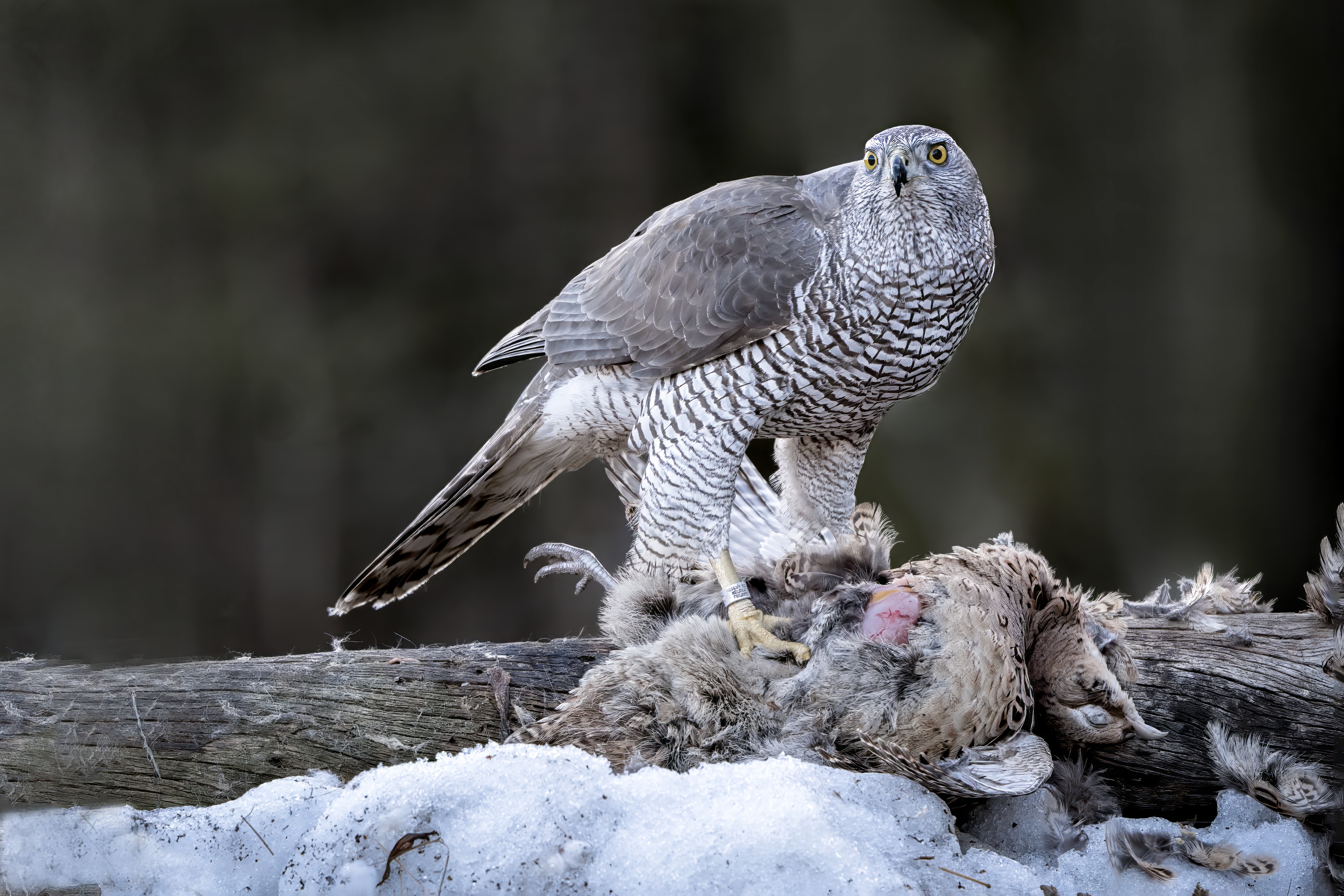
Goshawk with Pheasant. Photo by Ronnie Gilbert
You’ll recall that this is the game-shooting industry whose organisations routinely state they have a ‘zero tolerance’ policy towards raptor persecution, and many of them are members of the Partnership for Action Against Wildlife Crime (PAW) Raptor Group, in which case you’d think they’d be quick to condemn this latest crime, and reassure the public that if Mason and/or the estate was a member of any of these organisations they’ve now been expelled, right?
Six days on from Mason’s conviction, here’s how those shooting organisations have responded to the news:
Scottish Gamekeepers Association – silence
Scottish Land & Estates – silence
Scottish Association for Country Sports – silence
British Association for Shooting & Conservation – silence
Countryside Alliance – silence
Game & Wildlife Conservation Trust – silence
Perhaps they’re all waiting for Mason to be sentenced next month before they denounce his criminal activities? Although I can’t think of any reasonable argument for a delay.
Or perhaps they’ll wait for the inevitable public revulsion when the RSPB publishes the video nasty showing Mason bludgeoning the Goshawk to death, before they bother to comment?
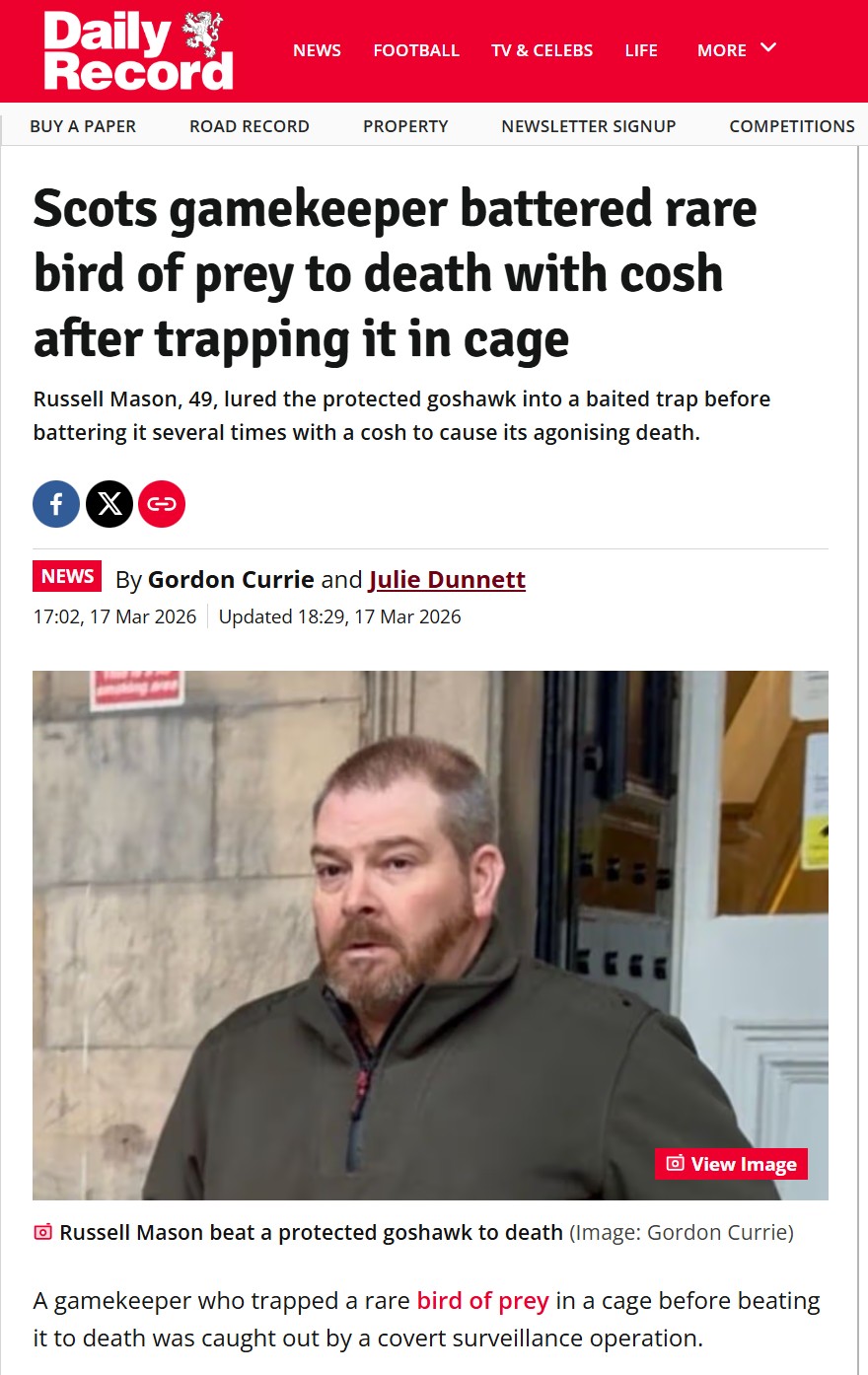
Further to yesterday’s news that Scottish gamekeeper Russell Mason, 49, had pleaded guilty to battering a trapped Goshawk to death on a shooting estate in Perthshire (see here), the Daily Record has published more detail about this case, which is quite disturbing.
The article is reproduced below in case this URL is broken/removed at a later date.
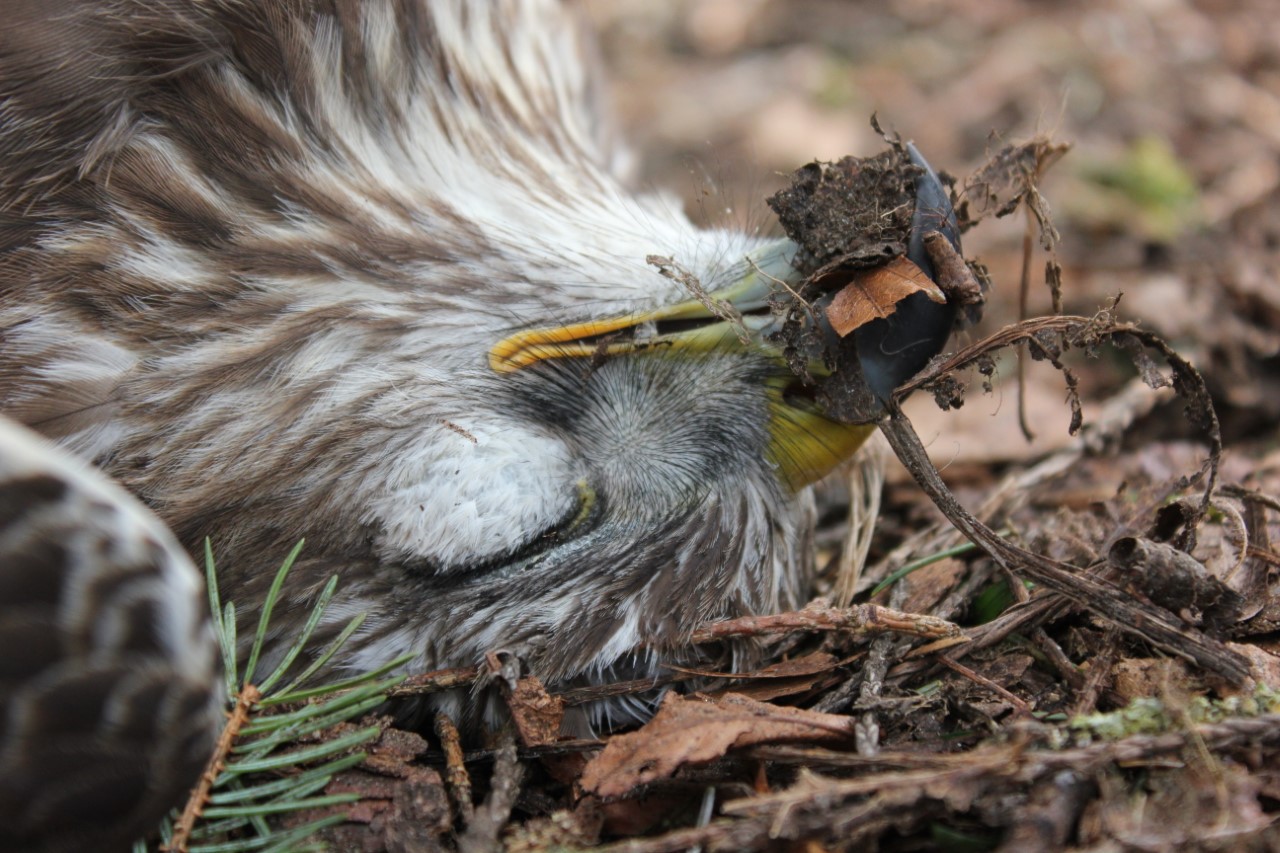
Russell Mason, 49, lured the protected goshawk into a baited trap before battering it several times with a cosh to cause its agonising death.
He was also found to have left nearly 200 rounds of live ammunition lying around in his bedroom and unsecured within his Polaris Ranger vehicle.
Fiscal depute Karon Rollo told Perth Sheriff Court: “Goshawks are rare birds of prey. They hunt birds and small animals. They have a wingspan of up to four feet and weigh between two and three pounds.
“They were persecuted to extinction in Scotland in the last century, but have been reintroduced, with now around 100 breeding pairs in existence.
“A crow cage trap was visited by RSPB staff on 9 January 2024. At the time this trap was set, it had a meat bait, and the door was chained and padlocked shut.
“It had a sign on the trap stating that the Scottish Government pays the estate to catch carrion crows from 1 March to 30 June to increase the chick survival rates for conservation-listed bird species.
“To continue observations and continue with this research, it was decided to install a continuous recording static camera covering this crow cage trap“.
She said RSPB staff visited the camera several times to review the captured footage and became aware of a male visiting the trap on 12 February 2024.
“At this time there was a goshawk and a crow in the trap,” Ms Rollo said. “The male opened and entered the trap. After entering he used a hand-held net to capture the goshawk and put it to the ground.
“He then struck the bird six times with a cosh. He placed the bird into a carrier bag, rolled it up and put the package under his arm.
“He left the trap, placed the net in the back of the vehicle and the bag in the cab. He locked the trap and drove off“.
The prosecutor said: “The male was identified from the footage by police officers, who knew him as being gamekeeper Russell Mason. The crow cage trap number related to the accused.
“Footage on other dates, including him putting a decoy bird in the trap, confirmed his identity. An avian vet specialising in raptors was shown the footage.
“He opined that the goshawk looked healthy and was exhibiting the normal behaviour of a captured raptor. Goshawks, in his experience, as ‘particularly flighty and stressy birds’ and this one was no exception.
“He describes it as showing a man beating a goshawk to death with a cudgel with the bird having been first netted within a crow cage trap.
“He states there were six blows to the body, which may have caused broken wings or rib fractures during the trauma, and that it was quite obviously not killed outright with one blow.
“He is of the view that it is extremely unlikely that it would have been lying passively in the net and therefore there is a high possibility that it would have sustained painful fractures and injuries before dying“.
A search of Mason’s cottage found unsecured ammunition, along with clothes matching those seen on the CCTV footage. A bag and cosh were found in his vehicle.
The bag was analysed and found to have goshawk DNA on it. The search team recovered 195 illegally stored rounds of ammunition.
Mason admitted intentionally or recklessly killing a goshawk on 12 February 2024 by seizing it with a net before repeatedly striking it with a cosh on Cochrage Moor, Bridge of Cally, Perthshire.
He also admitted breaching the terms of his firearms certificate by failing to store ammunition securely.
Sentence on Mason was deferred for the preparation of social work reports until next month by Sheriff Alison McKay and he was granted bail.
Mason was previously placed on the sex offenders register after being spotted carrying out a solo sex act in his car by a resident of a sheltered housing complex.
He was spotted by an elderly woman with his trousers down as he sat in the car beside a path used by children to walk to and from school.
When officers told Mason they were at the scene to investigate reports of someone masturbating in a car, he said: “That was me.”
Mason admitted carrying out an act of public indecency outside the sheltered housing complex in Harriet Court, Blairgowrie, and was placed on the register for a year.
ENDS
A reminder – sentencing for Mason’s latest convictions (wildlife crime & firearms offences) has been deferred until 24 April 2026 for background reports.
UPDATE 23 March 2026: Game-shooting industry’s response to the recent conviction of Perthshire gamekeeper Russell Mason (here)
A Scottish gamekeeper has pleaded guilty to killing a Goshawk after he battered it to death after it was caught inside a Crow cage trap on a shooting estate in Perthshire.
At Perth Sheriff Court this morning, on what should have been the opening day of a criminal trial, gamekeeper Russell Mason, 49, changed his plea to guilty in relation to the charge that he had killed a Goshawk on Cochrage Moor (Muir), believed to be part of the Milton of Drimmie and Strone estate near Blairgowrie, on 12 February 2024 (see here for background to this case).
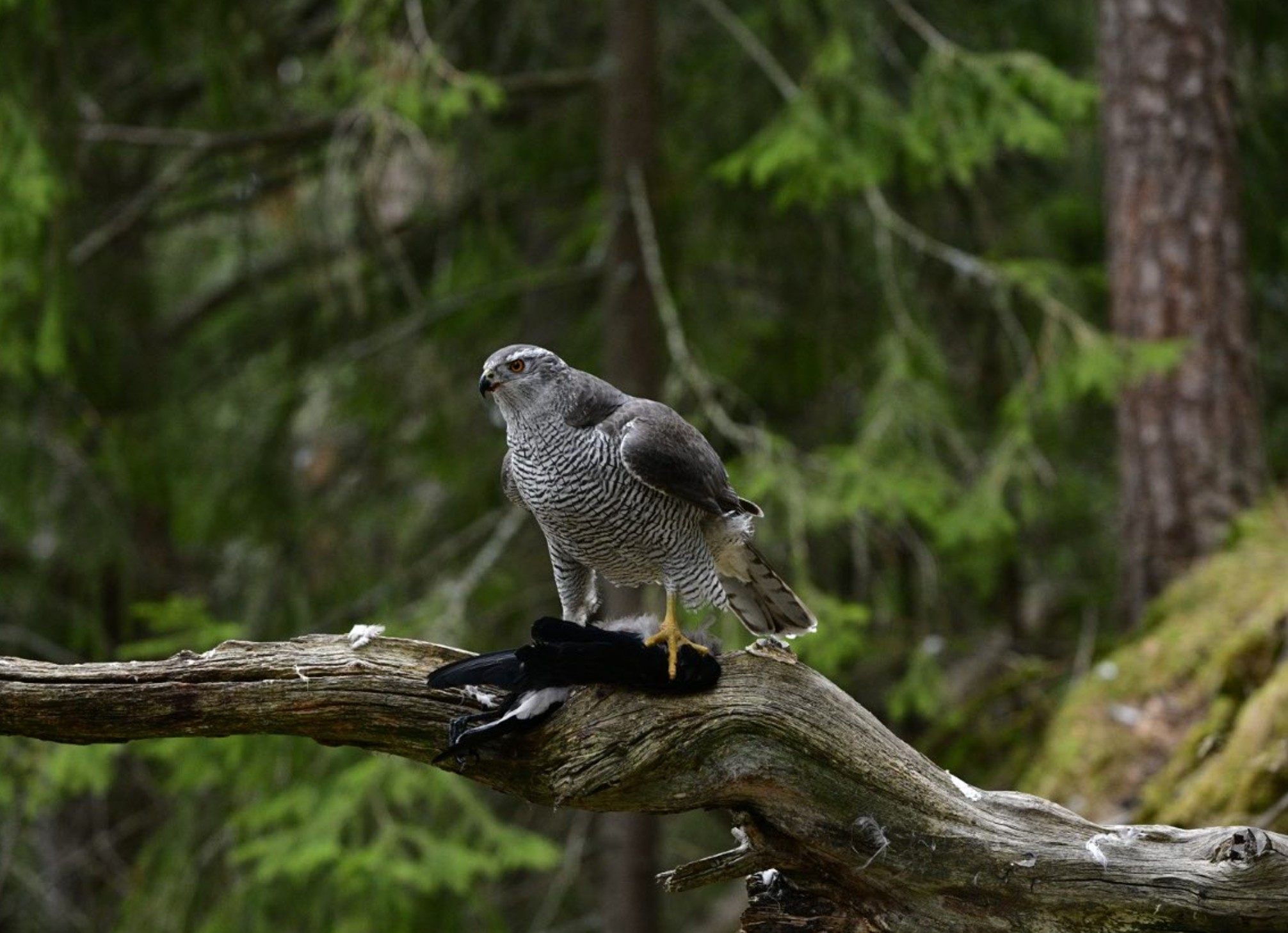
Goshawk with a Crow. Photo by Ronnie Gilbert
The court was shown a six-minute video of Mason killing the Goshawk – the footage had been filmed covertly by the RSPB’s Investigations Team and was crucial to providing the Crown Office with sufficient evidence to prosecute.
Mason also pleaded guilty to various firearms offences but it is believed that charges relating to alleged snaring offences were dropped, probably as part of a plea bargain.
The court heard that Mason has a previous conviction (the details were not discussed) and sentencing was deferred until 24 April 2026 for background reports. The Sheriff mentioned that a ‘restriction of liberty order’ may be considered. This is a direct alternative to a custodial sentence and usually involves electronic monitoring/tagging.
I expect the RSPB will publish its gruesome footage once sentencing is complete.
Congratulations to Police Scotland, RSPB, Scottish SPCA and the Crown Office & Fiscal Service for an exemplary investigation and prosecution. This is what effective partnership-working looks like.
Incidentally, this is the third successful conviction for raptor persecution in as many months where covert video evidence provided by the RSPB has been pivotal to the case.
The other two cases so far this year were:
12 January 2026, Scarborough Magistrates’ Court: gamekeeper Thomas Munday pleaded guilty to battering to death a Buzzard that had been caught inside a Crow cage trap on a Pheasant shoot at Hovingham, North Yorkshire (here)
and
29 January 2026, York Magistrates’ Court: gamekeeper Racster Dingwall pleaded guilty to conspiring to kill a Hen Harrier as it came in to roost on a grouse moor on the Conistone & Grassington Estate in the Yorkshire Dales National Park (here).
Many of you will be aware of the game-shooting industry’s recently ramped-up efforts to try to discredit and smear the reputations of RSPB Investigations Team members; these three convictions shouldn’t leave you in any doubt of the industry’s motivation.
Without the skill and expertise of the RSPB’s ability to capture such covert footage, these criminals would have escaped justice and the game-shooting industry’s claims of respectability and adherence to the law would go unchallenged. It’s as simple as that.
We can expect more news on the repercussions of today’s conviction in due course – i.e. was Mason a member of the Scottish Gamekeepers’ Association? Was he a member of the Tayside & Central Regional Moorland Group? (certainly someone with the same name and affiliation has previously signed an official letter to the Scottish Parliament about snaring regulations). Will NatureScot impose a three-year General Licence restriction on this estate? Is the estate a member of the landowners’ lobby group, Scottish Land & Estates? And will there be a prosecution for alleged vicarious liability?
NB: As legal proceedings have now concluded, comments are open on this case, with the usual caveat that offensive/libellous posts will not be published.
UPDATE 18 March 2026: Convicted Scottish gamekeeper Russell Mason – more disturbing details about this case (here)
UPDATE 23 March 2026: Game-shooting industry’s response to the recent conviction of Perthshire gamekeeper Russell Mason (here)
Two days ago, a jury at the High Court in Glasgow returned a guilty verdict in the trial of former Head Gamekeeper David Campbell, 77, who had been accused of murdering his ex-colleague from Edradynate Estate, Brian Low, after ambushing him and shooting him in the chest and neck with a shotgun on a remote woodland track near Aberfeldy on 16 February 2024.
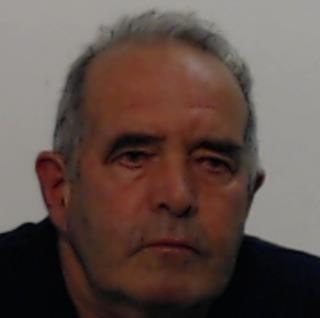
Former Head Gamekeeper and now convicted murderer David Campbell. (Photo by Police Scotland)
The circumstances of this horrific murder were shocking and understandably Campbell’s conviction made the headlines in widespread news coverage yesterday. For example:
But for many living in the rural area around Edradynate Estate, near Aberfeldy, Perthshire, and those who have been investigating wildlife crime on Edradynate Estate for decades, Campbell’s conviction came as no surprise whatsoever.
During his 33-years of employment as Head Gamekeeper on Edradynate Estate (1984-2017), Campbell was at the centre of at least 22 police investigations into the alleged poisoning, shooting and trapping of birds of prey, as well as firearms offences. I say alleged – what I mean is that there is no question whatsoever that raptors were illegally killed on that estate, over a period of three decades, but nobody was ever convicted for any of it and David Campbell had always denied any involvement.
Here’s a blog I wrote in 2017, after the Crown Office had dropped another prosecution against an Edradynate Estate gamekeeper relating to the alleged poisoning of Buzzards in 2015, despite a plea from Police Scotland to pursue a prosecution:
Edradynate Estate has been at the centre of investigations for alleged wildlife crime for a very, very long time. In 2002, the estate’s Head gamekeeper and underkeeper were arrested and charged with nine offences relating to the use of poisoned baits and also bird cruelty, including the use of spring traps. However, on 22 July 2004, two years after the original arrests and 13 court hearings later, the Crown Office dropped the case (sound familiar?). A COPFS spokeswoman later admitted that the time taken to prepare the case had been a major factor in the decision to scrap it (see here).
In July 2010, a poisoned red kite was discovered. An un-named gamekeeper from the estate (who said he was a member of the Scottish Gamekeepers’ Association) claimed the bird had been ‘planted’. It also emerged that in addition to the poisoned red kite, over the previous 15 years, 9 buzzards, 2 sparrowhawks, 2 crows, 1 gull, 1 tawny owl, 1 pole cat, and 1 domestic cat, had all been found poisoned in the area. Twelve poisoned baits (Carbofuran, Mevinphos and Alphachloralose) had also been discovered (see here). Nobody was prosecuted for any of this.
In March 2011, two poisoned buzzards, two poisoned crows, and two Carbofuran-laced pheasant baits were discovered. A gamekeeper was taken for questioning but he was later released without charge (here).
In February 2012 an Edradynate Estate gamekeeper was charged with a number of alleged firearms and explosives offences (see here). However, in September 2012 the Crown deserted the case without providing an explanation (see here). Gosh, this is becoming quite a habit, isn’t it?
Writing about the Crown Office’s decision in 2017 to drop the case against Campbell for the alleged poisoning of Buzzards on Edradynate in 2015, former Police Wildlife Crime Officer Alan Stewart wrote on his blog,
‘This has been the fourth case in relation to the poisoning of raptors submitted to the fiscal against the same accused. I submitted the first Edradynate case in 1994 but it was always going to be short of evidence of identification. The fiscal sat on it in case anything further was discovered that would help the case but had to drop it at the end of the time bar, which at that time was 6 months‘
and
‘I was involved in a further search, which I think was in the month of March. Two or three dead (poisoned) buzzards were found and there were a couple of pheasant baits recovered as well. No pesticides were found but we took samples from the accused’s vehicle and from various items of his clothing. Traces of pesticide were found in the vehicle and on several items of clothing, including from an item he was wearing when he was detained. It was a reasonable circumstantial case, which I thought would be clinched with the pesticide traces on the clothing worn by the accused. I suspect that identification, which is always crucial, was again considered to be the stumbling block. This case was eventually dropped as well‘
and
‘Between 1993 and 2011 I am aware of 14 poisoned baits involving the banned pesticides carbofuran, mevinphos and alpha-chloralose being found on Edradynate estate. There have also been 31 poisoned victims including 17 buzzards, 4 carrion crows, 2 sparrowhawks, 2 tawny owls, a domestic cat, a common gull, a red kite and a polecat found either on the estate or very close to its boundary. I doubt if anyone would disagree that this number of baits and victims were the very tip of the iceberg. I doubt also if anyone would think that someone was ‘coming in off the street’ and dumping all these dead creatures on the estate to cause trouble‘.
In 2018, Police Scotland issued an appeal for information after three dogs and two Buzzards were ‘deliberately poisoned’ between October 2017 and April 2018 around the Edradynate and Pitnacree Estates area (see here). Campbell was no longer working on the estate by this time (see discussion below) and there was local speculation that someone was trying to set up the new Head Gamekeeper but as far as I’m aware, nobody was prosecuted. I’m not aware of any further raptor persecution incidents at Edradynate since the new gamekeeping team was employed.
Alongside the reports of rampant raptor persecution at Edradynate over many, many years, there were stories relating to Campbell’s alleged threatening behaviour towards locals. The court heard some of that testimony during Campbell’s murder trial, although those charges were dropped on the last day of his trial. Further evidence of Campbell’s alleged behaviour was reported by Alan Stewart in one of his books – see here, and this is really worth a read.
It is apparent that many locals were terrified of Campbell, too scared to speak out for fear of retaliation of what he might do to them, or their beloved pets. One individual I’ve spoken to, who wishes to remain anonymous, tells a story of dogs being poisoned and shot and a claim about how Campbell was allegedly seen drowning a dog in a peat hag after it didn’t do as it was told.
Some speak of Campbell’s alleged ‘reign of terror’ in this small rural community and if their testimonies are true, it paints a picture of violence being normalised and being beyond the reach of the law.
The only time Edradynate Estate was held to account was when SNH (now NatureScot) imposed a three-year General Licence restriction in 2017 (see here), assumed to be in relation to the alleged poisoning of Buzzards in 2015 – the case that the Crown Office refused to prosecute.
One of the poisoned Buzzards found in 2015 (photo RPUK)
Despite the widely publicised and appalling catalogue of wildlife crime on Edradynate Estate, reported over several decades, the game shooting industry apparently turned a blind eye.
The Scottish Gamekeepers Association accepted at least two donations from the estate owner, Michael Campbell (no relation to gamekeeper David Campbell and recently deceased); one in 2014 and one in 2015. Surely the SGA was aware of the long history of allegations made about this estate? Perhaps they didn’t care. As there hadn’t been a single conviction they could conveniently ignore the allegations and continue to accept the donations and continue to sit around the table at so-called ‘partnership’ meetings claiming to be doing all they could to eradicate raptor persecution.
Edradynate Estate was featured in the Fieldsports magazine in 2014, where one of the named guns was Robbie Douglas-Miller – surely not this one?
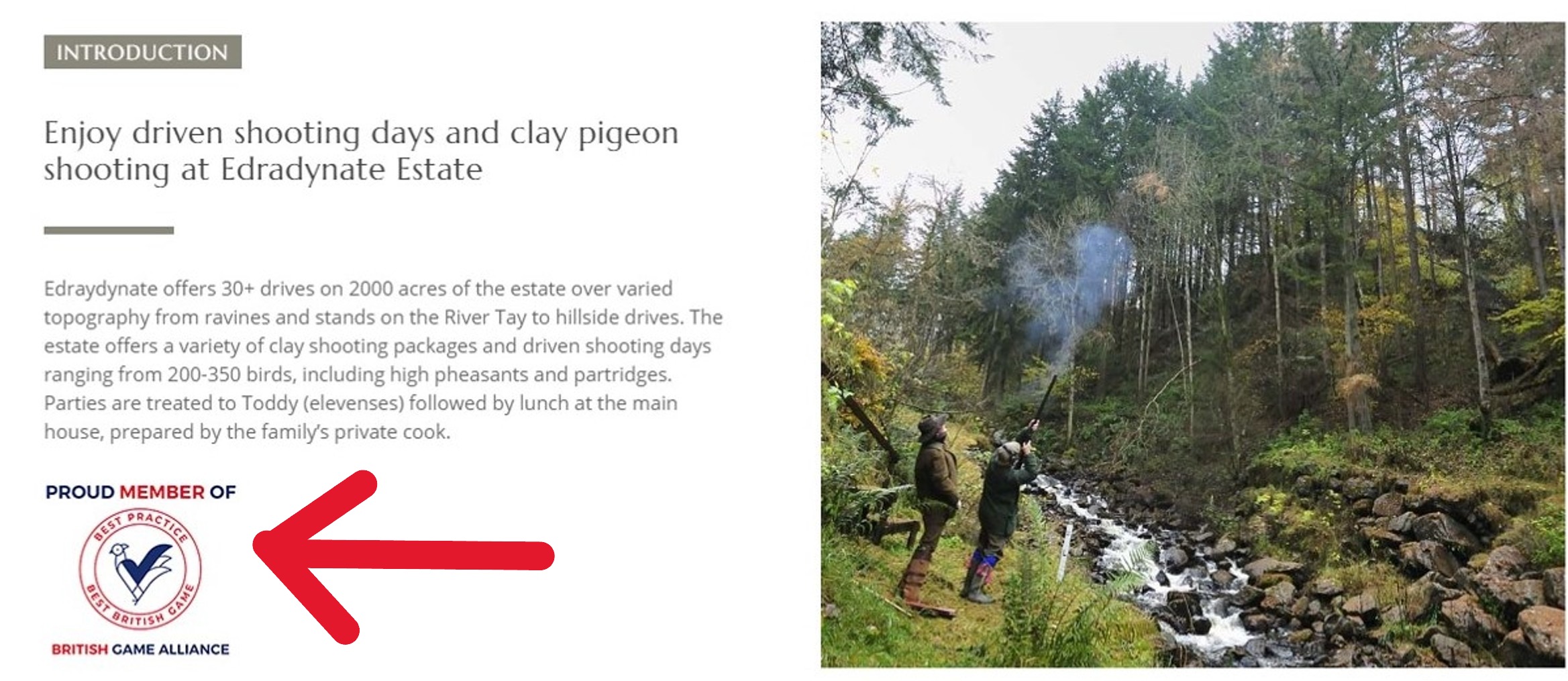
In 2020 Edradynate Estate was endorsed by the British Game Alliance, the game shooting industry’s own ‘assurance’ scheme (at the time), membership of which is supposed to indicate ‘rigorous and ethical standards’.
Screen grab from Edradynate Estate website 2020
And in 2023, the Game & Wildlife Conservation Trust (GWCT) accepted an auction donation from Edradynate Estate owner Michael Campbell with an estimated value of £2,500.
By February 2017, David Campbell’s employment as Head Gamekeeper at Edradynate Estate had ended, reportedly after his relationship with owner Michael Campbell had deteriorated and he was ‘removed from his job‘. Later that year David Campbell was charged with maliciously poisoning game cover crops on the estate as an ‘act of revenge’, a charge he denied, and of which he was ultimately cleared after the court ruled the case against him had not been proven beyond reasonable doubt (here).
In the sentencing remarks after gamekeeper Campbell’s recent conviction for murder, Judge Lord Scott said this:
“You have no previous convictions. This appalling and senseless act of extreme wickedness casts a shadow over what seems to have been a long life spent by you in gainful employment and some benefit to the community“.
I do wonder on what background information Lord Scott based this statement. Whilst it’s true that Campbell had no previous convictions, it is indisputable that he was a suspect in multiple crime investigations spanning several decades, and that many in the local community lived in fear of him. And at some point his firearms and shotgun licences had been revoked, presumably on evidence that his suitability was questioned and/or he was considered a risk to public safety.
I understand that following Campbell’s murder conviction, Alan Stewart is preparing a new book. I also understand that a TV production company was granted permission to film during the trial inside Glasgow’s High Court for a documentary about this case.
According to an exclusive article in The Courier yesterday, David Campbell is expected to mount an appeal against his murder conviction and it is anticipated that he will lodge formal paperwork with the Court of Appeal in the coming days.
Stepping away from the tragic murder of Brian Low, there are wider, more general implications to consider.
It is extensively evidenced that there’s a strong link between violence towards animals and violence towards humans. I think ‘violence towards animals’ in this context often refers to issues of illegal animal cruelty (e.g. Badger baiting, putting pets inside microwaves etc) but personally I would also define the routine duties of a gamekeeper as qualifying as ‘violence towards animals’, even though much of this activity is still considered legal in the UK.
I fully accept that some people will disagree with this opinion, and may argue that those who have been granted firearms/shotgun licences, as most (all?) gamekeepers have, are subject to rigorous police checks of their character and suitability. However, you’ve only got to look at the number of wildlife crimes that include the use of a firearm/shotgun, let alone the murder of innocent people by firearm certificate holders, to know that the system isn’t fit for purpose.
I recently read an analysis produced by the National Wildlife Crime Unit (NWCU) about polycriminality in wildlife crime offenders in the UK, which suggested that a significant proportion (59% of offenders) are also linked to violent offending against humans, ranging from low level common assaults to attempted murder, murder and kidnap. (Unfortunately I don’t think this report is available in the public domain).
Wildlife & Countryside LINK is using this analysis to push for a series of recommendations for the government to improve policing resources for tackling wildlife crime, which in turn should increase public safety as well as the safety of wildlife and the environment.
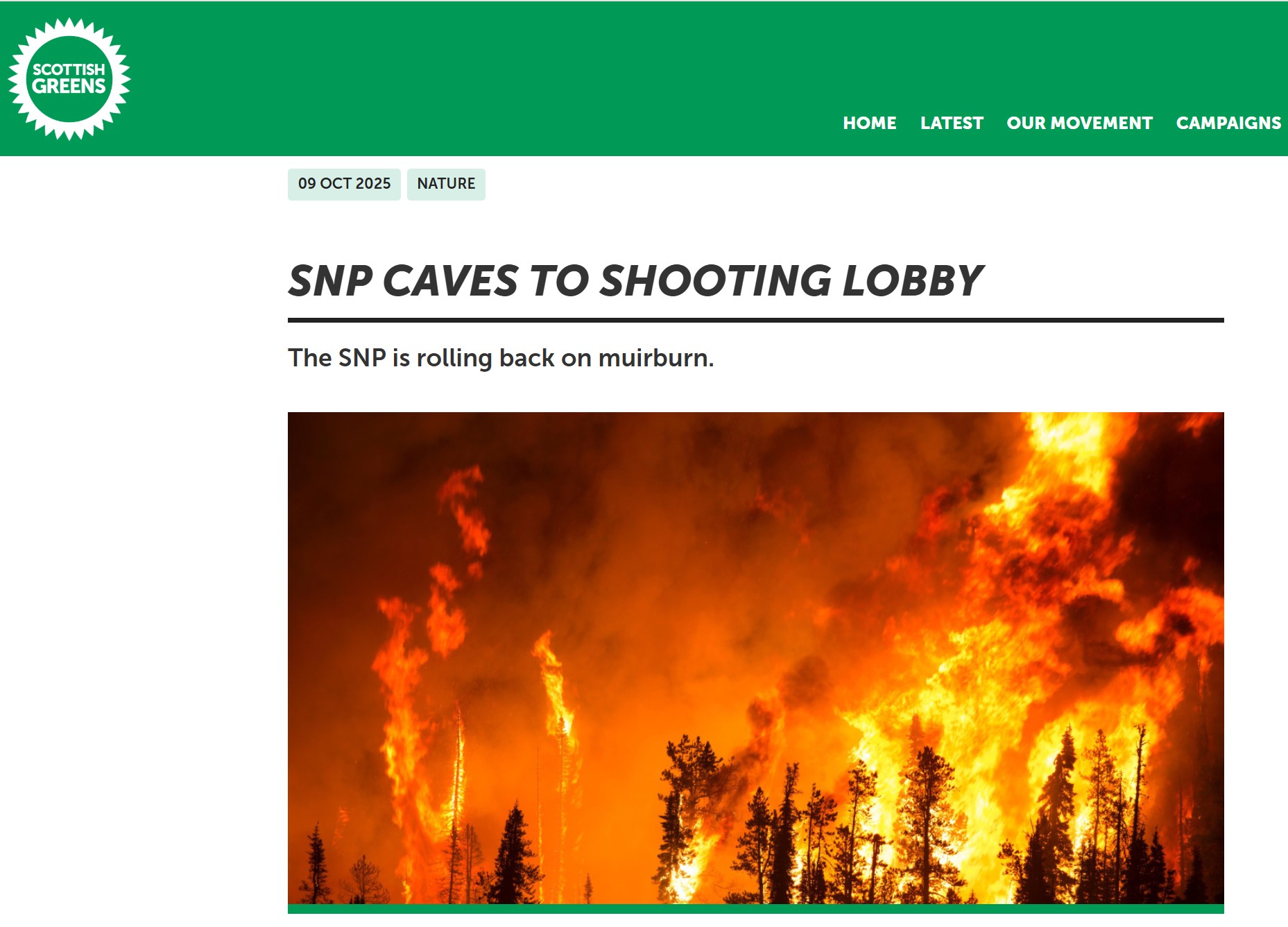
As expected, the Scottish Government’s announcement on Thursday that it has delayed the implementation of muirburn licensing (for the second time) has been met with anger.
Scottish Greens MSP Ariane Burgess said the Scottish Government has ‘caved to the shooting lobby‘ and accused Ministers of putting the interests of wealthy landowners ahead of environmental protection and public safety.
She is calling for the immediate implementation of muirburn licensing, proper investment in emergency services, and a supported shift away from land management practices that fuel ecological degradation.
Ariane continued:
“This is deeply disappointing. We have just had a summer of devastating wildfires across Scotland, and it is vital that we act rather than backtracking. Yet again, the SNP is bending to the demands of wealthy landowners.
“During the scrutiny of the Wildlife Management and Muirburn Act we took detailed evidence on the role of muirburn in wildfire risk. There is very little credible evidence to support the hunting and shooting lobby’s ridiculous claim that these practices have any role in preventing wildfires“.
RSPB Scotland has also published a blog in reaction to the Government’s decision, saying ‘Scotland’s wildlife can’t afford any more delays to muirburn legislation’.
RSPB Senior Land Use Policy Officer Andrew Midgley said it was “a huge disappointment to those of us who wish to see this potentially damaging and often risky activity properly regulated. This is the second time it has been kicked down the road.
“On the very same day, in a sadly ironic twist, muirburn that was reported as being conducted on a grouse moor in Aberdeenshire got out of control and started a wildfire. The wildfire spread onto a neighbouring National Nature Reserve managed by the Government agency NatureScot, and burnt into woodland that is part of our network of internationally important nature conservation sites. That this occurred is no cause for gloating. It’s a tragic lesson in why regulation is needed without further delay.
“It’s now nearly six years since an independent group recommended that the regulation of burning in the hills be strengthened and it’s eighteen months since the legislation was passed in the Scottish Parliament. It was acknowledged that muirburn is a high-risk land management activity that should be carefully managed and that regulation would help. This latest delay is further evidence that the Government and NatureScot are failing to properly get a grasp of this issue“.
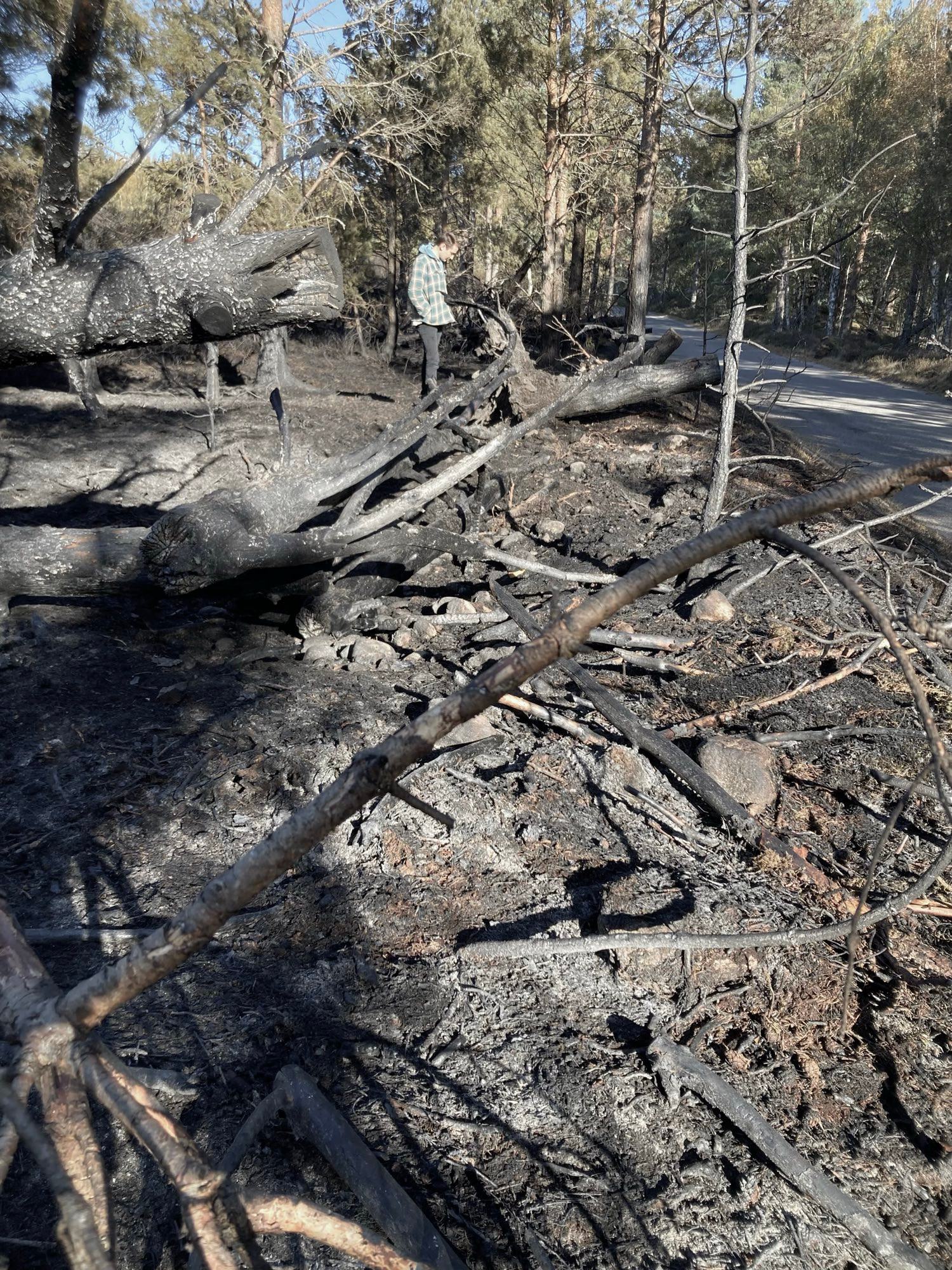
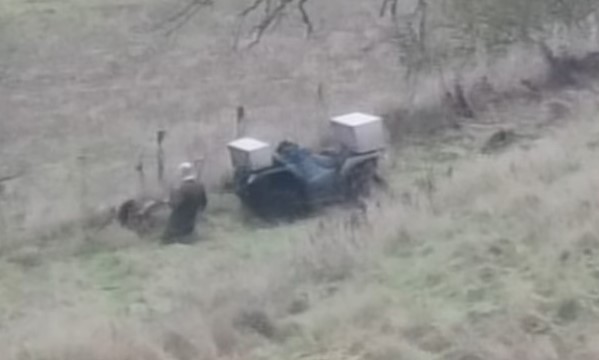
The out-of-control muirburn that was started on a grouse moor in the Cairngorms National Park on Thursday, just a few hours after the Scottish Government’s announcement, is thought to have had a 3km wide front and has burned approximately 200ha.
Local sources have reported that the fire burned approximately 5ha of the Muir of Dinnet National Nature Reserve before the Scottish Fire & Rescue Service were able to get it under control.
A scene from the aftermath, from @kredp.bsky.social
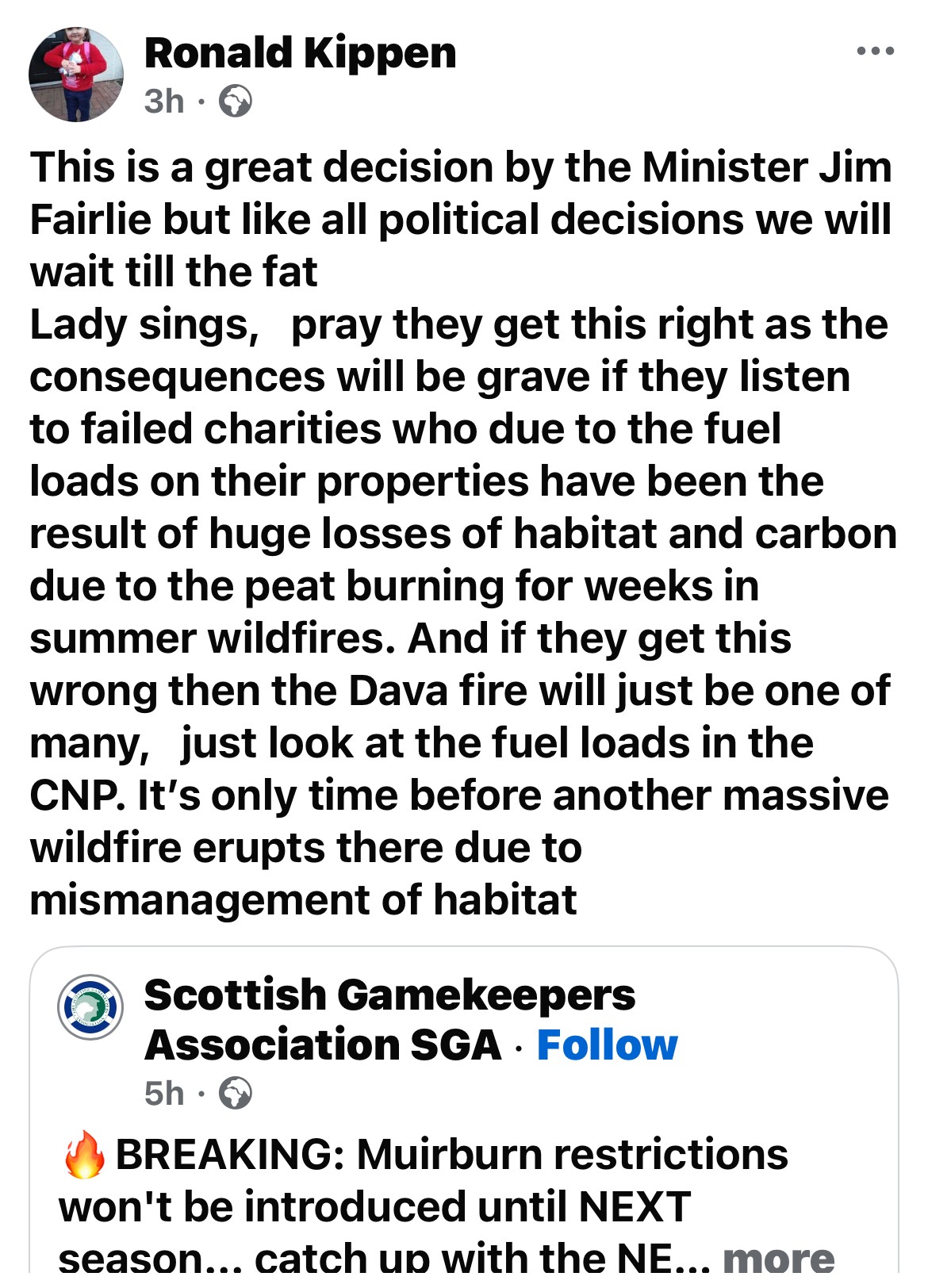
Why on earth gamekeepers were lighting fires under conditions known to present a high risk factor remains to be answered. But in a masterclass of irony, SGA Committee member Ronnie Kippen posted this on the same day:
You’re dead right, Ronnie, it was only a matter of time (just a few hours, in fact) before another massive wildfire erupted in the Cairngorms National Park ‘due to mismanagement of habitat’.
Strangely, I haven’t seen any of the usual suspects shouting about the Dinnet wildfire – in complete contrast to the publicity they’ve given to other wildfires this year where grouse moor management wasn’t thought to be implicated.
Meanwhile, the Scottish Gamekeepers Association (SGA) has welcomed the Government’s decision to delay muirburn licensing, describing it as “common sense“.
No surprise really, this is the same organisation that thinks White-tailed Eagles could eat small children, that “strongly believe the goshawk never was indigenous to the United Kingdom and there is absolutely no hard evidence to suggest otherwise” (here), that think it’s “unfair to accuse gamekeepers of wildlife crime” (here) and plenty of other examples of assorted nonsense.
The SGA’s statement in response to the muirburn licensing delay concludes with this statement:
“The SGA supports the Minister’s move and looks forward to making future changes more workable, drawing on our members’ centuries of knowledge in this area“.
“Making future changes more workable”? That suggests that the SGA is willing to accept the principle of muirburn licensing, albeit with “future changes“.
However, if you look closely at the list of amendments put forward to Stage 3 of the Land Reform Bill (due to be debated at the end of this month), you’ll see that Tim Eagle MSP (Scottish Conservative, Highlands & Islands) has lodged an amendment to repeal muirburn licensing altogether:
I doubt very much whether Mr Eagle has lodged this amendment without the lobbying, encouragement and support of the land management sector – I wonder whether the SGA has been part of that lobbying effort?
It’s good to see another amendment, lodged by Ariane Burgess MSP, calling for peatland to be redefined as that having 30cm depth instead of 40cm depth, which would bring it in line with the new definition in England.
UPDATE 13 October 2025: ‘The problem, which the Scottish Government is willfully ignoring, is that muirburn is responsible for a large number of wildfires’ (here)
UPDATE 30 October 2025: Scottish Govt fiddles while grouse moors burn (here)
A former gamekeeper has been sentenced after being found guilty of two wildlife crime offences relating to the digging and blocking of a badger sett in Fife.
Dylan Boyle, 52, from Avonbridge, Falkirk, had been filmed on 10 January 2023 by a field officer from the League Against Cruel Sports who was monitoring the activities of the Fife Fox Hunt on farmland near Cupar, which terrier man Boyle was operating alongside that day.
Footage showed Boyle digging in to an active badger sett with a spade and deliberately blocking entrances to the sett with rocks, nets and earth using a spade. A fox that bolted from the sett was shot and killed.
Screen grab from LACS video footage of Boyle taking photos whilst a dog savages a fox that had bolted from the badger sett that Boyle had been digging up
Boyle had pleaded not guilty to a number of wildlife crime offences and faced trial at Kirkaldy Sheriff Court in September 2024. Boyle’s defence team relied on testimony from an expert witness who happened to be the ‘chief’ of the Scottish Gamekeepers Association’s ‘training centre’. That expert witness reportedly told the court that he’d viewed the footage of Boyle and had ‘not seen anything wrong’ in Boyle’s actions of deliberately interfering with an active badger sett, contrary to the Protection of Badgers Act 1992.
That is deeply concerning given the SGA’s positioning to be a training provider for those operating under the new Wildlife Management & Muirburn (Scotland) Act 2024.
Boyle told the court that it wasn’t an active badger sett and that badgers ‘must have moved in overnight’ the evening after Boyle had been filmed.
Boyle’s implausible explanation was not accepted by the court and he was found guilty of two offences but sentencing was deferred for six months for Boyle ‘to be on good behaviour’ (see here).
Appearing for sentencing at Kirkaldy Sheriff Court last week, Sheriff Mark Allen fined Boyle a pathetic £400 after hearing he had ‘been of good behaviour’ since his conviction.
Penalties for interfering with a badger sett include a maximum of 12 months imprisonment and / or a £40,000 fine.
Robbie Marsland, Director of the League Against Cruel Sports in Scotland said:
“Despite Scotland having some of the strongest animal welfare legislation in the UK, the courts too often issue modest penalties for wildlife crimes.
“Mr. Boyle’s actions demonstrated wanton cruelty and a disregard for the law but sentences like this provide little deterrent to those who harm wildlife.
“If we are serious about protecting Scotland’s wildlife, meaningful penalties that reflect the severity of these crimes are required to serve as a deterrent.
“While this case should remind those who harm wildlife that our cameras are everywhere, it should also prompt a serious reconsideration of how our justice system responds to animal cruelty“.
Last November the BBC aired an episode of Highland Cops (Series 2, Episode 4) that featured a Police Scotland Wildlife Crime Officer, PC Dan Sutherland, investigating the suspicious disappearance of a satellite-tagged golden eagle on a grouse moor in the Highlands (available for next 9 months on iPlayer here, starts at 35.15 mins).
The programme followed PC Sutherland, along with an RSPB Investigations Officer, searching the moor for evidence of either the eagle or its tag.
PC Sutherland is an experienced WCO and he explained that this wasn’t the first time he’d been involved in an investigation into this type of incident and he gave a comprehensive commentary on the lengths that offenders will go to to hide the evidence of their crimes (e.g. tags being burned, tags being tied to rocks and dumped in lochs).
He also said: “So within Highlands & Islands, 100% of all birds of prey that are being killed happen on or near land that’s managed for gamebird shooting“.
The Scottish Gamekeepers Association (SGA) lodged a formal complaint to the BBC about what the SGA described in its quarterly members’ rag as having “caused unfair reputation [sic] damage” to the game-shooting industry and wanted the BBC to make “a prominent correction“.
Here’s the response from the BBC’s Executive Complaints Unit, published 13 February 2025:
It shouldn’t come as a surprise to anyone, not least the SGA, that this complaint was not upheld. The Scottish Parliament voted overwhelmingly last year to introduce new legislation (Wildlife Management & Muirburn (Scotland) Act 2024) precisely because raptor persecution, and particularly the illegal killing of golden eagles, persists on many driven grouse moors.
Well done PC Sutherland for saying it as it is, and well done to the BBC for not pandering to the histrionics of the SGA.
Last Friday I was contacted by a journalist from the Scottish Daily Mail who asked me this:
“I wondered if it would be possible to get a comment from Raptor Persecution UK about the Scottish Gamekeepers Association claiming that ‘insults’ made about them and the work they do on Raptor Persecution UK’s blog is taking its toll on members. In the recent chairman’s column, he claims ‘skilled predator management is now dressed up by campaigners as ‘casual killing’. What is Raptor Persecution UK’s response to this.
It’s for tomorrow’s paper, so a response today would be much appreciated“.
The thing was, I hadn’t read the ‘Chairman’s column’ she referred to. I guessed she was referring to the SGA’s latest quarterly rag for members, ‘Scottish Gamekeeper‘, which hadn’t yet been published (it’s due out this weekend).
It seemed pretty obvious to me then, that someone from the SGA was attempting to plant yet another story in the press, portraying themselves as ‘victims’, presumably in a pathetic attempt to elicit public support and sympathy for their wildlife-killing ways. We’ve been here before (e.g. here in 2021), although to do it at Christmas-time seemed more than a little cynical.
Normally I wouldn’t give the time of day to a journalist from the Mail but as she’d asked so nicely I thought it would be rude not to respond.
I told the journalist that given the SGA’s members’ long-running and well-documented campaign of vitriol and hatred against those of us who campaign against the illegal killing of birds of prey by gamekeepers on shooting estates (e.g. see here and here), this latest attempt to present themselves as victims of ‘insults’ was risible.
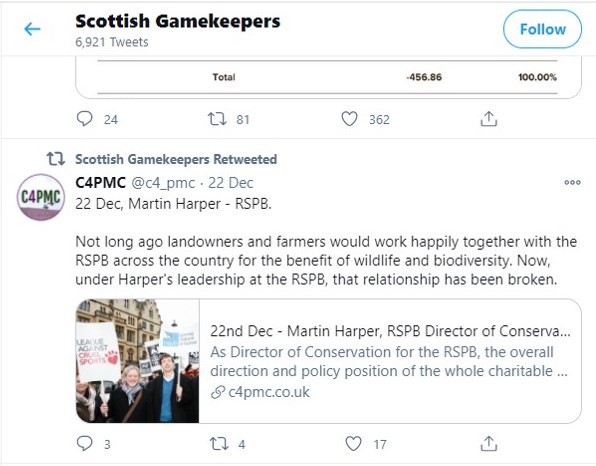
Are these the same gamekeepers who, for the duration of this last month, have been sharing an ‘advent calendar of abuse’ on social media, this time targeting named staff members of the RSPB?
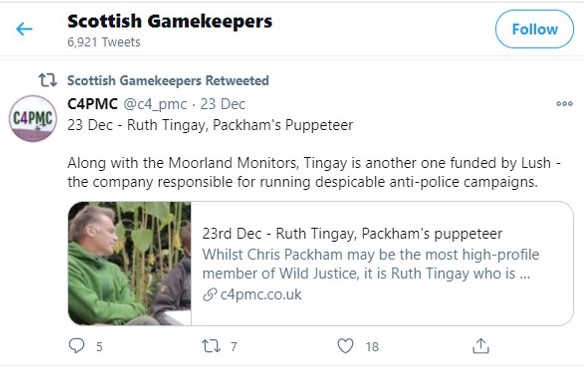
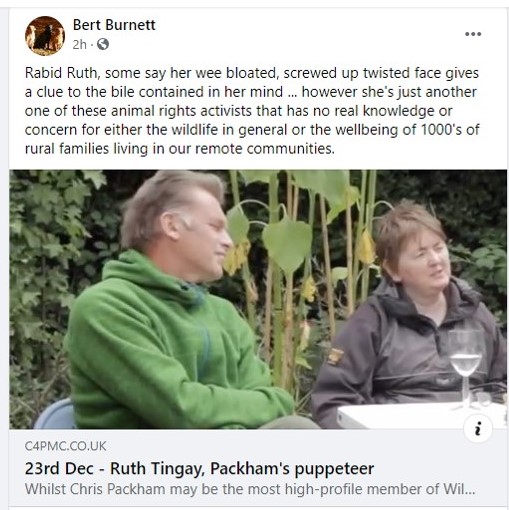
This ‘advent calendar of abuse’ is written and published by the grouse shooting industry’s very own hateful astroturfers, C4PMC (see here for an insight in to who they really are), and C4PMC has form for it.
They first started publishing these vindictive narratives in December 2020 (during a Coronavirus lockdown, no less) where each day they targeted a named individual known to campaign against driven grouse shooting. Those targeted included all the usual suspects (me, Chris Packham, various RSPB staff members, raptor fieldworkers, conservationists, even politicians), and guess who was involved in spreading that malicious abuse via their own social media accounts?
Yep, the SGA and friends, including former SGA Director and regular SGA columnist Bert Burnett, and several members of the Scottish Regional Moorlands Group, including the Angus Glens Moorland Group, Speyside Moorland Group, Southern Uplands Moorland Group, Tayside Moorland Group and the Grampian Moorland Group. Here are some examples:
And now they’re actually claiming that ‘insults’ are ‘taking their toll’ on SGA members?!
I also told the journalist, on the issue of ‘casual killing’, recent research has demonstrated that up to a quarter of a million animals are killed on Scotland’s grouse moors each year (in addition to all the gamebirds that are killed), and nearly half of those animals are non-target species (e.g. Hedgehogs, Dippers, Mistle Thrushes). I’d argue that referring to this as ‘casual killing’ is not an ‘insult’, it’s justified criticism.
I also told the journalist that whilst I thought that limited and targeted predator control, in some circumstances, for the conservation of threatened species, is justifiable, the wholesale slaughter of wildlife, just to protect gamebirds that are later shot and killed for so-called ‘sport’, is, in my opinion, inexcusable.
If you’re killing wildlife for a living, in order for others to pay some money to kill even more wildlife just for fun, don’t be surprised when others have legitimate concerns about it.
Funnily enough, the article in the Scottish Daily Mail never materialised. When I asked the journalist what had happened to it, she said the editor had pulled it.
Perhaps there was a realisation that the world according to the SGA was just too embarrassing, even for the Mail!
A proposal to translocate white-tailed eagles to Cumbria that has been in development for a number of years (see here) has reached the public consultation stage.
The Cumbrian White-tailed Eagle Project is being overseen by a steering group comprising the University of Cumbria, Cumbria Wildlife Trust, The Lifescape Project, RSPB, the Wildland Institute, the Lake District National Park Authority alongside local estate owners and managers.
According to the steering group, research has indicated that Cumbria has sufficient suitable habitat to support a population of white-tailed eagles and the county is considered an important strategic location to encourage links between other populations in Scotland, Ireland and Northern Ireland and the south of England.
The group is now engaging with the public to listen to views on bringing back this species to Cumbria and has begun a series of drop-in sessions, meetings and workshops (details here).
Unsurprisingly, this news has triggered the usual idiotic fear-mongering hysteria about white-tailed eagles based on ignorance and a persistent Victorian attitude to raptors, led, of course, by The Telegraph:
This is just lazy journalism. Had The Telegraph bothered to undertake any research at all, it would know that a series of scientific studies have shown that white-tailed eagles are generalist predators with a broad diet, and the most recent study from Scotland (here) shows that lambs are not an important food source for this species but marine prey is. This finding is also supported by a recent dietary study from the WTE Isle of Wight Reintroduction Project (here), which also concluded “there have been no cases of livestock predation since the project began“.
The hysteria was continued by this tweet from Mark Robinson, a farmer in North Yorkshire whose Twitter bio says he’s also the Reform Party spokesperson for the Thirsk and Malton Constituency (having failed to get elected in June). According to Farmer Robinson, the eagles will be ‘snatching up babies’ -:
It sounds like Farmer Robinson has been reading the discredited guff of the Scottish Gamekeepers Association, who has previously written to the Scottish Government about concerns that white-tailed eagles might eat children (here).
UPDATE 23 October 2025: Should White-tailed Eagles be reintroduced to Cumbria? Another questionnaire seeks your views (here)
Last week 51-year old Dylan Boyle was found guilty at Kirkaldy Sheriff Court in connection with the digging and blocking of an active badger sett during an outing with the Fife Fox Hunt in January 2023 (see Police Scotland press statement here, where the police describe Boyle’s actions as “reckless and deplorable“).
This is an interesting case, not just because Boyle is reportedly an ex-gamekeeper but because part of his (unsuccessful) defence was apparently based upon testimony from an expert witness who just happens to be the ‘chief’ of the Scottish Gamekeepers Association’s (SGA) ‘training centre’.
Why is that important? Well, because the SGA is positioning itself to provide the mandatory training courses as required by those operating grouse moor licences under the new Wildlife Management & Muirburn (Scotland) Act 2024.
I’ll come back to that. First, here’s some more important background information about the case, as provided in a press release by the League Against Cruel Sports (Scotland) –
Man found guilty on two charges for wildlife crimes
Charge 1, digging a badger sett. Contrary to the Protection of Badgers Act 1992.
Charge 2, blocking a badger sett. Contrary to the Protection of Badgers Act 1992.
A former terrier man with the Berwickshire and Fife Fox Hunts, Dylan Boyle, has been found guilty on two charges related to the destruction of a badger sett, by digging into an active badger sett and deliberately blocking entrances to the sett with rocks, nets and earth using a spade. The conviction was supported by covert film evidence captured by the animal charity, League Against Cruel Sports.
Dylan Boyle, aged 52, a transport officer who lives in Avonbridge, pled not guilty at a three-day trial which concluded on Friday 13th September 2024 at Kirkcaldy Sheriff Court.
Sentencing was deferred until the 13th of March 2025, but potential penalties for interfering with a badger sett include a maximum of 12 months imprisonment and / or a £40,000 fine.
The incident, which took place in January 2023 near Cupar, was witnessed and filmed by a Field Research and Investigations Officer for the League Against Cruel Sports who was monitoring the activities of the Fife Fox Hunt, which the terrier man was operating alongside at the time.
During the three-day trial the court was shown video footage of Boyle digging a badger sett. The League Against Cruel Sports investigator also gave verbal evidence relating to the blocking of the badger sett entrances.
On the second day of the trial three other charges were dropped. Two of these related to the treatment of a fox, in which it had been alleged Boyle had pulled a fox out from underground, shot it twice and encouraged his dog to attack and bite at the fox.
Screen grab from video footage of Boyle taking photos whilst a dog savages a fox that Boyle had dug out from a badger sett
The third charge to be dropped was the entering of a dog into an active badger sett, a serious offence concerning the welfare of the protected badgers as well as the dog. According to the Sheriff, the evidence that was presented in court by the Fiscal Prosecutions Officer was not sufficient to bring about a conviction on this occasion. During the final day’s trial, Boyle admitted entering his dog underground.
Sheriff Mark Alan found Boyle guilty on the charges of digging a badger sett and blocking a badger sett, both contrary to the Protection of Badgers Act 1992.
The Sheriff, in summing up, commented that he was very satisfied with the evidence given by the experts from the League Against Cruel Sports, stating that he was “satisfied that Boyle knowingly dug and blocked an active badger sett with disregard to the welfare of the badgers”.
The Sheriff also stated that if Boyle is caught committing further crimes between now and his sentencing in March 2025, then he could be facing jail time.
Robbie Marsland, Director of Scotland and Northern Ireland for League Against Cruel Sports, welcomed the guilty verdict and said:
“I’m very pleased that the League Against Cruel Sports’ vigilant fieldworkers were able to provide Police Scotland with video evidence that led to this successful conviction.
“Crimes against wildlife are all too common in Scotland and I hope this case will serve to remind people like Mr Boyle that our cameras can be anywhere.”
ENDS
The League Against Cruel Sports has published its video footage of the crime scene which provides an insight of Boyle’s offences:
As mentioned above, it’s reported that the defence called Alan Tweedie as an expert witness to defend Boyle’s actions. Alan Tweedie is the SGA’s Training Centre ‘chief’ (here).
According to a member of the public who attended the trial, Tweedie told the court he was an ex-gamekeeper and is now self-employed and works for the SGA providing training courses for gamekeepers.
Tweedie was asked whether he had seen the video evidence, and he told the court that he had. He was asked whether he’d seen anything in the video footage that he thought was wrong and Tweedie reportedly told the court that he saw nothing wrong in Boyle’s actions.
Given Boyle’s subsequent convictions, based on the League’s video evidence, it’s of significant concern that Alan Tweedie didn’t spot the wildlife crime offences described by Police Scotland as “reckless and deplorable”.
If this is the view of the SGA’s ‘training centre chief’ what confidence can be placed in the SGA’s ability to provide suitable training that would meet the requirements of the Wildlife Management & Muirburn (Scotland) Act 2024?
I should say here that I’m far as I’m aware, it hasn’t yet been decided who will provide the training requirements brought in under the new legislation. I understand that NatureScot has been consulting with a number of organisations (including animal welfare and conservation groups) about its proposed plans but that these discussions have so far mostly focused on the training content rather than who will deliver it. Although if you look on the SGA’s website, the SGA is quite clearly positioning itself to deliver the training elements associated with corvid and spring trap use (see here).
One to watch.
UPDATE 17.00hrs: There’s more commentary on the trial written by Jamie McKenzie in an article posted on 18 September in The Courier, although it sits behind a paywall. Here are the interesting bits:
Former gamekeeper Dylan Boyle, 51, was filmed by investigators from the League Against Cruel Sports (LACS) at a farm at Letham, near Cupar, on January 10 last year.
During a trial at Kirkcaldy Sheriff Court he had denied two charges of interfering with a badger sett by digging and damaging it and obstructing access by blocking an entrance with rocks.
Boyle, of Avonbridge near Falkirk, told the trial he had been there with a terrier dog to control foxes that day.
He insisted it was not an active badger sett and he only saw fox holes.
The trial heard an ecologist and police officer went to the site the next day and found tell-tale signs of an active badger sett, as had an LACS investigator on the day of the offence.
The court heard key indicators included D-shaped entrance holes – fox holes are more oval-shaped – and badger hair, scratch marks, bedding material and latrines.
Prosecutor Gerard Drugan put to Boyle he was suggesting experts were wrong about the presence of badger holes, to which the accused replied: “That could have happened the night before – they (experts) were there the following day.”
Mr Drugan said: “Your position is that somehow, overnight, badgers moved into the locus and reshaped the holes?”
Boyle replied: “Yes.”
The fiscal depute said: “But (the LACS investigator) saw they were badger holes?”
Boyle, who said he had studied gamekeeping and wildlife management at college, said: “He could be wrong.”
The fiscal said: “People who have spent a long time being involved with badgers are wrong?
“(The LACS investigator) was wrong,” Boyle responded.
Sheriff Mark Allan said he was satisfied it was an active badger sett on the key date and found Boyle guilty of two charges in contravention of the Protection of Badgers Act 1992.
The sheriff told Boyle: “I am satisfied you both dug the badger sett and obstructed the sett and did so with reckless disregard as to the consequences of your actions.”
Making reference to Boyle’s own background, education and knowledge, the sheriff said: “You should take care, you should not show reckless disregard for what it was you were doing on that particular occasion.
“You require to be careful and ensure what you are not doing is interfering with a badger sett.”
Sentence was deferred for six months, until March 13, for Boyle to be of good behaviour.
ENDS
UPDATE 18 March 2025: Former Scottish gamekeeper receives pathetic sentence for digging Badger sett (here)












 Raptor Persecution UK