Killing red kites is de rigueur in Nidderdale AONB, North Yorkshire

Today the RSPB’s Investigations Team has published a blog focusing on red kite persecution in North Yorkshire.

Many of you will already know that North Yorkshire is consistently rated as the worst county in the UK for recorded raptor persecution crimes and in recent years there has been a steady report of illegally-killed or injured raptors, particularly red kites, being discovered in this region. (Photo: M Ruddock)

In fact in the last ten years (2007-2017), twenty six red kites have been confirmed as victims of illegal persecution in North Yorkshire (18 poisoned, 8 shot), and these are only the ones that have been found. How many other victims were there? (Graph: RSPB)
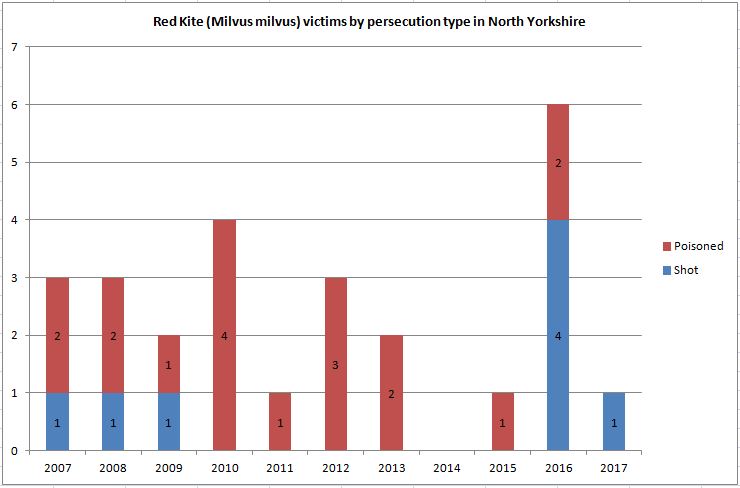
But North Yorkshire is a huge area and has two National Parks (Yorkshire Dales & North York Moors) as well as two designated Areas of Outstanding Natural Beauty (Howardian Hills & Nidderdale). When the average member of the public hears of a poisoned or shot kite being found in North Yorkshire, they probably think of it as a one off, random, & isolated killing. They’d be wrong.

The RSPB has created a map of where these confirmed red kite killings took place and it’s really quite obvious to see where red kite persecution is de rigueur; parts of the eastern side of the Yorkshire Dales National Park and parts of the Nidderdale AONB. Oh, and guess what the major land use is in these two areas? Intensively managed driven grouse moors. (Maps: RSPB)
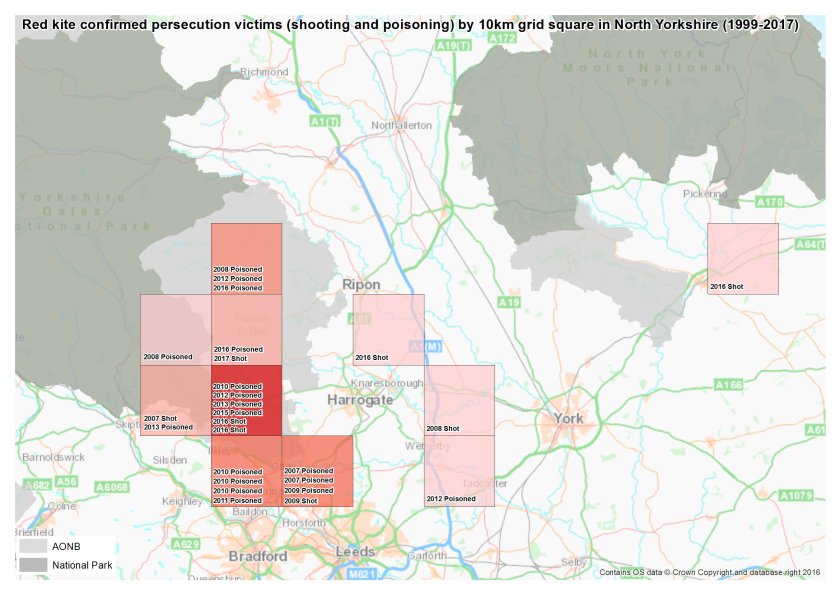
Here is a closer view of the Nidderdale map, showing that 22 of the 26 red kite victims were killed here:

When you look at these maps it’s worth remembering that they are only showing confirmed incidents of red kite persecution. These maps do not include other confirmed crimes such as illegally-killed or injured buzzards, illegally-killed or injured hen harriers, illegally-killed or injured peregrines, illegally-killed or injured kestrels, illegally-killed or injured marsh harriers, poisoned baits, illegal poison caches, and illegally-set traps. Nor do they include ‘probable’ crimes against raptors, particularly ‘disappearing’ satellite-tagged raptors, especially hen harriers.

A couple of weeks ago, Police Superintendent Chris Hankinson (who leads the Raptor Persecution Priority Delivery Group in England & Wales) wrote a comment on this blog (here). He said that the RPPDG was ‘working towards publication of a national map showing raptor persecution incidents with the aim of triggering activity from the local police force and community who can assist with information and intelligence to capture those responsible‘.

With the greatest respect, Supt Hankinson, the national maps are already available and have been for years (thanks to the diligent recording work of RSPB Investigations staff and their annual BirdCrime reports) and yet there hasn’t been a single prosecution for red kite persecution in the Nidderdale AONB (or the whole of North Yorkshire) for over ten years. Stop wasting your time pandering to those organisations in the RPPDG ‘partnership’ who are probably contesting every single incident and get on with leading the group to the known hotspot areas. The Nidderdale AONB would be a good start.

UPDATE 16.51hrs: Meanwhile, local business owners are putting up their own money towards a reward to catch the kite killers. Great stuff – the local fight back is on. See article in Harrogate Advertiser here

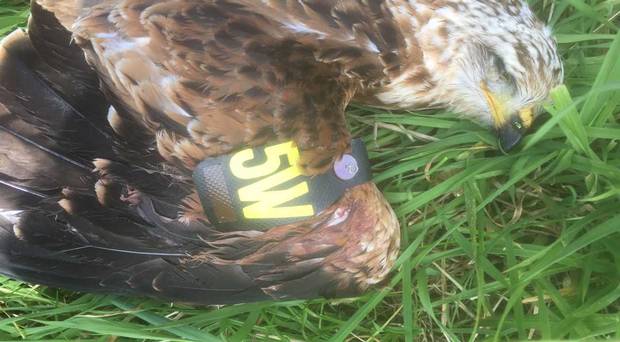
Red kite shot dead near Toddington, Bedfordshire

Bedfordshire Police and the RSPB are appealing for information following the discovery of shot red kite in Bedfordshire.

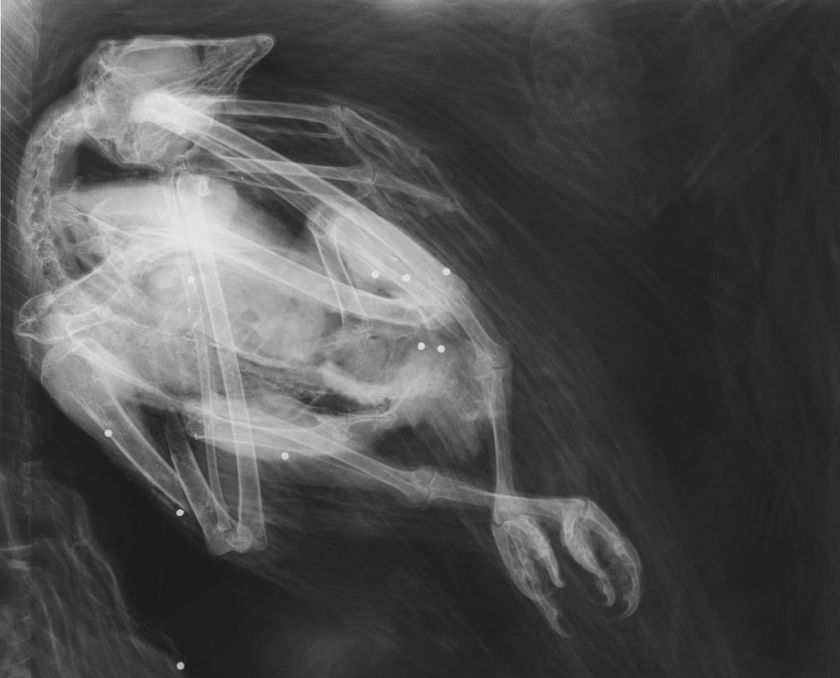
A member of the public found the kite’s corpse at Daintry Wood near Toddington (unfortunately no date has been provided. UPDATE: corpse found 27 Feb 2017) and it was sent to ZSL for a post mortem where an x-ray revealed 10 pieces of lead shot lodged in its body, indicating it had probably been shot at close range.

Anyone with information is asked to call Bedfordshire Police on 101.

RSPB press release here

Another red kite shot dead in Nidderdale, North Yorkshire

North Yorkshire Police are appealing for information after the discovery of a yet another shot red kite.

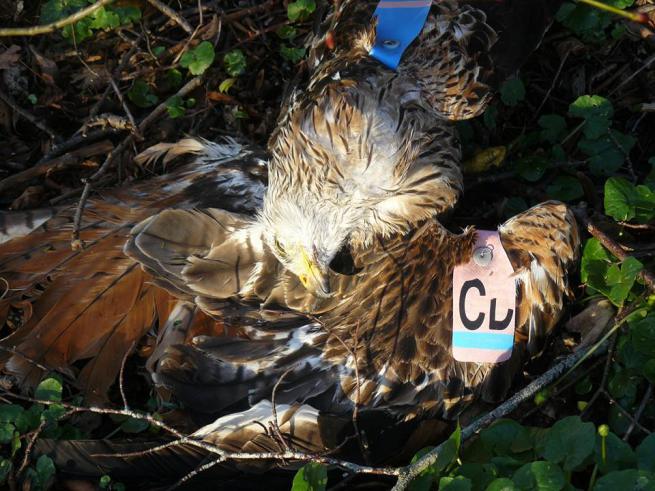
The latest victim was found near Greenhow, in Nidderdale, on the afternoon of Saturday 11 March 2017.

Anyone with information is asked to contact Police Wildlife Crime Officer David MacKay: david.mackay@northyorkshire.pnn.police.uk and quote reference number 12170047155.

Last year North Yorkshire Police investigated the deaths of 10 red kites that had been shot or poisoned in the county. The Nidderdale Area of Outstanding Natural Beauty and the neighbouring Yorkshire Dales National Park are notorious black spots for raptor persecution, particularly for red kites and hen harriers. This region is dominated by land managed for driven grouse shooting.

Photo of red kite by Claire Marshall

Ross-shire Massacre: three years on

Today marks the three year anniversary of the mass poisoning of red kites and buzzards at Conon Bridge in the Scottish Highlands – a crime that became known as the Ross-shire Massacre.

A total of 22 dead raptors (16 red kites and 6 buzzards) were discovered in a small geographic area over a number of weeks, beginning on 18 March 2014. Toxicology tests confirmed that 16 of these raptors (12 red kites and 4 buzzards) had been poisoned with a banned substance. Police Scotland has so far refused to name the poison, ‘for operational reasons’.

Nobody has ever been charged in connection with this crime.

Under Scottish law, there is a three year time limit for bringing a prosecution for offences committed under the Wildlife & Countryside Act (in England the time limit is two years). The clock starts ticking from the date the offence was commissioned. Three years later, the case becomes ‘time barred’ and even if the culprit is identified after this date, a prosecution under the Wildlife & Countryside Act is not possible.

We’ve been waiting for this three-year anniversary to arrive because we’ve got quite a bit to say about this case, particularly the police investigation, but we’ve been unable to publish these comments while the case was still considered ‘live’. Once the three-year anniversary was reached, we expected to be able to write a blog about the string of police cock-ups without worrying about legal restrictions and compromising the investigation.

However, it has been suggested to us that the three-year time bar may not take effect until the third anniversary of the last dead bird’s discovery, rather than the third anniversary of the actual poisoning offence. This seems a bit of a stretch to us (we believe there was only one poisoning offence, on 18 March 2014, not a series of them) but, as we’re not lawyers, we need to tread carefully and err on the side of caution.

We’re not entirely certain of the date the last dead raptor was found at Conon Bridge, although we blogged about it on 26 April 2014. Because of this uncertainty, we will not be blogging about this case until early May, just to be absolutely sure that we’re not compromising any chance of someone being prosecuted for this crime (yes, highly unlikely, we know, but we have to play the game or face a charge of contempt).

More in May. In the meantime, for anyone who wants to read what we’ve previously written about this fiasco, click here and scroll through the pages.

Two red kites confirmed poisoned in Nidderdale, North Yorkshire

Yesterday, North Yorkshire Police put out the following press release:

POLICE WARNING FOLLOWING RED KITE POISONING

Police are appealing for information and warning about the dangers of illegal bird of prey poisoning.

Two red kites were found poisoned in the Nidderdale area of North Yorkshire in 2016.

One was found near Pateley Bridge on 12 March 2016. Tests have attributed its death to alphachloralose. Traces of aldicarb and three rodenticides (difenacoum, bromadiolone and brodifacoum) were also identified.

The second was found near Bouthwaite on 18 May 2016. Shockingly, tests have shown the presence of eight different poisons – alphachloralose, aldicarb, bendiocarb, carbofuran and isofenphos, together with three rodenticides.

Officers are appealing for information about the two incidents, and warning members of the public about the dangers of this illegal practice. Hard-hitting posters urging people to report suspected wildlife poisoning are being distributed across the county.

Inspector Jon Grainge, of North Yorkshire Police’s Rural Taskforce, said: “The use of poisons in the two Nidderdale cases is particularly shocking. The practice of lacing animal carcasses with poison to kill other wildlife is cruel and illegal. It is also a serious risk to members of the public and their children or pets if they come into contact with them.

If you find a mammal or bird that you believe has been poisoned, please do not touch it, as poisons can transfer through skin contact. Also keep youngsters and pets well away. Make a note of the location, including GPS co-ordinates if possible, and anything else that is around or near the animal, and contact the police immediately”.

Anyone with information about the poisoning of the red kites found in Nidderdale should contact North Yorkshire Police on 101, quoting reference number 12160043415, or email ruraltaskforce@northyorkshire.pnn.police.uk.

ENDS

Have a look at this map. The poisoned red kite at Bouthwaite was found just to the north of the Gouthwaite Reservoir, and the poisoned red kite near Pateley Bridge was found just to south. Look at the land use on either side of the reservoir: this is driven grouse shooting country.

nidderdale

Presumably these two poisoned red kites were part of the ten suspicious red kite deaths investigated in North Yorkshire in 2016. Most of those were confirmed shot but there were a number of suspected poisonings too.

It seems strange that North Yorkshire Police is only now appealing for information about two poisoned red kites that were found nine and eleven months ago respectively. The delay may be due to issues at the toxicology lab (it wouldn’t be the first time) and therefore beyond North Yorkshire Police’s control. The delay is certainly at odds with the commendable speed with which North Yorks Police announced some of last year’s shot red kites (e.g. see here – shot kite found on Sunday, press release out by Monday). They were also incredibly quick off the mark to go out and investigate the three illegal pole traps found on the Mossdale Estate grouse moor in the Yorkshire Dales National Park last year, and although senior officers ballsed up what should have been a straight forward prosecution, at least they were honest and transparent, admitted the mistake and amended their policies as a result.

The long delay aside, it is very good to see North Yorkshire Police provide detailed information about the type of poisons used in these two crimes (take note, Police Scotland). It’s also very good to see them proactively warning the public of the danger of these highly toxic substances (again, take note Police Scotland), especially as we head towards spring, which is typically the time when illegal raptor persecution really hots up.

North Yorkshire Police have certainly got their work cut out fighting wildlife crime, and particularly raptor persecution. North Yorkshire is consistently rated the worst county in the UK for the number of reported crimes against raptors, and a lot of it takes place in the Nidderdale Area of Outstanding Natural Beauty and the neighbouring Yorkshire Dales National Park. We were only talking about this region two days ago in relation to the ongoing persecution of hen harriers.

ydnp_aonb

Photo of red kite by Mali Halls

Mass poisoning of raptors in Ross-shire to feature at film festival in New York

In March 2014, 22 red kites and buzzards were illegally poisoned in Ross-shire, in an incident that became known as the Ross-shire Massacre.

This shocking crime drew wide public attention and revulsion, leading to public protests in Inverness town centre.

Rossshire Massacre film

In 2015, film-maker Lisa Marley produced a short but beautifully evocative film about the crime and the subsequent police investigation.

Her film, Red Sky on the Black Isle, will feature at the Wildlife Conservation Film Festival taking place in October 2017 in New York. Good stuff. The more international exposure that can be given to the illegal persecution of birds of prey throughout the UK, the better.

As we approach the third anniversary of the Ross-shire Massacre, when the case becomes time-barred (meaning that a prosecution is no longer possible), we will be blogging about some aspects of this case that, for legal reasons, we’ve been unable to publish before now. More in March….

Galloway Red Kite Trail worth £8.2 million to local economy

A good news story!

RSPB Press Release, 10 January 2017

Wildlife Trail Generates Millions for Economy

Tourists spend £8.2 million in Dumfries & Galloway after travelling to see red kites

People visiting Dumfries and Galloway to see the region’s red kites have contributed over £8.2m to the local economy, a new report has found.

These birds of prey were re-introduced to an area north of Castle Douglas from 2001 and two years later the Galloway Kite Trail – a self guided tour circling Loch Ken – was launched as a partnership project led by RSPB Scotland.

An economic survey carried out by the conservation organisation found that between 2004 and 2015 the trail attracted over 100,000 visitors to the area and that £8.2m of spending was directly attributable to people who came to the region to see red kites. On average, the trail also supported the equivalent of 19 full-time jobs each year – however that figure rose to 21 in 2015.

Calum Murray, RSPB Scotland Community Liaison Officer, said: “The re-introduction of red kites has been a massive conservation success story and we now have over 100 pairs breeding in Dumfries and Galloway, but this survey clearly demonstrates how nature can bring economic benefits to areas as well.

Tourists are visiting the Galloway Kite Trail from all over the UK and many are coming here especially to see our amazing red kites. The report also shows the fantastic support that is being given to the trail by local businesses and many of our visitors are now making repeat trips!

The Galloway Kite Trail is a community based project facilitated by RSPB Scotland, in partnership with Forestry Commission Scotland and Bellymack Hill Farm, which takes visitors to some of the best locations in the region to see red kites – as well as promoting activities and services provided by local businesses.

Overall visitors to the Galloway Kite Trail spent an estimated £54.6million in the region.

Doug Wilson, VisitScotland Regional Director, said: “The Galloway Kite Trail has been a fabulous success story, in many more ways than one. As an ambitious nature conservation project, it has achieved outstanding results in terms of increasing red kite numbers, educating the public about these spectacular birds of prey and raising awareness of RSPB Scotland’s superb efforts to protect them and their habitat and encourage breeding.

The Kite Trail has also become an outstanding asset in Dumfries and Galloway’s incredible portfolio of outdoors activity attractions, giving visitors another great reason to come to the beautiful Galloway Forest Park and explore the stunning Loch Ken area. Having attracted well over 100,000 visitors, the trail has delivered significant benefits to tourism within the region and the impact on our local economy has been tremendous.”

Red kites were persecuted to extinction in Scotland in the 19th century but have now made a comeback in many parts of the country. These graceful birds, which are slightly longer-winged than buzzards, feed mainly on carrion and small mammals and often come together in groups during the winter to roost.

Kites are now breeding in all three vice-counties in Dumfries and Galloway with a nesting pair discovered near Stranraer in Wigtownshire last year. A total of 105 breeding pairs were counted in surveys in summer 2016, with at least 120 young fledged.

ENDS

For more information about the Galloway Kite Trail visit this website here or download a Trail leaflet here.

A fantastic success story, both in terms of the conservation of the red kite and as a demonstration of the value of these birds to the local and regional economy. Great stuff, and in sharp contrast to the fortunes of red kites in northern Scotland, where a report published in October 2016 revealed that the high rate of red kite persecution in that area is just as bad as it was 25 years ago.

Gamekeepers want sea eagles, kites, buzzards, sparrowhawks & ravens added to General Licences

Further to this morning’s blog about RSPB Scotland’s damning response to SNH’s General Licence consultation (see here), we said we’d write a separate blog about some of the other responses that SNH received.

SNH has now published all the responses, and they’re well worth a read: all-responses-to-snh-general-licence-consultation-2016

There are many organisations and individuals calling for ravens to be added to the General Licences (no surprise) and, yet again, there are a number of requests for buzzards and sparrowhawks to also be added, which would allow these species to be casually killed across Scotland without any monitoring or regulation, although some have suggested these raptors should be on ‘regional’ General Licences to limit the casual killing to a particular area. How thoughtful.

One of the reasons given for adding ravens and buzzards to the General Licences was this: “There are arguably too many of them around and they cloud the skies in our local area“.

Here’s a photograph of some ravens and buzzards clouding the skies:

Actually, this is a photograph (by Richard Barnes) of Dunlin flocking on the coast of North America but it could just as easily be a plague of swarming raptors over a Scottish grouse moor, if you happen to be a pathological raptor hater stuck with an 18th century attitude, that is.

Take a look at the consultation response from Garry MacLennan. Surely not the same Garry MacLennan, Head Gamekeeper at Invermark Estate? Aren’t raptors supposed to be ‘thriving’ there? Perhaps the headline should have read ‘Raptors are thriving on Scottish grouse moors and we want licences to kill them’.

Also have a look at the responses from Iain Hepburn (the same Iain Hepburn as the head gamekeeper at Dunmaglass Estate?), Duncan Mackenzie and Calum Kippen (the same Corrybrough Estate gamekeepers who attended the recent meeting between the Cairngorms National Park Authority & the Scottish Gamekeepers’ Association?). Aren’t these the gamekeepers who want licences to monitor and ring raptors? Don’t they see a bit of a conflict of interest there if they also want licences to kill these raptors?

Best of all though, is the response from Bert Burnett (presumably of the SGA). Bert suggests that ravens should be added to the General Licences and argues that regional general licences “could be rolled out for various species that may start to cause problems like sea eagles and kites etc“. Ah yes, that very serious problem of sea eagles mistaking small children for prey.

Of course, these calls for licences to cull raptors are nothing new. Scottish (and English) gamekeepers and land owners have been asking for these for 20 years (see here, here, here, here, hereherehere). So far, SNH has resisted but given Natural England’s recent capitulation on buzzard-killing licences, how much longer before we see the same in Scotland?

“Risible, make-believe tosh”: RSPB responds to Gift of Grouse propaganda

RSPB Scotland has responded to the ridiculous claim (see here) made by the Gift of Grouse that raptors are ‘thriving’ on Scottish grouse moors. Here is the RSPB’s press release (reproduced below):

RSPB SCOTLAND RESPONDS TO GIFT OF GROUSE PRESS RELEASE

RSPB Scotland has dismissed a press release issued today by the “Gift of Grouse” campaign that attempts to draw a veil over the continued persecution of birds of prey on areas of land managed intensively for driven grouse shooting. The reports on which these assertions are based are not in the public domain, and therefore have not been subject to the usual levels of public scrutiny.
However, recent peer-reviewed scientific reports published in the last 12 months link sharp declines in nesting peregrines and hen harriers in NE Scotland to illegal killing; a recently-published SNH report shows that there has been no decline in the levels of persecution of red kites in north Scotland over 25 years; and, results of the 2015 golden eagle survey show that levels of home range occupancy by golden eagles is significantly below the national average in the eastern highlands, where grouse moor management is a dominant land use. In this part of eastern Scotland, prey availability is high, and golden eagles should be more numerous and more productive than almost anywhere else in the country.
There are also ongoing concerns about the regular “disappearance” of satellite-tagged birds of prey in grouse moor areas, to the extent that a review of these incidents has been commissioned by the Cabinet Secretary for the Environment, Climate Change and Land Reform, Roseanna Cunningham MSP.
Ian Thomson, RSPB Scotland’s Head of Investigations said: “The content of today’s statement from the Gift of Grouse campaign is pure, unadulterated propaganda from an industry that, quite rightly, is under increasing public scrutiny by the Scottish Parliament. Their claims have no supporting evidence, their methodology is not explained, and to suggest that incidental observations of raptors which may merely have been flying over an estate indicate a population that is “thriving” is clearly ludicrous.
It is astonishing that the Angus Glens area is being held up as an example of good practice, given the long absence of successfully-breeding raptors over much of this region, as well as its appalling recent history of illegal killing of protected species. Walkers in the area this spring were greeted by a plethora of gas guns, inflatable decoys and strings of fireworks scattered across the hills, all designed to scare off, rather than welcome, birds of prey!
ENDS
Good, strong stuff from RSPB Scotland.
Earlier today The Times ran a story based on the Gift of Grouse propaganda entitled ‘Our conservation skills help raptors to thrive, say gamekeepers’. It includes an amusing quote from RSPB Scotland spokesman James Reynolds, who dismissed the report as “a pile of risible, make-believe tosh“. He added:
These claims by the grouse industry simply serve to show the pathological state of denial in which they are gripped. That they are prepared to pedal such nonsense, flying in the face of repeatedly proven facts and official surveys, shows the degree of desperation that they are prepared to go to in order to try and make this damaging industry respectable. Thankfully, the Scottish people aren’t so easily fooled by such contemptuous rubbish“.

Scottish landowners pretend that raptors are ‘thriving’ on driven grouse moors

Gift of GrouseWe’ve come to expect outlandish propaganda from the Gift of Grouse campaign group, designed to portray driven grouse moors as models of excellence for raptor conservation. But this time they’ve exceeded all expectation. Forget their usual unsubstantiated post-truth drivel, wholly disconnected to reality, because that’s got nothing on their latest effort, which takes the stretching of credibility to new depths.

The following press release from the Gift of Grouse is set to hit the headlines tomorrow:

ENCOURAGING NUMBERS OF BIRDS OF PREY SIGHTED ON SCOTTISH MOORLANDS

An increasing number of birds of prey are thriving on Scottish grouse moors due to gamekeepers’ conservation efforts.

More than 10 different raptor species including golden eagles, red kites and hen harriers have been identified on prominent grouse moors this year. They are among the 86 bird species that have been recorded on estates in the Angus Glens.

A snap shot from a range of estates across the Angus Glens Moorland Group highlighted encouraging evidence with gamekeepers on Invermark Estate in particular sighting nine raptor species including buzzards and golden eagles. Some of these are nesting and successfully breeding on the estate.

A number of other estates also reported healthy numbers with Ballogie Estate, Royal Deeside, revealing a total of 15 buzzards regularly hunting on the moor. Figures from the Speyside Moorland Group were equally as strong with 12 species of birds of prey recorded on Strathspey Estate alone. Atholl Estate in Perthshire are also monitoring 12 different raptor species.

Garry MacLennan, head gamekeeper on Invermark Estate, said: “Scottish grouse moors are far from being raptor deserts, as some opponents of shooting claim. We have monitored a growing number of buzzards, kestrels, golden eagles and white-tailed eagles. Keepers and estate managers do recognise there are some areas of the country where there are fewer raptor species but there is plenty of hard evidence to show that raptors are successfully nesting on grouse moors.”

The findings from Invermark are part of annual surveys undertaken using SNH guidelines.  These surveys were conducted by Taylor Wildlife, an ecological consultancy specialising in upland environments.

Richard Cooke, manager of Invermark Estate, said: “The survey is an extremely helpful way for us to monitor the biodiversity of the estate and which species are benefitting the most from our habitat management practices. Throughout the year we carry out rotational muirburn and control predation under the general licence, including foxes, stoats and other mustelids in particular.  This is to the benefit of many ground nesting birds and is reflected in the rich birdlife recorded by the annual audit.

The Tayside Moorland Group has also carried out species monitoring at a number of estates throughout the region with Glenturret Estate in Perthshire recording no less than 12 different raptor species hunting and nesting on the moorland this year. The estate tally included several breeding pairs of hen harriers, a nesting pair of peregrine fledging four chicks, short eared owls and numerous red kites.

Conservation training, conscientious moorland management and favourable weather conditions can all impact positively upon species numbers found on Scottish moorland.

Figures revealed in Wildlife Estates Scotland’s latest annual report show that 11 accredited estates reported the presence of golden eagles, with seven of these reporting 19 pairs. Eleven estates also recorded sightings of hen harriers with four reporting 18 breeding pairs. Buzzards were also reported on 20 estates, with a total estimated population of over 920 birds.

It was also recently revealed in a national survey that golden eagle numbers have surpassed 500 pairs giving them a ‘favourable conservation status’ in the UK. Eagles have made a home on several moorland estates across Scotland with Millden Estate, a member of the Angus Glens Moorland Group, recording a particularly high number of sightings.

Jason Clamp, head gamekeeper on Millden Estate, commented: “We are fortunate enough at Millden to have regular sightings of golden eagles. Seeing several of these magnificent birds on a daily basis has to be one of the highlights of my job. We are also very careful to leave a sustainable population of mountain hares for birds of prey, such as golden eagles, to hunt.

At Millden our team of gamekeepers has taken a proactive role in ensuring that we have a suitable breeding habitat for various birds of prey such the merlin, of which we currently have four nesting pairs. This has been brought about through controlled heather burning ‘muirburn’, which creates micro habitats suited to ground-nesting birds like the merlin.

We are delighted that the golden eagle, a species of conservation concern, amongst many other species, has found a safe and suitable environment in which to flourish in such impressive numbers, where careful moorland management has been imperative.”

ENDS

Wow! Where to start with this? It’s such ludicrously far-fetched bollocks it could have come straight from the mouths of gamekeepers and grouse moor managers. Oh, hang on…

Perhaps the idiots behind the Gift of Grouse campaign didn’t see the results of the latest national golden eagle survey, published just a few short weeks ago. You know, the survey that showed breeding golden eagles are still largely absent from driven grouse moors in the Eastern Highlands, just as they were in the last national survey conducted in 2003. Only 30% of known territories were occupied in this area – that’s a pathetic 34 out of 91 territories.

Perhaps the idiots behind the Gift of Grouse campaign didn’t see the results of the recent study on northern red kites, showing that illegal persecution on driven grouse moors in this region is just as bad now as it was in 1989.

Perhaps the idiots behind the Gift of Grouse campaign didn’t read the recent scientific paper showing hen harriers have suffered a ‘catastrophic decline’ on the driven grouse moors of NE Scotland.

Perhaps the idiots behind the Gift of Grouse campaign didn’t read the scientific paper showing peregrines continue to suffer a ‘long-term decline’ on the driven grouse moors of NE Scotland.

It’s all very well saying that raptors have been ‘sighted’ on grouse moors – of course they’ve been seen there – they are drawn to those areas precisely because of the absence of territorial breeding adults (as well as an abundant food supply). Nobody disputes that you can see raptors over these moors – the crucial distinction, which the Gift of Grouse idiots have carefully avoided, is how many raptors are breeding there? Remember, no breeding hen harriers in the Angus Glens for ten years!

It’s interesting that this press release refers to the grouse moors of the Angus Glens – a well known hotbed of illegal raptor persecution for over a decade. Here’s a map to illustrate the point:

Four grouse moor estates are highlighted in red (Invermark, Millden, Hunthill, Glenogil [with thanks to Andy Wightman’s Who Owns Scotland website for estate boundaries]). You see those purple dots? They represent confirmed illegal raptor persecution crimes. Are we seriously being asked to believe that raptors are ‘thriving’ in this region?

It’s also interesting to note that the ‘data’ behind the Gift of Grouse propaganda come from an ‘annual audit’ carried out by Taylor Wildlife consultancy. We’ve blogged about this group before – these are the ‘experts’ who claimed to have recorded 81 species of birds ‘feeding or breeding’ on an Angus Glens grouse moor last year. The problem is, their survey methods didn’t adhere to the usual industry standard – rather than conduct their breeding bird survey between March and June, when you’re supposed to do it, they conducted their survey between June and August, which is, er, after the breeding season!

Will we get to see this year’s report to scrutinise the methods and results? Highly unlikely – we’re still waiting to see their 2015 report but apparently it’s a secret and we’re not allowed to read it. Can’t think why.

Also of note in this latest press release is the reference to Glenturret Estate in Perthshire, another well-known driven grouse moor. We’ve blogged about this estate before, when it was claimed that Hen Harrier Day protesters might ‘disturb’ hen harriers – a species that has consistently failed to breed successfully on this moor. This year, they are claiming to have ‘several breeding pairs of hen harriers’ amongst other species. That’s interesting, because according to monitoring data from the Scottish Raptor Study Group, there was only one hen harrier breeding attempt on Glenturret this year, and, as has so often happened here in recent years, the nest failed for ‘unknown reasons’. Unfortunately it’s not possible to work out why hen harriers keep failing here because the estate has apparently refused to allow nest cameras to be installed.

Glenturret used to have lots of successfully breeding raptors, but these days, not so much. They certainly don’t have breeding golden eagles anymore because the eagle’s eyrie was burnt out last year. Here’s a photograph of the cliff face, taken in April 2015 – note the blackened hillside. Spontaneously combusting eagle eyries are a common problem on some Scottish grouse moors. Either that or golden eagles need to learn to discard their fag butts with more care.

We’ll add updates to this blog tomorrow when we see which newspapers have swallowed the Gift of Grouse guff hook, line and sinker. We’ll be particularly interested to see whether SNH issues a statement to rebutt the claims being made – SNH has access to the actual raptor breeding data via the Scottish Raptor Monitoring Scheme – let’s see them put it good use.

UPDATE 5 December 2016: “Risible, make-believe tosh”: RSPB responds to Gift of Grouse propaganda (here).