03 August 2007. Grampian Police are appealing for information following the discovery of two poisoned four week old peregrine falcon chicks in their nest in the Inverurie area.
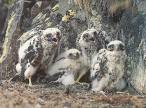
Peregrine chicks
The birds were discovered at the end of May when members of the North East Raptor Study Group visited the nest to ring and weigh the birds.
The two chicks had full crops and, following a post mortem examination and toxicology report, it was discovered that their food source was contaminated with an illegal pesticide, resulting in their death.
Peregrines are a “Schedule One” bird under the Wildlife and Countryside Act 1981 and are specially protected. New penalties for killing peregrines include up to a £10,000 fine or 12 months in prison.
Dave MacKinnon, Force Wildlife Crime Officer for Grampian Police said: “We are unable to give the exact location of the nest as these birds are specially protected. What I can say is that it appears the chicks had been fed poisoned bait by their parents, laced with a banned pesticide.
A young male red kite found dead by the side of the road in Callander, Perthshire, in July 2007 had been illegally posioned. Sadly, it wasn’t an isolated incident. A few weeks earlier, two red kite chicks had been found closeby. Tests revealed that one chick had definitely been poisoned; the body of the 2nd chick was too decomposed for analysis. The chicks were unrelated to the dead adult kite.
Irish Times May 6th 2009. Eight buzzards have been killed in suspected poisoning incidents in the northeast in the last two months. The National Parks Wildlife Service (NPWS) said yesterday it was investigating the discovery of buzzard carcasses on farmlands in north Dublin, Louth and Meath.
A Scottish Borders gamekeeper was convicted of killing a buzzard, setting a poisoned bait and possessing 3 proscribed pesticides on 25 October 2005.
The gamekeeper (name removed under the Rehabilitation of Offenders Act 1974) at Blakehope Estate in the Borders pleaded guilty at Jedburgh Sheriff Court on 14 December 2006 to five offences under the Wildlife & Countryside Act 1981.
He was sentenced to 100 hours community service.
Readers could be forgiven for thinking Sheriff Woody had left Toy Story for a day’s work at Jedburgh Sheriff Court.
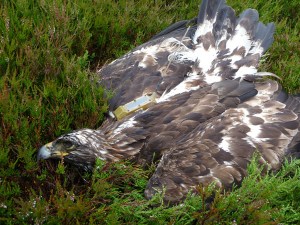
The poisoned golden eagle found on Lewis in July 2005, killed by Carbofuran
An Isle of Lewis crofter was convicted of possessing Carbofuran at his home on 25 November 2005. At Stornoway Sheriff Court on 26 July 2006, John Mackenzie pleaded guilty to possession of a proscribed pesticide under Section 15(A) of the Wildlife & Countryside Act 1981. He was fined just £50.
A staggeringly pathetic fine, hot on the heels of the discovery of a dead golden eagle found on Lewis in July 2005 that had been poisoned with Carbofuran.
Two Scottish Borders gamekeepers were convicted of possessing proscribed pesticides at Oxnam Estate, Jedburgh, on 22 June 2005.
At Jedburgh Sheriff Court on 14 May 2006, Gamekeeper A (name removed under the Rehabilitation of Offenders Act 1974) pleaded guilty to possession of Cymag and Carbofuran, for he which he was respectively fined £100 and admonished.
Gamekeeper B (name removed under the Rehabilitation of Offenders Act 1974) pleaded guilty to possession of Carbofuran and was fined £100.
These were all offences under Section 15(A) of the Wildlife & Countryside Act 1981. A fitting punishment and a strong deterrent? The scales of justice seem a wee bit unbalanced.
Police raided Innes House Estate near Elgin, Moray in November 2006 after dying buzzards and crows were seen in a nearby field. Later laboratory testing confirmed the birds carried traces of Carbofuran.
At Elgin Sheriff Court on 30 April 2007, head gamekeeper Michael Royan was found guilty of possessing proscribed pesticides (Carbofuran, Cymag & Alphachloralose) and he was also convicted of a firearms offence. He was fined £1,000.
According to the 2010 Innes House Estate website, Michael Royan is still employed as Head Gamekeeper.
At Aberdeen Sheriff Court on 12 July 2006, the head gamekeeper on the North Glenbuchat Estate, Strathdon, Aberdeenshire, was found guilty of three offences: killing a wild bird, possession of birds’ eggs, and possession of a proscribed pesticide under the Wildlife & Countryside Act 1981.
The 56 year old head keeper, Hector McNeil, of Whitehillock, Glenbuchat, had worked as a gamekeeper on the Estate for 30 years. He was fined £850.
The RSPB claimed this was one of many cases but a spokesman for the Scottish Gamekeepers Association had said the case was not typical of the profession.
At Aberdeen Sheriff Court in 2007, a 34 year old gamekeeper of Lumsden, Huntley, was accused of killing a peregrine at Clova Estate, Huntley, Aberdeenshire in October/November 2006. He was also accused of having a bottle of poison at his home address and at Tomatin Estate (Invernesshire), and further accused of having an illegal pesticide (Carbofuran) in his possession at his home address and elsewhere.
After long court delays, in early 2009 he was found not guilty of a charge under Section 15(A) of the Wildlife & Countryside Act 1981.
In January 2009, the Scottish government released its ‘Map of Shame’ showing confirmed poisoning incidents between 2004-2008. The map, using data from the Scottish Agricultural Science Agency (SASA), was hailed as a “significant step” in the fight against wildlife crime as it showed the scale of raptor persecution.
In reality, the map doesn’t tell us anything new at all. The RSPB has been producing these maps for years; the difference with this one is that for the first time, the Scottish Rural Property & Business Association (SRPBA) which represents landowners, agreed to its contents.
The map locates 88 incidents in which raptors were poisoned over the previous 5 years, including iconic species such as the golden eagle, white-tailed sea eagle, red kite, buzzard, tawny owl and peregrine.
What the map fails to tell us is the name of the shooting estates involved. What is the point of providing such a vague map? There is no point, other than to confirm what was already known – raptor persecution incidents are widespread across Scotland. If the SRPBA is as committed to stamping out wildlife crime as it claims it is, why wouldn’t it take every opportunity to name and shame those known to be involved?
It is not just wildlife-interest groups that are asking for the estates to be named. In September 2009, MSP Sarah Boyack (Scottish Labour) called for the government to name and shame the offending estates and said taking steps to reduce the number of incidents of wild raptors being shot and poisoned was a “matter of urgency”. http://news.stv.tv/scotland/121040-msp-name-and-shame-bird-killers/
The government is due to release the official 2009 raptor poisoning figures shortly….