Red kite poisoned N Yorkshire: police appeal 11 months later

North Yorkshire Police are appealing for information 11 months after a red kite was found poisoned in Tadcaster. The RSPB has also put up a £1,000 reward for information leading to an arrest and charge.

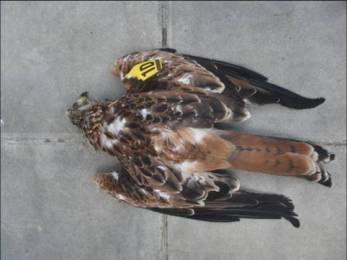
The dead bird (a three-year old believed to have been part of a breeding pair) was discovered by a member of the public at Toulston Polo Ground in October 2012. Toxicology results have revealed the bird had been poisoned with Carbofuran.

On the face of it, this looks like another farcical mishandling of a raptor persecution crime by the police, with an exceptionally long delay between the discovery of the victim and an appeal for information. However, rumours from colleagues in Yorkshire suggest that the initial testing (post-mortem) was not straightforward, leading to a prolonged delay. It is also rumoured that the bird was eventually submitted for toxicology analysis under a private submission co-funded by the Yorkshire Kite Group and the RSPB, leading to the detection of the banned poison Carbofuran.

The bird is believed to be the 20th poisoned red kite reported in North Yorkshire since 2000.

North Yorkshire police press release here

5th suspected red kite poisoning in Northern Ireland this year

Y1D2013Last week we blogged about the growing concern of suspected red kite poisonings in Northern Ireland, following the discovery of a fourth dead bird in County Down this year (see here). Incredibly, conservationists had not been able to confirm the poisonings as they were still waiting for toxicology results from the lab – from as far back as January!
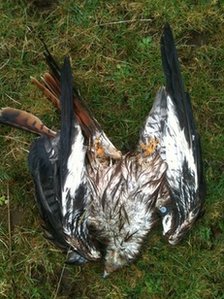
This week brings news of a 5th dead kite, this time found in the Cairncastle area of County Antrim and also suspected to have been poisoned. It was found by walkers on Sunday 18th August.

This bird (Yellow 1D) was born in May this year and was the offspring of one of the poisoned adults found in County Down.

The RSPB and the Police Service of Northern Ireland (PSNI) are appealing for information. Adam McClure, the RSPB’s Red Kite Officer in Northern Ireland said: “While we can’t say for certain until we have the results of the post-mortem, we strongly suspect that this bird, and potentially some of the others, has fallen victim to poisoning. All birds of prey are protected under the law, but unfortunately this doesn’t mean they are safe from poison. In some cases they are deliberately targeted as some people incorrectly see them as a threat to livestock or game birds. They are also vulnerable to poisoned bait left out with the intention of controlling foxes and crows. However, this is an illegal practice as it is indiscriminate and can affect not only scavenging birds like red kites but also pets, livestock and humans“.

Anyone with information about these suspected poisonings is urged to call PSNI: 0845 600 8000 or contact Crimestoppers anonymously: 0800 555 111.

Dead buzzard in Scottish Borders shot AND poisoned

Back in mid-July we blogged about a dead buzzard that had been found near Heriot in the Scottish Borders – it had been shot, but the precise cause of death was not known (see here).

Fast forward to August and it has now been revealed the buzzard had also been poisoned and that this was the cause of death, according to the BBC (see here). The poison used has not been named.

Enormous credit, once again, to the local Police Wildlife Crime Officer Hannah Medley for pursuing this case and also for publicising the findings in the media. Credit also to the lab folk at SASA for managing to detect poison in what had previously been described as a badly decomposed carcass.

This confirmed poisoning now takes the number of known (reported) poisonings in Scotland this year above the published figure from last year, so hopefully we will no longer have to read the ridiculous claims from the usual suspects that ‘poisoning cases are significantly declining’. The facts show that they are doing nothing of the sort. How ironic in this, the so-called Year of Natural Scotland.

Unfortunately the public haven’t been allowed to see this year’s on-going tally as yet – we know of several poisoned birds that have not yet been reported in the media, even though the birds were poisoned much earlier in the year. We’ll have more to say about these cases later in September and we’ll be asking the usual questions of a particular Police Scotland division about why they’ve kept these poisonings a secret for so long.

Poisoned peregrine rescued in Northern Ireland

A farmer, an RSPB warden, a politician and a falconer/gamekeeper have joined forces in Northern Ireland this week to rescue a stricken peregrine falcon believed to have been poisoned.

The bird was found by a farmer in a field at Churchill, Derrygonnelly, County Fermanagh. The farmer contacted an RSPB warden who collected the bird and passed her over to Stormont politician Jim Wells, who also just happens to be a peregrine expert and Chairman of the Northern Ireland Raptor Study Group.

Jim immediately recognised the symptoms of Alphachloralose poisoning (it thins the blood and causes death by hypothermia) and so he whacked up the car heater as he drove the victim towards Lisburn. Once there, the peregrine was passed to registered falconer/gamekeeper Alan Coates.The bird was put in an incubator and given a saline solution and appears to be making good progress, although it is still early days. She remains under Alan’s care and is currently enjoying strips of pheasant breast!

Suspected red kite poisonings: 4 in Northern Ireland this year alone

_69410526_deadkiteConcern is growing over the number of suspected red kite poisonings in Northern Ireland, following the discovery of a 4th bird last week in Castlewellan, County Down.
The birds were part of a reintroduction project, initiated by the RSPB in 2008 after persecution in the 18th century had caused their extinction. This reintroduction project has so far resulted in a small breeding population and this year it is believed seven pairs managed to successfully raise young. Three of the four birds found dead this year were breeding adults.

What is especially surprising, and shocking, about these deaths is that the RSPB do not yet know whether poisoning has been confirmed. Why not? Because they’re still waiting to receive the toxicology results from the lab…..one of these dates back to early January!

These toxicology results are crucial for understanding what’s going on in Castlewellan – we have been informed that three of the birds were picked up within the same valley – an area of approximately 1km2 – if the birds were poisoned, which seems likely, the team needs to know whether this was as a result of secondary poisoning (e.g. by eating rodents that have been poisoned with rodenticides) or whether the birds were deliberately and directly targeted with illegal poisons (such as Carbofuran). Without this information it is very difficult for the team to address the problem with the appropriate action.

The problem in Northern Ireland is not just limited to County Down –  watch out for a press release next week concerning another red kite victim elsewhere in the country…

BBC news article here

Moy game fair: carry on regardless

The Moy Game Fair starts today. On the Moy Estate.

Moy is quite the venue. In 2010, the following was found there:

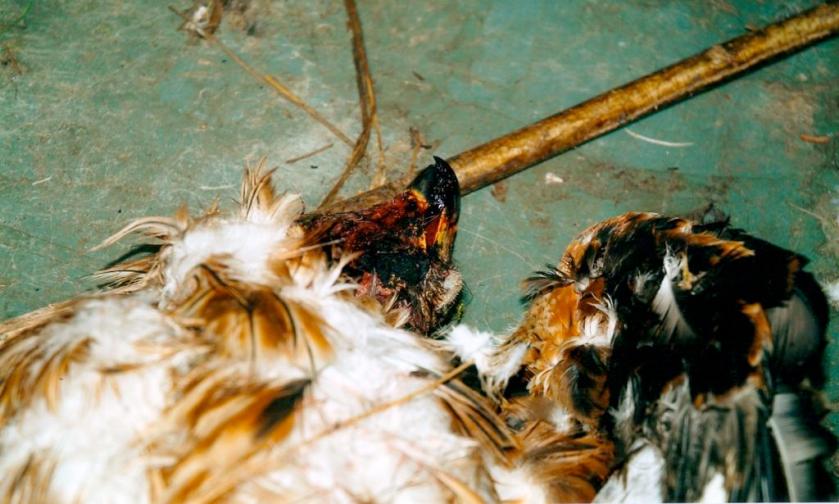
  • A dead red kite in the back of a gamekeeper’s vehicle. It had two broken legs and had died as a result of a blow to the head (see photo).
  • The remains of a further two dead red kites.
  • A red kite’s severed leg, along with wing tags that had been fitted to a sateliite-tracked red kite, hidden in holes covered with moss.
  • Six illegal baited spring traps set in the open.
  • A trapped hen harrier caught in an illegally set spring trap.
  • A poisoned bait.
  • Four leg rings previously fitted to golden eagle chicks found in the possession of a gamekeeper.

In May 2011, gamekeeper James Rolfe was convicted for possession of the dead red kite found in the back of his vehicle. He was fined £1,500. No charges were brought against anyone for any of the other offences.

If you’re heading to the Moy Game Fair, keep an eye out for ‘missing’ red kites. In May 2011, a satellite-tracked red kite ‘disappeared’ there. In August 2011, another red kite ‘disappeared’ there.

Ironically, representatives from the game-shooting industry will all be there, telling visitors how great their industry is for nature conservation. So much for strong leadership and zero tolerance (see here).

Talking of venue choice……..take a look at this! A government-approved GWCT training course being held at the one and only Glenogil Estate!

The photograph below shows the dead red kite with two broken legs and severe head injuries, lying in the back of a gamekeeper’s vehicle.

Moy kite 2a

Ireland publishes its first persecution report, with interesting results

94f6f996ec3a866ce6d587d28bd5b809_LThe Irish National Parks and Wildlife Service (NPWS) has published its first national raptor persecution report, relating to reported incidents in 2011.

The NPWS issued the following press release:

“33 poisoning or persecution incidents affecting birds of prey were recorded in Ireland in 2011, according to a report published today by the Department of Arts, Heritage and the Gaeltacht. 

15 birds of prey were confirmed poisoned, and four more suspected cases were recorded. 8 birds of prey were shot.

Some of the deaths were accidental, but many were deliberate. The most frequent casualty was the red kite, a native species that was recently re-introduced to Ireland. It is believed that seven of the ten kites found dead were poisoned by eating rats that had themselves been poisoned. As well as red kite, other raptor species that were deliberately targeted included peregrine falcon, buzzard, sparrowhawk, and kestrel.

The report is the result of cooperation between the National Parks and Wildlife Service, the Department of Agriculture, Food & the Marine’s Regional Veterinary Laboratories and the State Laboratory, and also involves An Garda Síochána, the Golden Eagle Trust and BirdWatch Ireland. 

The report notes that the use of tracking devices on birds has enabled dead birds to be found, but this also means that the true levels of mortality are likely to be significantly higher.

The use of poison has been greatly restricted under EU law in recent years. It is illegal to poison any animal or birds other than rats, mice or rabbits in Ireland and only then using certain registered products. The Campaign for Responsible Rodenticide Use has recently been set up with funding from industry. This campaign aims to promote best practice so that rat poison in particular should not get into the wildlife food chain where it harms owls, kites and other birds of prey.

The poisoning of golden and white-tailed sea eagles has been a particular problem in recent years, but fortunately in 2011, no poisonings were recorded. Records of poisoning and persecution in 2012 are currently being analysed and the second annual report is due for release shortly.

The Minister for Arts, Heritage and the Gaeltacht, Mr Jimmy Deenihan, T.D., welcomed the report. ”This gives us at least a partial view of the scale of the problem in Ireland”, he said. ”It is simply not acceptable for majestic birds of prey and other wildlife to be persecuted or poisoned. First it is illegal, but just as important it harms our reputation as a clean, green country. I would urge anyone to report such incidents to the National Parks and Wildlife Service in my Department. There are alternatives to poison which can be successfully used when control is essential ” he said.”

Here is a copy of the report: Persecution Report Ireland 2011

The publication of this report, and the anticipated future annual reports, demonstrates a basic but very important step forward, allowing the authorities and NGOs to monitor and record raptor persecution incidents in a coordinated effort, to help tackle the issue as well as to improve public awareness and education.

The report includes the usual list of victims and the substances that were used to kill them (Alphachloralose, Carbofuran etc) although we did notice one particular substance that was less familiar – Nitroxynil (also called Nitroxinil). As far as we understand, Nitroxynil is an active ingredient in the veterinary treatment of cattle and sheep, for example in sheep dips. According to this report, Nitroxynil  was detected in the carcases of three poisoned white-tailed eagles and one golden eagle, as well as in several recovered baits, including an egg and two lagomorphs (rabbit or hare).

It would appear, given that it was detected in different baits, that Nitroxynil has been used deliberately in Ireland to target any animal that might scavenge from a bait. It’s also possible that some of the deaths were from accidental poisoning, although fallen stock should not be left out on the hill.

We’re not certain, but we don’t recall seeing Nitroxynil listed in any recent toxicology reports published in Scotland by SASA. We don’t know if SASA tests for this substance when they’re presented with a potentially poisoned animal – it would be fair to say that SASA can’t test for every known poison due to resource constraints, and it’s reasonable for them just to test for the more commonly-used poisons. However, we have noticed in recent SASA reports that there are quite a number of birds for which SASA have been unable to establish the cause of death (i.e. the poisons they regularly screen for have not been detected) even though the circumstances of the bird’s death may have been suspicious. If SASA are not already testing for Nitroxynil, we hope that they pay attention to the frequency of detection in Irish cases and consider including it in the list of poisons for which they routinely screen.

Well done to the Irish NPWS and their project partners for getting this report published.

In Scotland we’re still waiting for the promised 2012 wildlife crime report from the Scottish Government. Environment Minister Paul Wheelhouse told the Police Wildlife Crime Conference in March 2013 that his staff were working on the report. Earlier this month, we asked him if he could tell us when we might expect to see it published (see here). According to our calendar (he has to respond within 20 working days), Mr Wheelhouse is due to provide a response to that question, and the other questions we posed, by this coming Wednesday…..

UPDATE 29th July: SASA are on the ball – they’ve recently started to test for Nitroxynil – see here.

Police appeal after 2 buzzards found poisoned in April

buzzardpoisonedchittlehamptonThe police are appealing for information after the discovery of two poisoned buzzards in Chittlehampton, North Devon. The birds were found in April.
More information here, but very little detail given.

Red kite poisoned in Scotland

rk5And so it continues….

Today, the Scottish Government agency responsible for reporting on poisoned animals released the stats for the first quarter of this year (i.e. Jan-March 2013).

You will not be surprised to learn that, yet again, poisoning incidents have taken place and Police Scotland have chosen to suppress the information.

The data confirm that a poisoned red kite was discovered in March in ‘Central Scotland’ – no detailed location information given, naturally. Lab tests show it had been poisoned with Mevinphos. Four months for that information to slip out in a largely un-read government report. The level of secrecy involved in these cases is quite remarkable.

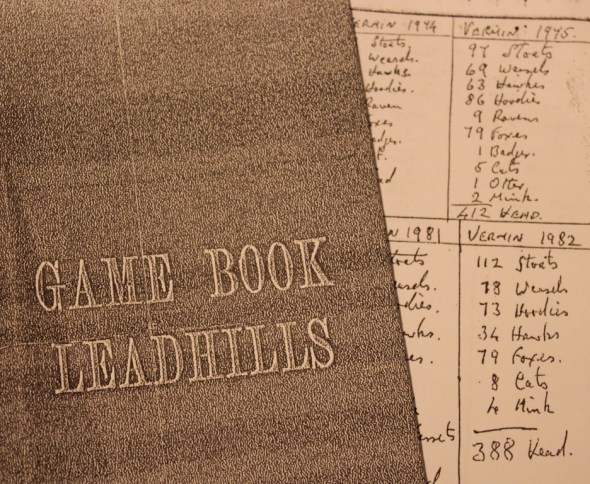
The data also show the poisoned baits that were uncovered at Leadhills in March – interestingly, they confirm the presence of Carbofuran but don’t comment on the number of baits found (which we know was a considerable number – see here) but they do say the baits were found inside gamebags. Four months on from the discovery and we’re still waiting for Police Scotland to make a public statement, not least to warn residents and visitors about the discovery of potentially fatal poison in a publicly-accessible location.

Also included in the data is the discovery of a Carbofuran-laced pigeon bait in Tayside in February 2013. Again, where was/is the public warning from Police Scotland?

It’s just bloody pathetic. Don’t tell us that the information has been suppressed for ‘operational’ reasons – that’s totally ridiculous and isn’t fooling anyone. The suppression of information benefits the landowners and gamekeepers – nobody else.

Compare this suppression of information with the work of Police Wildlife Crime Officers in Devon & Cornwall. Two of their WCOs – PC Josh Marshall and PC Paul Freestone – are so amazingly proactive that as well as having their own personal wildlife crime blogs (here and here), they’ve even set up a Wildlife Crime Group blog for their area (see here). On this blog, you’ll find information providing tips and advice about different types of wildlife crime, as well as information about specific alleged offences. For example, here they report on the recent suspected poisoning of two buzzards, and even provide photographs – all within a few days of the alleged crime being reported. Hats off to those two guys – committed, proactive, helpful and informative (although if you’re reading this Josh & Paul, you might want to revise your information about potential threats to harriers!!).

Back to Scotland….we would like to know why Police Scotland consistently fails to inform the public about alleged raptor persecution incidents, especially those involving the discovery of highly dangerous banned poisons in public areas. The public has a right to be kept informed. Sure, the Police may need a few weeks to conduct their initial investigations without letting on what they’re up to – as we’ve said over and over and over again, nobody in their right mind would want to interfere with that process and jeopardise a potential prosecution – but when it gets to three, four, five months after the incident and its bloody obvious that the investigation is dead in the water, then what possible reason is there for withholding the information, putting the lives of people and animals at risk? Here are some reasons: wanting to appease the landowners and gamekeepers on whose land the poison had been found, and wanting to appease the wider gameshooting industry who just hate to have the truth exposed about poisoning and the other methods of persecution that are being used against raptors on a regular basis.

If you’re also curious about the blanket suppression of information, you could always email the new Police Scotland Wildlife Crime Portfolio Leader, Detective Superintendent Cameron Cavin, and ask him to explain. One question to ask, as a friendly opener, nothing more, might be whether he has ever held membership in a game-shooting organisation, like, ooh, er, let’s say BASC for example, and if so, whether that membership is still held?…. Coincidentally, Det. Super. Cavin also just happens to have strong connections with central Scotland so he might also have information about the progress of the case concerning the poisoned red kite found there in March, or perhaps about the buzzard found there in March that had been caught in an illegal trap and had to be euthanised as a result of its injuries (see here). Bear in mind if you do email him, he’s obliged to reply within 20 working days so he can’t just ignore you, although obviously he can choose to fob you off without providing a satisfactory answer.

Email: Cameron.Cavin@centralscotland.pnn.police.uk

27 eagles, 7 years, 0 prosecutions

Last September we wrote an article called ’26 eagles, 6 years, 0 prosecutions’ (see here). We thought it was time to update it and it’s now called: ’27 eagles, 7 years, 0 prosecutions’.

Why update it now? Well mostly in response to Paul Wheelhouse’s comment yesterday that the Scottish Government “has achieved much since 2007” in relation to tackling illegal raptor persecution. Yes, ‘much’ has been achieved in terms of forming new committees and partnerships and having meetings and publishing soundbites, but what has actually been achieved on the ground, where it matters? According to the following list, absolutely bloody nothing.

As previously stated, some of these eagles on this list are just ‘missing’ and may not be dead, although the frequency with which these sat-tagged eagles are going ‘missing’ is indicative of something more sinister, of that there’s no more doubt. It’s also reasonable to point out that there may be (probably will be) a hell of a lot of other eagles that we haven’t included in this list because we just don’t know about them. We only see the tip of a very very large iceberg, as is becoming clearer to everyone by the day.

It’s also worth pointing out that if Scottish Land & Estates and the Scottish Gamekeepers Association had their way, we wouldn’t be able to report on any of these cases because presumably the police are still investigating them all. I can’t for the life of me think why those two organisations would prefer this information was kept secret.

_41773232_goldeneagle203MAY 2006: A dead adult golden eagle was found on the Dinnet & Kinord Estate, near Ballater, Aberdeenshire. Tests revealed it had been poisoned by the illegal pesticide Carbofuran. Grampian Police launched an investigation. Seven years and 2 months later, nobody has been prosecuted.


Dead GE_DaveDickJUNE 2006: A dead golden eagle was found on Glen Feshie Estate in the Cairngorms. Tests revealed it had been poisoned by the illegal pesticide Carbofuran. Northern Constabulary launched an investigation. Seven years and 1 month later, nobody has been prosecuted.


eagle-poisonedAUGUST 2007: A dead adult female golden eagle was found on an estate near Peebles in the Borders. She was half of the last known breeding pair of golden eagles in the region. Tests revealed she had been poisoned by the illegal pesticide Carbofuran. Lothian & Borders Police launched an investigation. Five years and 11 months later, nobody has been prosecuted.


bird-nAUTUMN 2007: Tayside Police received a detailed tip-off that a young male white-tailed eagle (known as ‘Bird N’) had allegedly been shot on an estate in Angus. The timing and location included in the tip-off coincided with the timing and location of the last-known radio signal of this bird. Five and a half years later, the bird has not been seen again. With no body, an investigation isn’t possible.

white_tailed_eagle_dead_rspb@body2MAY 2008: A one year old male white-tailed eagle hatched on Mull in 2007 and known as ‘White G’ was found dead on the Glenquoich Estate, Angus. Tests revealed he had been poisoned by an unusual concoction of pesticides that included Carbofuran, Bendiocarb and Isofenphos. A police search in the area also revealed a poisoned buzzard, a baited mountain hare and 32 pieces of poisoned venison baits placed on top of fenceposts on the neighbouring Glenogil Estate. Laboratory tests revealed the baited mountain hare and the 32 poisoned venison baits contained the same unusual concoction of highly toxic chemicals that had killed the white-tailed eagle, ‘White G’. Five years and 2 months later, nobody has been prosecuted.

glen orchyJUNE 2009: An adult golden eagle was found dead at Glen Orchy, Argyll, close to the West Highland Way. Tests revealed it had been poisoned by the illegal pesticide Carbofuran. Strathclyde Police launched a multi-agency investigation. Three years and 3 months later, estate employee Tom McKellar pled guilty to possession of Carbofuran stored in premises at Auch Estate, Bridge of Orchy and he was fined £1,200. Nobody has been prosecuted for poisoning the golden eagle.

Alma Millden 2009JULY 2009: A two year old female golden eagle known as ‘Alma’ was found dead on the Millden Estate, Angus. Tests revealed she had been poisoned by the illegal pesticide Carbofuran. Alma was a well-known eagle  – born on the Glen Feshie Estate in 2007, she was being satellite-tracked and her movements followed by the general public on the internet. Tayside Police launched an investigation. Four years later, nobody has been prosecuted.

TH1_17220118eagle glen ogilAUGUST 2009: A young white-tailed eagle was found dead on Glenogil Estate, Angus. Tests revealed it had been poisoned by the illegal pesticide Carbofuran. Tayside Police were criticized in the national press for not releasing a press statement about this incident until January 2010. Three years and 11 months later, nobody has been prosecuted.

Skibo eagle 2010MAY 2010: Three dead golden eagles were found on or close to Skibo Estate, Sutherland. Tests revealed they had been poisoned; two with Carbofuran and one with Aldicarb. Northern Constabulary launched a multi-agency investigation. One year later (May 2011), Sporting Manager Dean Barr pled guilty to possession of 10.5 kg of Carbofuran stored in premises at Skibo Estate. Three years and 2 months later, nobody has been prosecuted for poisoning the three golden eagles.

244JUNE 2010: Leg rings with unique identification numbers that had previously been fitted to the legs of four young golden eagles in nests across Scotland were found in the possession of gamekeeper James Rolfe, during a multi-agency investigation into alleged raptor persecution at Moy Estate, near Inverness. It is not clear how he came to be in possession of the rings. The bodies of the eagles from which the rings had been removed were not found. No further action was taken in relation to the discovery.

wtefarr2010JUNE 2010: A golden eagle and a white-tailed eagle were found dead on Farr & Kyllachy Estate, Inverness-shire. Tests revealed they had been poisoned by the illegal pesticide Carbofuran. Northern Constabulary apparently did not search the property until July 2011. Three years and 1 month later, nobody has been prosecuted.

LochindorbDECEMBER 2010: A decomposing carcass of a white-tailed eagle was found and photographed on Logie (Lochindorb) Estate, Morayshire. It was reported to Northern Constabulary. By the time the police arrived to collect it, the carcass had disappeared. The police said they couldn’t investigate further without the body.

247135-police-operation-after-golden-eagle-poisoned-with-illegal-pesticide-410x230MARCH 2011: The body of a young golden eagle was discovered on North Glenbuchat Estate, Aberdeenshire. Tests revealed it had been poisoned by the illegal pesticide Carbofuran. Grampian Police launched an investigation and raided the property in May 2011. Two years and 4 months later, we are not aware of any pending prosecutions.

wtseAPRIL 2011: The body of a white-tailed eagle was found at the base of cliffs on Skye. The person who discovered it (a professional medic) considered it to have been freshly shot with a rifle, decapitated with a sharp implement and thrown from the cliff top. He took photographs and alerted Northern Constabulary and RSPB. There was a delay of two weeks before the now probably decomposed carcass was collected. A post-mortem was inconclusive. This incident was not made public until one year later after a tip off to this blog. Two years and 3 months later, we are not aware of any pending prosecutions.

ge headNOVEMBER 2011: The signal from a satellite-tracked young golden eagle (hatched in 2010) stopped functioning when she was at a location in the Monadhliaths, a well-known raptor persecution black spot in the Highlands. Her last known location was checked by researchers but there was no sign of the bird. Another technical malfunction of a satellite transmitter or another ‘disappearance’ in suspicious circumstances?

Lochaber poisoned ge March 2012MARCH 2012: The body of a young golden eagle being tracked by satellite was discovered in Lochaber. Tests revealed it had been poisoned with the banned pesticides Aldicarb and Bendiocarb. Information about this incident was not made public until three months later. One year and 4 months later,  we are not aware of any prosecutions for poisoning this bird.


ge headMARCH 2012: The signal from a satellite-tracked young golden eagle (hatched in 2011) stopped functioning when the bird was in the eastern glens, a well-known raptor persecution blackspot. Another technical malfunction of a satellite transmitter or another ‘disappearance’ in suspicious circumstances?


May2012 GE tayside grampianMAY 2012: The dead body of a young satellite-tracked golden eagle (hatched in 2011) was discovered near a lay-by in Aboyne, Aberdeenshire. The data from its satellite tag & the injuries the bird had when found (2 broken legs) suggested it had been caught in an illegal trap in the Angus glens and then removed, under cover of darkness, to be dumped in another area where it was left to die, probably a slow and agonising death. Information on this incident was not released until almost five months later, by the RSPB. It appears the police failed to properly investigate this incident as we understand that no search warrants were issued. One year and 2 months later, we are not aware of any pending prosecutions for killing this bird.

ge headMAY/JUNE 2012: The signal from a young satellite-tracked golden eagle stopped functioning when the bird was north-east of the Cairngorms National Park. Another technical malfunction of a satellite transmitter or another ‘disappearance’ in suspicious circumstances?


optableOCTOBER 2012: An adult golden eagle was found shot and critically injured on grouse moor at Buccleuch Estate, near Wanlockhead, South Lanarkshire. The bird was rescued by the SSPCA and underwent surgery but it eventually succumbed to its injuries in April 2013. Nine months later, we’re not aware of any pending prosecutions for shooting this bird.


ge headMAY 2013: The signal from a two-year-old satellite tracked golden eagle stopped functioning after it’s last signal from North Glenbuchat Estate in Aberdeenshire. Another technical malfunction of a satellite transmitter or another ‘disappearance’ in suspicious circumstances?