RSPB publishes 2015 UK Birdcrime report

On Friday (3 Feb 2017) the RSPB published its latest UK Birdcrime report (2015).

The format for the 2015 report has changed. Instead of publishing a downloadable PDF, the report has been published ‘online’ – see here.

This isn’t to everyone’s liking, including ours; we prefer to have a report that can be filed and read offline. Nevertheless, the new online version includes all the usual information that we’ve come to expect from the RSPB’s Investigations Team, including a downloadable PDF of the data appendices (very useful), and for the first time it includes a new ‘interactive’ map of persecution incidents. This is a fantastic development, and although at the moment it only includes data from 2015, it is hoped that data from previous and future years will be added in due course, which will make this a very valuable tool when looking at persecution hotspot areas.

Overall, the RSPB received 196 reports of shooting, trapping and destruction of birds of prey in 2015. 64 of these were confirmed crimes, including the shooting or attempted shooting of 46 raptors and 16 trapping crimes.

There were also 50 reports of poisoning and pesticide-related incidents. Of these, 32 were confirmed and included the illegal poisoning of 15 buzzards, four red kites and three peregrines.

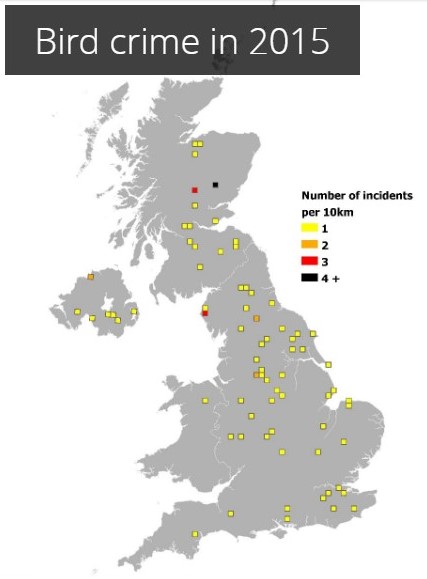
A map documents some of the 2015 reported incidents, although some are not mapped because there wasn’t an associated grid reference and others were not mapped “as requested by Police Scotland“.

birdcrime-2015-map

This map illustrates the geographical extent of raptor persecution in the UK (even with some of the Scottish incidents being withheld) and according to the report the UK breakdown for 2015 was 61% of all confirmed persecution reports were in England, 29% in Scotland, 9% in Northern Ireland and 1% in Wales.

The regional breakdown is very familiar to those who take an interest in regional trends. It’s no surprise to see that the worst area for reported raptor persecution continues to be North Yorkshire (40 reports), closely followed by Highland (39 reports) and then Aberdeenshire (23 reports). All three areas are dominated by land managed for driven grouse shooting, including three National Parks (Yorkshire Dales NP, North York Moors NP and Cairngorms NP).

The report includes a pie chart to illustrate the occupation / interests of 176 individuals convicted of bird of prey persecution related offences between 1990-2016. Again, no surprises here:

occupations-convicted-1990-2015_from-rspb-birdcrime-2015

Given that 68% of all those convicted of raptor persecution offences over the last 26 years were gamekeepers, the response to the 2015 Birdcrime report by the National Gamekeepers’ Organisation is predictable in its denial and insincerity. We might have more trust in them if they didn’t harbour convicted criminals.

ngo-reponse

Many congratulations and thanks to the RSPB Investigations Team for continuing to compile these data and for making them available to the public.

We’ll be writing another, related blog, later today about Police Scotland’s continued withholding of data.

ECCLR Committee’s latest thoughts on gamebird licensing petition

This morning the Scottish Parliament’s Environment, Climate Change & Land Reform (ECCLR) Committee considered how to progress the Scottish Raptor Study Group’s petition calling for the introduction of a state-regulated licensing system for all gamebird hunting in Scotland.

You may recall the petition was submitted to the Scottish Parliament’s Public Petitions Committee last summer. That Committee took evidence in October 2016 from the SRSG and RSPB Scotland (see here) and then evidence from the Scottish Moorland Group and BASC in December 2016 (see here) before deciding to pass the petition to the Environment, Climate Change & Land Reform (ECCLR) Committee for further consideration.

This morning the ECCLR Committee spent 7 minutes discussing the petition and various ways forward. The video of this morning’s discussion can be viewed here (the relevant start time is 1:46.11) and the official transcript can be read here (starts at page 37): ecclr-transcript-31-jan-2017

One Committee member, Alexander Burnett MSP (Scottish Conservative & Unonist Party, Aberdeenshire West), declared his shooting interests before suggesting that the petition should be dismissed outright because, amongst other things, “those who shoot are already licensed by extremely rigorous shotgun and firearms regimes“. He clearly hasn’t been following the case of the East Arkengarthdale Estate gamekeeper who was able to keep his shotgun and firearms certificates, despite admitting his involvement with an illegal poisons cache (see here).

Fortunately, Mr Burnett’s suggestion found no support from other Committee members and a decision was made to:

(a) Write to the Environment Cabinet Secretary to ask when the gamebird licensing review will be published, and to suggest that it be made available pronto so the ECCLR Committee can continue deliberations without further delay. It was suggested that the Committee would like to be in a position to proceed by March. (Remember, the publication of this review is already overdue and this delay is now affecting other areas of Parliamentary process).

(b) Write to the Environment Cabinet Secretary and ask for her opinion on the effectiveness of other measures such as vicarious liability, general licences etc.

(c) After receipt of the gamebird licensing review, and following a short period of time to consider its findings, the ECCLR Committee will potentially invite the Petitioner (Logan Steele of the Scottish Raptor Study Group) and a range of stakeholders to give further evidence.

UPDATE 22 Feb 2017: letter-from-ecclr-convenor-to-cab-sec-re-petition-pe1615_7feb2017

UPDATE 6 April 2017: Cab Sec letter to ECCLR re gamebird licensing_7March2017

Mass poisoning of raptors in Ross-shire to feature at film festival in New York

In March 2014, 22 red kites and buzzards were illegally poisoned in Ross-shire, in an incident that became known as the Ross-shire Massacre.

This shocking crime drew wide public attention and revulsion, leading to public protests in Inverness town centre.

Rossshire Massacre film

In 2015, film-maker Lisa Marley produced a short but beautifully evocative film about the crime and the subsequent police investigation.

Her film, Red Sky on the Black Isle, will feature at the Wildlife Conservation Film Festival taking place in October 2017 in New York. Good stuff. The more international exposure that can be given to the illegal persecution of birds of prey throughout the UK, the better.

As we approach the third anniversary of the Ross-shire Massacre, when the case becomes time-barred (meaning that a prosecution is no longer possible), we will be blogging about some aspects of this case that, for legal reasons, we’ve been unable to publish before now. More in March….

East Arkengarthdale Estate: some questions for the grouse shooting industry

Following on from today’s earlier news that in December 2014 a poisons cache had been uncovered on a driven grouse moor at East Arkengarthdale Estate in Yorkshire, and that a gamekeeper had admitted that he was responsible for placing poisons in the cache, but he avoided prosecution and had his firearms certificates reinstated (see here), we’ve got some questions for the grouse-shooting industry.

arken

Let’s start with questions for the Moorland Association. Email: amanda@moorlandassociation.org

  1. Is East Arkengarthdale Estate a member of the Moorland Association?
  2. When were you first aware of the discovery of this poisons cache, that was found two years ago?
  3. Were you aware of it when you gave evidence at Westminster on the petition to ban driven grouse shooting?
  4. If East Arkengarthdale Estate is a member, will you be expelling them from your organisation?
  5. If not, why not?
  6. Will you be publishing a statement about the discovery of a poisons cache on a driven grouse moor in Yorkshire?
  7. If not, why not?
  8. Will you be praising the superb work of the RSPB Investigations Team for uncovering this poisons cache on a driven grouse moor?
  9. Can you confirm whether Adrian Thornton-Berry, a Moorland Association official, was the sporting agent (via Dalesport Sporting Agency) at East Arkengarthdale Estate in December 2014 when the poisons cache was discovered?
  10. Did Amanda see the poisons cache through her kitchen window?

Questions for the National Gamekeepers’ Organisation. Email: info@nationalgamekeepers.org.uk 

  1. Is this (unnamed) gamekeeper a member of the National Gamekeepers’ Organisation?
  2. If yes, do you intend to expel him from your organisation?
  3. If not, why not?
  4. Could you explain why this gamekeeper had an electronic calling device (typically used to attract predators) with a series of raptor calls stored in it?
  5. Could you explain why this gamekeeper was visiting a poisons cache on a driven grouse moor?
  6. Could you explain why those poisons had been hidden in a bucket, underground?

Questions for the Game & Wildlife Conservation Trust. Email: info@gwct.org.uk

  1. When did you first become aware of the discovery of a poisons cache at East Arkengarthdale Estate?
  2. Were you aware of it when one of your 2014 auction prizes (some driven grouse shooting on 4 Yorkshire grouse moors, including East Arkengarthdale Estate) was fulfilled in October 2015?
  3. Have you received funding/donations from East Arkengarthdale Estate?
  4. Will you be accepting any further funding/donations from East Arkengarthdale Estate in light of today’s news?

Questions for BASC. Email: click here

  1. Why did your senior staff member, Dr Colin Shedden, tell a Scottish parliamentary committee that “any hint of illegal activity can lead to the right to hold a [shotgun] certificate, and the ability to shoot, being withdrawn“, when on the very same day, the BASC Chairman was defending the right of a gamekeeper to keep his shotgun certificate despite him admitting to placing poisons in a secret cache?

‘Giant buzzards’ eating dogs, warns Tipperary newspaper

The following article was headline news last week in the Tipperary Star, a local rag in the Irish Republic:
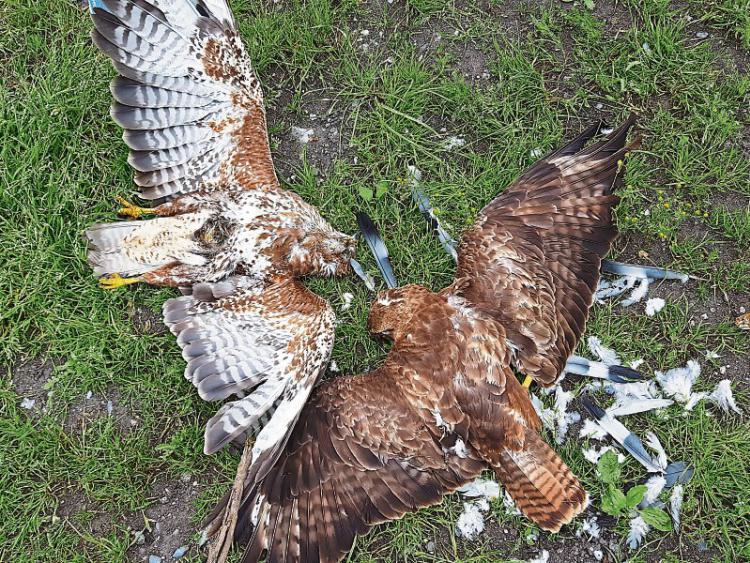
ATTACKING BUZZARDS TARGET TERRIERS

By Noel Dundon

A call to have the protection orders on buzzards lifted has been made following a number of incidents in which the birds of prey have taken terriers and other animals in deadly swoops through mid Tipperary.

Buzzards are causing major problems in the mid-Tipperary area at the present time with a number of terriers having been taken, leading to a call for protection orders to be lifted.

Two families have been left in distress after their dogs were preyed upon and killed by giant buzzards in the Templetuochy area where hares, rabbits, cats and other small animals have also been taken.

However, it has also been revealed that are birds of prey circling overhead Deputy Michael Lowry in Glenreigh, Holycross, while Moyaliffe, Drombane, Inch, Clonmore and Castleiney are also areas where buzzards have been spotted on the attack.

There is one report of a Yorkshire terrier having been attacked, but survived and was patched up by a veterinary surgeon, only to be attacked again and killed a short time later – all by the same buzzard which can have a wingspan of up to three feet with very powerful and strong claws used to take prey.

Forested areas which afford cover are the best hunting ground for buzzards and dog and cat owners are being advised to be on the watch out for their pets which could be taken at the blink of an eye.

There are also concerns that with the increase in buzzards, the spring lambing season after Christmas could be an ideal hunting ground for them – but a very costly one for sheep owners.

ENDS

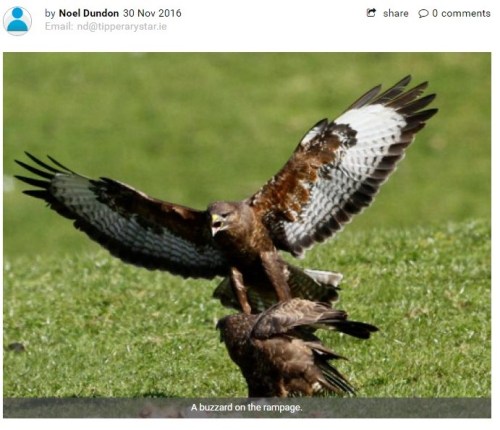
The online version of the article was illustrated with this photograph, entitled ‘A buzzard on the rampage’.

Is this ‘journalist’ having a laugh? Since when did ‘giant buzzards’ (or even normal-sized buzzards) start killing dogs, and since when did the sight of soaring buzzards above a politician’s head become a cause for alarm?

This type of sensationalist, ignorant, scare-mongering would be funny if it didn’t have consequences. Unfortunately, this baseless demonisation of birds of prey does have consequences, and serious ones at that. As we see all too often, there are still people clinging on to 19th Century attitudes who think that raptors are ‘vermin’ and should be destroyed. Articles like this one above will only fuel their prejudice and lead to the illegal persecution of these birds.

Tipperary is no stranger to raptor persecution – in the last few years the following crimes have been recorded:

July 2015: shot buzzard

May 2014: poisoned peregrine

January 2014: shot white-tailed eagle

July 2013: shot peregrine

June 2013: shot peregrine

June 2013: shot peregrine

Raptor persecution is a serious issue in Ireland, and the latest official report shows the trend is pointing upwards with 35 confirmed persecution incidents in 2015 – the highest number since recording began in 2011 (see here).

We’d encourage strong (but polite) words of complaint to the Tipperary Star:

Email journalist Noel Dundon: nd@tipperarystar.ie

Email editor Anne O’Grady: aog@tipperarystar.ie

UPDATE 6/12/2016: BirdWatch Ireland has issued a strong statement in response to the Tipperary Star (see here).

Red kite persecution in North Scotland at same level as 25 years ago, says new report

A new SNH-commissioned report, published today, shows that the high level of illegal red kite persecution in North Scotland has not changed in 25 years.

The latest report (see here) is a follow up study on a paper published in 2010 (see here) that showed illegal persecution was responsible for holding back the spread of re-introduced red kites in North Scotland. That study used data from 1989-2006. The latest study looked at more recent data (2007-2014) and shows that absolutely nothing has changed. Red kites in North Scotland are still being illegally killed at an astonishingly high rate.

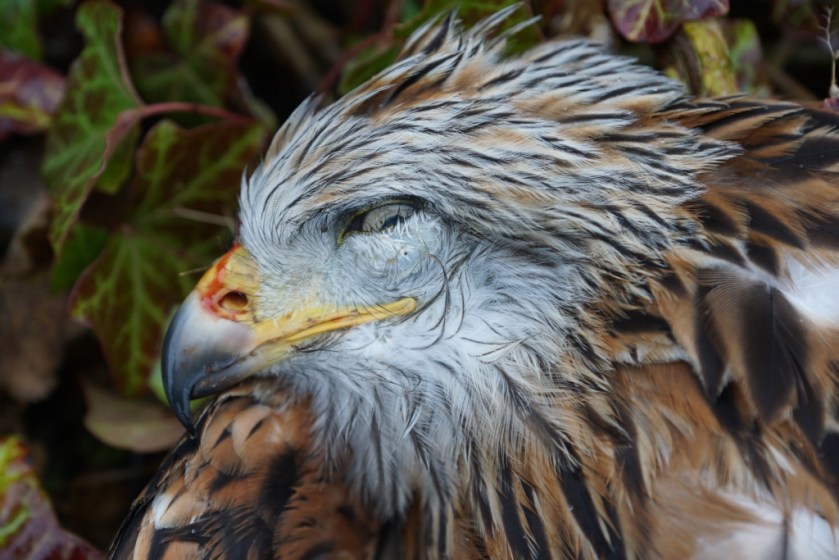
A dead red kite

The Scotland red kite breeding population, currently at around 283 pairs, should be at around 1,500 pairs, if population growth is comparable with other re-introduced kite populations in other parts of the UK. The sickening reality is that the current North Scotland kite population is around 70 breeding pairs, in comparison to the reference population in the Chilterns (reintroduced at the same time as the N Scotland kites but not exposed to illegal persecution) which currently stands at over 1,000 breeding pairs. Illegal persecution has robbed Scotland of 1,430 breeding pairs of red kites.

What an absolute bloody disgrace.

Here is a quote from the new report:

It is clear that illegal killing is still the major factor limiting population growth of red kites in North Scotland. There is no evidence that the rate of illegal killing has changed between the time periods 1989-2006 (i.e. the years used in the original paper by Smart et al., 2010) and 2007-2014‘.

The Cabinet Secretary for the Environment, Roseanna Cunningham, had this to say in an SNH press release about today’s report:

It is of course, good news that red kite numbers are increasing in Scotland. But it must be said that it is extremely disappointing that this success is being lessened by illegal persecution of these magnificent birds.

I want to be clear that wildlife crime is not acceptable in a modern Scotland and this is why we are doing all we can to end the illegal killing of birds of prey and working in partnership with stakeholders to achieve that. Scotland already has the strongest wildlife legislation in the UK and earlier this year, we accepted proposals to introduce tough new maximum penalties for those who commit crimes against wildlife.

The Scottish Government has ordered a review of satellite tracking data – we want to make sure we are getting the most information we can on when and how birds are disappearing.

Last year, we also funded the free pesticide disposal scheme which removed over 700kg of illegally held poisons in Scotland, to allow those still in possession of illegal substances to have them removed. I’m also seeing some really encouraging best practice from the farming community on the responsible use of rodenticide, which can be used by wildlife criminals to persecute raptors.”

We’ll be commenting in a later blog about the Cabinet Secretary’s comments, and putting them in to context with other, similar comments that have been trotted out by her predecessors over the years. Suffice to say, we’ve heard it all before and whilst those (Government) who could stop all of this find reasons not to do so, the killing continues.

Today’s report can be added to the mountain of scientific evidence about the extent and damage that illegal persecution is causing to our native, protected raptors at the hands of the game-shooting industry (e.g. see recent papers on catastrophic decline of hen harriers (here) and peregrines (here) due to illegal killing on the grouse moors of NE Scotland).

The hand-wringing and platitudes from the Government, and the denials and obfuscation from the game-shooting industry have all worn thin.

When does it STOP, Roseanna Cunningham?

UPDATE 2PM: The Scottish Gamekeepers’ Association has issued a statement in response to this report. Basically, it reads ‘It’s nuffin to do wiv us, Guv’. Read it here.

Three poisoned buzzards found in Co Laois, Ireland

The National Parks and Wildlife Service in Ireland is appealing for information after the discovery of three poisoned buzzards.

The buzzards were discovered in a field in Cappakeel, Emo, County Laois over the August Bank Holiday weekend. Toxicology tests have revealed they’d been poisoned with Carbofuran.

Full details from the Leinster Express here

poisoned-buzzards-laois

The illegal killing of birds of prey in the Cairngorms National Park

Many people think of the Cairngorms National Park as a wildlife haven. It’s what many expect of a National Park; indeed, it’s what we should all expect of a National Park.

The Cairngorms National Park Authority (CNPA) promotes it as such (this screen grab taken from the CNPA website):

CNPscreengrab

But just how much of a ‘wildlife haven’ is it?

Here’s the gruesome reality.

The following list, which we’ve compiled from various data sources but predominantly from the RSPB’s annual persecution reports, documents over 60 illegal raptor persecution incidents inside the Cairngorms National Park (CNP) since 2002. (The Park wasn’t formally established until 2003 but we’ve included 2002 data as the area had been mapped by then). This list includes just the crimes we know about. How many more went unreported/undiscovered?

2002

Feb: 2 x poisoned buzzards (Carbofuran) + rabbit bait. Tomintoul

Mar: 2 x poisoned buzzards (Carbofuran) + 2 rabbit baits. Cromdale

2003

Apr: 3 x poisoned buzzards (Carbofuran) + 2 grey partridge baits. Kingussie, CNP

Jun: Attempted shooting of a hen harrier. Crannoch, CNP

2004

May: 1 x poisoned buzzard (Carbofuran). Cuaich, CNP

Nov: 1 x poisoned red kite (Carbofuran). Cromdale, CNP

Dec: 1 x poisoned buzzard (Carbofuran). Cromdale, CNP

2005

Feb: 1 x poisoned buzzard (Carbofuran). Cromdale, CNP

Feb: 1 x poisoned buzzard (Carbofuran). Cromdale, CNP

Mar: 3 x poisoned buzzards, 1 x poisoned raven (Carbofuran). Crathie, CNP

2006

Jan: 1 x poisoned raven (Carbofuran). Dulnain Bridge, CNP

May: 1 x poisoned raven (Mevinphos). Grantown-on-Spey, CNP

May: 1 x poisoned golden eagle (Carbofuran). Morven [corbett], CNP

May: 1 x poisoned raven + 1 x poisoned common gull (Aldicarb) + egg bait. Glenbuchat, CNP

May: egg bait (Aldicarb). Glenbuchat, CNP

Jun: 1 x poisoned golden eagle (Carbofuran). Glenfeshie, CNP

2007

Jan: 1 x poisoned red kite (Carbofuran). Glenshee, CNP

Apr: Illegally set spring trap. Grantown-on-Spey, CNP

May: Pole trap. Grantown-on-Spey, CNP

May: 1 x poisoned red kite (Carbofuran). Tomintoul, CNP

May: Illegally set spring trap. Grantown-on-Spey, CNP

Jun: 1 x poisoned buzzard (Carbofuran) + rabbit & hare baits. Grantown-on-Spey, CNP

Jun: 1 x poisoned buzzard (Carbofuran) + rabbit bait. Grantown-on-Spey, CNP

Jul: 1 x poisoned raven (Carbofuran). Ballater, CNP

Sep: 1 x shot buzzard. Newtonmore, CNP

Sep: 1 x shot buzzard. Grantown-on-Spey, CNP

Dec: 1 x poisoned buzzard (Alphachloralose). Grantown-on-Spey, CNP

Dec: 1 x poisoned buzzard (Carbofuran) + rabbit bait. Grantown-on-Spey, CNP

2008

Jan: 1 x poisoned buzzard (Alphachloralose). Nr Grantown-on-Spey, CNP

Mar: 1 x poisoned buzzard (Carbofuran). Nr Grantown-on-Spey, CNP

Dec: 1 x poisoned buzzard (Alphachloralose). Nr Grantown-on-Spey, CNP

2009

May: 2 x poisoned ravens (Mevinphos). Delnabo, CNP

Jun: rabbit bait (Mevinphos). nr Tomintoul, CNP

Jun: 1 x shot buzzard. Nr Strathdon, CNP

Jun: 1 x illegal crow trap. Nr Tomintoul, CNP

2010

Apr: Pole trap. Nr Dalwhinnie, CNP

Jun: 1 x pole-trapped goshawk. Nr Dalwhinnie, CNP

Jun: Illegally set spring trap on tree stump. Nr Dalwhinnie, CNP

Sep: 2 x poisoned buzzards (Carbofuran) + rabbit bait. Glenlochy, CNP

Oct: 2 x poisoned buzzards (Carbofuran) + rabbit bait. Nr Boat of Garten, CNP

2011

Jan: 1 x shot buzzard. Nr Bridge of Brown, CNP

Mar: 1 x poisoned golden eagle (Carbofuran). Glenbuchat, CNP

Apr: 1 x poisoned buzzard (Carbofuran & Aldicarb). Nr Bridge of Brown, CNP

May:  1 x poisoned buzzard (Carbofuran) + rabbit bait. Glenbuchat, CNP

May: 1 x shot short-eared owl, found stuffed under rock. Glenbuchat, CNP

Jun: 1 x shot peregrine. Pass of Ballater, CNP

Aug: grouse bait (Aldicarb). Glenlochy, CNP

Sep: Satellite-tagged golden eagle ‘disappears’. Nr Strathdon, CNP

Nov: Satellite-tagged golden eagle ‘disappears’. Nr Strathdon, CNP

2012

Apr: 1 x shot short-eared owl. Nr Grantown-on-Spey, CNP

Apr: Peregrine nest site burnt out. Glenshee, CNP

May: Buzzard nest shot out. Nr Ballater, CNP

2013

Jan: White-tailed eagle nest tree felled. Invermark, CNP

May: 1 x shot hen harrier. Glen Gairn, CNP

May: Satellite-tagged golden eagle ‘disappears’. Glenbuchat, CNP

2014

Apr: Satellite-tagged white-tailed eagle ‘disappears’. Glenbuchat, CNP

May: Armed masked men shoot out a goshawk nest. Glen Nochty, CNP

2015

Sep: Satellite-tagged hen harrier ‘Lad’ found dead, suspected shot. Newtonmore, CNP

2016

May: 1 x shot goshawk. Strathdon, CNP

Jun: Illegally set spring traps. Invercauld, CNP

In addition to the above list, two recent scientific publications have documented the long-term decline of breeding peregrines on grouse moors in the eastern side of the National Park (see here) and the catastrophic decline of breeding hen harriers, also on grouse moors in the eastern side of the Park (see here).

And let’s not forget the on-going massacre of mountain hares, taking place annually within the boundary of the National Park (e.g. see here, here).

So, who still thinks the Cairngorms National Park is a ‘wildlife haven’?

With over 40% of the National Park covered by driven grouse moors, it’s anything but. The next blog will explore how the Cairngorms National Park Authority has failed, so far, to effectively address the illegal killing of birds of prey, but there is a small chink of light ahead…..more shortly.

UPDATE 7/9/16: How to stop the illegal persecution of raptors in the Cairngorms National Park (here)

Buzzard found poisoned in Ayrshire

buzzard 3The SSPCA is appealing for information following the discovery of a young dead buzzard in Ayrshire.

A member of the public found the bird on farmland between Maybole and Patna in April. Toxicology results indicate it had been poisoned with a lethal pesticide. The SSPCA believes this was the result of “a deliberate act”.

SSPCA press release here


40 eagles, 10 years, 0 prosecutions

In April 2012, we wrote an article called ’21 eagles, 6 years, 0 prosecutions’ (see here).

In September 2012, we updated it and called it ’26 eagles, 6 years, 0 prosecutions’ (see here).

In July 2013 we updated it again. This time, ’27 eagles, 7 years, 0 prosecutions’ (see here).

In December 2013 we had to do another update: ‘31 eagles, 7 years, 0 prosecutions’ (see here).

In April 2014 we had to do another update: ’32 eagles, 8 years, 0 prosecutions’ (see here).

Fearnan Angus Glens Dec 2013 - Copy

After this morning’s news (here) that eight young satellite-tagged golden eagles have ‘disappeared’ on grouse moors in the Monadhliath Mountains over the last five years, we thought it was time for another update. This time it’s called: ’40 eagles, 10 years, 0 prosecutions’.

36 of these 40 eagles have either been found dead on, or have ‘disappeared’ on, Scottish grouse moors. (The other 4 have either died or have ‘disappeared’ in other habitat types).

Three of these 40 eagles have ‘disappeared’ in 2016. So much for the grouse-shooting industry claiming that they’ve cleaned up their act and that persecution is a thing of the past. The tactics of how to kill an eagle have clearly changed (see here) but the persecution continues.

As before, a number of eagles included in this list (16 of them, to be precise) may not be dead. However, they are included here because their satellite tags unexpectedly stopped functioning (i.e. they’d been transmitting perfectly well up until the eagles’ last known location, often a known persecution hotspot). Two further satellite-tagged eagles (‘Angus’ and ‘Tom’) are not included in this list as although their transmitters stopped functioning, there had been recognisable problems with their tags prior to the final transmissions and so the benefit of the doubt has been applied.

Many of these listed eagles from recent years have only been discovered because the eagles were being satellite-tracked. Much kudos to the dedicated teams of fieldworkers who have put in hours and hours of skilled hard work to allow this to happen. Obviously there are many other eagles out there that have not been sat-tagged and on the balance of probability will have been killed at the hands of the game-shooting industry. 40 eagles in the last 10 years is the bare minimum. The number of prosecutions (zero) is indisputable.

MAY 2006: A dead adult golden eagle was found on the Dinnet & Kinord Estate, near Ballater, Aberdeenshire. Tests revealed it had been poisoned by the illegal pesticide Carbofuran. Grampian Police launched an investigation. No prosecution.

JUNE 2006: A dead golden eagle was found on Glen Feshie Estate in the Cairngorms. Tests revealed it had been poisoned by the illegal pesticide Carbofuran. Northern Constabulary launched an investigation. No prosecution.

AUGUST 2007: A dead adult female golden eagle was found on an estate near Peebles in the Borders. She was half of the last known breeding pair of golden eagles in the region. Tests revealed she had been poisoned by the illegal pesticide Carbofuran. Lothian & Borders Police launched an investigation. No prosecution.

NOVEMBER 2007: Tayside Police received a detailed tip-off that a young male white-tailed eagle (known as ‘Bird N’) had allegedly been shot on a grouse moor estate in the Angus Glens. The timing and location included in the tip-off coincided with the timing and location of the last-known radio signal of this bird. The eagle has not been seen again. With no carcass, an investigation isn’t possible.

MAY 2008: A one year old male white-tailed eagle hatched on Mull in 2007 and known as ‘White G’ was found dead on the Glenquoich Estate in the Angus Glens. Tests revealed he had been poisoned by an unusual concoction of pesticides that included Carbofuran, Bendiocarb and Isofenphos. A police search in the area also revealed a poisoned buzzard, a baited mountain hare and 32 pieces of poisoned venison baits placed on top of fence posts on the neighbouring Glenogil Estate. Laboratory tests revealed the baited mountain hare and the 32 poisoned venison baits contained the same unusual concoction of highly toxic chemicals that had killed the white-tailed eagle, ‘White G’. No prosecution.

JUNE 2009: An adult golden eagle was found dead at Glen Orchy, Argyll, close to the West Highland Way. Tests revealed it had been poisoned by the illegal pesticide Carbofuran. Strathclyde Police launched a multi-agency investigation. Three years and 3 months later, estate employee Tom McKellar pled guilty to possession of Carbofuran stored in premises at Auch Estate, Bridge of Orchy and he was fined £1,200. No prosecution for poisoning the golden eagle.

JULY 2009: A two year old female golden eagle known as ‘Alma’ was found dead on the Millden Estate in the Angus Glens. Tests revealed she had been poisoned by the illegal pesticide Carbofuran. Alma was a well-known eagle  – born on the Glen Feshie Estate in 2007, she was being satellite-tracked and her movements followed by the general public on the internet. Tayside Police launched an investigation. No prosecution.

AUGUST 2009: A young white-tailed eagle was found dead on Glenogil Estate in the Angus Glens. Tests revealed it had been poisoned by the illegal pesticide Carbofuran. Tayside Police was criticized in the national press for not releasing a press statement about this incident until January 2010. No prosecution.

MAY 2010: #1 of three dead golden eagles found on or close to Skibo Estate, Sutherland. Tests revealed they had been poisoned; two with Carbofuran and one with Aldicarb. Northern Constabulary launched a multi-agency investigation. One year later (May 2011), Sporting Manager Dean Barr pled guilty to possession of 10.5 kg of Carbofuran stored in premises at Skibo Estate. No prosecution for poisoning the golden eagle.

MAY 2010: #2 of three dead golden eagles found on or close to Skibo Estate, Sutherland. Tests revealed they had been poisoned; two with Carbofuran and one with Aldicarb. Northern Constabulary launched a multi-agency investigation. One year later (May 2011), Sporting Manager Dean Barr pled guilty to possession of 10.5 kg of Carbofuran stored in premises at Skibo Estate. No prosecution for poisoning the golden eagle.

MAY 2010: #3 of three dead golden eagles found on or close to Skibo Estate, Sutherland. Tests revealed they had been poisoned; two with Carbofuran and one with Aldicarb. Northern Constabulary launched a multi-agency investigation. One year later (May 2011), Sporting Manager Dean Barr pled guilty to possession of 10.5 kg of Carbofuran stored in premises at Skibo Estate. No prosecution for poisoning the golden eagle.

JUNE 2010: #1: Leg rings with unique identification numbers that had previously been fitted to the legs of four young golden eagles in nests across Scotland were found in the possession of gamekeeper James Rolfe, during a multi-agency investigation into alleged raptor persecution at Moy Estate, near Inverness. It is not clear how he came to be in possession of the rings. The bodies of the eagles from which the rings had been removed were not found. No further action was taken in relation to the discovery.

JUNE 2010: #2: Leg rings with unique identification numbers that had previously been fitted to the legs of four young golden eagles in nests across Scotland were found in the possession of gamekeeper James Rolfe, during a multi-agency investigation into alleged raptor persecution at Moy Estate, near Inverness. It is not clear how he came to be in possession of the rings. The bodies of the eagles from which the rings had been removed were not found. No further action was taken in relation to the discovery.

JUNE 2010: #3: Leg rings with unique identification numbers that had previously been fitted to the legs of four young golden eagles in nests across Scotland were found in the possession of gamekeeper James Rolfe, during a multi-agency investigation into alleged raptor persecution at Moy Estate, near Inverness. It is not clear how he came to be in possession of the rings. The bodies of the eagles from which the rings had been removed were not found. No further action was taken in relation to the discovery.

JUNE 2010: #4: Leg rings with unique identification numbers that had previously been fitted to the legs of four young golden eagles in nests across Scotland were found in the possession of gamekeeper James Rolfe, during a multi-agency investigation into alleged raptor persecution at Moy Estate, near Inverness. It is not clear how he came to be in possession of the rings. The bodies of the eagles from which the rings had been removed were not found. No further action was taken in relation to the discovery.

JUNE 2010: A golden eagle was found dead on Farr & Kyllachy Estate, Inverness-shire. Tests revealed it had been poisoned by the illegal pesticide Carbofuran. Northern Constabulary apparently did not search the property until July 2011. No prosecution.

JUNE 2010: A white-tailed eagle was found dead on Farr & Kyllachy Estate, Inverness-shire. Tests revealed it had been poisoned by the illegal pesticide Carbofuran. Northern Constabulary apparently did not search the property until July 2011. No prosecution.

DECEMBER 2010: A decomposing carcass of a white-tailed eagle was found and photographed on Logie (Lochindorb) Estate, Morayshire. It was reported to Northern Constabulary. By the time the police arrived to collect it, the carcass had disappeared. The police said they couldn’t investigate further without the body.

FEBRUARY 2011: The signal from a young satellite-tracked golden eagle ( ‘Lee’, hatched in 2010) unexpectedly stopped transmitting after a final signal from the North Angus Glens. A technical malfunction or another mysterious ‘disappearance’?

MARCH 2011: The body of a young golden eagle was discovered on North Glenbuchat Estate, Aberdeenshire. Tests revealed it had been poisoned by the illegal pesticide Carbofuran. Grampian Police launched an investigation and raided the property in May 2011. A poisoned buzzard, a poisoned bait and a shot short-eared owl were found. No prosecution.

APRIL 2011: The body of a white-tailed eagle was found at the base of cliffs on Skye. The person who discovered it (a professional medic) considered it to have been freshly shot with a rifle, decapitated with a sharp implement and thrown from the cliff top. He took photographs and alerted Northern Constabulary and RSPB. There was a delay of two weeks before the now probably decomposed carcass was collected. A post-mortem was inconclusive. This incident was not made public until one year later after a tip off to this blog. No prosecution.

SEPTEMBER 2011: The signal from a satellite-tracked young golden eagle (‘Strathy’, hatched in 2010) unexpectedly stopped transmitting after a final signal from an Aberdeenshire grouse moor. A technical malfunction or another mysterious ‘disappearance’?

NOVEMBER 2011: The signal from a one-year-old satellite-tracked golden eagle (#57124) unexpectedly stopped transmitting after a final signal from a grouse moor in the Monadhliaths. A technical malfunction or another mysterious ‘disappearance’?

MARCH 2012: The body of a young golden eagle being tracked by satellite was discovered in Lochaber. Tests revealed it had been poisoned with the banned pesticides Aldicarb and Bendiocarb. Information about this incident was not made public until three months later. No prosecution.

MARCH 2012: The signal from a satellite-tracked young golden eagle (‘Angus 26′, hatched in 2011) unexpectedly stopped transmitting after a final signal from a grouse moor in the Angus Glens. This bird’s suspiciously damaged sat tag was found in the area. No prosecution.

MAY 2012: The signal from a young satellite-tracked golden eagle (#32857) unexpectedly stopped transmitting when the bird was north-east of the Cairngorms National Park. A technical malfunction or another mysterious ‘disappearance’?

MAY 2012: The dead body of a young satellite-tracked golden eagle (hatched in 2011) was discovered near a lay-by in Aboyne, Aberdeenshire. The data from its satellite tag & the injuries the bird had when found (2 broken legs) suggested it had been caught in an illegal trap on a grouse moor in the Angus Glens and then removed, under cover of darkness, to be dumped in another area where it was left to die, probably a slow and agonising death. Information on this incident was not released until almost five months later, by the RSPB. It appears the police failed to properly investigate this incident as we understand that no search warrants were issued and no vehicles were searched. No prosecution.

JULY 2012: The signal from a one-year-old satellite-tracked golden eagle (‘Foinaven’) unexpectedly stopped transmitting after a final signal from a grouse moor in the Monadhliaths. A technical malfunction or another mysterious ‘disappearance’?

OCTOBER 2012: An adult golden eagle was found shot and critically injured on grouse moor at Buccleuch Estate, near Wanlockhead, South Lanarkshire. The bird was rescued by the SSPCA and underwent surgery but it eventually succumbed to its injuries in April 2013. No prosecution.

MAY 2013: The signal from a two-year-old satellite tracked golden eagle (‘Angus 33′, hatched in 2011) unexpectedly stopped transmitting after its last signal from North Glenbuchat Estate in Aberdeenshire. A technical malfunction or another mysterious ‘disappearance’?

JUNE 2013: A dead golden eagle was found under power lines on an RSPB reserve on Oronsay. This bird had been shot although it is not known whether this was the cause of death or an historical injury.

JULY 2013: The signal from a young satellite tracked golden eagle (‘Cullen’, hatched 2010) unexpectedly stopped transmitting after its last signal in Aberdeenshire. A technical malfunction or another mysterious ‘disappearance’?

DECEMBER 2013: A two year old satellite tracked golden eagle (‘Fearnan’) was found dead on a grouse moor in the Angus Glens. Tests revealed he had been poisoned with the banned pesticide Carbofuran. No prosecution.

MARCH 2014: The signal from a one-year-old satellite-tagged golden eagle (#129002) unexpectedly stopped transmitting after a final signal from a grouse moor in the Monadhliaths. A technical malfunction or another mysterious ‘disappearance’?

APRIL 2014: The signal from a young satellite tracked white-tailed eagle (the first fledged sea eagle chick in East Scotland in ~200 years) unexpectedly stopped transmitting after its last signal from the North Glenbuchat Estate in Aberdeenshire. Police raided the property a couple of weeks later. No prosecution.

OCTOBER 2014: The signal from a one-year-old satellite-tagged golden eagle (#107133) unexpectedly stopped transmitting after a final signal from a grouse moor in the Monadhliaths. A technical malfunction or another mysterious ‘disappearance’?

OCTOBER 2014: The signal from a two-year-old satellite-tagged golden eagle (#119886) unexpectedly stopped transmitting after a final signal from a grouse moor in the Monadhliaths. A technical malfunction or another mysterious ‘disappearance’?

MAY 2016: The signal from a less-than-one-year-old satellite-tagged golden eagle (#00000583) unexpectedly stopped transmitting after a final signal from a grouse moor in the Monadhliaths. A technical malfunction or another mysterious ‘disappearance’?

JUNE 2016: The signal from a two-year-old satellite-tagged golden eagle (#129010) unexpectedly stopped transmitting after a final signal from a grouse moor in the Monadhliaths. A technical malfunction or another mysterious ‘disappearance’?

JULY 2016: The signal from a two-year-old satellite-tagged golden eagle (#129015 ‘Brodie’) unexpectedly stopped transmitting after a final signal from a grouse moor in the Monadhliaths. A technical malfunction or another mysterious ‘disappearance’?

THE UNTOUCHABLES: 40; JUSTICE: 0

Cabinet Secretary for the Environment Roseanna Cunningham has responded to this morning’s news (read her statement here) by calling for an analysis of the satellite tag data from around 90 surviving and missing eagles “to discover if there is a pattern of suspicious activity“. It just beggars belief. We’ll shortly be blogging in more detail about her response and that of the Scottish Moorland Group, which is equally as fatuous.

In the meantime, please sign this petition (here) calling on the Scottish Government to introduce a licensing scheme for gamebird shooting.

And then please sign this petition (here) calling on the Westminster Government to ban driven grouse shooting.

ALMD