There’s been a good deal of media interest and coverage about the recent prosecution, conviction and sentencing of part-time gamekeeper Timothy Hall and his son, Lewis Hall, for their role in the illegal laundering of wild Scottish peregrines which they sold for high prices to buyers in the Middle East (see here and here).
Most media outlets have simply summarised the press releases about Operation Tantallon issued by Police Scotland and the Crown Office, but the Guardian newspaper has published from a different angle, focusing on the work of Scottish Raptor Study Group (SRSG) member George Smith, whose 40 years of dedicated and detailed monitoring of peregrines in south Scotland helped bring the successful prosecution against Timothy and Lewis Hall.
Written by journalist Phoebe Weston, who is developing a reputation for in-depth coverage of raptor persecution crimes – e.g. her earlier three-part podcast on the illegal persecution of hen harriers on grouse moors (‘Killing the Skydancer‘) was excellent, her latest piece on the Hall peregrine case is well worth a read – see here.
It’s good to see George’s significant, long-term fieldwork receiving national attention – like so many other SRSG members, George undertakes this skilled (and licenced) work on an entirely voluntary basis but his hard-won data provide the Scottish Government and its agencies with vital detail about the distribution and abundance of raptors (in George’s case, peregrines) and help to inform long-term conservation policies.
I’m particularly pleased to see George’s work highlighted because he is one of a number of SRSG members who are repeatedly targeted online by a malicious group of individuals, some of them prominent members of the Scottish Gamekeepers Association, who deliberately and falsely accuse George and his colleagues of unlawful and negligent practices, all in a desperate bid to discredit the good name of the SRSG.
They base these vicious (and libellous) accusations on what they claim to be their concern for the raptor species being monitored/tagged.
I haven’t seen any of them comment on the successful prosecution of part-time gamekeeper Timothy Hall and his son, Lewis Hall, for their crimes against the same peregrines that George has dedicated 40 years of his life to protect.
Further to this morning’s blog about the sentencing of part-time gamekeeper Timothy Hall, 48, and his son Lewis Hall, 23, who had previously pleaded guilty to multiple offences relating to the illegal laundering of wild peregrines stolen from nest sites across Scotland and then sold on under the guise of being legally captive-bred birds (see here), I want to write a few thoughts about this outcome.
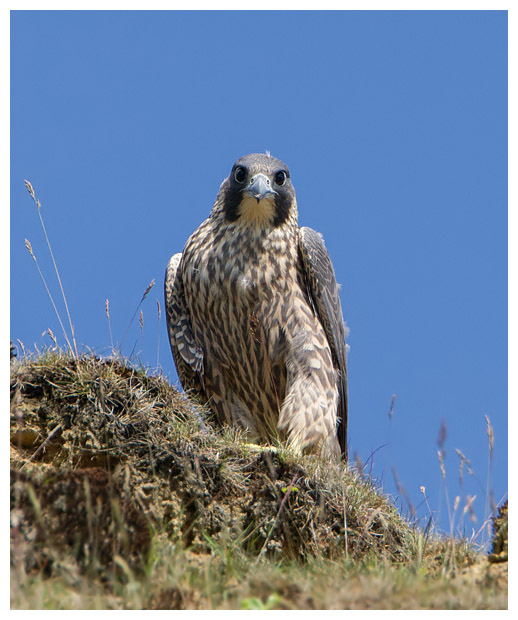
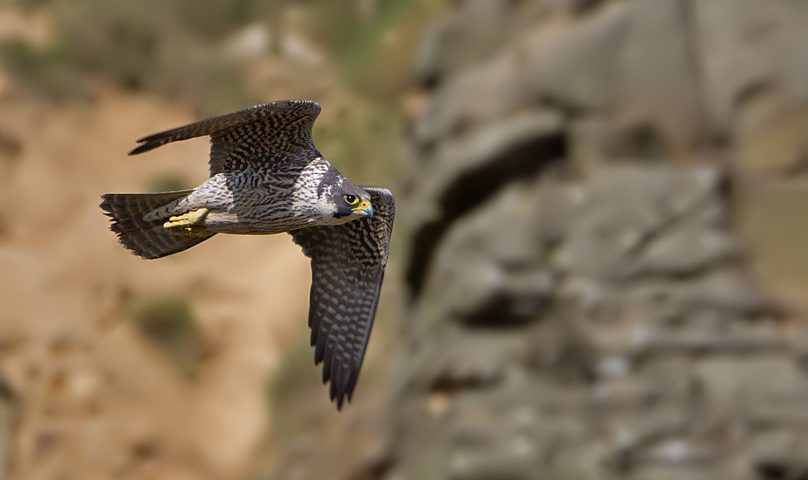
Juvenile peregrine, out in the wild where it belongs. Photo by Pete Walkden
There’s a lot to say about this case but I first want to acknowledge the multi-agency partnership working of all those involved in getting these criminals in to court. Beginning in May 2021, this investigation has been long-running, painstakingly meticulous and exceptionally diverse. The staggeringly inadequate sentences handed down today do not in any way reflect the dedicated and exemplary efforts of these agencies, all of whom deserve our appreciation and thanks.
Very well done to the Scottish Raptor Study Group (SRSG), Scottish SPCA, Police Scotland, National Wildlife Crime Unit (NWCU), Science and Advice for Scottish Agriculture (SASA) and the Animal Plant and Health Agency (APHA).
So, sentencing. We learned earlier today that Timothy Hall had been ordered to complete 220hrs of unpaid work over a period of 18 months and his son, Lewis Hall, 150hrs over a period of 15 months. They were both also banned from having birds of prey in their possession or under their control for a period of five years.
To say this is a disappointing sentence is a massive understatement. It’s not what any of us had expected, especially given that the presiding Sheriff, Peter Paterson, is no stranger to hearing wildlife crime cases (more on that below). It wasn’t as though this case was heard by an inexperienced and naïve member of the judiciary, nor that he wasn’t provided with extensive and compelling evidence about the scale of offending, which had been going on for several years and clearly met the standard of being serious and organised crime.
So why the staggeringly pathetic sentence, then?
I’m not going to try and justify it because I can’t. It’s even more inexplicable given the Sheriff’s track record. This is the Sheriff who presided over the notorious case against gamekeeper Alan Wilson in 2019, whose extensive wildlife crimes on the Longformacus Estate resulted only in an order to carry out 225hrs of unpaid work (and a 10-month curfew) – another monumentally inadequate sentence.
However, in that case Sheriff Paterson had acknowledged that Wilson’s offending warranted a custodial sentence but said that as the Wildlife & Countryside Act only allowed sentences of up to six months, and Scottish Ministers had recently introduced a presumption against jailing offenders for less than 12 months, he felt he had no choice but to impose a different sentence (here).
I argued against that logic (here), suggesting that because Wilson had been convicted of multiple offences, each carrying a maximum six month custodial penalty, a potential custodial sentence for all his offences would have exceeded the 12-month limit and so should have been imposed.
It wasn’t to be, but we consoled ourselves with the knowledge that increased penalties for wildlife crimes in Scotland were imminent (new legislation was enacted in Nov 2020), which elevated custodial sentences for certain wildlife crimes to five years in custody and unlimited fines, and so any future prosecutions would surely result in a tougher sentence, right?
Well apparently not.
There is some legitimate justification (although I don’t agree with it in this case) for Lewis Hall not to receive a custodial sentence. As of 26 January 2022 the Sentencing Young People guidelines in Scotland came into force, which argues that anyone under the age of 25 years should preferentially be given a rehabilitation order instead of a custodial sentence. However, and this is important, the guidelines state that the full range of sentencing options, including imprisonment, remains open to the court, but that a (shorter) custodial sentence should only be imposed on a young person when the court is satisfied that no other sentence is appropriate.
Given that Lewis Hall (23) was up to his neck in serious organised crime, receiving huge payments from the Middle East into his own bank account, for the sale of stolen peregrines (according to the evidence), what possible reason did Sheriff Paterson have for only imposing a sentence of 150hrs unpaid work?? It doesn’t make sense.
And as for Timothy Hall (48), I can’t see any reason whatsoever why he shouldn’t have received a custodial sentence. Under the Animals and Wildlife (Penalties, Protections and Powers) (Scotland) Act 2020, Timothy Hall’s offences, committed over a number of years, included crimes relating to Section 1 of the Wildlife & Countryside Act (Protection of wild birds, their nests & eggs) and Section 6 (Sale, possession etc of live or dead wild birds, eggs etc), both of which now attract penalties of up to five years imprisonment and significant fines. The Sheriff even agreed Hall’s crimes had passed the custodial threshold, so why only impose a sentence of 220hrs unpaid work??
It makes a total mockery of the court’s sentencing powers, of the Government’s will to crack down on wildlife crime, of the investigating agencies’ hard work, of the public’s desire to see wildlife criminals held to account and of effective deterrents put in place for other would-be criminals.
Sure, Lewis Hall is still facing action under the Proceeds of Crime legislation, and both he and his father face an ongoing investigation by HM Revenue & Customs for undeclared income (£41,164 according to COPFS), but that should have all been in addition to punishment under the wildlife crime legislation.
I just can’t comprehend how they got off so lightly. Compare and contrast with two other recent cases, where a falconer was fined over £7,000 for a minor admin error when selling legitimately captive-bred peregrines (here) and a drug addicted tree surgeon was given an eight-week custodial sentence for robbing eggs from a single peregrine nest (here).
Timothy Hall’s wife, a serving police officer whose not guilty pleas were accepted by the court in December 2023 (but has a reserved fraud charge hanging over her, see here), remains suspended from Police Scotland on full pay. I don’t know how long she’s been employed as a serving officer but the pay scale for a constable ranges from £30,039 on commencing service up to £48,237 for up to 11 years of service.
I don’t doubt the Hall family will be celebrating this evening.
Here’s Lewis Hall leaving court after sentencing, screen-grabbed from BBC Reporting Scotland this evening:
UPDATE 26 June 2024: Prosecutors seeking to recover £164,000 from Scottish peregrine launderer Lewis Hall (here)
UPDATE 10 October 2024: Scottish court orders convicted Peregrine launderer Lewis Hall to pay back thousands under Proceeds of Crime Act (here)
UPDATE 23 November 2024: Suzanne Hall, wife & mother of convicted peregrine launderers ‘no longer a serving police officer’ (here).
Part-time gamekeeper Timothy Hall, 48, and his son, Lewis Hall, 23, appeared at Jedburgh Sheriff Court this morning for sentencing after they earlier pleaded guilty to the illegal laundering of wild peregrines which had been stolen from sites across southern Scotland (see here for previous blogs).
Despite their offences passing the threshold for a custodial sentence, Timothy Hall was ordered to complete 220 hours of unpaid work and Lewis Hall was ordered to complete 150 hours.
More on this shortly…
UPDATE 13.40hrs: Press release from Police Scotland –
Two men sentenced for wildlife crime offences in the south of Scotland
Two men have been sentenced with community payback orders after pleading guilty to a series of wildlife crime related offences involving peregrine falcons in the south of Scotland.
Timothy Hall, 48 was given 220 hours, and Lewis Hall, 23, was given 150 hours community payback orders today at Selkirk Sheriff Court [Ed: case moved to Jedburgh Sheriff Court]. Both have been banned from keeping birds of prey for 5 years.
They admitted charges relating to 22 peregrine falcons, including being involved in the illegal sale of the protected species at Selkirk Sheriff Court on Monday, 11 December, 2023.
Timothy Hall also pleaded guilty to charges relating to firearms and animal welfare offences.
The ground breaking investigation led by Police Scotland was launched in 2021 and during a search of a property in Lamberton, Berwick-upon-Tweed, seven chicks were discovered as well as a number of other birds of prey.
While it is legal to sell captive-bred peregrines, possessing or selling wild birds is not.
To confirm the chicks were wild a new innovative DNA tactic was introduced which definitively established that they had not been bred in captivity, even linking some of them to wild adult peregrine falcons known to nest in the south of Scotland.
The investigation spanned two and a half years and through extensive enquiries Police Scotland was able to trace the sale of a number of peregrines to UK establishments trading in the birds and confirmed some had been exported overseas.
Throughout the investigation a range of partners provided invaluable contributions and expertise including the Scottish SPCA, the UK National Wildlife Crime Unit (NWCU), the Scottish Raptor Study Group, Science and Advice for Scottish Agriculture (SASA) and COPFS.
Police Scotland also worked closely with the Animal and Plant Health Agency (APHA) to improve processes and procedures relating to illegal wildlife trade to prevent people engaging in this type of criminality.
Detective Superintendent Bryan Burns said: “The sale of peregrine falcons has become an extremely lucrative business which Timothy and Lewis Hall exploited for their own financial gain.
“If their illegal activities had continued unchallenged, this would have had a massive impact on the population of young birds, and had the potential to wipe out the entire population of peregrine falcons in the south of Scotland.
“This case has been a monumental effort by Detective Constable Steven Irvine who led the investigation and was determined to bring the perpetrators to justice, going into meticulous detail to unravel the true extent of the criminality involved.
“These convictions would not have been possible without the incredible support from the partner agencies involved who all played a vital part in the investigation.”
Assistant Chief Constable for Major Crime, Public Protection and Local Crime, ACC Bex Smith, added: “This case not only has huge ramifications locally but also across the UK and worldwide and shows that Police Scotland is at the forefront of tackling illegal wildlife trade, working with our partners to use new and ground breaking forensic techniques. Wildlife crime remains a key priority for the Service and we will continue to use all resources at our disposal to put a stop to this illegal activity.”
Chief Inspector Kevin Kelly, head of the UK National Wildlife Crime Unit said: “This is part of the largest wildlife crime investigation in UK history, showing the illegal wildlife trade is a thriving business for criminals.
“The UK is home to some of the rarest birds of prey in the world, some of these are being taken and laundered in the legal falconry trade bringing lucrative returns for criminals and having a direct impact on the current nature crisis. The NWCU is committed to tackling this.”
Dr Lucy Webster from Science and Advice for Scottish Agriculture (SASA), part of the Scottish Government, led on the forensic work. She said:
“This is the first case to use our new forensic DNA method to test whether documented breeding records for Peregrine Falcons are true or false. However, we went beyond establishing false breeding records here, and also identified family links to several wild Peregrine nests. This powerful method will continue to support investigations and combat the illegal trade of wild Peregrines in the UK and beyond.”
Anyone with information or concerns about wildlife crime in their area can contact Police Scotland on 101.
ENDS
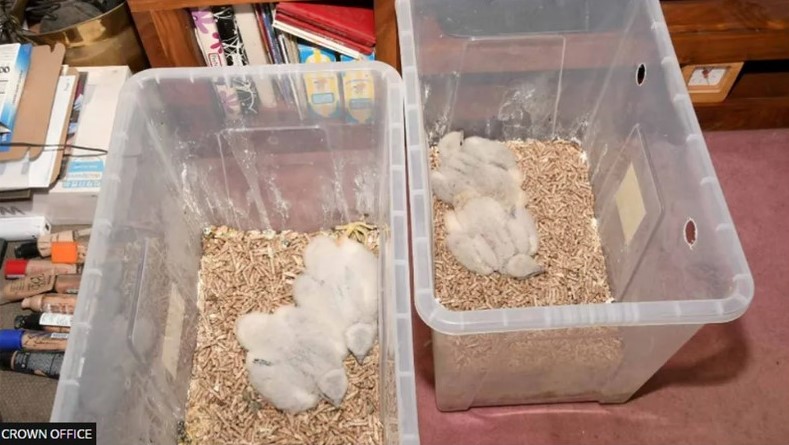
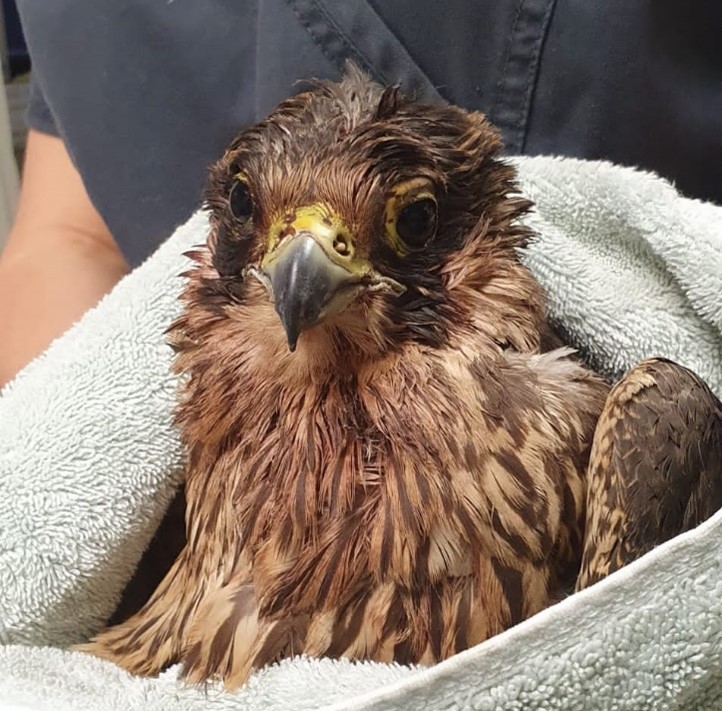
Some of the young stolen Peregrine chicks found at Timothy Hall’s address during multi-agency raid in 2021 (Photo via COPFS). The chicks were later fostered back to wild nest sites.
UPDATE 14.00hrs: Press release from Crown Office & Procurator Fiscal Service COPFS):
Father and son receive bans for illegally selling peregrine falcon chicks
A father and son who, over a number of years, illegally possessed and sold wild peregrine falcon chicks for large sums of money, have been ordered to carry out periods of unpaid work.
Both men are also prohibited from possessing or having under their control any bird of prey for a period of five years.
Timothy Hall, 48, pled guilty to acquiring for commercial purposes, keeping for sale and selling 15 wild peregrine falcon chicks between 2019 and 2020 and to being in possession of a further seven wild peregrine falcon chicks on 18th May 2021.
He also admitted a charge of failing to provide for the needs of nine other birds of prey by not providing a clean and adequate living environment and not providing sufficient clean water for them. He also admitted breaching the Firearms Act by not properly securing a shotgun.
He was ordered to carry out 220 hours of unpaid work over a period of 18 months.
Lewis Hall, 23, pled guilty to acquiring for commercial purposes, keeping for sale, and selling wild peregrine falcon chicks between 2020 and 2021, which included 13 of the previously referred to peregrine falcon chicks sold in 2020 and the seven chicks found on 18th May 2021.
He was ordered to carry out 150 hours of unpaid work over a period of 15 months.
Both men were sentenced at Jedburgh Sheriff Court.
Iain Batho, who leads on wildlife and environmental crime for the Crown Office and Procurator Fiscal Service (COPFS), said:
“It is highly important to preserve Scotland’s natural heritage, including the wildlife that forms part of it. As such, birds of prey are given strict protection by our law.
“The sale of peregrine falcons has become an extremely lucrative business and Timothy and Lewis Hall took advantage of that for their own financial gain and to the detriment of the wild peregrine falcon population in the South of Scotland.
“Their illegal activities had the potential to have a devastating impact on the entire population of nesting peregrine falcons in that part of the country.
“The result in this case is a testament to the collaborative working between COPFS, Police Scotland, the UK National Wildlife Crime Unit (NWCU), the Scottish SPCA and Science and Advice for Scottish Agriculture (SASA).”
The court heard how in April 2021 a member of the Lothian and Borders Raptor Study Group alerted police to suspicious failures of peregrine falcon nests in the Berwickshire area which had previously been productive.
Officers later investigated two nesting sites and discovered they had been disturbed and a number of eggs were missing from both locations.
A police search of Timothy Hall’s home in Berwick-Upon-Tweed subsequently found a total of seven peregrine falcon chicks as well as a number of other birds of prey.
Further enquiries concluded that none of the chicks were captive-born and had been taken from the wild.
The court was also told that an examination of Lewis Hall’s mobile phone contained a note that suggested he had been monitoring known peregrine falcon nest sites.
Data on the same device also showed that a drone linked to the phone had flown 20 separate flights directly over several known peregrine falcon nest sites.
The court also heard evidence that, between 2019 and 2020, Timothy and Lewis Hall were involved in the sale of 15 peregrine falcon chicks for which they received a total of £41,164.
To confirm the chicks were wild, a new innovative DNA tactic was used which definitively established that they had not been bred in captivity and which linked some of them to wild adult peregrine falcons known to nest in the south of Scotland.
Under legislation, selling captive-bred peregrine falcons is legal but possessing or selling wild birds is unlawful.
Lewis Hall will now be subject to action under proceeds of crime legislation.
UPDATE 20.30hrs: Commentary on the staggeringly inadequate sentencing of Timothy and Lewis Hall, convicted for illegal laundering of wild peregrines in south Scotland (here)
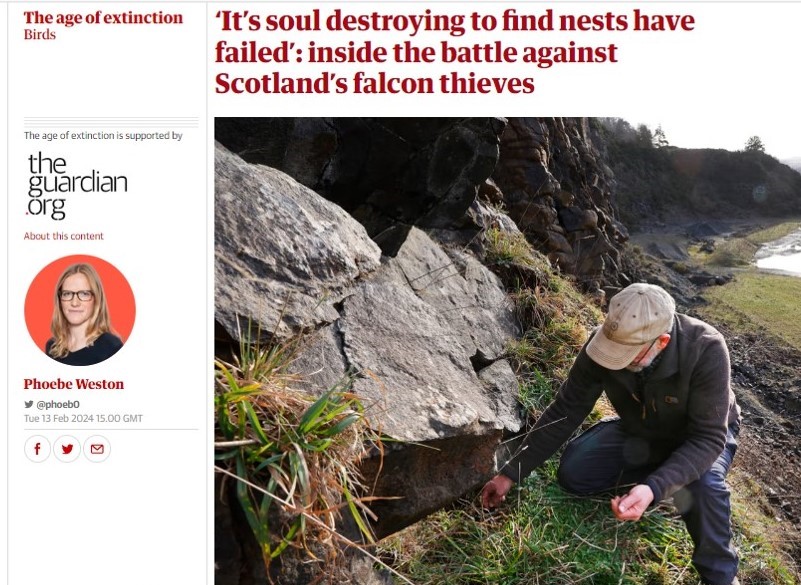
UPDATE 14 February 2024: It’s soul destroying to find nests have failed” – inside the battle against Scotland’s falcon thieves (here)
UPDATE 15 February 2024: SSPCA press release on conviction of part-time gamekeeper Timothy Hall and his son Lewis Hall for illegal laundering of Scottish peregrines (here)
UPDATE 26 June 2024: Prosecutors seeking to recover £164,000 from Scottish peregrine launderer Lewis Hall (here)
UPDATE 10 October 2024: Scottish court orders convicted peregrine launderer Lewis Hall to pay back thousands under Proceeds of Crime Act (here)
UPDATE 23 November 2024: Suzanne Hall, wife & mother of convicted peregrine launderers ‘no longer a serving police officer’ (here).
Further to the blog I wrote yesterday about the conviction of Gary MacFarlane for the illegal sale of peregrine chicks (here), I’ve just received some more information about this case.
I had written that I wasn’t sure whether or not the case related to the laundering of wild peregrines, although Police Scotland’s press release had alluded to it.
However, I’m now reliably informed that the case against MacFarlane was centred on apparently legitimate captive-bred peregrines and his crimes involved admin offences where he’d entered incorrect details on Article 10 certificates about the paternal genetic lineage of some chicks he was selling, simply because he’d guessed at the identity of the sire, having used semen from a number of males to artificially inseminate the female. His case was NOT related to the laundering of wild peregrines and passing them off as captive-bred birds.
To be honest, the financial consequences of MacFarlane’s admin errors (a fine of £2,100 and the confiscation as proceeds of crime of £5,220 in cash found at his house) seem a bit over the top, especially as the Article 10 system as prescribed by APHA seems ridiculous to say the least.
I won’t go into details because I’m not sure I understand it fully but as a quick summary, APHA has allowed some falcon breeders to enter details on Article 10 certificates of up to 80 individual males as the potential sire of a captive-bred chick. MacFarlane apparently didn’t understand the system and as he’d used semen from six males, he thought he had to indicate on the certificate which one of those males sired the offspring, rather than saying ‘it was one of these six’. He guessed at the identity of the purported sire, got it wrong and has now paid the price. He’s also received an automatic five year ban from keeping Schedule 4 birds so he’s also lost his breeding stock.
The APHA system as it stands is useless, if the idea is to be able to keep track of individual captive-bred birds but then allows breeders to include the details of up to 80 potential sires – it’s bonkers. I understand there is ongoing work between a number of agencies to try and resolve and update the system.
But that’s for discussion elsewhere – it’s not really within the remit of this blog and it’s beyond my area of expertise.
Press release from Police Scotland (1st February 2024):
Man to pay £7,000 in fine & confiscation charges following peregrine falcon case
A 61-year-old man has been ordered to pay over £7,000 in fine and confiscation charges after pleading guilty to advertising and selling peregrine falcon chicks without the required legal documentation under the Control of Trade in Endangered Species Regulations 2018.
Gary MacFarlane from Blackridge, West Lothian, was fined £2,100 when he appeared before Livingston Sheriff Court for sentencing today, Thursday, 1 February, 2024.
He previously pleaded guilty to 11 charges at a hearing at Livingston Sheriff Court on Thursday, 26 October, 2023, where he was ordered to forfeit £5,220 in cash which had been seized from his home address.
The charges included four counts of advertising and selling peregrine falcons without Article 10 certificates being issued, which is a requirement under the legislation for selling such protected species.
He also admitted seven counts of making false declarations in terms of the parent lineage of the chicks.
Detective Constable Steven Irvine, of the National Wildlife Crime Unit, said:
“This case sends a strong message to those who flout regulations in terms of our endangered and protected species that Police Scotland will thoroughly investigate these crimes and bring those responsible to justice.
“Gary MacFarlane sold protected chicks for his own profit and under false pretences which led to an extensive police investigation involving significant support from partner organisations including the SSPCA, the Scottish Government’s SASA forensic unit, the Animal Plant Health Agency, the National Wildlife Crime Unit and raptor specialists.
“Members of the public have a vital role to play in tackling wildlife crime and I would encourage anyone with information or concerns about this type of criminality to contact Police Scotland on 101 or Crimestoppers anonymously on 0800 555 111.”
ENDS
This is a strange press release. I’m assuming it refers to the theft and illegal laundering of wild peregrines being passed off as captive bred birds, (‘He admitted seven counts of making false declarations in terms of the parent lineage of the chicks‘) but if it was the theft and illegal laundering of wild peregrines this hasn’t been stated explicitly, it’s rather just inferred.
Nor does the press release say when the offences took place, nor whether this case is linked to Operation Tantallon – the high profile police investigation into the theft and illegal laundering of peregrines in Scotland which saw part-time gamekeeper Timothy Hall and his son Lewis Hall convicted in December 2023. They are due for sentencing on 12 February 2024 (see here).
However, an article from a court reporter in The Herald (here) provides a bit more detail, saying the offences took place in June 2021 and came to light after buyers tipped off the Animal Plant & Health Agency (APHA) that MacFarlane was selling peregrines without the A10 certificates required for the sale of this species.
UPDATE 2 February 2024: Falconer’s conviction for illegal selling of peregrine chicks in Scotland was NOT related to laundering of wild peregrines (here).
The owner of Caerphilly Bird Rescue in Wales has been handed a suspended prison sentence and a lifetime ban from keeping animals after pleading guilty to six animal welfare offences.
Carol Gravenor, 67, of Coed Main, Caerphilly, was charged after 26 birds, including pigeons, blackbirds, crows, jackdaws, a peregrine falcon, and a buzzard, were found in an unsuitable and unhygienic environment.
An RSPCA inspector found the birds with injuries and illnesses which had not been treated properly, including fractured wings and damaged eyes and legs.
This peregrine was found in a small filthy cage with no water. Photo: RSPCA
Mrs Gravenor appeared at Newport Magistrates’ Court on Thursday January 11, where she was given a 14-week prison sentence suspended for 12 months. She was also ordered to pay £300 and a £154 victim surcharge.
This article in the Caerphilly Observer (dated 12 January 2024) provides a report from the RSPCA inspector about what was found at the sanctuary and an explanation from Mrs Gravenor’s solicitor about how she’d become ‘overwhelmed’ and ‘swamped’ following the death of her husband in 2021.
The birds were removed from the premises on 11 April 2023 and most had to be euthanised on welfare grounds.
Press release from South Yorkshire Police (25 January 2024)
APPEAL FOLLOWING PEREGRINE FALCON FOUND SHOT IN DONCASTER
We are appealing for information alongside the RSPB for information after a juvenile Peregrine Falcon was found with life-threatening injuries in Doncaster.
The shot peregrine. Photo via South Yorkshire Police
On 11 December 2023, an injured Peregrine Falcon was found on a school playing field at Littlemoor Infant Academy in Askern – a school which backs onto open countryside.
The bird, which had suffered shotgun injuries, was taken to a rehabilitation centre, where it received expert veterinary care at the Ryedale Wildlife Rehabilitation Centre.
X-rays revealed that the bird had two shotgun pellets embedded in its leg and a dislocated coracoid bone, which prevented the bird from flying. The location of the pellets and the nature of the injuries sustained suggest that the bird was probably flying when it was shot.
We are urging anyone with information to come forward and speak to us.
Peregrine Falcons are the fastest animal on the planet, capable of speeds in excess of 100 miles per hour. Pairs will nest on coastal cliff-edges, in quarries and in urban areas on buildings and industrial sites.
Although fully protected and recovering across the UK, illegal persecution is impacting Peregrine numbers. In the UK, the RSPB has recorded 173 incidents of Peregrine persecution over the last 20 years, with a minimum of 195 Peregrines either dying or sustaining injuries as a result of these criminal activities.
In the last five years alone, 29 Peregrines have been illegally persecuted in England with almost a quarter of these incidents taking place in Yorkshire. Data shows that nationally a significant proportion of raptor persecution incidents are linked to land managed for gamebird shooting.
Having suffered injuries which prevented sustained flight, the Peregrine was taken to Ryedale Wildlife Rehabilitation Centre in North Malton, where it received expert care with the support of Battle Flatts Veterinary Clinic. After a month of rehabilitative care the Peregrine was released back into the wild on 13 January 2023.
Jean Thorpe, Ryedale Wildlife Rehabilitation Centre: “When a bird has suffered in this way it’s difficult to know if they’ll survive. The stress alone can be too much for them, and rehabilitation can be really challenging.
“We were lucky with this one. It’s a real privilege to have the opportunity to encounter one of these incredible birds but I just wish it was under different circumstances.
“This isn’t the first shot Peregrine I’ve had to care for, and I doubt it will be the last. These crimes are happening right under our noses, it’s unforgivable.”
Inspector Peter Heginbotham, from South Yorkshire Police Wildlife and Rural Crime Team, said: “To know that a protected Peregrine Falcon has been intentionally shot with a shotgun and found in Doncaster is extremely concerning, but unfortunately not unique. Sadly, Peregrine Falcons are still being shot, trapped and poisoned in northern England.
“We will thoroughly investigate this crime and would encourage anyone who can assist us with our investigation to please come forward and help us tackle and prevent these crimes from happening.”
If you have any information, please contact us online, via live chat or by calling 101 quoting incident number 576 of 13 December 2023.
Alternatively, to get in touch anonymously, call the RSPB’s dedicated Raptor Crime Hotline on 0300 999 0101 or Crimestoppers on 0800 555 111.
ENDS
There’s an article about the rehabilitation and a video showing the release of this peregrine on BBC news website (here).
The story is apparently going to feature on BBC Look North this evening. Perhaps South Yorkshire Police will explain why it took six weeks to publish an appeal for information.
Well done and thanks, yet again, to the remarkable Jean Thorpe and her colleagues at Battle Flatts Vets.
Essex Police are appealing for information after the discovery of an injured peregrine in the Highwood area of Chelmsford on 15th January 2024.
The wounded bird was admitted to the South Essex Wildlife Hospital and on examination is believed to have been shot.
I’ve asked for information about the peregrine’s condition and asked whether an x-ray had confirmed the bird had been shot. I’ll update this post when I hear.
Anyone with information is asked to contact Essex Police on Tel 101.
This latest raptor persecution victim is the 9th in Essex in recent years, following the shooting of a buzzard in December 2023 (here), the shooting of another buzzard in January 2023 (here), the shooting of a red kite in September 2022 (here), the shooting of another red kite in November 2021 (here), another red kite found dead in suspicious circumstances in November 2021 (here), the shooting of another three buzzards in 2020, one in Dec (here), one in September (here) and one in June (here), and the suspected shooting of a Hobby in August 2020 (here).
Derbyshire man caught on camera raiding peregrine falcon nest given custodial prison sentence.
At Southern Derbyshire Magistrates Court on 15 January 2023, Christopher Wheeldonof Darley Dale, Matlock pleaded guilty to intentionally disturbing Peregrine Falcons and taking Peregrine Falcon eggs and was sentenced to 8 weeks in prison for these offences. His total sentence, including additional charges unrelated to this case is 18 weeks.
Covert footage taken by the RSPB’s Investigations Team helped secure this conviction.
The Peregrine eggs are believed to have been hatched and then laundered into the illegal falconry trade.
Christopher Wheeldon caught on RSPB camera stealing the peregrine eggs
In April 2023, officers from RSPB Investigations installed a surveillance camera to monitor a Peregrine Falcon nest in a limestone quarry near Bolsover, Derbyshire. The falcons were incubating a clutch of eggs when on 23 April 2023 video footage showed a rope being dropped from above, causing the parent bird to abandon the nest. The Peregrines can be heard sounding distress calls as a man abseils down to the nest and steals three eggs from the cliff-ledge nest, before climbing back to the cliff top. Derbyshire Police were alerted, and enquiries soon identified Christopher Wheeldon as the individual involved. Search warrants were executed at two addresses, resulting in the discovery of items of clothing seen in the video at Wheeldon’s address.
Sadly, no eggs or Peregrines were recovered. It is considered likely that the eggs were destined to be laundered by being artificially incubated, and when hatched, the chicks passed off as ‘legal’ captive-reared birds. Unfortunately, once in the system, and following the removal of the Government registration scheme, it is now virtually impossible to trace these wild birds. It is likely these wild Peregrines were stolen to order and are now in the overseas falconry trade, where wild British Peregrine Falcons are regarded as being of genetically superior stock and command high prices.
On Monday 15 January Wheeldon, who pleaded guilty to disturbing these protected birds and taking their eggs, received an eight-week prison sentence for these crimes and a further 10 weeks for unrelated shop-lifting charges.
District Judge Stephen Flint said on sentencing: “Even the birds are not beyond you’re thieving grasp. You may conceive these as just eggs but they are protected. This was a deplorable thing to do.”
Although Peregrine Falcons are specially protected under the Wildlife and Countryside Act 1981, these magnificent birds of prey have sadly been subjected to a diverse range of persecution over the years. Over the years the RSPB Investigations team has documented many incidents of shot and poisoned Peregrines on land managed for driven grouse shooting in the UK, including Derbyshire.
In other parts of the county, Peregrines face a different sort of persecution, with nests in quarries being targeted for their highly prized chicks and eggs, to be intended for the illegal falconry industry. Previously, in May 2020, RSPB managed to film another Peregrine nest robbery in Derbyshire but unfortunately this did not lead to a conviction in court.
This latest case highlights the ongoing demand for wild Peregrine eggs from the UK to furnish the overseas market. With the laundering of wild Peregrine Falcons fetching tens of thousands of pounds, this crime will continue to be worth the risk to some.
Without the reinstatement of full registration controls for captive bred birds this illegal activity will continue to threaten wild Peregrine populations across the UK. The RSPB Investigations Team will continue to monitor nests in Derbyshire and the wider area, and as this case shows, hope to secure more convictions in the future.
The RSPB would like to thank Derbyshire Police Rural Crime Team for their thorough investigation and diligent work which has resulted in this successful outcome, the South Peak Raptor Study Group for their continued efforts in monitoring these birds and Tarmac for their assistance throughout.
Thomas Grose, RSPB Investigations Officer: “Peregrine Falcons represent the epitome of being wild and free and it is this very characteristic that makes them such a target for criminals involved in the illegal falconry trade, earning money from the laundering and trading of these birds overseas. The theft of Peregrine eggs and chicks has been a persistent threat to these birds in Derbyshire. This case is a great example of organisations working together to bring those responsible to justice. Without dedicated volunteers and the efforts of Derbyshire Police this would have been just another failed nest. I hope this sends the message that we are watching and will continue our efforts to protect these amazing birds of prey.”
Chris Wilkinson, Derbyshire Police Rural Crime Team: “The nesting sites of these beautiful birds of prey are protected in law for a reason. Peregrines are an endangered species and groups, including the RSPB, have been working hard to ensure they are free from persecution and able thrive in Derbyshire. The efforts made by the RSPB, Derbyshire Police, NWCU and the Animal and Plant Health Agency to secure the conviction and subsequent sentence handed down by the courts, goes to show that we will go above and beyond to identify those responsible and bring them to justice.”
If you have information about anyone killing birds of prey which you wish to report anonymously, call the RSPB’s confidential Raptor Crime Hotline on 0300 999 0101.
ENDS
This is an interesting case in that the culprit received a custodial sentence for the persecution of birds of prey. As regular blog readers will know, custodial sentences are rare in this area of wildlife crime – there have been a handful, the most notorious in 2014 when a gamekeeper who was caught on camera by the RSPB trapping and killing goshawks on an Aberdeenshire shooting estate in 2012, received a four month custodial sentence (here).
There have been plenty of other convictions for raptor persecution since then, mostly gamekeepers, with many of the cases reaching/passing the custodial threshold but sentences have been consistently and disappointingly weak, typically consisting of paltry fines, community orders and/or suspended sentences.
So what made Wheeldon’s offences so different as to warrant an immediate custodial sentence?
Well, I’d argue that the fact Wheeldon didn’t have an expensive barrister to represent him, unlike many gamekeepers who appear before the courts charged with raptor persecution, was probably a crucial factor. The majority of those given a custodial sentence for raptor persecution offences have been individuals stealing eggs/chicks for the falconry trade or for private egg collections, and who haven’t had top barristers standing up for them in court.
I’d also guess that Wheeldon’s criminal history influenced the magistrate’s decision. Wheeldon, 34, previously of Lime Grove, Matlock but now of Wheatley Gardens, Two Dales, is described on the Derbyshire Livewebsite as a ‘drug-addicted tree surgeon’, and he has a bit of a record.
He reportedly lost his driving licence for ‘driving with excess drugs’ in 2021 (here) and was charged with attempted robbery of a takeaway in Matlock in January 2023 (here – I don’t know the outcome of that case). In addition, during sentencing yesterday, it emerged that Wheeldon was also convicted of five counts of shop lifting, four of which took place during the first week of January this year.
He actually received a longer sentence for the shoplifting offences (10 weeks) than he did for disturbing the peregrine nest (8 weeks) and stealing the peregrine eggs (another 8 weeks, to run concurrently). So whilst a custodial sentence is to be welcomed, it still doesn’t act as a deterrent for others who may be considering committing an offence; and an offence that is supposedly a national police wildlife crime priority, especially when this offence can theoretically attract a custodial sentence of up to six months in England.
A report on wildlife crime in the UK, published in 2021 by the United Nations Office on Drugs & Crime (UNODC) recommended improved sentencing guidelines to provide consistency on tackling wildlife crime.
Following the report’s publication, Green peer Natalie Bennett asked the UK government what plans it had to produce sentencing guidelines for raptor persecution (and other wildlife offences). DEFRA Minister Lord Benyon said the report’s recommendations “will be considered by the relevant agencies“.
No plans, then.
Nevertheless, Wheeldon’s prosecution and conviction is a good result – and especially as it was led by Derbyshire Constabulary’s Rural Crime Team, who previously have been less than impressive on some raptor persecution investigations (e.g. here, here, here). So well done to Derbyshire Police, to the RSPB’s Investigations Team and also to the Crown Prosecution Service.
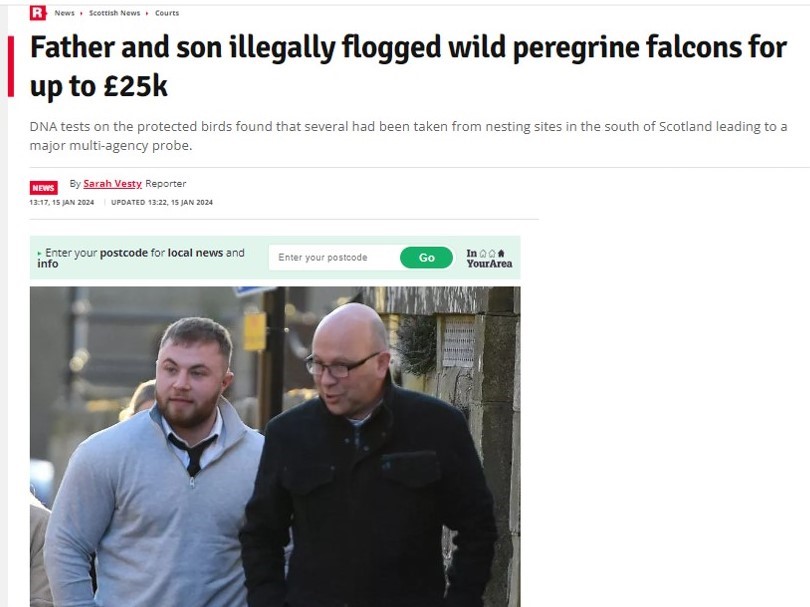
Further to this morning’s blog about sentencing being deferred for part-time gamekeeper Timothy Hall and his son, Lewis Hall, who have pleaded guilty to numerous offences relating to wild peregrines in Scotland being laundered as ‘captive bred’ peregrines to buyers in the Middle East (see here), the Daily Record has published more details about this case.
Headline from Daily Record, 15 January 2024
The article explains that the alarm was first raised by George Smith, a member of the Scottish Raptor Study Group who has monitored peregrine nest sites in the Scottish Borders for decades. He was concerned that breeding attempts were failing at sites that had previously been known to be routinely successful.
Officers from Police Scotland visited the sites with George and noticed marks that suggested someone had recently climbed to the nests.
Intelligence reports led to Timothy Hall’s home at Lamberton Holdings in Berwickshire where a large number of peregrines and eggs were found. Timothy Hall and his son Lewis claimed the young birds were captive bred but DNA evidence showed that at least seven recently-hatched chicks were not related to the captive peregrines owned by the Halls. Two chicks were later matched to an adult bird at a wild nest site and one was linked to another wild site.
Mobile phones and a drone used by the Halls was shown to have been used on 20 separate occasions to fly to known nest sites.
An analysis of bank accounts showed large sums of money being transferred from peregrine sales by Lewis Hall to a joint bank account owned by his parents. Some legitimate buyers had been duped by false paperwork procured by Lewis Hall in an attempt to pass off the young peregrines as legitimately captive bred.
Sheriff Peter Paterson reportedly told the court this morning: “These are very serious matters. I want to know what’s happened to the money. They claim they have limited assets and income.
“According to the background report for Lewis Hall, and I quote, ‘it’s clear these criminal actions have been carried out over a lengthy period of time and with great scale’. I will be informing HMRC and I’ll ask them to investigate any further charges.”
To read the full article in the Daily Record click here.





 Raptor Persecution UK