29 ‘missing’ Hen Harriers & nearly 40 birds of prey poisoned, trapped or shot in Yorkshire Dales National Park since 2015

Media attention has been drawn to the Yorkshire Dales National Park this week, following the RSPB’s press release on the suspicious disappearance of a satellite-tagged Hen Harrier named ‘Sita’.

When it comes to the illegal killing of birds of prey, the Yorkshire Dales National Park is rarely out of the news, and that’s hardly surprising when 29 satellite-tagged Hen Harriers have gone ‘missing’ there and 39 other raptors have been found poisoned, trapped or shot there since 2015, including Peregrines, Hen Harriers, Red Kites and Buzzards.

Yorkshire Dales National Park. Photo by Ruth Tingay

Given these appalling figures, the RSPB has described the Yorkshire Dales National Park as a ‘no-fly zone for birds of prey’.

High profile cases within the National Park have included the conviction of a gamekeeper who was filmed shooting two Short-eared Owls on a grouse moor and then stamping the corpse of one of them into the peat and shoving the other one inside a drystone wall (here); a gamekeeper filmed on a grouse moor using a tethered Eagle Owl to attract Buzzards that he then shot and killed from close range (here); the stamping to death of four Hen Harrier chicks in a nest on a grouse moor (after obscuring the camera pointing at the nest, here); the grisly death of a Hen Harrier caused by his head and leg being pulled off whilst he was still alive (here); and three individuals caught on camera on a grouse moor discussing the shooting and killing of a Buzzard and a Raven before apparently shooting and killing a Hen Harrier (here) – one gamekeeper has been charged with conspiracy to kill a Hen Harrier, he has pleaded not guilty and his case will proceed to trial in January 2026 after his barrister failed in his attempt to have the case thrown out on a legal technicality.

The Yorkshire Dales National Park Authority has also long recognised the extent of this criminal activity and has responded to public concern (e.g. see here and here). Earlier this year the Park Authority terminated its five-year ‘partnership’ with the grouse shooting industry to tackle these crimes, after recognising the futility of this endeavour. Two conservation organisations (the RSPB and the Northern England Raptor Forum) had already walked away from the sham in 2023 and 2024 respectively.

In an article published a couple of days ago by the Craven Herald & Pioneer, Mark Corner, a member of the Yorkshire Dales National Park Authority is quoted saying the continued illegal killing of raptors in the Park was “a crying shame“.

He added: “As the member champion for the natural environment, I’m personally embarrassed that we are the worst spot in the country in terms of the illegal killing of birds.”

In the same article, there’s an hilarious quote from the Yorkshire Dales Moorland Group, which is one of a number of regional groups set up in 2015 to represent local grouse moor owners and their gamekeepers in an attempt to counter the bad publicity about ongoing illegal raptor persecution. I think that members of most of these regional moorland groups have been, or still are, the subject of police investigations into illegal raptor persecution.

A spokesperson for the Yorkshire Dales Moorland Group reportedly told the reporter that ‘hen harrier numbers were at a 200-year high across the uplands’.

That’s simply not true – Hen Harrier breeding attempts on grouse moors across the north of England have been in sharp decline over the last two years – the only areas where they remain stable is on land managed for conservation rather than for Red Grouse shooting.

According to its FaceBook page, the Yorkshire Dales Moorland Group claims to have “around 100,000 acres of managed uplands here in the Dales where the estates are members of this group (virtually all of the moors)“.

Why is it then, there were only two Hen Harrier breeding attempts in 2025 across the whole of the Yorkshire Dales and neighbouring Nidderdale? I’d like the Moorland Group to provide a plausible explanation for these absences.

The Yorkshire Dales Moorland Group also told the Craven Herald reporter:

Our keepers have and will always assist the police in searches for missing persons, lost dogs or missing birds. Tag failure is rare but not unheard of.

The default accusation that persecution is responsible is regrettable. The conservation work undertaken by moor keepers is commendable as can be seen by the abundance of raptors and other rare species in the Dales“.

What “abundance of raptors” are those then? All the dead ones? Or just the ones that are allowed to breed because they don’t pose any threat to Red Grouse stocks?

And if these grouse shooting estates are so keen to help the police, how many of them signed the letter last year agreeing to allow the police to enter the land and use equipment for the purposes of crime prevention and detection? Did any of them sign it?

And if these gamekeepers are so keen to help police investigations, how many of them have given ‘no comment’ responses when interviewed about suspected raptor persecution crimes on these moors? Maybe it’d be quicker to count how many gamekeeper didn’t give a ‘no comment’ interview.

The article also quotes Alex Farrell, Head of Uplands at BASC:

As a committed conservation organisation, we are taking progressive steps with our partners to oversee the continued recovery of hen harriers.

Figures released by Natural England today show that collaborative effort resulted in 106 fledged hen harrier chicks in England this year – up from 80 last year“.

What “progressive steps” is BASC taking?

Oh, and those figures released by Natural England show that the small increase in Hen Harrier fledging rates are in spite of, not because of, any so-called ‘collaborative effort’ from the grouse shooting industry.

The data couldn’t be any clearer (see here).

Peregrine from Charing Cross Hospital found with shotgun pellet in leg

One of London’s resident breeding Peregrines, Tom, from Charing Cross Hospital in Hammersmith, is receiving veterinary care after an x-ray revealed a shotgun pellet lodged in his leg.

According to reports on social media, Tom was found grounded at the weekend and was taken for assessment at the South Essex Wildlife Hospital. It’s not clear from the information published whether the shotgun pellet was the cause of his grounding or whether it is an old injury that he’d survived.

All photos from South Essex Wildlife Hospital

Hopefully Tom will make a speedy recovery and can be returned to his territory ASAP.

The South Essex Wildlife Hospital has featured a few times on this blog, involved in the treatment and often successful rehabilitation of shot raptors from the south-east. It’s a registered charity – if you’d like to make a donation to support its work, please click here.

Three Peregrines fledge successfully at St Albans Cathedral as police investigation continues into trampling of first clutch of eggs

Good news!

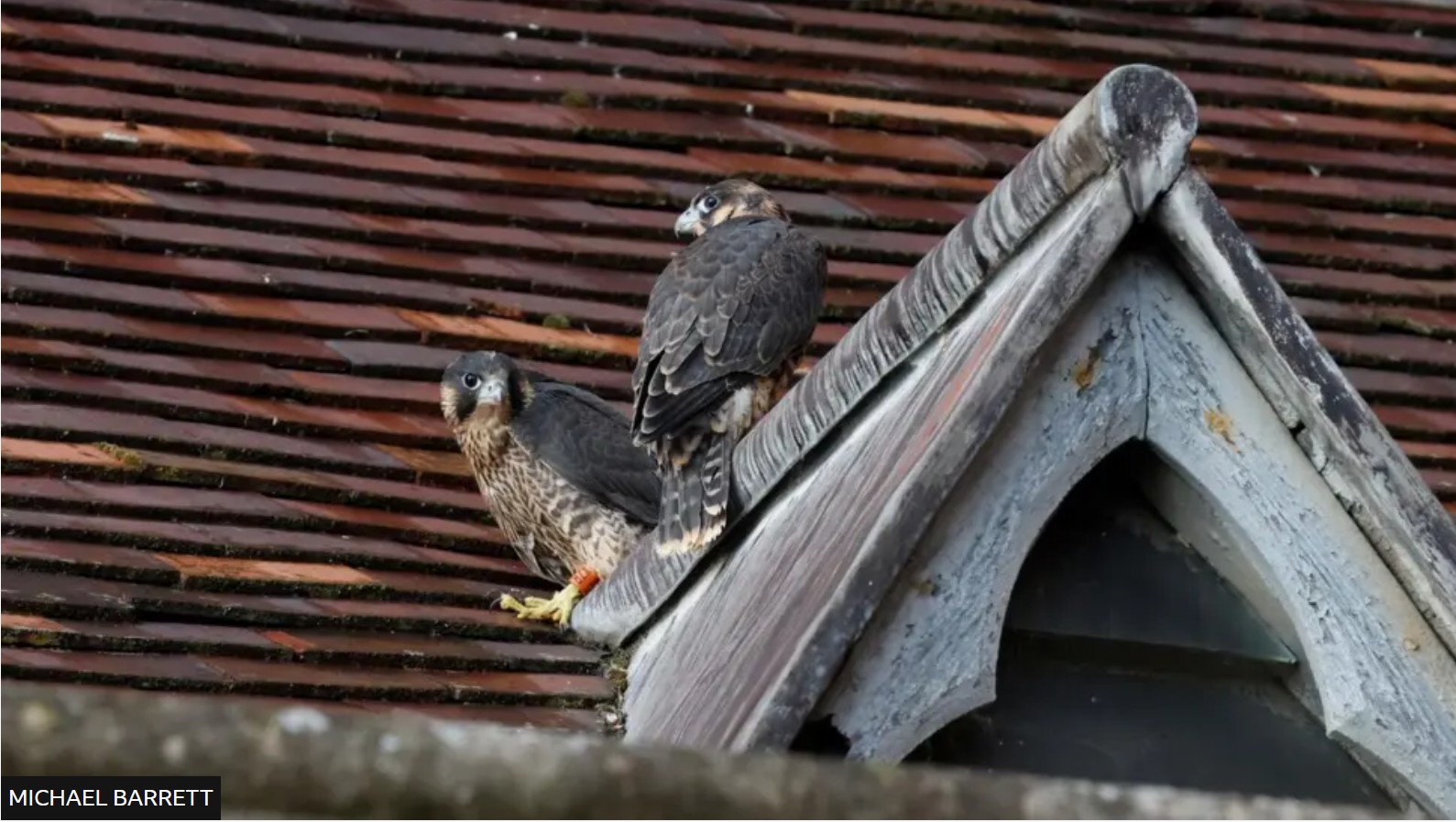
Three young peregrines have successfully fledged from St Albans Cathedral in Hertfordshire.

This is the site where the breeding pair’s first clutch of eggs was trampled on in April 2025, as seen on the Cathedral’s livestream webcam overlooking the peregrine’s nest scrape, leading to a man ‘helping police with enquiries’ (see here, here and here for previous blogs).

Two of the three Peregrine fledglings at the cathedral. Photo by Michael Barrett via BBC website

The police investigation is apparently still ongoing, three months after the trampling incident.

According to the St Albans Cathedral website:

‘Hertfordshire Constabulary have today confirmed (Friday 11 July) that “Our investigation is ongoing, and we are working with the Crown Prosecution Service following further lines of enquiry.”

UPDATE 19 April 2026: No prosecution after man crushed Peregrine eggs at St Albans Cathedral (here).

Peregrines lay second clutch of eggs at St Albans Cathedral as police continue investigation into destruction of first clutch

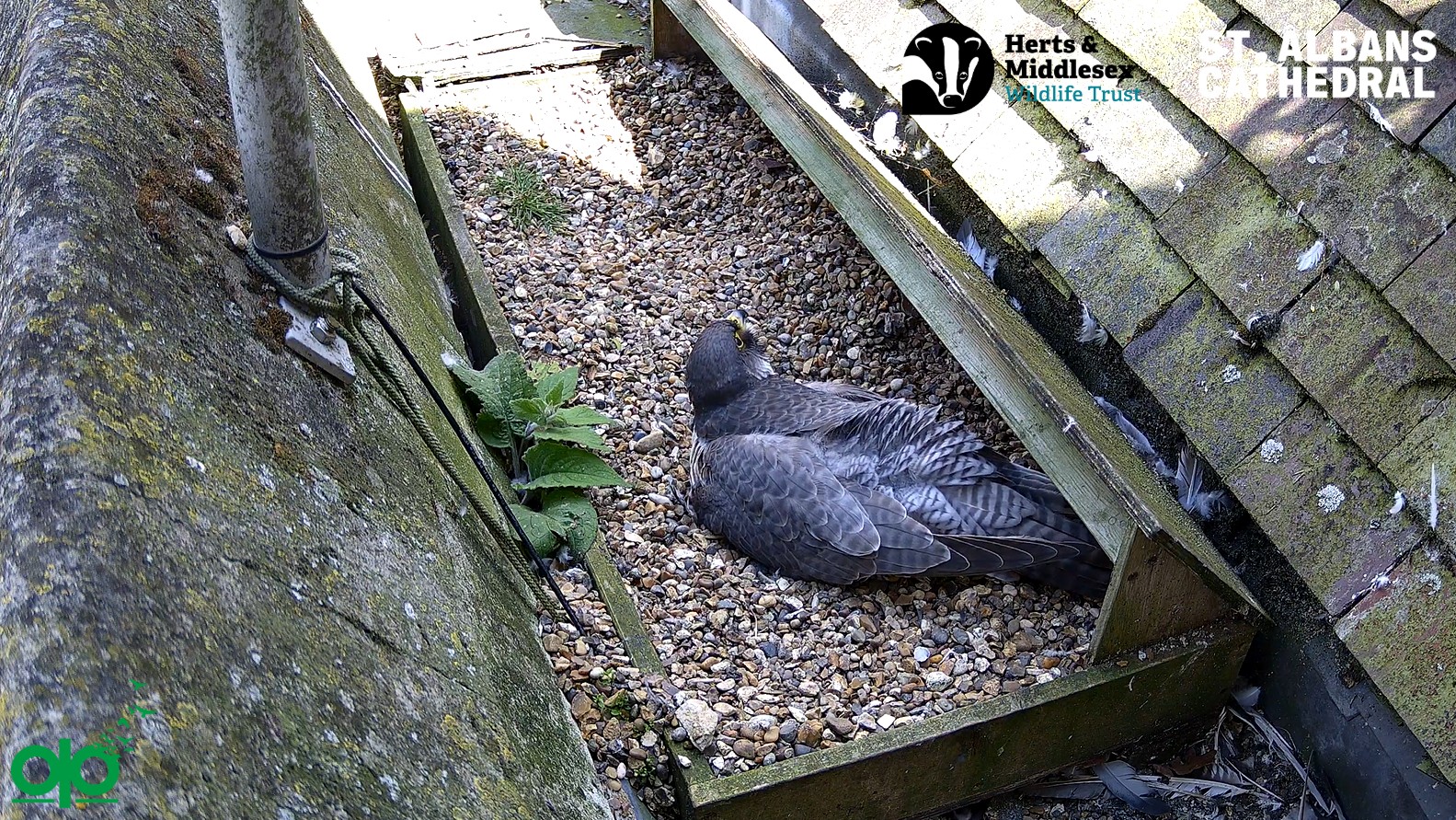
Following on from Monday’s news that Hertfordshire Police and the National Wildlife Crime Unit are continuing to investigate what looked to be the deliberate trampling of Peregrine eggs at St Albans Cathedral on 7th April 2025 (see here), the good news is that the Peregrines have re-laid and are now incubating their second clutch of eggs.

Screengrab from the livestream nest camera this morning showing the female Peregrine incubating three eggs

St Albans Cathedral published a statement earlier this week to say the peregrines had re-laid two eggs (egg 1 on 4th May, egg 2 on 7th May) and this morning there are now three eggs.

The statement also confirms that security has been reviewed and updated at the Cathedral with new protective measures in place to prevent a repeat of the incident on 7th April.

The livestream camera has also been reactivated.

The statement and the link to the nest camera can be found here.

Police Air Support Unit joins in fight against illegal targeting of Peregrines in Northern Ireland

Press release from the Police Service of Northern Ireland (PSNI), 2nd May 2025:

POLICE AIR SUPPORT UNIT JOINS IN FIGHT AGAINST ILLEGAL TARGETING OF PEREGRINE FALCONS

‘Operation Raptor – Peregrine Watch’, an initiative by Police Service of Northern Ireland along with our partners in the Partnership for Action against Wildlife Crime (PAW) Bird of Prey Sub Group, seeks to bring an end to the illegal persecution of birds of prey, will now have ‘eyes in the sky’ as the Police Service of Northern Ireland’s Air Support Unit lends its expertise and cutting edge technology to the cause. 

A special licence granted by the Northern Ireland Environment Agency (NIEA), and specific permissions obtained with the assistance of the Northern Ireland Raptor Study Group (NIRSG), has enabled police to deploy hi-tech drones to carry out checks of various sites around Northern Ireland where Peregrine Falcons are known to nest, breed and live. 

Peregrine falcons in Northern Ireland are a protected species under the Wildlife (Northern Ireland) Order 1985 as amended by the Wildlife and Natural Environment (NI) Act 2011, which safeguards all birds of prey from persecution and disturbance. The penalties for crimes under the Order include, but are not limited to, a fine of up to £5,000 per offence and up to six months imprisonment.

The police drones will be used to view and assess falcon nesting and breeding areas that may otherwise be inaccessible and will allow the various agencies involved in PAW to keep a close check on nests, particularly in ‘at risk’ areas, in the hope of reducing instances of illegal poisoning, shooting, trapping and taking of peregrine falcons and their eggs.

Operation Raptor was promoted at the recent NI Raptor Study Group conference.
L-R: Dr Marc Ruddock (NI Raptor Study Group), Margaret Mee (White-tailed Eagle Project), Dr Ruth Tingay (Raptor Persecution UK), Chief Inspector Tim Flanigan (PSNI), Emma Meredith (PSNI Wildlife & Animal Welfare Officer)

Speaking about Op Raptor – Peregrine Watch, Police Service lead for Rural and Wildlife Crime Superintendent Johnston McDowell said:

This initiative between the PAW Bird of Prey Sub Group and our Air Support Unit, working alongside local officers, is a direct result of birds being targeted with very serious and dangerous substances in a number of areas across Northern Ireland.

Many of the poisons identified in previous cases are deadly not only to our precious wildlife but also to humans, and so the potential impact could go beyond the persecution and destruction of our beautiful native birds of prey.” 

The initiative also encourages people to report any suspicions around birds being targeted. Police work closely with our colleagues in the Health and Safety Executive who are responsible for Biocides, and the Department of Agriculture and Rural Development who are responsible for Rodenticides, to identify poisons being used and take steps to identify and prosecute offenders.

Superintendent McDowell concluded: “The Police Service of Northern Ireland is committed to working with partner agencies to tackle wildlife crime through prevention and education, as well as enforcement, and will continue to work hard to combat wildlife crime.”

Wildlife crime can be reported to police via 101, or online at www.psni.police.uk/makeareport/ or confidentially through crimes stoppers on 0800 555 111 or online at http://www.crimestoppers-uk.org.

ENDS

‘Investigation still ongoing’ into person seen trampling peregrine eggs at St Albans Cathedral

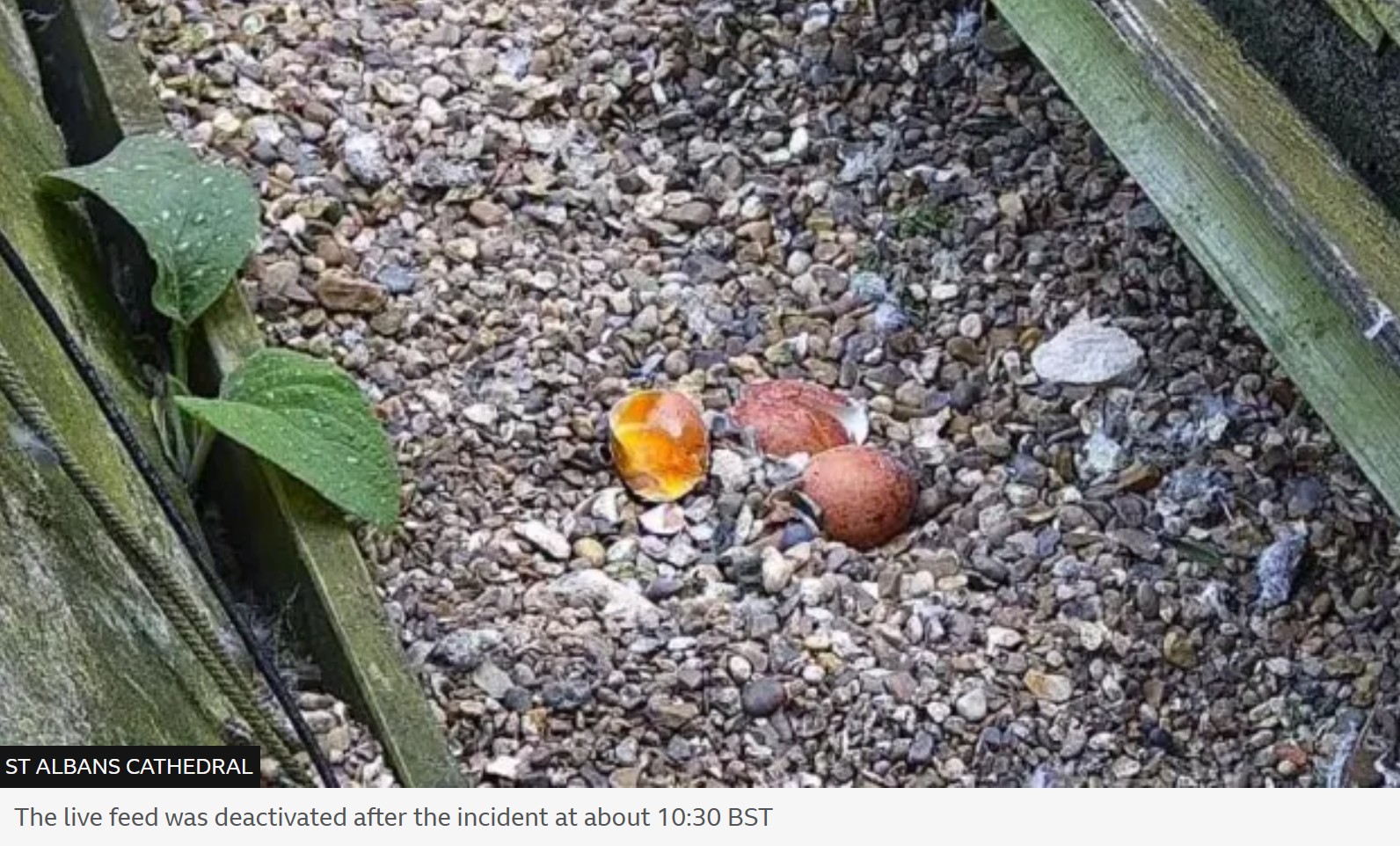
Almost a month ago (7 April 2025) a person was seen to be deliberately walking over three peregrine eggs in a nest tray on the roof of St Albans Cathedral in Hertfordshire, crushing the eggs. The incident was caught on the Cathedral’s livestream nest camera and the following day Hertfordshire Police said a man was ‘helping with enquiries’ (see here).

In an article posted online last week (28 April) by the St Albans Times,

Herts police are working with partners at St Albans Cathedral and the National Wildlife Crime Unit to look into the incident, and officers from the Rural Operational Support Team spoke to a man to assist with their enquiries, but nobody has been charged at this time.

A spokesperson for Herts Constabulary would only confirm today that the investigation is still ongoing‘.

UPDATE 9th May 2025: Peregrines lay second clutch of eggs at St Albans Cathedral as police continue investigation into destruction of first clutch (here)

UPDATE 19 April 2026: No prosecution after man crushed Peregrine eggs at St Albans Cathedral (here).

Peregrine eggs smashed at St Albans Cathedral as person seen walking over them on livestream camera

An individual is ‘helping police with their inquiries‘ after a person was seen on livestream camera deliberately walking over three Peregrine falcon eggs laid by the resident breeding pair at St Albans Cathedral in Hertfordshire yesterday.

The livestream feed, run in partnership by St Albans Cathedral and Herts and Middlesex Wildlife Trust, has been taken off air.

A livestream viewer said:

The female bird was sitting on the eggs and all of a sudden there was a noise that spooked her, it sounded like a door opening.

Then I saw a man’s leg enter in front of the camera. He stood there for 30 or 40 seconds before literally walking across – he didn’t stamp but he stepped on the eggs and just kept walking“.

More details on BBC News website here.

UPDATE 5 May 2025: ‘Investigation still ongoing’ into person seen trampling Peregrine eggs at St Albans Cathedral (here).

UPDATE 19 April 2026: No prosecution after man crushed Peregrine eggs at St Albans Cathedral (here).

DEFRA endorses Natural England’s recommendations for a presumption AGAINST the issuing of licences for taking wild birds of prey for falconry

Some good news for birds of prey! DEFRA has endorsed Natural England’s recommendations for a presumption AGAINST the issuing of licences for taking birds of prey from the wild for falconry and aviculture.

A licensing policy review was undertaken by Natural England following the furore in 2020 when NE issued licenses for the removal of young peregrines from the wild for a purported captive-breeding programme.

That news had generated heated arguments both for and against the licences, as reported on Mark Avery’s blog (e.g. see herehere and here). In 2022 NE said that although licences had been issued in 2020, ‘the licenses expired earlier this year with no chicks having been taken‘. It’s not clear why the licences weren’t used.

Young peregrines on a nest ledge. Photo by Ruth Tingay (taken under licence)

In 2022, licences to take birds of prey from the wild were temporarily suspended whilst NE began a fairly comprehensive licensing policy review which included a public consultation with wide stakeholder engagement from the falconry and non-falconry communities. Natural England has published links to various reports resulting from the consultation process, here.

The species most frequently mentioned by those wanting to take birds from the wild for falconry purposes were peregrine (58%), sparrowhawk (58%), merlin (22%) and goshawk (10%). One individual falconer respondent mentioned buzzard and golden eagle. However, many falconer and non-falconer respondents considered the latter two species to be unsuitable for inclusion in a future wild take licensing regime. In the case of golden eagles, it was stated that this was due to their rarity in England. Many falconers also considered merlin to be unsuitable for inclusion due to their rarity.

The consultation process included detailed evidence from the National Wildlife Crime Unit (NWCU) about the increase in the legal and illegal trade in peregrines, both for the domestic and international market, and how licensed ‘wild take’ may add to the problem.

Many of you will be familiar with Operation Tantallon, the recent successful multi-agency investigation leading to the subsequent prosecution and conviction of two peregrine launderers in south Scotland who were selling wild Scottish peregrines to wealthy falconers in the Middle East (see here).

The scale of their offending was considerable and I heard at a wildlife crime conference earlier this week that many more cases are currently under investigation as a result of Operation Tantallon.

In October 2023 Natural England’s ‘wild-take’ licensing review came to an end and drew the following conclusions:

  • Wild take is not integral to the present-day practice of falconry or aviculture in England. Few modern falconry texts define falconry as involving the use of ‘wild’ birds of prey and there are limited historical references to the cultural importance of wild take or of  wild-taken birds to British falconers. No clear consensus exists within the falconry community or in the available falconry literature regarding the cultural importance of wild take as a core aspect of falconry practice.
  • Despite rapid growth in the popularity of falconry in recent decades, the available evidence suggests that there are sufficient birds of the relevant species readily available – via captive populations – to meet current demand. There is no evidence of significant inbreeding risks in these captive populations and captive-bred birds are generally considered to perform to a similar standard as wild birds when used for falconry purposes.
  • Most non-falconers are opposed to licenced wild take on ethical grounds and have concerns regarding the potential impacts of falconry and wild take on the conservation and welfare of the species affected. Both falconers and non-falconers are supportive of additional measures to ensure that individuals keeping birds of prey have suitable experience in caring for such birds.
  • Few respondents to the public call for evidence expressed a desire to gain commercially from wild take. However, risks identified relating to the illegal trade in birds of prey nevertheless suggest a need for strict controls on commercial use of such birds alongside improved traceability and other measures to be taken forwards by the responsible agencies. Difficulties in tracing individual birds under current arrangements mean there is a credible risk that the offspring of a wild bird taken under licence could be illegally laundered via commercial breeding operations into the domestic and international trade.

On the basis of the above conclusions, Natural England put forward the following recommendations to DEFRA in late 2023 and advised that a clear policy statement should be published for England setting out the following:

  • That licences permitting the wild take of native birds of prey for falconry or avicultural purposes should not be issued other than in exceptional circumstances;
  • That the commercial use of native birds of prey taken from the wild under a licence issued for falconry or avicultural purposes – and any offspring of such birds –should not be permitted other than in exceptional circumstances; and,
  • That the power to grant licences remains on statute, with the adopted policy (as above) subject to future evidence-based review as required.

These are the recommendations that DEFRA has now endorsed and has implemented the policy of a presumption AGAINST issuing licences to take wild birds of prey for falconry and aviculture.

Natural England has stated that, ‘Whilst the power to grant licences will remain on statute, Defra ministers support the view that licences should not be issued, other than in exceptional circumstances. No evidence was provided during the review process that would support the issuing of licences for any specific exceptional circumstances at the present time‘.

There’s a useful Natural England blog on the subject, here.

For those interested in Natural England’s policy review, it can be read/downloaded here:

From my personal point of view, this is an excellent decision and is good news for birds of prey in England.

I’ve previously outlined my reasons, here.

50,000 people support the Northern Ireland Raptor Study Group’s petition to ban possession of dangerous, raptor-killing pesticides

Many, many thanks to all of you who signed the Northern Ireland Raptor Study Group’s (NIRSG) petition calling for a ban on the possession of dangerous, raptor-killing pesticides.

The petition has just passed its target of 50,000 signatures and the NIRSG has issued the following press release:

The NIRSG held a recent Raptor Conference which provided incredible insights into a range of topics locally and globally. Many of the talks raised a consistent theme of targeted persecution of birds of prey. Not least amongst these was the on-going issue in Northern Ireland of the Possession of Dangerous pesticides.

Some of the NIRSG 2025 conference attendees supporting the call for a ban on dangerous, raptor-killing pesticides. Photo by Marc Ruddock

The NIRSG highlighted that 63 raptors have been killed between 2009 and 2023 with a range of poisons, dominated by Carbofuran which has been banned for nearly 25 years. There have been at least 30 buzzards, 16 peregrine falcons, 13 red kites, 3 white tailed eagles and 1 golden eagle all poisoned in this time frame.

This evidence is collated by the Partnership for Action Against Wildlife Crime in Northern Ireland (PAW NI) and published in raptor persecution reports, which include ‘hotspots’ of illegal killing of our native birds of prey. These reports are publicly available on the PAWNI webpage available here and also aggregated in the RSPB Bird Crime reports available here.

In 2011, the wildlife legislation in Northern Ireland was strengthened, resulting in increased sentences of £5,000 fines (per offence) and up to 6 months imprisonment. The updated laws included a provision to ban the possession of prescribed ingredients under “Section 15B Possession of pesticides harmful to wildlife” of the Wildlife (Northern Ireland) Order 1985 as amended.

As part of that legislation there should have been an attached Order listing the banned chemicals. That list has never been created. Wildlife has continued to be poisoned by these dangerous and banned substances.

The legislation states in Section 15B Part 2: “A prescribed ingredient is one which is prescribed for the purposes of this Article by an order made by the Department; but the Department may not make an order under this Article unless it is satisfied that it is necessary or expedient to do so in the interests of protecting wild birds or wild animals from harm”. [Emphasis added by NIRSG]

There is significant evidence of continued harm from banned pesticides to birds of prey, based on robust post-mortem and laboratory results, which has been published in many reports. We believe it is indeed expedient for Minister Andrew to implement this Order to protect our birds of prey from harm. 50,000 people agree with us. Thank you to everyone who has supported the petition and helped give a voice to our wildlife.

The NIRSG will be seeking a meeting with Minister Andrew Muir to present the petition now that it has surpassed 50,000 signatures.   

ENDS

NatureScot fails to make any compliance checks on use of new grouse moor licences

As many of you will be aware, the 2024 grouse shooting season in Scotland (12 Aug – 10 Dec 2024) saw the use of grouse moor licences for the first time ever, introduced by the Wildlife Management & Muirburn (Scotland) Act 2024 passed by the Scottish Parliament in March 2024.

For new readers, this Act was introduced as the Scottish Government’s response to the continued widespread illegal killing of birds of prey on grouse moors. It works on the basis that all red grouse shooting must now be licensed in Scotland under a section 16AA licence and if, on the civil burden of proof (i.e. on the balance of probability) sufficient evidence is found that the licence has been breached (including evidence of illegal raptor persecution), the licence can be withdrawn as a sanction, preventing the shooting of red grouse on a particular estate for a period of up to five years.

The licences have already been weakened significantly by NatureScot after a legal threat from the game-shooting industry (see here) and I’ll be writing more about that, probably later this week.

Red grouse photo by Pete Walkden

As part of the new grouse moor licensing scheme, NatureScot published a Code of Practice for Grouse Moor Management (also known as the Grouse Code) which sets out the legal requirements associated with managing land for killing and/or taking red grouse.

The Wildlife Management & Muirburn (Scotland) Act 2024 requires that a licence holder comply with the Grouse Code. Non-adherence to the Grouse Code could result in a licensing sanction and/or suspension or revocation. Here is the Grouse Code:

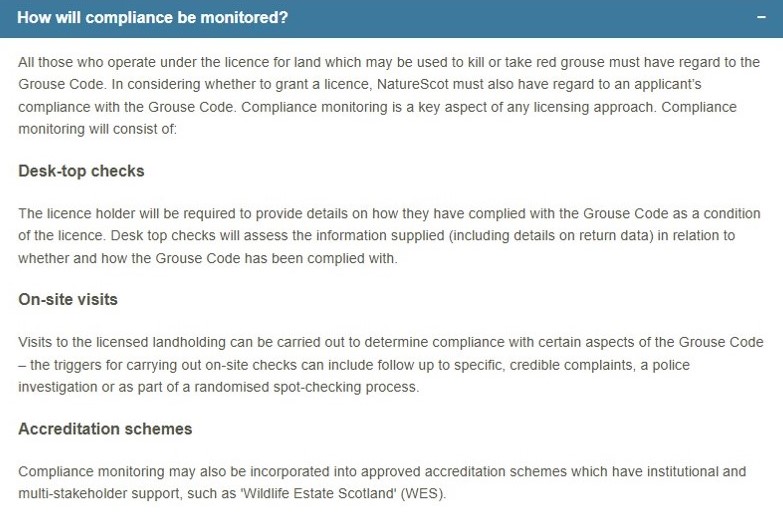
You’ll note on pages 2-3 of the Grouse Code that it includes a section on compliance monitoring.

Stating the obvious, NatureScot says, ‘Compliance monitoring is a key aspect of any licensing approach‘ and then outlines the types of compliance monitoring checks it says it will conduct:

Sounds reassuringly comprehensive, doesn’t it?

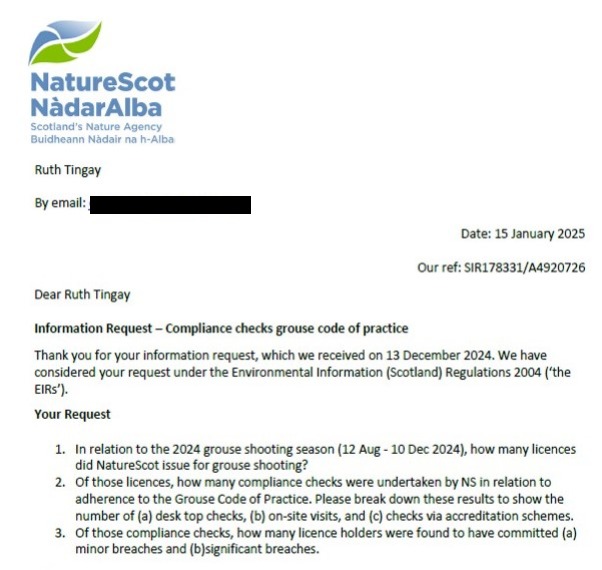
However, in recent months I’ve learned that NatureScot can’t be trusted (more on that soon!) so rather than rely on what NatureScot says it will do with regard to Grouse Code compliance checks, I decided to find it what it actually did by submitting an FoI request as follows:

  1. In relation to the 2024 grouse shooting season (12 Aug – 10 Dec 2024), how many licences did NatureScot issue for grouse shooting?
  2. Of those licences, how many compliance checks were undertaken by NatureScot in relation to adherence to the Grouse Code of Practice? Please break down these results to show the number of (a) desk top checks, (b) on-site visits, and (c) checks via accreditation schemes.
  3. Of those compliance checks, how many licence holders were found to have committed (a) minor breaches and (b) significant breaches?

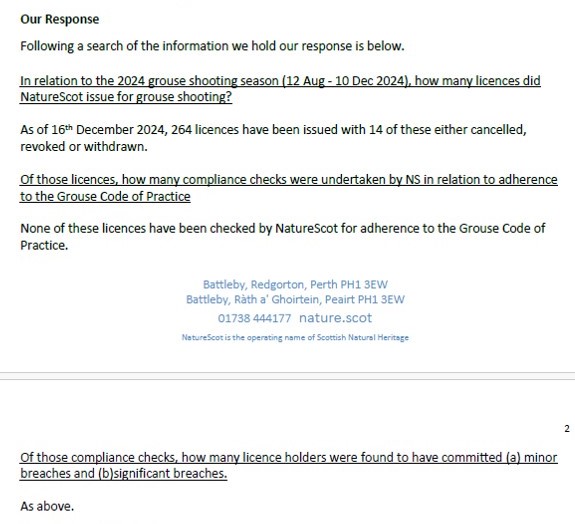
Here is NatureScot’s response:

So, NatureScot issued 264 grouse shooting licences for the 2024 season and says that 14 ‘were either cancelled, revoked or withdrawn‘. I’m guessing that none of them were ‘cancelled’ or ‘revoked’, but rather all 14 were ‘withdrawn’ by the licence applicant, probably as a result of the threatened legal challenge against NatureScot by the grouse-shooting industry that resulted in a narrowing of the licensable area, so perhaps some licence holders withdrew their original licence applications and submitted revised applications showing the more limited boundary.

Whatever the reason, I’m quite confident that no licences have been ‘cancelled’ or ‘revoked’ by NatureScot because if they had, NatureScot would have publicised it on its website in the same way it does for General Licence restrictions. I suspect in this case, NatureScot has deliberately included the words ‘cancelled’ and ‘revoked’ in its FoI response in an attempt to infer enforcement action when actually it hasn’t done any enforcement whatsoever.

That leaves 250 grouse shooting licences that NatureScot issued for the 2024 grouse shooting season. Of those, NatureScot didn’t undertake one single compliance check.

That’s astonishing, given that the Scottish Parliament introduced grouse shoot licensing on the basis that many grouse moor owners and managers couldn’t be trusted to abide by the law, despite years of warnings that if they didn’t stop illegally killing birds of prey they’d face imposed regulations. Given this long history of criminality, you’d think that compliance monitoring would be fundamental.

Regulation, in this case licensing, is only as strong as the associated compliance monitoring efforts and subsequent enforcement action. We’ve already seen the illegal shooting of an osprey (here) and a peregrine (here) since the licensing scheme began, and no sign of any subsequent enforcement action, which suggests that the licensing scheme simply isn’t an effective mechanism for stopping The Untouchables. NatureScot’s failure to undertake a single licence compliance check is playing right into their hands.