
There were some interesting sights at the 2013 Scottish Game Fair in early July, including this poster on the Scottish Gamekeepers’ Association stand, entitled “Record Numbers of Raptor!!”[sic].
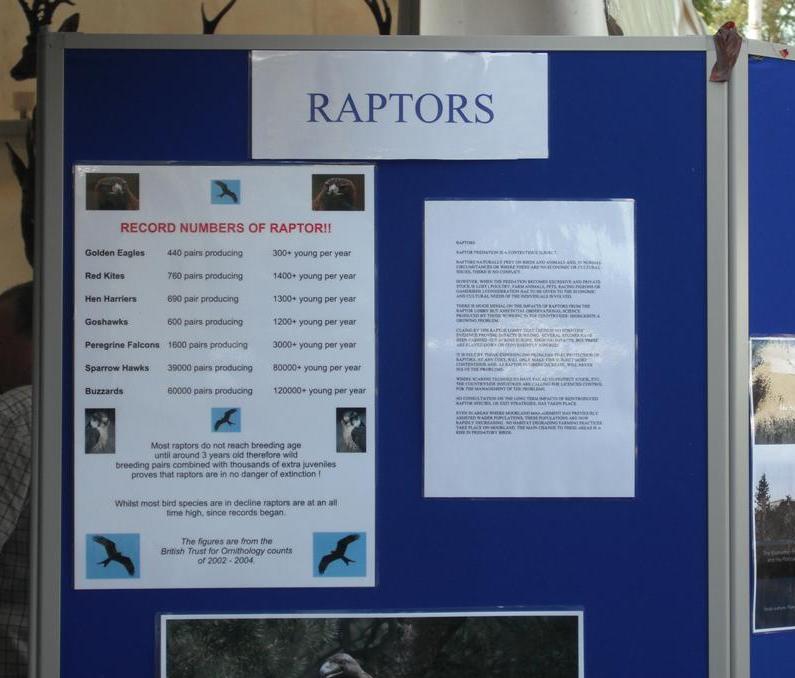
Any casual visitors to the SGA stand could be forgiven for thinking that raptors are doing just fine and there’s no cause for concern; that’s the message the SGA clearly wanted to portray. But let’s just look a bit more closely at their ‘information’, shall we?
You might think, given that this was the Scottish Gamekeepers’ Association at the Scottish Game Fair, their raptor figures would just relate to raptors in Scotland. You’d be wrong. Rather disingenuously, they used data relating to raptor figures in the UK as a whole, not just Scottish data, thereby potentially misleading the public to believe that Scotland holds a significantly higher number of breeding raptors than it actually does.
For example, the SGA claims there are 760 pairs of red kites producing 1400+ young per year. Actually, the number of breeding pairs monitored in Scotland in 2012 was 214, with 314 fledged. This is thought to be ‘close to an accurate population estimate’ according to the Scottish Raptor Study Group.
Another example: the SGA claims there are 600 pairs of goshawks producing 1200+ young per year. Actually, the number of breeding pairs in Scotland is more like 150, with an estimated 200 occupied territories in total.
And another example: the SGA claims there are 1600 pairs of peregrines producing 3000+ young per year. Actually, the last national survey of peregrines in Scotland showed 542 breeding pairs, an 8% decline from the previous national survey.
And here’s yet another example: the SGA claims there are 690 pairs of hen harriers producing 1300+ young per year. Actually, the last national survey of hen harriers in Scotland showed 505 pairs, a 20% decline from the previous national survey.
In fact, the data they’ve provided for every species on this list, with the exception of the golden eagle, are a gross exaggeration of the respective Scottish populations of these birds. Did they choose these figures to deliberately mislead the public? Surely not.
In addition to using potentially misleading population figures, the SGA also chose to use data from 2002-2004. That’s a bit odd given that far more up to date data for many species (i.e. from as recently as 2011) are freely available in the public domain (see here). Now, what possible reason could they have for ignoring the more recent facts and figures? Surely nothing to do with the fact that these more recent data directly contradict the following SGA statement:
“That whilst most bird species are in decline raptors are at an all time high, since records began”.
Conveniently, this statement fails to mention the 20% decline in the Scottish hen harrier population, and the 8% decline in the Scottish peregrine population, not to mention the severely constrained Scottish populations of red kites, golden eagles and goshawks, all linked to the effects of illegal persecution taking place on gamekeepered land across Scotland. Funny that, isn’t it?
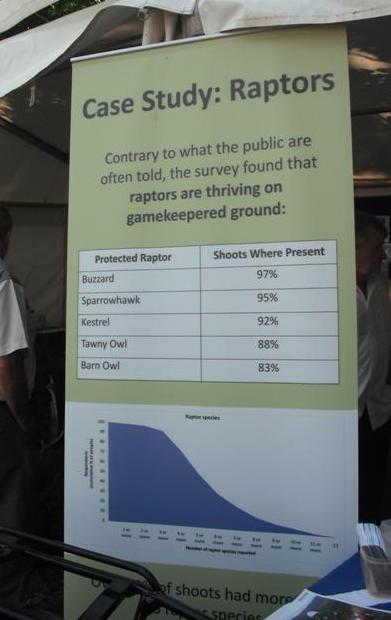
Even funnier is this photo (below), also pictured at the SGA stand. According to this, ‘Raptors are thriving on gamekeepered ground’. Conveniently (again), the list of raptor species they chose to illustrate this lie statement does not include hen harriers, peregrines, red kites, golden eagles or goshawks. Their statement is right up there with another SGA classic: “Professional gamekeepers do not poison raptors” (see here).
 Scottish Land and Estates and the Scottish Gamekeepers’ Association have written a letter of complaint to the BBC, claiming ‘misrepresentation’ on The One Show programme.
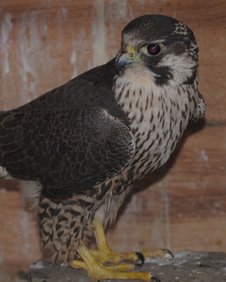 A peregrine falcon was found with a broken wing in January – apparently it had been shot. It has now been nursed back to health and released back into the wild at the location where it was found.
 The following letter has appeared in The Scotsman in the continuing ‘debate’ on grouse moor management (see
  Happy Hogmanay!
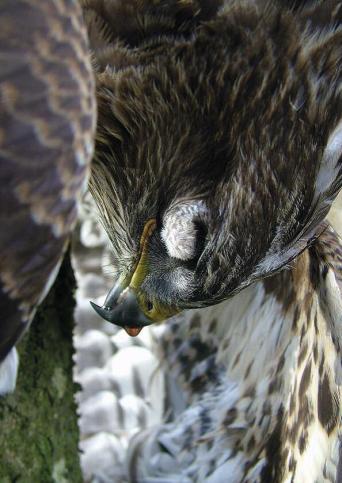 RSPB Scotland has just published its latest report, The Illegal Killing of Birds of Prey in Scotland in 2011. You probably won’t be surprised or shocked by the content, especially if you’ve read the previous 17 annual reviews. In fact, when you read this 18th review, you might get a strong sense of déjà vu.
 Once again the occupations and interests of those convicted for illegal raptor persecution crime have been analysed (data from 2003-2011 inclusive). 87% of them were gamekeepers (7% pigeon racers, 3% pest controllers, 3% farmers).
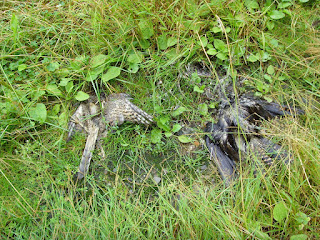 Here’s another example of fine, proactive wildlife policing from Devon WCO Josh Marshall.
 Raptor Persecution UK