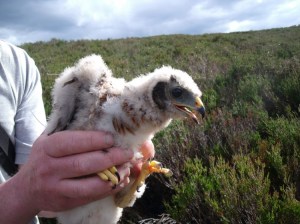
Glen Tanar Estate supports hen harriers & golden eagles

Some very welcome good news for a change –

Michael and Claire Bruce, the forward-thinking owners of Glen Tanar Estate, near Aboyne on Royal Deeside, have this year demonstrated that there is no need to persecute hen harriers or golden eagles to accomodate driven grouse shooting.

Glen Tanar Estate forms a substantial part of the Cairngorms National Park, and the Estate includes several EU Natura 2000 sites as well as a National Nature Reserve. Golden eagles and hen harriers have bred successfully on the Estate for many years. However, shooting parties have been absent since the late 1990s when the local grouse population dropped below a sustainable level – partly due to predation by hen harriers but also partly due to land management practices.

In 2010, in addition to normal moor management, Michael started a hen harrier diversionary feeding experiment to try and discourage the harriers from taking too many grouse. Feeding started when there were three eggs in the harriers’ nest and continued until the chicks fledged. The supplementary food included chopped up white rats and poultry. Three chicks fledged successfully, and a satellite transmitter was attached to one male and one female chick so that the dispersal movements of these young birds can be monitored. In addition to the successful harrier breeding attempt, driven grouse shooting began on August 12th 2010 for the first time in over a decade.

Michael said: “Estates where shooting forms an important part of the economy have to find innovative ways of reducing conflict between raptors and red grouse. Supplementary feeding may be one way of doing this“.

He added that at Glen Tanar Estate, concerns over boosting the hen harrier population were mitigated by the presence of golden eagles. “Some estates fear that feeding hen harriers will simply increase the harrier population and increase predation on grouse, and there is a risk this may be true. However, feeding hen harriers has never been tried before in the presence of golden eagles, which themselves predate harriers. The hope in Glen Tanar is that eagles, harriers and grouse will all find a level that allows commercial shooting of driven grouse to take place“.

Golden eagles on the Glen Tanar Estate this year produced two of the heaviest chicks ever recorded. The resident adult eagles had been fed over the winter with thin, un-saleable deer carcasses. The food was given partly to attract the eagles to a regular winter-feeding site where it is hoped to provide a photographic hide in the future. However, Michael believes that winter feeding of golden eagles should also reduce predation on grouse.

Michael Bruce and his team on the Glen Tanar Estate deserve our full admiration for their efforts, and it is hoped other estate owners will follow his lead.

If you wish to show your support of Glen Tanar Estate, encourage your friends, family, colleagues, everyone, to visit them for holiday cottages, walking, wildlife safaris, fishing etc. More information can be found on the Glen Tanar website: http://www.glentanar.co.uk/

Record Year for Raptor Poisoning

Published on Friday an annual RSPB Scotland report confirmed that 2009 marked the highest number of raptor poisoning incidents for 2 decades. “The Illegal Killing of Birds of Prey in Scotland in 2009”  indicates that human persecution continues to have a serious impact on the populations of some of the country’s most vulnerable species.

Last year, 21 buzzards, 4 red kites, 2 golden eagles and 1 white-tailed eagle, the latter gifted to Scotland from Norway as part of a reintroduction programme, were among the victims in 46 poisoning cases confirmed by Scottish Government testing.

Illegal killing, through shooting, nest destruction or the use of spring traps, were also confirmed in nine incidents. As many raptors are long-lived and have slow reproduction rates the killing of these species, particularly adult breeding birds, has dire consequences for their populations as a whole. This illegal persecution is affecting the conservation status of raptors such as hen harriers, golden eagles and red kites.

The vast majority of poisoning incidents were associated with shooting estates and in particular grouse moors. Predictably, various pro-shooting bodies have attempted to discredit the RSPB Scotland figures and  fudge the issue.  Notably, the landowners’ organisation, the Scottish Rural Property and Business Association (SRPBA) said the figures were misleading.

A spokesman said: “The official government report on the illegal poisoning of birds of prey for 2009, published in March 2010, shows the level has stayed the same for the last three years with the exception of 2008 when there were 16 incidents. There is ample legislation in existence to deal with this problem and we support the full weight of the law being brought to bear on those using illegal poisons.”

As these crimes are mainly committed in extremely remote areas and discovered by hill walkers and similar outdoor enthusiasts stumbling upon dead birds, it must be remembered that these “confirmed” cases must represent only a fraction of the true number of raptors illegally killed each year.

The increase in these incidents proves beyond reasonable doubt that the perpetrators of these crimes have little  fear of the Scottish judiciary system. Perhaps if the penalties for killing our birds of prey were more of a deterrent we would see this disgraceful trend reverse.

Press and Journal report. http://www.pressandjournal.co.uk/Article.aspx/1838869

BBC News Report. http://www.bbc.co.uk/news/uk-scotland-10730222

RSPB Report. http://www.rspb.org.uk/Images/illegalkillingscotland_tcm9-256571.pdf

Duncan Orr-Ewing, RSPB Scotland discusses the report on Radio 4’s Today http://news.bbc.co.uk/today/hi/today/newsid_8847000/8847745.stm

Environment Minister appreciates the efforts of the Scottish Gamekeepers Association

Scottish Environment Minister, Roseanna Cunningham, really showed those pesky gamekeepers that she means business when it comes to stamping out wildlife crime. In her speech at the Scottish Gamekeepers Association’s (SGA) annual general meeting on 5 March 2010, hard-hitting Roseanna gave them what for. Well actually, she didn’t.

Here is an excerpt from her speech:

Unfortunately, the illegal killing of birds of prey in Scotland remains at an unacceptably high level, as shown by the recent high profile cases such as the poisoning of the golden eagle, Alma, which was being radio-tracked by SNH. Raptor persecution is one of the UK Wildlife Crime Priorities and we are committed to tackling this.

In Scotland even one incident of deliberate, illegal poisoning would be one too many. It is shameful that some of our most iconic species continue to face illegal persecution.

We all know that the illegal killing of birds of prey is having a serious impact on the populations of iconic species such as golden eagles and hen harriers. Birds of prey are our national assets, with huge public, cultural and tourism appeal. 

However, I realise that those responsible for these illegal activities are in the minority.

I am most grateful for the efforts of the SGA who are trying to conserve birds of prey and the support that the SGA gives to the Partnership for Action Against Wildlife Crime Scotland (PAWS), in helping to defeat this type of crime.

The partnership approach taken in tackling this issue is apparent in the mix of people you see here today. We all have the same goal of defeating wildlife crime. Working together to share knowledge, resources and skills to deal with these issues is the only way to tackle this problem”.

Roseanna, it might be time to change your political advisors because they are clearly not giving you the full picture. What ‘efforts’, exactly, has the SGA made to try and conserve birds of prey? Perhaps you are referring to their long-running campaign (since 2000) to get licences to cull raptors? SGA chairman Alex Hogg even goes as far as saying if they had licences to kill raptors legally then the wildlife crime would stop ‘overnight’. http://www.independent.co.uk/environment/nature/birds-of-prey-persecution-a-special-ios-online-report-396066.html Is that an admission that if licences to kill raptors are not forthcoming then gamekeepers will continue the criminal activity of killing protected species? Wonderful! What a great effort they are making to conserve birds of prey!

Film footage of Gamekeepers on Leadhills Estate ruled inadmissable

Female Hen harrier at nest

On 30 April 2003, an undercover RSPB investigation team were filming at a hen harrier nest on the Leadhills Estate, South Lanarkshire (also known as Hopetoun Estate and Abington Farms Ltd). This estate has a shocking record of alleged persecution against hen harriers and peregrines.

According to an article published by a former RSPB investigator (see link below), a gamekeeper was filmed walking up the valley towards the hen harrier nest, and ‘finding’ the nest by throwing a training bag for his labrador dog. The keeper was also allegedly filmed picking up the dog by its throat and kicking it to the ground. He was later charged with a cruelty offence after SSPCA officers and a vet had viewed the evidence.

Later the same night, the RSPB team reportedly filmed a group of men approaching the hen harrier nest in the dark using torches.  They are reported to have shot the incubating female and removed the eggs from her nest. One of the RSPB team followed the men back to the road and took their vehicle registration number. The vehicle was allegedly found to be used by the estate’s head gamekeeper. A shotgun cartridge found next to the nest was allegedly matched to the gun belonging to the head gamekeeper’s son. The son was later charged in relation to killing the harrier and destroying the nest.

After prolonged legal activity, the charges against both keepers were all dropped. It is thought this was in connection to the use of undercover footage by the RSPB. (See our post about a similar incident at Haystoun Estate in 2003).  http://www.the-soc.org.uk/docs/SBN80.pdf


Dinnet Estate Gamekeeper convicted for offence

On the night of June 25 2003, a gamekeeper on the Dinnet Estate in Aberdeenshire was filmed by RSPB investigators as he left his Landrover carrying a shotgun, climbed over a fence on to the neighbouring Crannach Estate, and began to stalk a recently-fledged hen harrier for several hundred metres across the hillside. At one point he was seen to point his shotgun at the harrier but he did not shoot.

At Stonehaven Sheriff Court on 17 February 2006, the keeper was convicted of firearms offences and of trespassing with a firearm on the neighbouring Crannoch Estate. He was fined £500.


hen harrier & buzzards illegally killed in 1992

According to the Hansard Report April 2004 (Hansard is the edited verbatim report of proceedings in UK parliament), the following illegal raptor persecution incidents were recorded in 1992:

Dalswinton Estate (Dumfries, Dumfriesshire) – 1 x buzzard killed by Chloralose.

Invercauld Estate (nr Braemar, Aberdeenshire) – 1 x buzzard killed by Chloralose.

Dochfour Estate (Inverness-shire) – 1 x buzzard killed by Chloralose.

Cawdor Estate (Nairn, Inverness-shire) – 1 x buzzard killed by Strychnine.

Balival Estate (nr Kingussie, Inverness-shire) – 1 x hen harrier killed by Strychnine.

Careston Estate (Brechin, Perthshire) – 1 x buzzard killed by Chloralose.

Over Cardney Estate (Dunkeld, Perthshire) – 1 x buzzard killed by Chloralose.

Glenbeich &Ardveich Farms (Lochearnhead, Perthshire – 1 x buzzard killed by Chloralose.

Straloch Farm (Blairgowrie, Perthshire) – 1 x buzzard killed by Chloralose.

This report was published in the days when the government publicised the names of the Estates where illegal raptor persecution incidents had been recorded. Shame they don’t do that anymore – you have to wonder why? The Hansard report documenting these and other persecution incidents, can be read here: http://hansard.millbanksystems.com/written_answers/1994/apr/28/bird-killing

Hen harriers, golden eagles & buzzards illegally killed in 1990

According to the Hansard Report April 2004 (Hansard is the edited verbatim report of proceedings in UK parliament), the following illegal raptor persecution incidents were recorded in 1990:

Cromlix Estate (nr Dunblane, Perthshire) – 1 x buzzard + 1 x hen harrier killed by Chloralose.

Rosehaugh Estate (Black Isle, Ross-shire) – 1 x buzzard killed by Chloralose.

Ledmore Estate (Lairg, Sutherland) – 1 x golden eagle + 1 x buzzard killed by Chloralose.

Hopetoun Estate (Abington, South Lanarkshire) – 1 x buzzard killed by Chloralose.

Glenfernate Estate (Blairgowrie, Perthshire) – 1 x buzzard killed by Chloralose.

Grimerston Estate (Isle of Lewis) – 1 x golden eagle killed by Chloralose.

This report was published in the days when the government publicised the names of the Estates where illegal raptor persecution incidents had been recorded. Shame they don’t do that anymore – you have to wonder why? The Hansard report documenting these and other persecution incidents, can be read here: http://hansard.millbanksystems.com/written_answers/1994/apr/28/bird-killing

Scottish police accused of failing to tackle wildlife crime

POLICE forces in Scotland have been accused of failing to tackle wildlife crime after it was revealed that just 24 cases of illegal killing of birds of prey have been taken to court in five years.

Out of 157 cases involving killing the birds – including golden eagles, red kites and hen harriers – just 15 per cent have resulted in court action.

And the average penalty for a crime linked to persecution of birds of prey was just £240, despite the maximum available penalty being £10,000 or a year in jail.

Read more at: http://scotlandonsunday.scotsman.com/news/System-39failing39-on-wildlife-crime.6130378.jp

gamekeeper guilty of shooting hen harrier on Craigmill Estate, Morayshire

In May 2001, a part-time gamekeeper on Craigmill Estate, Morayshire was convicted of shooting a young female hen harrier. He pleaded not guilty to killing a 2nd harrier on the same day, not guilty to having both dead birds in his possession, and not guilty to carrying a shotgun for the purpose of killing a wild bird. The court accepted his not-guilty plea. He was fined £2,000 for killing the harrier.

In July 2000, the hen harrier nest had been under close observation by RSPB workers because eggs had been destroyed in previous years. They recorded video footage of the keeper as he approached the nest and shot the bird. In his defence, the keeper stated he had been attempting to restore the area for grouse shooting and he had shot the bird in “acute frustration”. There is a long history of hen harrier persecution on grouse moors in the UK, making it the most persecuted raptor in Britain.

Further info: http://news.bbc.co.uk/1/hi/uk/1352092.stm