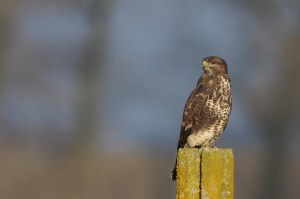
Paltry Fine for Cabrach Estate Gamekeeper who Shot Trapped Buzzards

According to a report in the Press and Journal, on 27 April 2006 a gamekeeper on the Cabrach Estate in NE Scotland shot two buzzards he had caught in a crow trap and was seen burying them down a nearby rabbit hole. The keeper, David Scott, was subsequently charged and due to the seriousness of the offence, the matter was fast-tracked by the Fiscal. He appeared at Egin Sheriff court in May 2006, pleaded guilty and was fined a paltry £200 when potentially the fine could have been ten times this level.

Apparently an additional 11 buzzards that had been shot were found buried in rabbit holes near the crow trap, according to the RSPB’s 2006 Annual Persecution Report.

From the Press & Journal, 9 May 2006 (written by Raymond Shewan):

A Gamekeeper shot two buzzards which had become caught in a trap designed to control crow numbers, Elgin Sheriff Court heard yesterday.

It was claimed that David Scott, 40, killed the protected birds of prey rather than risk injury trying to release them.

His solicitor, William Park, said Scott now realised he had not chosen the right course of action in shooting them.

Fiscal depute Geoff Main told the court that witnesses walking on the Cabrach estate, near Dufftown, had seen a trap containing two crows and two buzzards and had watched as Scott drove up in a Land Rover before shooting the buzzards and disposing of them in rabbit holes.

Mr Park said Scott was an under-keeper on the estate which had a serious problem with carrion crows and hooded crows killing the chicks of ground-nesting birds, including grouse.

The estate had given its keepers permission to trap crows and it had seven traps which were designed to lure them with a live decoy.

On April 25 Scott, of the Kennels, Cabrach Lodge, had checked one of the traps and found two buzzards which had found their way in, attracted by rabbit bait put down for crows.

Mr Park said Scott, who admitted two charges of breaking wildlife and countryside legislation by intentionally killing the buzzards, was in a situation where he had to make a choice of what to do.

He said one option would have been to open the trap and release the birds, but that would also have meant releasing the crows.

Alternatively, he could have gone into the trap – which measured 6ft by 6ft by 5ft – to manually remove the buzzards, although Mr Park claimed that would have put him at some risk of “significant harm”.

“In the circumstances, he elected to shoot the birds,” said Mr Park. “He realises the decision he took was a serious error of judgment on his part and one he must accept responsibility for. He realises that such offences can provoke strong feelings, but there was no cruel intent or malice on his part.”

Sheriff Robert Brodie said he found it difficult to understand Scott’s decision to shoot two protected birds.
He noted that Scott was a first offender and fined him £200.

END

Eight years earlier, police raids in February and March 1998 reportedly revealed widespread poisoning across the estate – 10 rabbits, 6 pigeons, 6 grouse and 2 hares were laced with the lethal poison Carbofuran and laid out on the hill. Three illegal pole traps and an owl whose legs had been smashed by a trap were also reportedly found, along with a dead peregrine in the back of the estate’s landrover. Tests revealed the peregrine had been poisoned with Carbofuran. The head gamekeeper was convicted at Elgin Sheriff Court in October 1998 and was fined £700.

The estate is reportedly owned by multi-millionaire Christopher Moran, a businessman with an interesting past. See here for details.
Gamekeeper guilty of multiple bird deaths on Barns Estate, Peebleshire

A gamekeeper on the Barns Estate near Kirkton Manor, Peebleshire, was found guilty of killing 20 raptors by poisoning them. The keeper was charged with killing 25 birds originally, but several of the corpses were too badly decomposed to ascertain their cause of death. The gruesome discovery on the Barns Estate, where the accused had worked as a gamekeeper for 17 years, was made in March 2004 and included buzzards, a goshawk and a tawny owl. Investigators found 12 rabbit and pheasant carcasses that had been slit open and laced with blue poison granules.

The keeper’s defence lawyer: “He is clearly someone who has respect for the countryside. I think it would have been wrong to portray [him] as someone who has no respect for birds of prey”.

Fortunately, Sheriff James Farrell (Selkirk Sheriff Court) disagreed and the keeper was convicted and fined £5,500.

A spokesman for Wemyss & March Estates Ltd (who manages the Barns Estate) said he was completely unaware of his gamekeeper’s illegal activities.

Further info: http://news.bbc.co.uk/1/hi/scotland/3597952.stm

3 buzzards found poisoned on Invercauld Estate, Royal Deeside

Three buzzards found dead in woodland next to a grouse moor on Invercauld Estate, Deeside in March 2005 had been poisoned: http://news.bbc.co.uk/1/hi/scotland/4400327.stm

Invercauld Estate, located between Braemar and Crathie and next door to the Balmoral Estate, attracts a large number of paying guests who visit for grouse shooting, deer stalking and salmon fishing. According to their website, “The Estate is managed commercially but with great respect for the natural environment”. The Estate is run under the guidance of Captain Farquharson and other members of his family. Simon Blackett, the Estate Factor, is married to Geva Blackett, the former parliamentary officer for the Scottish Gamekeepers Association.

In the late 1990s,  a gamekeeper on the Estate was convicted of using an illegal spring trap and was fined £120. http://www.antisnaring.org.uk/news/traps/invercauld_estate_gamekeeper_fined?searched=invercauld&advsearch=oneword&highlight=ajaxSearch_highlight+ajaxSearch_highlight1

Poisoner at Leadhills Estate could not be identified

A gamekeeper on the Leadhills Estate in South Lanarkshire, was found not guilty of alleged raptor persecution crimes on the Leadhills grouse moor.

Leadhills Estate was raided in September 2006 after a tip-off about the continued use of illegal poisons to kill raptors. Rabbit baits and two dead buzzards were recovered from the estate, as well as knives and a gamebag that contained residues of the illegal poison, Carbofuran.

The case came to court in November 2008. Sheriff Stewart concluded, “No doubt illegal posioning was occuring on this estate in 2006 and that birds were poisoned”. However, from the evidence presented, she was unable to determine whether this particular gamekeeper was responsible, as his defence team claimed that the knives and gamebag were used communually, rather than exclusively by him. This defence is often used to successfully avoid individual prosecution.

Sea eagle feared killed on Glenogil Estate, Angus

This is the missing sea eagle, known as 'Bird N'

A young white-tailed sea eagle, less than six months old, is feared to have been killed on Glenogil Estate, Angus in the autumn of 2007, according to an article published in The Scotsman. Tayside police apparently received an anonymous tip-off that suggested the eagle had allegedly been shot on the estate. The information correlates with radio tracking data from the bird, who was regularly tracked in the area but whose signal disappeared around the time of the alleged incident, although the signal could have failed as a result of a mechanical malfunction.The young eagle has never been seen again. No arrests have been made.

The sea eagle was one of 15 young birds that were donated by Norway for the East Scotland re-introduction project. The young birds were released in Fife in August 2007, fitted with radio transmitters and wing tags for identification.

Glenogil Estate is owned by multi-millionaire John Dodd, who is reported to take grouse moor management advice from Mark Osborne. Glenogil has been at the centre of previous investigations of alleged wildlife crime offences, and John Dodd was fined £107,000 in 2008 for the suspected use of illegal poisons on raptors.  Dodd is appealing the decision.

For further information about the missing sea eagle: http://news.bbc.co.uk/1/hi/scotland/tayside_and_central/7124862.stm

http://news.scotsman.com/birdsofprey/Claim-and-denial-as-a.3589649.jp

Gamekeeper admits shooting buzzard on Redmyre Estate, Perthshire

Gamekeepers often refer to buzzards and other raptors as 'vermin' - an attitude carried on from unenlightened Victorian times.

Graham Kerr, a gamekeeper on the Redmyre Estate in Abernyte, Perthshire, has pleaded guilty to shooting a buzzard with a rifle on 9 September 2009, because he believed the buzzards were ‘causing concern’ to the pheasants he was rearing for a commercial shoot.

In court in February 2010, Kerr, 53, of Mary Findlay Drive, Dundee,  also admitted the possession of illegal poisons Carbofuran and Alpha-Chloralose which he intended to use to kill other buzzards. He will be sentenced at a later date.

Further info: http://news.scotsman.com/dundee/Gamekeeper–stockpiled-outlawed-poisons.6078206.jp

1 year old sea eagle found poisoned on Glenogil Estate, Angus

A one year old white-tailed sea eagle was found poisoned on Glenogil Estate in August 2009. The young bird, known as ‘Bird 89’, had been donated by Norway in 2008 as part of the East Coast Re-introduction Project. Glenogil Estate is owned by multi-millionaire businessman John Dodd, according to The Scotsman. Grouse management at Glenogil is undertaken in association with Mark Osborne, according to The Guardian: http://www.guardian.co.uk/environment/2008/sep/22/wildlife.conservation

Bird 89 was found in a ‘decomposed’ state in August 2009. It is thought the eagle died much earlier than this, as its radio tracking signal stopped working in March 2009. According to some sources, the RSPB tracking team could not locate the dead bird for many months until they hired an expert tracker in August. http://thescotsman.scotsman.com/scotland/Sea-eagle-found-poisoned-.5995940.jp

The RSPB has accused Tayside Police of being incompetent, as the poisoning incident was not made public until January 2010, almost five months after the bird was found, and probably 10 months after the bird was actually killed. Further info: http://thescotsman.scotsman.com/birdsofprey/RSPB-claims-police–less.6012566.jp

No arrests have been made.

According to The Scotsman, previous incidents of suspected wildlife crime on or close to Glenogil Estate include:

May 2006: Suspected rabbit poisoned bait found – tests by Science and Advice for Scottish Agriculture lab confirmed it had been laced with outlawed pesticide carbofuran.

June 2006: Bait found laced with carbofuran, also found on equipment and vehicles. Estate owner John Dodd subsequently had £107,000 withdrawn from his single farm payment subsidy by the Scottish Government. He is appealing against this. Further information available here:  http://www.guardian.co.uk/environment/2008/sep/22/wildlife.conservation

November 2007: Tayside Police informed a white-tailed eagle had been shot by a Glenogil estate employee. No carcase was found, but the bird, fitted with a radio transmitter, is still missing.

May 2008: A white-tailed sea eagle known as ‘White G’ was found dead by a neighbouring landowner. It had been poisoned with carbofuran and other pesticides.

Three days later, Tayside Police and RSPB staff found the carcass of a buzzard lying next to the Glenogil Estate boundary fence. It had been poisoned. Carcass of a hare was found to have been laced with same chemicals that killed eagle.

October 2008: A meat bait is found on a fence post within Glenogil Estate, laced with an illegal chemical mix.

March 2009: Two dead buzzards found on the estate. Both birds had been poisoned.

August 2009: White-tailed sea eagle ‘Bird 89’ found poisoned on Glenogil Estate.

Poisoned bait found on Raeshaw Estate, nr Peebles

Red kites, like buzzards, are easy targets for poisoners as their diet includes lots of carrion.

According to an article in The Guardian, poisoned bait was found on the Raeshaw Estate in the Moorfoot hills, near Peebles, in June 2009, during a police raid. The raid followed the discovery of a poisoned red kite on neighbouring land. Several injured dogs were found during the raid and were removed by the SSPCA, who suspected they had been used for badger baiting. Further information can be found here: http://www.guardian.co.uk/environment/2009/jun/15/police-raid-red-kite

In 2004, the bodies of nine raptors (5 barn owls, 2 buzzards, 1 kestrel & 1 tawny owl) were found dead on Raeshaw Estate (see here). Nobody was ever prosecuted.

Golden eagle (‘Alma’) found poisoned on Millden Estate, Angus

Here is 2-year old Alma, dead on a grouse moor after being poisoned. Her satellite tag is visible on her back. No arrests have been made for this wildlife crime.

A two-year old golden eagle named ‘Alma’ was found poisoned on the Millden Estate, nr Brechin, Angus, in July 2009. Alma was wearing a satellite tag fitted by Roy Dennis as part of a study to monitor golden eagle movements in Scotland.

According to The Guardian, the Millden Estate is managed by Nick Baikie, a grouse moor manager who is reported to have been previously employed by Mark Osborne, an Oxfordshire-based chartered surveyor. Grouse moors run by Osborne in Scotland and England have previously been raided by police investigating alleged wildlife crime offences. Milden is one of several sporting estates in Glen Esk. It is thought to be owned by multi-millionaire investment banker Richard Hanson, who bought it in 2004: http://www.accessmylibrary.com/coms2/summary_0286-21868070_ITM

Police searched the Millden Estate, including the grouse moor and the gamekeepers’ cottages. No arrests have been made.

Further details can be found in an article written in the Guardian newspaper: http://www.guardian.co.uk/environment/2009/jul/30/conservation-scotland

buzzard found poisoned on Gledfield Estate, nr Ardgay, Sutherland

A buzzard was found posioned on the Gledfield Estate nr Ardgay in Sutherland on 24 July 2009. This is the third buzzard to be found poisoned on this shooting estate in the last 12 months.

The full story can be found on the BBC news website: http://news.bbc.co.uk/1/hi/scotland/highlands_and_islands/8166855.stm