Scottish landowners pretend that raptors are ‘thriving’ on driven grouse moors

Gift of GrouseWe’ve come to expect outlandish propaganda from the Gift of Grouse campaign group, designed to portray driven grouse moors as models of excellence for raptor conservation. But this time they’ve exceeded all expectation. Forget their usual unsubstantiated post-truth drivel, wholly disconnected to reality, because that’s got nothing on their latest effort, which takes the stretching of credibility to new depths.
The following press release from the Gift of Grouse is set to hit the headlines tomorrow:

ENCOURAGING NUMBERS OF BIRDS OF PREY SIGHTED ON SCOTTISH MOORLANDS

An increasing number of birds of prey are thriving on Scottish grouse moors due to gamekeepers’ conservation efforts.

More than 10 different raptor species including golden eagles, red kites and hen harriers have been identified on prominent grouse moors this year. They are among the 86 bird species that have been recorded on estates in the Angus Glens.

A snap shot from a range of estates across the Angus Glens Moorland Group highlighted encouraging evidence with gamekeepers on Invermark Estate in particular sighting nine raptor species including buzzards and golden eagles. Some of these are nesting and successfully breeding on the estate.

A number of other estates also reported healthy numbers with Ballogie Estate, Royal Deeside, revealing a total of 15 buzzards regularly hunting on the moor. Figures from the Speyside Moorland Group were equally as strong with 12 species of birds of prey recorded on Strathspey Estate alone. Atholl Estate in Perthshire are also monitoring 12 different raptor species.

Garry MacLennan, head gamekeeper on Invermark Estate, said: “Scottish grouse moors are far from being raptor deserts, as some opponents of shooting claim. We have monitored a growing number of buzzards, kestrels, golden eagles and white-tailed eagles. Keepers and estate managers do recognise there are some areas of the country where there are fewer raptor species but there is plenty of hard evidence to show that raptors are successfully nesting on grouse moors.”

The findings from Invermark are part of annual surveys undertaken using SNH guidelines.  These surveys were conducted by Taylor Wildlife, an ecological consultancy specialising in upland environments.

Richard Cooke, manager of Invermark Estate, said: “The survey is an extremely helpful way for us to monitor the biodiversity of the estate and which species are benefitting the most from our habitat management practices. Throughout the year we carry out rotational muirburn and control predation under the general licence, including foxes, stoats and other mustelids in particular.  This is to the benefit of many ground nesting birds and is reflected in the rich birdlife recorded by the annual audit.

The Tayside Moorland Group has also carried out species monitoring at a number of estates throughout the region with Glenturret Estate in Perthshire recording no less than 12 different raptor species hunting and nesting on the moorland this year. The estate tally included several breeding pairs of hen harriers, a nesting pair of peregrine fledging four chicks, short eared owls and numerous red kites.

Conservation training, conscientious moorland management and favourable weather conditions can all impact positively upon species numbers found on Scottish moorland.

Figures revealed in Wildlife Estates Scotland’s latest annual report show that 11 accredited estates reported the presence of golden eagles, with seven of these reporting 19 pairs. Eleven estates also recorded sightings of hen harriers with four reporting 18 breeding pairs. Buzzards were also reported on 20 estates, with a total estimated population of over 920 birds.

It was also recently revealed in a national survey that golden eagle numbers have surpassed 500 pairs giving them a ‘favourable conservation status’ in the UK. Eagles have made a home on several moorland estates across Scotland with Millden Estate, a member of the Angus Glens Moorland Group, recording a particularly high number of sightings.

Jason Clamp, head gamekeeper on Millden Estate, commented: “We are fortunate enough at Millden to have regular sightings of golden eagles. Seeing several of these magnificent birds on a daily basis has to be one of the highlights of my job. We are also very careful to leave a sustainable population of mountain hares for birds of prey, such as golden eagles, to hunt.

At Millden our team of gamekeepers has taken a proactive role in ensuring that we have a suitable breeding habitat for various birds of prey such the merlin, of which we currently have four nesting pairs. This has been brought about through controlled heather burning ‘muirburn’, which creates micro habitats suited to ground-nesting birds like the merlin.

We are delighted that the golden eagle, a species of conservation concern, amongst many other species, has found a safe and suitable environment in which to flourish in such impressive numbers, where careful moorland management has been imperative.”

ENDS

Wow! Where to start with this? It’s such ludicrously far-fetched bollocks it could have come straight from the mouths of gamekeepers and grouse moor managers. Oh, hang on…

Perhaps the idiots behind the Gift of Grouse campaign didn’t see the results of the latest national golden eagle survey, published just a few short weeks ago. You know, the survey that showed breeding golden eagles are still largely absent from driven grouse moors in the Eastern Highlands, just as they were in the last national survey conducted in 2003. Only 30% of known territories were occupied in this area – that’s a pathetic 34 out of 91 territories.

Perhaps the idiots behind the Gift of Grouse campaign didn’t see the results of the recent study on northern red kites, showing that illegal persecution on driven grouse moors in this region is just as bad now as it was in 1989.

Perhaps the idiots behind the Gift of Grouse campaign didn’t read the recent scientific paper showing hen harriers have suffered a ‘catastrophic decline’ on the driven grouse moors of NE Scotland.

Perhaps the idiots behind the Gift of Grouse campaign didn’t read the scientific paper showing peregrines continue to suffer a ‘long-term decline’ on the driven grouse moors of NE Scotland.

It’s all very well saying that raptors have been ‘sighted’ on grouse moors – of course they’ve been seen there – they are drawn to those areas precisely because of the absence of territorial breeding adults (as well as an abundant food supply). Nobody disputes that you can see raptors over these moors – the crucial distinction, which the Gift of Grouse idiots have carefully avoided, is how many raptors are breeding there? Remember, no breeding hen harriers in the Angus Glens for ten years!

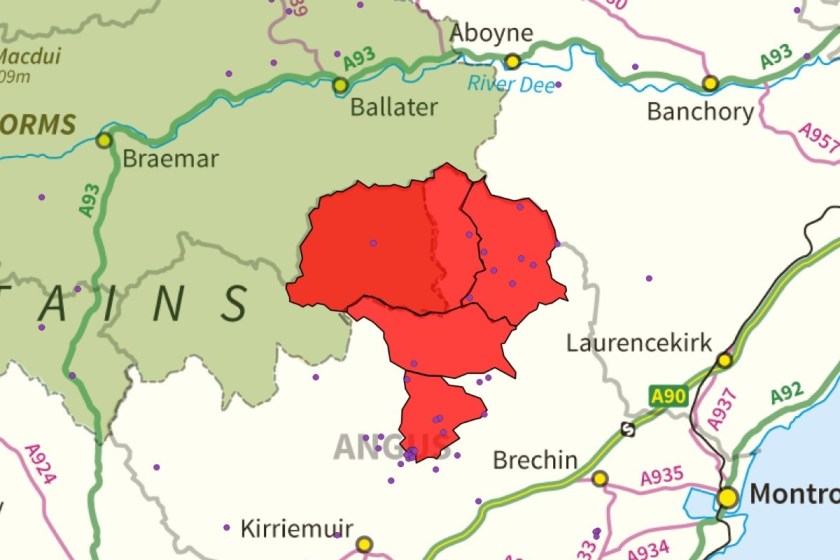
It’s interesting that this press release refers to the grouse moors of the Angus Glens – a well known hotbed of illegal raptor persecution for over a decade. Here’s a map to illustrate the point:

Four grouse moor estates are highlighted in red (Invermark, Millden, Hunthill, Glenogil [with thanks to Andy Wightman’s Who Owns Scotland website for estate boundaries]). You see those purple dots? They represent confirmed illegal raptor persecution crimes. Are we seriously being asked to believe that raptors are ‘thriving’ in this region?

It’s also interesting to note that the ‘data’ behind the Gift of Grouse propaganda come from an ‘annual audit’ carried out by Taylor Wildlife consultancy. We’ve blogged about this group before – these are the ‘experts’ who claimed to have recorded 81 species of birds ‘feeding or breeding’ on an Angus Glens grouse moor last year. The problem is, their survey methods didn’t adhere to the usual industry standard – rather than conduct their breeding bird survey between March and June, when you’re supposed to do it, they conducted their survey between June and August, which is, er, after the breeding season!

Will we get to see this year’s report to scrutinise the methods and results? Highly unlikely – we’re still waiting to see their 2015 report but apparently it’s a secret and we’re not allowed to read it. Can’t think why.

Also of note in this latest press release is the reference to Glenturret Estate in Perthshire, another well-known driven grouse moor. We’ve blogged about this estate before, when it was claimed that Hen Harrier Day protesters might ‘disturb’ hen harriers – a species that has consistently failed to breed successfully on this moor. This year, they are claiming to have ‘several breeding pairs of hen harriers’ amongst other species. That’s interesting, because according to monitoring data from the Scottish Raptor Study Group, there was only one hen harrier breeding attempt on Glenturret this year, and, as has so often happened here in recent years, the nest failed for ‘unknown reasons’. Unfortunately it’s not possible to work out why hen harriers keep failing here because the estate has apparently refused to allow nest cameras to be installed.

Glenturret used to have lots of successfully breeding raptors, but these days, not so much. They certainly don’t have breeding golden eagles anymore because the eagle’s eyrie was burnt out last year. Here’s a photograph of the cliff face, taken in April 2015 – note the blackened hillside. Spontaneously combusting eagle eyries are a common problem on some Scottish grouse moors. Either that or golden eagles need to learn to discard their fag butts with more care.

We’ll add updates to this blog tomorrow when we see which newspapers have swallowed the Gift of Grouse guff hook, line and sinker. We’ll be particularly interested to see whether SNH issues a statement to rebutt the claims being made – SNH has access to the actual raptor breeding data via the Scottish Raptor Monitoring Scheme – let’s see them put it good use.

UPDATE 5 December 2016: “Risible, make-believe tosh”: RSPB responds to Gift of Grouse propaganda (here).

Case against gamekeeper Stanley Gordon re: shot hen harrier, part 7

Criminal proceedings continued at Elgin Sheriff Court today against Scottish gamekeeper Stanley Gordon.

Mr Gordon, 60, of Cabrach, Moray, is facing a charge in connection with the alleged shooting of a hen harrier in June 2013.

Here’s a summary of what’s happened so far in this case:

Hearing #1 (19 May 2016): Case continued without plea until 16 June 2016.

Hearing #2 (16 June 2016): Case continued without plea until 14 July 2016.

Hearing #3 (14 July 2016): Case continued without plea until 11 August 2016.

Hearing #4 (11 August 2016): Case continued without plea until 1 September 2016.

Hearing #5 (1 September 2016): Mr Gordon enters a not guilty plea. A provisional trial date is set for 19 December 2016, with an intermediate diet set for 18 November 2016.

Hearing #6 (18 November 2016): Case adjourned for another intermediate diet on 2 December 2016.

Hearing #7 (2 December 2016). Provisional trial date of 19 December is dumped. Case adjourned for another intermediate diet on 10 February 2017.

Illegally-set traps on Invercauld Estate: not another cover up?

Cairngorms Invercauld - CopyIn July we blogged about the discovery in June of a critically-injured Common gull that had been found caught in two illegally-set spring traps on Invercauld Estate in the Cairngorms National Park (see here).
We also blogged about a bizarre press statement from Invercauld Estate (issued via the GWCT’s twitter feed) in which they denied any illegal activity had taken place or if it had, it was perhaps a set-up ‘intended to discredit the grouse industry‘ (see here).

We also blogged about the Scottish Gamekeepers’ Association’s response, which was an announcement that they would conduct their own enquiry before commenting further (see here).

We also blogged about Police Scotland’s view that a Common gull had been found caught in an illegally-set trap but ‘despite a thorough investigation‘, Police enquiries had failed to find further evidence to proceed with a potential prosecution and ‘there are at present no further investigative opportunities available‘ (see here).

In September, through a series of FoIs, we uncovered a very interesting letter, dated 27 July 2016 and written by Angus McNicol, who identified himself as the Estate Manager for Invercauld Estate. The letter was addressed to the Cabinet Secretary for the Environment, Roseanna Cunningham. A copy of the letter was also sent to the Cairngorms National Park Authority (CNPA). It was written, in our view, to reassure the Cabinet Secretary and the CNPA that Invercauld Estate takes wildlife crime very seriously and that they’d ‘taken action’ in this case. The specific action taken was unknown (to us) because that part of the letter had been redacted. We’ll come back to this.

Since then, it all went quiet, apart from a persistent rumour (we’ve been told this by five separate, well-informed sources) that a gamekeeper had been sacked as a result of this incident. This claim has also been made on the ParksWatchScotland blog (here), which says: ‘Unusually, the gamekeeper in this case has been dismissed, although he apparently has not been charged‘.

Hmm. Naturally, we wanted to find out if this rumour had any basis.

We knew that Grant Moir (CNPA Chief Executive) had asked for a meeting with Invercauld Estate and the sporting partner ‘to discuss the issue’ of the illegally-set traps – he had said so in a press statement in July (here). Perhaps the minutes from that meeting would reveal whether a gamekeeper had been sacked, so we asked, via FoI, for a copy of those minutes.

We received a response from the CNPA in mid-November which confirmed that two meetings had indeed taken place:

Meeting 1 (22 August 2016) with the following people present: Peter Argyle (CNPA Convener), Grant Moir (CNPA Chief Executive), Hamish Trench (CNPA Director of Conservation & Visitor Experience) and Invercauld Estate’s sporting partner from the Micras beat (his name was not given).

Meeting 2 (25 August 2016) with the following people present: Peter Argyle (CNPA Convener), Grant Moir (CNPA Chief Executive), Hamish Trench (CNPA Director of Conservation & Visitor Experience), the Chair of Trustees for Invercauld Estate (name not given) and the Manager for Invercauld Estate (name not given but presumably this was Angus McNicol, the author of the letter from Invercauld Estate to the Environment Cabinet Secretary).

According to the CNPA’s response to our FoI, ‘The purpose of both meetings was to discuss the recent incident and understand the actions taken by the estate and sporting partner. As a result of the meetings we will now be meeting with the other sporting partners on Invercauld Estate‘.

Interestingly, according to the CNPA, there isn’t a record of the minutes from either of these meetings.

So, we’re still none the wiser about whether a gamekeeper was sacked by Invercauld Estate, which brings us back to that redacted letter from Invercauld Estate to the Cabinet Secretary. Was the readacted part of that letter a statement from Invercauld Estate, saying that they’d sacked a gamekeeper as a result of this incident?

If so, that’s incredible. A wildlife crime took place on Invercauld Estate in June 2016 (that’s undeniable). Has Invercauld Estate identified a suspect and sacked him/her? And if so, does the Scottish Government know about it, does the Cairngorms National Park Authority know about it, and does the Scottish Gamekeepers’ Association know about it (given they were conducting their ‘own enquiry’ in to this incident back in July)?

The question then becomes, does Police Scotland know about it, and if so, will they be prosecuting? If not, why not?

Some transparency about this case wouldn’t go amiss.

Statement from Wildlife Estates Scotland on membership status of Newlands Estate

Those of you who’ve been following the long drawn-out saga of prosecutions relating to the wildlife crime that took place on Newlands Estate, Dumfriesshire in 2015 will know that we’ve been asking questions of various organisations associated with this estate.

One of those questions has been about the membership status of the Newlands Estate in the ‘Wildlife Estates Scotland (WES)’ scheme, administered by Scottish Land & Estates. Since Newlands Estate gamekeeper Billy Dick’s conviction (for killing a buzzard) was upheld in July this year, we’ve asked this:

‘Will the Newlands Estate’s accredited membership of Wildlife Estates Scotland (WES) now be revoked? The conditions of membership of this scheme include: “the requirements to maintain best practice standards of animal welfare and comply with all legal requirements and relevant Scottish codes of practice”. At the time of Mr Dick’s conviction, a spokesperson for WES said the Newlands Estate’s membership and accreditation of WES had been ‘voluntarily suspended’ pending the outcome of legal proceedings. Well, now the gamekeeper’s criminal conviction for wildlife offences has been upheld, how about answering the question?’

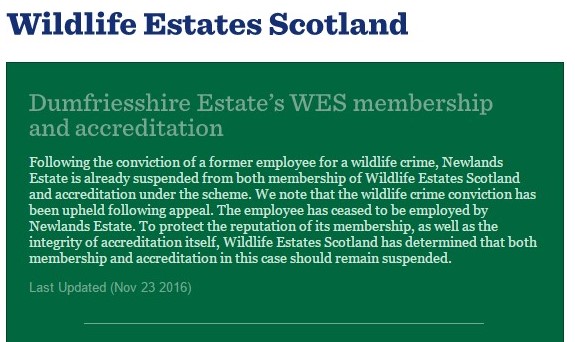
Four months on, and thanks to blog readers for writing to WES, the following statement has appeared on the WES website this morning:

wes-statement-newlands

So, Newlands Estate is still a member of WES, albeit in a suspended state. Presumably, WES is waiting to find out whether the allegation of vicarious liability is proven against landowner Andrew Duncan during forthcoming legal proceedings.

That’s an interesting position for WES to take. A wildlife crime did take place on Newlands Estate and a Newlands Estate employee was convicted for it. Why isn’t that sufficient cause for WES to expel Newlands Estate? Two conditions of WES membership were clearly breached (“the requirements to maintain best practice standards of animal welfare and comply with all legal requirements and relevant Scottish codes of practice“). Whether Mr Duncan is subsequently convicted or acquitted of vicarious liability is irrelevant and will not erase these facts.

Let’s imagine, for example, that Mr Duncan is exonerated and WES decides to lift the suspension on membership. WES will still have a wildlife crime estate on its membership list. How does that ‘protect the reputation of its membership, as well as the integrity of accreditation itself’? Here’s a hint, WES: IT DOESN’T.

Other questions we’ve been asking since Newlands Estate gamekeeper Billy Dick’s failed appeal in July 2016 are yet to be answered:

  1. Is/was criminal gamekeeper William (Billy) Dick a member of the Scottish Gamekeepers’ Association? The SGA refused to comment on Mr Dick’s membership status at the time, saying they ‘wanted to wait until the legal process had concluded’. Well, now Mr Dick’s criminal conviction for wildlife offences has been upheld, how about answering the question? Emails to: info@scottishgamekeepers.co.uk
  2. Will Scottish Land & Estates now expel the Newlands Estate from the ranks of SLE membership? SLE said at the time that Newlands Estate’s membership of SLE had been ‘voluntarily suspended’ pending on-going legal proceedings. Well, now the gamekeeper’s criminal conviction for wildlife offences has been upheld, how about answering the question? Emails to: info@scottishlandandestates.co.uk

Vicarious liability prosecution: Andrew Duncan (Newlands Estate), part 11

They’re having a laugh.

Criminal proceedings continued yesterday (22 November 2016) against landowner Andrew Walter Bryce Duncan, who is alleged to be vicariously liable for the crimes committed by gamekeeper William (Billy) Dick in April 2014.

Gamekeeper Dick was convicted in August 2015 of killing a buzzard on the Newlands Estate, Dumfriesshire by striking it with rocks and repeatedly stamping on it (see here). Mr Dick was sentenced in September 2015 and was given a £2000 fine (see here). Mr Dick attempted to appeal his conviction but this was refused on 15 July 2016 (see here).

Here’s a quick review of the proceedings against Andrew Duncan so far:

Hearing #1 (18th August 2015): Trial date set for 23rd Nov 2015, with an intermediate diet scheduled for 20th Oct 2015.

Hearing #2 (20th October 2015): Case adjourned. November trial date dumped. Notional diet hearing (where a trial date may be set) scheduled for 18th January 2016.

Hearing #3 (18th January 2016): Case adjourned. Another notional diet & debate scheduled for 11th March 2016.

Hearing #4 (11th March 2016): Case adjourned, pending the result of gamekeeper Billy Dick’s appeal. Another notional diet scheduled for 4th April 2016.

Hearing #5 (4th April 2016): Case adjourned, pending the result of gamekeeper Billy Dick’s appeal. Another notional diet scheduled for 3rd June 2016.

Hearing #6 (3rd June 2016): Case adjourned, pending the result of gamekeeper Billy Dick’s appeal. Another notional diet scheduled for 17th June 2016.

Hearing #7 (17th June 2016): Case adjourned, pending the result of gamekeeper Billy Dick’s appeal. Another notional diet scheduled for 15th July 2016.

Hearing #8 (15 July 2016): Case adjourned. Another notional diet scheduled for 2 August 2016.

Hearing #9 (2 August 2016): Proceedings moved to trial. Intermediate diet scheduled for 15 November 2016 and provisional trial date set for 7/8 December 2016.

Hearing #10 (15 November 2016): The case was adjourned for another intermediate diet scheduled for 22 November 2016. A new trial date may be set depending on what happens during this hearing.

Hearing #11 yesterday (22 November 2016): The case was adjourned for yet another intermediate diet scheduled for 6 December 2016. Trial dates expected to be assigned during this Dec hearing, so presumably the provisional trial dates of 7/8 Dec have been dumped.

Vicarious liability in relation to the persecution of raptors in Scotland (where one person may potentially be legally responsible for the criminal actions of another person working under their supervision) came in to force nearly five years ago on 1st January 2012. To date there have been two successful prosecutions/convictions: one in December 2014 (see here) and one in December 2015 (see here).  One further case did not reach the prosecution stage due, we believe, to the difficulties associated with identifying the management structure on the estate where the crimes were committed (see here).

Case against gamekeeper Stanley Gordon re: shot hen harrier, part 6

Criminal proceedings continued at Elgin Sheriff Court on Friday against Scottish gamekeeper Stanley Gordon.

Mr Gordon, 60, of Cabrach, Moray, is facing a charge in connection with the alleged shooting of a hen harrier in June 2013.

Here’s a summary of what’s happened so far in this case:

Hearing #1 (19 May 2016): Case continued without plea until 16 June 2016.

Hearing #2 (16 June 2016): Case continued without plea until 14 July 2016.

Hearing #3 (14 July 2016): Case continued without plea until 11 August 2016.

Hearing #4 (11 August 2016): Case continued without plea until 1 September 2016.

Hearing #5 (1 September 2016): Mr Gordon enters a not guilty plea. A provisional trial date is set for 19 December 2016, with an intermediate diet set for 18 November 2016.

Hearing #6 (18 November 2016): Case adjourned for another intermediate diet on 2 December 2016.

Vicarious liability prosecution: Andrew Duncan (Newlands Estate) part 10

Criminal proceedings continued on 15 November 2016 against landowner Andrew Walter Bryce Duncan, who is alleged to be vicariously liable for the crimes committed by gamekeeper William (Billy) Dick in April 2014.

Gamekeeper Dick was convicted in August 2015 of killing a buzzard on the Newlands Estate, Dumfriesshire by striking it with rocks and repeatedly stamping on it (see here). Mr Dick was sentenced in September 2015 and was given a £2000 fine (see here). Mr Dick attempted to appeal his conviction but this was refused on 15 July 2016 (see here).

Here’s a quick review of the proceedings against Andrew Duncan so far:

Hearing #1 (18th August 2015): Trial date set for 23rd Nov 2015, with an intermediate diet scheduled for 20th Oct 2015.

Hearing #2 (20th October 2015): Case adjourned. November trial date dumped. Notional diet hearing (where a trial date may be set) scheduled for 18th January 2016.

Hearing #3 (18th January 2016): Case adjourned. Another notional diet & debate scheduled for 11th March 2016.

Hearing #4 (11th March 2016): Case adjourned, pending the result of gamekeeper Billy Dick’s appeal. Another notional diet scheduled for 4th April 2016.

Hearing #5 (4th April 2016): Case adjourned, pending the result of gamekeeper Billy Dick’s appeal. Another notional diet scheduled for 3rd June 2016.

Hearing #6 (3rd June 2016): Case adjourned, pending the result of gamekeeper Billy Dick’s appeal. Another notional diet scheduled for 17th June 2016.

Hearing #7 (17th June 2016): Case adjourned, pending the result of gamekeeper Billy Dick’s appeal. Another notional diet scheduled for 15th July 2016.

Hearing #8 (15 July 2016): Case adjourned. Another notional diet scheduled for 2 August 2016.

Hearing #9 (2 August 2016): Proceedings moved to trial. Intermediate diet scheduled for 15 November 2016 and provisional trial date set for 7/8 December 2016.

At hearing #10 on Tuesday (15 November 2016) the case was adjourned for another intermediate diet scheduled for 22 November 2016. A new trial date may be set depending on what happens during this hearing.

Vicarious liability in relation to the persecution of raptors in Scotland (where one person may potentially be legally responsible for the criminal actions of another person working under their supervision) came in to force over four and a half years ago on 1st January 2012. To date there have been two successful convictions: one in December 2014 (see here) and one in December 2015 (see here).  One further case did not reach the prosecution stage due, we believe, to the difficulties associated with identifying the management structure on the estate where the crimes were committed (see here).

Following gamekeeper Mr Dick’s failed appeal in July 2016 (see here), we posed a number of questions. These are still to be answered:

  1. Is/was criminal gamekeeper William (Billy) Dick a member of the Scottish Gamekeepers’ Association? The SGA refused to comment on Mr Dick’s membership status at the time, saying they ‘wanted to wait until the legal process had concluded’. Well, now Mr Dick’s criminal conviction for wildlife offences has been upheld, how about answering the question? Emails to: info@scottishgamekeepers.co.uk
  2. Will Scottish Land & Estates now expel the Newlands Estate from the ranks of SLE membership? SLE said at the time that Newlands Estate’s membership of SLE had been ‘voluntarily suspended’ pending on-going legal proceedings. Well, now the gamekeeper’s criminal conviction for wildlife offences has been upheld, how about answering the question? Emails to: info@scottishlandandestates.co.uk
  3. Will the Newlands Estate’s accredited membership of Wildlife Estates Scotland (WES) now be revoked? The conditions of membership of this scheme include: “the requirements to maintain best practice standards of animal welfare and comply with all legal requirements and relevant Scottish codes of practice”. At the time of Mr Dick’s conviction, a spokesperson for WES said the Newlands Estate’s membership and accreditation of WES had been ‘voluntary suspended’ pending the outcome of legal proceedings. Well, now the gamekeeper’s criminal conviction for wildlife offences has been upheld, how about answering the question? Emails to: info@scottishlandandestates.co.uk

We’ll also be watching closely to see whether the Newlands Estate will now be subject to a General Licence Restriction from SNH. If you recall, this restriction may be imposed by SNH where evidence of raptor crime is apparent and it has been available as a sanction for offences committed since 1 January 2014. Mr Dick killed the buzzard on Newlands Estate in April 2014. Although, even if the GL restriction is put in place, the estate can easily side-step it by applying for an ‘individual’ licence instead (e.g. see here).

Trial for gamekeeper re: alleged shooting of a hen harrier

Criminal proceedings continued at Elgin Sheriff Court on Thursday against Scottish gamekeeper Stanley Gordon.

Mr Gordon, 60, of Cabrach, Moray, is facing a charge in connection with the alleged shooting of a hen harrier in June 2013.

Mr Gordon entered a not guilty plea at Thursday’s hearing and so this case will now move to trial. An intermediate diet has been set for 18 November 2016 (this is an administrative hearing to establish whether both the defence and prosecution are ready for trial) and the trial date itself has been set for 19 December 2016.

Previous blogs on this case hereherehere and here

An interesting letter from Invercauld Estate

In July we blogged about the discovery in June of a critically-injured Common gull that had been found caught in two illegally-set spring traps on Invercauld Estate in the Cairngorms National Park (see here).

Cairngorms Invercauld - Copy

We also blogged about a bizarre press statement from Invercauld Estate (issued via the GWCT’s twitter feed) in which they denied any illegal activity had taken place or if it had, it was perhaps a set-up ‘intended to discredit the grouse industry‘ (see here).

We also blogged about the Scottish Gamekeepers’ Association’s press statement, which said the SGA was conducting its own enquiry (see here).

We also blogged about Police Scotland’s view that a Common gull had been found caught in an illegally-set trap but ‘despite a thorough investigation‘, Police enquiries had failed to find further evidence to proceed with a potential prosecution and ‘there are at present no further investigative opportunities available‘ (see here).

So that looked like the end of it. Until, through a series of FoIs to the Scottish Government and the Cairngorms National Park Authority, a very interesting letter has emerged.

The letter, dated 27 July 2016 (so a week after the original story had broken) was written by Angus McNicol, who identifies himself as the Estate Manager for Invercauld Estate, and was addressed to the Cabinet Secretary for the Environment, Roseanna Cunningham. A copy of the letter was also sent to the Cairngorms National Park Authority. It’s a fascinating read.

Here is a copy of the letter: Invercauld Estate letter

Having read it, our first question was, ‘Why was this letter written?’ That’s a hard question to answer because we can’t get inside Mr McNicol’s head to read his thought processes. We can, though, speculate about the intentions. In our opinion, this letter was written to reassure the Cabinet Secretary that Invercauld Estate takes wildlife crime seriously and they’ve done something about it.

You’ll see that one paragraph in this letter has been partially redacted (by the Scottish Government – and, incidentally, the copy of the letter received from the Cairngorms National Park Authority was redacted in exactly the same place). It’s this partial paragraph that interests us the most. Here it is:

Invercauld redacted

Let’s focus on the sentence immediately before the redaction begins. “Whilst this was a press report, we decided to act on the worst case scenario, taking the report at face value“. Assuming that the ‘worst case scenario‘ might have been that an Estate employee was responsible for illegally setting the traps, the Estate ‘decided to act‘. What action they took is unknown, because that bit has been redacted. But interestingly, the word ‘gamekeepers’ appears later in the same paragraph.

Later in the letter, Mr McNicol reiterates that ‘action‘ had been taken:

Invercauldredacted2

So, was the ‘action’ to which Mr McNicol refers, disciplinary action against one or more Invercauld Estate gamekeepers in relation to this crime? Has somebody been sacked?

If that’s actually what happened, and if Mr McNicol has admitted this in writing, wouldn’t that trigger an investigation in to a potential vicarious liability prosecution?

Is that why, later in the letter, Mr McNicol goes to great lengths to explain the measures that Invercauld Estate has put in place to ensure its staff do not commit wildlife crimes? These measures, explained in such detail, might form the defence of ‘due diligence’ – remember, if an estate is accused of being vicariously liable for certain wildlife crimes, a defence of due diligence is permitted (see here).

Whether an estate’s attempts at due diligence are a sufficient defence to an accusation of vicarious liability is for a court to decide. We presume, if our interpretation of what happened is accurate, that both the Scottish Government and the Cairngorms National Park Authority have notified Police Scotland about the content of Mr McNicol’s letter and Police Scotland will now be following this up with an investigation? Time will tell.

The content of Mr McNicol’s letter raises some other interesting points.

Why, if Invercauld Estate has taken action against an employee, did the Estate deny in their original press statement that the offence had even taken place or claim that if it had, it had been a set-up ‘intended to discredit the grouse industry‘?

Who is the person/organisation that conducted “independent searches of hill ground and of buildings on the Estate to check for illegal traps, snares and illegal pesticides“? Presumably it wasn’t the GWCT – they can hardly be classed as being ‘independent’ if they’re publishing press statements on their twitter feed on behalf of Invercauld Estate. And presumably it wasn’t anybody from Scottish Land & Estates – they can hardly be classed as ‘independent’ as Mr McNicol states Invercauld Estate is a member of SLE. And presumably it wasn’t anybody from the SGA – they can hardly be classed as ‘independent’ as Mr McNicol states that ‘all the relevant staff are members of the SGA‘. So who was it?

When did these ‘independent searches of hill ground and of buildings on the Estate to check for illegal traps, snares and illegal pesticides” take place, and how often have they been conducted?

Why did Police Scotland, as part of what they described as a ‘thorough investigation‘, only speak to a representative of Invercauld Estate (Mr McNicol)? Why didn’t officers question, under caution, the gamekeepers who work on the part of the Estate where the illegally-set traps were found?

It’s all very interesting.

Perhaps we’ll get some answers once the SGA has finished its enquiry in to what happened. Presumably they’ll be publishing their findings in due course….

PAW Scotland rejects gamekeeper’s claims as ridiculous

Further to the claims of Scottish gamekeeper Donald McBeath that ‘bird activists’ are killing golden eagles and hen harriers as part of a smear campaign against grouse shooting (see here and here), the Partnership for Action against Wildlife Crime (PAW Scotland) has dismissed his claims as ridiculous.

PAW Scotland statement:

The Partnership for Action Against Wildlife Crime (PAW) Scotland is calling for a cool-headed discussion about the disappearance of birds of prey in the Scottish highlands.

The call comes following unsubstantiated claims by a gamekeeper who believes ‘bird activists’ might be to blame. Louise Batchelor, a spokesperson for PAW Scotland, says that there appeared to be no evidence to back the claims. There were reports that the gamekeeper said: “I certainly would imagine that there would be a few activists who would take a chance of doing something and I wouldn’t put it past them.’’

Reports also said that some pressure groups had called for grouse shooting to be outlawed and they reported the gamekeeper as saying that call ‘might give activists a motive for sacrificing a few birds of prey’. Louise Batchelor said: “The idea that ‘bird activists’ were responsible for the disappearance of golden eagles and hen harriers as part of some conspiracy theory, to smear gamekeepers, is ridiculous. This kind of claim, made without foundation, cannot go unchallenged and PAW Scotland will continue to take the lead in any serious debate about what is happening to Scotland’s birds of prey. ”

It’s understood that the gamekeeper behind the claims does not belong to the Scottish Gamekeepers Association, who are members of PAW Scotland. A spokesman for the SGA said: “As has always been the case since these reports have emerged, our sole focus is the investigation.  The SGA will do anything we can to assist Police Scotland and the Scottish Government in their investigations and we do not comment on the opinion of private individuals.”

END

Well done, PAW Scotland!