Thanks to the blog reader who sent us this screen grab of a tweet doing the rounds recently (it now appears to have been deleted).
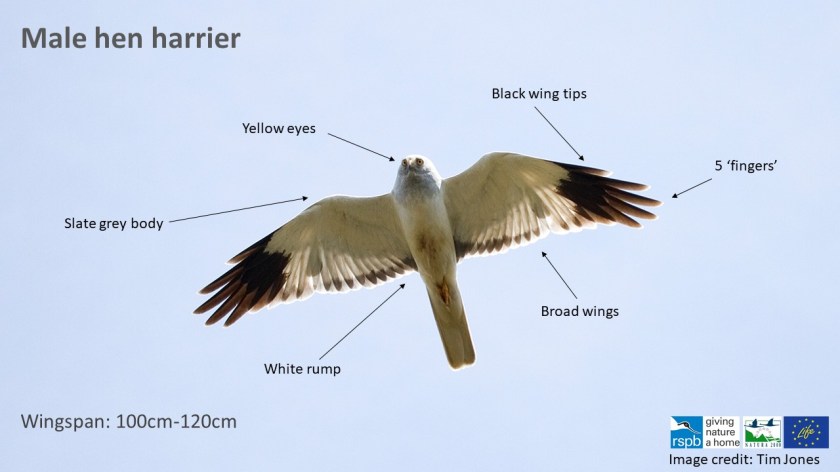
Oh dear. Perhaps Sporting Rifle will consider publishing a link to the RSPB’s very helpful online article ‘How to ID a Hen Harrier’, which includes these useful guides:
And perhaps Sporting Rifle will consider revising its article about hen harrier conservation by publishing the facts about why hen harriers are in a spiral of decline across the UK? (BIG CLUE: GAMEKEEPERS ARE INVOLVED).
Perhaps Sporting Rifle will also consider publishing the findings of the recent scientific paper which showed that hen harriers are ten times more likely to be killed on grouse moors than any other habitat. Yes, TEN TIMES more likely!
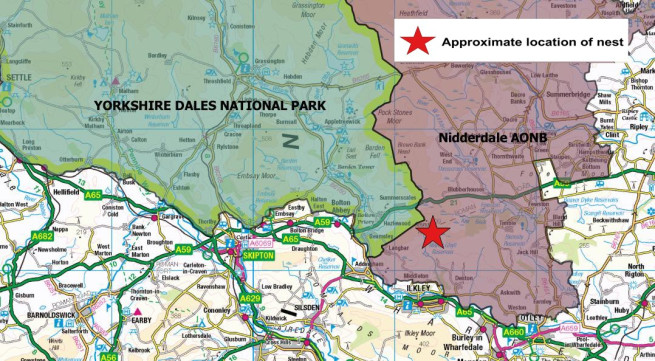
Or perhaps Sporting Rifle will also consider publishing the recent news that one of the many tagged hen harriers to vanish in suspicious circumstances just happened to vanish less than 20 miles from the proposed ‘reintroduction’ site in Wiltshire, in an area heavily managed by gamekeepers for pheasant and partridge shooting?
Incidentally, on the subject of DEFRA’s outrageous proposal to ‘reintroduce’ hen harriers to southern England this year, we’ve heard recently that some of our colleagues in Spain have been approached again by Natural England, seeking donor birds, with an apparent assurance that these donor birds won’t go any where near the UK’s upland grouse moors! If this is an accurate report (and we have no reason not to believe it, given the source), it fits in with Natural England’s previous distortions of the truth about hen harrier persecution (we blogged about that here).
The Spanish are not stupid. We’re aware that at least some of those who’ve been approached recognise that there is no evidence whatsoever to support such an ‘assurance’, and besides, Spanish raptor conservationists are well aware of the ongoing killing of hen harriers on UK grouse moors and they consider this southern England reintroduction proposal to be a sham – just a distraction from where the conservation agencies should be focusing their efforts. By all accounts, at least some of them have told Natural England to get lost.
Further to previous blogs on the prosecution of Scottish gamekeeper Alan Wilson for alleged wildlife crimes in the Scottish Borders (see here, herehere and here) further details have emerged about the charges he faces.
From the Peebleshire News (12/4/19) (and with thanks to the blog reader who sent us a copy):
WILDLIFE CHARGES
A gamekeeper has been accused of 12 wildlife offences at Jedburgh Sheriff Court. Alan Wilson, 60, is charged with shooting two goshawks, four buzzards, a peregrine falcon, three badgers and an otter at Henlaw Wood, Longformacus, between March 2016 and May 2017.
He also faces charges of using a snare likely to cause partial suspension of animal or drowning, failing to produce snaring records within 21 days when requested to do so by police and no certificate for an air weapon.
Wilson, of xxxxx xxxxx xxxxx pleaded not guilty to all 12 charges and a trial date was set for June 13 with an intermediate hearing on May 27.
ENDS
Please note: we will not be accepting comments on this news item until legal proceedings have concluded. Thanks.
The case against Scottish gamekeeper Alan Wilson continued with a procedural hearing at Jedburgh Sheriff Court on Monday 1st April.
Mr Wilson faces multiple charges of alleged wildlife crimes following a police raid on a shooting estate at Longformacus in the Scottish Borders in June 2017 (see herehere and here).
Mr Wilson has not yet entered a plea but will have a chance to do so at another intermediate hearing, and depending on his plea, a potential trial date has been set to begin on 13 June 2019.
Please note: we will not be accepting comments on this news item until legal proceedings have concluded. Thanks.
David Campbell, the former head gamekeeper of Edradynate Estate in Perthshire, has been cleared of all charges relating to the poisoning of game crops on the estate in April 2017.
It had been alleged that David Campbell had maliciously damaged game crops by spraying them with an unknown substance which caused them to rot and perish. At the time of the alleged offences, Campbell was no longer an employee of the estate, having worked there since 1983 but after falling out with the landowner, millionaire city financier Michael Campbell (no relation), his employment was terminated in February 2017.
Last week, David Campbell’s defence solicitor had argued that the case against his client should be dropped because there was a lack of evidence to show his client was the person caught on the covertly-filmed CCTV. Sheriff Gillian Wade had rejected the argument and said the court had been presented with sufficient evidence for the case to proceed.
However, at Tuesday’s court hearing Sheriff Wade cleared David Campbell after ruling the case against him had not been proved beyond reasonable doubt.
This latest failed prosecution is one of several linked to the Edradynate Estate, although the majority of the previous allegations have related to the alleged illegal poisoning of birds of prey, rather than alleged crop poisoning. Despite at least 22 police investigations over several decades (according to former Tayside wildlife crime officer Alan Stewart), nobody from Edradynate Estate has ever been successfully prosecuted for any of these alleged wildlife crimes.
[A poisoned buzzard at Edradynate in 2015, photo RPUK]
We’ve blogged about this estate a lot over the years (see links here), and most recently in relation to the alleged poisoning of two buzzards in 2015 and the Crown Office’s decision in 2017 not to prosecute one of the Edradynate gamekeepers (un-named), despite Police Scotland urging otherwise (see here).
Edradynate Estate is currently serving a three year General Licence restriction, imposed in Sept 2017 and which we believe relates to the alleged buzzard poisonings in March 2015.
Last year three dogs and two more buzzards were reported to have been “deliberately poisoned” in the area but nobody has been charged (see here) and we are not aware of any suggested link between these poisonings and any current employee of Edradynate Estate.
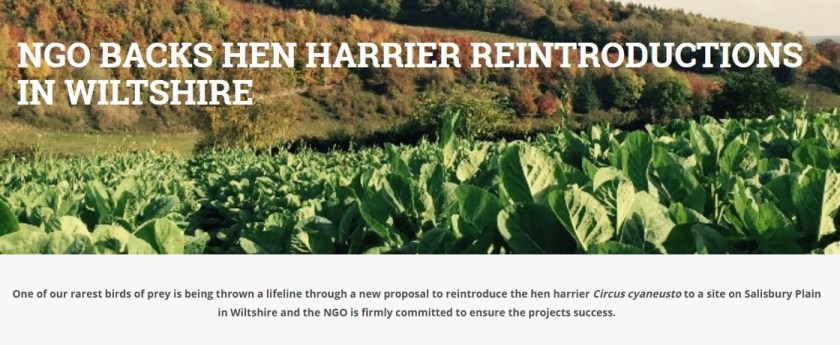
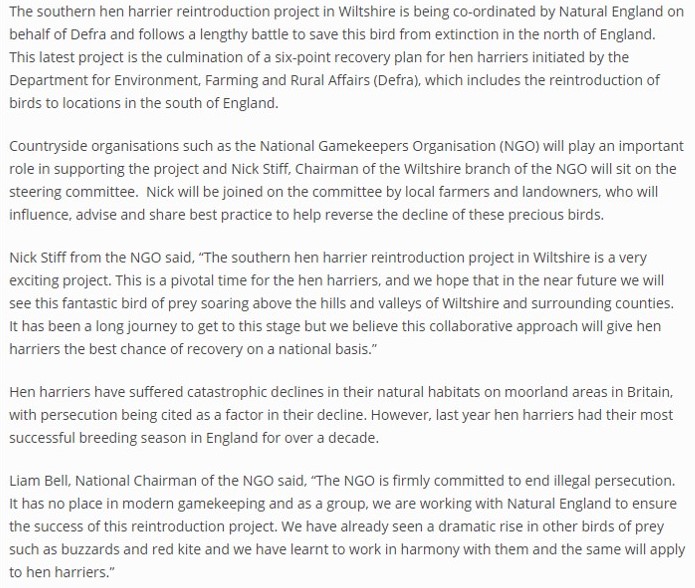
It’s not quite April Fools’ Day but the National Gamekeepers’ Organisation thought it’d get in there early this year.
Just a week on from the publication of a scientific paper that demonstrated the catastrophic loss of satellite-tagged hen harriers was undeniably linked to land managed by gamekeepers for grouse shooting (see here), the National Gamekeepers’ Organisation (NGO) published this on its website:
Amazing, eh?
Remind us again, NGO – where was the last known location of the latest hen harrier to ‘disappear’ in suspicious circumstances? Ah yes, in Wiltshire, close to the proposed hen harrier reintroduction site and in an area heavily managed for pheasant and partridge shooting. And what did the NGO say about this bird’s disappearance? Ah yes, that it was “a set up” by the RSPB.
And remind us again, NGO – what examples do you have of the NGO “living in harmony with buzzards“? Ah yes, you supported a gamekeeper (who had a prior poison-related conviction) to get licences to kill buzzards to ‘protect’ his pheasants.
And remind us again, NGO – what was your most recent action on the RPPDG, the group that’s supposed to tackle illegal raptor persecution? Ah yes, it was to resign.
And please could you tell us, NGO, what is “Circus cyaneusto“?! Is this an imaginary harrier species, to match the gamekeepers’ imaginary devotion to hen harriers that we’re supposed to believe?
A couple of weeks ago we blogged about how Tim Weston, a Development Officer for the National Gamekeepers’ Organisation (NGO) had suggested that the suspicious disappearance of satellite-tagged hen harrier ‘Vulcan’ had been a “set-up” by the RSPB (see here).
At the same time, he argued that there was “zero wildlife crime” in the area where Vulcan vanished, even though the RSPB had already recorded 27 confirmed raptor persecution incidents since 2000, including 10 shot, 9 poisoned, 7 trapped and one nest destruction.
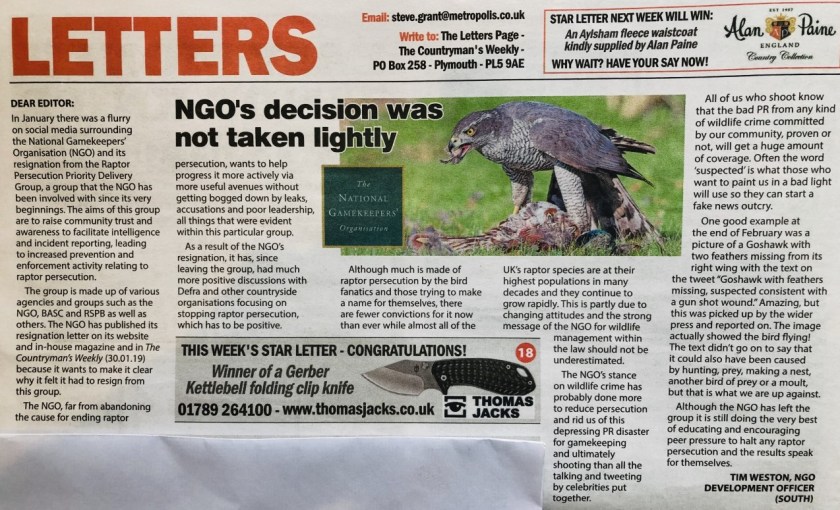
Tim’s not great with figures. Nor logic. In a letter he wrote for last week’s Countryman’s Weekly rag he suggests that as there are now fewer convictions for raptor persecution, it follows that there are fewer crimes. Good grief. Perhaps he missed the latest edition (2017) of the RSPB’s annual Birdcrime report, which says:
‘In 2017, there were 68 confirmed incidents of raptor persecution, but only four prosecutions relating to raptor crime. Of those, only one resulted in a conviction‘.
The main focus of Tim’s letter was on the NGO’s recent resignation (here, here and here) from the Raptor Persecution Priority Delivery Group (RPPDG), a group established to tackle illegal raptor persecution:
Check out that last paragraph:
“Although the NGO has left the [RPPDG] group it is still doing the very best of educating and encouraging peer pressure to halt any any raptor persecution and the results speak for themselves”.
Indeed, Tim, “the results do speak for themselves” because two days after your letter was published we were able to read those results in a top quality scientific paper that revealed that 72% of satellite tagged hen harriers were either confirmed as illegally killed or disappeared in circumstances in which illegal killing was the only plausible explanation, most of them on or close to grouse moors. The research results also revealed that the likelihood of an individual hen harrier dying, or disappearing, was ten times higher within areas predominantly covered by grouse moor, compared to areas with no grouse moors.
Sorry Tim, no cigar for you, although you do appear to have won a knife, what with your letter being deemed the ‘star letter’ of last week’s rag (which gives everyone a pretty good idea about the quality of the other letters published in Countryman’s Weekly).
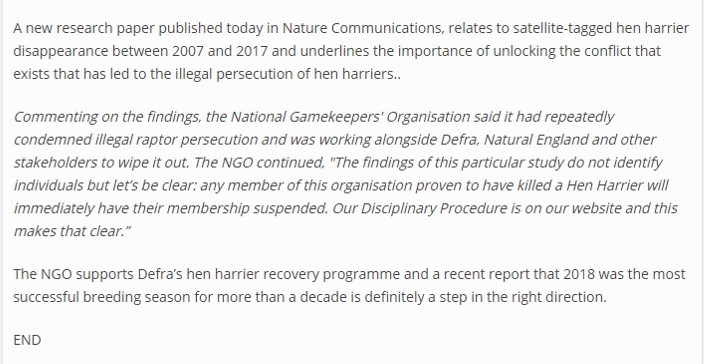
And what of the National Gamekeepers’ Organisation’s formal response to the hen harrier satellite tag paper? Was it any more convincing than Tim’s grasp of the extent of raptor persecution?
Not really. This is from the NGO’s website:
Who ever wrote this response for the National Gamekeepers’ Org didn’t quite manage to include the information that was central to the research findings: that, er, the illegal killing of hen harriers is intrinsically linked to the distribution of grouse moors across northern England, which is, er, where gamekeepers work.
The trial of Edradynate Estate’s former head gamekeeper continued at Perth Sheriff Court last week.
David Campbell, 69, denies that between 14 and 16 April 2017 at Edradynate Estate he maliciously damaged game crops by spraying them with an unknown substance which caused them to rot and perish.
[Edradynate Estate driveway, photo by Ruth Tingay]
At the time of the alleged offences, Campbell was no longer an employee of the estate, having worked there since 1983 but after falling out with the landowner, millionaire city financier Michael Campbell (no relation), his employment was terminated in February 2017. Michael Campbell told the court in November 2018 that he believed his former employee had caused the damage ‘in revenge’ (see here).
During a hearing in late January, the court heard from various witnesses who claimed David Campbell was ‘upset’ about having to leave his long-term position at Edradynate (see here).
At day three of the trial last week David Campbell’s solicitor, David Holmes, failed to have the case thrown out of court. Mr Holmes argued that there was a lack of evidence to show that his client was the person seen on the covert CCTV images. However, Sheriff Gillian Wade rejected this argument and said the court had been presented with sufficient evidence to let the Crown continue with its prosecution.
The case continues.
It might seem odd that we’re reporting on this case, and although we can’t explain that decision while this trial is on-going, all will become clear in due course.
PLEASE NOTE: We’re not accepting comments on this case until the trial concludes. Thanks.
The owner of Denton Moor, a company called NG Bailey, has announced it will not renew the grouse shooting lease to its current tenant following a spate of wildlife crime.
Denton Moor in the Nidderdale AONB in Yorkshire was where the RSPB filmed footage of several armed men, dressed as gamekeepers, shooting at a nesting Marsh harrier and removing eggs from the nest in May 2017 (see here). Despite good efforts from North Yorkshire Police, the armed men have not been identified.
[RPUK map showing the location of Denton Moor]
Last month gamekeeper Austin Hawke was convicted of wildlife crime on the same moor after a badger was found dead in a snare in May 2018 (see here).
Campaigners have been targeting NG Bailey for some time and the recent conviction of one of the shooting tenant’s gamekeepers seems to have been the last straw for the landowner.
David Hurcomb, Chief Exec said:
“NG Bailey is aware of the prosecution of Austin Hawke, the gamekeeper who isemployed by and works for the tenants. To clarify, Austin Hawke is not employed by Denton Park Estate. As a business, we find this behavior totally unacceptable and do not condone this type of conduct – it is not reflective of the company’s values or ethical practices. We have advised the tenants that under no circumstances will the lease be renewed when it expires”.
Excellent news. Although whether that means it’ll be leased to someone other than the current tenant remains to be seen. We’re not sure when the current lease expires.
The efforts of a wide range of people have led to this result, allowing campaigners to join up the dots and apply pressure. Well done to them all, including the RSPB Investigations team, North Yorkshire police, local raptor workers, the Crown Prosecution Service and local campaigners.
Well done also to David Hurcomb and his colleagues at NG Bailey – this is a very welcome decision.
Some of you may remember the footage of an armed man, believed to be a gamekeeper, lying in wait close to a decoy hen harrier on a grouse moor in the Peak District National Park, back in 2016 (see here).
The footage was so disturbing, and the public reaction so strong, it prompted the National Trust (the landowner) to pull the shooting lease early and replace the shooting tenant with someone else (see here). Incidentally, that new tenant hosted a successful hen harrier breeding attempt last year (see here), even though some of the offspring didn’t survive for very long after leaving the safety of this moor (e.g. Arthur, see here and Octavia, see here).
We’ve also blogged before about what was believed to be the use of a tethered live eagle owl as a decoy on a grouse moor in the Lammermuirs (see here), although the suspected gamekeeper took off pretty sharpish once he realised he’d been spotted.
Well, it seems this method of using to decoys to lure in birds of prey to within close range of a shotgun is more prevalent than we’d thought.
Today the RSPB Investigations Team has published a video of several armed men (identified as gamekeepers by the RSPB) over a period of months spending hours and hours and hours of their time sitting in specially-dug holes in close proximity to a plastic peregrine and a plastic hawk, believed to have been used as decoys to attract other birds of prey. The location? A grouse moor in the Peak District National Park.
Hmm, it’s really no surprise that the Peak District National Park was identified in the recent scientific analysis of hen harrier sat tag data as one of the grouse moor areas where hen harriers were most likely ‘disappear’ in suspicious circumstances (see here).
The RSPB has also written a blog about this footage, and similar evidence of decoy use that has been recorded on other grouse moors in the north of England. Read the eye-opening blog here.
Fantastic investigative work from the RSPB to get such close and clear footage and there’s a strong chance that these gamekeepers won’t be using those particular decoy sites again in the near future!
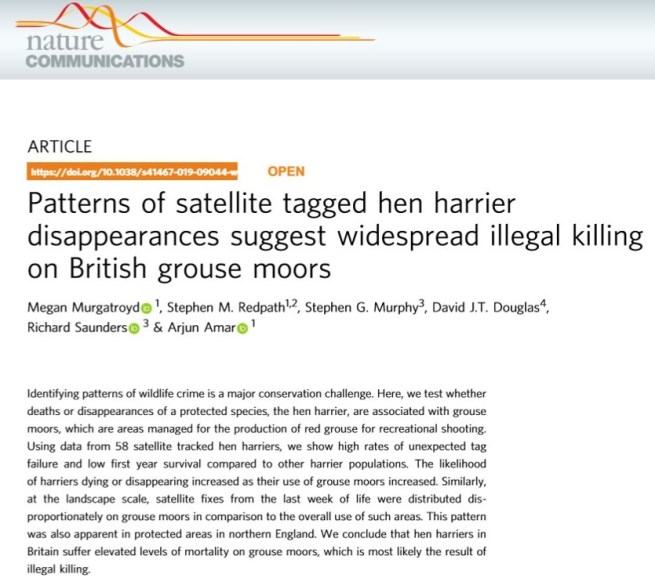
At long last, after years of stalling, hiding, prevaricating and obsfuscating (e.g. see here and here) and 13 years after its publicly-funded study began, Natural England’s hen harrier satellite tag data has finally been analysed and published in a peer-reviewed scientific journal.
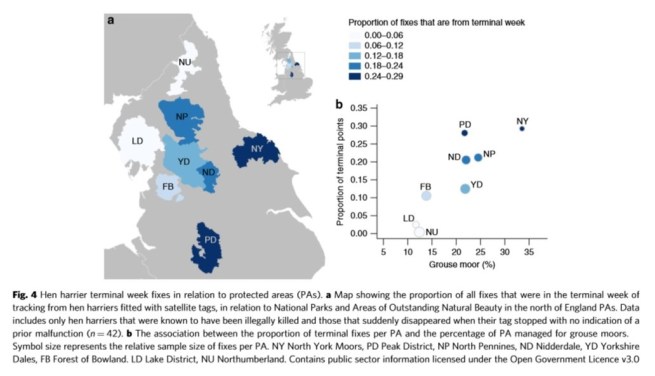
The results? Entirely predictable (hen harriers are highly likely to be killed on grouse moors – gosh, who knew?), and are more likely to be killed inside protected areas such as National Parks and Areas of Outstanding Natural Beauty (AONBs) with large areas of grouse moors than any other type of landuse, especially these protected areas in North Yorkshire, Bowland and the Peak District:
Unfortunately the results do not have the same fine resolution as those of the golden eagle sat tag review, but that is simply a consequence of using different types of satellite tag and duty cycles. E.g. the golden eagle tags, especially the newer GSM solar powered tags, are ‘on’ constantly and are collecting data every minute when fully charged, whereas the hen harrier tags are using the Doppler/Argos system so the tags are less spatially accurate and have frequent periods when they are not ‘on’, thus not collecting data. Nevertheless, even being forced to undertake an analysis at a coarse scale, the results are still damning.
The most devastating result, in our opinion, is the extent of the criminality and this is what should be grabbing the attention of Ministers. Sure, we’ve all known for years that hen harriers are killed by gamekeepers on many driven grouse moors; everybody knows and acknowledges that, but the scale of the killing has always been challenged (or more usually, denied).
But this paper puts an end to those denials. 72% of the Natural England sat tagged hen harriers are presumed to have been illegally killed, versus 9% natural deaths. 72% is the MINIMUM value. If you exclude the tagged birds that are still alive/being tracked (7), and thus just look at the tagged birds with a known end fate, then the maximum value of illegally killed satellite tagged hen harriers would be 82% versus 9.8% natural deaths. It’ll be interesting to add the RSPB-tagged birds to this in due course.
82% of young tagged hen harriers are likely to have been illegally killed, on grouse moors. Compare that to the 31% of satellite tagged golden eagles that ‘disappeared’ in suspicious circumstances on or near driven grouse moors in Scotland. In a direct response to that 31%, Scottish Environment Secretary Roseanna Cunningham ordered an independent review of grouse moor management, specifically to examine opportunities for licensing.
How do you think her Westminster counterparts, Michael Gove & Dr Therese Coffey will respond to the 82% figure? Let’s see, shall we?
A press release has been issued by the partner organisations involved in the hen harrier sat tag analysis, as follows:
STUDY SUGGESTS WIDESPREAD ILLEGAL KILLING OF HEN HARRIERS ON ENGLISH GROUSE MOORS
A new study reveals that young hen harriers in England suffer abnormally high mortality compared to populations in Orkney and mainland Scotland and the study provides compelling evidence that the most likely cause is illegal killing in areas associated with grouse moor management.
Published today in Nature Communications, this paper represents the culmination of a 10-year Natural England study involving 58 satellite tagged hen harriers. The analyses have been led by the University of Cape Town and Aberdeen University with the provision of land use data by the RSPB. The study showed the likelihood of hen harriers dying, or disappearing, was ten times higher within areas predominantly covered by grouse moor, compared to areas with no grouse moor. The study revealed that 72% of tagged harriers were either confirmed or considered very likely to have been illegally killed.
The hen harrier, sometimes called the ‘skydancer’ because of its amazing acrobatic display in the breeding season, is one of England’s rarest birds and is legally protected. Illegal killing of hen harriers has long been thought to limit their population size, but identifying the scale of these crimes and their impact on harrier populations has been difficult because they occur in remote areas and evidence is likely to be destroyed, thus successful prosecutions are rare. This long-term study has enabled patterns of disappearances to be assessed across a large number of birds. This provides overwhelming evidence that illegal killing is occurring on some grouse moors, where some gamekeepers view hen harriers as a threat to their grouse stocks.
Stephen Murphy from Natural England led the data collection and commented: “Natural England welcomes the publication of this study, which demonstrates the value of tagging as a legitimate conservation tool. These analyses are a significant step in understanding the fate of tagged hen harriers, and confirm what has long been suspected – that illegal persecution is having a major impact on the conservation status of this bird.”
Dr Megan Murgatroyd, from the University of Cape Town, who is the lead author of the study said: “Natural England’s long-term commitment to this tracking study has yielded an important dataset involving over 20,000 individual fixes. This is a remarkable achievement for a species whose population in England has averaged only a handful of pairs for the last few years. Whilst dead harriers can be disposed of, the pattern of hen harrier disappearances revealed by this data could not be hidden. [Ed: She’s clearly been listening to Dr Hugh Webster – that’s his line!] The multiple levels of analyses of the data have all led to the same robust conclusion that hen harriers in Britain suffer elevated levels of mortality on grouse moors, and this is most likely the result of illegal killing.“
Dr David Douglas, RSPB Principal Conservation Scientist and a co-author on the paper, said: “The high rate of illegal persecution on grouse moors revealed by this study goes a long way to explaining why hen harriers are barely hanging on as a breeding bird in England. Satellite tag data is giving us very valuable insights into what is happening to our birds of prey in the UK. It has already provided compelling evidence of the link between suspicious golden eagle deaths and grouse moors in Scotland and now it has done the same for hen harriers in England.”
Rob Cooke from Natural England said: “Natural England will continue its satellite tracking work to further improve our understanding of hen harrier movements and behaviour, and will continue work to improve the conservation status of the species. Natural England welcomes the support of many landowners in this, and will continue to work with all landowners and other interested parties to find ways of enabling hen harrier populations to increase from their current critically endangered levels in England”.
ENDS
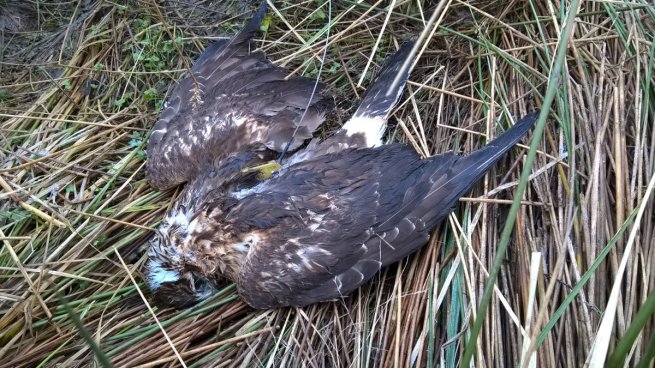
[Satellite-tagged hen harrier Carroll, who’d been shot]
UPDATE 20 March 2019: Responses to hen harrier satellite tag paper: Supt Nick Lyall, Chair RPPDG (here)
UPDATE 21 March 2019: Responses to hen harrier satellite tag paper: BASC (here)
UPDATE 21 March 2019: Responses to hen harrier satellite tag paper: DEFRA Wildlife Minister Dr Therese Coffey (here)
UPDATE 22 March 2019: Responses to hen harrier satellite tag paper: Northern England Raptor Forum (here)
UPDATE 24 March 2019: Responses to hen harrier satellite tag paper: Moorland Association (here)
UPDATE 25 March 2019: Responses to hen harrier satellite tag paper: GWCT (here)
UPDATE 9 June 2026: Moorland Association’s amateurish attempt to analyse Hen Harrier tag data is full of holes (much like a shot Hen Harrier) (here)







 Raptor Persecution UK