Retired Edradynate Estate gamekeeper David Campbell, 75, made his second court appearance today, accused of the shotgun murder of retired groundsman Brian Low, 65, who was killed whilst walking his dog near Aberfeldy, Perthshire in February 2024.
Campbell’s first court appearance was at Dundee Sheriff Court on 27 May 2024 after being charged with murder and of attempting to defeat the ends of justice between 17 February and 24 May 2024 by hiding the alleged murder weapon.
Edradynate Estate where the accused and the victim had previously worked. Photo by Ruth Tingay
Appearing in private at Perth Sheriff Court on Tuesday 4th June 2024 for a full committal hearing, prosecutors allege that Campbell, of Crieff Road, Aberfeldy, murdered Brian Low by shooting him in the head and body on Leafy Lane, Pitilie, on 16 February 2024. Prosecutors claim he killed former Edradynate Estate worker Mr Low, having ‘previouslyshown ill-will and malice towards him‘.
Campbell made no plea during the hour-long hearing and was fully committed for trial.
Campbell’s defence solicitor David Holmes argued successfully for bail, which was granted by Sheriff Clair McLachlan. However, the Crown Office has appealed this decision and Campbell remains on remand until the appeal has been heard. Bail appeals can take up to 72 hours.
For those interested in the early court and bail procedure for those charged with serious offences in Scotland such as murder, this useful blog by Scottish advocate Andrew Crosbie and this useful blog by Douglas Thomson from the Society of Solicitors in the Supreme Courts of Scotland will be of interest.
As this case is live, comments are turned off until criminal proceedings conclude.
UPDATE 8 June 2024: Former Edradynate Estate gamekeeper & murder suspect David Campbell refused bail (here)
UPDATE 21 March 2025: Murder trial date set for Edradynate Estate ex-gamekeeper David Campbell, accused of shooting former colleague Brian Low in Aberfeldy (here)
Retired Edradynate Estate head gamekeeper David Campbell, 75, appeared at Dundee Sheriff Court yesterday accused of the shotgun murder of Brian Low, 65, a retired groundsman also from Edradynate Estate.
Edradynate Estate driveway. Photo by Ruth Tingay
Campbell is accused of murdering Brian Low by shooting him in the neck and body with a shotgun as Mr Low walked his dog on Leafy Lane, Pitilie, on 17 February 2024. According to an article in The Courier (paywalled), prosecutors claim Campbell had ‘previously shown ill-will and malice‘ towards Mr Low.
Campbell is further accused of attempting to defeat the ends of justice between 17 February and 24 May 2024 by hiding the alleged murder weapon.
Campbell made no plea during the court hearing and was remanded in custody. He is due to appear in court again within eight days (this useful blog by Scottish advocate Andrew Crosbie outlines the court procedure for those facing allegations of serious crime such as murder).
As this case is live, comments are turned off until criminal proceedings conclude.
UPDATE 4 June 2024: Retired gamekeeper David Campbell accused of shotgun murder is granted bail – Crown Office appeals Sheriff’s decision (here)
UPDATE 8 June 2024: Former Edradynate Estate gamekeeper & murder suspect David Campbell refused bail (here)
UPDATE 21 March 2025: Murder trial date set for Edradynate Estate ex-gamekeeper David Campbell, accused of shooting former colleague Brian Low in Aberfeldy (here)
The case against Ruabon Moor gamekeeper Stuart Hart has been discontinued.
Hart, 47, had faced two charges – Using a trap to kill or take a wild bird (in this case, a Goshawk) and possession of an article capable of being used to commit a summary offence (see here and here for earlier blogs).
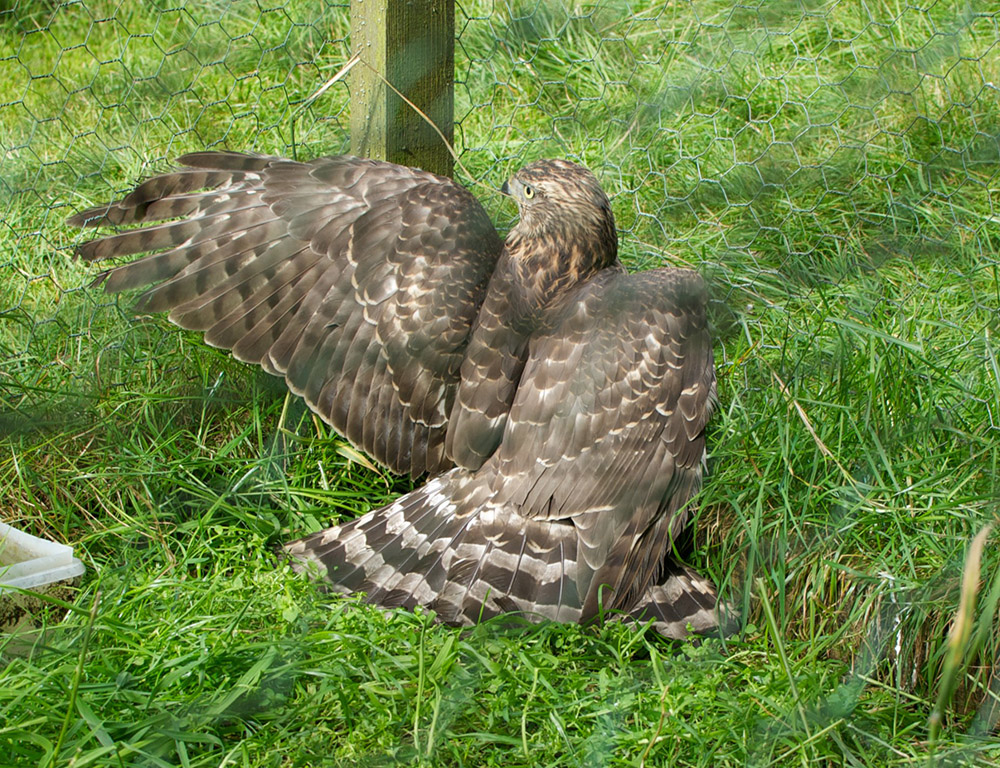
Young goshawk in a cage trap. Photo by RSPB (file photo, not linked to this case)
The first hearing in this case was held at Wrexham Magistrates on 28 March 2024. Hart had not entered a plea as his defence solicitor told the court he considered there had been procedural errors in the way the case had been brought. He also told the court that he wanted to challenge the admissibility of the RSPB’s video evidence (here).
The case was adjourned and was due to be heard again today (30 April 2024). However, according to the court, the case has now been discontinued.
Interesting. More to come on this…
UPDATE 26 November 2024: Ruabon Moor gamekeeper prosecution – why the case was discontinued (here)
The first hearing in the case against gamekeeper Stuart Hart was heard at Wrexham Magistrates, North Wales last Thursday (28 March 2024).
Hart, 47, faces two charges – Using a trap to kill or take a wild bird (in this case, a Goshawk) and possession of an article capable of being used to commit a summary offence (see here for earlier blog).
Young goshawk in a cage trap. Photo by RSPB (file photo, not linked to this case)
Hart’s defence solicitor, Michael Kenyon, told the court there were procedural errors in the way the case had been brought, and in addition he wanted to challenge the admissibility of the RSPB’s video evidence, so the case was adjourned to be heard by a District Judge. (A District Judge is legally-qualified, usually a former solicitor or barrister, whereas magistrates are non-legally-qualified volunteers who depend on a qualified legal advisor in the court to direct them on the relevant law).
Hart has not yet entered a plea.
Michael Kenyon will be a familiar name to those who follow raptor persecution prosecutions. He represented gamekeeper Timothy Cowin in 2018 who was accused of shooting dead two short-eared owls on Whernside, Cumbria after being caught on camera by RSPB Investigations staff. Kenyon challenged the procedural basis of that case (e.g. see here), resulting in an extraordinary series of hearings at five different courts across NW England (here). Eventually Cowin was convicted (here).
Hart’s case will next be heard on 30 April 2024.
NB: Comments are turned off for legal reasons until criminal proceedings have concluded.
UPDATE 30 April 2024: Case discontinued against Ruabon Moor gamekeeper Stuart Hart (here)
UPDATE 26 November 2024: Ruabon Moor gamekeeper prosecution – why the case was discontinued (here)
A gamekeeper is due to appear before Wrexham Magistrates tomorrow (Thurs, 28 March 2024) after being charged with alleged wildlife crime offences.
According to court documents, Stuart Hart, 47, faces two charges – Using a trap to kill or take a wild bird (in this case, a Goshawk) and possession of an article capable of being used to commit a summary offence.
Young goshawk in a cage trap. Photo by RSPB (file photo, not linked to this case)
A press release about this case issued by North Wales Police earlier this month (here) was quite vague, with no details about the date of the alleged offences and no detail about the location other than ‘on the outskirts of Wrexham‘.
Hopefully more detail will be available after tomorrow’s hearing. This will be the defendant’s first court appearance and he’s yet to enter a plea.
NB: Comments are closed until criminal proceedings have concluded.
UPDATE 31 March 2024: Defence solicitor in prosecution against gamekeeper Stuart Hart wants to challenge admissibility of RSPB video evidence (here)
UPDATE 30 April 2024: Case discontinued against Ruabon Moor gamekeeper Stuart Hart (here)
Some of you may remember a joint statement issued by five pro-shooting organisations in January 2020 professing ‘zero tolerance’ for raptor persecution crimes.
I wrote at the time why I didn’t find their claim convincing and that the five signatory organisations (BASC, Moorland Association, National Gamekeepers Organisation, Countryside Alliance, Country Land & Business Association) needed to do much more to persuade anyone to take them seriously. Just being so-called partners on the sham Raptor Persecution Priority Delivery Group (RPPDG) is nothing more than a greenwashing exercise, in my opinion.
More evidence has now surfaced about the National Gamekeepers Organisation (the membership body for gamekeepers in England & Wales) and what I would call its underhand tactics to try and disrupt investigations into alleged raptor persecution crimes.
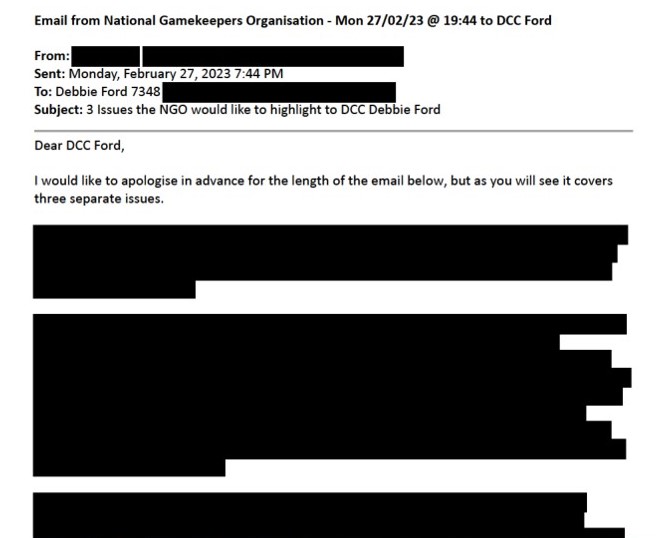
In December 2023 I submitted an FoI request to Northumbria Police asking for, amongst other things, copies of 2023 correspondence between the National Gamekeepers Organisation (NGO) and Deputy Chief Constable Debbie Ford, who at the time was the National Police Chiefs Council (NPCC) Lead for Rural & Wildlife Crime.
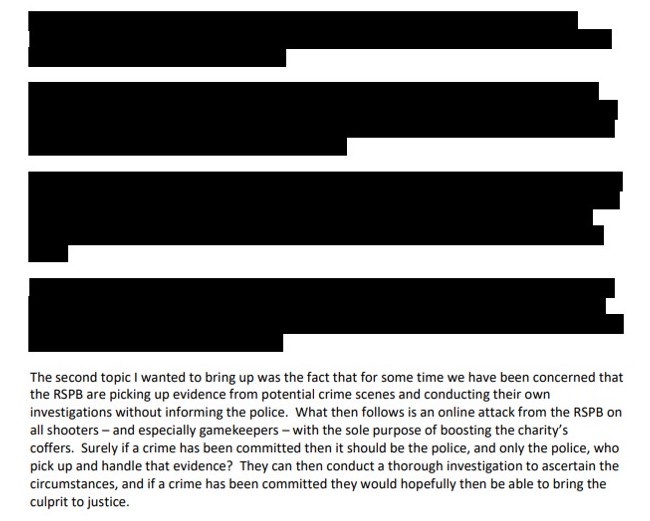
It turns out that the NGO had written to DCC Ford in February 2023 to highlight its three concerns in relation to bird crime.
The NGO’s first complaint was redacted by the FoI officer at Northumbria Police (see below). I’ve since submitted a separate FoI request for this detail and await a response.
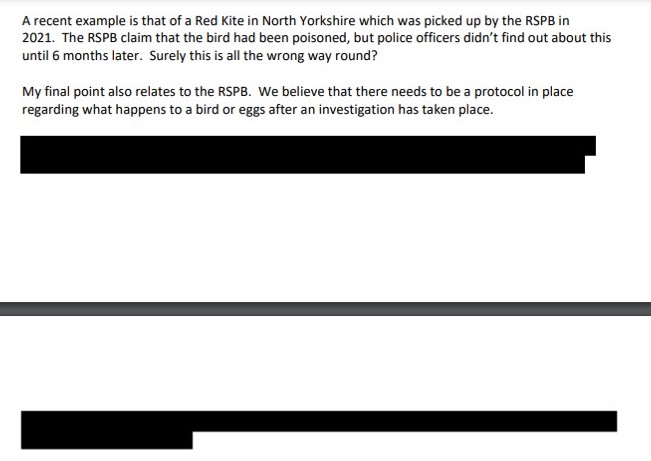
The second complaint related to, surprise surprise, the NGO’s objection to the involvement of the RSPB in raptor persecution investigations. I’ll come to that below.
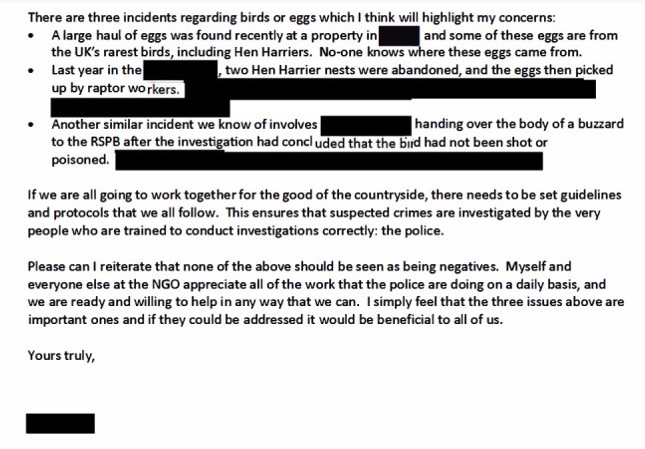
The third complaint related to the RSPB and members of the North of England Raptor Forum (NERF) and about what happens to birds and eggs once an investigation had concluded. It isn’t clear to me what the basis of this complaint is.
Here’s a copy of the FoI response I received from Northumbria Police:
Let’s focus on the NGO’s second complaint about the RSPB’s involvement in raptor persecution investigations.
This is a tired old trope that gets regurgitated every now and then by those who seek to marginalise the expertise and experience of the RSPB. Expertise and experience that has been utilised by police forces across the UK, time and time and time again, resulting in criminal gamekeepers being hauled before the courts and being convicted of raptor persecution crimes. This partnership working has been particularly effective in recent years, with the police leading many multi-agency raids (with partners including the RSPB, Natural England, NWCU and Natural England), resulting in the high profile conviction of a number of criminal gamekeepers (e.g. here, here, here, here, here, here, here, here).
Perhaps it’s these successful convictions of gamekeepers that have triggered the NGO’s complaint? But in this case, the NGO has provided wholly misleading ‘evidence’ to DCC Ford to justify their complaint. They reference a poisoned red kite found in Yorkshire in 2021 by the RSPB’s Investigations Team and argue that ‘police officers didn’t find out about this until 6 months later‘.
That’s not a factual account of what happened at all, and I daresay the NGO probably knows this because I wrote about that case 12 days before the NGO sent its email to DCC Ford. It relates to a poisoned red kite found on Swinton Estate that North Yorkshire Police failed to investigate, despite being told by the RSPB about the discovery of the kite on the day it was found (see here for case details).
So not only is the NGO going crying to the National Police Lead on Wildlife Crime with a baseless complaint about the RSPB, it’s also attacking an organisation that it’s supposedly in ‘partnership’ with on the RPPDG – you know, that ‘partnership’ that is supposedly focused on tackling raptor persecution crimes.
There’s more.
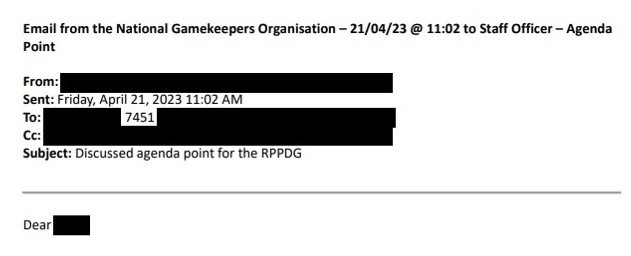
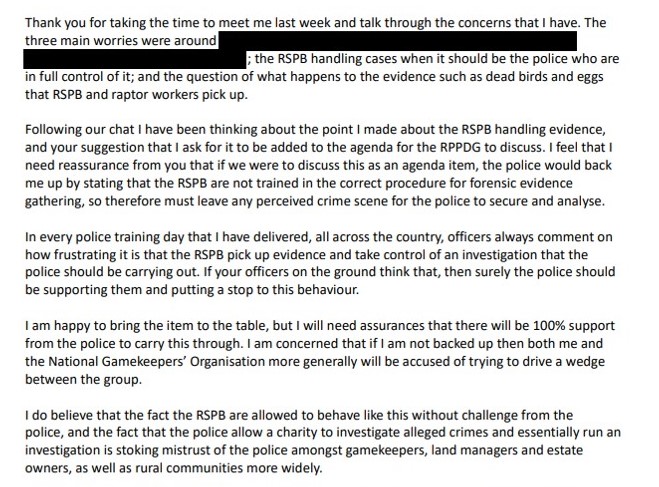
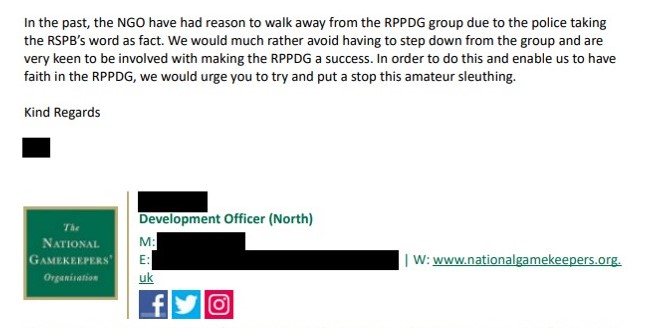
According to the FoI response I received from Northumbria Police, DCC Ford didn’t reply in writing to address the NGO’s complaints, but someone from DCC Ford’s office had a conversation with the NGO and suggested that the NGO raise the issue at the next RPPDG meeting.
In response to that suggestion, the NGO’s Development Officer (North), who I presume is John Clarke, wrote back to DCC Ford’s staff officer wanting “assurances that there will be 100% support from the police to carry this through” and he included a veiled threat about the NGO leaving the RPPDG (having already resigned once before) if the police didn’t support the NGO’s attack on the RSPB:
Interestingly, the NGO’s complaint has not been raised at any subsequent RPPDG meetings, presumably because the police refused to support it.
Why is the National Gamekeepers Organisation still serving on the RPPDG? It’s absurd to think that this so-called ‘partnership’ for tackling raptor persecution crimes will achieve anything of significance whilst the NGO is attempting to disrupt police investigations via the back door.
Press release from North Wales Police (7th March 2024):
Wrexham man charged with wildlife offences
A man has been charged with attempting to take Goshawks in a cage trap on land on the outskirts of Wrexham.
Young goshawk in a cage trap. Photo by RSPB (file photo, not linked to this case)
Birds of prey such as Goshawk are protected under the Wildlife and Countryside Act 1981.
The 47 year old man from the Wrexham area was postal charged with using a trap for the purpose of killing or taking a wild bird and possessing an article capable of being used to kill or take a wild bird.
He is due to appear before Wrexham Magistrates Court on Thursday, March 28th.
North Wales Police rural crime team will pursue anyone targeting wildlife and continue to work with our partners the RSPB and National Wildlife Crime Unit.
ENDS
This press release is quite vague, and I believe deliberately so. Definitely one to watch. Comments are closed until criminal proceedings have concluded.
UPDATE 9th March 2024: This blog article has been picked up by Nation Cymru, the Welsh news service, here.
UPDATE 27th March 2024: Gamekeeper Stuart Hart due in court tomorrow to face charges of alleged wildlife crime (here)
Press release from Scottish SPCA (7th March 2023):
Penicuik man receives ban from keeping animals for five years after trapping and killing magpies
Alexander Hamilton was sentenced to a five-year ban from owning and keeping animals and 100 hours of community service at Edinburgh Sheriff Court on Tuesday, 5 March.
64-year-old Hamilton of Windsor Drive, Penicuik pled guilty to trapping magpies in illegal traps in his garden causing them distress. The birds were also deprived of adequate food water and shelter.
Scottish SPCA Chief Inspector Mark Rafferty, Special Investigation Unit, said:
“On 29 July 2022 our animal helpline received a call from a resident in Windsor Drive, Penicuik reporting two magpies caught in cages in the back garden of a neighbour.
We attended that same day but found no one at home. On looking over the fence into the back garden, we observed a Larsen Mate trap and two other cages. The two cages had no suitable shelter, food or water and no visible tag attached to them.
We attended later that day at the address and the occupier, Hamilton, let us into his garden. We found a dead magpie lying on the paving slabs in the back garden, just inside the gate.
In the bottom corner of the garden, screened off from the rest of the garden by a large unsecured fencing panel, was an area where there were three traps.
Three of the magpie traps in Hamilton’s garden. Photo: SSPCA
The first trap was a Larsen Mate trap containing one Magpie. The bird was in a distressed state due to being confined within the trap and was in poor condition. This trap was of a manufactured type, and was specifically designed for the purpose of catching targeted species.
Crow cage traps and Larsen traps are bird traps used to catch various territorial members of the crow family most commonly used by gamekeepers or sheep farmers.
Trap operators are responsible for traps carrying their Trap Registration Number and all traps used must only display a single tag or sign showing one NatureScot Trap Registration Number. These conditions were not being adhered to rendering this trap illegal.
The second trap contained one magpie and there was also a cage containing a magpie in poor body condition.
The magpie within this cage was distressed and managed to squeeze through the mesh on the floor of the cage and enter a space underneath the adjacent shed. The bird could be heard scraping and pecking at the wooden floor of the shed and was clearly distressed.
The birds were released from the cages and the traps and were released back into the wild.
We’re pleased with the five-year ban at the sentencing result. All animals should be protected from suffering and this includes magpies. Our team treat these cases seriously and it is good to see that the courts share this view. We will continue to investigate this type of offending, to ensure people like Hamilton are caught and stopped from further cruelty acts. I would like to thank the Procurator Fiscal Karon Rollo and the Wildlife and Environmental Crime Unit.
If anyone is concerned about an animal, they can contact our confidential animal helpline on 03000 999 999.”
ENDS
This is a good conviction for the Scottish SPCA, who reported Hamilton to the Crown Office using their powers under the Animal Health & Welfare (Scotland) Act 2006 and without needing support from Police Scotland (contrary to MSP Edward Mountain’s ludicrous claims that the SSPCA lacks the qualifications and training to implement the law).
There looks to have been some plea bargaining on the sentencing. According to this article in Edinburgh Evening News, Hamilton’s defence lawyer told the court that Hamilton owned two gundogs and asked for any animal ban imposed by the court to exclude those animals.
Sheriff Gillian Sharp obliged by sentencing Hamilton to carry out 100 hours of unpaid work in the community and disqualified him from owning or keeping animals, with the exemption of his two dogs, for five years.
Hamilton is reportedly no longer a gamekeeper and is now employed as a labourer. His conviction means he can no longer operate under the terms of a General Licence until the conviction is considered spent.
Press release from Police Scotland (4th March 2024):
Photo: Ruth Tingay
47-year-old man arrested and charged following death of goshawk near Blairgowrie
On Thursday, 29 February, wildlife crime officers acting under warrant searched an estate near Blairgowrie with the assistance of our partners the RSPB and the SSPCA.
This resulted in a 47-year-old man being arrested and charged with killing a goshawk, which is a protected bird, contrary to section 1 of the Wildlife and Countryside Act 1981.
A report will be submitted to the Procurator Fiscal.
The incident took place on Monday, 12 February.
Police Scotland Wildlife Crime Coordinator Detective Sergeant David Lynn said:
“Police Scotland will pursue anyone deliberately targeting Scotland wildlife. This multi-agency day of action shows our collective commitment to safeguarding Scotland’s wild animals.”
ENDS
This is an efficiently-handled case by Police Scotland and agency partners SSPCA & RSPB. The time from the alleged offence and the subsequent arrest and charge is unusually short. It’s also good to see an early press statement – well done.
NB: As an individual has been charged this case is considered live so comments have been turned off until criminal proceedings end. Thanks for your understanding.
UPDATE 23 July 2025: Trial date for Scottish gamekeeper accused of killing a Goshawk on a Perthshire shooting estate (here)
UPDATE 17 September 2025: Change of trial date for Scottish gamekeeper accused of killing a goshawk on a Perthshire shooting estate (here)
UPDATE 12 November 2025: Trial of Scottish gamekeeper accused of killing Goshawk now delayed until March 2026 (here)
UPDATE 16 March 2026: Trial due to begin tomorrow for Scottish gamekeeper accused of killing a Goshawk on a Perthshire shooting estate (here)
UPDATE 17 March 2026: Scottish gamekeeper Russell Mason pleads guilty to battering a Goshawk to death on shooting estate in Perthshire (here)
UPDATE 18 March 2026: Convicted Scottish gamekeeper Russell Mason – more disturbing details about this case (here)
UPDATE 23 March 2026: Game-shooting industry’s response to the recent conviction of Perthshire gamekeeper Russell Mason (here)
UPDATE 24 April 2026: Scottish gamekeeper Russell Mason receives derisory sentence for brutal killing of Goshawk (here)
The SSPCA has issued the following press release in response to the recent conviction and sentencing of part-time gamekeeper Timothy Hall and his son, Lewis Hall, for the illegal laundering of Scottish peregrines which they were selling for high prices to buyers in the Middle East.
This press release contains details about the poor conditions provided by Timothy Hall for the raptors found at his address, and the subsequent return to the wild of the stolen peregrine chicks.
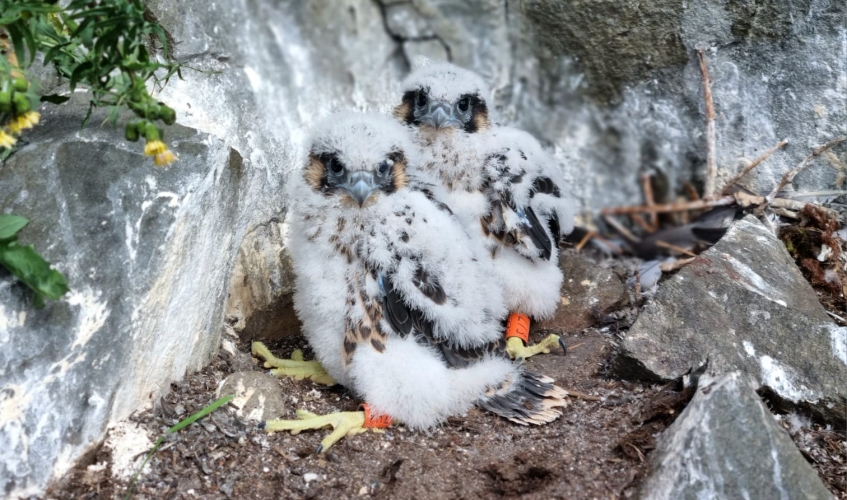
Young peregrines returned to the wild. Photo via SSPCA
Berwick men receive ban for illegally selling peregrine falcons
Timothy Hall previously pled guilty to the charges and was sentenced to a five-year ban from possessing or breeding birds of prey and 220 hours of community service at Jedburgh Sheriff Court today.
His son Lewis Hall was sentenced to 150 hours community service.
48-year-old Timothy Hall of Lamberton, Berwick Upon Tweed pled guilty in December to being responsible for nine birds of prey of various breeds. Failing to ensure a suitable environment, allowing a build-up of faeces and urates, and not providing an appropriate supply of water for bathing or drinking and did thereby expose the birds to disease or injury.
Lewis Hall, 23, of Fordyce Cottage, Duns, pled guilty to acquiring for commercial purposes, keeping for sale, and selling wild peregrine falcon chicks between 2020 and 2021.
Scottish SPCA specialist investigator, Mark Rafferty, said, “These birds are a protected species and it is illegal to disturb their nests or illegally breed them.
“During April 2021, information came to light that several Peregrine Falcon nesting sites around the Scottish Borders and East Lothian had seen thefts of eggs and chicks over a prolonged period of time.
“We carried out a raid, alongside the Police National Wildlife Crime Unit (WECU), where we found a number of peregrine falcon chicks and a number of adult birds at Hall’s address in Berwick.
“The entire housing/aviary situation was completely unsuitable in terms of size and design for the species being held in each unit. The lack of clean water, and failure to remove the excessive accumulation of faecal and animal tissue waste posed unacceptable health risks to the birds housed within.
“None of the birds were presented with an environment where breeding was likely either naturally or artificial insemination.
“Our team were able to take the peregrine falcon chicks to surrogate nests and monitor them from a distance. Once they had developed fully they were able to return to the wild safely.
“We are extremely disappointed at the sentencing result today. This was a specialised case which has taken years to appear in court. Our team, along with the Police Wildlife Crime Unit and David Anderson, Raptor ecologist from the Scottish Raptor Study Group , worked hard to provide sufficient evidence and DNA testing to get a better result.”
“If anyone is concerned about an animal, they can contact our confidential animal helpline on 03000 999 999.”