Statement expected from Environment Minister on shot buzzard

Following yesterday’s story on the shot buzzard found dead in the Scottish Borders, we tweeted Environment Minister Paul Wheelhouse and asked him this:

@PaulWheelhouse Minister, are you now ready to take the action you promised? Another raptor crime on your watch.

To his credit, he responded this morning:

@RaptorPersScot I will say more when I have a full briefing but my first reaction is instinctive – I’m both disgusted and very much angered.

We wait with interest…

Police appeal 3 weeks after shot buzzard found dead in Borders

Police in the Scottish Borders are appealing for information after a shot buzzard was found dead close to St Mary’s Loch.

The dead bird was found by a dog walker on 6th March and it’s believed to have been there for about three days.

BBC news article here

It’s good to see the police launch an appeal but why did it take three weeks? Good to see also that this incident features on their own website (here). Perhaps this is the influence of the new wildlife crime officer in this region, PC Hannah Medley? Good for her if it is.

Anyone with info about this incident, please call the police on 101.

Oh, and Environment Minister Paul Wheelhouse, we’re hope you’re watching. Here’s ANOTHER crime against birds of prey in Scotland – and another one that won’t show up on the annual poisoning maps. How many more incidents are needed before you take the action you’ve promised us you’ll take?

Pets killed by the bird poisoners

poisonThere’s an article in the Express today talking about pets that have been poisoned by gamekeepers (see here). According to the article, ‘new figures show 60 dogs and 28 cats have been poisoned in the last decade’. Unfortunately, the article doesn’t tell us who published these ‘new figures’ or on what evidence they’re based.

We do know that pets are poisoned, snared, shot etc by gamekeepers because we’ve read the stories in the newspapers and seen the toxicology reports –  we just aren’t sure about the accuracy of these ‘new figures’.

The article goes on to say, ‘over the past decade more than 250 protected birds such as golden and white-tailed eagles, peregrine falcons, red kites and buzzards have died and there are fears a child could fall victim if they touch the bait’. This figure, we know, is definitely an underestimate of the number of raptors poisoned over the last decade.

The main thrust of the article is based around last week’s news that the UK government has decided to ignore the Environmental Audit Committee’s recommendations for addressing wildlife crime (see here) and how the Opposition are now slagging them off for it.

If you think gamekeepers should be held accountable for what they get up, please sign this e-petition: HERE.

2013 wildlife crime conference: Paul Wheelhouse, Environment minister

The 2013 Scottish Police Wildlife Crime conference took place last Thursday (14th March). Many of this year’s presentations were once again directly relevant to raptor persecution and we’ll be commenting on these in due course.

To start off this year’s blog series, here are excerpts from the Environment Minister’s speech. He started by thanking the organisers etc before moving onto the meaty stuff:

“We’re now more than a year on since the passing of the Wildlife & Natural Environment (Scotland) Act 2011 and my predecessor, Stewart Stevenson, stood here last year and, amongst other things, talked about the new vicarious liability provisions. Now, we’ve not seen any prosecutions under the vicarious liability yet; I think it remains very likely that circumstances will arise in the future when these provisions can be brought into play and we will all be very interested to see how they work out in court.

In the meantime though, I am certain that whilst persecution of wild birds does exist in parts of our countryside, this change in the law has already had a deterrent effect as responsible land managers take a close look at management practices and training for employees and contractors. As Stewart said last year, we’ve never been out to get prosecutions; we just want to see an end to these criminal acts. However, if a conviction is what it takes to make those breaking the law stop, take notice and address their behaviour, then so be it. I shall be keeping an eye on this particular area with interest. A true test of course may be when we see raptors in all areas that should be their natural habitat and a disappearance of these ‘not spots’.

So what’s coming up in 2013? Legislative changes my team of policy officials have been working on which are of relevance to the conference include provisions relating to snaring, and invasive non-native species, and you will be hearing more from Catherine Murdoch about non-native species later today, and Kenny Wilmott from BASC will be talking about the importance of keeping up to date in relation to the use of snares and traps.

2013 will also see the publication of the first government report into wildlife crime. Policy officials are currently working on this and I’m sure it will make for an interesting read and it will no doubt provide a focal point to drive forward the debate on what is a very important topic. What we are looking to achieve with this report is an idea of what wildlife crime in Scotland looks like overall, the big picture if you will. This will not be easy because it’s the first report, there’ll be nothing to compare it with. However, like poisoning maps, once we have a few reports published we will hopefully start to see trends and pictures emerge. It will also be a challenge to compare data from all of the different agencies such as the police, National Wildlife Crime Unit, the Crown Office and the Scottish Government Justice Department. However challenging that may be, it is an extremely worthwhile cause. And unfortunately crimes and any resulting prosecutions don’t fall neatly into calendar years. They also are not always recorded in a manner which allows for obvious interpretation of the charges. So for example, where there is more than one charge, which so often occurs in the lesser charges of wildlife crimes, then the main charge is usually what appears in the records. We’ll therefore be looking to present the data as simply as possible, but with a view to ensuring any comparisons are meaningful, if indeed that is possible. And I’m looking forward to the publication of this report to act as a standard we can use going forward. I will leave the experts to talk to you about the legislative changes across the rest of today, however should you fancy a chat with a policy official over a sausage roll at lunch, please feel free to collar any one of them.

I’d like now to turn to the annual raptor poisoning maps which were published this morning. These maps generate significant media interest and many of you will already have seen the figures. There has been a major drop in confirmed incident numbers recorded for 2012 and this must be welcomed in the warmest possible terms. Whilst any poisoning is unacceptable, the fact that just three birds were confirmed poisoned in 2012 – a golden eagle and two buzzards – must represent progress. This is the second significant drop in two years and we hope it is evidence of the beginning of the end of poisoning of birds of prey in Scotland. We are now, however, facing a critical moment with the maps. The purpose of the maps is to highlight problem areas with an agreed and confirmed set of data, and to build the partnership working within PAW. So, so far we’ve made good progress on those objectives but we cannot now afford to see things slipping back. So let me make it abundantly clear: poisoning cannot be replaced with other types of persecution, and whilst it’s not appropriate for me to elaborate, I was heartened to hear that the police investigation into the 2012 poisoning case for a buzzard has made progress. And it does sicken me that unfortunately, once again, a bird has died as a result of Carbofuran poisoning, but I very much hope to see a positive outcome in that particular case. If we do continue to see a downward trend with the poisoning maps, but there is evidence perhaps of other types of persecution taking its place, as I’ve already said on the record, I will have no hesitation nor indeed very little option but to consider what other measures might be necessary.

optableLast year we lost two golden eagles – one was poisoned, another was found dead in suspicious circumstances, whilst a third which was shot is thankfully in recovery with the SSPCA, and I must thank Chief Superintendant Mike Flynn and his colleagues for their excellent efforts in caring for the eagle so far and I look forward to one day seeing that particular victim of a crime return to good health. These golden eagle incidents generated a huge amount of media and public interest and rightly so, as our golden eagles are part of what makes up our national identity. As a partnership we share a duty of care to work hard to stop wildlife crime and as I stated earlier, we will know if we’ve achieved success when we see the raptors return to areas where they are currently absent. And we must also recognise that this will not happen overnight.

Keeping on the raptor theme, the Raptor Persecution Priority Delivery Group, which is a key PAW Scotland group, has been continuing to look at a number of initiatives, latest being a hen harrier action plan. The members of this group have come up with a strategy to look at the status of this species across Scotland and see what can be done to help it recover. Whilst the plan is still being finalised I wanted to draw your attention to it and highlight what work is being done in the background. This is an exciting piece of work and I hope it will build on the partnership working approach by involving all those on the ground in monitoring and reporting on nesting birds. If I’m standing here this time next year, I hope that I’ll be able to give you an update as to what’s been accomplished and that genuine progress is being observed”.

The Minister then went on to discuss other areas of wildlife crime, police reform in Scotland and the Year of Natural Scotland. He ended by thanking everyone for their work and particularly on behalf of “the innocent victims of wildlife crime who clearly cannot speak for themselves”.

Comment:

It’s tempting to make comparisons between Scotland’s Environment Minister and his UK equivalent. In light of the UK government’s appalling recent attitude towards dealing with wildlife crime, Wheelhouse looks like an environmental god. He isn’t that, but he is certainly a good way further ahead than his contemporaries south of the border. But although comparisons are useful, it’s also important to assess his presentation just within the context of Scottish wildlife crime, and particularly within the field of raptor persecution.

In our opinion, this presentation drew the battle line. Wheelhouse is exceptionally well-informed on the persecution issue (especially for someone who has only been in post for six months), he understands the important details of how these crimes are reported (or not reported) and he seems genuinely determined that raptor persecution will not be allowed to continue on his watch.

Wheelhouse is clearly not fooled by the superficial short-term results of the poisoning maps. He understands that other persecution methods are being used to achieve the same effect. He understands that despite vicarious liability and other measures, persecution will undoubtedly continue. He understands that the only true measure of success will be the return of raptors into areas where currently they are conspicuously absent. He understands the shambolic state of raptor crime reporting and the limitations of the data in their current format. He understands the fury and frustration we all experience when we hear of yet another persecuted bird of prey and he seems to understand that our patience has run out – we simply will not tolerate this disgraceful practice any longer.

Of course, it’s easy to give a rousing speech and to say the things the audience wants to hear. It’s fair to say that most of us have become jaded by the empty rhetoric that’s been heaped on us decade after decade while the raptor killing continues right under our noses. However, to be fair to Wheelhouse, he personally is not responsible for all those previous platitudes and promises. Is he going to be different and stick by his commitment to stamp out persecution? More than with any other Environment Minister of recent years, there is a sense that something is going to happen this time. As always though, it will be the actions that follow the words that we’ll be taking the most interest in. The battle line has most definitely been drawn and now it’s a question of watching and waiting. The next persecution incident is just around the corner…

Poisoning stats down, incredulity up

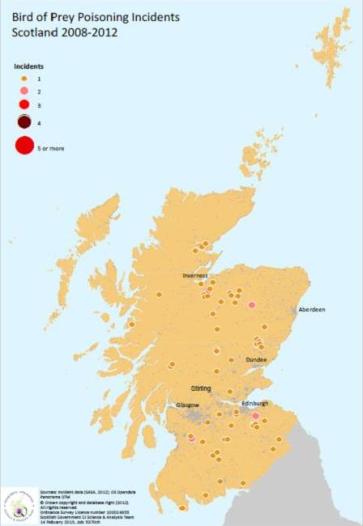
Poisoning 2008-2012The ‘official’ 2012 incidents of confirmed poisoned raptors in Scotland have just been published and show a marked decline in the number of poisoning incidents. According to the latest figures, the number of reported poisoned raptors fell from 16 in 2011 to three in 2012 (one golden eagle and two buzzards).

PAW Scotland press release here

BBC news article here

Are these figures an accurate reflection of what’s going on? We don’t think so. In fact we know they’re not. What the latest poisoning maps fail to show is the number of poisoned baits that were discovered in 2012, the number of other bird species that were poisoned in 2012, and the number of other animals that were poisoned in 2012. And obviously the maps don’t show the poisoning incidents that went undetected/unreported in 2012.

We know for certain that missing from this map is a poisoning incident recorded in the ‘Border’ region in May 2012. According to the published SASA statistics, a poisoned raven and crow were found, along with meat bait and two rabbit baits. This incident is listed as being subject to an ‘on-going police investigation’. Notably, this incident was not reported in the press. Why not? More importantly, why is this incident missing from this map? Why is the focus just on the number of confirmed poisoned raptors? Yes, the illegal poisoning of raptors is of huge concern, but it’s not just raptors that are victim to this barbaric practice. By excluding the discovery of poisoned baits and other types of poisoned species, the wider picture is not being shown. Why is that?

For example, we also know from the SASA stats that a horse and a dog were poisoned with Strychnine in January 2012, a cat was poisoned with Carbofuran and Isofenphos in March 2012, and another cat was poisoned with Carbofuran and Isofenphos in July 2012. None of these incidents appear on this map. There may well be others but the published SASA stats only go up to September 2012 – there’s the customary six-month delay in publishing more recent incidents. Obviously it’s not in the public interest to know where and when lethal poison is being laid out until many months after the event.

On a similar note, has anyone noticed the dot on the map in the Whithorn region (SW Scotland)? Could this possibly be the dead buzzard we blogged about last week (see here)? All we were told was that a man had been arrested following an investigation into a dead buzzard that had been found on the Glasserton Estate. Why didn’t the police press statement mention that the forensic tests confirmed it had been poisoned? Why are we not warned when potentially lethal poisoned baits are being placed out in areas where we might visit with our children and our pets? Why is it so difficult to tell the public what’s actually going on?

On a superficial level then, the latest figures suggest that all those people who’ve been busily poisoning our raptors for the last 100+ years have suddenly stopped. It’s highly implausible, but of course it is possible. Other possibile explanations include (a) the illegal poisoners have just got better at hiding the evidence; (b) they’ve switched to a new type of poison that isn’t currently being screened for in the SASA lab; (c) they’ve switched from poisoning as their method of choice to other methods that are less detectable, such as shooting and trapping.

Fortunately, the authorities are wise to point (c). Environment Minister Paul Wheelhouse said: “There has been real progress but we will not be complacent. I am determined to stamp out these practices once and for all and will remain vigilant to any change in approach being taken by those who seek to persecute raptors“. Of course, this statement is almost a carbon copy of statements made by previous Environment Ministers, going back several years, all of whom were ‘determined to stamp out illegal raptor persecution’ and all of whom failed. The current Minister has recently been presented with three perfect opportunities to make a stand: the dead golden eagle found on Deeside with two broken legs which is believed to have been caught in an illegal trap on an Angus grouse moor before being dumped further north away from the estate (we’ll be blogging more about this case in the next few days); the shot and critically injured golden eagle found on a grouse moor in Dumfries and Galloway; and the shot hen harrier that was found dead on another sporting estate in Grampian. It’ll be interesting to see how many more of these incidents he will tolerate before stronger sanctions are applied. Or, more to the point, how many more incidents we will allow him to tolerate.

Arrest after dead buzzard found on Glasserton Estate

Dumfries and Galloway Constabulary have arrested and bailed a 62 year old man from Whithorn in relation to a number of offences under the Wildlife and Countryside Act 1981, following an investigation into the death of a buzzard, which was discovered on the Glasserton Estate, Whithorn, in December 2012. The case has been the subject of a detailed police investigation which included a forensic examination of the dead bird.

We don’t have any further details at the moment. Thanks to the journalist at Express newspapers for passing this info on to us.

If you think gamekeepers should be held to account under a licensing scheme, please sign this e-petition: HERE

Landowners & gamekeepers claim ‘misrepresentation’ on BBC’s The One Show

One-Show-smallScottish Land and Estates and the Scottish Gamekeepers’ Association have written a letter of complaint to the BBC, claiming ‘misrepresentation’ on The One Show programme.
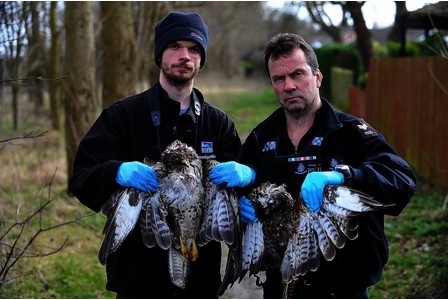
The programme (see here and here) included a feature on golden eagle persecution and during a studio interview, the RSPB’s Stuart Benn laid the blame firmly at the door of gamekeepers on Scottish grouse moors.

Doug McAdam, Chief Exec of Scottish Land & Estates, took great exception to that statement and wrote a hilarious letter of complaint, on behalf of SLE and SGA, to The One Show’s executive editor, Sandy Smith.

Here is his letter: SLE SGA complaint about BBC One Show

According to dear old Doug, there have only been four dead golden eagles found since 2010 and no charges [for these deaths] have been brought against anyone involved in grouse moor management. Conveniently, he failed to include the other known incidents of dead raptors turning up on grouse moors since 2010 (including white-tailed eagles, red kites, hen harriers, buzzards, short-eared owls, sparrowhawks, peregrines, kestrels), or the critically-injured golden eagle found shot and left to die on a grouse moor, or indeed the satellite-tagged raptors (particularly golden eagles and hen harriers) who have all gone ‘missing’ after their last known signal was received from, er, a grouse moor. There may well be more of these ‘missing’ birds but of course we’re no longer allowed to hear about them after the introduction of the new PAW Scotland ‘protocol’ that aims to keep these incidents away from the public’s gaze (see here).

Apart from trying to play down the extent of persecution incidents on grouse moors, and inferring that a lack of criminal convictions is a good indicator that gamekeepers are not involved with the illegal killing of golden eagles on grouse moors, Doug goes on to emphasise the SLE’s involvement with PAW Scotland, as though membership of that ‘partnership’ should be a measure of good behaviour. We’ve all seen how effective these ‘partnerships’ can be, following the near-extinction of breeding hen harriers on English grouse moors during the six-year Hen Harrier Dialogue ‘partnership’ designed to resolve the conflict. Indeed, three raptor conservation organisations have now resigned from that particular ‘partnership’ because they recognised it could be used as a convenient political cover by certain organisations with grouse-shooting interests.

Doug makes an astonishing claim about the PAW Scotland partnership: “Our combined efforts with the police, rural communities, the RSPB and over 120 other relevant stakeholders have been universally acknowledged as a key factor in reducing the number of raptor persecution incidents“.

Talk about misleading! For a start, there are not 120 ‘relevant stakeholders’ in relation to addressing raptor persecution. Many of the stakeholders have absolutely no involvement in directly addressing raptor persecution – they are there to specifically address other types of wildlife crime such as poaching, theft of freshwater pearl mussels, bat persecution and badger persecution.

Secondly, where does this notion come from that work by PAW Scotland has been ‘universally acknowledged as a key factor in reducing the number of raptor persecution incidents’? Has it been ‘universally acknowledged’? We don’t think PAW Scotland has had any demonstrable impact whatsoever on the number of raptor persecution incidents – where’s the evidence? Perhaps by ‘universal’ he means those with a vested interest in having people think that illegal raptor persecution is being dealt with effectively (e.g. the police, SNH, Scottish Government, SLE, SGA etc etc).

Doug finishes by saying, “Owners of moorland estates all over Scotland look after golden eagles” (ahem) and he invites Sandy Smith to visit a grouse moor “to find out for yourself the valuable conservation measures being implemented“. Let’s hope Sandy takes him up on his offer. Ooh, which grouse moor to choose? We could give Sandy quite a few suggestions….

Sandy Smith responded with a letter of his own: One Show’s reply to SLE

He says he’s sent an email to all One Show staff and suppliers “asking them to ensure they don’t make assumptions about gamekeepers based on out of date or inaccurate assumptions“.

Interestingly, Sandy Smith was the former executive editor of Panorama – a programme recognised for its investigative journalism and an ability to differentiate between fact and PR. Let’s hope he’s taken those qualities with him to The One Show.

We’ve sent a letter to Sandy, giving him the URL of this blog, to ensure his staff are kept up to date and are not basing their work on inaccurate assumptions (spin). You may wish to do the same – send your email, marked for the attention of Sandy Smith, to: TheOneShowEmails@bbc.co.uk

If you think grouse moor owners and their gamekeepers need to be held to account for their activities, please sign this e-petition and share it with your friends and colleagues: SIGN HERE.

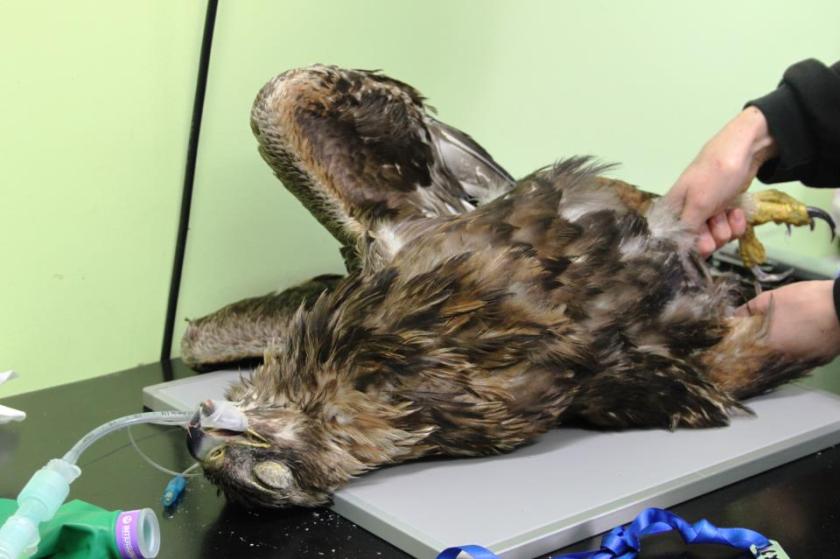
Here’s a photo showing how well golden eagles are looked after on some Scottish grouse moors. This one was found critically injured on Buccleuch Estate last aututmn – he had been shot and left to die, although it is not known on whose land he was shot. He is currently recuperating with the SSPCA after undergoing life-saving surgery. Needless to say, nobody has been charged for this crime.

The shot golden eagle undergoing emergency surgery

Would you believe it, another guilty gamekeeper!

Another day, another location, another criminal gamekeeper, another wildlife crime conviction, another shit sentence.

This time it’s gamekeeper Shaun Leslie Allanson (37), convicted of crow cage trap misuse on the Blansby Park Estate, nr Pickering, North Yorkshire.

Today at Scarborough Magistrates Court, this ‘professional’ pleaded guilty to intentionally taking a buzzard using a live pigeon in a cage trap on 28 Aug 2012, and using a cage trap with a live pigeon decoy between 31 Aug and 19 Sept.

His punishment? 120 hours community service and £85 costs. Wonder if he’s a member of the National Gamekeepers’ Organisation? We’ll do some asking….

There’s a fuller story in the Telegraph here.

Well done North Yorkshire Police and well done to the Natural England employee who first recognised the crow trap was being used illegally and for releasing the buzzard to safety.

2 buzzards shot & dumped in ditch

4571243Two buzzards have been shot and dumped in a ditch in East Yorkshire.
The birds were discovered by members of the public on Tuesday, on the edge of Burton Constable estate near Sproatley. The RSPB has offered a £1,000 reward for information leading to a conviction.

Well done to Humberside police for publicising this incident so quickly, and particularly well done WCO Sergeant Dave Jenkins who made a short video to increase awareness about this crime.

Full story (and video) here.

And for posterity, the video can be watched on YouTube here

And here’s coverage of the story on BBC News website here

SNH species action framework conference: presentations & podcasts

species action frameworkSNH have been under fire in recent weeks over their controversial decision to authorise the use of clam traps. (Thanks, by the way, to all of you who took the time to contact SNH on this issue – we await their latest response with interest).

However, sometimes SNH do things well and this blog entry reflects that. Last November (2012), SNH held a Species Action Framework Conference in Edinburgh to discuss the results of their five-year programme focusing on the conservation and management of 32 species (see website here). Kudos to them for recently publishing the presentations, both as downloadable PowerPoints as well as Podcasts.

The following presentations may be of particular interest to RPS readers:

Managing Species Conflicts (Steve Redpath, Aberdeen University). Powerpoint presentation here; podcast here.

Sea Eagle (Andrew Stevenson, SNH and Rhian Evans, RSPB). Powerpoint presentation appears to be unavailable; podcast here.

Hen Harrier (Des Thompson, SNH and Simon Lester, Langholm Moor Demonstration Project). Powerpoint presentation here; podcast here.

The hen harrier presentation and podcast is particularly amusing, with head gamekeeper Simon Lester brushing over the reasons why none of the 34 Langholm harrier chicks raised during the current Langholm project have ever returned to breed at Langholm (er, because they’re dead?). Can’t blame the hen harrier anymore for failing grouse stock so instead he concentrated on buzzards and ravens as the prime culprits, although without producing supporting evidence. He did say that 78% of tagged red grouse had been ‘killed or eaten by raptors’. That’s quite a misleading statement – there’s a massive difference between ‘killing’ and ‘eating’. Who’s to say that the ‘eating’ wasn’t the result of scavenging the dead grouse as carrion? Anyway, we look forward, hopefully in the near future, to seeing some hard data rather than having to rely upon Simon Lester’s ‘beliefs’.

We’ll be blogging more about the demonisation of buzzards at Langholm in a later post – we’re currently reviewing some fascinating data that show, fairly conclusively on first appraisal, that red grouse are not a major component of the buzzards’ diet at Langholm. Watch this space…