Case against Stody Estate gamekeeper Allen Lambert: part 2

Last week we blogged about Norfolk gamekeeper Allen Lambert who had been charged with seven alleged wildlife crime offences including the killing of 14 buzzards, 1 sparrowhawk and 1 tawny owl (see here).

The case against 64-year old Lambert, a gamekeeper on the award-winning Stody Estate, was heard last Thursday (19th December 2013) at Kings Lynn magistrates court.

It has been reported that Lambert pled guilty to keeping banned pesticides (Mevinphos & Aldicarb) but denied killing raptors and keeping some of their bodies.

His case was adjourned until 22nd January 2014.

Interestingly, the news report calls Lambert a ‘former’ gamekeeper.

News report from EDP24 here.

Golden eagle found poisoned on Angus grouse moor

A two-year old golden eagle named ‘Fearnan’ has been found dead on a Scottish grouse moor. He had been poisoned with a banned pesticide. The poison hasn’t been named but we’ll take an educated guess at Carbofuran, the gamekeepers’ poison of choice.

Interestingly, there are three separate press releases about this latest disgraceful crime:

One from the government via PAW (here)

One from the police (here)

One from RSPB Scotland (here)

Usually, we’re lucky to see anything for at least 4-5 months after the crime so it’s somewhat surprising to see the scuffle for media attention on this one. Could this be a sign that Environment Minister Wheelhouse has put his foot down and demanded that timely press statements are released? We can’t think of any other reason why the police should suddenly change their tactics from seemingly apathetic to seemingly responsive.

Of course, regular blog readers will already know that Fearnan is not the only poisoned eagle to have been found dead in the Angus Glens. In fact, there’s been a fair bit of raptor persecution over the last nine years. Here’s a list of incidents we’ve compiled from various published reports:

2004 May, near Edzell: long-eared owl and two short-eared owls starved to death in crow cage trap.  No prosecution.

2004 May, Invermark Estate: peregrine nest destroyed. No prosecution.

2006 March, Glenogil Estate: poisoned rabbit bait (Carbofuran). No prosecution.

2006 April, Easter Ogil: poisoned buzzard (Alphachloralose). No prosecution.

2006 April, Easter Ogil: poisoned tawny owl (Alphachloralose). No prosecution.

2006 May, Glenogil Estate: poisoned rabbit bait (Carbofuran). No prosecution.

2006 June, Glenogil Estate: poisoned woodpigeon bait (Carbofuran). No prosecution.

2006 June, Glenogil Estate: Traces of Carbofuran found in estate vehicles & on equipment during police search. No prosecution. Estate owner had £107k withdrawn from his farm subsidy payments. This was being appealed, but it is not known how this was resolved.

2006 July, Millden Estate; poisoned sheepdog (Lindane). No prosecution.

2007 November, Glenogil Estate: Disappearance of radio-tagged white-tailed eagle ‘Bird N’ coincides with tip off to police that bird been shot. No further transmissions or sightings of the bird.

2008 May, ‘Nr Noranside’: poisoned white-tailed eagle ‘White G’ (Carbofuran, Isophenfos, Bendiocarb). No prosecution.

2008 May, ‘Nr Noranside’: poisoned buzzard (Bendiocarb). No prosecution.

2008 May, ‘Nr Noranside’: poisoned mountain hare bait (Carbofuran, Isophenfos, Bendiocarb). No prosecution.

2008 May, Glenogil Estate: 32 x poisoned meat baits on fenceposts (Carbofuran, Isophenfos, Bendiocarb). No prosecution.

2008 October, ‘Glenogil Estate: poisoned meat bait on fencepost (Carbofuran). No prosecution.

2009 March, Glenogil Estate: poisoned buzzard (Carbofuran). No prosecution.

2009 March, Glenogil Estate: poisoned buzzard (Carbofuran). No prosecution.

2009 April, Millden Estate: poisoned buzzard (Alphachloralose). No prosecution.

2009 July, Millden Estate: poisoned golden eagle ‘Alma’ (Carbofuran). No prosecution.

2009 August, Glenogil Estate: poisoned white-tailed eagle “89” (Carbofuran). No prosecution.

2010 May, ‘Nr Noranside’: poisoned red kite (Carbofuran). No prosecution.

2010 September, Glenogil Estate: poisoned buzzard (Chloralose). No prosecution.

2010 October, Glenogil Estate: poisoned buzzard (Carbofuran). No prosecution.

2010 October, Glenogil Estate: poisoned pigeon bait (Carbofuran). No prosecution.

2010 October, Glenogil Estate: poisoned pigeon bait (Carbofuran). No prosecution.

2011 February, Airlie Estate: buzzard caught in illegal crow trap. (see below)

2011 March, Airlie Estate: 3 x buzzard caught in illegal crow trap. Prosecution (!) but dropped after statement from suspect given to SSPCA deemed inadmissible.

2011 April, Millden Estate: shot buzzard. No prosecution.

2012 April, ‘Nr Noranside’: Remains of buzzard found beside pheasant pen. Suspicious death.

2011 June, Rottal & Tarabuckle Estate: dead kestrel inside crow cage trap. No prosecution.

2012 February, ‘Nr Edzell’: spring-trapped buzzard. No prosecution.

2012 February, ‘Nr Bridgend’: remains of buzzard found under a rock. Suspicious death.

2012 May, Millden Estate: satellite-tagged golden eagle caught in spring trap, then apparently uplifted overnight and dumped on Deeside. No prosecution.

2012 May, Glen Esk: disappearance of sat-tagged red kite. No further transmissions or sightings of bird.

2013 January, Invermark Estate: white-tailed eagle nest tree felled. No prosecution.

2013 November, Glen Lethnot: poisoned golden eagle. Prosecution? Highly unlikely!

We think you’ll agree, this is overwhelming evidence that some people in the Angus Glens are systematically persecuting birds of prey, they have been for many years, and those same people are avoiding criminal justice for their disgusting and illegal activities. We call them The Untouchables.

Why have they been able to avoid prosecution for so long?

Now would be a good time to ask the Environment Minister for an explanation. While you’re at it, please also mention your revulsion about the continued practice of illegal raptor persecution on driven grouse moors. The time for estate licensing is here; the game-shooting industry, quite clearly, cannot or will not self-regulate.  Emails to: ministerforenvironment@scotland.gsi.gov.uk

RIP Fearnan.
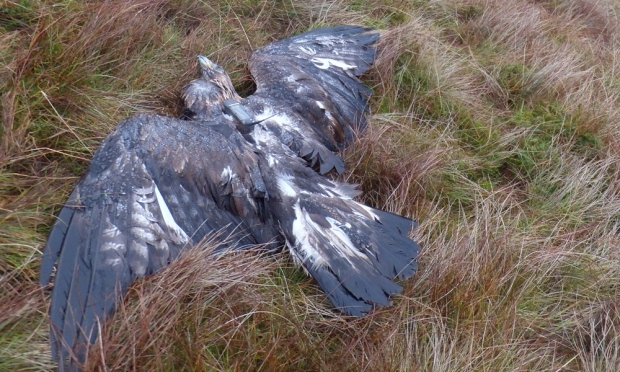
posioned GE Lethnot 2013

Poisoned buzzard found dead in Stirlingshire

Here we go again…

A dead buzzard found in Stirlingshire in September had been illegally poisoned, according to Police Scotland. Three months on, they are now appealing for information.

The buzzard was found by a member of the public in the Sheriffmuir area, north of Bridge of Allan. The name of the poison used has not been revealed.

Adding this incident to the already swollen tally of illegally-killed birds found in 2013, it is abundantly clear that illegal poisoning is most definitely not decreasing, despite what the game-shooting industry would have you believe. We have calculated a 66% increase in poisoning crimes this year, and there are still a couple of weeks to go.

You might want to email the Environment Minister, Paul Wheelhouse, and ask him (a) why the police appeal for information is three months late, and (b) what else he proposes to do about this disgraceful situation seeing as  illegal raptor poisoning in Scotland is back on the increase and current government measures to stop it are clearly not working.

Emails to: ministerforenvironment@scotland.gsi.gov.uk

News article here

Norfolk gamekeeper faces series of raptor persecution charges

A Norfolk gamekeeper is facing seven charges of alleged wildlife crime.

Allen Lambert, 64, of Stody, near Melton Constable, has been charged with killing 16 wild birds (14 buzzards, 1 sparrowhawk and 1 tawny owl), possession of nine birds (buzzards), failure to comply with a firearms certificate, and four counts of possession and storage of banned poisons (Aldicarb and Mevinphos).

The alleged offences took place between January and April 2013.

Lambert is currently on bail and will appear before King’s Lynn Magistrates court on Thursday (19th Dec).

News articles here and here

North Yorks still worst place for raptor persecution in 2012

The RSPB has published its 2012 Birdcrime report documenting bird persecution throughout the UK.

North Yorkshire has once again come top of the league for the number of reported crimes against birds of prey (34), with Aberdeenshire a close second with 31 reported incidents. Both counties, of course, include large areas of land used for driven grouse shooting.

The 2012 report includes statistics that are all too familiar: confirmed shootings of short-eared owls, sparrowhawks, buzzards, barn owls, tawny owls, hen harriers, golden eagles, marsh harriers, and peregrines; confirmed nest destruction of peregrines, goshawks and barn owls; confirmed illegal spring-trapping of buzzards, golden eagle and peregrine; other types of illegal trapping (including crow cage traps) of sparrowhawks, tawny owls, buzzards and goshawks; and the confirmed illegal poisoning of ravens, red kites, buzzards, golden eagles, marsh harriers, peregrines, cats and dogs.

Remember, these are just the confirmed incidents. Plenty more ‘probable’ and ‘unconfirmed’ cases, and of course there are all the incidents that went undiscovered/unreported.

Does that sound to you like the game-shooting industry is cleaning up its act?

Well done to the RSPB for their meticulous work and especially for their willingness to share these data with the general public.

RSPB press release here

Download the RSPB’s 2012 Birdcrime report here

The photograph shows the shot hen harrier Bowland Betty, found on a North Yorkshire grouse moor in 2012. Nobody has been brought to justice for her death.

‘Out of control’ buzzards need culling, says sporting estate landowner

It seems barely a month goes by without some idiot with a vested interest in game-shooting spouting off about the need to kill the plague of buzzards that has infested the countryside.

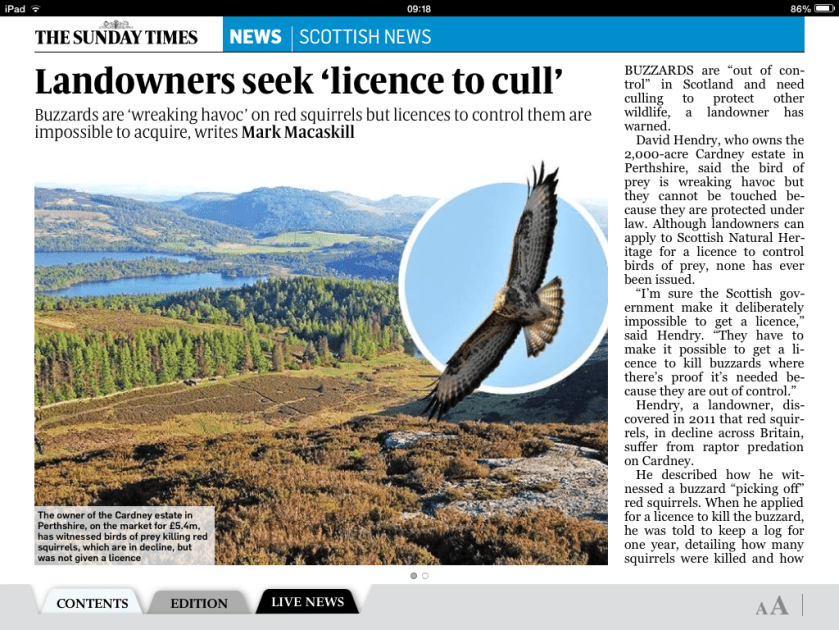
An article in yesterday’s Sunday Times reported that buzzards in Scotland are ‘out of control’ and ‘need culling to protect other wildlife’, according to David Hendry, the owner of Cardney Estate in Perthshire.

It’s no surprise that Hendry is at the centre of this latest claim. This former Chairman of the Scottish Gamekeepers’ Association has been calling for licensed raptor culling for over a decade, to include buzzards, sparrowhawks and peregrines (e.g. see here, here, here and here).

This time his justification for wanting a buzzard-killing licence was because he’d witnessed a buzzard eating red squirrels on his estate. Fortunately, his licence application to SNH was turned down because, surprise surprise, there was no evidence linking predation by the buzzard with a decline in the red squirrel population.

If we applied Hendry’s logic across the board, we would see requests for licences to kill golden eagles and a whole other suite of generalist predators whose diet may sometimes include red squirrel. It’s what predators do, Mr Hendry – they eat stuff. Get over it.

According to the article, Hendry’s desire to get a buzzard-killing licence was supported by Alan Stewart, the former Tayside Police wildlife crime officer who now works for the National Wildlife Crime Unit and who apparently has been mates with Hendry for years.

However, Stewart has written on his own blog that he was ‘mis-quoted’ in the Sunday Times article – apparently he wouldn’t support a ‘general cull’ of any bird of prey, but he would support a licence application to kill this particular red squirrel-eating buzzard, especially “since I knew the landowner concerned would not have abused any licensing privilege agreed“.

Good god. So a native bird eating a native mammal is cause for the bird to be killed??! Thankfully, the National Wildlife Crime Unit has no role whatsoever in the objective and scientific decision-making process concerning the granting of raptor-killing licences.

It’s bizarre that both Hendry and Stewart think that a buzzard is having such a detrimental impact on the estate’s wildlife that it needs be killed. According to Stewart, Cardney Estate has “an absolute wealth of wildlife” [despite the out-of-control buzzard, eh?] and Hendry’s pheasant and partridge shoots both seem to have managed just fine, with 677 birds shot on just one day in 2010 (see here).

Thanks to the contributor who sent in the following copy of the Sunday Times article:

Hendry1

Hendry 2

RSPB Scotland publishes 2012 persecution report

sam4RSPB Scotland has today published its annual persecution report which documents the known and suspected incidents of  illegal raptor killing throughout Scotland in 2012.

It’s a shame it’s taken so long to get it published, but that minor criticism aside, massive kudos and appreciation to them for their continued meticulous collection of these data and especially their willingness to publish them. Without these reports the general public, and probably the government, would be unaware of exactly what’s going on in our countryside. If we relied upon the ‘official’ figures (i.e. those ‘approved’ by the likes of Scottish Land & Estates, the Scottish Gamekeepers’ Association, Police Scotland etc) we wouldn’t know the half of it.

The 2012 report, just like all the previous 18 reports, makes for grim reading. Sure, it documents a reduction in the number of birds known to have been illegally poisoned last year; some people (guess who?) have spent much of 2013 shouting about this as being evidence of the game-shooting industry cleaning up its act – we know better – the 2013 figures (to date) show no such reduction and in fact show an increase in known poisoning incidents…but more of that next year. Let’s focus on the 2012 report for now.

Three things caught our attention in this report. The first thing was the Foreword by Stuart Housden, RSPB Scotland Director. This is the hardest-hitting Foreword of his that we’ve read. In the past it’s been a bit wishy-washy, with too many platitudes aimed at the landowning and gamekeeping communities and suggestions that the raptor killers are just an unrepresentative minority. This time it’s quite different:

It is evident that a significant number of individuals or estates illegally persecute birds of prey“.

Is this subtle change of language an indication that RSPB Scotland is tiring of the whole ‘partnership-working’ pretensions? Let’s hope so.

The second thing to catch our attention was an entry in Table 3 (page 24): Confirmed incidents of illegal killing or attempted killing (excluding poisoning) of birds of prey in Scotland, 2012

The entry of interest is this:

‘February. Buzzard caught in illegal spring trap. Nr Edzell, Angus’.

There isn’t any further detail about this incident, and it certainly hasn’t been publicised by the Police (no surprise there). However, for reasons that we can’t go in to right now, we are particularly interested in the details of this incident and would ask any blog reader with specific information to contact us, in confidence: raptor.persecution.scotland@hotmail.co.uk

The third thing that caught our attention was the Case Study: Poisoning in Progress (pages 19-20). This case relates to the discovery of poisoned corvids and poisoned bait found in the Borders in May 2012.

We’d blogged about this case in Sept 2012, criticising the Police for not publicising the discovery of poisoned birds and poisoned bait (see here). We also blogged about it in October this year, after the incident was excluded from the ‘raptor persecution’ section in the  Government’s ‘official’ 2012 Wildlife Crime Report (see here). We asked blog readers to contact the Environment Minister and ask why this incident had been excluded. Here is part of the reply received by one of our readers:

You ask why a bird poisoning incident was omitted from the Scottish Government’s first annual report into wildlife crime. I can advise you that the incident in question was not listed in the section on raptor crime because no raptors were involved“.

Now, have a read of the Case Study in the RSPB’s report. Guess what was found at the scene? “The feathers and bones of two dead buzzards, lying beside the old, dried-out carcases of two rabbits, in a wood beside a partridge rearing pen. A dead crow was also found a short distance away“.

That’s a pretty clear indication that raptors were indeed involved.

According to the Case Study report, the rabbits were covered in dead insects (a sure indication of the presence of poison) and they were submitted for toxicology analysis, along with the crow. The buzzards were not submitted as they were considered too decomposed.

The results – all contained the pesticide Bendiocarb.

There was no police follow-up, no search, no nothing. Why not, when there was clear evidence of long-term poisoning at the site? And even better, the site is a very well-known raptor persecution blackspot in the Borders, where many other poisoned raptors have previously been discovered.

It’s just the same old familiar pattern, same shit, same locations, different year. The sooner the Government launches its public consultation on increasing the powers of the SSPCA to allow them to investigate raptor persecution, the better. (Where is that consultation anyway? We heard it would be launched in mid-Oct. No sign yet…)

Anyway, well done and thanks again to RSPB Scotland – funny, lots of poisoning, trapping and shooting incidents but not a single ‘death by tree’ report!!

Download the report: The Illegal Killing of Birds of Prey in Scotland 2012

More on that vicarious liability prosecution

wane1Regular blog readers will know that we’ve been chasing information about the first potential prosecution under the new vicarious liability legislation for some time.

The case in point relates to the conviction of gamekeeper Peter Bell, who was guilty of poisoning offences on the Glasserton and Physgill Estates in December 2012 (see here).

In July 2013 we asked the Environment Minister for an update on the VL prosecution (see here). He replied in August and said it would be inappropriate to comment as police enquiries had not yet concluded (see here). Fair enough.

By early October we expected the police enquiries to have been completed, ten months after the original offence was committed, so we asked the Environment Minister for an update (see here).

One of our blog readers wrote the following comment a couple of days ago:

I duly sent an e-mail to Mr Wheelhouse about the update on whether or not there would be a prosecution under the vicarious liability following Mr Bells conviction. I’m apparently not allowed to post the reply anywhere but was told Mr Wheelhouse is unable to enter into discussion about such matters and I was pointed in the direction of The Crown Office and Procurator Fiscal Service for any information I might want“.

Interesting. So the first excuse given was that ‘police enquiries had not yet concluded’, and that has now changed to ‘Wheelhouse is unable to enter into discussion’ (and apparently members of the public are not permitted to publish the Minister’s replies to their queries).

Anyone getting the impression that these answers are designed to subdue any further reporting on this case?

Wheelhouse has apparently suggested contacting the Crown Office and Procurator Fiscal Service for the information. Let’s do that, taking note of the word ‘service’ – they are supposedly serving us, the general public.

The thing is, we’re not too sure who within COPFS to contact for this information. Rumour has it that the head of the Wildlife and Environmental Crime Unit (WECU) at COPFS, Craig Harris, has since moved on. Rumour also has it that a new head of unit has been installed although it’s not clear who that person is, although six-figure-Dysart’s name has been mentioned. Hmm.

We could ask the Lord Advocate, Frank Mulholland QC, who is the ministerial head of COPFS, although we’ve been unable to find a direct email address for him.

Let’s try our luck with the COPFS’s general email address and ask the following questions:

Dear COPFS,

Please can you tell us the name of the new head of the Wildlife and Environmental Crime Unit at COPFS? And please could you tell us whether there will be a prosecution under the vicarious liability legislation relating to the poisoning offences carried out at the Glasserton and Physgill Estates in December 2012? Thanks.

Emails to: enquirypoint@copfs.gsi.gov.uk

UPDATE: The email address to use is apparently this: _WildlifeSpecialists@copfs.gsi.gov.uk  Please note the underscore at the beginning of the address. Thanks to the contributors who have provided this new address.

Scottish govt and police are concealing poisoning incidents

The fiasco that is wildlife crime reporting in Scotland continues today with the release of the Scottish Government’s poisoning stats for the second quarter of this year (i.e. incidents from April, May and June).

These stats are published by SASA (Science and Advice for Scottish Agriculture), a division of the Scottish Government. A few years ago they used to publish the figures in a timely way – these days they’ve introduced a delay of approximately six months.  Here they are.

The stats are quite interesting. Take note of the number of buzzard deaths attributed to ‘probable starving’. These are the buzzards that are supposedly devouring gamebirds quicker than you can say, “Quick, pass the Carbofuran”. But, there’s something far more interesting in the report than that….or rather it’s not in the report…

For some reason, several known poisoning incidents are ‘missing’ from the data. We know that these incidents took place in March, April and May in Highland and Tayside. For one of them (a poisoned buzzard in March), this incident should have been reported in the stats for Q1 (Jan, Feb, March), but it wasn’t. We didn’t challenge that because it was reasonable to assume that a police investigation/raid may still be on-going and any publicity about the poisoning might have compromised a police operation.

But, now it’s October. These poisonings took place 7, 6 and 5 months ago, respectively. There hasn’t been a whisper of a police press statement about any of them. Why not?

And now the Scottish Government’s quarterly poisoning report has been sanitised to remove any mention of these incidents. Why is that?

Who stands to benefit from the concealment of these incidents? Certainly some organisations with a vested interest in wanting the public to believe that poisoning incidents are still on a downward trend, when actually they are not – they are on the increase from last year’s figures but of course nobody wants to admit that and if the figures aren’t in the public domain then they don’t have to admit to it!

Who told SASA to remove the data on these incidents? Was it Police Scotland?

Why don’t we ask them. Let’s ask Sgt Andrew Mavin, who is the Police Scotland Wildlife Crime Coordinator and who is quoted as saying, “Tackling crime, keeping people safe and building confidence is at the centre of everything the new service in Scotland stands for and this is exactly the approach we take to wildlife crime” (see here).

Is it really, Sgt Mavin? Then how do you justify the concealment of these poisoning incidents from public scrutiny? Why didn’t Police Scotland issue a press statement about them? Why didn’t Police Scotland shout it from the rooftops that highly toxic and illegal poisons are being left out in the countryside putting peoples’ lives at risk? Did Police Scotland ask SASA to remove these incidents from their public report? How can we have any confidence in Police Scotland when we find out that serious crimes are being kept hidden from the general public?

Here is his email address: andrew.mavin@scotland.pnn.police.uk

And while we’re on the subject of official cover-ups….we’ve been having a closer look at the Scottish Government’s Wildlife Crime Annual Report (2012) that was published last week (see here). We’re still not ready to write a detailed review on that report but we did notice something that’s relevant to today’s blog – the 2012 poisoning figures given in that report number three incidents. Conveniently, at least one other poisoning incident is ‘missing’. It involved the death of a raven and a crow and the discovery of poisoned meat bait and 2 rabbit baits, and it happened in the ‘Borders’ in May 2012. We blogged about it (here).

Why was this incident excluded from the Scottish Government’s so-called ‘official report’ on wildlife crime in 2012? Was it because no raptor species was reported as being poisoned? In which case, in the 2013 report are we going to see the exclusion of the 35+ poisoned meat baits found in gamebags on Leadhills Estate this year, because no poisoned raptor was actually found?

Let’s ask Environment Minister Paul Wheelhouse: ministerforenvironment@scotland.gsi.gov.uk

Dear Environment Minister,

Please can you explain why confirmed wildlife poisoning incidents are being concealed from the public and excluded from official government reports?

Thanks.

Benyon given the boot

Some good news! Richard Benyon MP, the DEFRA minister, has been booted out in today’s Government reshuffle. He now returns to the back benches, presumably with more time to pursue his ‘sporting’ interests on his grouse moor in Scotland and his pheasant shoot estate in Berkshire.

Benyon had been in post at DEFRA for just over three years, with special responsibility for biodiversity and the natural environment, amongst other things (see here).

He is best known to us for being in office when a buzzard ‘management’ trial was sanctioned in 2012 (see here) which DEFRA almost got away with until public opinion forced a speedy government u-turn (see here).

Benyon also refused to criminalise the possession of the banned poison Carbofuran in England (see here) and didn’t see the need to introduce vicarious liability in England, but instead applauded gamekeepers “for the wonderful work they do in providing excellent biodiversity across our countryside” (see here).

Good riddance.