Case against Scottish gamekeeper William Dick: part 5

Criminal proceedings have continued against Scottish gamekeeper William Dick.

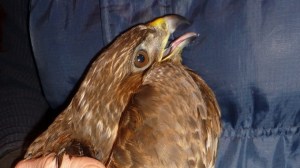
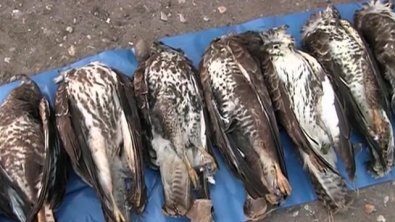
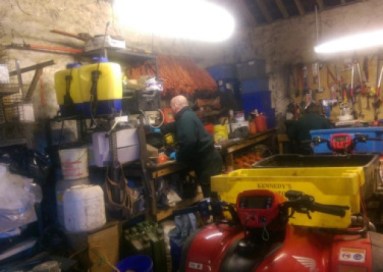
Dick, 24, of Whitehill Cottages, Kirkmahoe, Dumfries is accused of bludgeoning and repeatedly stamping on a buzzard. The offences are alleged to have taken place in Sunnybrae, Dumfries in April 2014. Dick has denied the charges.

An intermediate diet was heard at Dumfries Sheriff Court on 24th February 2015 and was continued for another hearing due to take place on 17th March 2015. A provisional trial date has been set for 23rd March 2015, pending the outcome of the next court hearing.

Previous blogs on this case here, here, here and here

Shot buzzard has to be euthanised

BZ shot west tilbury essex March 4th 2015 - CopyFrom the South Essex Wildlife Hospital, 4th March 2015:

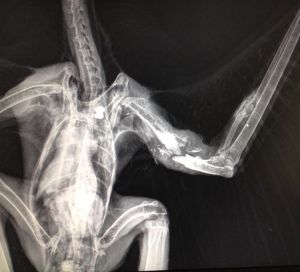
We had to euthanise a beautiful buzzard today, found in West Tilbury it had been shot at least 3 times, twice through the wing, it still has an air gun pellet lodged in its chest. We have of course notified this crime to the police“.

Thanks to Neil Phillips (@UK_Wildlife) for the notification.


Convicted vicarious liability landowner loses nearly £66,000 in subsidies

In January we blogged about the subsidy penalty given to Ninian Johnston Stewart, the first landowner to be convicted under vicarious liability legislation in Scotland after his gamekeeper laid out poisoned bait that killed a buzzard in 2012. At the time of Johnston Stewart’s conviction we knew that he’d lost some of his agricultural subsidy but we didn’t know how much. The only information in the public domain was the following quote from his defence agent, David McKie, who was discussing Johnston Stewart’s (derisory) fine of £675:

He [Johnston Stewart] had already been penalised substantially via a high five-figure deduction to his Single Farm Payment“.

The size of his subsidy penalty has now been revealed in the latest edition of the RSPB’s Investigations newsletter, Legal Eagle:

In 2012, Johnston Stewart’s business received nearly £120,000 in Single Farm Payments. Under ‘cross-compliance’ there is a requirement to comply with a number of conditions in order to receive payments. The poisoned bait and buzzard were found on land used for agriculture by the business and consequently he lost nearly £66,000 of the 2012 payment“.

That’s a good result, although you have to question why his entire 2012 subsidy (nearly £120,000) wasn’t withdrawn.

In other subsidy penalty news, regular blog readers will be aware that we’ve been trying to find out (unsuccessfully so far) whether the Stody Estate (Norfolk) has also received a subsidy penalty, following the conviction of gamekeeper Allen Lambert for poisoning 11 raptors (10 buzzards and a sparrowhawk) in 2012 and a series of other related crimes (see here, here, here, herehere and here). According to our reckoning, Stody Estate has potentially breached two Statutory Management Requirements: SMR1 (intentional killing of wild birds) and SMR9 (use of pesticides).

Thanks to the determination of one of our blog readers, here’s the latest response from the Rural Payments Agency:

12 February 2015

Ref: XXXXXX

Dear XXXXX

Re: Freedom of Information – Information Request

Thank you for your request for information dated 15 January 2015 which has been dealt with under Freedom of Information Act 2000 (FoIA).

To answer your questions:

1. Has the illegal poisoning of birds of prey carried out by an employee of the Stody Estate been reported to the RPA as a possible breach of Cross Compliance SMR1?

We can confirm that members of the public approached RPA following the media reporting of the prosecution, with several suggesting that SMR1 had been breached.

2. If the answer to the above question is yes, how many individuals have reported the potential breach to the RPA?

RPA can confirm that we have received e-mails from 20 individuals mentioning a possible breach in RPA regulations by the Stody Estate.

3. Is the RPA currently investigating a reported breach in cross-compliance at the Stody Estate relating to SMR1?

We previously answered a similar question in our response to you, reference XXXXX, and advised we do not hold any information that answers this question. RPA is obliged by European legislation to follow up these reports. We can assure you that RPA will take action, including cross compliance reductions to CAP subsidy payments, if this is found to be appropriate.

If you are not happy with the way we have handled your request, you can ask for an internal review. These requests should be submitted within two months of the date of receipt of the response to your original letter and should be addressed to: Access to Information, Rural Payments Agency, North Gate House, 21-23 Valpy Street, Reading, RG1 1AF.

Yours sincerely

Rural Payments Agency

You’d think that it would be a lot easier for members of the public to find out how their taxes have been spent, or more importantly, whether they’ve been withdrawn from those involved with criminality, wouldn’t you?

£1K reward for info on buzzard found with horrific leg injuries

Sledmere buzzard1 Jan 2015A reward of £1,000 has been offered to anyone with information about a buzzard which was found with horrific leg injuries.

The bird was found, alive, on 21st January 2015 on the Sledmere Estate in Yorkshire. One of its feet was missing, causing Humberside Police and the RSPB to suspect it was a victim of illegal trapping.

The leg damage was so severe the buzzard had to be euthanised.

Bob Elliot, RSPB’s Head of Investigations said: “Setting spring traps in the open is a criminal practice, which harms birds of prey in the most horrible way. These devices are the raptor equivalent of a land mine – deadly and indiscriminate. I would urge anyone with information about this incident to contact the police immediately“.

This bird was initially taken to Jean Thorpe’s Ryedale Rescue facility – we recently blogged about Jean’s work (here) and mentioned that she was fundraising to help support her efforts in this raptor persecution blackspot – you can still donate HERE.

RSPB press release here

ITV news article here

Sledmere buzzard2 Jan 2015

Scottish Government launches poisons disposal scheme

PoisonThe Scottish Government has today launched it’s promised ‘pesticides disposal scheme’ – a free service allowing those who are still in possession of these banned substances an opportunity to get rid of them without fear of consequence.

This scheme was initiated by former Environment Minister Paul Wheelhouse whilst he was still in office.

We have mixed views about the scheme.

On the one hand, it’s a proactive approach to rid Scotland of highly toxic substances that are still being used, illegally, with devastating effect on some of our raptor species, notably golden eagles, red kites, peregrines and buzzards. Only yesterday we blogged about the latest victim  -a poisoned peregrine found on a grouse moor (see here).

On the other hand, many of these poisons have been banned for years, and even being in possession of them has been an offence since 2005 (Possession of Pesticides (Scotland) Order 2005), so why, ten years later, are the criminals who are still in possession of these poisons being given yet another opportunity to escape justice?

The bigger concern of these two views undoubtedly has to be that these poisons need to be removed, and that concern outweighs the lesser concern that the criminals won’t be punished, so from that perspective we welcome the new scheme.

However, what we want (expect) to see as a result of the scheme is that anybody caught with these poisons after the scheme has ended MUST be given a more serious sentence for their crime. We fully expect that even after this scheme has ended, there will still be substantial amounts of these poisons being held illegally. Why? Because the criminals who hold and use these poisons have been doing so for a long, long time, despite the legislation and despite previous amnesties, because they know there’s a good chance that they’ll get away with it. And for those who do get caught, the penalty is usually so ineffectual that the risk was worth taking anyway. Those people, when caught, must feel the full force of the law and not some pathetic fine or community service order – nothing less than a mandatory custodial sentence will do.

It’s not clear for how long the free disposal scheme will run, other than a quote from the current Environment Minister, Dr Aileen McLeod, that the scheme will be “short-lived”.

Those wishing to dispose of their banned poisons via this scheme can do so without fear of prosecution, and without their personal details being given to the authorities. The Government will be collecting data about the uptake of the scheme, but these data will be limited to the type and number of poisons handed in, the cost of the scheme, and only the first three letters of the postcode from where the poisons have been collected.

As this is a free and confidential service, there is absolutely NO EXCUSE WHATSOEVER for anyone to still be in possession of these poisons by the time the scheme ends. Mind you, it’s been that way for the past decade and yet….

Scottish Government press release here

Details about how to use the free disposal service here

Frequently Asked Questions about the scheme here

A list of the poisons that will be accepted by the scheme and a description of what they look like and some common generic names here

Jailing raptor-killing gamekeepers ‘not the answer’, says Robertson

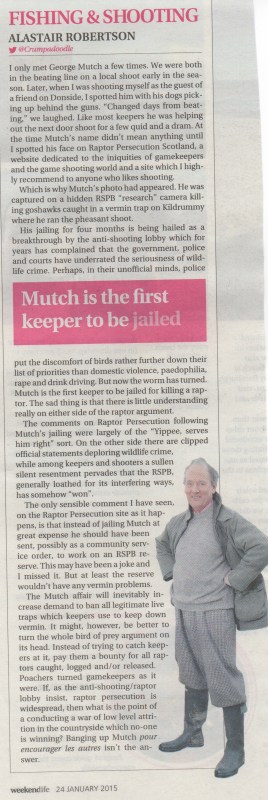
Alastair Robertson Scotsman 24 Jan 2015The fall-out from the shock custodial sentence for raptor-killing gamekeeper George Mutch continues….

The following appeared in yesterday’s Scotsman weekend magazine (24th January 2015). It’s the regular country sports column written by Alastair Robertson, the pro-game shooting journalist who also contributes to Daily Mail, Mail on Sunday, Telegraph, The Sun, Country Life & The Field.

“I only met George Mutch a few times. We were both in the beating line on a local shoot early in the season. Later, when I was shooting myself as a guest of a friend on Donside, I spotted him with his dogs picking up behind the guns. “Changed days from beating”, we laughed. Like most keepers he was helping out on the next door shoot for a few quid and a dram. At the time Mutch’s name didn’t mean anything until I spotted his face on Raptor Persecution Scotland, a website dedicated to the iniquities of gamekeepers and the game shooting world and a site which I highly recommend to anyone who likes shooting.

Which is why Mutch’s photo had appeared. He was captured on a hidden RSPB “research” camera killing goshawks caught in a vermin trap on Kildrummy where he ran the pheasant shoot.

His jailing for four months is being hailed as a breakthrough by the anti-shooting lobby which for years has complained that the government, police and courts have underrated the seriousness of wildlife crime. Perhaps, in their unofficial minds, police put the discomfort of birds rather further down their list of priorities than domestic violence, paedophilia, rape and drink-driving. But now the worm has turned. Mutch is the first keeper to be jailed for killing a raptor. The sad thing is that there is little understanding really on either side of the raptor argument.

The comments on Raptor Persecution following Mutch’s jailing were largely of the “Yippee, serves him right” sort. On the other side there are clipped official statements deploring wildlife crime, while among keepers and shooters a sullen silent resentment pervades that the RSPB, generally loathed for its interfering ways, has somehow “won”.

The only sensible comment I have seen, on the Raptor Persecution site as it happens, is that instead of jailing Mutch at great expense he should have been sent, possibly as a community service order, to work on an RSPB reserve. This may have been a joke and I missed it. But at least the reserve wouldn’t have any vermin problems.

The Mutch affair will inevitably increase demand to ban all legitimate live traps which keepers use to keep down vermin. It might, however, be better to turn the whole bird of prey argument on its head. Instead of trying to catch keepers at it, pay them a bounty for all raptors caught, logged and/or released. Poachers turned gamekeepers as it were. If, as the anti-shooting/raptor lobby insist, raptor persecution is widespread, then what is the point of conducting a war of low level attrition in the countryside which no-one is winning? Banging up Mutch pour encourager les autres isn’t the answer”.

END

So, no real surprises. Gamekeepers and shooters apparently ‘loathe’ the RSPB for ‘interfering’ (= catching raptor-killing gamekeepers and reporting them to the police). Oh, and killing raptors doesn’t really merit a custodial sentence because it doesn’t rank as a priority crime, even though the Government and Police Scotland have both stated that tackling wildlife crime IS a priority, and even though the penalty available for EACH offence could be a £5,000 fine and/or a six month custodial sentence. Some would say Mutch got off lightly with just a four-month jail sentence.

Instead of trying to catch gamekeepers at it, Robertson’s theory is that gamekeepers should be paid a bounty for each raptor they manage not to kill. A bit like giving a bank robber a bounty for each bank he manages to walk past without robbing it. ‘Ah, well done lad, you’ve managed to go a whole day without committing a crime – here, have some tax-payer’s money in recognition of your self-control’.

Talking of Mutch, we were interested to receive a photo taken on a grouse moor in September 2014.  This was on Edinglassie Estate in Aberdeenshire. Edinglassie is an award-winning estate, receiving the GWCT’s Golden Plover Award in 2013 for their progressive & sustainable moorland management, and becoming WES-accredited (SLE’s Wildlife Estates Scotland thing). Is that George Mutch, clearing the butts after a drive? Who would employ Mutch to help out on a game shoot? (There’s no more helping out for a few quid and a dram – new rules mean that, unless in exceptional circumstances, HMRC views beaters etc as ’employees’ for tax purposes). Interesting. Although to be fair, in September he was still denying his guilt and hadn’t yet been convicted (that came in Dec). Can’t imagine an esteemed estate like Edinglassie would employ him now he’s been convicted of raptor persecution…..

Subsidy penalty for Stody Estate?

stody buzzardsOn 1st October 2014, gamekeeper Allen Lambert from the Stody Estate in Norfolk was found guilty of poisoning 10 buzzards and one sparrowhawk, which had been found dead on the estate in April 2013. He was also convicted of storing banned pesticides & other items capable of preparing poisoned baits (a ‘poisoner’s kit’), and a firearms offence (see here and here).

On 6th November 2014, Lambert was sentenced. Even though the magistrate acknowledged that Lambert’s crimes passed the custody threshold, he only received a 10 week suspended sentence for poisoning 11 raptors (suspended for one year), a six week suspended sentence for possession of firearms and nine poisoned buzzards (suspended for one year), and was ordered to pay £930 prosecution costs and an £80 victim surcharge.

On 5th October 2014, we blogged about the millions of pounds worth of subsidies that had been awarded to Stody Estate in recent years (see here) and we encouraged blog readers to contact the Rural Payments Agency (RPA) to ask whether Stody Estate would receive a financial penalty in the form of subsidy withdrawal for being in breach of the terms & conditions of their subsidy-fest.

On 10th October 2014, the RPA responded by saying they would consider what action could be taken against Stody Estate (see here).

Then it all went quiet.

One of our blog readers decided to submit an FoI to the RPA in December 2014, to see what was going on. Here is his letter:

12 DECEMBER 2014

To whom it may concern

I am making this request for information under the Freedom of Information Act.

The information I request relates to the conviction in October 2014 of Mr Allen Lambert, a gamekeeper employed by the Stody Estate, Melton Constable, Norfolk, NR24 2ER for illegally poisoning ten buzzards and a sparrowhawk.

I would be grateful if you could provide me with all the information you hold relating to the following questions:

  1. Whether the RPA consider the illegal poisoning carried out by an employee of the Stody Estate as being in breach of Cross Compliance Statutory Management Requirement 1 – Wild Birds.
  2. Did the RPA investigate any breach of cross compliance at the Stody Estate relating to the illegal poisoning offence and what was the outcome of the investigation.
  3. Whether the RPA has imposed a fine on the Stody Estate’s Single Farm Payment, Environmental Stewardship Payment or any other public subsidy the estate receives and if so, how much.

I look forward to hearing from you.

Yours sincerely

XXXXX XXXXX

On 14th January 2015, the RPA responded with this:

14 JANUARY 2015

Dear XXXXX XXXXX

Re: Freedom of Information – Information Request

Thank you for your request for information dated 12 December 2014 which has been dealt with under Freedom of Information Act 2000 (FoIA).

You have asked:

‘1. Whether the RPA consider the illegal poisoning carried out by an employee of the Stody Estate as being in breach of Cross Compliance Statutory Management Requirement 1 – Wild Birds.’

‘2. Did the RPA investigate any breach of cross compliance at the Stody Estate relating to the illegal poisoning offence and what was the outcome of the investigation.’

‘3. Whether the RPA has imposed a fine on the Stody Estate’s Single Farm Payment, Environmental Stewardship Payment or any other public subsidy the estate receives and if so, how much.’

Having considered your request we regret that we are unable to provide you with any meaningful response as we do not hold any information that answers your questions. However, RPA would like to make clear that it is required to assess cross compliance reductions to CAP subsidy claims based on intent, extent, severity, permanence and repetition of the non-compliance. We can assure you that RPA will take action, including cross compliance reductions to CAP subsidy payments applicable, if this is found to be appropriate.

In order to qualify for most CAP subsidy payments, claimants are required to keep their land in Good Agricultural and Environmental Condition and comply with a set of Statutory Management Requirements (SMRs). This is known as cross compliance. One of the SMRs covers wild birds (SMR 1) and this includes a rule about killing, injuring or taking wild birds.

Further information is published on the GOV.UK website (Page 43 – deals with wild birds).

https://www.gov.uk/government/uploads/system/uploads/attachment_data/file/320833/The_Guide_to_Cross_Compliance_in_England_2014_complete_edition.pdf

If you are not happy with the way we have handled your request, you can ask for an internal review. These requests should be submitted within two months of the date of receipt of the response to your original letter and should be addressed to: Access to Information, Rural Payments Agency, North Gate House, 21-23 Valpy Street, Reading, RG1 1AF.

Yours sincerely

Rural Payments Agency

Not very helpful, is it?

Thanks to the blog reader who followed up with the FoI and shared the response with us. We understand the RPA can expect further FoIs until a satisfactory response is received. Watch this space….

Meanwhile, you might be interested to compare Lambert’s pathetic sentence with that of an anti-badger cull protester. Lambert was given a 10 week suspended sentence and ordered to pay £930 costs for the mass poisoning of protected birds, the illegal storage of banned poisons and a firearms offence. The badger cull protester, who breached the terms of an injunction designed to stop him disrupting badger culls (he filmed someone involved with the cull and stood outside the NFU office wearing a t-shirt that said: ‘FCK NFU’), was given a six month suspended sentence and ordered to pay costs that could amount to £55,000 (see here). The first installment of £25,000 is due on 1st May. A crowd-funding page has been set up for those who want to help – see here.

Police search premises in another poisoning blackspot in Northern Ireland

A few days ago we blogged about a multi-agency raid on premises in the Drumbanagher area of Co Armagh, a notorious buzzard-poisoning blackspot (see here).

It looks like the PSNI is taking raptor persecution very seriously, because on the same day, another search in another poisoning blackspot was also carried out, this time in Co Derry.

The team went to targeted locations in the Magherafelt area where a number of raptor persecution incidents are reported to have taken place, including the Carbofuran-poisoning of a peregrine last July (see here).

Great to see a coordinated, proactive response from the police and partner agencies, and how refreshing to see this response publicised.

Details on the Co Derry search here.

Peregrine photo by Steve Waterhouse

Balaclava sales set to rise

Daily Mail Bloody battle of the glens (2)The angst generated by the successful use of video evidence to convict gamekeeper George Mutch continues, as does the game-shooting lobby’s pathetic attempts to discredit the RSPB….

The following excerpts are from a recent article in the Mail, written by Jonathan Brocklebank:

The camera was hidden in a pile of twigs deep inside a sporting estate whose owner had no idea that it had been infiltrated by Europe’s wildlife charity.

But then, RSPB Scotland needs no invitation or permission to launch covert surveillance ops on private land. These days, it gives its own go-aheads.

So it was that gamekeeper George Mutch, 48, came to be filmed with a juvenile goshawk he beat to death with a stick on the Kildrummy Estate, Aberdeenshire. He began a four month jail sentence this week after damning footage showed him using two traps to catch birds of prey.

His apparent motive was to protect pheasants from the raptors, thus ensuring a plentiful supply of game birds for the shooting parties whose business helps keep such estates alive. Mutch, thought to be the first person ever to be jailed in Scotland for killing a bird of prey, will win no sympathy from animal lovers.

But the court case did not simply highlight the inhumane behaviour of a lone gamekeeper who brought disgrace upon his profession. It also served as a demonstration of the now immense power of the charity whose evidence convicted him.

That power, say ever-growing numbers of critics, leaves few areas of outdoor and rural life untouched.

[There follows some predictably tedious claims made by Botham’s You Forgot The Birds campaign, whose failed complaints about the RSPB to the Charity Commission Mr Brocklebank failed to mention (see here), and how some landowners are erecting signs saying RSPB Not Welcome (see here). It then continues….]

During Mutch’s trial, Aberdeen Sheriff Court was told the RSPB routinely enters estates without asking the landowners and, once inside, staff are free to use hidden cameras to gather ‘data’.

When questioned in court, Ian Thomson, the charity’s head of investigations, explained why they needed no permission. “Because we are entering an area for scientific study, we feel we are using our access rights under the Land Reform Act”.

Is it, then, acceptable for RSPB officials to march onto a private estate and set up equipment to secretly video employees?

It seems so. A spokesman for the charity told the Mail: “In Scotland, the Land Reform Act (2003) enshrined a legal “right to roam” and this includes access for survey and research purposes, provided this is carried out responsibly”.

He said the shocking images captured on the video spoke for themselves.

Notwithstanding Mutch’s appalling actions, there is a distinct air of discomfort in the Scottish Gamekeepers’ Association (SGA) over the means by which the RSPB’s evidence was obtained.

A spokesman for the organisation said it seemed wrong for individuals “from one particular profession” to be under surveillance in their workplace without their knowledge.

He added: “Is it the case now that charities can do this rather than the police – and is this the correct thing?

They have said they used their rights of access to go on to the land to do this. Really, they should have asked the landowner out of courtesy, if anything. Although it is not sacrosanct in law to do so, I think it would rile people a lot less if there were a little bit more cooperation from organisations such as the RSPB.

These are the things that lead to the breakdown of trust. If they did things a little bit more with due respect, they would find themselves in a lot less problems”.

His words hint at both a clash of cultures and at competing interests in the schism between senior figures in the charity and the ‘tweedies’ who own and manage vast swathes of the Scottish countryside.

While Scottish Natural Heritage (SNH) routinely issues licences to farmers to control wildlife which threatens their livestock, it has never issued a licence to a gamekeeper or landowner to control any species threatening birds kept for game, which also count as livestock under the Wildlife & Countryside Act 1981. The reasons for this, gamekeepers believe, is obvious: politics.

[The rest of the article covers complaints from a gamekeeper on the Lochnell Estate in Argyll about people turning up unannounced to monitor raptor nests; how many members the RSPB has; how much income the RSPB generates; the RSPB’s involvement in the renewal energy debate; how the RSPB is seen as the ‘go to’ organisation for advice on developments; how arrogant the RSPB is; and ends with the question: Is there a time, perhaps, when a charity just becomes too big?]

ENDS

So, the SGA thinks that wildlife crime investigators should let landowners know, in advance, of their arrival on a privately-owned estate. They seem to be missing the point. The landowner can now be held criminally vicariously liable for some crimes against raptors that are carried out by their gamekeepers; what do you think is the first thing the landowner would do, if he/she was notified that wildlife crime investigators were on their way? Advanced warning would hardly be in the interest of an investigation, (or justice), would it? Besides, as was pointed out in the article, nobody has to give advanced warning to a landowner of an impending visit and as long as they act responsibly once on the land, they’re well within their rights – that’s kind of the point of the Land Reform Act.

And what’s all this guff about gamekeepers have never been issued an SNH licence to ‘control’ (kill) “any species” that is perceived as a threat to their game birds? What utter nonsense! Gamekeepers routinely use the SNH General Licences to ‘control’ (kill) corvids. Ironically, this is what Mutch was supposed to be doing when he was filmed killing a trapped goshawk and shoving two other raptors in sacks and walking off with them. Sounds to us like the SGA are trying to play the victim card, again, albeit unsuccessfully.

McAdam 1The SGA aren’t the only ones up in arms about the admissibility of the RSPB’s video footage which was used to devastatingly good effect in the Mutch trial.

Here’s what the CEO of Scottish Land & Estates (SLE), Doug McAdam, wrote in last week’s SLE e-newsletter:

There can be no doubt that the custodial sentence handed down this week to a gamekeeper convicted of wildlife crime will send a very strong message out to those who continue to break the law. The illegal killing of any bird of prey is unacceptable and anyone who engages in such activity can, rightly, expect to feel the full weight of the law.

However, this case has raised some fundamental issues regarding access rights and the law as it becomes clear that a central party to this investigation [he means the RSPB] has chosen to totally disregard Scottish Government approved guidance contained in the Scottish Outdoor Access Code regarding undertaking survey work on someone else’s land. This is a serious matter in its own right, but it also reaches well beyond matters of wildlife crime, crossing in to areas such as new development and planning work where it could have some serious implications”.

Why is this “a serious matter”? It’s no such thing (unless you happen to be CEO of an organisation that just wants to have another go at discrediting the RSPB or is concerned about what future video footage may reveal). The Scottish Outdoor Access Code is just that – it’s a code, not a statutory instrument. It has as much legal influence as the Green Cross Code. It is trumped, magnificently, by the 2003 Land Reform Act. The totally independent Sheriff in the Mutch trial (who, don’t forget, was brought in because the defence thought that the original Sheriff, as an RSPB member, might be biased – see here) deemed that, in this instance, the RSPB video footage was admissible.

That’s not to say that other video footage will be deemed admissible in other trials – it will depend entirely on the circumstances of the case. In the Mutch trial, the RSPB argued successfully that their cameras were not in place to ‘catch someone at it’ – they had been placed as part of a long-term study in to crow cage trap use. That their footage captured Mutch engaging in his disgusting crimes was just a very happy coincidence.

You have to wonder, with all this consternation from the game-shooting crowd, just what it is they’re so frightened that covert cameras might record….

Now might be a good time to buy some shares in balaclava-making companies.

Police search notorious raptor poisoning blackspot

Drumbanagher NI police search Jan 2015Police in Northern Ireland last week joined forces with officers from the Northern Ireland Environment Agency and the Health & Safety Executive (NI) to conduct a search of premises in one of the region’s most notorious raptor- poisoning blackspots.

The search focused on premises in the Drumbanagher area of Co. Armagh following the discovery of a Carbofuran-poisoned buzzard last October. The Drumbanagher/Poyntzpass area is known for its commercial game-shooting interests.

A dead cat was found during the search and has been sent for analysis.

We’ve blogged about this location before. Here’s the list of known (to us) victims:

2006: 1 x poisoned buzzard (type of poison unknown).

2008: 4 x poisoned buzzards (Alphachloralose).

2009: 2 x poisoned red kites (Alphachloralose). One bird survived, the other one didn’t.

2011: 1 x dead buzzard found under a hedge. Too decomposed for analysis.

2011: 3 x dead buzzards, suspected poisoning, but carcasses removed before police attendance. 1 x poisoned magpie (Alphachloralose).

2012: Another poisoned buzzard (Alphachloralose), reportedly the ’36th dead buzzard’ found in this area.

2014: 1 x poisoned buzzard (Carbofuran).

Our previous blogs on this area here and here.

Article on last week’s police search from Farming Life here