buzzard poisoners in Derbyshire get away with it

On 30 April 2010, an article was posted on this blog about an investigation by Derbyshire police into the apparent poisoning of six buzzards. Here’s a quick re-cap:
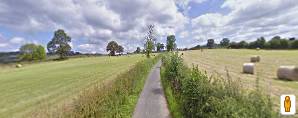
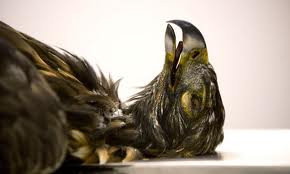
On 22 February 2010, two dead buzzards were found in Jebbs Lane, Idridgehay, nr Ashbourne in Derbyshire. The birds were believed to have been poisoned. On 7 April 2010, a further four buzzards were found dead nr Kirk Ireton, just a few miles away from the dead buzzards that had been found in February. These four buzzards were also believed to have been poisoned, and were found next to a dead pheasant, believed to have been used as a poisoned bait.
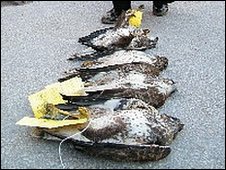
In a recent report, the following details have emerged on the outcome of this investigation:

“Feb 22 2010: 2 dead buzzards found on the ground and chicken bait found in a tree. Analysis has confirmed a residue of Carbofuran in the gizzard of both birds, which is likely to be the cause of death. As the police have failed to identify a suspect, this case is now closed“.

“April 7 2010, link to Feb 22 case: 4 buzzards found dead, 2 baits (pheasant & hare). Six buzzards have now been found on this estate. The estate is trying to make the shooting part of the estate viable and new gamekeepers have been employed. Analysis has confirmed a residue of Carbofuran in the crop content of the birds. The amounts are significant and are likely to be the cause of death. An advisory letter to dispose of Strychnine found has been sent and complied with. This case is now closed“.

So, six buzzards are confirmed to have been poisoned by Carbofuran (a banned pesticide) and two poisoned baits were found on the same sporting estate within a small period of time. The name of the estate has not been published (surprise!). Presumably, a search of the un-named estate failed to uncover any stocks of Carbofuran, but did uncover a stock of Strychnine. Strychnine is also a banned pesticide, outlawed in the UK since September 2006 by the EU’s Biocide Directive, which states that it can no longer be sold or stored in the UK. Instead of being prosecuted for this illegal stash, the criminals get sent an ‘advisory letter’. No action is taken against them for the six illegally poisoned buzzards.

And if you think this is an unacceptable outcome, the news we will release shortly (about another case) will blow your mind….
police investigate suspicious red kite deaths in Northumberland

Police are investigating the deaths of five red kites in the North-East of England. The deaths in the Northumberland area span a period of seven months and appear to be the results of poisoning.

Full story here: http://www.thenorthernecho.co.uk/news/8683086.Red_kite_deaths_could_be_due_to_poisoning/

young osprey dies of gunshot wounds in England

A £1,000 reward has been offered by the RSPB and Sussex Police for information that leads to the conviction of the person who shot a young osprey in Sussex. The shooting comes one month after a similar incident in Caithness, Scotland (see blog posts 15th & 18th September 2010) . In both cases, the young ospreys were found alive but died later from their injuries.

The latest osprey to die was born in Sweden earlier this summer and was migrating through the UK on its long journey south towards Africa. It was one of three chicks that hatched in a National Park and had been tagged by biologists from the Swedish Bird Ringing Centre.

Full BBC news story: http://www.bbc.co.uk/news/uk-england-sussex-11514737

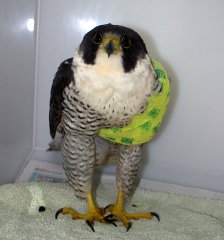
Peregrine Falcon Shot and Injured

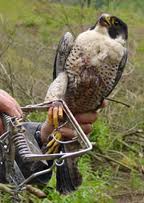
A male peregrine falcon has been shot and badly injured on the banks of the River Eden near Armathwaite in Cumbria.

A cyclist found the bird flapping in a field, bundled him up in a towel and put him in his rucksack before cycling to Carlisle to seek veterinary assistance.

Vet Edda Pohlandt, of Falcon Vets, London Road, Carlisle said: “The man who brought him in was cycling from Penrith to Carlisle for a physio appointment when he came across the bird. “He brought him straight in and I took a look at him. I did an x-ray and saw the pellet and the shattered bones. I put him under anaesthetic and then operated on him”

The injured wing must be kept in a sling for four weeks before Edda can carry out another x-ray. She said: “Birds tend to heal faster than humans. I’ll make a decision in a few weeks whether or not to take the pins out and see how he goes.

We have no further information at this stage as to any possible police enquiry

More on this story – http://www.cumberlandnews.co.uk/news/cumbria-vet-saves-life-of-shot-peregrine-falcon-1.761740?referrerPath=2.1825/2.1825

And here – http://raptorpolitics.org.uk/?p=1988#more-1988

RSPB Birdcrime 2009 Report Shows Continuing Raptor Persecution

The RSPB’s annual Birdcrime 2009 report was published today and shows that 2009 was the second worst year for raptor persecution in the last decade.

This depressing report shows that there were 384 reported persecution incidents against birds of prey in the UK  during 2009, 123 in Scotland, 224 in England, 17 in Wales and 11 in Northern Ireland, 9 incidents could not be allocated to a single country and were recorded at a UK level. Incidents include trapping, shooting, poisoning and nest destruction.

Again the trend showed that most incidents involved game shooting interests with a bias towards the upland grouse moors in Scotland and Northern England where the main victims of persecution are: golden eagle, white-tailed eagle, hen harrier, goshawk, peregrine and red kite.

In the report, the RSPB has made 11 recommendations for government action, so that these appalling crimes can be eradicated. These include the introduction of a “vicarious liability” offence which would make land managers and owners responsible for the actions of their employees.

Despite several successful prosecutions the conviction rate and subsequent sentencing appears pitifully poor and ineffective.

Full RSPB Report – http://www.rspb.org.uk/Images/birdcrime_tcm9-260567.pdf


Young red kite shot dead in Cumbria

30 young red kites were released into the Grizedale Forest in August 2010

Just five weeks after being released as part of the latest red kite reintroduction scheme, a young male kite has been found dead in Artengill, Cumbria. A post mortem examination revealed the young bird had been shot 4 times in the chest.

Police have begun an investigation, in partnership with the Forestry Commission and Natural England.

Will the culprit be brought to justice? Unlikely. It is yet another disgusting mindless act of violence by someone in the shooting community who knows he/she will get away with it. How many more of these incidents are we going to have to read about?

BBC news story here: http://www.bbc.co.uk/news/uk-england-cumbria-11264438

Cumbria Police Appeal for Information here: http://www.cumbria.police.uk/news/latest-news/police-appeal-after-cumbrian-red-kite-found-shot

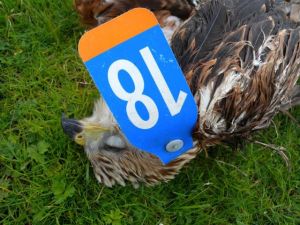
The young male was identified by his wing tag

2 more northumbrian kites found dead

A pair of red kites which became well known to birdwatchers and tourists have been found dead near Stocksfield, Northumberland. The bird carcasses have now been sent to the London Institute of Zoology for forensic analysis to determine how they died.

Numerous birdwatchers travelled to the kites’ nesting site near Whittonstall, Northumberland, last year, where they were clearly visible at long-range for several months. Visitors used the vantage point provided by the Highland Cattle Centre on the opposite side of a small valley to view the isolated nest high in trees.

This suspected case of persecution comes only a few months after 2 red kites were found dead illegally poisoned near Hexham, Northumberland.

2 Northumberland red kites confirmed poisoned

2 Northumberland red kites have been confirmed as having been poisoned.

The birds were found close to each other in Hexham, Northumberland on 12th February 2010  and were sent for post mortem analysis to a specialist veterinary surgeon in Newcastle. It was recently confirmed that the birds died as a result of eating meat which had been laced with poison.

Full story. http://news.bbc.co.uk/1/hi/england/tyne/10490567.stm

police investigation underway as six buzzards found poisoned

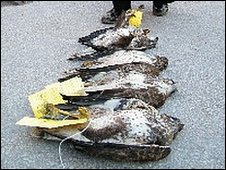
Derbyshire dead buzzards 2010A police investigation is underway in Derbyshire after the recent discovery of six dead buzzards. All had been poisoned.

On February 22nd 2010, two dead buzzards were found in Jebbs Lane, Idridgehay, near Ashbourne. Tests showed they had been poisoned.

On April 7th 2010, a farmer discovered 4 dead buzzards to the north of Kirk Ireton, near Ashbourne – just a few miles north of the Idridgehay poisonings.  The 4 dead buzzards were found next to the body of a dead pheasant and tests showed that the pheasant had been used as a poisoned bait.

Full story: http://news.bbc.co.uk/1/hi/england/derbyshire/8634955.stm

another gamekeeper convicted of illegal poisoning

26 year-old Ben Walker, a gamekeeper on the Sufton Estate, Herefordshire, has been convicted of 17 (yes, 17) charges relating to killing protected species with poisonous baits.

After a tip off, an undercover team from the RSPB spent several weeks in October and November 2009 making covert surveillance videos of Walker tending to his illegal baits on the Estate. He killed two buzzards and five ravens and told police he did it because they were a ‘threat’ to the birds he was rearing for a commercial shoot.

Walker received a £1,000 fine at Hereford Magistrates Court on 21 April 2010.  Once again, a judge has not imposed a custodial sentence, even though this option is available for these types of wildlife crime.

Well done to the Sufton Estate though, who sacked Walker for these offences. A second former employee is currently under investigation for wildlife crimes on this Estate.

Full story: http://news.bbc.co.uk/1/hi/england/hereford/worcs/8635231.stm