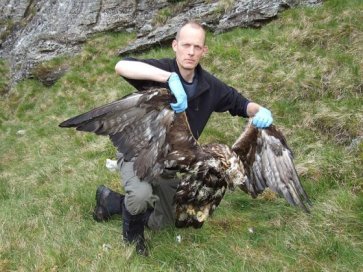
 So, three years and three months later, the infamous Glen Orchy case has concluded. Tom McKellar, previously described as a gamekeeper but curiously now described as a farmer, has been fined £1,200 for possessing the banned pesticide, Carbofuran.
The Crown Office press release (here – NB, link no longer works, copy of press release at foot of blog) doesn’t mention anything of the poisoned golden eagle that was found in Glen Orchy and prompted the search of McKellar’s house, which led to the discovery of the Carbofuran. Although it does mention how he was previously given a 300-hour community service order for the possession of illegal handguns (instead of the mandatory five-year prison sentence), also found during the search of his house.
Of course, McKellar wasn’t charged with laying poisoned baits (even though he reportedly admitted to doing so during an interview), and nor was he charged with poisoning that golden eagle, because even though he had this rare, banned poison in his house, and lived just down the road from where the dead eagle had been found, and he’d previously admitted to laying out poisoned baits, there apparently wasn’t enough evidence to link him to the poisoned eagle.
But this story doesn’t end there. There are other things that went on (or more to the point, didn’t go on) in this investigation and we’ll be discussing those in due course, including the failure to charge a second person….
Meanwhile, we’ll add this poisoned golden eagle to the growing list of illegally-killed eagles for which nobody has ever been (nor will be) prosecuted. Justice?
RSPB press statement here (NB: link no longer available, copy of RSPB statement at foot of blog)
UPDATE 11 Sept 2012: Glen Orchy, a hollow victory (here)
Previous blogs on this case here, here, here, here, here,here here, here
COPY OF CROWN OFFICE PRESS RELEASE:
7 September 2012
FARMER FINED £1,200 FOR POSSESSING BANNED SUBSTANCE
An Argyll farmer was today fined for possessing the banned substance carbofuran.
Tom McKellar, 50, from Bridge of Orchy, Argyll, pled guilty on 18 April at Oban Sheriff Court. Today he was fined £1,200 for the offence.
Carbofuran is a highly toxic pesticide and a single grain the size of a poppy seed can kill a bird. A quarter of a teaspoonful can be fatal to humans.
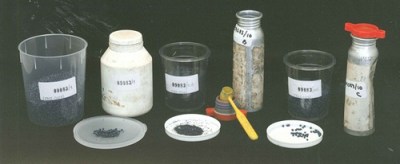
Following a search of his property by police on 17 June 2009, McKellar was found to have quantities of Carbofuran in three separate containers and traces of it within a syringe. When interviewed by police, he indicated that he had, in the past, placed it on meat for foxes to eat.
Craig Harris, Head of the Wildlife and Environmental Crime Unit (WECU) at COPFS, said:
“Carbofuran is an extremely toxic pesticide and even the tiniest amounts can be fatal to our wildlife.
“Possession of carbofuran is illegal and those who unlawfully retain stocks can expect to be brought before the court.
“This conviction and sentence should serve as a warning to anyone who thinks about keeping this substance.
“We remain committed to ensuring carbofuran is removed from the countryside and we will continue to work with our PAW partners to find the best way to achieve this.”
Notes to Editors
Tom McKellar pled guilty at Oban Sheriff Court on 18 April 2012 to possessing Carbofuran, an unauthorised pesticide, under section 15A of the Wildlife and Countryside Act 1981.
McKellar previously pled guilty at the High Court in Glasgow on 5 November 2010 to four charges relating to the illegal possession of a Webley revolver and a Browning pistol, recovered during police enquiries on 17 June 2009. On 3 December 2010 he was sentenced to a Community Service Order of 300 hours.
Products containing Carbofuran as an active ingredient were formerly used in the U.K. as insecticides to control agricultural pests in crops. Their use was restricted to farmers or contractors providing services to farmers for drilling into the ground. Approval for the use of Carbofuran was withdrawn in 2001 and its possession is now illegal in terms of the Wildlife and Countryside Act 1981, Section 15A and the Possession of Pesticides (Scotland) Order 2005/66, Article 2 and Schedule 1.
Carbofuran is one of the most toxic pesticides. In the granular form a single grain the size of a poppy seed can kill a bird. A quarter teaspoon (1 millilitre) can be fatal to humans.
Carbofuran poisoning has been identified as the cause of death in over 240 incidents submitted to the WIIS scheme in Scotland since 1988 (this system records incidents of specific chemicals to provide feedback for regulations). At least 95% of these incidents were attributed to the illegal abuse of a pesticide to poison non-target animals. The most frequent casualties were birds of prey, with the remainder comprising corvid species, cats and dogs. In the last decade, Carbofuran formulations appear to have become the poison of choice for individuals involved in illegal poisoning activities in Scotland.
PAW Scotland is the Partnership for Action Against Wildlife Crime in Scotland. PAW Scotland partners include a wide range of bodies committed to tackling wildlife crime including conservation, land management, shooting and law enforcement organisations.
ENDS
COPY OF RSPB STATEMENT:
7 September 2012
Farm manager convicted of poison possession after Golden Eagle is killed near Bridge of Orchy
A farm manager has today (7th September) been convicted of possessing an illegal poison, following a police-led enquiry into the death of a golden eagle.
Earlier at Oban Sheriff Court, Tom McKellar pled guilty to possession of the banned pesticide Carbofuran and was fined £1200.
On 7th June 2009, a party of hillwalkers descending Beinn Udlaidh in northern Argyllshire, came across the body of the eagle, lying face down in the grass on a remote hillside near Bridge of Orchy.
The following day, the group contacted RSPB Scotland, who immediately notified Strathclyde Police.
That afternoon, the local police wildlife crime officer and RSPB Scotland investigations staff recovered the eagle carcass from the remote hillside.
It was photographed and seized as evidence by the police, meanwhile a post mortem by Scottish Government laboratories confirmed the bird had been poisoned with Carbofuran, a substance banned since 2001.
Further police investigations, including a search of land and buildings at Auch Estate, Bridge of Orchy, recovered a quantity of carbofuran, a carbofuran-poisoned dead fox, and two handguns – found in the attic of a house occupied by estate employee Tom McKellar.
In subsequent days, the carcass of a sheep, laced with Carbofuran, was also found on a hillside in the area that the eagle had been found dead.
In December 2010, at the High Court in Glasgow, McKellar was convicted of possession of two hand guns, and was sentenced to 300 hours community service.
Commenting on today’s sentencing Ian Thomson, RSPB Scotland’s Head of Investigations, said:
“RSPB Scotland has invested considerable resources in assisting Strathclyde Police in the investigation of this significant case. We heartily commend the efforts of the police in their rigorous follow-up to the illegal poisoning of the golden eagle on Beinn Udlaidh, leading to this successful prosecution.
“We are very disappointed that, at the conclusion of the investigation, no-one has been charged with the poisoning of this golden eagle, one of our most vulnerable and iconic bird species, or with the laying out of poison baits in the open in our countryside.”
“While we welcome the conviction, yet again, we are dismayed that the final result of a high profile enquiry poses little in the way of a deterrent to those who continue to flagrantly disregard our wildlife protection laws. The illegal killing of protected birds of prey remains a persistent problem in some parts of Scotland, with, for example, six further golden eagles confirmed as illegally poisoned since this incident, including one in Lochaber earlier this year. We call upon the Scottish Government to urgently review the penalties imposed by the courts on those who break our wildlife laws.”
ENDS
UPDATE 6 May 2026: ‘Should I Marry a Murderer?’ New Netflix documentary provides sobering insight into brutal killing and burial of charity cyclist Tony Parsons by McKellar twins at Auch Estate, Glen Orchy (here)

 Very pleased to see regular updates are being made available to show us the movements of the 2012 sat-tagged Langholm harrier chicks. Well done Cat Barlow, the project officer at the Langholm Moorland Education Project, who is providing these updates on her blog, called ‘Making the Most of Moorlands’ (see
  Last Friday, Tom McKellar, an employee of Auch Estate, an Argyll sporting estate in Bridge of Orchy, was convicted of possessing the illegal poison Carbofuran and was fined £1,200 (see
  Based on these suspicions, we blogged about the case in January 2011, and suggested that no charges were being brought against anyone for poisoning that eagle. We also encouraged readers to contact the Scottish Government to complain. Many did, and all hell let loose. The Scottish Government responded by saying that the firearms offences were being dealt with separately, at a court with a higher authority than a Sheriff Court, and that the wildlife offences were still ‘being dealt with’. A well-known prosecutor threatened us, indirectly, with legal action. For what? Expressing an opinion? As it turns out, we were right all along, nobody has been prosecuted for poisoning that golden eagle, although we’ve had to wait for over three years to have this confirmed.
 Convicted egg-thief Matthew Gonshaw is appealing the ASBO that prevents him from travelling to Scotland during the breeding season.
