General licences suspended on four Scottish grouse moors in response to raptor persecution crimes

Yesterday, SNH published the following press release:

General licences restricted in wildlife crime hotspots

Scottish Natural Heritage (SNH) has restricted the use of general licences on four properties in two wildlife crime hotspots – one in Stirlingshire and one in the Borders – this week. The decision was made on the basis of evidence provided by Police Scotland of wildlife crime against birds.

Nick Halfhide, SNH Director of Operations, said:

“There is clear evidence that wildlife crimes have been committed on these properties. Because of this, and the risk of more wildlife crimes taking place, we have suspended the general licences on these four properties for three years. They may though still apply for individual licences, but these will be closely monitored.

“This measure should help to protect wild birds in the area, while still allowing necessary land management activities to take place, albeit under tighter supervision. We consider that this is a proportionate response to protect wild birds in the area and prevent further wildlife crime.”

General licences allow landowners or land managers to carry out actions which would otherwise be illegal, including controlling common species of wild birds to protect crops or livestock.

The new measure complements other recent actions to reduce wildlife crime, including vicarious liability for offences against wild birds, which was introduced in 2011.

Restrictions will prevent people from using the general licences on the land in question for three years. This period will increase if more evidence of offences comes to light.

END

As promised in earlier correspondence with SNH about potential General Licence restrictions (e.g. see here), SNH has published ‘details’ of the current restrictions on its website. Although when we say ‘details’ we use the term loosely. The names of the estates have not been published (but see below) and the specific reasons (crimes) that triggered the restriction orders are also absent.

Instead, SNH has published two maps showing the areas where the three-year restriction orders will be in place.

Restriction order #1 can be viewed here: GL restriction order 1_ Nov 2015-2018

The map denoting the area relating to Restriction order #1 is here:

Raeshaw Corshope GL restriction map 2015

Having consulted Andy Wightman’s brilliant website Who Owns Scotland to check estate boundaries, we now know that the delineated area shown in Restriction order #1 includes parts of Raeshaw Estate and the neighbouring Corsehope Estate.

This is fascinating. Raeshaw Estate is well known to us and continues to be of interest. It is a mixed upland estate combining driven grouse shooting as well as pheasant and partridge shooting. We have documentary evidence that Mark Osborne’s company is involved in the estate management (more on that in the near future). Raeshaw Estate has been raided by the police at least twice (2004 and 2009 – poisoned and shot raptors and poisoned baits – see here) although nobody has ever been prosecuted for these crimes. However, the General Licence Restriction can only be applied for crimes that have been uncovered since 1st January 2014; it cannot be applied retrospectively for offences that took place prior to 1st January 2014. This means that further raptor crimes have been uncovered here but there has not been any publicity about them. Why not? There was news of a shot buzzard found in the nearby area on 24th July 2015 (see here), but this bird was found AFTER SNH had notified the estate of the intention to restrict the General Licence (see here) so this incident cannot be the one that triggered the General Licence Restriction.

Corsehope Estate has not been on our radar, although we’re told by local sources that gamekeepers from Raeshaw Estate are involved with ‘vermin control’ here so now we’re very interested.

Restriction order #2 can be viewed here: GL retriction order 2_ Nov 2015-2018

The map denoting the area relating to Restriction order #2 is here:
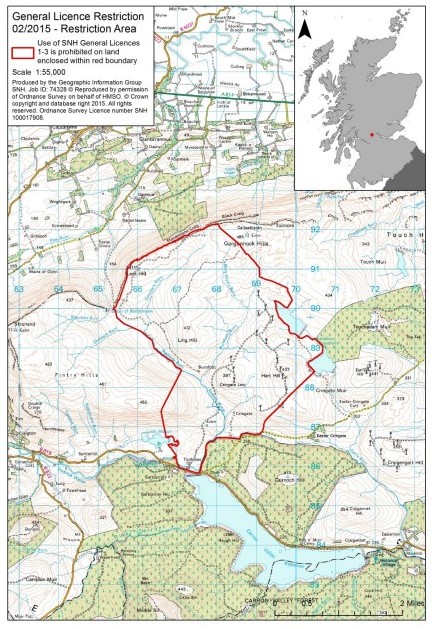
Burnfoot Wester Cringate GL restriction map 2015

Again, consulting Andy Wightman’s excellent website Who Owns Scotland to check estate boundaries, we now know that the delineated area shown in Restriction order #2 includes parts of Burnfoot Estate and Wester Cringate Estate.

This is also interesting. We believe (although it must be stressed that this is educated speculation as SNH has not published the information) that this restriction order probably relates to a series of raptor persecution crimes including a poisoned red kite (July 2014), a poisoned peregrine (February 2015) and an illegally trapped red kite (May 2015) – see here.

So, what do these General Licence Restriction orders mean? Basically, it means that the following activities, usually permitted under General Licences 1, 2 and 3, are now not permitted in the areas shown on the two maps for three years, starting 13th November 2015 and ending 12th November 2018:

The killing or taking of the following species:

Great black-backed gull, carrion crow, hooded crow, jackdaw, jay, rook, ruddy duck, magpie, Canada goose, collared dove, feral pigeon, wood pigeon, lesser black-back gull, and herring gull.

The use of the following methods to kill/take these species are not permitted:

Pricking of eggs, oiling of eggs, destruction of eggs and nests, use of Larsen trap, use of Larsen Mate trap, use of Larsen Pod trap, use of multi-catch crow cage trap, shooting with any firearm, targeted falconry, and by hand.

That sounds great, doesn’t it? But it’s not quite as clear cut as that. As we’ve discussed before, and as is stated in the SNH press release at the top of this blog, although these activities can no longer be carried out in the two denoted areas under the cover of the three General Licences, individuals may still apply for an individual licence to permit these activities, although SNH claims that if granted, these will be “closely monitored”.

What does ‘closely monitored’ actually mean? Closely monitored by whom? Daily inspections by SNH? Police Scotland? That’s hardly going to happen, is it?

Let’s hope that members of the general public, exercising their right to visit these areas under open access legislation, pay close attention to what’s going on around them. If they see a Larsen trap in use, or a crow cage trap in use, or witness any of the above bird species being killed/taken by any of the methods mentioned above, they inform the Police straight away. Actually, let’s hope they forget the police and inform RSPB Scotland and/or the SSPCA instead – they’re more likely to get a quick response from them.

It’ll be interesting to see how this all pans out. On the one hand, we welcome these Restriction orders and applaud the Scottish Government (especially former Environment Minister Paul Wheelhouse for initiating them), SNH and Police Scotland for pursuing what we hope will be the first of many such Restriction orders. But on the other hand, will these restrictions be anything more than a minor inconvenience to the estates involved because they can simply apply for individual licences to continue their game-shooting activities? We’ll have to wait and see.

RSPB Scotland’s response to the two General Licence Restriction orders here

As yet no response from Scottish Land & Estates or the Scottish Gamekeepers’ Association but we’ll post them here if/when they comment.

UPDATE 11.50hrs: The SGA has issued the following statement on their website:

On November 4th 2015, SNH announced general licence restrictions to two areas encompassing four properties.
The SGA has issued the following statement in response to questions.

A Spokesman for The Scottish Gamekeepers Association said: “The SGA cannot condone wildlife crime and has a clear and consistent policy regarding this.
“As regards this case, it is our understanding that legal discussions are taking place regarding the areas affected and, therefore, it is not appropriate for us to comment further.”
END
UPDATE 13.20hrs: Statement from Environment Minister Dr Aileen McLeod:

“The announcement by SNH that the use of general licences has been restricted on specified areas of land in the Borders and in Stirlingshire is a result of work that the Scottish Government commissioned in July 2013 as part of a package of measures to combat wildlife crime.

We welcome the progress that has been made with this work. However we have not been involved in the decision-making and do not have any comment on the individual cases in question. The General Licence system is a light touch form of regulation. It is clearly sensible to apply closer scrutiny to areas where there is good evidence that wildlife crime has taken place, and we believe that this will prove a useful tool in the fight against bird of prey persecution.”
Scottish gamekeeper convicted of snaring offences on estate in Aberdeenshire

George Allan, 61, a Scottish gamekeeper working on an estate in Aberdeenshire, has been convicted of two snaring offences. He was sentenced yesterday at Aberdeen Sheriff Court and received a £600 fine.

A press release about this conviction is available on the SSPCA website here.

According to our local sources, Allan was a full time gamekeeper employed by the Easter Skene Shooting Syndicate on land rented to them by Dunecht Estate. There is no suggestion that Dunecht Estate had any knowledge of what Allan was up to.

This, clearly, is not a raptor persecution case, so some people (people who don’t like this blog) will no doubt query why we’re blogging about it. There are a few reasons why:

  1. This is yet further evidence that some gamekeepers are not the ‘law-abiding guardians of the countryside and friends to all animals’ that we’re so frequently told they are. This gamekeeper had completed the obligatory snaring training course (a legal requirement for anyone who wishes to set snares in Scotland) and yet, even though he had passed this course and so presumably knew the laws relating to snare-use, he chose to ignore them.
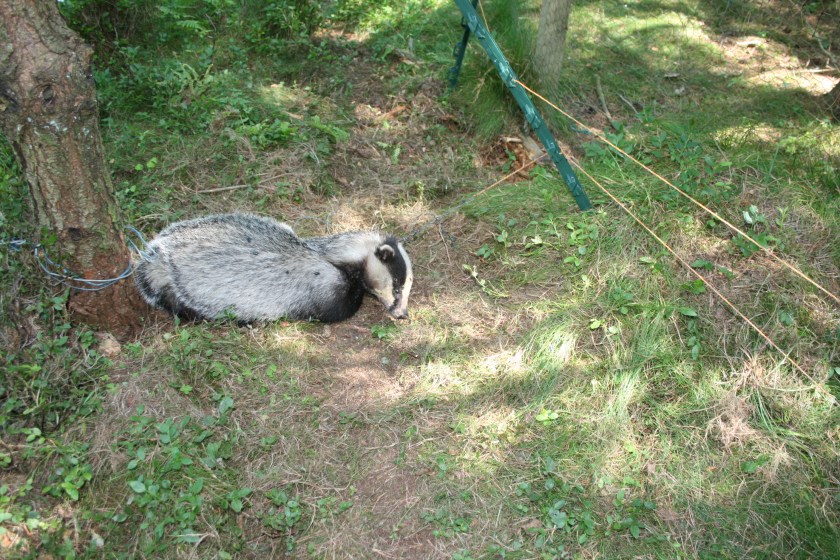
  2. He pled guilty to two snaring offences. There is no mention of him being convicted for causing unnecessary suffering to a badger. There is no doubt whatsoever that this badger suffered – it was electrocuted (from the electric fence) and, judging by the graphic photograph, it was more than likely asphyxiated too. So why wasn’t there a welfare charge against this keeper? Did the Crown accept a plea bargain and decide to just go for the snaring offences? As there was no conviction relating to the welfare of the badger, does this mean that this badger-related wildlife crime will not feature in the Government’s annual statistics on recorded badger crime?
  3. In order to secure the snaring convictions, the SSPCA used some advanced techniques to find supporting evidence. For the first time, they used forensic entomology to determine the age of the fly larvae present on the badger, to show that the badger had been in that snare for longer than the 24 hour period ‘allowed’ by the snaring regulations. Further evidence, as if it was needed (it isn’t), that the SSPCA will make extraordinary efforts to investigate wildlife crime offences. Why is it taking Environment Minister Dr Aileen McLeod so very long to make a decision about increasing the investigatory powers of this organisation? It’s now been one year and two months since the public consultation ended on this issue. These SSPCA investigators are experts in the field and know how to secure evidence that will stand up to legal scrutiny. It’s an absolute no-brainer that they should be given increased investigatory powers if the Scottish Government is committed to cracking down on wildlife crime, as it says it is.
  4. We’re interested to know if criminal gamekeeper George Allan is/was a member of the Scottish Gamekeepers’ Association. Emails to: info@scottishgamekeepers.co.uk

badger pic 1 - Copy

National Audubon Society (USA) raises awareness of hen harrier persecution in UK

An article about UK hen harrier persecution has been published by the National Audubon Society, a massive environmental NGO in North America.

Written by journalist Emma Bryce, it’s a pretty good overview of the situation, especially for North American readers who may have no prior knowledge of this issue.

One minor criticism – the article focuses heavily, understandably, on hen harrier persecution in England, although it’s just as big a problem in large areas of Scotland where driven grouse moors are dominant. We’ve blogged before about this perception of hen harrier persecution being just ‘an English issue’ – see here – it’s a position the harrier killers like to promote in an attempt to diminish the extent of their crimes.

Nevertheless, it’s great to see a well-respected organisation like the NAS take such an interest and help to raise awareness.

The article can be read here.

Audubon HH article

Vicarious liability prosecution: Andrew Duncan (Newlands Estate) part 2

Back in August we blogged (here) about a vicarious liability prosecution against Andrew Walter Bryce Duncan of Newlands Estate, Dumfriesshire.

The prosecution against Mr Duncan began after the conviction in August of Newlands Estate gamekeeper William (Billy) Dick, who was found guilty of illegally killing a buzzard by striking it with rocks and repeatedly stamping on it (see here). Dick was sentenced in September and received a £2,000 fine (here). It also emerged that the Newlands Estate was a member of Scottish Land & Estates (SLE) and an accredited member of SLE’s ‘Wildlife Estates Scotland’ initiative (see here).

The vicarious liability prosecution against Duncan continued last week with an intermediate diet at Dumfries Sheriff Court. Prior to that hearing, a provisional trial date had been set for 23rd November 2015.

However, at last week’s hearing the provisional trial date (November) was dumped and now a notional trial diet has been set for 18th January 2016. A notional trial diet just means that a formal trial date is likely to be set at that hearing.

So why the delay in the case against Mr Duncan? It may be because the gamekeeper, Billy Dick, is rumoured to be appealing his conviction, which if upheld could impact on the allegations against Mr Duncan. Although, confusingly, a vicarious liability prosecution is not dependent on the conviction of the person who committed the primary offence, but the prosecutor must demonstrate that the primary offence took place and that the offence was committed by a third party who has a specific relationship to the person being charged with vicarious liability (see here).

Clear? As mud. Guess we’ll have to wait and see what happens with the gamekeeper’s appeal.

Police appeal for info 5 months after peregrine nest robbery

South Yorkshire Police and the National Wildlife Crime Unit are appealing for information following the theft of a peregrine chick from a nest site in Rotherham.

They have published two photographs of the suspect (caught on an RSPB surveillance camera).

The crime took place over five months ago on Friday 8th May.

Chief Inspector Martin Sims, head of the NWCU said: “The illegal trade in birds of prey is a UK wildlife crime priority….”

Really.

The RSPB is offering a £1000 reward for information that leads to a conviction.

Police press release here

CCTV image 1_5

CCTV image 2_4

Ross-shire Massacre: local MSP tries again for review of police investigation

In November 2014, Dave Thompson, the local MSP for Skye, Lochaber and Badenoch, wrote to the then Cabinet Secretary for Justice, Kenny MacAskill, to ask for a review of how Police Scotland had handled the investigation into the deaths of 22 raptors that had been found poisoned near Conon Bridge (the Ross-shire Massacre). The Police had been severely criticised for their handling of this case, not just for the investigation itself but also for what many of us believed to be an appalling media strategy. We blogged about it here.

Here is a copy of Dave Thompson’s letter to the Cabinet Secretary:

Dave Thompson MSP letter to Justice Sec

We didn’t hear anything further so an FoI was recently submitted to the Justice Department to find out what had happened.

It turns out that in December 2014 Mr MacAskill’s successor, Michael Matheson, had responded to Dave Thompson’s request by stating that he couldn’t comment about a live, on-going police investigation but suggested that Mr Thompson should raise any concerns with the Chief Constable. Here is a copy of Mr Matheson’s letter:

Justice Minister letter

Almost a year on from his first request, and with no sign that the Police investigation has made any progress in the 18 months since the dead birds were discovered (see here), Dave Thompson has now written to the Chief Constable of Police Scotland to urge him to issue an interim report on the first stages of the Police investigation of this case. His second request for a review was no doubt influenced by the recent release of an excellent short documentary video (see here) about the mass poisoning.

Dave Thompson MSP said: “I appreciate the need to await the full review into the investigation, especially as the case is live, and as such, we must be sensitive to the investigative process.

However, I feel enough time has elapsed that the general public are owed an explanation of where the case is at, which is why I have requested an interim review to be issued by Police Scotland, so we can see how the process has been handled in the early stages.

I have written to the Chief Constable and copied in the Chief Superintendent, Julian Innes, and the Cabinet Secretary for Justice, Michael Matheson, on the matter.

I look forward to hearing back from the Chief Constable as soon as is practically possible on what is an issue that still remains a concern to many of my constituents and beyond“.

Here is the transcript of his latest letter:

Dear Chief Constable,

Given the length of time that has passed and the failure to date to bring a culprit to justice, I am writing to ask if Police Scotland could issue an interim report on the first stages of the investigation, perhaps the first six months, into the raptor deaths around Conon Bridge. 

As you know there is considerable public anger at the incident and I believe this would go some way to helping people understand how seriously the Police are taking the investigation and the constraints you may have been under in the early stages.

Yours sincerely

Dave Thompson SNP MSP

END

Another powerful deterrent sentence in Spanish raptor poisoning case

You may recall earlier this year we blogged about a raptor poisoning case in Spain, where a farmer was convicted of laying out poisoned baits that killed at least 11 red kites, five dogs, six foxes, a cat, a raven, a buzzard and four vultures (see here).

He was sentenced to two years in prison, two years disqualification from farming or any other profession relating to animal husbandry (post release), four years disqualification from hunting (post release), a fine of 90,270 Euros plus an additional fine of 28,500 Euros to be used specifically to monitor red kites in the local are for the next three years.

That sentence sent out a clear message to would-be poisoners that the Spanish authorities would not tolerate such offences; a stark contrast with the pathetic sentences handed out in the UK.

And now they’ve done it again.

Another case of raptor poisoning (from January 2012) has just concluded with an astonishing sentence. A farmer has been convicted of laying out nine poisoned baits and of poisoning six Spanish Imperial Eagles and a fox. His crimes were uncovered following a search of his land by specialist canine units trained to detect poisons. His sentence is as follows:

18 months imprisonment

AND

a three-year disqualification from hunting (post release)

AND

a fine of 360,000 Euros (£259,762.62) to be paid to the regional government for the estimated value of the six eagles.

Incredible! A custodial sentence, a ban on hunting and more than a quarter of a million quid fine.

Are you paying attention, Scottish & Westminster Governments? THIS is how to send a message that raptor persecution won’t be tolerated.

Article here.

Photo of Spanish Imperial Eagle by Tatavasco

Vicarious liability: contravention of human rights?

waneThe use of vicarious liability legislation is extremely topical right now, especially as we recently learned there was to be no vicarious liability prosecution in the Kildrummy case. We currently await a response from Police Scotland to explain why the legislation wasn’t enforced in this case (see here).
A couple of days ago a Cambridge University academic, Dr Findlay Stark, contacted us on Twitter to discuss his views about the vicarious liability legislation and whether it was in contravention of the European Convention on Human Rights.

Dr Stark is a lecturer in criminal law and specialises in the philosophical/theoretical aspects of this field. Rather than conduct an unsatisfactorily abbreviated discussion on Twitter, we asked him to consider writing a blog about this issue. He has done so, and it’s a fascinating read.

Dr Stark’s stance is that the current legislation may violate the human rights of the accused in a vicarious liability case. It’s important to point out that Dr Stark’s position is genuinely independent. There’s no hidden agenda for or against landowners/estate managers or conservationists; it’s a purely academic viewpoint and this gives some weight to his arguments.

He provides much food for thought and it’ll be interesting to see whether his recommendation is acted upon by the defence agent in the next vicarious liability prosecution.

Read his blog here

Mick Carroll: obituary

Mick CarrollWe are sad to hear of the passing of Mick Carroll.

Anyone involved with bird of prey protection in northern England in the last few decades would have known, or known of, Mick Carroll. For those who didn’t know him personally, you missed a treat, but you’ll know of his work, without knowing it was his work, if you’ve ever heard anything about the fight against raptor persecution in the English uplands.

The following obituary has been written by his friends and colleagues in the Northern England Raptor Forum (NERF).

MICK CARROLL: 26 August 1947 – 21 October 2015

Mick was born in Lancashire in 1947. He was adopted by John and Edith Carroll when he was six months old and spent his formative years in Colne where he went to the local primary school with his life-long friend, Clive Hartley.

Mick was introduced to the natural environment by his father when he was still a young boy. He was only 5 or 6 years old when they left their industrial home together and made their first trip to the nearby Bouldsworth Moor where he recalls seeing Ring Ouzel, Common Sand Piper and Short-eared Owls. Mick recalls, ‘I didn’t have bins in those days, everything was done by skeg o’t eye’. He would have to wait another six years before he got his first pair of 8 x 32 binoculars, which cost the princely sum of 6.10 shillings. That was a huge amount of money back then; half of the average weekly wage for a manual worker and the equivalent of £136 today. Not a bad gift for a 12 year old. With or without binoculars that first trip to Bouldsworth Moor awakened an all embracing interest in ornithology.

At 15 years of age Mick started work on a local hill farm and joined the Royal Air Force when he was 19. After completing his basic training he became a member of the RAF Regiment, as a gunner. He was initially posted to the RAF Depot at Catterick, North Yorkshire before serving in Bahrain and Cyprus. His next posting took him to Germany where he was involved in helicopter based mobile air operations with the British Army of The Rhine. Shortly after returning to the UK Mick was posted to British Honduras, now known as Belize before his last overseas posting took him to Northern Ireland. Whilst stationed there he suffered a back injury that would eventually force him out of military service at just 30 years of age.

Having left the military Mick moved to Pickering with his wife of 44 years, Helene, and returned to farming. He took an initial course at the agricultural college in Ponteland before moving to Durham to complete a course in farm management.

After qualifying from Durham his first farm job took him to Winteringham. Mick recalls, ‘That’s where I first came into contact with a murderous gamekeeper who shot out a Kestrel nest’. Mick found one of the young that had survived and took it home and cared for it. The bird was released back to the wild once it was fit to fly. Mick decided that if this behaviour towards birds of prey was the norm on the estate he would never be happy there and soon moved on. He spent the next few years farming in North Yorkshire before his old back injury forced him out of the industry. He took a job as Trees Officer with Scarborough Council monitoring Dutch elm disease. Six months later he moved on again.

His next job, with English Country Cottages, allowed him to travel the length and breadth of the North of England and that gave him the opportunity to intensify his passion for bird watching. Coincidentally at the end of the contract with English Country Cottages his military pension increased substantially thereby allowing him to become a full-time birder. He then took on a role at the Blacktoft Sands RSPB Reserve for 12 months and developed a special interest in birds of prey.

This expanded interest led him to monitoring raptors on the North York Moors, initially in the Dalby and Langdale Forests. He was subsequently invited to join the North York Moors Upland Bird [Merlin] Study Group with whom he was involved for many years. Mick had maintained his contact with the RAF Regiment and his love of the natural environment and his determination to protect that environment led to an invitation to join the RAF Fylingdales Conservation Group. Within this Group he was called upon to advise the contractors who were responsible for dismantling the ‘golf balls’. Prior to the structural changes taking place Mick and the team installed a nest box scheme on the base. He continued to provide advice on the environmental management of the site after the work had been completed.

In addition to his conservation commitments at RAF Fylingdales, Mick took on the roles of President of Scarborough Field Naturalists, Chairman of the Ryedale Naturalists, Regional Representative for the BTO, Executive Committee member of the Whitby Naturalists Club and member of the Yorkshire Naturalists’ Union.

When he was not fulfilling his duties with the various conservation groups, Mick and Helene traveled extensively birdwatching across the UK and wider afield including a trip to Israel to celebrate their 25th wedding anniversary and more recently a trip to the Middle East birdwatching in the Dhofar region of Oman.

Mick first encountered Hen Harriers, by chance, on the north-western plain of Germany. At the time he was serving with the RAF and had just bought a local bird guide from the NAAFI. He went to check out the local bird of prey population when he saw his first Hen Harrier. That was the start of his obsession with the species which never left him. Back in the UK, years later, he joined the Natural England Hen Harrier Recovery Project as a volunteer working alongside Stephen Murphy.

Mick didn’t only confine his harrier commitment to Hen Harriers and when Montagu’s Harriers made a second attempt to breed in North Yorkshire he was at the forefront, managing the nest monitoring and protection scheme. Mick was on guard duty every day for two months. This extraordinary commitment put him in bed for the best part of a week but he considered the effort a small price to pay when two chicks fledged from the site.

Mick first attended NERF meetings as a member of the North York Moors Raptor Study Group. However; his greatest achievement within NERF was the formation of the South Ryedale and East Yorkshire Raptor Study Group, which added both a huge geographical expanse to the overall study area and an influx of colleagues dedicated to monitoring and protecting birds of prey.

Since joining NERF he has used his expertise assisting colleagues to organise NERF conferences and has represented NERF on the DEFRA- led Buzzard Stakeholder Group. He was always available to represent NERF and his expertise was regularly sought by journalists and broadcasters.

In a moment of reflection and with typical candour Mick said, “I am really proud to have been a part of NERF but we need to be more politically active if we are to protect our iconic birds of prey. Raptors are under continued and serious threats, particularly from the game shooting industry, which should have been confined to history long ago. NERF is the leading voluntary NGO speaking collectively for raptors and we must continue to work together to ensure that they have a safe future, free from persecution. We will only achieve that goal if we hold successive Governments to account. They have a ‘duty of care’ for our shared environment and they often fail in that duty. When Government departments fail birds of prey, NERF is there to work with like-minded NGOs to challenge decisions that will have a negative impact on raptors. Long may that continue.”

Memories of Mick:

“Michael loved birds and the people who are involved in their conservation. He was a dear friend and a valued Natural England volunteer who played an invaluable part in the study and protection of Hen Harriers. Our thoughts are with Helene and his family”. Stephen Murphy, Natural England Hen Harrier Recovery Team

“RSPB staff seconded to the Langholm Moor Demonstration Project [LMDP] really enjoyed his two visits to Langholm Moor in 2015. Despite his illness, he made a tremendous contribution to the task of locating nests on the moor, whilst the Hen Harriers displayed overhead. It was an immensely enjoyable day for everyone. He made a very valuable contribution to the protection of birds of prey in general and Hen Harriers in particular. He leaves a void that will be difficult to fill“. Staffan Roos, RSPB.

“‘Larger than life’ is a phrase often used when talking about someone, but rarely is it as apt as when describing Mick Carroll. Mick was large in life and large in the field of nature, his love of birds, of their variety and their diverse behaviour was his passion and brought him endless hours of enjoyment in the field and in his armchair.

Mick was a fighter and has been fighting for the rights of birds for many years, in particular the rights of Hen Harriers to nest and raise their young in the hills of northern England without persecution. This fight is not over but will be carried on sadly without Mick, a man who was truly larger than life. He leaves a great legacy of surveyors, researchers, campaigners and friends in his wake.

Mick came up against an even more pernicious opponent in cancer, a fight he lost but not without bringing his own style to the proceedings; he organised and attended his own wake, a wake with so many friends from the BTO, RSPB, HOT, NERF, Forestry Commission, Natural England, RAF, local Naturalist clubs and neighbours that the Hospice where it was held ran out of visitors badges! Mick Carroll truly was larger than life“. Graham Oliver, SPREYRSG.

“The phone rings, the voice of the caller is gruff with a Yorkshire accent and he utters just two words “Now then!” It can only be one person in my world of friends and contacts: Mick Carroll.

I first encountered Mick at an AGM of the North York Moors Forest Bird Study Group, I was late getting to Pickering; I grabbed a pint and went upstairs to the meeting room. Just inside the door a voice said, “You’re late!” That was it; no more, no less, the Hon Sec. had spoken. I suppose that was about 15 years ago.

Mick joined the BTO in 1991 and became Regional Rep for Yorkshire [North East] in 2001. Since then our conversations have become longer that two words, much longer!

As RRs in Yorkshire we have had plenty to talk about and of course for me Mick’s mantra has always been: “We do things our way in Yorkshire, don’t we Mike?” and a slight variation “There’s only one way of doing things and that’s the Yorkshire way!”

However, Mick is a force to be reckoned with, he takes no prisoners as the saying goes and his no nonsense approach to bird protection is refreshing, especially regarding raptors. He has been a tremendous driving force in making the BTO Yorkshire Conference a bi-annual event and although his health has prevented him from being fully involved recently, I very much appreciate his skills as a speaker finder. He must have a good contact book!

Finally, I have an enduring memory of his reaction to a menu selection at a Regional Reps’ weekend away, Main Course: Lasagne, Risotto or Vegetation option. Mick: “Foreign Muck!” That was my friend, Mick“. Mike Brown, BTO Regional Representative for Yorkshire Central.

“Mick’s commitment to the protection of birds of prey across the North of England is legendary. He was instrumental in forming the SPREYRSG and overseeing the Group integration in to the Northern England Raptor Form. As you would expect NERF is full of bird of prey experts and Mick was first amongst equals. He was also a man of contradiction. He used his undoubted skill and endless contact list to make projects happen. There was no ‘no’ in Mick’s vocabulary; no compromise. When there was work to do, it was done. Then when it was finished, there was no self-congratulation, just quietly, then not so quietly, moving on to the next protection job. I have been involved in many BoP protection schemes and if I ever got stuck I would simply ask myself ‘what would Mick do?’

Mick has decided that his last contribution to protecting birds of prey will be to haunt the persecutors; the raptor killers. The list is long Mick; no rest for you mate“. Steve Downing, Calderdale Raptor Study Group, NERF.

Red sky on the Black Isle: new film on the Ross-shire Massacre

A short, 12 minute film has been released about the 2014 Ross-shire Massacre, the mass illegal poisoning of 22 red kites and buzzards.

Entitled ‘Red Sky on the Black Isle’, this is an excellent film and includes interviews with some of the key individuals involved with the investigation which, as you’ll know, still remains unsolved 19 months on (see here).

Watch the film here

Rossshire Massacre film