Raptor persecution in the Peak District National Park: last night’s programme

The BBC’s Inside Out programme last night featured an excellent piece on driven grouse shooting and its association with illegal raptor persecution in the Peak District National Park.

If you missed it, it’s available to watch on BBC iPlayer here for the next 29 days.
There were some great quotes, that we’ll record here for posterity:

Tim Birch (Derbyshire Wildlife Trust): “People love this place. And it is a national disgrace that we do not have the kind of birds of prey that should belong back in this landscape“.

Mistress of the understatement, Blanaid Denman (RSPB Skydancer Project): “Six years ago in 2011 there were four successful [hen harrier] nests in England. This year there were three. So I think it’s safe to say things are not going very well“.

Mark Avery (talking about driven grouse shooting): “More and more people are becoming aware of the problems and agitated about what’s happening in our National Parks“.

Andy Beer (Midlands Director, National Trust) talking about the NT’s advertisement for a new tenant on the Hope Woodlands & Park Hall Estate following the imminent removal of their current tenant: “We won’t settle for a partner who we can’t have 100% confidence in. We haven’t been prescriptive in our tender about whether it should be driven grouse shooting or not, but certainly very intensive forms of land use are difficult to square with our outcomes, including increasing numbers of birds of prey“.

The current shooting tenant at Hope Woodlands & Park Hall Estate (believed to be Mark Osborne) apparently declined to comment about the removal of the shooting lease.

Steve Bloomfield (Director of Operations, BASC), talking about raptor persecution: “We’ve seen people that have broken the law. There’s always a minority in any profession that brings it in to disrepute, and we want to get rid of them from our profession“. Fine words, but what action, exactly, has BASC ever taken to oust the criminals from the grouse shooting industry? Perhaps if BASC spent more time focusing on that instead of campaigning with the Countryside Alliance to get Chris Packham silenced (e.g. here, here, here), or if the BASC Chairman (in his capacity as a lawyer) hadn’t defended the right of a gamekeeper to keep his firearms certificates even though the keeper was known to have placed poisons in an underground stash on a grouse moor (here), Steve Bloomfield’s statement might be more credible.

Surprisingly, the Moorland Association, which represents grouse moor owners, did not make an appearance in this film, but apparently told the BBC it “fully supports efforts to encourage numbers of hen harriers“. Really? Is this the same Moorland Association whose Director said last year,

“If we let the hen harrier in, we will soon have nothing else. That is why we need this brood management plan“.

One other interviewee worthy of mention here was a chap called Ian Gregory, listed as ‘grouse shooting spokesman’. We don’t know if this is the same Ian Gregory as the Ian Gregory from You Forgot the Birds but judging by the poor quality of his comments in last night’s film, it may well be.
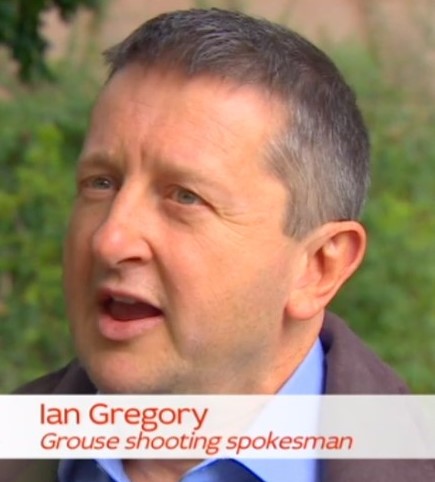
Commenting on footage of a Moscar Estate gamekeeper trying to release a badger from a snare by shooting at the snare, Ian Gregory said:

“In these pictures we’re seeing a badger being released from a trap which was intended for foxes. Foxes are a nightmare for ground-nesting birds and that’s the reason that gamekeepers try to reduce the number of foxes that we have“.

Apart from revealing his woeful ignorance of ecological food webs, Ian Gregory forgot to mention that snares must never be set on runs where there is evidence of regular recent use by non-target species such as badgers, as they may be caught or injured by the snare. And, according to BASC’s Code of Best Practice, ‘Knowledge of the tracks, trails and signs of both target and non-target species [i.e. badgers] is essential. If you are not competent in identifying the tracks, trails and signs of non-target species, you must not set snares‘.

As an aside, it’s worth reading former Police Wildlife Crime Officer Alan Stewart’s blog about the CPS’s decision not to prosecute the Moscar Estate gamekeepers, here.

Ian Gregory had more unsubstantiated tosh to impart to the viewer. Talking about hen harriers, he said:

“There is a problem about their populations in the UK. Some of that may be down to illegal activity but it’s also down to the pressure of human beings wanting more places for recreation, more countryside for recreation, more for their homes, so it’s not just a question of persecution, this is a much more complicated issue“.

Ah, so the demand for new housing on driven grouse moors is responsible for the catastophic decline of breeding hen harriers in England? And the scientific evidence for that claim is…..where, exactly? We had a look in the Conservation Framework for Hen Harriers which set out very clearly that illegal persecution was the biggest single factor affecting the hen harrier population’s chance of survival. Funnily enough, new housing estates being built on grouse moors didn’t feature.

All in all, this was an excellent film by the BBC’s Inside Out film and even more members of the public will now be aware of the disgraceful activities of the grouse shooting industry.

If you haven’t already done so, please consider signing this new e-petition calling for a ban on driven grouse shooting. PLEASE SIGN HERE.
Environment Committee to seek ‘detailed update’ on gamebird shoot licensing petition

As mentioned on yesterday’s blog (here), the Scottish Parliament’s Environment Committee met this morning and discussed progress on Logan Steele’s petition (on behalf of the Scottish Raptor Study Group) calling for the introduction of a licensing scheme for gamebird hunting.

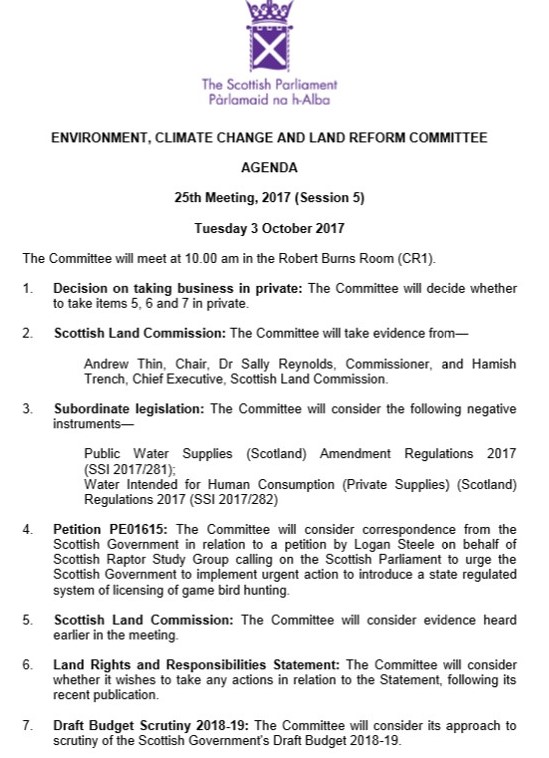
The discussion was over in a flash and the Committee agreed to keep the petition open and write to the Scottish Government / Cabinet Secretary for a “detailed update” about the progress that has been made on the proposed package of measures announced by the Cabinet Secretary in May 2017, including the establishment of an independent group to look at the environmental impacts of grouse moor management.

Good. We’re all eager to hear about what progress has been made.

Well done, Environment Committee, for not letting this slip off the radar.

Ban driven grouse shooting – new petition launched!

Persistence is a beautiful thing….

Gavin Gamble has lodged a new epetition on the UK Government website calling for a ban on driven grouse shooting [in England]:

Gavin has also set up a website to provide further background reading on this issue – here

Mark Avery blogged about the imminent launch of this new petition last week, while the Westminster Petitions Committee was still checking that it met the required petition standards. His blog attracted a fair few comments and they’re well worth a read.

Gavin’s petition has now gone live and will be open until 2 April 2018 (assuming there isn’t another general election before then in which case the petition will be closed early).

PLEASE SIGN THE PETITION HERE

Gamebird shoot licensing: Environment Committee to review progress tomorrow

The Scottish Parliament’s Environment, Climate Change & Land Reform (ECCLR) Committee will meet tomorrow to discuss progress on the petition calling for the introduction of state-regulated licensing for gamebird hunting.

As you know, this petition was lodged with the Public Petitions Committee in the summer of 2016 by Logan Steele, on behalf of the Scottish Raptor Study Group (SRSG). The Petitions Committee took evidence in October 2016 from the SRSG and RSPB Scotland (see here) and then evidence from the Scottish Moorland Group and BASC in December 2016 (see here) before deciding to pass the petition to the Environment Committee for further consideration.

The Environment Committee first considered the petition in January 2017 (here) and then heard evidence from various organisations (SRSG, RSPB Scotland, SNH, SGA and SLE) in April 2017 (here).

On the basis of those evidence sessions, on 23 May 2017 the Environment Committee agreed to keep the petition open and to write to Environment Secretary Roseanna Cunningham (see letter here) to recommend that the Scottish Government explores the implementation of a licensing scheme for grouse moor shooting, much to the disappointment of the grouse shooting industry which doesn’t think licensing is necessary and basically just wants to maintain the status quo.

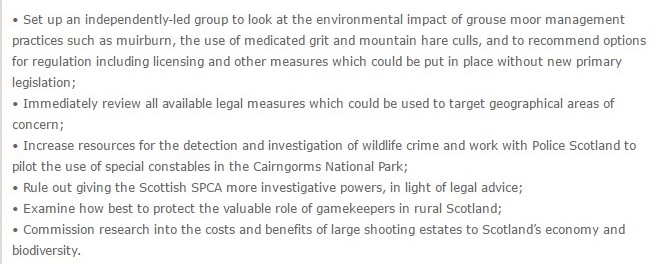
The following week, on 31 May 2017, the Environment Secretary announced a significant package of measures designed to protect raptors and to investigate the wider environmental and economic impacts of grouse moor management:

Since that announcement on 31 May 2017 we’ve heard very little more, although in mid-September Roseanna Cunningham told the Scottish Parliament that “good progress is being made” and that she will “announce further details shortly“.

Perhaps we’ll get an announcement this week? It’s good to see the Environment Committee isn’t letting this issue slide.

Tomorrow’s meeting will be available to watch live on Scottish Parliament TV (here) (Committee Room 1 from 10am) and we’ll post an archive of the video and the official transcript when available.

UPDATE 3 October 2017: Environment Committee to seek ‘detailed update’ on licensing petition (here)

Raptor persecution in Peak District National Park – BBC 1 this evening

Tonight’s BBC’s Inside Out programme will feature an investigation in to raptor persecution that’s taking place in the Peak District National Park.

This is a regional programme (BBC East Midlands) starting at 7.30pm but will be available on iPlayer shortly afterwards (see here).

To coincide with this programme, the Derbyshire Wildlife Trust has today called the low number of raptors in the National Park “a national disgrace” and blamed activities relating to the driven grouse shooting industry (see BBC news article here).

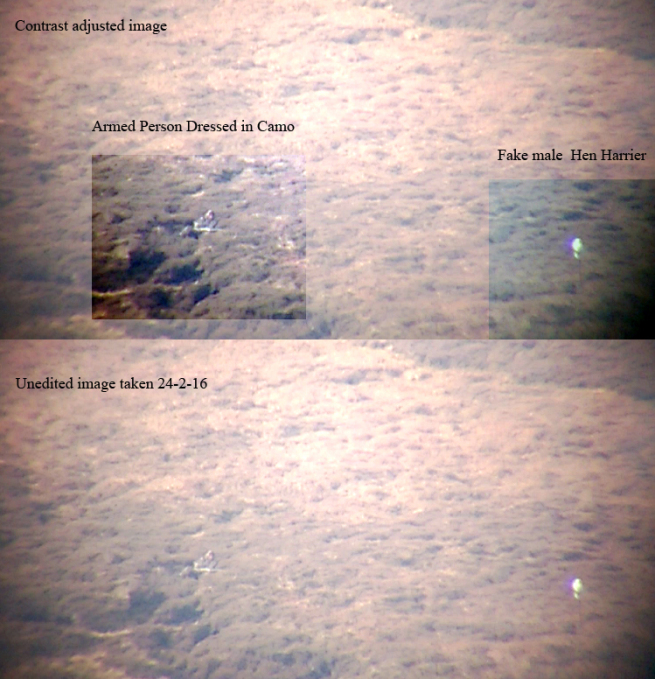
The article also mentions the footage that we published in April 2016 appearing to show an armed man sitting close to a hen harrier decoy on a National Trust-leased grouse moor within the National Park. This resulted in the National Trust terminating the grouse shooting lease four years early and searching for a new tenant. The National Trust has come under increasing public pressure not to lease the moor for grouse shooting and the campaigners are expected to be included in tonight’s Inside Out programme.

Part of the Peak District National Park (mostly the grouse moors of the Dark Peak area) has been recognised as a raptor persecution hotspot for many years (e.g. see RSPB ‘Peak Malpractice‘ reports here and here). As a result of the ongoing concerns, in 2011 the National Park began hosting a Bird of Prey Initiative where ‘partners’ are supposed to have been ‘collaborating’ to increase bird of prey populations. It has failed miserably. In 2015 it was announced that none of the project targets had been met (here) but that the Iniative was going to continue with “renewed commitment” and “new rigour and energy“. Strangely, we haven’t heard any more results from this so-called partnership initiative since then, although Rhodri Thomas, an ecologist with the Peak District National Park Authority gave a very honest presentation at the Sheffield raptor conference in September 2016. His opening words were:

“Has the Initiative worked? Well, we’ve not met the targets that we’d set for 2015, we’ve not met them by a fairly substantial amount in some cases, so I think the answer from that point of view is a fairly clear no“.

Meanwhile, cases of confirmed illegal raptor persecution have continued to emerge (e.g. a shot peregrine that was found critically injured next to a Peak District grouse moor in September 2016. It didn’t survive its injuries).

Don’t forget – BBC 1 (East Midlands) Inside Out tonight at 7.30pm.

Sticking with the Peak District National Park and alleged wildlife crime, did anyone see yesterday’s news that the Crown Prosecution Service has decided there will no charges relating to the alleged snaring of badgers that was filmed by the Hunt Investigation Team on the Moscar Estate earlier this year? Interesting.

Also of interest, to us, was the name of the spokesman for Moscar Estate who was cited in the article: Ian Gregory. Surely not the same Ian Gregory of You Forgot the Birds notoriety?

Buzzard shot in Hertfordshire

Press release from Hertfordshire Police, 26 September 2017:
Officers from Hertfordshire Constabulary’s Rural Operational Support Team (ROST) are appealing for witnesses and information after a buzzard was found seriously injured.

The bird was found by a member of the public on a track leading off Ledgemore Lane, Great Gaddesden, Hemel Hemstead on Wednesday September 6th 2017.

The bird was recovered and examined by a veterinaty surgeon. It was concluded that the bird had been shot and sadly, due to the severity of its injuries, the animal had to be put to sleep.

PC Simon Tibbett, from ROST, said: “All British wild birds, their nests and their eggs are protected under the Wildlife & Countryside Act 1981. Therefore it is an offence to shoot a buzzard or interfere with their nests in any way and punishable by a fine or up to six months in jail.

As a bird of prey, buzzard persecution is monitored by DEFRA and the National Wildlife Crime Unit as raptor persecution is a national wildlife crime priority.

We take wildlife crime very seriously in Hertfordshire and we are keen to trace those responsible for this offence. I would urge anyone with information to please get in touch“.

Jenny Shelton, Investigations Liaisons Officer at the RSPB said, “I think we speak for most people when we say we are angry and saddened to hear that someone has shot this bird. 

Our UK population of buzzards dropped during the 20th century due to unlawful killing, and sadly persecution is still a problem today. If you know anything about this incident, please contact police on 101 or the RSPB Investigations team on 01767-680551“.

Anyone who has witnessed people shooting or carrying hunting rifles in the area, or has any further information, should contact PC Simon Tibbett on Hertfordshire Constabulary’s non-emergency number 101, quoting reference D1/17/7143.

ENDS

Two more buzzard shootings were reported from nearby London Colney in April 2017, both believed to have been shot with an air rifle – see here.

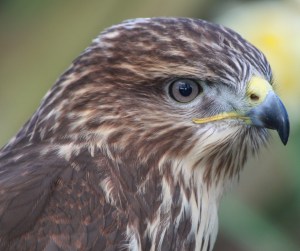
Buzzard photo by RPUK

Bleasdale Estate gamekeeper denies killing two peregrines in Bowland

A 34-year old gamekeeper, James Hartley, appeared at Preston Magistrates Court today to face a series of charges relating to the alleged killing of two peregrines on the Bleasdale Estate, Bowland, in April 2016.

The charges read out in court were as follows:

  1. Killing a Schedule 1 wild bird. On 13 April 2016 at Bleasdale in the county of Lancashire, intentionally killed a wild bird included in Schedule 1 to the Wildlife & Countryside Act 1981, namely a peregrine falcon, contrary to sections 1(1)(a), 1(4) and 21(1) of the Wildlife & Countryside Act 1981.
  2. Disturb the nesting site of a Schedule 1 wild bird. On 13 April 2016 at Bleasdale in the county of Lancashire, intentionally or recklessly disturbed a wild bird included in Schedule 1 to the Wildlife & Countryside Act 1981, namely a peregrine falcon, while it was in, on or near a nest containing eggs or young, contrary to sections 1(5)(a) and 21(1) of the Wildlife & Countryside Act 1981.
  3. Killing a Schedule 1 wild bird. On 13 April 2016 at Bleasdale in the county of Lancashire, intentionally killed a wild bird included in Schedule 1 to the Wildlife & Countryside Act 1981, namely a peregrine falcon, contrary to sections 1(1)(a), 1(4) and 21(1) of the Wildlife & Countryside Act 1981.
  4. Set trap / gin / snare etc to cause injury to wild bird. On 13 April 2016 at Bleasdale in the county of Lancashire, set in position a trap which was of such a nature and so placed as to be calculated to cause bodily injury to any wild bird coming in to contact with it, contrary to sections 5(1)(a) and 21(1) of the Wildlife & Countryside Act.
  5. Take a Schedule 1 wild bird. On 13 April 2016 at Bleasdale in the county of Lancashire, intentionally took a wild bird included in Schedule 1 to the Wildlife & Countryside Act 1981, namely a peregrine falcon, contrary to sections 1(1)(a), 1(4) and 21(1) of the Wildlife & Countryside Act 1981.
  6. Possess live / dead Schedule 1 wild bird or its parts. On 13 April 2016 at Bleasdale in the county of Lancashire, had in your possession or control a dead wild bird included in Schedule 1 to the Wildlife & Countryside Act 1981, namely a peregrine falcon, contrary to sections 1(2)(a), 1(4) and 21(1) of the Wildlife & Countryside Act.
  7. Possess an article capable of being used to commit a summary offence under section 1 to 13 or 15-17. On 13 April 2016 at Bleasdale in the county of Lancashire, for the purpose of committing an offence, namely killing a Schedule 1 wild bird, namely a peregrine falcon, under section 1(1)(a), 1(4) and 21(1) of the Wildlife & Countryside Act 1981, had in your possession a firearm which was capable of being used for committing the offence, contrary to section 18(2) of the Wildlife & Countryside Act 1981.
  8. Possess an article capable of being used to commit a summary offence under section 1 to 13 or 15-17. On 12 April 2016 and 27 April 2016 at Bleasdale in the county of Lancashire, for the purpose of committing an offence, namely killing a Schedule 1 wild bird, namely a peregrine falcon, under section 1(1)(a), 1(4) and 21(1) of the Wildlife & Countryside Act 1981, had in your possession hammer, trap and knife which were capable of being used for committing the offence, contrary to section 18(2) of the Wildlife & Countryside Act 1981.
  9. Cause unnecessary suffering to a protected animal – Animal Welfare Act 2006. On 12 April 2016 and 15 April 2016 at Bleasdale in the county of Lancashire, caused unnecessary suffering to a protected animal, namely a peregrine falcon, by an act, namely trapping and leaving for a number of hours, and you knew or ought reasonably to have known that the act would have that effect or be likely to do so.

Mr Hartley denied all charges.

The following commentary has been compiled from notes we took during the hearing:

The lawyer from the Crown Prosecution Service then summarised the prosecution case. She said the Crown’s case is that the defendant is responsible for the destruction of two birds at their nest site. She said the matter came to light when the RSPB sited a camera within the boundary of Bleasdale Estate to monitor nesting peregrines. The Crown alleges that camera footage captures an individual in a camouflage suit attending the nest site. The individual remained there for a number of minutes setting what is believed to be a trap. The female peregrine is seen to leave the nest and four shotgun discharges are heard and the female does not return. The male peregrine remained at the site all day, believed to be trapped in the device set earlier. Later in the evening a person is seen to attend the nest site and remove something.

She went on to explain that the defendant is the gamekeeper for this particular ‘beat’ on the Bleasdale Estate and during a police search of his property a bag was seized containing a number of tools. A forensic analysis showed that a wooden-handled hammer and an orange-handled knife both contained peregrine DNA. The defendant gave a ‘no comment’ interview.

The defence lawyer, Tim Ryan, told the court that his client did not carry out the offences and is not the person shown in the video footage. He said part of his defence case would be to question the admissibility of video evidence under section 78 of the Police & Criminal Evidence Act.

The next hearing will take place on 11 January 2018 which is expected to deal with legal arguments about the admissibility of video evidence. Depending on the outcome of that hearing, a preliminary trial date was set to begin on 12 February 2018 and is expected to last for five days.

PLEASE NOTE: Comments are welcome but contributors are reminded that the offences are only alleged at this stage and it is up to the court to determine innocence or guilt. Please consider your words carefully as libellous commentary could interfere with the progression of this case! Thanks.

UPDATE 10 January 2018: Case against Bleasdale Estate gamekeeper James Hartley: part 2 (here)

SNH imposes General Licence restriction on ‘mystery’ gamekeeper

So, SNH has today announced it has imposed two General Licence restriction orders, based on evidence provided by Police Scotland of alleged raptor persecution crimes.

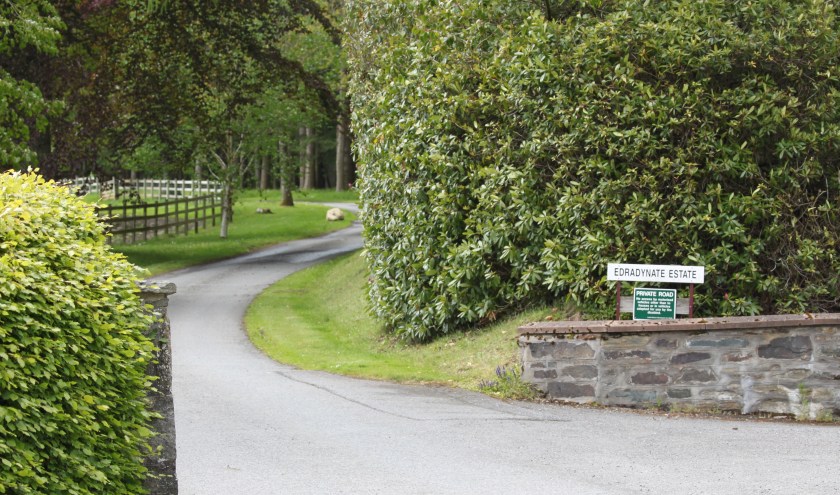
We know that one of those restriction orders has been placed on Edradynate Estate, Perthshire, because SNH has been quite upfront about it and has named the estate (see here).

But what about the other General Licence restriction? Well, according to the SNH press release, this has been imposed on “an individual” rather than on an estate.

This in itself is interesting. We know from the SNH framework for imposing these restrictions that this action can be taken against an individual, as well as on certain areas of land, but the framework document suggests that imposing it on land would be preferable to imposing it on an individual:

“While the wording provides for the exclusion of individuals, it is the intention that where SNH has robust evidence that wild birds have been killed or taken or where there is intention to do so other than in accordance with a licence, SNH will exclude the area of land on which such evidence is found from General Licences 1, 2 and/or 3“.

Hmm. So who is this individual and why did SNH impose the restriction on him/her, rather than on an estate?

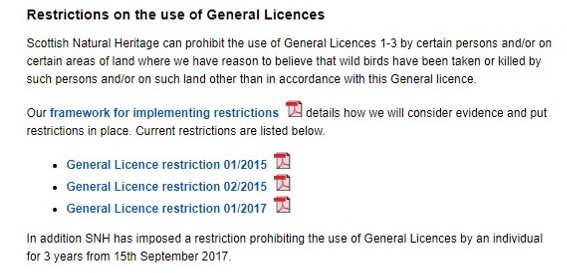
The SNH press release points the reader to the SNH webpage on General Licences for “full licence restriction details“. However, when you look at the SNH webpage, all you find is this:

Is SNH having a laugh? The “full licence restriction details” of this particular GL restriction order amounts to one sentence:

“In addition [to the restriction imposed on Edradynate Estate] SNH has imposed a restriction prohibiting the use of General Licences by an individual for 3 years from 15th September 2017“.

That’s it? No name? No information on the area, let alone the name of the land where the evidence of raptor persecution took place? Not even the region?

What’s with the secrecy? Who is SNH shielding, and why?

This could be absolutely anyone! Is it Nicola Sturgeon? Is it Alex Salmond? Is it JK Rowling? Highly unlikely, it has to be said, but you get the point we’re trying to make.

And what happened to the transparency that was promised when former Environment Minister Paul Wheelhouse first announced this new measure to tackle ongoing raptor persecution? He said he expected details of General Licence restrictions to be published on the SNH website to act as “a reputational driver“. That’s not going to happen if SNH withholds the details, is it?

This is a very dangerous precedent to set. SNH has previously withheld details of estates that were being considered for a GL restriction but in that case, the justificiation for being all secret squirrel was reasonable: the GL restrictions hadn’t yet been imposed, but rather the estates had been notified of an intent to impose, and SNH argued that the estates needed time to respond/appeal (see here). That was fair enough.

But in this case, SNH has already imposed the GL restriction, and we’re struggling to understand the justification SNH might have for keeping the details secret.

What is it with statutory agencies and their reluctance to release information that’s clearly in the public interest?

We’ll be submitting an FoI to SNH to ask for further details, and, based on the response, we’ll consider appealing the decision to the Scottish information Commissioner.

In the meantime, have a look at today’s press statement from RSPB Scotland about these latest GL restrictions. This gives us more of a clue about the recipient of the restriction order. The statement includes the following quote from Head of Investigations, Ian Thomson:

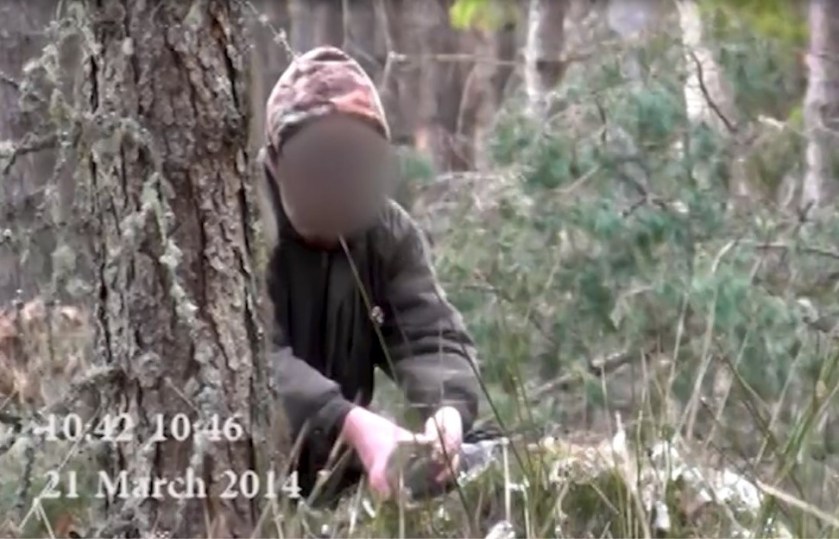
“The other restriction was imposed after RSPB investigations staff passed video footage to police of a gamekeeper allegedly setting illegal traps, baited with a dead woodpigeon, very close to a goshawk nest in NE Scotland.”

Ok, now we’re getting somewhere. The recipient of the GL restriction is a gamekeeper, working in NE Scotland, who was filmed allegedly setting illegal traps close to a goshawk nest. And the RSPB has even provided a video clip of the alleged offence, with the individual’s face pixellated (presumably done on legal advice).

Well, quelle surprise! Another gamekeeper trying, allegedly, to persecute a goshawk in north east Scotland. This is becoming quite a habit in this part of the country. First we had gamekeeper George Mutch, caught on video trapping and battering to death a goshawk on the Kildrummy Estate in 2012, crimes for which he went to prison (see here), then we had a gang of masked armed men caught on video shooting at a goshawk nest on Forestry Commission land at Glen Nochty in 2014 (see here), and now this latest case.

But who is this latest gamekeeper and on whose land was he working when he allegedly set this trap?

More on this in the next blog…..

UPDATES:

More on the mystery gamekeeper with the general licence restriction (here).

Evidence of wildlife crime results in General Licence restriction on Edradynate Estate

As many of you will know, SNH has the ability to impose a three-year General Licence restriction order on land, or on an individual, where there is sufficient evidence, substantiated by Police Scotland, that raptor persecution has taken place (see SNH framework here).

This measure, based on a civil burden of proof, was introduced by then Environment Minister Paul Wheelhouse in 2013 in response to the continuing difficulties of meeting a criminal burden of proof to facilitate a criminal prosecution. The measure became available for incidents that occured on or after 1 January 2014.

Photo of a poisoned buzzard (RPUK)

Since then, only two restriction orders have been imposed, both in November 2014: one for the Raeshaw/Corsehope Estates in the Scottish Borders, and one for the Burnfoot/Wester Cringate Estates in Stirlingshire (see here for details, and an explanation of what a General Licence restriction actually means).

As you’ll also probably be aware, Raeshaw Estate and Corsehope Estate made a legal challenge to SNH’s decision and this resulted in a judicial review. The judicial review dragged on for some time but eventually concluded in March this year, and the court found that SNH had acted fairly and that the General Licence restriction at Raeshaw Estate and Corsehope Estate should remain in place (see here).

While this legal challenge was underway, SNH, quite reasonably, did not impose any further General Licence restrictions, even though there were plenty of candidate estates to consider. Once the legal argument had been settled, we expected SNH to open the floodgates and impose many more restriction orders for offences that had taken place since January 2014. We asked SNH about this in June 2017 and we were told that two notifications were underway, relating to offences in Perthshire and Aberdeenshire, although no further details were given at that time, presumably as SNH was giving the affected parties time to respond/appeal. Fair enough.

Today, SNH has announced that two General Licence restriction orders have been imposed in two separate cases.

The first of those cases relates to Edradynate Estate in Perthshire: SNH_GL Restriction Notice_Edradynate Estate_15Sept2017

Here is the decision notice:

And here is the estate boundary map to which the General Licence restriction applies for the next three years:

For the next three years, Edradynate Estate will no longer be able to enjoy the privilege of using General Licences 1, 2 or 3, but the estate will be entitled to apply for the use of an Individual Licence that will allow them to kill certain bird species but under closer scrutiny than if the estate was using a General Licence. We’ll be monitoring the use of any Individual Licences that SNH approves for this estate, and, if there is any breach of the licence conditions, we fully expect SNH to revoke the Individual Licence just as they did for Raeshaw Estate earlier this year.

SNH has not provided any information about the Police Scotland evidence used as the basis for this General Licence restriction order on Edradynate Estate. However, it’s probably a fair assumption that it relates to the alleged poisoning of several buzzards in 2015. This is one of the five prosecution cases that the Crown Office dropped earlier this year, without explanation. The case did not involve video evidence, as some of the others did, and the case was dropped by the Crown despite a plea from Police Scotland to proceed (see here).

We’ve been blogging about Edradynate Estate for a very long time. It’s well worth reading an earlier summary we wrote (here) which includes some fascinating commentary about the estate by former RSPB Investigator Dave Dick, who claimed as far back as 2004 that the estate was “among the worst in Scotland for wildlife crime“, and commentary by former Police Wildlife Crime Officer Alan Stewart, who said in 2005, “Edraynate Estate has probably the worst record in Scotland for poisoning incidents, going back more than a decade“. The details involve a disturbingly high number of poisoned birds and poisoned baits that were found over the years, as well as a number of dropped prosecution cases (nobody has ever been convicted for any of the alleged offences). The summary also includes information about links between the estate and the Scottish Gamekeepers’ Association.

Now, whether you think a General Licence restriction order is a sufficient sanction against this estate is open to debate. However, while we wait for the Scottish Government to get on with estate licensing, a General Licence restriction order is all that is currently available, so well done to SNH for imposing the General Licence restriction order on this particular estate and for being semi-transparent about the details.

Unfortunately, we can’t say the same about the second General Licence restriction order that SNH has just imposed. We’ll be blogging about that one in the next blog…..it’s an absolute shocker.

Edradynate Estate (photo by RPUK)

UPDATES:

RSPB press statement here

SNH imposes General Licence restriction on ‘mystery’ gamekeeper (here)

More on the mystery gamekeeper with the General Licence restriction (here)

Scottish parliamentary committee considers petition calling for mountain hare protection

Earlier this month Harry Huyton (on behalf of OneKind) presented evidence to the Scottish Parliament’s Public Petitions Committee in support of a petition calling for greater protection for mountain hares.

This petition, signed by over 11,000 people, specifically calls for:

‘The Scottish Parliament to urge the Scottish Government to introduce greater protection for mountain hares on both animal welfare and conservation grounds, which may include: introducing a three-year moratorium on all mountain hare killing, permitting culls and driven hunts only under licence, and ending all culling and driven hunting of mountain hares within Scotland’s National Parks using a Nature Conservation Order‘.

The full transcript of proceedings can be read here (starts at page 38):

Transcript Public Petitions Committee_14Sept2017

Photo of culled mountain hares being transported on a grouse moor on Farr Estate in February 2017 (photo by Pete Walkden)

It was an interesting discussion and Harry made many good suggestions about how the currently unregulated mass culling of mountain hares on grouse moors could be better regulated, including a fascinating analogy with seal culling. He said:

“We have tried to put forward a number of approaches. The other possibility would be a simple extension of the licensing regime. Given that the current regime applies five months of the year, why not just extend it to apply the whole year round? If we ran it for a few years, it would not only result in fewer mountain hares being killed but provide quite essential data on the level to which the species is being controlled.

I point the committee to a similar arrangement that was introduced five years ago for seal killing in Scotland. In that example, the move from unregulated to licensed activity not only resulted in a big reduction in the number of seals killed but brought transparency to the sector. Every three months, SNH publishes the latest data on the number of licences that have been issued and the number of seals that have been killed under licence, and that is essential from a conservation and, indeed, a welfare perspective“.

The Petitions Committee agreed to seek written evidence from several named stakeholders: SNH, Scottish Land & Estates, Scottish Wildlife Trust, James Hutton Institute and GWCT.

As Harry noted in his blog about this evidence session, the responses from some of these organisations is quite predictable – they will not support any change to the status quo (e.g. see responses given back in 2015 when ten conservation organisations called on the Scottish Government to introduce an immediate three-year ban – see here – an action that the Scottish Government ignored).

With that in mind, Harry urges those ten conservation organisations (National Trust for Scotland, John Muir Trust, RSPB Scotland, RSZZ, Highland Foundation for Wildlife, Scottish Wildlife Trust, Scottish Raptor Study Group, The Cairngorms Campaign, the Mammal Society and the Badenoch & Strathspey Conservation Group) to update and republish their earlier joint statement so the Petitions Committee are provided with a more balanced view.

We strongly urge those ten groups to act. Given the comments made by some members of the Petitions Committee about mountain hares (as part of a discussion about Les Wallace’s petition calling for a study on the economic impact of driven grouse shooting), we think the Petitions Committee is quite confused about mountain hare culling.

For example, during the discussion on Les’s petition (starts on page six of this transcript), Petitions Committee Convenor Johann Lamont (Lab) said:

“It was interesting to hear last week that the mountain hare is thriving because of grouse“.

Committee member Brian Whittle (Con) said:

“Also, having subsequently had a wee look at it, I have found that other environmental issues are driving down the mountain hare population. The planting of spruce and conifers is driving the ferret, weasel and fox populations, which is decimating the hares. There is quite a tension“.

Hmm. Would love to see the scientific paper that demonstrates wild ferrets are decimating mountain hares!

Hopefully the ten conservation organisations can provide the Committee with a more scientifically accurate account of what is happening to mountain hares on driven grouse moors, such as this account by Dr Adam Watson, based on decades of scientific research.