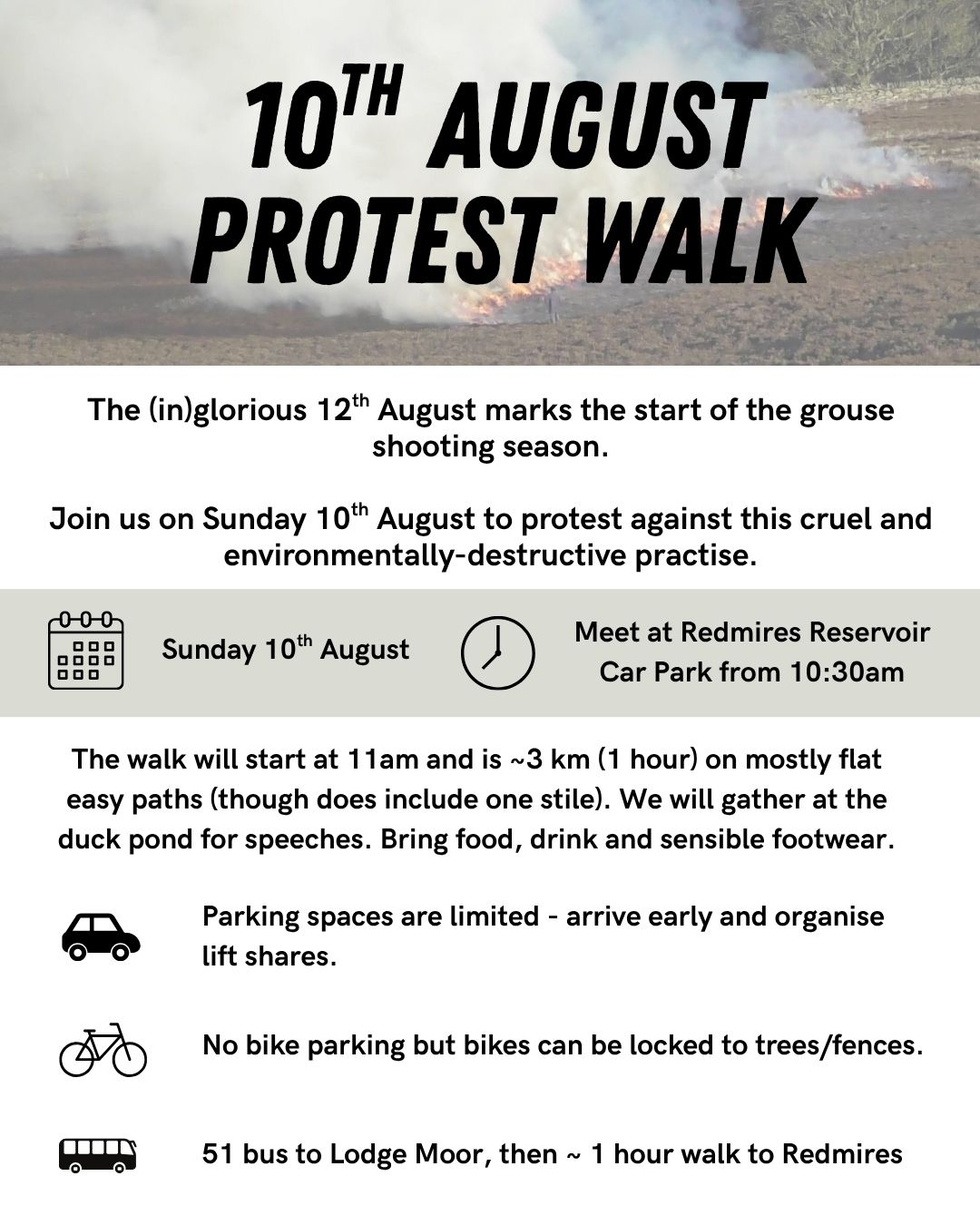
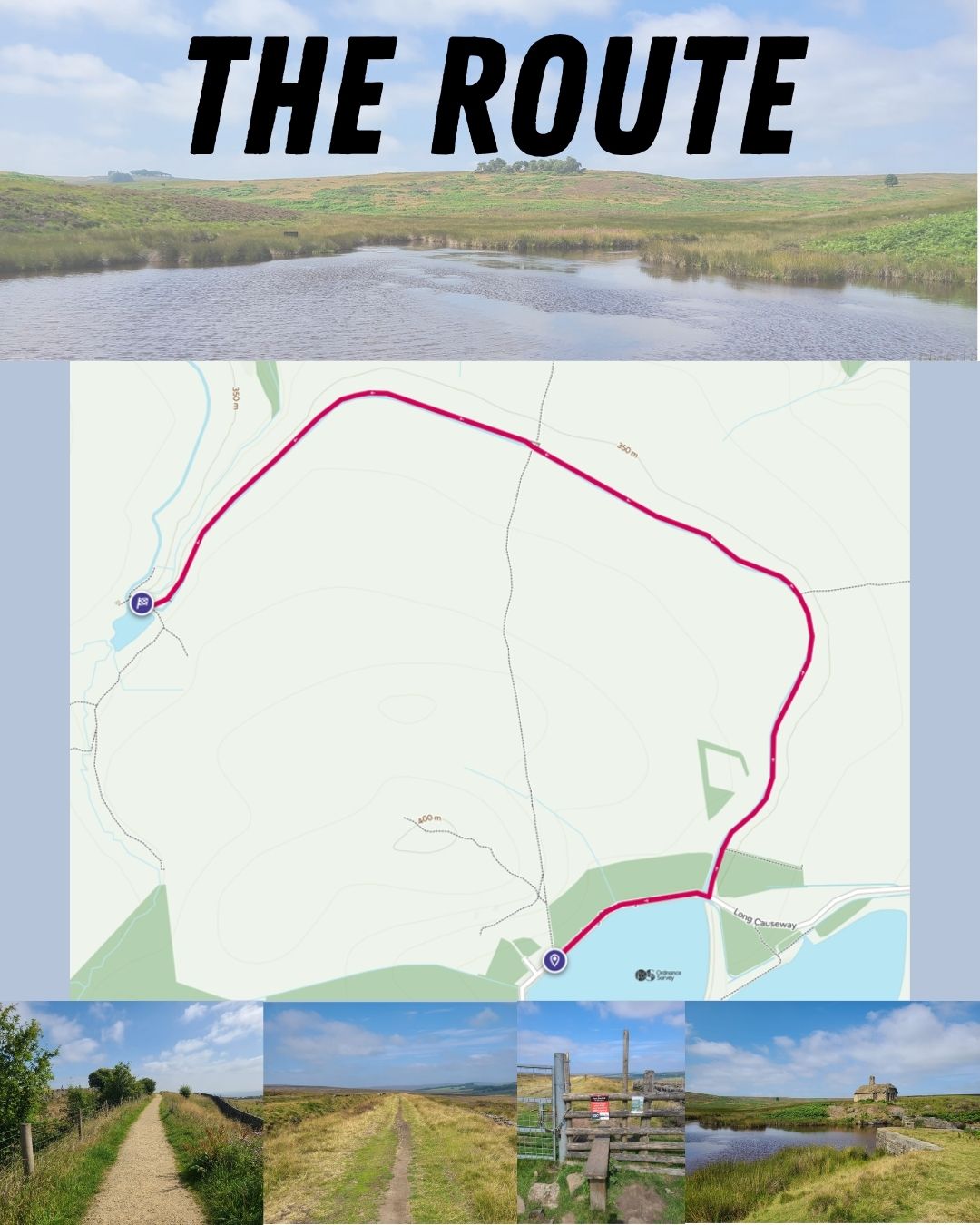
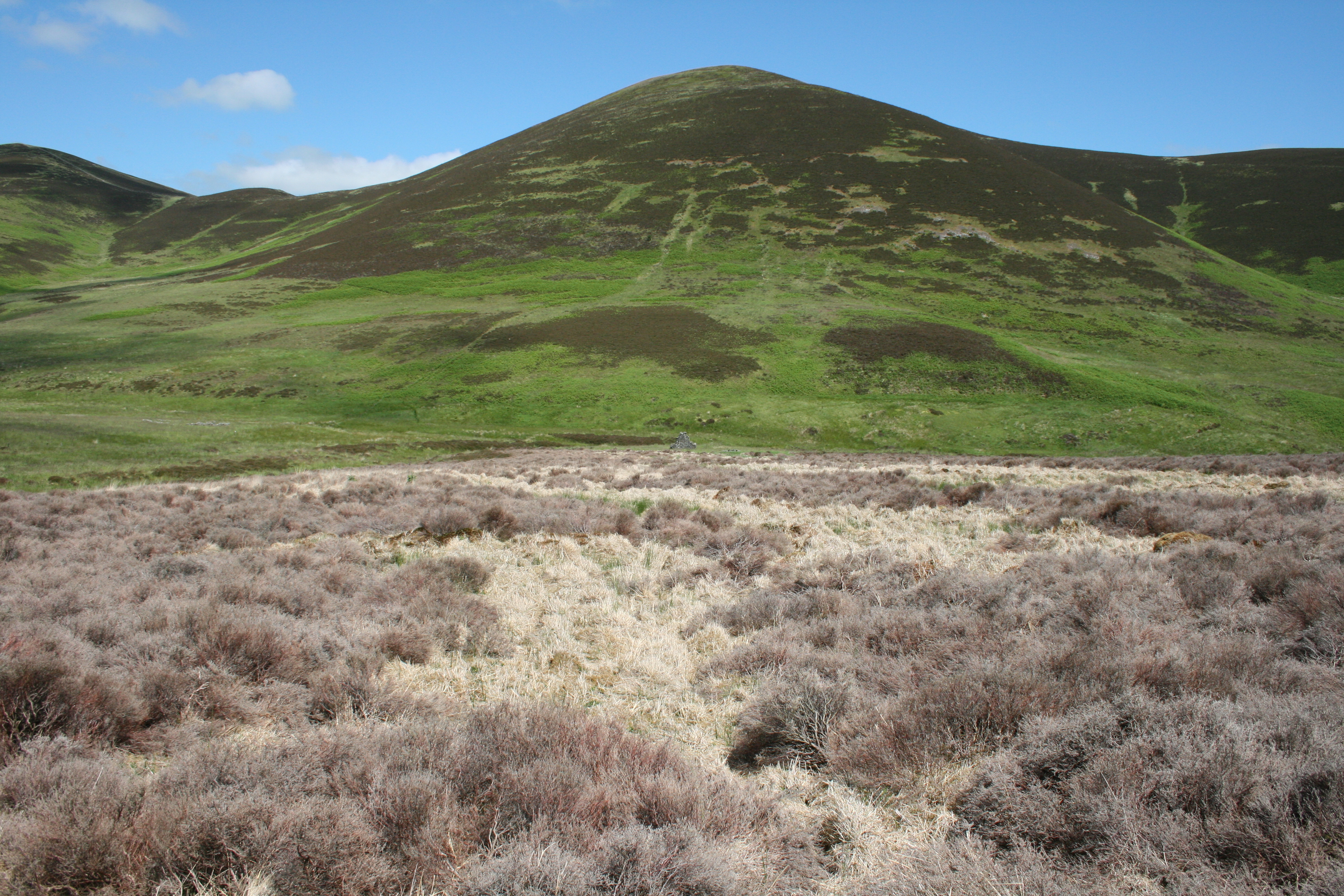
There’ll be an anti- grouse shooting protest walk taking place in the Peak District National Park this coming Sunday (10 August 2025), timed to coincide with the start of the grouse-shooting season on the Inglorious 12th.
Organised by the new campaign group Reclaim Our Moors (see here for earlier blog on them), the one-hour walk, followed by speeches, will take place on Moscar Estate, meeting at 10.30am, and is open to anyone who wants to join in.
Here are the details from Reclaim Our Moors:
If you want to contact the group directly, contact details can be found here.
Shooting estates in England are failing to declare millions of Pheasants that are being bred, reared and released in to the countryside.
That’s the finding of new research published yesterday by environmental campaigner and best-selling author Guy Shrubsole (see here for his excellent blog).
According to official statistics that Guy obtained via FoI from the Animal Plant & Health Agency (APHA), only 25.9 million Pheasants are accounted for on the latest ‘Poultry Register’. We know (from the shooting industry itself) that approximately 50 million Pheasants are released annually, which means approximately 20 million Pheasants are currently unaccounted for.
Guy didn’t ask for the equivalent data on Red-legged Partridges or Mallards.
It’s a legal requirement for anyone who keeps 50 or more birds, including Pheasants and Red-legged Partridges, to register with APHA.
Registration is mandatory because it helps APHA to manage the spread of diseases such as Avian Influenza. For example, during disease outbreaks APHA can quickly contact registered keepers to provide information and guidance on biosecurity updates. By knowing where birds are kept, APHA can also implement targeted surveillance and control measures to prevent the spread of diseases, especially Highly Pathogenic Avian Influenza (HPAI).
Pheasant feeder (with spilled food = massive biosecurity hazard) at a Pheasant release pen in Worcestershire. Photo by Ruth Tingay
Failure to register with APHA is an offence, but it’s been going on for years. In a Natural England and BASC-commissioned report published in 2020, registration compliance (for Pheasant keepers) was estimated to be less than 25%.
This low level of compliance on registering Pheasants will come as no surprise to anyone who pays attention to the behaviour of the UK gamebird shooting industry. It’s not an industry celebrated for adherence to the law on many issues, including the illegal killing of birds of prey, the illegal setting and use of traps, the illegal possession, storage and use of pesticides and poisons, the illegal burning of deep peat moorland, the illegal use of toxic lead ammunition to kill waterfowl etc etc.
Given the current high risk of Avian Flu in England (another case was reported yesterday nr Yeovil, Somerset (ref AIV 2025/54), and BASC’s idiotic legal challenge against the Government’s restrictions on gamebird releases on or close to Special Protection Areas, restrictions that were imposed specifically to help prevent the spread of HPAI to these important conservation sites (see here for yesterday’s blog on this), this level of non-compliance, with millions of unregistered ‘Ghost Pheasants’ roaming the countryside, could lead to a catastrophic HPAI epidemic as we head into the shooting season.
Four more outbreaks of Highly Pathogenic Avian Influenza (HPAI, also known colloquially as Bird Flu) have been confirmed across the UK in recent days, including on a pheasant shoot in Exmoor National Park.
And yet in a staggering display of arrogance and selfishness, the British Association for Shooting & Conservation (BASC) has now launched yet another legal challenge against the Government’s restrictions on gamebird releases; restrictions that have been put in place precisely to protect wild birds of high conservation value from the risk of being exposed to highly contagious HPAI.
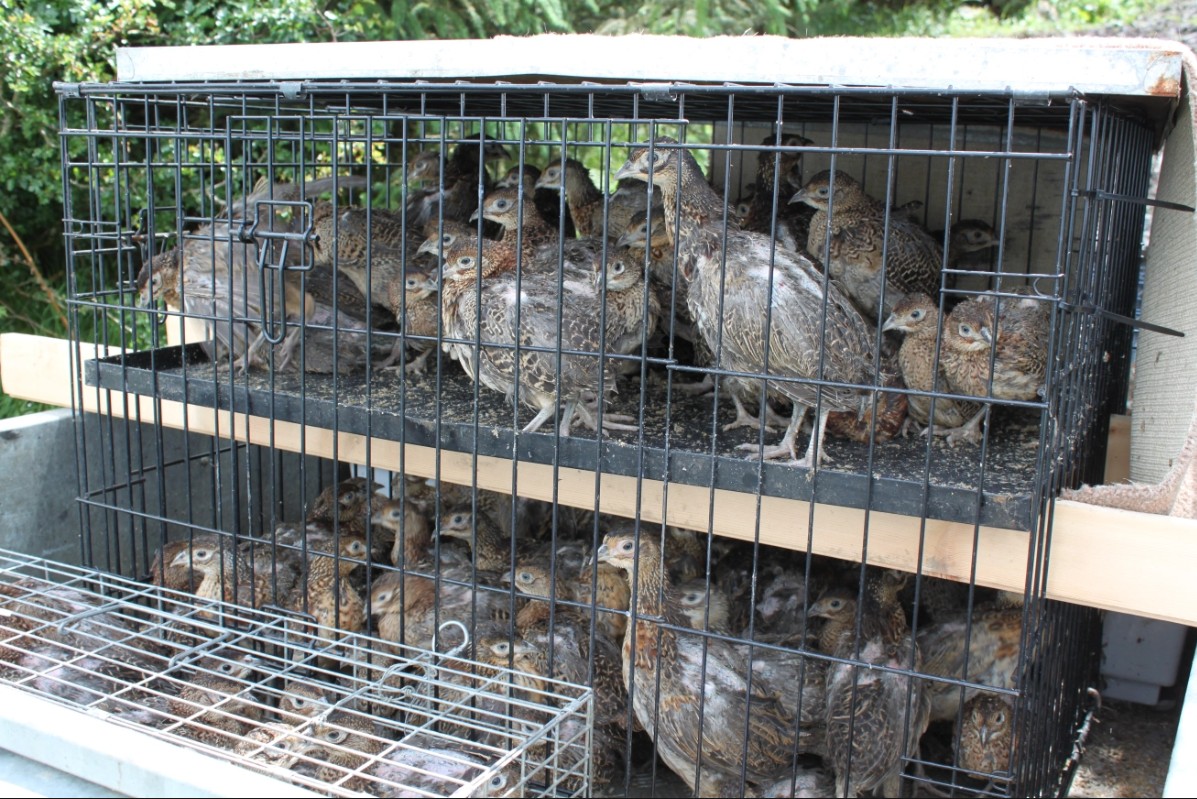
Captive-bred non-native Pheasant poults, in pretty poor condition, being transported for release in the UK countryside. Photo by Ruth Tingay
You may remember earlier this month I blogged about how Defra had sensibly withdrawn General Licence 45 in March this year – this is the licence under which restricted numbers of gamebirds (Pheasants and Red-legged Partridges) can be released on or within 500m of Special Protection Areas – which was withdrawn due to Defra’s legitimate concerns about the spread of HPAI.
Instead of being able to use GL45 this year, Natural England said that gamebird shoots could apply for individual licences to release gamebirds on or close to SPAs, but that only some licences would be permitted and only with a delayed release date for the poults, whereas licences for many other SPAs would be unlikely to be issued at all (see earlier blog here).
BASC reacted with predictable fury and self-righteousness and said it had started legal proceedings against Defra’s decision to withdraw GL45, claiming that Defra had “not provided the formal reason behind it or published a detailed decision-making document“.
However, after some investigative work by Wild Justice’s legal team at Leigh Day, it turns out that BASC has apparently dropped that legal challenge, presumably because it didn’t have a hope in hell of going anywhere given the current high risk of HPAI.
At the time of that legal challenge, there were at least five outbreaks of Highly Pathogenic Avian Influenza in West Yorkshire, County Durham, North Yorkshire, Wrexham, and Pembrokeshire.
Since then, four more outbreaks of HPAI have been confirmed in July 2025, resulting in the mass culling of captive poultry and in one case, 2,500 Pheasant poults on a Pheasant shoot near Winsford in Exmoor National Park, with subsequent 3km Protection Zones and 10km Surveillance Zones being put in place which prevents, amongst other things, the release of gamebirds for shooting. The locations of the latest outbreaks are:
25 July 2025 – near Tow Law, Bishop Auckland, County Durham (ref: AIV2025/50).
28 July 2025 – near Winsford, Somerset (Exmoor National Park) (ref: AV2025/51). Centred on grid ref: SS9162536026.
30 July 2025 – near Bampton, Devon (ref: AIV2025/52). Centred on grid ref: SS9793221915.
30 July 2025 – Snetterton, near Breckland, Norfolk (ref: AIV2025/53). Centred on grid ref: TM0069490799.
Against this backdrop of disease outbreaks, it’s really hard to comprehend BASC’s decision to start legal proceedings for a second challenge against gamebird restrictions, but that is exactly what it’s done.
This time the challenge is against Natural England and here is BASC’s reasoning, published on its website yesterday:
BASC hasn’t published the contents of its Pre-Action Protocol (PAP) letter to Natural England so it’s difficult to evaluate the strength/weakness of its legal arguments at this stage. Although any focus on the ridiculous ever-changing status of ‘wild/captive’ Pheasants (see the conundrum of Schrodinger’s Pheasant) is welcome as far as I’m concerned, and especially the interpretation of ‘released’, because even if it’s judged that gamebirds aren’t considered ‘released’ until they’re formally set free from the release pens, they still pose a considerable risk to spreading HPAI when vast release pens aren’t covered off to prevent wild birds flying in and out of them (nor Pheasants for that matter).
A large pheasant release pen on the left of the picture, with a low boundary fence providing full access for wild birds and/or Pheasants to enter and leave the pen at will. Photo: Ruth Tingay
Whatever the technical legal arguments though, it seems that the ‘rights’ of BASC members to release millions of non-native gamebirds for so-called ‘sport’ shooting is of more importance to BASC than reducing the risk of spreading a highly contagious disease and protecting the health of wild birds of high conservation value. It doesn’t look good, does it?
Wild Justice has today written to BASC and BASC’s lawyers to state its intention to apply to be an ‘interested party’ in this case if it proceeds to an application for judicial review. General Licences 43 and 45 were introduced by Defra as a direct consequence of a legal challenge by Wild Justice between 2019 and 2021 to regulate the previously uncontrolled annual release of approximately 60 million non-native gamebirds (Pheasants and Red-legged Partridges) into the countryside, so any potential new legal challenge against those General Licences is of significant interest to Wild Justice. Sign up for Wild Justice’s free newsletter to keep updated.
UPDATE 1 August 2025: Shooting estates failing to declare millions of Pheasants – could spell disaster in Avian Influenza epidemic (here).
BRITAIN’S RAREST BREEDING BIRD RAISED FOUR YOUNGSTERS AT SECRET LOCATION
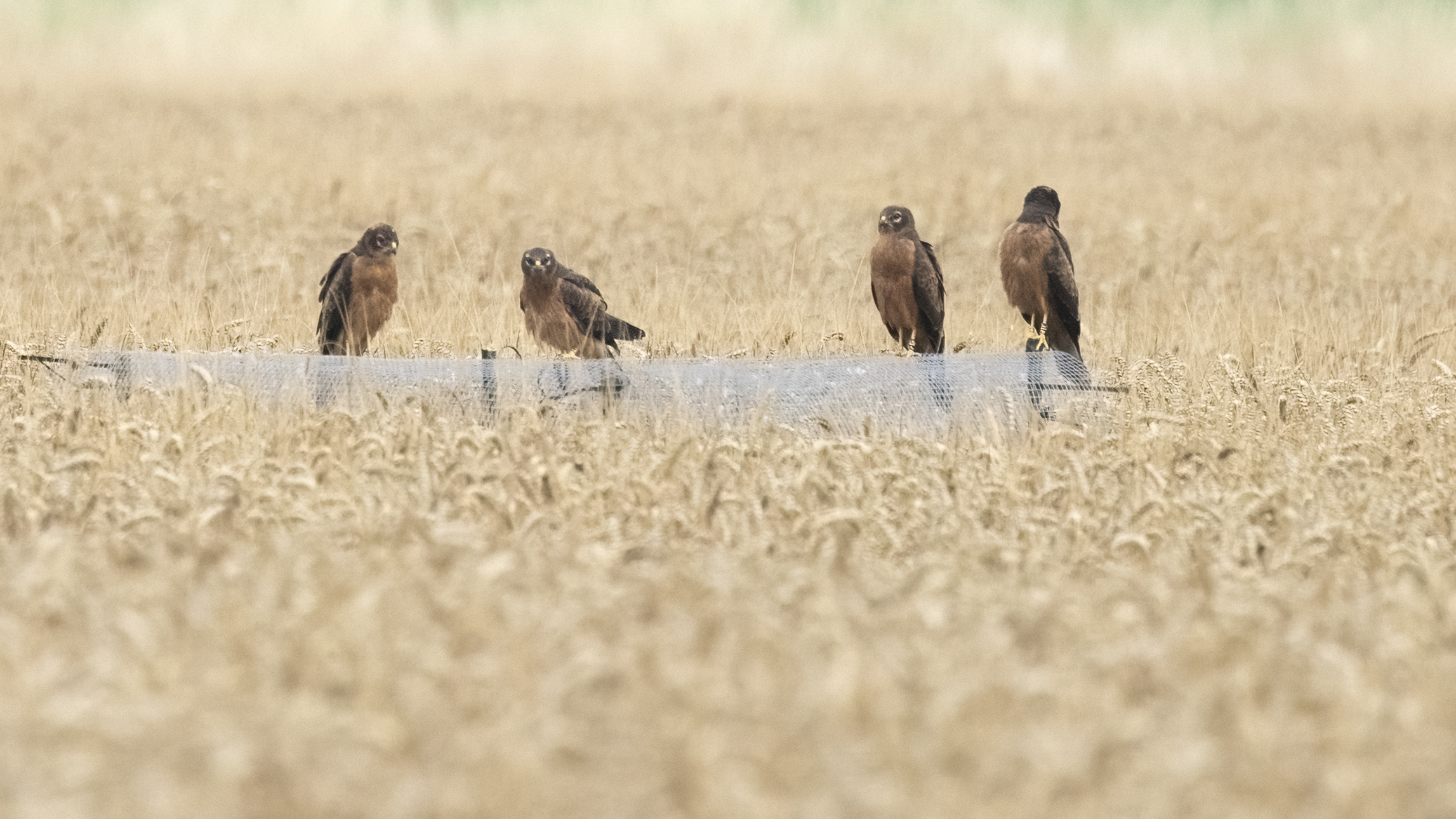
A pair of Montagu’s Harriers, Britain’s rarest breeding bird, have successfully raised four youngsters at a secret location in England
The pair of birds which arrived in May have been closely monitored by the RSPB who, working closely with a farmer, installed a protection fence around the nest in early July
This week the four chicks have made their first flights, delighting all involved
Montagu’s Harrier juveniles, 25 July 2025. Photo by RSPB
The Montagu’s Harrier is Britain’s rarest breeding bird species and hasn’t successfully nested in the UK since 2019. After a high of nine successful nests in 2011, its population has sadly dwindled – with it being officially placed on the Red List in 2021. But this year a pair arrived in the UK and have gone on to delight conservationists by raising four healthy youngsters.
Montagu’s Harriers winter in Africa and return to Europe to nest, often in agricultural fields, in particular winter sown cereals in the UK, and can return to the same nesting areas each year. Their previous strongholds in Spain and France are diminishing due to intensification of agriculture and earlier harvest dates, as well as wetter summers. Many nests across Europe are protected from predators by the installation of small metal fences by conservationists, volunteers and farmers.
The birds were first seen at the now secret location in May, raising hopes they would breed. Their nest was located in June by the licensed use of a drone and then closely monitored by a volunteer birdwatcher and the RSPB. Photographs indicated that both adult birds were ringed, remarkably the male being a chick from a UK nest in 2015 and the female from a nest in France in 2023.
Male Montagu’s Harrier. Photo by RSPB
As soon as their behaviour indicated that youngsters had hatched, the RSPB entered the field under licence and installed a small protective fence to safeguard the nest from ground predators. The chicks were then ringed in mid-July and last week made their first flights, delighting all involved.
Mark Thomas, Montagu’s Harrier species lead at RSPB, said:“We are overjoyed that a pair have returned, they managed to find each other and through the close protection of a dedicated farmer and the RSPB have managed to raise four youngsters. What’s even more remarkable is that we have been able to work out that the male was colour-ringed by the RSPB as a chick in a UK nest in 2015 and that his partner is wearing a ring indicating she is from France. This Anglo-French alliance could just be the springboard needed to save this species in Britain.”
The farmer, who cannot be named in order to protect the location, said: “It’s fantastic to have these amazing birds on the farm and a just reward for the extensive conservation work we have been undertaking for decades.”
It is now hoped the birds will all migrate safely, and the adults will return in 2026.
ENDS
Channel 4 News has also covered this story with an article and a video, here.
What excellent news this is – kudos to the farmer and the RSPB for protecting the nest. Let’s hope the adults and four juveniles manage to get out of England successfully, unlike some of their predecessors (e.g. see here, here and here).
I’m sure many of you remember the young, satellite-tagged Golden Eagle called ‘Merrick’.
She was part of the South Scotland Golden Eagle Project, a lottery-funded conservation initiative which translocated young Golden Eagles from various sites across north Scotland to boost the tiny remnants of the Golden Eagle breeding population in south Scotland that had previously been decimated by illegal persecution and become isolated by geographic barriers.
Camera trap photo of golden eagle Merrick in 2022, from South Scotland Golden Eagle Project
Merrick hit the headlines in autumn 2023 when her satellite tag suddenly and inexplicitly stopped transmitting on 12 October 2023 at a location in the area to the west of Fountainhall, between Heriot and Stow, close to the boundary of the Raeshaw Estate in the Scottish Borders.
Police Scotland issued an appeal for information in November 2023 in which they stated they believed Merrick ‘had come to harm’ but no further details were provided at that time.
We didn’t hear anything more for another six months but then in May 2024 the South Scotland Golden Eagle Project issued a press release that revealed evidence from the crime scene that led Police Scotland to believe that Merrick had been ‘shot and killed’, whilst she was sleeping in a tree, and that someone had then ‘removed her body and destroyed her satellite tag’ (see here).
The criminal who shot Merrick as she slept has not been arrested or charged. It’s the same old story – insufficient evidence to identify an individual and so whoever killed this eagle escapes without consequence, just like every single other eagle-killer in Scotland. Not one of them has ever been convicted.
New legislation was supposed to address this failure with the introduction of the Wildlife Management and Muirburn (Scotland) Act, whereby a grouse-shooting licence could be revoked in circumstances where, on the balance of probability, a crime was considered to have taken place where land was being managed for grouse shooting, but at the time of Merrick’s shooting this legislation wasn’t yet in place and can’t be applied retrospectively.
That just leaves a General Licence restriction as the only potential ‘sanction’ in this case, not that I’d describe a GL restriction as an effective sanction, for reasons that have been explored previously on this blog (e.g. here and here). Nevertheless, it’s still something.
As we head towards the two-year anniversary of Merrick being shot and killed, I wanted to know whether NatureScot had considered a General Licence restriction in this case, either on the land where Merrick was believed to have been shot or on land nearby. It was rumoured that this was under consideration over a year ago in June/July 2024 but I hadn’t seen any restriction notice so in June this year, I submitted an FoI to NatureScot to find out what the status was.
NatureScot replied to me on 21 July 2025 with this:
‘We have received an information package from Police Scotland to this case, and it is currently under consideration‘.
Tellingly, NatureScot didn’t elaborate on how long this decision had been under consideration so I’ve since submitted a further FoI request to find out on what date NatureScot received the ‘evidence package’ from Police Scotland which would allow NatureScot to begin its deliberations.
I await the response with interest.
UPDATE 11 August 2025: 16 months (& waiting) for NatureScot to make decision on General Licence restriction relating to ‘shooting and killing’ of sleeping Golden Eagle called Merrick (here).
The following is a guest blog by someone who wishes to remain anonymous, although I know their identity.
DID SCOTTISH FORESTRY KNOW STOBO HOPE WAS ‘NAPALMED’ WITH HERBICIDE LONG BEFORE ‘NEW INFORMATION CAME TO LIGHT’?
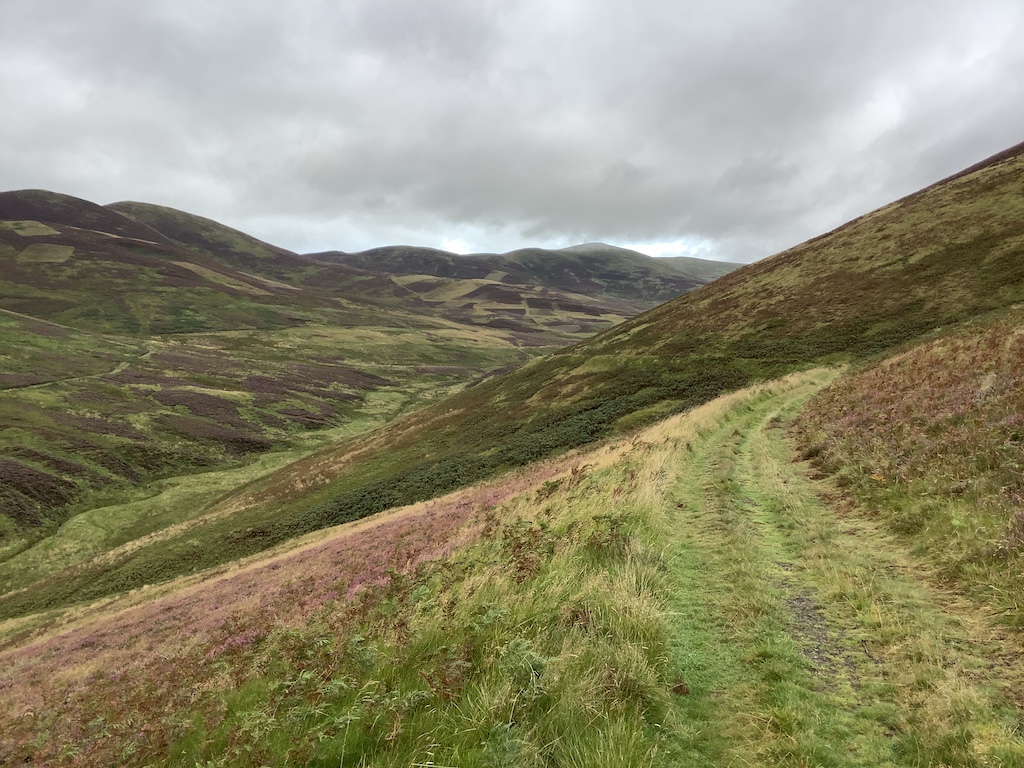
Herbicide damage at Stobo Hope, July 2024. A short video of Stobo Hope may be seen here (credit – Ted Leeming).
Readers may be familiar with Stobo Hope, a haunt of golden eagles and other raptors, with a notable black grouse lek. A Sitka spruce plantation with a £2 million taxpayer funded grant was approved by regulator Scottish Forestry. Wild Justice and Raptor Persecution UK readers greatly helped a community crowdfunder (see here) to fund a successful judicial review to challenge approval of this forestry scheme without an Environmental Impact Assessment (EIA) (see here).
Forestry work started in February 2024, the petition for judicial review was lodged in April 2024, and in September 2024, Scottish Forestry conceded the judicial review, with the £2 million grant cancelled all work since halted by court order. However, this was not before more than 750,000 conifers had been planted, and vast areas sprayed with herbicide, killing semi-natural grasslands and heather moorland. Drone footage (credit – Ted Leeming) from July 2024 (see here) shows the extent of a damaged, but otherwise beautiful landscape. An excellent blog by Parkswatch (see here) casts doubt on Scottish Forestry’s tree carbon sequestration calculations for Stobo, which seem to be tilted in favour of the landowner, the Forestry Carbon Sequestration Fund, based in the tax haven of Guernsey (see here) and managed by True North Real Asset Partners (see here).
Parkswatch has just published another excellent blog on Stobo, questioning the environmental credentials of Sitka spruce plantations across Scotland – see here).
The John Buchan Way from Peebles to Broughton; lengths of this walk could become forestry tracks.
Why did Scottish Forestry concede the judicial review?
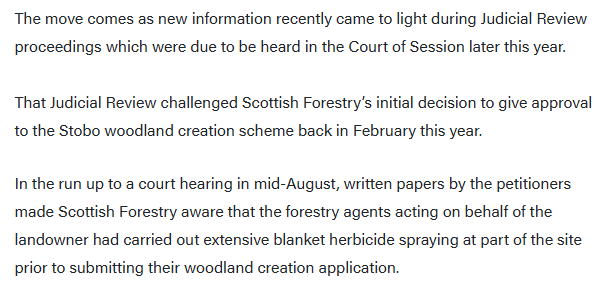
The petitioners for judicial review, the Stobo Residents Action Group, had argued that Scottish Forestry had not addressed NatureScot’s concerns about the forestry scheme’s impact on the designated National Scenic Area. On 10 September 2024, Scottish Forestry issued a news release (see here) stating work at Stobo was halted ‘as new information came to light during judicial review proceedings’. It stated ‘in the run up to the court hearing in mid-August [2024], written papers by the petitioners made Scottish Forestry aware that forestry agents acting on behalf of the landowner had carried out extensive blanket spraying’:
Extract from 10 September 2024 news release.
Scottish Forestry stated ‘a material piece of information was not disclosed by the applicant’ in reference to the herbicide spraying.
Further extract from 10 September 2024 news release.
Scottish Forestry responded to a press enquiry on 11 September 2024, which had asked why the herbicide damage was not noticed sooner (it had occurred in August 2023, five months before the forestry grant contract was signed), stating ‘our staff visited the site in early summer and even then there were no clear signs of the extent of the herbicide spraying’. The response also states ‘it was only when the petitioners presented their papers in [mid-] August [2024] we were made aware of the herbicide spraying’.
Extract from 11 September 2024 statement.
A hearing for judicial review in the Court of Session had been scheduled for autumn 2024, and the petitioners now had sufficient funds to go to court. It appears Scottish Forestry were increasingly concerned about their reputation if it was determined they had acted unlawfully in determining no Environmental Impact Assessment (EIA) was required.
The ‘non-disclosure’ of blanket use of herbicide by the forestry agents, then called Pryor and Rickett Silviculture (see here) – now called Euroforest Silviculture – seems to have resulted in the contract and £2 million grant being cancelled, the same legal remedies sought by the petitioners for the now conceded judicial review.
Stobo Hopehead, with Hammer Head, before herbicide application.
Do Scottish Forestry ever consider environmental impacts?
There seems to be scepticism that Scottish Forestry consider environmental impacts of proposed forestry schemes. Readers may recall Pryor and Rickett Silviculture were advised by the Game and Wildlife Trust (GWCT) to carry out predator control to supposedly help black grouse at Stobo (see here), despite NatureScot’s GWCT-commissioned research demonstrating large areas of contiguous moorland are required for black grouse (this moorland would disappear from places such as Stobo if the tree planting was permitted). Pryor and Rickett Silviculture subsequently applied to NatureScot for a licence to hunt foxes with nineteen dogs (see here), but NatureScot rejected this application, echoing the RSPB’s prediction of black grouse extinction. Scottish Forestry claimed in January 2024 that the proposed Stobo forestry scheme would not have a significant negative impact on black grouse, biodiversity, landscape, or any other environmental features, ruling out an EIA.
It is understood that the Stobo woodland creation scheme is undergoing an EIA, with Scottish Forestry expected to reach a decision on whether to allow this scheme to go ahead.
Intervention by the Scottish information Commissioner
The Scottish Information Commissioner found Scottish Forestry had failed to comply with the Environmental Information (Scotland) Regulations 2004, resulting in previously withheld information about Stobo now being released, some of which is provided in this blog.
As a reminder to readers, Scottish Forestry stated: ‘it was only when the petitioners presented their papers in [mid-] August [2024] we were made aware of the herbicide spraying’.
Communications after mid-August 2024; after this time Scottish Forestry were ‘made aware’ of blanket herbicide spraying
An email dated 21 August 2024 from Scottish Forestry’s Director of Operational Delivery, Brendan Callaghan, states:
‘it transpires that the forestry agents sprayed a very large area with herbicide before they screened the project. We weren’t aware they had done this’……’There has also been a delay in showing up as dead, but now it certainly does and looks dreadful. This wasn’t visible when [redacted] and I visited in May/June’.
‘[redacted] and I are going tonight to check they haven’t enhanced the photos. This could easily reach the media’.
Email from Scottish Forestry staff member, 21 August 2024.
An email dated 23 August from the Director of Operational Delivery states it ‘now looks like someone has napalmed the site’:
Email from Scottish Forestry staff member, 23 August 2024.
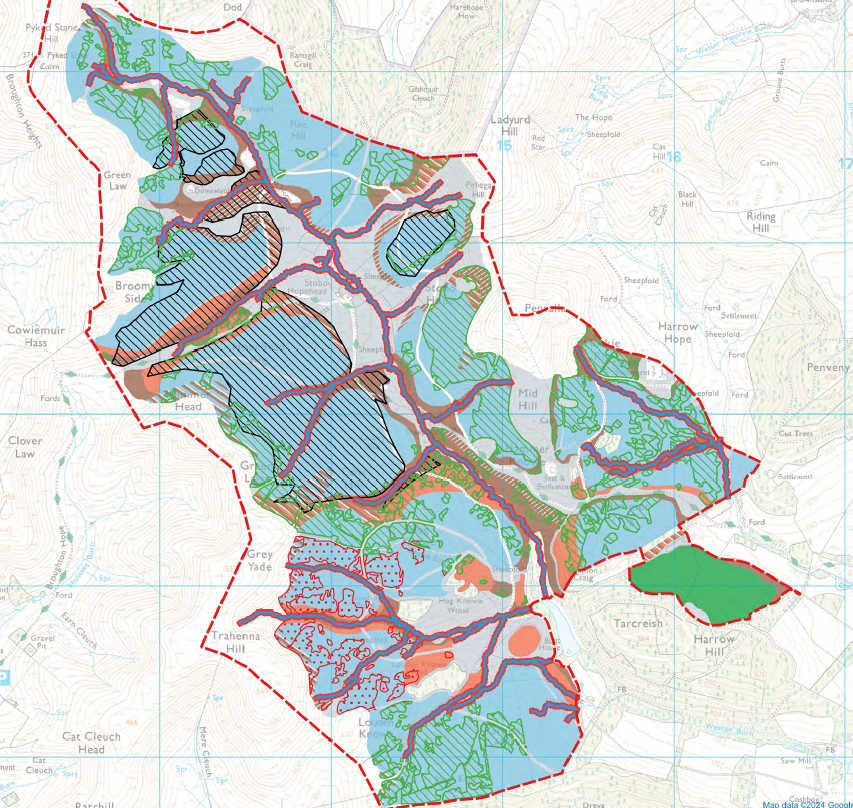
A ‘Heather Control Map’ by Euroforest Silviculture shows the area sprayed with herbicide in August 2023 (diagonal black lines), and the area to be sprayed with herbicide in 2024 (diagonal green lines).
Heather control plan superimposed on planting plan for Stobo. Blue indicates Sitka spruce, green Douglas fir and orange commercial Scots pine. Native broadleaves are indicated by brown, while light grey indicates open areas. Commercial conifers make up 82% of the planted area.
Communications before mid-August 2024; the time before which Scottish Forestry were ‘made aware’ of blanket herbicide spraying
It appears the Director of Operational Delivery discussed Stobo in an email on 1 July 2024, after a media enquiry by the Scotsman about herbicide use at Stobo:
‘We think this concern refers to an area of heather which has been over sprayed with herbicide and completely killed. I noticed when I walked over the site, but not sure of the exact size of the area, certainly a few hectares, but not that extensive. The area is adjacent to the John Buchan Way’.
Email to Scottish Forestry staff, 1 July 2024.
An email dated 3 July 2024 to the Director of Operational Delivery and copied to others, including Scottish Forestry’s Chief Executive Officer (CEO) Paul Lowe, states ‘The Stobo campaigners have posted the following video’:
Email to Scottish Forestry staff, 3 July 2024.
The email link is to a video on You Tube, showing the herbicide damage at Stobo (see here).
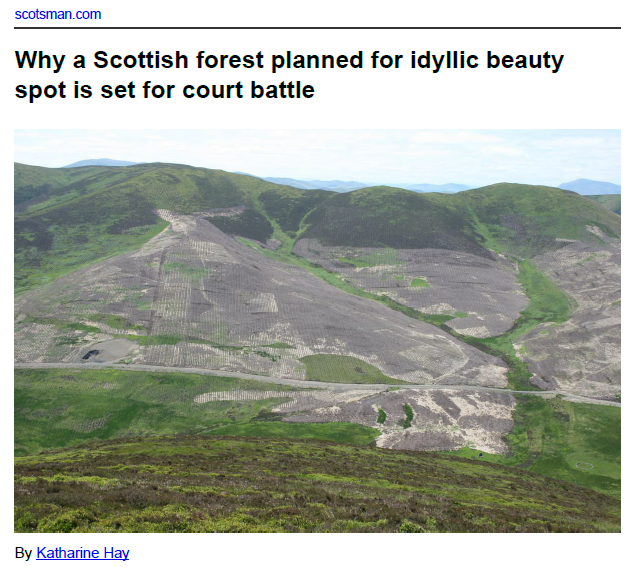
Scottish Forestry keep a record of media coverage of forestry matters, with documents dated 3 and 14 July 2024 containing articles from the Scotsman (see here) and Times (see here) respectively, showing pictures of herbicide destruction, such as this:
Scotsman picture, published 2 July 2024.
On 10 July 2024, an email was sent to staff including the Director of Operational Delivery and CEO, stating ‘For info – Raptor Persecution pushing the fundraiser’, providing a link to a Raptor Persecution UK article:
Email with Raptor Persecution link, dated 10 July 2024.
This blog article ‘Your help needed – ‘Save Stobo Hope from commercial forestry project’ (see here), had quoted from the crowdfunder webpage, mentioning the herbicide impact as having:
‘wiped out important plant communities including heather, blaeberry and many species of wildflowers, grasses, ferns, lichens and mosses. This will also have had a devastating effect on faunal populations, destroying the habitat, cover and food supply for mammals, birds, reptiles and invertebrates including the red-listed black grouse‘
This article contained an identical picture published by the Scotsman on 4 July 2024, and further pictures of the damage from herbicide, including this picture taken in June 2024 along the John Buchan Way:
Herbicide application along the John Buchan Way, June 2024.
When did Scottish Forestry become aware of the August 2023 herbicide application?
Let us recall Scottish Forestry stating in September 2024 that they had visited the site in early summer and ‘even then there were no clear signs of the extent of the herbicide spraying’. They also stated ‘it was only when the petitioners presented their papers in [mid-] August [2024] we were made aware of the herbicide spraying’.
This claim seems to be rather unconvincing. Alternatively, it could be that senior Scottish Forestry staff were only aware of the media articles, but didn’t read them. Perhaps these staff saw the links to the video of the herbicide destruction and to Raptor Persecution UK, but did not visit these sites. It may even be Scottish Forestry staff visited Stobo when it was dark, or there was a thick fog, not unknown in the Scottish Borders.
The police-led Hen Harrier Taskforce was launched in 2024 to tackle the ongoing illegal persecution of Hen Harriers on UK grouse moors.
The Taskforce was set up specifically in response to the ‘all time high’ level of Hen Harrier persecution crimes in 2022/2023 (at least 21 known incidents in 2022 and at least 33 known incidents in 2023). The extent of the criminality had become a major source of embarrassment for the police and for the government and they needed to be seen to be doing something.
The main premise of the HH Taskforce is summarised in this excerpt from the press release announcing the launch:
‘The Hen Harrier Task Force is an initiative led by the UK National Wildlife Crime Unit and supported by seven police forces (Cumbria, Derbyshire, Durham, Northumbria, North Yorkshire, South Yorkshire and West Yorkshire), DEFRA, the RSPB, National Gamekeepers’ Organisation, British Association for Shooting and Conservation (BASC), The Wildlife Trusts, GWCT, national parks, Country Land and Business Association (CLA), Natural England and The Moorland Association to combat the persecution of hen harriers in the UK. The taskforce aims to detect, deter, and disrupt offenders involved in wildlife crime by using technology and improving partnership working’.
You’ll note the heavy over-representation of game shooting organisations in this so-called ‘partnership’, including the National Gamekeepers Organisation and the Moorland Association (lobby group for England’s grouse moor owners).
However, several months after the launch, the Moorland Association (or at least its Chief Executive, Andrew Gilruth) was expelled from the Raptor Persecution Priority Delivery Group (RPPDG) and presumably that includes the Hen Harrier Taskforce, for ‘wasting time and distracting from the real work‘ of the RPPDG (see here).
After reading what I’m about to write in this blog, you might be wondering how the National Gamekeepers Organisation can be viewed as a credible ‘partner’ in the RPPDG and on the Hen Harrier Taskforce.
On 26 June 2025, the RSPB published its latest damning report about the extent of Hen Harrier persecution on driven grouse moors across the UK. Called ‘Hen Harriers in the Firing Line‘, the report demonstrated that record numbers of Hen Harriers were illegally killed or went ‘missing’ in suspicious circumstances during the years 2020-2024.
The following day, the National Gamekeepers Organisation posted this response in the News section of its website:
The article starts off well with a statement of truth. That is, that wildlife crimes are ‘non-notifiable’, in England & Wales at least, which means that wildlife crime figures are not officially collected at a national level by the Home Office. (In Scotland, wildlife crime recording became a statutory obligation under the Wildlife and Natural Environment (Scotland) Act 2011).
Most wildlife crimes in England & Wales are recorded as ‘miscellaneous’ offences and are therefore invisible in police records, with no duty to be reported upon. This problem has been the subject of a long-running campaign by Wildlife & Countryside LINK (e.g. here), and others, who for several years now have been urging the Home Office to make at least certain wildlife crimes (i.e. those associated with the National Wildlife Crime Priorities) notifiable so that there’s a better record of offences, allowing police resources to be applied appropriately. If the scale of a crime isn’t known, Police and Crime Commissioners are hardly going to allocate what are already tight police budgets towards tackling a crime that doesn’t look like it has any significance.
So having recognised and acknowledged that police forces don’t have to keep records of wildlife crime offences, the National Gamekeepers Organisation (NGO) then inexplicably announces that it has sent FoIs to all UK police forces to seek information on Hen Harrier persecution incidents.
Eh??!! Where’s the logic in that??
The stupidity doesn’t end there. It gets worse.
Let’s assume that the NGO did write FoIs to all 48 UK police forces and received responses from all of them (highly unlikely to get a 100% return rate but let’s go with it for now). Take a look at this particular statement in the NGO’s news article:
The NGO states that, ‘Having carried out Freedom of Information requests the NGO can state that from 2020 through to 2023, the police across all UK forces recorded eight Hen Harrier investigations in total. One was in Cumbria and the other 7 in Northumberland. Foul play was not cited by the police in any investigation‘. [Emphasis is mine].
Really? According to my data on Hen Harrier persecution recorded between 2020 – 2023, there were 82 recorded incidents across eight UK regions (North Yorkshire & Cumbria: 45; Northumberland: 12; County Durham: 11; Scotland: 7; South Yorkshire: 3; Lancashire: 3; Isle of Man: 1).
That’s quite a few more incidents, and is far more widespread, than the NGO’s claim of 8 incidents in just two police force areas.
The vast majority of those 82 incidents involved the suspicious ‘disappearance’ of satellite-tagged Hen Harriers. The number doesn’t include tags that have been listed as no longer transmitting as a result of possible tag failure, or birds that are known to have died a natural death. The National Wildlife Crime Unit, which leads the Hen Harrier Taskforce (on which the NGO serves so should be fully aware), explicitly uses satellite tag data to identify crime hotspots, i.e. locations where Hen Harriers repeatedly disappear in suspicious circumstances. Here’s another relevant excerpt from the Hen Harrier Taskforce launch press release:
‘Rather than purely focusing on the wildlife aspect of the crime, DI Harrison has tasked his team with taking a holistic view of the criminality and considering all types of offences. Criminals will often steal and destroy the satellite tags to conceal their offending. This could constitute criminal damage, theft and fraud. In the last few years alone, £100,000 worth of satellite tags have been lost in circumstances suspected to be criminal. The apparent use of firearms adds a further level of seriousness to these cases’. [Emphasis is mine].
For the NGO to use the line, ‘Foul play was not cited by the police in any investigation‘ is misleading at best.
Further, in amongst those 82 incidents recorded between 2020 – 2023 are a number of Hen Harriers where police investigations and post mortems explicitly detected ‘foul play’ (I prefer to call it crime, because that’s what this is). These are:
10 February 2022: An unnamed satellite-tagged Hen Harrier ‘disappeared’ in a grouse moor dominated area of the Peak District National Park (here). One year later it was revealed that the satellite tag/harness of this young male called ‘Anu’ had been deliberately cut off (see here).
12 April 2022: Hen Harrier ‘Free’ (Tag ID 201121) ‘disappeared’ at a ‘confidential site’ in Cumbria (here). It later emerged he hadn’t disappeared, but his mutilated corpse was found on moorland in the Yorkshire Dales National Park. A post mortem revealed the cause of death was having his head twisted and pulled off while he was still alive. One leg had also been torn off whilst he was still alive (here).
20 June 2022: Hen harrier chick #1 stamped to death in nest on a grouse moor in the Yorkshire Dales National Park (here).
20 June 2022: Hen Harrier chick #2 stamped to death in nest on a grouse moor in the Yorkshire Dales National Park (here).
20 June 2022: Hen Harrier chick #3 stamped to death in nest on a grouse moor in the Yorkshire Dales National Park (here).
20 June 2022: Hen Harrier chick #4 stamped to death in nest on a grouse moor in the Yorkshire Dales National Park (here).
14 December 2022: Hen Harrier female (brood meddled in 2022, #R3-F1-22) ‘disappeared’ from winter roost (same as #R2-F2-20) on moorland in the North Pennines AONB (here). Later found dead with two shotgun pellets in corpse (here).
9/10 May 2023: Hen Harrier male called ‘Dagda’, tagged by the RSPB in Lancashire in June 2022 and who was breeding on the RSPB’s Geltsdale Reserve in 2023 until he ‘vanished’, only to be found dead on the neighbouring Knarsdale grouse moor in May 2023 – a post mortem revealed he had been shot (here).
29 July 2023: Hen Harrier female (brood meddled in 2020, R2-F2-20) ‘disappeared’ at a confidential site in the North Pennines. Later notes from the NE spreadsheet: “Dead. Recovered – awaiting PM results. Final transmission location temporarily withheld at police request“ (here). Later report stated she’d been found dead with 3 shotgun pellets in corpse (here).
So, clearly the police forces that allegedly responded to the National Gamekeeper Organisation’s FoI requests haven’t been accurately recording Hen Harrier persecution crimes (because they don’t have to) but regardless of that, for the NGO to take that misinformation at face value, when (a) it knows that these crimes are not notifiable so individual police force records have to be viewed as unreliable, and (b) the NGO would have been fully aware of these high profile crimes (because they were all over the press and they’d also have been raised at the RPPDG meetings in which the NGO is a participant) can be viewed as either a measure of the NGO’s stupidity or what I see as an indication of its willingness to deceive.
What’s even more revealing is the lengths the NGO will go in its efforts to tarnish the RSPB’s reputation. Why submit FoI requests to 48 UK police forces to ask for Hen Harrier persecution data when you’re already a member of the RPPDG and the Hen Harrier Taskforce, where those persecution data are reliably recorded and readily available?
The whole premise of the NGO’s ‘news article’ seems to me to be using obviously unrepresentative data it received from an unspecified number of police forces to smear and undermine the reputation of the RSPB. You could paraphrase the NGO’s whole article as:
‘Aha! The RSPB’s Hen Harrier persecution data are clearly fabricated because all UK police forces only recorded eight Hen Harrier persecution incidents in two force areas between 2020 and 2023. There, we told you the RSPB make up the data just to make us gamekeepers look bad. You can’t believe a word the RSPB says. We love all raptors and especially Hen Harriers‘.
It’s half-baked nonsense and exposes the National Gamekeepers Organisation’s real intentions.
The NGO suggests that the RSPB is fabricating persecution data “to damage the public perception of gamekeepers” when actually it’s the NGO mispresenting information to damage the reputation of the RSPB. The NGO is right to suggest that the public’s perception of gamekeepers is poor, but that’s because gamekeepers are consistently linked to raptor persecution crimes. If gamekeepers want to improve their reputation it’s quite simple – stop killing birds of prey.
For anyone who still wants to pretend that the grouse shooting industry isn’t responsible for the systematic extermination of Hen Harriers on grouse moors across the UK, here’s the latest catalogue of crime that suggests otherwise.
This male hen harrier died in 2019 after his leg was almost severed in an illegally set trap that had been placed next to his nest on a Scottish grouse moor (see here). Photo by Ruth Tingay
This is the blog I now publish after every reported killing or suspicious disappearance.
“They disappear in the same way political dissidents in authoritarian dictatorships have disappeared” (Stephen Barlow, 22 January 2021).
Today the list has been updated to include the two most recently reported victims: an RSPB-satellite-tagged male called ‘Dynamo’ who vanished whilst hunting on a nearby grouse moor close to his nest site on United Utilities-owned land in the Forest of Bowland, Lancashire in May 2025 (here) and another male, this time-untagged, who also vanished from another active nest site on United Utilities-owned land in the Forest of Bowland, Lancashire, in May 2025 (here).
I’ve been compiling this list only since 2018 because that is the year that the grouse shooting industry ‘leaders’ would have us believe that the criminal persecution of Hen Harriers had stopped and that these birds were being welcomed back on to the UK’s grouse moors (see here).
This assertion was made shortly before the publication of a devastating new scientific paper that demonstrated that 72% of satellite-tagged Hen Harriers were confirmed or considered likely to have been illegally killed, and this was ten times more likely to occur over areas of land managed for grouse shooting relative to other land uses (see here). A further scientific paper published in 2023 by scientists at the RSPB, utilising even more recent data, echoed these results – see here.
2018 was also the year that Natural England issued a licence to begin a Hen Harrier brood meddling trial on grouse moors in northern England. For new blog readers, Hen Harrier brood meddling was a conservation sham sanctioned by DEFRA as part of its ludicrous ‘Hen Harrier Action Plan‘ and carried out by Natural England (NE), in cahoots with the very industry responsible for the species’ catastrophic decline in England.
For more background see here and for a critical evaluation of the trial after 5 years see this report by Wild Justice. In 2024 the brood meddling trial appeared to collapse for reasons which are not yet clear (see here) and the licence for the so-called ‘scientific trial’ expired. In March 2025 Natural England announced the end of the brood meddling trial (here) and in April 2025 announced that a licence application to continue brood meddling, submitted by the Moorland Association, had been refused (here).
Brood meddling was earlier described as a sort of ‘gentleman’s agreement’ by commentator Stephen Welch:
“I don’t get it, I thought the idea of that scheme was some kind of trade off – a gentleman’s agreement that the birds would be left in peace if they were moved from grouse moors at a certain density. It seems that one party is not keeping their side of the bargain“.
With at least 143 Hen Harriers gone since 2018, and 31 of those being brood meddled birds, there is no question that the grouse shooting industry was simply taking the piss. Meanwhile, Natural England pretended that ‘partnership working’ was the way to go and consecutive Tory DEFRA Ministers remained silent for all those years.
*n/a – no hen harriers were brood meddled in 2018. **Post mortem reports on a further seven hen harriers found dead in 2024/2025 are awaited. Those seven individuals are not included in this table.
‘Partnership working’ according to Natural England appeared to include authorising the removal of Hen Harrier chicks from a grouse moor already under investigation by the police for suspected raptor persecution (here) and accepting a £75k ‘donation’ from representatives of the grouse shooting industry with a contract clause that prevented Natural England from criticising them or the sham brood meddling trial (see here). This was in addition to a further £10k ‘donation’ that Natural England accepted, under the same terms, in 2021 (here).
Thankfully, the Scottish Government finally decided to act by introducing a grouse moor licensing scheme under the Wildlife Management & Muirburn (Scotland) Act 2024. The intention behind this new legislation is that grouse shooting estates could have their licences suspended/revoked if, on the balance of probability, it is shown that any raptor persecution crimes (& some other associated offences) are linked with grouse moor management on that estate. There, are, however, ongoing issues with the licence as it’s been significantly watered-down after an intervention from the grouse shooting industry (see here). Work is underway to address this.
In England a new Hen Harrier Taskforce was established in 2024, led by the National Wildlife Crime Unit, to use innovative techniques to target Hen Harrier persecution hotspots (locations where Hen Harriers repeatedly ‘disappear’ or are found illegally killed). It’s too early to judge the Taskforce’s success/failure and it’s been met with considerable resistance from the Moorland Association, the grouse moor owners’ lobby group (e.g. see here). So far though, it’s quite clear that the the illegal killing continues.
So here’s the latest gruesome list of ‘missing’/illegally killed hen harriers since 2018. Note that the majority of these birds (but not all) were fitted with satellite tags. How many more [untagged] harriers have been killed? We now have evidence that gamekeepers are specifically targeting untagged Hen Harriers, precisely to avoid detection (see here for extraordinary footage/audio captured by the RSPB’s Investigations Team as featured on Channel 4 News in October 2024).
February 2018: Hen Harrier Saorsa ‘disappeared’ in the Angus Glens in Scotland (here). The Scottish Gamekeepers Association later published wholly inaccurate information claiming the bird had been re-sighted. The RSPB dismissed this as “completely false” (here).
5 February 2018: Hen Harrier Marc ‘disappeared’ on a grouse moor in Durham (here).
9 February 2018: Hen Harrier Aalin ‘disappeared’ on a grouse moor in Wales (here).
March 2018: Hen Harrier Blue ‘disappeared’ in the Lake District National Park (here).
March 2018: Hen Harrier Finn ‘disappeared’ near Moffat in Scotland (here).
18 April 2018: Hen Harrier Lia ‘disappeared’ in Wales and her corpse was retrieved in a field in May 2018. Cause of death was unconfirmed but police treating death as suspicious (here).
8 August 2018: Hen Harrier Hilma ‘disappeared’ on a grouse moor in Northumberland (here).
16 August 2018: Hen Harrier Athena ‘disappeared’ on a grouse moor in Scotland (here).
26 August 2018: Hen Harrier Octavia ‘disappeared’ on a grouse moor in the Peak District National Park (here).
29 August 2018: Hen Harrier Margot ‘disappeared’ on a grouse moor in Scotland (here).
29 August 2018: Hen Harrier Heulwen ‘disappeared’ on a grouse moor in Wales (here).
3 September 2018: Hen Harrier Stelmaria ‘disappeared’ on a grouse moor in Scotland (here).
24 September 2018: Hen Harrier Heather ‘disappeared’ on a grouse moor in Scotland (here).
2 October 2018: Hen Harrier Mabel ‘disappeared’ on a grouse moor on the edge of the Yorkshire Dales National Park (here).
3 October 2018: Hen Harrier Thor ‘disappeared’ next to a grouse moor in Bowland, Lanacashire (here).
23 October 2018: Hen Harrier Tom ‘disappeared’ in South Wales (here).
26 October 2018: Hen Harrier Arthur ‘disappeared’ on a grouse moor in the North York Moors National Park (here).
1 November 2018: Hen Harrier Barney ‘disappeared’ on Bodmin Moor (here).
10 November 2018: Hen Harrier Rannoch ‘disappeared’ on a grouse moor in Scotland (here). Her corpse was found nearby in May 2019 – she’d been killed in an illegally-set spring trap (here).
14 November 2018: Hen Harrier River ‘disappeared’ on a grouse moor in the Nidderdale AONB (here). Her corpse was found nearby in April 2019 – she’d been illegally shot (here).
16 January 2019: Hen Harrier Vulcan ‘disappeared’ in Wiltshire close to Natural England’s proposed reintroduction site (here).
28 January 2019: Hen Harrier DeeCee ‘disappeared’ in Glen Esk, a grouse moor area of the Angus Glens (see here).
7 February 2019: Hen Harrier Skylar ‘disappeared’ next to a grouse moor in South Lanarkshire (here).
22 April 2019: Hen Harrier Marci ‘disappeared’ on a grouse moor in the Cairngorms National Park (here).
26 April 2019: Hen Harrier Rain ‘disappeared’ on a grouse moor in Nairnshire (here).
11 May 2019: An untagged male Hen Harrier was caught in an illegally-set trap next to his nest on a grouse moor in South Lanarkshire. He didn’t survive (here).
7 June 2019: An untagged Hen Harrier was found dead on a grouse moor in Scotland. A post mortem stated the bird had died as a result of ‘penetrating trauma’ injuries and that this bird had previously been shot (here).
5 September 2019: Wildland Hen Harrier 1 ‘disappeared’ on a grouse moor nr Dalnaspidal on the edge of the Cairngorms National Park (here).
11 September 2019: Hen Harrier Romario ‘disappeared’ on a grouse moor in the Cairngorms National Park (here).
14 September 2019: Hen Harrier (Brood meddled in 2019, #183704) ‘disappeared’ in the North Pennines (here).
23 September 2019: Hen Harrier (Brood meddled in 2019, #55149) ‘disappeared’ in North Pennines (here).
24 September 2019: Wildland Hen Harrier 2 ‘disappeared’ on a grouse moor at Invercauld in the Cairngorms National Park (here).
24 September 2019: Hen Harrier Bronwyn ‘disappeared’ near a grouse moor in North Wales (here).
10 October 2019: Hen Harrier Ada ‘disappeared’ on a grouse moor in the North Pennines AONB (here).
12 October 2019: Hen Harrier Thistle ‘disappeared’ on a grouse moor in Sutherland (here).
18 October 2019: Member of the public reports the witnessed shooting of an untagged male Hen Harrier on White Syke Hill in North Yorkshire (here).
November 2019: Hen Harrier Mary found illegally poisoned on a pheasant shoot in Ireland (here).
November 2019: Hen Harrier Artemis ‘disappeared’ near Long Formacus in south Scotland (RSPB pers comm).
14 December 2019: Hen harrier Oscar ‘disappeared’ in Eskdalemuir, south Scotland (here).
December 2019: Hen Harrier Ingmar ‘disappeared’ in the Strathbraan grouse moor area of Perthshire (RSPB pers comm).
27 January 2020: Members of the public report the witnessed shooting of a male Hen Harrier on Threshfield Moor in the Yorkshire Dales National Park (here).
23 March 2020: Hen Harrier Rosie ‘disappeared’ at an undisclosed roost site in Northumberland (here).
1 April 2020: Hen Harrier (Brood meddled in 2019, #183703) ‘disappeared’ in unnamed location, tag intermittent (here).
5 April 2020: Hen Harrier Hoolie ‘disappeared’ on a grouse moor in the Cairngorms National Park (here)
8 April 2020: Hen Harrier Marlin ‘disappeared’ on a grouse moor in the Cairngorms National Park (here).
19 May 2020: Hen Harrier Fingal ‘disappeared’ on a grouse moor in the Lowther Hills, Scotland (here).
21 May 2020: Hen Harrier (Brood meddled in 2019, #183701) ‘disappeared’ on a grouse moor in Cumbria shortly after returning from wintering in France (here).
27 May 2020: Hen Harrier Silver ‘disappeared’ on a grouse moor on Leadhills Estate, Scotland (here).
2020: day/month unknown: Unnamed male Hen Harrier breeding on RSPB Geltsdale Reserve, Cumbria ‘disappeared’ while away hunting (here).
9 July 2020: Unnamed female Hen Harrier (#201118) ‘disappeared’ from an undisclosed site in Northumberland (here).
25 July 2020: Hen Harrier Harriet ‘disappeared’ on a grouse moor in the Yorkshire Dales National Park (here).
14 August 2020: Hen Harrier Solo ‘disappeared’ in confidential nest area in Lancashire (here).
7 September 2020: Hen Harrier Dryad ‘disappeared’ on a grouse moor in the Yorkshire Dales National Park (here).
16 September 2020: Hen Harrier Fortune ‘disappeared’ from an undisclosed roost site in Northumberland (here).
19 September 2020: Hen Harrier Harold ‘disappeared’ on a grouse moor in the Yorkshire Dales National Park (here).
20 September 2020: Hen Harrier (Brood meddled in 2020, #55152) ‘disappeared’ next to a grouse moor in North Yorkshire (here).
24 February 2021: Hen Harrier Tarras ‘disappeared’ next to a grouse moor in Northumberland (here)
12th April 2021: Hen Harrier Yarrow ‘disappeared’ near Stockton, County Durham (here).
18 May 2021: Adult male Hen Harrier ‘disappeared’ from its breeding attempt on RSPB Geltsdale Reserve, Cumbria whilst away hunting (here).
18 May 2021: Another adult male Hen Harrier ‘disappeared’ from its breeding attempt on RSPB Geltsdale Reserve, Cumbria whilst away hunting (here).
24 July 2021: Hen Harrier Asta ‘disappeared’ at a ‘confidential site’ in the North Pennines (here). We learned 18 months later that her wings had been ripped off so her tag could be fitted to a crow in an attempt to cover up her death (here).
14th August 2021: Hen Harrier Josephine ‘disappeared’ at a ‘confidential site’ in Northumberland (here).
17 September 2021: Hen Harrier Reiver ‘disappeared’ in a grouse moor dominated region of Northumberland (here)
24 September 2021: Hen Harrier (Brood meddled in 2021, R2-F-1-21) ‘disappeared’ in Northumberland (here).
15 November 2021: Hen Harrier (brood meddled in 2020, #R2-F1-20) ‘disappeared’ at the edge of a grouse moor on Arkengarthdale Estate in the Yorkshire Dales National Park (here).
19 November 2021: Hen Harrier Val ‘disappeared’ in the Lake District National Park in Cumbria (here).
19 November 2021: Hen Harrier Percy ‘disappeared’ in Lothian, Scotland (here).
12 December 2021: Hen Harrier Jasmine ‘disappeared’ on a grouse moor (High Rigg Moor on the Middlesmoor Estate) in the Nidderdale AONB in North Yorkshire (here).
9 January 2022: Hen Harrier Ethel ‘disappeared’ in Northumberland (here).
26 January 2022: Hen Harrier Amelia ‘disappeared’ in Bowland (here).
10 February 2022: An unnamed satellite-tagged Hen Harrier ‘disappeared’ in a grouse moor dominated area of the Peak District National Park (here). One year later it was revealed that the satellite tag/harness of this young male called ‘Anu’ had been deliberately cut off (see here).
12 April 2022: Hen Harrier ‘Free’ (Tag ID 201121) ‘disappeared’ at a ‘confidential site’ in Cumbria (here). It later emerged he hadn’t disappeared, but his mutilated corpse was found on moorland in the Yorkshire Dales National Park. A post mortem revealed the cause of death was having his head twisted and pulled off. One leg had also been torn off whilst he was still alive (here).
April 2022: Hen Harrier ‘Pegasus’ (tagged by the RSPB) ‘disappeared’ on a grouse moor at Birkdale in the Yorkshire Dales National Park (here).
May 2022: A male breeding Hen Harrier ‘disappeared’ from a National Trust-owned grouse moor in the Peak District National Park (here).
May 2022: Another breeding male Hen Harrier ‘disappeared’ from a National Trust-owned grouse moor in the Peak District National Park (here).
14 May 2022: Hen Harrier ‘Harvey’ (Tag ID 213844) ‘disappeared’ from a ‘confidential site’ in the North Pennines (here).
20 June 2022: Hen harrier chick #1 stamped to death in nest on a grouse moor in the Yorkshire Dales National Park (here).
20 June 2022: Hen Harrier chick #2 stamped to death in nest on a grouse moor in the Yorkshire Dales National Park (here).
20 June 2022: Hen Harrier chick #3 stamped to death in nest on a grouse moor in the Yorkshire Dales National Park (here).
20 June 2022: Hen Harrier chick #4 stamped to death in nest on a grouse moor in the Yorkshire Dales National Park (here).
17 August 2022: Hen Harrier (brood meddled in 2022, #R1-M1-22) ‘disappeared’ on moorland in the Yorkshire Dales National Park (here).
September 2022: Hen Harrier ‘Sullis’ (tagged by the RSPB) ‘disappeared’ on a grouse moor in Cumbria (here).
5 October 2022: Hen Harrier (brood meddled in 2022, #R3-M2-22) ‘disappeared’ on moorland in the Yorkshire Dales National Park (here).
10 October 2022: Hen Harrier ‘Sia’ ‘disappeared’ near Hamsterley Forest in the North Pennines (here).
October 2022: Hen Harrier (brood meddled in 2021, #R1-F1-21) ‘disappeared’ in the North Sea off the North York Moors National Park (here).
1 December 2022: Hen Harrier male (brood meddled in 2021, #R1-M1-21) ‘disappeared’ on moorland in the Yorkshire Dales National Park (here).
7 December 2022: Hen Harrier female (brood meddled in 2020, #55144) ‘disappeared’ from winter roost (same as #R3-F1-22) on moorland in North Pennines AONB (here).
14 December 2022: Hen Harrier female (brood meddled in 2022, #R3-F1-22) ‘disappeared’ from winter roost (same as #R2-F2-20) on moorland in the North Pennines AONB (here). Later found dead with two shotgun pellets in corpse (here).
15 December 2022: Hen Harrier female (brood meddled in 2022, #R2-F1-22) ‘disappeared’ on moorland in the Yorkshire Dales National Park (here).
30 March 2023: Hen Harrier female (brood meddled in 2022, #R1-F3-22) ‘disappeared’ in Yorkshire (here). Notes from NE Sept 2023 spreadsheet update: “Final transmission location temporarily withheld at police request“.
1 April 2023: Hen Harrier male (brood meddled in 2022, #R2-M1-22) ‘disappeared’ in Yorkshire (here). Notes from NE Sept 2023 spreadsheet update: “Final transmission location temporarily withheld at police request“.
April 2023: Hen Harrier ‘Lagertha’ (tagged by RSPB) ‘disappeared’ in North Yorkshire (here).
April 2023: Hen Harrier ‘Nicola’ (Tag ID 234078) ”disappeared’ in North Yorkshire (here).
April 2023: Untagged male Hen Harrier ‘disappeared’ from an active nest on RSPB Geltsdale Reserve in Cumbria (here).
April 2023: Another untagged male Hen Harrier ‘disappeared’ from an active nest on RSPB Geltsdale Reserve in Cumbria (here).
April 2023: Untagged male Hen Harrier ‘disappeared’ from an active nest in Durham (here).
4/5 May 2023: Satellite-tagged male Hen Harrier called ‘Rush’ ‘disappeared’ from a grouse moor in Bowland AONB in Lancashire (here).
9/10 May 2023: Hen Harrier male called ‘Dagda’, tagged by the RSPB in Lancashire in June 2022 and who was breeding on the RSPB’s Geltsdale Reserve in 2023 until he ‘vanished’, only to be found dead on the neighbouring Knarsdale grouse moor in May 2023 – a post mortem revealed he had been shot (here).
17 May 2023: Satellite-tagged Hen Harrier called ‘Wayland’ ‘disappeared’ in the Clapham area of North Yorkshire, just north of the Bowland AONB (here).
31 May 2023: Hen Harrier male (brood meddled in 2022, tag #213932, name: R2-M3-22) ‘disappeared’ in Northumberland (grid ref: NY765687) (here).
11 June 2023: Hen Harrier male (brood meddled in 2021, tag #213922, name: R2-M1-21) ‘disappeared’ at a confidential site in the Yorkshire Dales National Park. Notes from the NE spreadsheet: “Final transmission location temporarily withheld at police request“ (here).
12 June 2023: Hen Harrier male (brood meddled in 2020, tag #203004, name: R1-M2-20) ‘disappeared’ on a grouse moor in Co. Durham (grid ref: NY976322) (here).
6 July 2023: Satellite-tagged female Hen Harrier named ‘Rubi’ (tag #201124a) ‘disappeared’ on a grouse moor in Co. Durham (grid ref: NY911151) (here).
23 July 2023: Hen Harrier female (brood meddled in 2023, tag #55154a, name: R1-F1-23) ‘disappeared’ on a grouse moor in Co. Durham (close to where ‘Rubi’ vanished), grid ref: NY910126 (here).
29 July 2023: Hen Harrier female (brood meddled in 2020, R2-F2-20) ‘disappeared’ at a confidential site in the North Pennines. Notes from the NE spreadsheet: “Dead. Recovered – awaiting PM results. Final transmission location temporarily withheld at police request“ (here). Later found dead with 3 shotgun pellets in corpse (here).
9 August 2023: Satellite-tagged Hen Harrier called ‘Martha’ ‘disappeared’ on a grouse moor (Westburnhope Moor) near Hexham in the North Pennines (here).
11 August 2023: Satellite-tagged hen harrier called ‘Selena’ ‘disappeared’ on a grouse moor (Mossdale Moor) in the Yorkshire Dales National Park (here).
11 August 2023: Hen Harrier female (brood meddled in 2023, tag #201118a, name: R3-F1-23) ‘disappeared’ in Co. Durham (grid ref: NZ072136) (here).
15 August 2023: Satellite-tagged Hen Harrier called ‘Hepit’ ‘disappeared’ on a grouse moor (Birkdale Common) near Kirkby Stephen in the Yorkshire Dales National Park (here).
24 August 2023: Hen Harrier female (brood meddled in 2023, tag #55155a, name: R1-F2-23) ‘disappeared’ at a confidential site in Northumberland. Notes from the NE spreadsheet: “Final transmission location temporarily withheld at police request“ (here).
August-Sept 2023: Satellite-tagged Hen Harrier called ‘Harmonia’ ‘disappeared’ in the Yorkshire Dales National Park (here).
September 2023: Hen Harrier female ‘Saranyu’, tagged by the RSPB in Cumbria in June 2023, ‘disappeared’ in Durham in September 2023 (no further details available yet – just outline info provided in 2022 Birdcrime report) (here).
September 2023: Hen Harrier female ‘Inger’, a female tagged by the RSPB in Perthshire in July 2022, ‘disappeared’ on a grouse moor in the Angus Glens in September 2023 (here).
15 September 2023: Hen Harrier male called ‘Rhys’, tagged in Cumbria on 1st August 2023, ‘disappeared’ on a grouse moor in the Yorkshire Dales National Park. Grid ref: SD798896 (here).
24 September 2023: Hen Harrier female (brood meddled in 2023, name: ‘R2-F2-23’) ‘disappeared’ in the North Pennines, grid ref: NY888062 (here).
25 September 2023: Hen Harrier female (brood meddled in 2022, name: ‘R1-F4-22’) ‘disappeared’ on a grouse moor in the Yorkshire Dales National Park, grid ref: SE077699 (here).
26 September 2023: Hen Harrier female called ‘Hope’, tagged in Cumbria on 21 July 2023, ‘disappeared’ next to a grouse moor in the Yorkshire Dales National Park, grid ref: SD801926 (here).
4 October 2023: Hen Harrier male (brood meddled in 2020, name: ‘R1-M3-20’) ‘disappeared’ in Co Durham, grid ref: NY935192 (here).
4 October 2023: Hen Harrier female (brood meddled in 2023, name: ‘R4-F1-23’) ‘disappeared’ on a grouse moor in the Yorkshire Dales National Park, grid ref: SE003981 (here).
14 October 2023: Hen Harrier male called ‘Cillian’, tagged in Cumbria on 1 August 2023, ‘disappeared’ in south west Scotland, grid ref: NY051946 (here).
15 November 2023: Hen Harrier female called ‘Hazel’, tagged in Cumbria on 21 July 2023, ‘disappeared’ on the Isle of Man, grid ref: SC251803 (here).
27 November 2023: Hen Harrier female called ‘Gill’, tagged in Northumberland on 10 July 2023, ‘disappeared’ at a confidential location in Teeside (here).
12 February 2024: Hen Harrier female called ‘Susie’, Tag ID 201122, found dead at a confidential location in Northumberland and the subject of an ongoing police investigation (here).
15 February 2024: Hen Harrier female called ‘Shalimar’, tagged on the National Trust for Scotland’s Mar Lodge estate in 2023, ‘disappeared’ in suspicious circumstances on a grouse moor in the notorious Angus Glens (here).
7 March 2024: Hen Harrier male (brood meddled in 2023, name R2-M1-23) found dead in Devon. According to an FoI response from Natural England in June 2024 this death is the subject of an ongoing police investigation (here).
24 April 2024: Hen Harrier male called ‘Ken’, Tag ID 213849a, ‘disappeared’ in suspicious circumstances close to a grouse moor in Bowland, grid ref SD 684601 (here).
17 May 2024: Hen Harrier male (brood meddled in 2023, name R2-M2-23) ‘disappeared’ in suspicious circumstances next to Middlesmoor grouse moor in Nidderdale, grid ref SE043754 (here).
25 June 2024: Hen Harrier female (brood meddled in 2023, name R2-F1-23) ‘disappeared’ in suspicious circumstances on a grouse moor in Yorkshire Dales National Park, grid ref NY985082 (here).
July 2024: Hen Harrier female named ‘Helius’ satellite tagged by the RSPB ‘disappeared’ in suspicious circumstances in Bowland (here).
October 2024: An un-tagged Hen Harrier was seemingly shot on a grouse moor by one of three gamekeepers being secretly filmed by the RSPB (here).
1 October 2024: Hen Harrier female named ‘Dreich’, Tag ID: 254842, ‘disappeared’ in Lanarkshire. Listed by NE as ‘Missing Fate Unknown, site confidential – ongoing investigation‘ (here).
15 October 2024: Hen Harrier male named ‘Baldur’, Tag ID: 240291, ‘disappeared’ in Northumberland. Listed by NE as ‘Missing Fate Unknown, site confidential – ongoing investigation‘ (here).
19 October 2024: Hen Harrier female named ‘Margaret’, Tag ID: 254844, ‘disappeared’ in Northumberland. Listed by NE as ‘Missing Fate Unknown, site confidential – ongoing investigation‘ (here).
12 January 2025: Hen Harrier female named ‘Dina’, Tag ID: 254837, ‘disappeared’ near a grouse moor in the Lammermuirs, south Scotland (grid ref: NT 681512). Listed by NE as ‘Missing Fate Unknown’ (here).
15 January 2025: Hen Harrier female named ‘Red’, hatched on the Tarras Valley Nature Reserve in 2024, ‘disappeared’ on a grouse moor in County Durham in the North Pennines, in the same area another tagged Hen Harrier (Sia) vanished in 2022 (here).
3 February 2025: Hen Harrier female (brood meddled in 2022, name R3-F2-22) ‘disappeared’ on a grouse moor in the North York Moors National Park. Listed by NE as ‘Missing Fate Unknown’ (here).
27 February 2025: Hen Harrier female named ‘Sita’, satellite-tagged on behalf of Hen Harrier Action in Bowland in 2024 and tracked by the RSPB, ‘disappeared’ from a roost site on an unnamed grouse moor in the Yorkshire Dales National Park (here). More details published on 1 October 2025 (here).
4 April 2025: Hen Harrier female named ‘Bonnie’, Tag ID: 254841, ‘disappeared’ in Scotland. Listed by NE as ‘Missing Fate Unknown. Site confidential – ongoing investigation’ (here).
10 April 2025: Hen Harrier female named ‘Gill’, Tag ID: 240294, ‘disappeared’ in Scotland. Listed by NE as ‘Missing Fate Unknown. Site confidential – ongoing investigation’ (here).
May 2025: Male Hen Harrier (with active nest on RSPB Geltsdale Reserve in Cumbria) ‘disappeared’. Strongly suspected to have been shot whilst away hunting on nearby grouse moor (here).
May 2025: Another male Hen Harrier (with another active nest on RSPB Geltsdale Reserve in Cumbria) ‘disappeared’. Strongly suspected to have been shot whilst away hunting on nearby grouse moor (here).
May 2025: Male Hen Harrier called ‘Dynamo’, satellite-tagged by the RSPB and with an active nest on United Utilities-owned land in Bowland, Lancashire, ‘disappeared’. Strongly suspected to have been shot whilst away hunting on a nearby grouse moor (here).
May 2025: Another male Hen Harrier (untagged) with an active nest on United Utilities-owned land in Bowland, Lancashire, ‘disappeared’. Strongly suspected to have been shot whilst away hunting on a nearby grouse moor (here).
To be continued…….
Of these 143 incidents, only one has resulted in an arrest and a subsequent prosecution (ongoing – after a ‘not guilty plea’ a gamekeeper is due in court again in September 2025, see here).
I had thought that when we reached 30 dead/missing Hen Harriers then the authorities might pretend to be interested and at least say a few words about this national scandal. We’ve now reached at least ONE HUNDRED AND FORTY THREE Hen Harriers, and still Govt ministers remain silent on the illegal persecution issue. They appear not to give a monkey’s. And yes, there are other things going on in the world, as always. That is not reason enough to ignore this blatant, brazen and systematic destruction of a supposedly protected species, being undertaken to satisfy the greed and bloodlust of a minority of society.
And let’s not forget the response from the (now former) Moorland Association Chair (and owner of Swinton Estate) Mark Cunliffe-Lister, who told BBC Radio 4 in August 2023 that, “Clearly any illegal [Hen Harrier] persecution is nothappening” (here), in the year when a record 33 Hen Harriers had been confirmed ‘missing’ and/or illegally killed.
Nor should we forget the response from the Game and Wildlife Conservation Trust’s (GWCT) Director of Policy Dr Alistair Leake who wrote a letter to the Guardian newspaper in November 2023 stating that the Hen Harrier brood management [meddling] scheme “is surely a shining example of human / wildlife conflict resolution that would be the envy of other countries trying to find similar solutions“ (I kid you not – here).
In addition to the seven outstanding cases from 2024/2025, which are not included on the 143 list above because post-mortems are apparently ‘still pending’ (they’re not pending at all, they’ve been completed but Natural England and the Hen Harrier Task Force are refusing to publicise the results – why is that?), I’m aware of at least anotherseven cases from 2025 that are still to be publicised. There may be others of which I’m not yet aware.
Chicks fledge with RSPB support after suspicious loss of parent Hen Harriers.
In May 2025, over a period of eight days, four breeding male Hen Harriers suspiciously disappeared from their nests in northern England – two from RSPB Geltsdale Nature Reserve in Cumbria, and a further two from the Forest of Bowland in Lancashire.
The disappearances point to yet more illegal killing, which is the main factor limiting the recovery of this rare, red-listed species in the UK.
A quick response by reserve staff and volunteers has resulted in the successful fledging of five Hen Harrier chicks from two of these nests.
Against the odds, five healthy Hen Harrier chicks have now successfully fledged from two nests in Northern England, following the suspected illegal killing of the male parent birds. Two of the nests failed at incubation stage but RSPB staff and volunteers quickly responded to the nests that had youngsters, providing periods of emergency supplementary food, under licence, to the females in a determined effort to save their chicks. In addition to providing food, staff and volunteers ensured the nests were closely monitored.
Two Hen Harrier chicks from the rescued nest at the RSPB’s Geltsdale Reserve in Cumbria (photo RSPB)
Chris Hind, a volunteerat Geltsdale RSPB Reserve ‘’We were incredibly hopeful that our efforts would pay off, but nothing was guaranteed. To see these birds take to the sky after weeks of tough work is fantastic but, as with all Hen Harriers in the UK, these birds face an uncertain future.”
Sadly, the disappearance of the four males fits a pattern and since 2020 a total of eight breeding males have disappeared whilst foraging away from the Geltsdale reserve. In 2023 a satellite-tagged male, known as Dagda, was found shot dead on neighbouring moorland [Ed: see here for Channel 4 News report]. It is highly unusual for a male to naturally desert its nest, and the loss of a male usually has a devastating impact on their breeding success with the female abandoning their nest.
In Bowland, one of the disappearing birds was a satellite tagged individual known as Dynamo, his tag suddenly stopped transmitting with no sign of malfunction. The tag data showed that over the previous 10 days he had remained within six kilometres of the nest but often travelled off the RSPB monitored land to forage. The sudden and suspicious disappearance of satellite tagged Hen Harriers are synonymous with suspected and confirmed incidents of illegal persecution. If birds die naturally, satellite tags still transmit data and are recoverable. Despite a land search at the last point of transmission no body or tag was recovered. Dynamo is the 115th satellite tagged Hen Harrier to have suddenly disappeared in the UK since 2010.
Lancashire and Cumbria Police launched investigations, however, to date no charges have been brought.
A recent RSPB report (Hen Harriers in the firing line) revealed that between 2020 and 2024, 102 confirmed and suspected incidents of Hen Harrier persecution were recorded in the UK, with most of these incidents taking place on or near land managed for grouse shooting. 89% of these incidents were recorded in Northern England.
To effectively prevent these crimes the RSPB is calling for greater regulation of the grouse shooting in England through the introduction of a robust licensing system. Only through this balanced and proportionate approach can a meaningful deterrent to those committing these crimes be introduced. This legislation was introduced in Scotland in 2024, under the Wildlife Management and Muirburn (Scotland) Act, whereby estates which are suspected of killing birds of prey may lose their licence to shoot grouse. This legislation has been well received by many within the industry in Scotland, as this legislation only penalises those who deliberately commit these crimes.
Mark Thomas, RSPB Head of Investigations UK: “Sadly, these four missing Hen Harriers are just the latest in a long line of identical incidents recorded over decades and demonstrates the catastrophic knock-on effect to the breeding success and recovery of this species.
‘Those killing Hen Harriers to do so with little or no fear of recrimination. Now is the time for the Westminster government to act on licensing this industry, if it is truly serious about the conservation of this amazing species.’
If you wish to contact us anonymously, call the RSPB’s confidential Raptor Crime Hotline on 0300 999 0101.
ENDS
There’s so much to unpack in this press release. I’ll need to write a number of follow-up blogs to address the issues, that will include:
Why Cumbria Police didn’t issue a press release or an appeal for information following the disappearance of the two adult males from Geltsdale (the RSPB told us about them in May – here);
Why Lancashire Police didn’t issue a press release or an appeal for information following the disappearance of the two adult males from Bowland;
Why the landowner, United Utilities, didn’t issue a press release or an appeal for information following the disappearance of the two adult males from Bowland;
Why the Hen Harrier Taskforce didn’t issue a statement about these four missing Hen Harriers;
Why a number of other police forces haven’t issued a press release or an appeal for information, and the HH Taskforce hasn’t issued a statement, about any of the other recently (i.e. in last few months) confirmed persecuted and ‘missing’ Hen Harriers that are still to be reported publicly;
Why Defra Minister Daniel Zeichner didn’t mention any of these four ‘missing’ Hen Harriers (or any of the others known to have been killed and/or known to have ‘disappeared’ in suspicious circumstances in the last few months), when he was giving the government’s response on 30 June at the Westminster Hall debate on Wild Justice’s petition calling for a ban on driven grouse shooting.
I’ll come back to these issues, and more, shortly…
Meanwhile, well done to the RSPB staff and volunteers who have worked tirelessly to enable these Hen Harriers to fledge, and well done to the RSPB for telling the world about the suspicious disappearances of the four adult males.
UPDATE 24 July 2025: 143 Hen Harriers confirmed ‘missing’ or illegally killed in UK since 2018, most of them on or close to grouse moors (here).
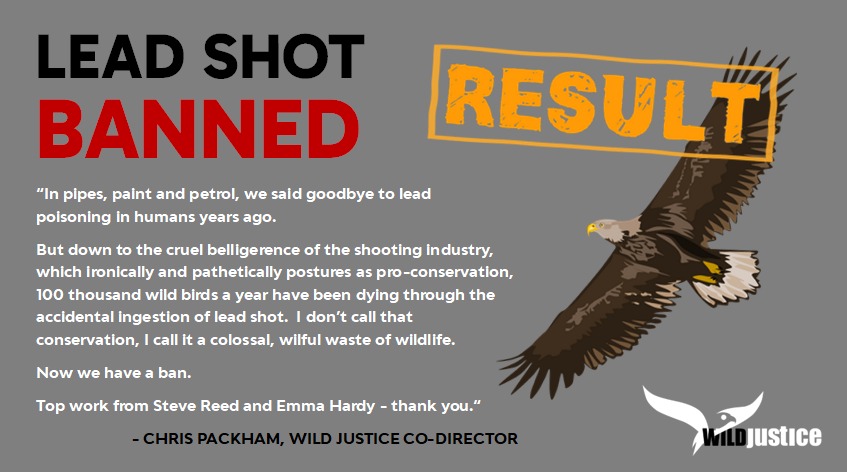
Two weeks ago Defra made it’s long-awaited announcement that a ban on the sale and use of toxic lead ammunition (with limited exceptions) would be coming in to force across England, Wales and Scotland in 2029 (see here).
Although the precise details of the ban have yet to be revealed, the news was welcomed across the board by conservation organisations, many of whom have spent decades campaigning against toxic lead ammunition because of the damage it causes to wildlife (especially waterbirds and raptors), the environment and human health.
An excellent summary article was published last week welcoming the ban and discussing its potential impact, published by The Conversation and written by two leading scientists who have been at the forefront of academic research into the use of toxic lead ammunition in the UK – Professor Rhys Green and Dr Debbie Pain. It’s well worth a read for a general overview for those new to this topic.
The government intends to introduce the new legislation by summer 2026 and a three-year transition period will follow (so effectively this is a four-year transition period from the date of Defra’s announcement). This is a shorter transition period than the five-year transition period proposed by the Health & Safety Executive and government sources tell me the shorter transition period was preferred by Defra and the devolved governments in Wales and Scotland ‘because the original five-year transition was proposed due to Covid-19 manufacturing delays, which have now returned to pre-pandemic levels‘.
I don’t know what evidence Defra used to decide that manufacturing levels have rebounded but it’s clear that a number of the game shooting organisations are intending to lobby for a return to the five-year transition period because they don’t think that non-toxic ammunition is ‘readily available’.
If it isn’t readily available, then what ammunition are the thousands of wildfowlers using, given that lead ammunition has been banned for killing waterfowl in England since 1999, in Wales since 2002, and banned for use over wetlands in Scotland since 2005?
Although a series of scientific studies have shown that compliance with those bans is poor (see here, here and here), it seems highly unlikely to be due to a lack of available non-toxic lead ammunition and more likely to be down to arrogance by those shooters who, by their own admission, don’t accept the justification for a lead ban and so carry on using it knowing that enforcement measures are mostly non-existent. There’s a clear lesson there for the English, Welsh and Scottish governments and the enforcement authorities when the wider ban is finally in force in 2029.
Since Defra’s announcement about the ban two weeks ago, apart from whining about the shortened transition period away from toxic lead ammunition, a number of the game-shooting organisations have been undertaking a gaslighting exercise with extraordinary claims about their environmental foresight.
It’s been interesting to watch because from what I’ve been reading online, many, many gamebird shooters still do not recognise the need to move away from toxic lead ammunition – they simply see it as a threat to their bird-killing hobby/industry – and they’re furious with their membership organisations for what is perceived as ‘rolling over’ to the pressure.
The gaslighting clearly hasn’t impressed the shooting organisations’ members, so I can only conclude it’s for the benefit of Ministers and civil servants.
Here are some examples.
The Moorland Association responded to Defra’s lead ban announcement by proclaiming:
“Grouse moors: Leading the transition. Our moors have already been paving the way. Sporting organisations, including the MA, GWCT, BASC and others, voluntarily endorsed a five-year lead-free target back in 2020“.
Ah, yes, the five-year so-called ‘voluntary transition’ away from using toxic lead ammunition (2020-2025) that failed spectacularly!
Peer-reviewed evidence produced by scientists at the University of Cambridge in 2025 at the end of the voluntary five-year transition period showed that of 171 Pheasants found to contain shot, 99% of them had been killed with lead ammunition.
And as for Red Grouse – the same study also analysed shotgun pellets found in Red Grouse carcasses shot in the 2024/25 shooting season and on sale through butchers’ shops and online retailers. In all 78 grouse carcasses from which any shot was recovered, the shot was lead.
Quite how these results translate to: ”Grouse moors: Leading the transition. Our moors have already been paving the way‘ is anyone’s guess.
Then there was the response by the Countryside Alliance:
“This is an important step for the future of shooting, which will benefit the countryside and rural economy. The Alliance has long advocated a move away from lead ammunition which is necessary and beneficial“.
I’m interested in the Countryside Alliance’s definition of “long“. Yes, it was one of the nine organisations that signed up to the (now failed) five-year ‘voluntary transition’ away from toxic lead ammunition in 2020 but what was the Countryside Alliance saying prior to that?
That doesn’t look to me like evidence of the Countryside Alliance having “long advocated” for a move away from toxic lead ammunition – it looks like gaslighting.
And what about BASC? What has it had to say?
Apart from clapping itself on the back for participating in the (now failed) five year ‘voluntary transition’ from 2020-2025, BASC said:
“Today’s announcement confirms that the Government plans to introduce legislation to restrict lead ammunition by summer 2026, with a further three-year transition period running until 2029.
“In doing this, the Government has shortened the expected timeframe for shotgun ammunition from five years to three years on the assumption that the ammunition is readily available – that is not the case for commercial and supply reasons beyond our sector’s control, and we urge government to adhere to a five-year timescale proposed by the Health and Safety Executive“.
Hang on a minute! Wasn’t it BASC that proclaimed “significant progress” had been made at the end of the so-called voluntary transition period in 2025? And wasn’t it BASC who said:
“Market-led solutions have emerged, with more than 150 sustainable cartridge options now available, and many shooters have successfully transitioned to lead-free ammunition” (see here).
Surely BASC wasn’t lying when it made these claims in March 2025?
We already know how consuming toxic lead ammunition can lead to a wide range of health risks in humans (e.g. see here). It seems to me there’s scope for examining its effect on short and long-term memory loss, too.