A couple of weeks ago we attended a raptor satellite tracking workshop in Perthshire that was designed to bring together raptor tagging experts and law enforcement officers to help promote a better understanding of how satellite tags work and how the tag data can help the police in the investigation of crimes against birds of prey.
Organised by the National Wildlife Crime Unit (NWCU) and Scottish Natural Heritage (SNH), approx 80 invited attendees turned up to share expertise and discuss new opportunities for working together. There were many police officers present, including some of senior rank as well as those on the ground, representatives from the Crown Office, NWCU, SNH, Cairngorms National Park, Raptor Study Group, RSPB Investigations, South Scotland Golden Eagle Project and a number of individual researchers and analysts. Many thanks to SNH for hosting us all at Battleby.
[Photo: Ruth Tingay]

The workshop programme was probably quite a challenge to put together because it had to cater for a wide range of experience and expertise; undoubtedly there were some in the room who didn’t know the first thing about raptors or satellite tags and others who didn’t know the first thing about police investigations, and some in the room who knew bits, or a lot, about all three topics. Given the diversity of knowledge, the organisers did a pretty good job putting together an interesting and useful agenda.
 Ian Thomson (Head of Investigations, RSPB Scotland) opened proceedings with an introduction to raptors, going through some general identification pointers for the non-birders and explaining which species are most likely to become victims of illegal persecution and on which type of land-use, illustrated with a hotspot map showing where high levels of illegal persecution have been recorded in areas intensively managed for driven grouse shooting.
Charlie Everitt (Scottish Investigative Support Officer, NWCU) went through the various legislation that provides protection to birds of prey in Scotland (on paper, at least), including the European Directives, Wildlife & Countryside Act and the WANE Act, as well as the availability of additional sanctions such as General Licence restrictions.
Des Thompson (SNH) provided a summary of the Golden Eagle Satellite Tag Review, which was a bit bizarre given that one of the report’s authors was in the room. Still, Des gave a good overview of what he called “the best scientific report SNH has ever commissioned“, providing the non-expert attendees with the report’s most significant findings.
Dr Ewan Weston (Scottish Raptor Study Group) gave an excellent talk on the various types of satellite tags that are available to researchers, the main differences between the tag types, the pros and cons of using each type, how researchers choose which tag to use depending on the research questions they are trying to answer, transmission intervals, ethical justification and assessment, tag reliability issues and how a technical malfunction can easily be identified from the pattern of tag data.
Ian Thomson’s second talk was an absolute masterclass in how to interpret satellite tag data. He talked about how the data are downloaded from the tag to the researcher, the type of information collected by the tag, what the tag data can and can’t tell us, and what to look for in the data when the tag has suddenly stopped and the raptor has ‘disappeared’. He showed various examples of what the data look like when they are downloaded from the tag and then went through three case studies, showing the actual tag data from three crime cases and how the researchers knew that something was wrong, just by looking at the pattern within the data. You could literally see the expressions of enlightenment on the faces of those unfamiliar with sat tag data interpretation – they now understood how researchers can distinguish a tag that suddenly stops working in suspicious circumstances from a tag that has a genuine technical malfunction. This was probably the most important presentation of the day, to help the police understand the level of detailed data scrutiny that tag operators undertake before raising the alarm about the sudden ‘disappearance’ of a tagged bird.
Brian Etheridge (Scottish Raptor Study Group), one of the most experienced satellite taggers in the country, gave a brilliant talk on the practical aspects of fitting satellite tags to raptors. This was also a real eye-opener for those in the audience who hadn’t previously seen a satellite tag in the hand and there were a number available on the day for attendees to examine.
[Photo: Ruth Tingay]
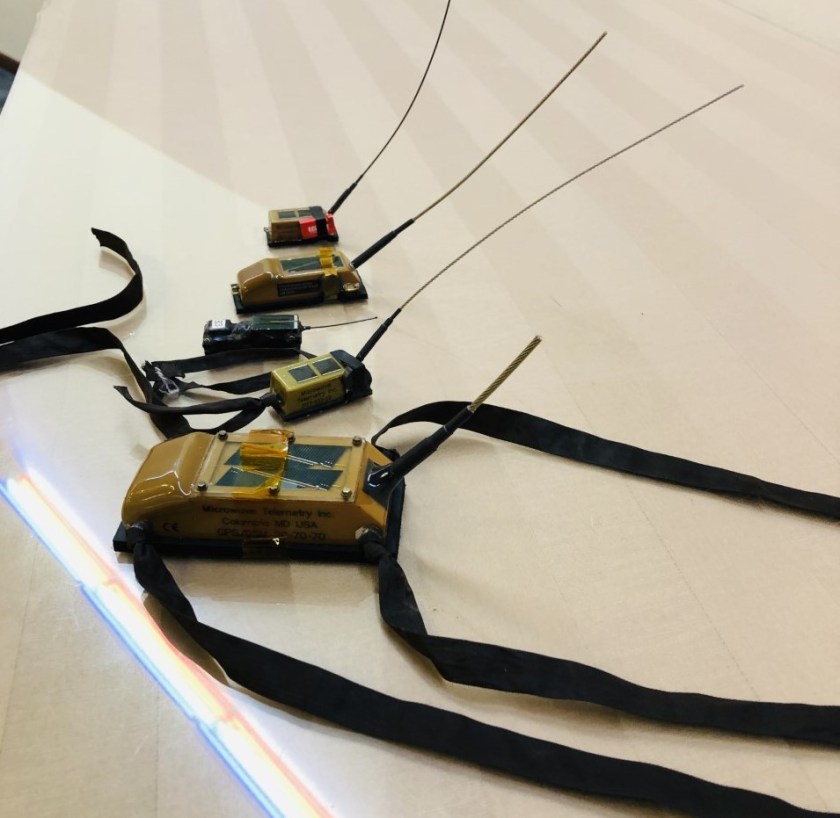
Brian’s talk covered a lot of ground including how the sat tag fitters have to be licensed, the strict regulation and scrutiny involved for every single tagging proposal and subsequent project in the UK, welfare considerations and restrictions, the new tags on the market and how they differ from the old style, how sat tag technology has improved year after year, how researchers decide which chick to tag, and then a demonstration of how the tags are fitted to the bird, making a point to say that ‘granny knots‘ are not used, which raised some smiles in the audience. Brian’s talk resulted in an exciting proposal from a specialist police officer in the audience – for obvious reasons we’re not going to discuss the detail here but what was proposed has the potential to have a significant impact on raptor crime investigations. Good stuff.
Here’s a drawing of a satellite-tagged elk in 1970, used by Brian to illustrate how far sat tag technology has come! [Illustration from the book Wired Wilderness: Technologies of tracking & the making of modern wildlife]

Charlie Everitt’s second talk was interesting – he described the process of a police investigation centred around a ‘missing’ sat tagged raptor and how the tag data can be used to raise sufficient ‘reasonable suspicion’ for police to search for further evidence at the site of the bird’s last known location. He talked about the limitations of current crime recording (i.e. how a ‘missing’ tagged bird can’t be classified as a crime, no matter how suspicious the circumstances, without further evidence. Those killing sat tagged raptors know this very well, which is why these days they destroy the tag and the corpse to avoid prosecution), how the police cannot share with anyone else the sat tag data they’ve been given, as the data are held as ‘a production’ (evidence) and thus subject to strict procedural controls, and the importance of receiving the tag data quickly once the researcher suspects a crime has been committed. Charlie used the case study of golden eagle Fred as an example of how the police could use the tag data to discount any number of ludicrous claims being made by those who sought to deflect attention from the ongoing issue of golden eagle persecution.
After the presentations there was an open discussion between the audience and the speaker panel, with some very interesting questions raised. One of those was why the police/SNH haven’t used the geographic location maps that show clusters of missing sat tagged raptors as supportive evidence to impose a General Licence restriction on certain grouse shooting estates? Good question! We were told that this was an issue currently being assessed (probably because now the police and SNH have a much better understanding of just how rigorous the sat tag data are).
We were also told, by Des Thompson, that “four of the main clusters identified by the Golden Eagle Sat Tag Review were going to be the focus of the Scotland PAW Raptor Group going forward“. We don’t know which four of the six clusters have been targeted for attention, nor what that ‘focus‘ actually means in real terms, but we’ll certainly be asking for progress reports in due course.
[RPUK map showing the main six geographic clusters of ‘missing’ sat tagged golden eagles as identifed by the Golden Eagle Sat Tag Review]

We also learned that SNH, Cairngorms National Park Authority and the BTO were trialling a number of new tags this summer to see whether the precise time and location of a suspiciously missing tag/bird could be identified more quickly from the tag data. If the tags perform well during testing, they expect to roll them out in due course. We look forward to seeing the results.
All in all this was an excellent workshop that provided a real opportunity for genuine partnership working, some of which has already proved fruitful even in the short period since the workshop took place. More of this, please!