Local community holds 2nd meeting to raise concerns about grouse moor management in National Park

In November 2018 we blogged about a local community in the North York Moors National Park that had called a public meeting to discuss concerns about grouse moor management in the area (see here).

This wasn’t just a flash in the pan, one-off event. Some members of this community in Goathland are clearly agitated about the damaging environmental impact of grouse moor management and are determined to do something about it.

Here’s Goathland, in the heart of this National Park and practically surrounded by driven grouse moors:

On Wednesday evening a second public meeting was held and the following notes were written and posted on Twitter by Richard Gray (@glaisdale1001) on Thursday:

Obviously these notes should be viewed as the personal opinion of one attendee and not as a formal record of what took place but nevertheless they make for an interesting read.

It’s really encouraging to see a local community willing to get together and speak out like this and it looks like this is just the beginning for Goathland.

Undoubtedly there are communities in other parts of northern England where the landscape is dominated by driven grouse moors that will share the Goathland community’s environmental concerns and “general feeling of no confidence in Natural England“. Hopefully those communities will now be inspired by Goathland and start to question and challenge the status quo in their own areas.

Well done, Goathland!

UPDATE 11 January 2019: Additional notes from the 2nd Goathland meeting on grouse moor management (here)

Raptor smuggler Jeffrey Lendrum receives 3 year custodial sentence

Following yesterday’s blog on serial raptor egg smuggler Jeffrey Lendrum’s guilty plea at Snaresbrook Crown Court (here), he has been sentenced to serve three years and one month in jail.

Press release from UK Border Force (10/1/19):

WILDLIFE CRIMINAL JAILED FOR RARE BIRD EGGS IMPORTATION ATTEMPT

A man who tried to smuggle 19 rare and endangered bird eggs into the UK strapped to his body has today, 10 January, been jailed for three years and one month.

The smuggling attempt was uncovered by Border Force officers at Heathrow Airport on 26 June 2018 when officers stopped Jeffrey Lendrum after he arrived on a flight from Johannesburg.

Lendrum, 57 and of no fixed UK address, was wearing a heavy jacket which officers thought was unusual due to the very warm weather conditions. When asked whether he had anything to declare, Lendrum stated he had some Fish Eagle and Kestrel eggs strapped to his body. During a full search, he was found to be wearing a body belt concealing 19 bird eggs as well as 2 newly-hatched chicks.

Border Force specialist officers identified that the eggs were protected under the Convention on International Trade in Endangered Species (CITES), the import trade for which is controlled by the issue of permits. Officers ensured that both the eggs and the live chicks were kept warm and quickly transported to the Heathrow Animal Reception Centre, managed by the City of London Corporation. The live chicks and the eggs were later moved to a specialist care facility at the International Centre for Birds of Prey.

Lendrum was arrested and the investigation passed to the National Crime Agency (NCA). Lendrum stated during an interview that his intention was to rescue the eggs after he encountered some men chopping down trees containing their nests. However in court, experts stated that a number of the eggs were from birds that nest in cliffs. Their values on the black market ranged from £2,000 to £8,000.

At Snaresbrook Crown Court on Tuesday (8 January) Lendrum, who has previous convictions for similar CITES offences in Canada, Brazil and Africa, pleaded guilty to attempting to import the 19 bird eggs.

Grant Miller, head of the national Border Force CITES team at Heathrow, said:

My officers are experts in their field and, in this case, their vigilance has stopped a prolific wildlife criminal in his tracks. Their intervention also ensured that the birds and eggs received the immediate care and attention that they needed.

Wildlife crime is a global issue and Border Force officers play a crucial role in preventing offenders from moving the products across borders, stripping them of their illegal profits.

We will continue to work closely with enforcement partners such as the NCA to tackle the international illegal wildlife trade which threatens the survival of endangered animals and plants“.

Chris Hill, NCA investigations manager Heathrow, said:

This offence was clearly no accident as Lendrum had gone to great lengths to both source and then attempt to conceal the birds eggs. His claims that he was engaged in an effort to save them from deforestation did not hold water.

Wildlife crime is a cynical business, indulged in by those who have no qualms about the environmental damage they cause as long as there is a profit to be made. This case sends a clear message that we are determined to bring cases like this before the courts“.

The importation of endangered species into the UK is strictly controlled by CITES, which is an international agreement covering more than 35,000 species of animals and plants. The Heathrow-based Border Force CITES team are specialist officers who work across the UK and who are recognised as world leaders in their field.

Anyone with information about activity they suspect may be linked to smuggling and trafficking of any kind should call Crimestoppers on 0800 555 111.

ENDS

Well done to all involved, especially the UK Border Force and the National Crime Agency. This is an excellent result.

Rattled? Much?

Have a read of Letter of the Month in the latest edition of Shooting Gazette (‘Driven shooting’s finest journal‘):

He wants the British game-shooting industry to emulate the NRA, one of the most ridiculed and dangerous bastions of far-right lunatics on the planet? And this is the star letter?!

Perhaps those Dubarrys should be swapped for a pair of jack boots.

Are raptor-killing licences on the cards for gamekeepers in Scotland?

Rumours are circulating that licences to kill raptors (in order to protect ‘livestock’, i.e. pheasants & partridge poults) are being considered in Scotland.

It must be stressed that these are only rumours, but based on the sources, we’re treating them seriously.

Separate to these rumours, and perhaps more than coincidentally, Alex Hogg’s editorial piece in the latest edition (Dec 2018) of the Scottish Gamekeepers Association’s quarterly rag for its members focuses strongly on raptor-killing licences – something he claims would lessen the likelihood of gamekeepers “making bad decisions when it comes to raptors” (he means committing wildlife crimes).

Here’s the article – see what you think:

The timing and content of his editorial may well just be coincidental; it’s not like he and his sorry-arsed organisation haven’t been lobbying to be allowed to kill raptors for years. For example, here he is in 2010 bemoaning the impact of buzzards on his pheasant shoot, although he goes further and makes the totally unsubstantiated claim that “biodiversity is seriously threatened in Scotland by buzzards” but then later contradicts this claim when he argues that licences would only be needed to kill “a few rogue buzzards“.

But it’s not just Alex’s editorial that has raised our antennae. In December, licensing authority SNH sent around the following email about the 2019 General Licences, saying that a consultation is planned this spring, in readiness for its 2020 General Licences:

Hmm. Another coincidence? Perhaps, or could this be a planned ‘sweetner’ for the gamekeepers in anticipation that the Werritty Review will recommend licensing for grouse shooting estates when it reports later this spring?

We wouldn’t put it past the Scottish Government to try something like this – it pulled a similar trick when the Werritty Review was first announced in May 2017 by revealing that it would not consider giving additional investigative powers to the SSPCA to help tackle illegal raptor persecution (see here).

If issuing gamekeepers with licences to kill raptors is planned, it’s going to be pretty hard for the Scottish Government to defend such an action in this context. The Werritty Review was set up to examine grouse moor management precisely because of the ongoing issue of illegal raptor persecution; evidence of which Professor Werritty himself concluded was “compelling and shocking“. If the Scottish Government decides to address these crimes by simply legalising the killing of raptors by gamekeepers, it will undoubtedly face a serious backlash from the public and potentially a number of legal challenges.

Watch this space.

UPDATE 10.30hrs: SNH emailed us today and requested we post the following statement –

This is not true – we are not changing our policy towards licensing raptor control. We consult on General Licences on a regular basis; this is not new“.

We’ll be revisiting this statement, and this issue, in the very near future.

Serial international raptor egg smuggler faces lengthy custodial sentence

The name Jeffrey Lendrum will be familiar to many blog readers. He’s the criminal who was sentenced to 2.5 years in prison in 2010 when he was caught trying to smuggle peregrine eggs (stuffed inside socks taped to his stomach) out of Birmingham airport enroute to the Middle East (see here). Lendrum had stolen the eggs from nest sites in Wales and investigators believe he had collected them to order for an Arab falconer in Dubai.

Prior to that 2010 conviction, Lendrum had been found guilty of similar offences involving stolen falcon eggs from nests in Zimbabwe (1984) and Canada (2002).

In 2016, Lendrum was sentenced to 4.5 years in jail in Brazil after being caught in possession of rare falcon eggs at Sao Paulo airport, enroute from Chile to Dubai (see here). However, in 2017 it was reported (here) that he was appealing his sentence and the Brazilian authorities released him on bail pending that appeal. Lendrum subsequently disappeared.

In June 2018 Lendrum was caught at Heathrow airport wearing a body belt that contained 19 eggs of various raptor species from South Africa (here). He initially pleaded not guilty which led to his trial at Snaresbrook Crown Court yesterday.

Lendrum eventually pleaded guilty on the first day of his trial to four charges of Evasion of a Restriction contrary to the Customs and Excise Management Act. He was remanded in custody and sentencing is expected today (Wednesday).

Coverage of this story can be found in the Daily Telegraph (here) and Daily Mail (here).

We’re interested in the legislation under which Lendrum was charged and convicted. Clearly not any wildlife-specific legislation and also clearly quite serious as his trial took place in the Crown Court rather than a lower Magistrates Court. This looks like a creative approach to tackling someone who commits serial wildlife crimes – good work by the UK Border Force and the National Crime Agency.

The judge reportedly warned Lendrum yesterday that he faced a lengthy jail term. Although according to this fascinating article written by Joshua Hammer, who has been researching Lendrum for a proposed biography, Lendrum is suffering from cancer so his apparent ill health may well be used in mitigation to influence (lessen) the severity of his sentence. We’ll see.

UPDATE 10 January 2018: Raptor smuggler Jeffrey Lendrum receives 3 year custodial sentence (here)

Marsh harrier found illegally shot

The RSPB Investigations Team is reporting the discovery of a shot Marsh harrier.

This bird was discovered critically injured on the river bank near Barton-upon-Humber in North Lincolnshire on 9th  September 2018. A dog walker reported it to the RSPCA and it was also reported to the police. An RSPCA officer took the harrier to the East Winch Wildlife Centre near Boston where an x-ray revealed it had been shot. The bird later died from its injuries.

[Photo by RSPCA]

Humberside Police investigated but were unable to identify the criminal responsible.

If anyone has any information relating to this incident, call Humberside Police on 101 quoting crime reference number 16/115793/18.

Further details on the RSPB Investigations blog here

Marsh harriers are increasingly in the firing line, whether it’s on lowland game shooting estates (e.g. here), on land adjacent to an RSPB Reserve (e.g. here) or on upland grouse moors (e.g. here).

And let’s not forget (as several people did) the grouse shooting industry’s interest in obtaining licences to kill Marsh harriers to prevent the so-called ‘disruption’ of driven grouse shoots.

Scottish Raptor Monitoring Scheme: new research paper & a job vacancy

The Scottish Raptor Monitoring Scheme (SRMS) is a fine example of credible, effective & genuine partnership-working for the benefit of raptor conservation. That’s probably because its membership doesn’t include any representatives from the game-shooting industry.

Established in 2002, the award-winning SRMS now includes nine partner organisations (Joint Nature Conservation Committee, Scottish Natural Heritage, British Trust for Ornithology, Scottish Raptor Study Group, RSPB, Forestry Commission Scotland, Rare Breeding Birds Panel and the Scottish Ornithologists’ Club) who all collaborate to collect and analyse data on Scottish raptor populations. These data provide the Scottish Government with the information it needs to meet its international reporting responsibilities and they are also used to help inform local authority planning applications and a wide array of conservation applications.

A new scientific research paper on the SRMS’s experiences and approach to nationwide raptor monitoring has just been published in the journal Bird Study. The paper is available in full here: the scottish raptor monitoring scheme recent developments in good practice monitoring

Here’s the abstract:

The work of the SRMS has been coordinated in recent years by Dr Amy Challis but Amy is going on maternity leave from early March so the position of Scottish Raptor Monitoring Coordinator is now available for an initial period of one year.

Make no mistake, this is a challenging role, not helped at all by SNH’s disgraceful decision last year to licence the mass killing of ravens in Strathbraan ‘just to see what happens’. Aside from the very obvious scientific flaws with that licence, as described by SNH’s own Scientific Advisory Committee (here), SNH’s behaviour exacerbated a deep mistrust amongst many members of the Scottish Raptor Study Group, some of whom are now wondering whether to submit their hard-won raptor monitoring data to the SRMS because they can’t be sure that SNH won’t utilise the data for other dodgy ‘experiments’.

It’s quite telling that the job application form for the post of Scottish Raptor Monitoring Coordinator includes the following information about what will happen at the interview stage:

Candidates will be asked to imagine that they are giving a short presentation to a group of raptor workers and their aim is to convince them of the value of collaborating in a modernised and inclusive monitoring scheme, with particular focus on the benefits and risks of sharing data with a range of stakeholders (maximum 10 minutes; laptop and projector available for a presentation if desired)’.

Having said that, the SRMS is currently updating its data use and sharing policy which will hopefully provide a greater level of confidence to raptor fieldworkers that their data will only be used for genuine conservation purposes and only with their express permission on a case-by-case basis.

The deadline for applying for this job is 5pm on 10th January 2018 (this Thursday). A job description and details of the skills required and how to apply can be downloaded here:

jobvacancy_scottishraptormonitoringcoordinator

Approx 100 dead pheasants dumped next to N Wales coast path

The bodies of approx 100 pheasants have been dumped next to the North Wales Coastal Path nr Mostyn, a popular walking and cycling spot.

It is believed they were dumped on the embankment, known locally as the ‘cob’, following a traditional Boxing Day shoot.

Resident Janice Scott said: “I came across the pile of pheasants on a walk, but in truth I smelt them before I saw them. I believe that they have been dumped following a traditional Boxing Day shoot, but there’s simply no excuse to just dump them like that. It really isn’t a nice thing to come across, in fact it’s horrendous.’’

Cllr Bob Hazlehurst said: “The cob has become a dumping ground, with people tipping all sorts down there, but nothing quite as strange as this. I’ve simply no idea where they’ve come from or who’s chosen to dump them there. I just hope they are removed as soon as possible.

We are trying to take steps to prevent the persistent fly tipping in the cob area. CCTV has been touted, but how effective that would be with the size of that area is questionable.’’

Steve Jones, chief officer Streetscene and Transportation said: “Flintshire County Council have been made aware of a number of dead pheasants deposited on the Coastal path near Mostyn and have arranged for Streetscene to collect and remove the birds.

This practice of dumping shot game birds is becoming a common practice in the UK. We’ve previously blogged about it over the last couple of years (e.g. see herehereherehereherehereherehere), and undoubtedly it’s driven by an over supply of birds and little demand by consumers for purchasing game bird meat. The game shooting industry is well aware of the PR disaster this practice brings to its door but it seems unable to do anything about it.

This is hardly a surprise when you consider that an estimated 50 million non-native gamebirds (pheasants & red-legged partridge) are released in to our countryside EVERY YEAR, to provide live targets for people with guns. This is barely regulated – they can release as many of these alien species as they like and kill as many of them as they like, as long as they’re killed within the shooting season. The Code of Good Shooting Practice says “shoot managers must ensure they have appropriate arrangements in place for the sale or consumption of the anticipated bag in advance of all shoot days“ but this, evidently, is not happening.

And of course sitting alongside these unregulated releases is legal and illegal predator control – the mass slaughter of native wildlife, including raptors, done to protect the gamekeepers’ ‘livestock’. And for what? Just so the shot game can be thrown down an embankment and left to rot?

Shooting industry representatives are doing their best to proclaim effective self-regulation and as recently as November 2018 BASC claimed that “the values and standards of the UK shooting community…is driven by strong ethics and respect for quarry“.

Images like this from Wales prove BASC’s claim to be just more hollow words.

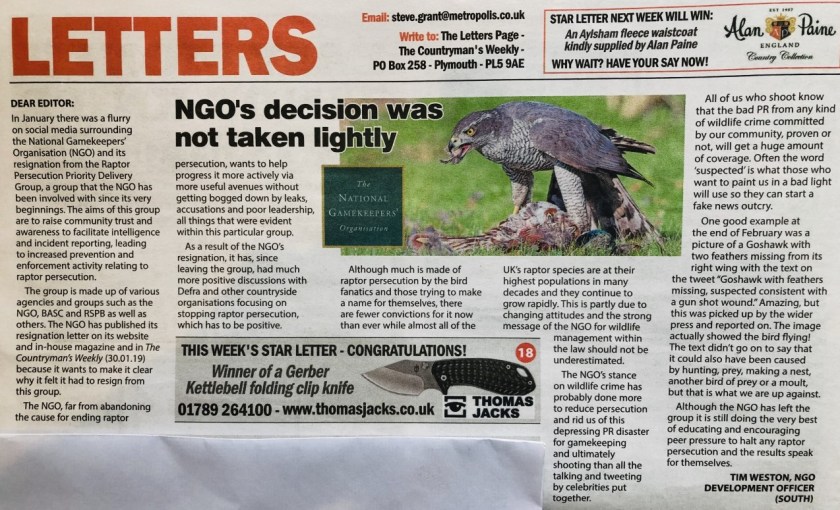
Police Supt Nick Lyall to create ‘hostile environment’ for raptor killers in England & Wales

Hats off to Police Superintendent Nick Lyall, the current Chair of the Raptor Persecution Priority Delivery Group (RPPDG) in England and Wales.

This guy took up post in September and promised accountability, transparency, and most importantly, delivery of the group’s objectives, which centre on a partnership approach to tackling illegal raptor persecution. No easy task given that the RPPDG, which was formed in 2011, has so far delivered absolutely nothing of any use because its membership has been top heavy with those only interested in protecting the image of the grouse shooting industry and because the so-called ‘partnership’ has suffered from a chronic lack of leadership by its former Chairs.

Now, thanks to Nick’s leadership, things look set to change. We blogged last month about some of his preparatory work (here) and today he’s published a blog about some of his plans for 2019, which he’s calling ‘The Year of the Raptor’.

[Supt Nick Lyall visiting RPPDG partners in the Yorkshire Dales in November: L-R David Butterworth (CEO Yorkshire Dales National Park Authority), Nick Lyall, Ian Court (Wildlife Officer at YDNPA) and Sgt Stuart Grainger of North Yorkshire Police Rural Task Force]

This is Nick’s 4th blog since September – full marks to him in the transparency stakes; we’ve never seen this level of communication from previous Chairs and it is a very welcome change.

In his latest blog (here), Nick outlines some of his immediate plans for the RPPDG and the one which caught our eye was this:

The creation of an Enforcement Group that will focus on partnership working and the `Achilles Heel` approach to tackling head-on those people that are known or strongly suspected to be involved in persecution offences. Creation of a hostile environment for those committing persecution offences‘.

The specifics of this proposed Enforcement Group and its operational capabilities aren’t detailed as yet, which is understandable, but we hope that it will be restricted to law enforcement bodies only and will specifically exclude all those shooting industry organisations whose main aim seems to be to protect the raptor killers from any enforcement measure. Presumably the group will have access to highly sensitive police intelligence logs including the names of shooting estates and associated individuals who are suspected of committing wildlife crime and presumably the group will also have the authority to act on those intelligence logs and go after the suspects. Let’s face it, these estates (and many of the individuals) are already well known because raptor crime is reported there time and time and time again but enforcement action, with a few notable exceptions, has been appalling.

Directly linked to this lack of enforcement in some cases has been a lack of available resources as police budgets are slashed, and a lack of trained police officers and control room operators in some regions but by no means across the board. Nick discusses his plans to tackle both these issues, in addition to launching a national publicity campaign based on North Yorkshire Police’s exemplary Operation Owl campaign.

Of course, there’s also the obligatory ‘let’s talk with the shooting industry’ approach, which has proven utterly futile in the past with organisations actively opposing cooperation with police-led initiatives to tackle illegal raptor persecution (e.g. see here and here) but Nick will just have to learn the hard way. At least they won’t be able to accuse him of not trying.

All in all though, Nick’s proposals look thoughtful and well-considered and there’s every reason to be (cautiously) optimistic about the future role of the RPPDG.

Chris Packham appointed CBE for services to nature conservation

MASSIVE CONGRATULATIONS to Chris Packham who has been appointed CBE in the New Year’s Honours for services to nature conservation.

The irony of this recognition from ‘The Establishment’ won’t be lost on him, but neither will the opportunities it will provide for him to expand his outstanding campaigning efforts against illegal raptor persecution, fox hunting and badger killing. Perhaps he’ll wear his ‘Never mind the bollocks – where’s the hen harriers?’ t-shirt when he rocks up at the Palace for his investiture.

On hearing the news, Chris said:

In an age where illegal fox hunting, the continued persecution of birds of prey and the unscientific, uneconomic and inhumane killing of badgers continue, our wildlife needs a voice to shout above the noise. Maybe the silent have spoken, maybe a terrified fox, a wounded hen harrier or a trapped badger whispered and this is their thanks. I’ll take that, say ‘ta very much’ and stop shouting … and start screaming and I won’t stop until the killing does“.

[Chris Packham deep in thought on a Yorkshire grouse moor. Photo by Ruth Tingay]

The Nasty Brigade won’t be best pleased. They’ll be spitting the feathers, blood or fur of whatever poor creature they’ve blown to bits today, knowing full well that Chris’s new status will hinder their long-running crusade to have him sacked from the BBC, all because he dares to speak out, in his own time, about their atrocities.

Well done Chris, and thank you. It’s official – you’re bloody brilliant.

UPDATE 1pm: Video clip of Chris being interviewed on BBC Breakfast this morning: