With straight faces, landowners’ lobby group asks tourists to ‘respect nature’

This made me laugh out loud.

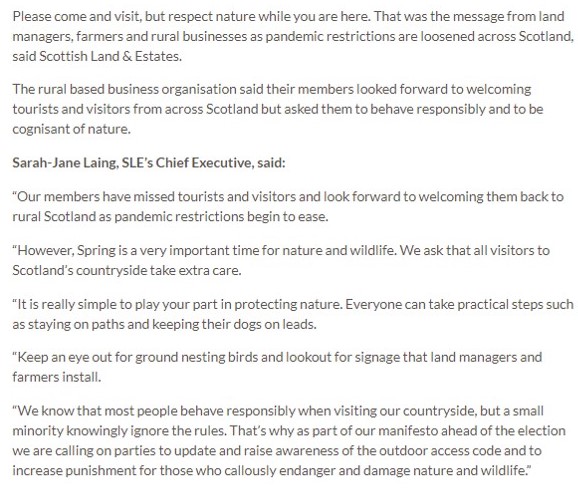
Landowners’ lobby group Scottish Land & Estates (SLE) posted this on their website two days ago:

This is the same Scottish Land & Estates whose membership includes the notorious Leadhills Estate, a grouse-shooting estate in South Lanarkshire where over 70 confirmed incidents of wildlife crime have been reported since 2000 and is currently serving a three-year general licence restriction based on “clear evidence” of ongoing raptor persecution (see here).

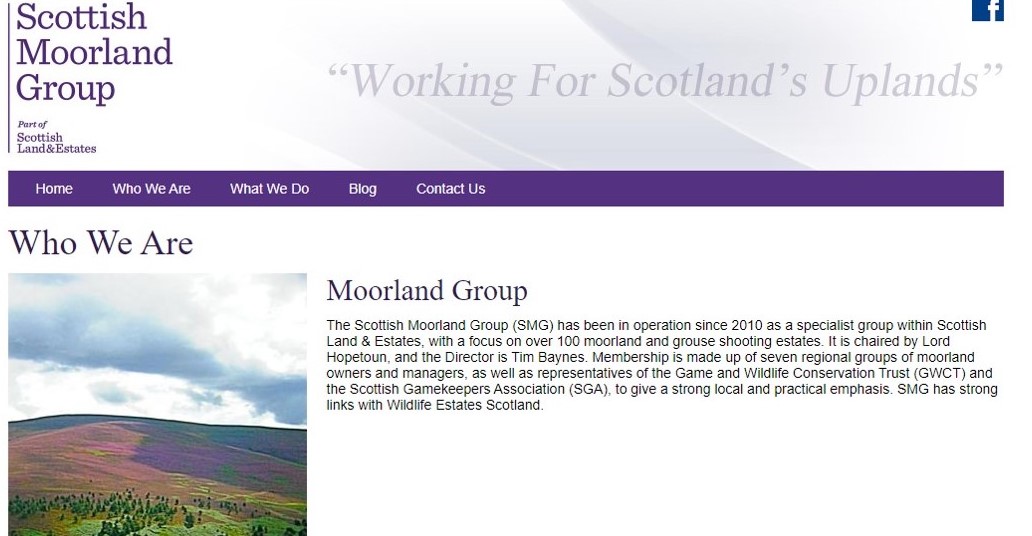
This is the same Scottish Land & Estates whose Moorland Group Chair, for years, was Lord Hopetoun of Leadhills Estate as illustrated by this screengrab from the SLE website:

This is also the same Scottish Land & Estates whose membership includes the notorious Longformacus Estate in the Scottish Borders, a grouse and pheasant-shooting estate where gamekeeper Alan Wilson was convicted of nine wildlife crime offences including the shooting of protected raptors, badgers and otters, the setting of illegal snares and the possession of banned poisons (see here). According to SLE’s CEO, Sarah-Jane Laing, responding to a question on this blog on 31 March 2021 (here) about why the Longformacus Estate hadn’t been expelled from SLE:

“Yes, Longformacus is a member. As per our statements at the time membership was suspended during the police investigation in to the atrocious crimes but was reinstated when the police took no action against the estate owner“.

This is also the same Scottish Land & Estates who supports seven regional moorland groups; grouse moors in five of those seven regions have been in the last three years, or currently are, under police investigation for alleged raptor persecution crimes (grouse moors in the regions covered by the Angus Glens Moorland Group, Grampian Moorland Group, Tomatin Moorland Group, Tayside & Central Moorland Group and the Southern Uplands Moorland Group).

And SLE has the audacity to ask tourists to ‘respect nature’?!

Inadequate sentence for persistent egg thief

Back in February this year, 63-year-old Terence Potter from Huddersfield appeared at Sheffield Magistrates Court and pleaded guilty to a number of offences related to the theft of nearly 200 wild bird eggs, including eggs from the red-listed Curlew (see here).

The offences were:

  • Two counts of possessing items capable of being used to take and possess birds’ eggs;
  • Three counts of possession of a wild bird’s eggs (179 black-headed gull eggs, eight golden plover and seven curlew);
  • Three counts of taking wild bird eggs (179 black-headed gull eggs, four golden plover and three curlew)

Yesterday, Potter returned to Sheffield Magistrates Court for sentencing. He was given a 12-week custodial sentence, suspended for 12 months and ordered to pay £120 costs and a £128 victim surcharge. The equipment he used to commit the offences was forfeited.

The RSPB’s Investigations team has written a blog about this case (here).

This isn’t the first time Potter has been convicted of stealing wild birds eggs and I daresay it won’t be the last, given this inadequate sentence.

Seven years before he was caught for his latest offences, Potter was convicted of nine related offences including six charges of taking birds’ eggs, two charges of possession of 587 eggs (including a number of Schedule 1 raptor eggs), and possessing articles to commit offences.

His sentence that time? A two-year conditional discharge and ordered to pay £85 costs (see here, page 9).

In the RSPB blog, Investigations Officer Tom Grose said, “We are pleased with today’s outcome….” (here). I disagree. Yesterday’s conviction is pleasing, of course, and all credit to everyone involved, including the gamekeepers who first reported Potter acting suspiciously, and to South Yorkshire Police, the RSPB Investigations team and the Crown Prosecution Service for their diligence in putting forward the case, but I’m not convinced that a suspended sentence is ‘pleasing’. It’s pathetic for someone who knew exactly what he was doing and the dire consequences of stealing eggs from birds of high conservation concern.

In my view he should have been jailed the first time he was convicted (and the court had the capacity to do that) and most certainly this second time.

Having said that, short custodial sentences aren’t always effective for these weirdly obsessive individuals (e.g. see here).

Political hustings on animal welfare in Scotland now available to view

Last week Scottish animal welfare charity OneKind hosted a political hustings to allow the public to quiz candidates from the five main political parties on their animal welfare policies ahead of the election on 6th May.

The hustings was organised by More for Scotland’s Animals (MFSA), a coalition of 11 leading animal welfare organisations (see here).

Grouse shooting featured quite prominently at this event and a journalist from The Herald wrote about his interpretation of events (see here).

The recording of the hustings is now available to watch so you can draw your own conclusions about which parties are taking note of animal welfare in their policies.

Don’t forget, the recording of the REVIVE hustings, focusing on party policies around grouse moor management, is also available to view here.

Red kite believed to have been shot & hung from a tree

There is a disturbing news report this afternoon that a red kite has been shot dead and was hung from a tree in a Norfolk village.

According to the Eastern Daily Press, ‘Norfolk police were called to Swaffham Road in Cockley Cley on Friday, April 9, after someone reported a dead bird hanging from a tree.

Police arrived on the scene to find a red kite, and an X-ray led to a vet finding shot dust around the right ulna and one of the legs being broken, police have said‘.

Given the date, location, species and the x-ray that was published in this article (that appears to have been lifted from here), I believe this red kite is the same one that Norfolk Constabulary tweeted about and I blogged about last week (see here) although there was no mention of it being hung in a tree.

Presumably this new information has been provided to the press by Norfolk Constabulary, although I still can’t find a press release on the police website. It’s really not good enough. Raptor persecution is a national wildlife crime priority and the bare minimum should be a press release from the police with what can be viewed as reliable detail for accurate reporting.

Other new information in the EDP article includes a named contact at Norfolk Constabulary – PC Chris Shelley.

If you have any information about this incident please contact PC Shelley on 101 quoting reference 36/25060/21 or contact Crimestoppers anonymously on 0800 555111.

This is the second report of a dead raptor found hung in a tree in recent weeks. Earlier this month Police Scotland were investigating an incident where a dead buzzard had been strung up in a tree, reportedly after dying of natural causes (here).

Revive hustings – which political parties are supporting grouse moor reform in Scotland?

There was a fascinating political hustings last night where candidates from the five main parties were quizzed for an hour and a half about their views on various aspects of grouse moor management and reform.

Imagine that happening in England? No, me neither. But the fact that this took place in Scotland, with political candidates from all the main parties prepared to spend a few hours of their time discussing this one issue, is testament to the growing public concern about the role of grouse moor management in the climate and nature emergencies and thus its subsequent position on the political agenda.

The hustings was hosted by REVIVE, the coalition for grouse moor reform, whose members are OneKind, League Against Cruel Sports, Friends of the Earth, Common Weal and Raptor Persecution UK.

Max Wiszniewski compered the event with additional support from Louise Robertson and the candidates were as follows:

Mairi McAllan, SNP (former lawyer & special advisor to First Minister on Environment, Climate Change and Land Reform)

Laura Moodie, Scottish Greens

Ian Davidson, Scottish Labour (who also featured at the Scottish Gamekeepers Association hustings last month – see here)

Alan Reid, Scottish Liberal Democrats 

Edward Mountain, Scottish Conservatives (who also featured at the SGA’s husting last month and describes himself as a ‘proud member’ of the SGA – see here)

As expected, there was a variety of views and approaches, some credible, some not, and some of these views were quite different from the views put forward by different candidates of the same parties at the Scottish Gamekeepers’ hustings last month (see here).

On the subject of raptor persecution, all candidates were clear on having a zero tolerance policy…..and yet still it goes on.

The event was recorded and is available to watch below:

Operation Wingspan – Police Scotland raise awareness of raptor persecution

In October 2020, Police Scotland launched a 12-month-long campaign called Operation Wingspan to raise awareness of wildlife crime. The campaign focuses on the seven wildlife crime priorities set by the UK Wildlife Crime Tasking and Co-ordination Group and the National Wildlife Crime Unit.

The seven wildlife crime priorities are currently:

Badger persecution

Bat persecution

Raptor persecution

Convention on International Trade of Endangered Species (CITES)

Freshwater pearl mussels

Poaching (deer & fish) and hare coursing

Cyber-enabled wildlife crime

Operation Wingspan is currently focusing on the illegal persecution of birds of prey. Police Scotland and the RSPB have produced a short video to explain:

Regular blog readers will be unlikely to learn anything new from this video but that’s no reason to criticise it. It is clearly aimed at new audiences who may not even understand that the term ‘raptors’ refers to birds of prey, let alone have any awareness that these birds are protected but still illegally trapped, shot and poisoned, especially on land managed for game bird shooting.

And reaching new audiences is exactly what is needed. This subject has come a long, long way in terms of raising public awareness in the last decade but there’s still much more to do. The more people that are aware of these crimes, the more pressure will be loaded on politicians to pull their fingers out and take meaningful action instead of twiddling around at the edges year after year after year, too afraid to take on influential landowners.

Breach of hen harrier diversionary feeding licence on North Yorkshire grouse moor

A few days ago I was informed that there may have been a suspected breach of a hen harrier diversionary feeding licence last weekend, on a grouse moor in North Yorkshire.

Observers were monitoring what they believed to be an active hen harrier nest. Their observation position was approximately one mile from the nest site so as not to disturb the breeding attempt.

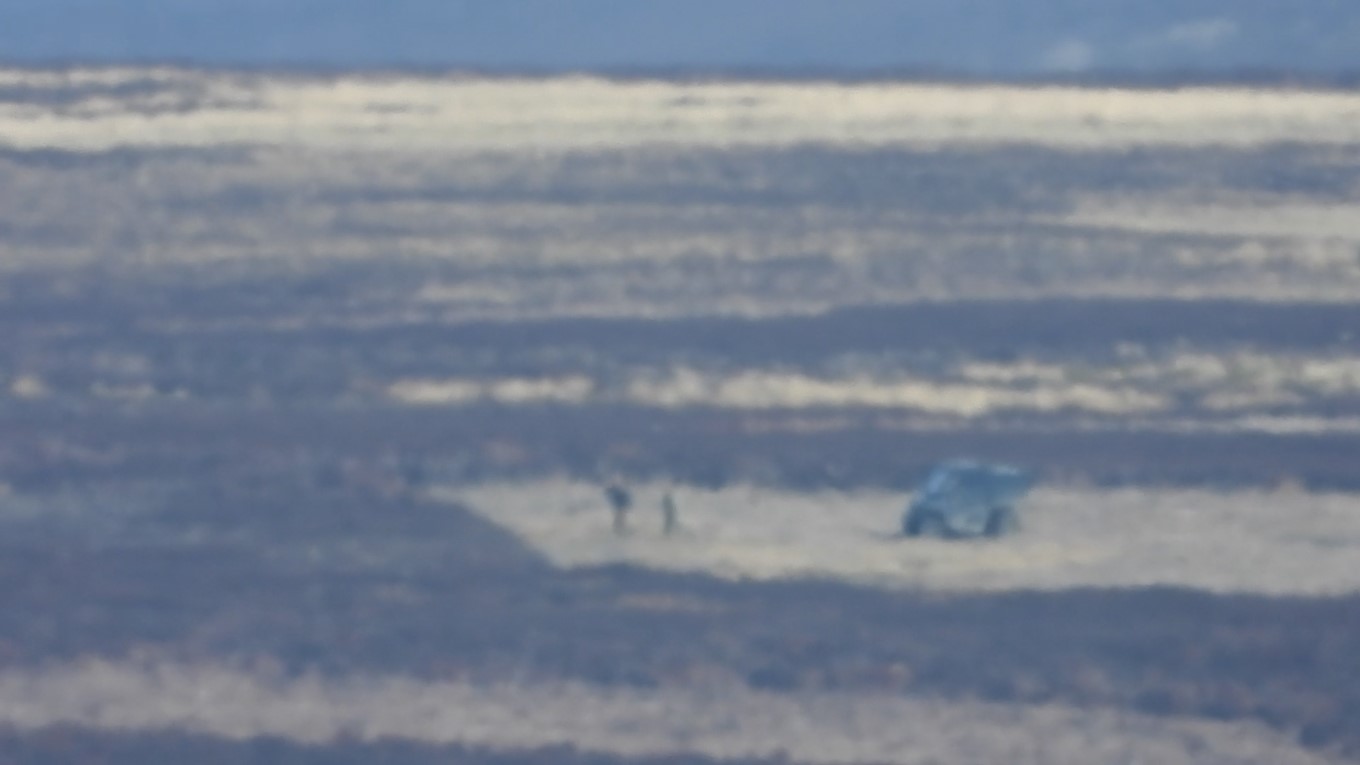
During this period, they observed and filmed a buggy carrying two individuals, being driven towards the nest site. It stopped and one person got out and appeared to be placing something on top of a fencepost, before returning to the buggy and driving towards the nest. Both individuals exited the buggy, walked in to the heather to the nest, flushed off a very agitated female hen harrier, did something at the nest that wasn’t clear (one individual was crouching down and the other appeared to be taking photos of the dive-bombing female) before returning to the buggy and driving away.

[Screengrab from the video footage, filmed from approx one mile away, showing two individuals walking from the buggy towards the hen harrier nest]

I’ve been told by a number of people that this was a gamekeeper and a Natural England employee, but I have been unable to verify this. I understand that the nest contained five eggs that the female was incubating.

It was suggested to me that before visiting the nest, one of the individuals had been setting out food as part of a diversionary feeding strategy, which is encouraged as part of DEFRA’s Hen Harrier Action Plan. However, the licence that permits diversionary feeding (CL25) sets out quite clearly that diversionary feeding can ONLY begin after the eggs have hatched, and not before:

I don’t know what the exact reasoning is behind this restriction of not being permitted to provide diversionary food prior to the chicks hatching but an educated guess would be that it would limit unnecessary disturbance in the vicinity of the harrier’s nest at a highly sensitive period, especially as the licence notes that red grouse are unlikely to be taken by hen harriers during the incubation period, so diversionary feeding shouldn’t be necessary.

The restriction may also be related to the fact that as a general rule of thumb, most raptors, if disturbed, are more likely to desert their nest during the incubation period than they would be had they reached the nestling period, presumably because they’ve invested much more in the breeding attempt by the nestling stage.

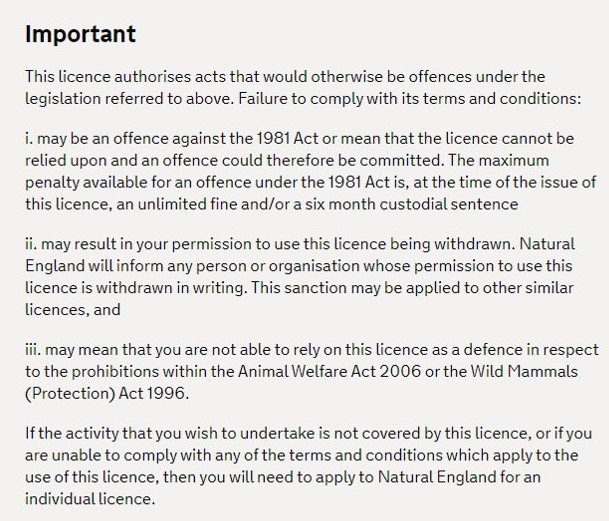
However, the reasoning behind the restriction isn’t really the issue right now. The issue is that there has been a potential breach of a licence condition. Here’s what Natural England’s CL25 licence says might happen if there is a failure to comply with the terms and conditions of the licence:

I contacted North Yorkshire Police to ask whether a potential licence breach would be enforced by the police or by another agency. A police spokesperson told me that Natural England would be the enforcement agency and it was also confirmed that yes, this licence breach had occurred last weekend.

The police spokesperson said that NE had given assurances that the individual concerned ‘had been spoken to’ and that ‘the activity had ceased in accordance with guidelines’. Natural England apparently said there was ‘no malicious intent in any activity’ although it’s not clear how they assessed that.

Interesting. I’ve written to Natural England today to ask them about any potential enforcement action they may be taking against this estate for failing to comply with the terms and conditions of the licence.

My money is on there being absolutely zero enforcement action taken, given Natural England’s track record of happily working in cahoots with the very industry responsible for the hen harrier’s catastrophic decline in England in their scandalous hen harrier brood meddling conservation scam.

Actually, I wonder whether this nest will be targeted for brood meddling this year and if so, whether this ‘extended’ diversionary feeding (and who knows how long it had been going on?) will be mentioned to the Scientific Advisory Committee scrutinising the supposed rigour (ahem) of the brood meddling trial?

UPDATE 4th May 2021: Grouse-shooting estate under investigation for alleged breach of hen harrier diversionary feeding licence (here)

Police conduct another multi-agency raid after two buzzards confirmed poisoned in Teesdale

Press statement from Durham Constabulary (21 April 2021)

Operation targets raptor persecution

Officers have teamed up with partner agencies on a special operation to target raptor persecution.

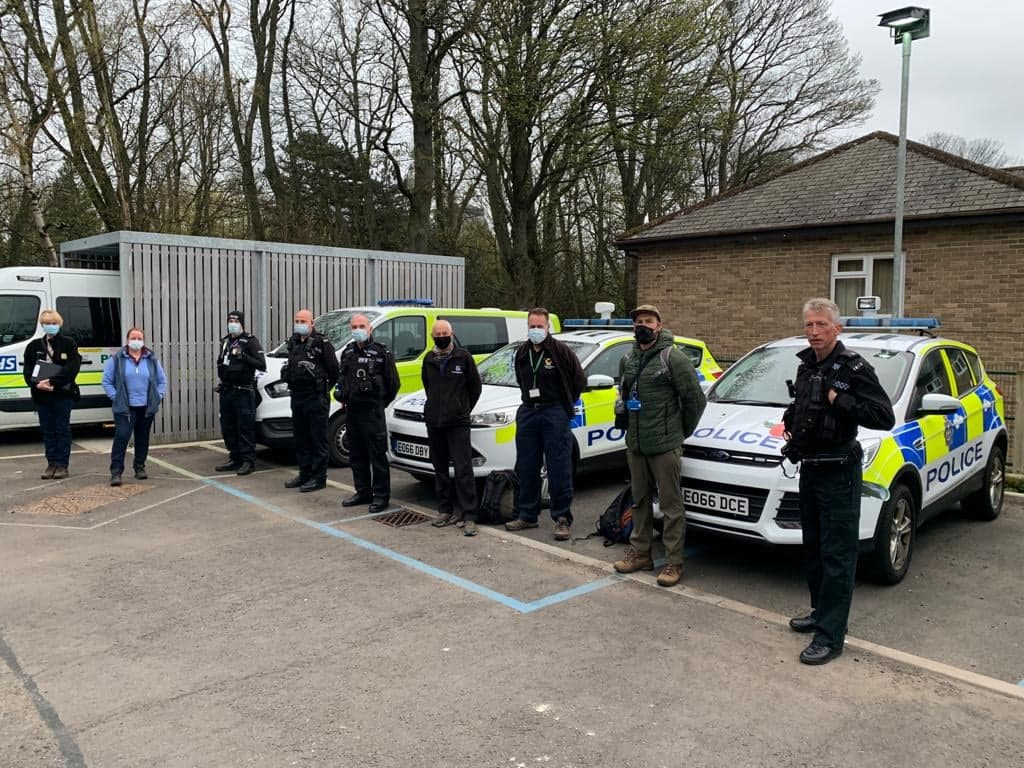
Operation Sunbeam included members of the Barnard Castle Neighbourhood Policing Team, RSPB, Natural England and the National Wildlife Crime Unit who carried out searches at two properties in Teesdale this morning (April 21).

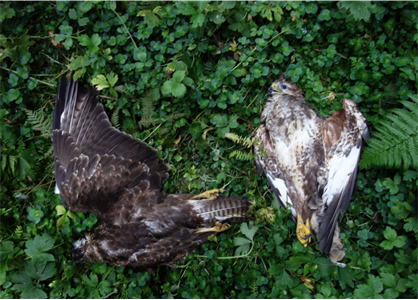
It follows an incident last year when two common buzzards were found dead in Teesdale woodland. Forensic tests indicate they were illegally poisoned with a banned pesticide.

[Two poisoned buzzards. Photo by RSPB]

After gathering all the information, the team searched the properties for any harmful substances and two men are now helping officers with their enquiries.

PC David Williamson, who led the operation, said: “We will always do everything we can to support our rural communities and work with partners to act on information received about alleged criminal activity.

“The positive action taken this morning will continue and I would encourage anyone with information about this type of crime to get in touch.”  

[Genuine & credible partnership working. Photo from Durham Constabulary]

The action was part of the Health and Safety Executive’s Wildlife Incident Investigation Scheme which was makes enquiries into the death or illness of wildlife, pets and beneficial invertebrates that may have resulted from pesticide poisoning. 

Guy Shorrock, senior investigating officer for the RSPB, provided specialist advice on the subject.

He said: “The illegal killing of birds of prey is a serious national problem so we are delighted with the really well-prepared response from Durham Police, working with partner agencies.

“We hope this sends a clear message that the illegal killing of birds of prey won’t be tolerated and action will be taken.”

Ian Guildford, investigative support officer for the National Wildlife Crime Unit added: “It was a very well organised response and great to see agencies coming together to tackle this type of issue.”

If you have any information call 101 or email PC Williamson at david.williamson@durham.police.uk

ENDS

This is brilliant and follows in the footsteps of three other recent multi-agency raids in response to raptor persecution crimes.

On 15th March 2021 there was a raid in Lincolnshire (see here), on 18th March a raid in Dorset (here), on 26th March a raid in Devon (see here) and now this raid in Teesdale.

It’s alarming that all four raids were triggered by the use of banned poisons to kill birds of prey and it’s also quite telling that these offences took place in counties spread across England. This is not a small, localised issue as the shooting industry would have us believe – this is widespread criminality and involves the use of banned poisons that have the capacity to kill anything that touches it, including humans.

Well done to all the partners involved – this is genuine and credible partnership working. Let’s hope their efforts are rewarded with successful prosecutions and convictions.

Landowners appear to launch damage limitation exercise as police investigate raptor persecution in Aberdeenshire

Today, in response to media enquiries, Police Scotland confirmed that a criminal investigation was underway after the discovery of a dead bird of prey found in Aberdeenshire last month.

The details of the alleged crime, including the species of raptor, the cause of death and the actual location have not yet been revealed but I think it’s fair to assume this is going to be a big story, potentially involving a member estate of Scottish Land & Estates (SLE), the landowners’ lobby group.

What makes me think that? The response from Scottish Land & Estates, who posted this on their website today:

Grouse shooting featured at political hustings on animal welfare in Scotland

Last Thursday (15th April 2021), Scottish animal welfare charity OneKind hosted a political hustings to allow the public to quiz candidates from the five main political parties on their animal welfare policies ahead of the election on 6th May.

The hustings was organised by More for Scotland’s Animals (MFSA), a coalition of 11 leading animal welfare organisations (see here).

The MSP candidates were:

  • Maurice Golden (Scottish Conservative and Unionist Party)
  • Alison Johnstone (Scottish Green Party)
  • Ben Macpherson (SNP)
  • Molly Nolan (Scottish Liberal Democrats)
  • Colin Smyth (Scottish Labour)

I watched this hustings event and it was incredibly popular, with over 60 questions put forward for the candidates on a range of issues such as snaring, grouse shooting, fox hunting and greyhound racing but there simply wasn’t enough time for all the questions to be asked and answered.

I understand that OneKind is currently seeking permissions for a recording of the event to be posted online but in the meantime, journalist Mark Smith wrote an opinion piece for The Herald yesterday, focusing largely on the issue of grouse shooting. Mark’s opinions are his, of course, but where he reports on who said what, I think it’s an accurate account.

It is reproduced below:

IF you haven’t yet decided who to vote for, perhaps I can be of some assistance. Late last week, I put the same single question to five different politicians, one from each of the five main parties, and maybe their answers can tell us a little bit about the problems of modern Scottish politics. You can see familiar patterns at play in what they say – some new, some extremely old – and for voters trying to make up their minds, it’s very frustrating indeed.

What happened was that the charity OneKind asked the politicians along to an online hustings event to discuss the main issues around animal welfare and I took the opportunity to ask them about an issue I’ve written about many times: grouse shooting. My question was: do the candidates think there is a place for driven grouse shooting in Scotland or should it be banned? I was curious to see how far the parties would be willing to go.

Their answers were interesting, and in some cases passionate, but they also revealed something of the dilemmas that Scottish voters face, not only if they care about animal welfare but also if they care about the constitution. What if you’re a Scot who wants reform on animal welfare and other important issues – drugs, criminal justice, schools – but you’re also worried that voting for the SNP and the Greens (who have some good policies on these issues) could break up the UK? And what on earth are you to do if you’re concerned about independence but also not inclined to support the Conservatives? It’s not easy.

Alison Johnstone, the Green MSP, is a good example. She is a superb campaigner on animal welfare – informed, passionate, and committed – and her answers on driven grouse shooting were impressive. Her party, she said, want a complete ban on the practice, not only because there’s no justification for animals being killed for pleasure, but also because driven grouse shooting is an unproductive and inefficient way to use land. “We also see stink pits, snares and poor practice on every level,” she said. “I cannot wait to ban it.”

I have to say: I agree with every word Ms Johnstone says, having spoken to lots of people on every side of the argument over the years – gamekeepers, campaigners, police, lawyers, etc – and in any normal situation, she’d have my vote. The problem is that, for many people, the Greens’ policies – and there’s a lot to like in their manifesto – are tainted by the party’s stance on the constitution, meaning I could vote for animal welfare and end up with independence. Are there any unionists in the Scottish Greens, I wonder? And if so, how do they feel? If you’re out there, email me.

The other problem, obviously, is that the Greens are in bed with the SNP – all tucked up, nice ’n’ cosy – and this makes me doubt that anything significant will be done on animal welfare. The SNP representative at the hustings was the MSP Ben Macpherson who seems like a nice enough guy, but he’s saddled with defending what his party hasn’t done. In many ways, the SNP behave like a party in opposition, but Mr Macpherson also has to deal with the age-old problem of ruling parties during elections. They need to promise things are going to change (but not promise too hard in case they actually have to do it) but they also need to explain why they haven’t changed things already.

In the case of Mr Macpherson, this led to a lot of wibbly-wobbly government speak. On fox hunting, for example, the SNP “remain committed to closing the loopholes”. On cruelty to greyhounds, “we need to look at it very seriously”. On snares, “we accept the need for greater regulation”. And, sadly, there was the same lack of urgency on driven grouse shooting; Mr Macpherson said his party “remain committed” to bringing in a licensing system.

In any normal world, the SNP would be punished for all of this, for its lack of progress on important issues people care about – but Scottish politics is not a normal world. Alison Johnstone belongs to a party that has genuinely radical and transformative polices and Ben Macpherson belongs to a party that’s pretty much shagged-out on policy after 14 years in power, and yet neither party will be judged on any of that. They are the parties of Scottish independence and it means their promises on policy, and their delivery on those promises, doesn’t matter very much. How on earth did we get here?

The primacy of independence has also meant the banishment of the Lib-Dems and Labour to the outer reaches of Scottish politics, which is a pity. The Lib-Dems were represented at the hustings by Molly Nolan, the party’s candidate for Caithness, Sutherland and Ross, and she had some sensible stuff to say about how animal welfare can be improved, such as giving wildlife police officers the resources they need. She also pointed out that any licensing system for driven grouse shooting needs to be robust; there’s no point in introducing licences and then carrying on as normal.

But by far the most impressive performer was Labour’s Colin Smyth whose concern for animal welfare clearly comes from a genuine place. The legislation on fox hunting, he said, was “unfinished business” and, as for driven grouse shooting, he said the current situation was unsustainable and a licensing system was not good enough. I don’t know much about Mr Smyth – and it’s obviously easier to promise things when you’re a long way off from having to deliver them – but listening to his old-school campaigning politics, passionately delivered, was refreshing and pretty inspiring I have to say.

I wish I could say the same for the Tories. Their representative, the MSP Maurice Golden, said he wanted new legislation on pets, but he also said snares were “necessary land-management tools”. He said the laws on fox hunting don’t need changing. And as for my question about driven grouse moors, Mr Golden said the industry improves bio-diversity and is a “fulcrum for jobs”. His answers were deeply disappointing.

But maybe we shouldn’t be surprised by any of this: Tories defending vested interests and governments defending a lack of action. What makes it different, though, is that many Scottish voters will be guided by other factors. Some people who care about animal welfare will vote Tory and some people who think the nationalists have done poorly in government will vote SNP. That’s where we are now. It’s disappointing. It’s distorting. And it’s exhausting. One day, maybe, politics in Scotland will go back to normal.

ENDS

UPDATE 24th April 2021: Political hustings on animal welfare in Scotland now available to view (here)