Rare breeding success for sea eagles in Cairngorms National Park but outlook for chick is bleak

The Cairngorms National Park Authority has issued the following press release today (6th July 2021). My commentary on this news is below the press release:

Raptor breeding successes for East Cairngorms Moorland Partnership

The productivity of breeding raptors in the east of the Cairngorms National Park this season is encouraging and includes the hatching of a sea eagle chick on Balmoral, the first time that the species has successfully bred on the estate.

The breeding pair of sea eagles – also known as white-tailed eagles – have been observed on Balmoral for the last few years. Both adult birds carry satellite tags and close collaboration with the Royal Society for the Protection of Birds (RSPB) has allowed the Balmoral Ranger Service to follow their weekly movements during the breeding season. A healthy male chick has now hatched and been ringed. Three golden eagle chicks have also recently been ringed as part of long-term monitoring on Balmoral.

Balmoral Estate is a member of the East Cairngorms Moorland Partnership (ECMP) which has seen breeding success for golden eagles, hen harriers, red kite, osprey, peregrine and merlin, as well as short-eared owls, in 2021, across the various land holdings.

[The young white-tailed eagle chick on the nest at Balmoral. Photo by North East Scotland Raptor Study Group, a member of the Scottish Raptor Study Group]

Richard Gledson, Estate Manager at Balmoral Estate said: “All at Balmoral Estate are delighted that sea eagles have nested successfully for the first time. A previous nesting attempt in 2017 on the same site sadly failed and we have had our fingers crossed since then. The birds have been with us for a couple of years, and we have been working closely with the North East Scotland Raptor Study Group who ringed the chick last week and with the RSPB who have been sending data from their satellite tags.”

Glenavon Estate – which is home to three pairs of golden eagles, including one of the highest nesting sites in Scotland – has had a golden eagle chick satellite tagged for the first time in recent years. Satellite tags are used by biological researchers on a variety of species including eagles and harriers, and provide valuable insight into their movement and survival. Golden eagle chicks have also been tagged on the Glenlivet Estate and Mar Lodge Estate.

Furthermore, Mar Lodge has hosted six hen harrier nests in 2021. One pair failed early in the season, but the other five nests all have chicks. Two hen harrier chicks have been satellite-tagged in collaboration with the RSPB. Evidence from satellite tags fitted to some of the harriers which are now breeding shows that the birds range widely, foraging across ground on neighbouring ECMP estates.

Last year, Mar Estate witnessed the first successful breeding attempt of sea eagles in Deeside for 200 years, but the relatively inexperienced pair failed this season at the hatching stage, with poor weather likely a contributing factor, however hopes are high for success with continued breeding efforts next season and beyond.

Dr Ewan Weston of the North East Scotland Raptor Study Group, who has carried out much of the satellite tagging on ECMP estates, commented: “This year’s raptor tagging on ECMP estates builds on a positive collaboration with the estates over recent years. Despite a very wet, snowy May, the general picture in the area is that raptors, particularly golden eagles, red kites and hen harriers have done well.”

The East Cairngorms Moorland Partnership is a landscape-scale collaboration between five sporting estates and the Cairngorms National Park Authority. The partnership seeks to deliver private interests alongside public benefits, including improving the conservation status of raptors, demonstrating best practice muirburn management, expanding areas of woodland and scrub and peatland restoration. Partners have been collaborating with a wide range of ecologists in the National Park.

Xander McDade, Convenor at the Cairngorms National Park Authority, said: “We are delighted to hear that productivity of raptors in the east of the National Park looks good for 2021. However, we know that we can still do more for the birds and are committed to finding ways of improving the conservation status of moorland raptors, along with other red and amber moorland bird species. This includes working closely with the five estates that make up the ECMP on a range of conservation measures.”

ENDS

First of all, the breeding success of this pair of white-tailed eagles on Balmoral Estate is obviously very good news and long, long over due.

Norway donated 85 sea eagles for a reintroduction project in eastern Scotland between 2007-2012, although over a quarter of those didn’t survive (the main known causes of death included illegal poisoning, illegally shot, accidentally electrocuted and being hit by trains). The East Coast reintroduction was the third phase of a national reintroduction project that started back in 1975 on the west coast of Scotland, after the species was extirpated from Britain thanks to persecution in the late 1800s and early 1900s.

The first successful breeding attempt in east Scotland in 2013, the first for over a century, was an historic milestone in the project and was hoped to be the beginning of a new and vibrant population in the east, mirroring the successful population growth in the west.

So far though, progress has been incredibly slow and ongoing persecution has been at the centre of that (e.g. see here for the news that a sea eagle’s nest tree was deliberately felled on a grouse moor in the Angus Glens, also in 2013-nobody was prosecuted).

A number of young satellite-tagged sea eagles have ‘disappeared’ in suspicious circumstances on or next to grouse moors since then, and only last year a young sea eagle was found dead, illegally poisoned, on another grouse moor inside the Cairngorms National Park (see here). Nobody was prosecuted for that crime.

[A police officer examines the corpse of the illegally poisoned sea eagle found dead on a grouse moor in the Cairngorms National Park in 2020. Photo by Police Scotland].

So yes, it’s excellent news that Balmoral Estate has hosted a successful breeding attempt this year – well done to the team there – but it’s only half of the story. What happens when that young eagle fledges and disperses from Balmoral later this year?

Will it meet the same fate as this young golden eagle, which fledged from a nest site in the eastern Cairngorms last year and was found dead, ‘deliberately poisoned’ on a grouse moor on Invercauld Estate earlier this year?

[An illegally poisoned golden eagle, laying next to a poisoned mountain hare bait, found dead on a grouse moor in the Cairngorms National Park in 2021. Photo by RSPB Scotland]

I can see why the Cairngorms National Park Authority would want to issue this press release – not just to deservedly celebrate the successful breeding attempt on Balmoral Estate but probably more cynically, to try and undo some of the reputational damage that has been caused to the Park Authority and to its Eastern Cairngorms Moorland Partnership (ECMP) after the discovery of the poisoned golden eagle earlier this year on one of the ECMP’s partner estates (now no longer a partner) and the deserved criticism that the Park Authority has received for refusing to publish the correspondence it had had with the ECMP about the future of Invercauld Estate as a member of the ECMP following the discovery of the poisoned eagle (see here). This is the same tactic the Park Authority employed a few years ago when illegally-set traps were found on Invercauld Estate (here).

The ECMP can thank its lucky stars that one of its (now five) member estates is Mar Lodge, owned by the National Trust for Scotland, and with a glowing reputation for raptor conservation, especially for breeding hen harriers. Without Mar Lodge’s efforts, the ECMP’s raptor conservation efforts would be looking pretty feeble to date.

Although I noted the irony of the statement in the Park Authority’s press release that, ‘Evidence from satellite tags fitted to some of the harriers which are now breeding shows that the birds range widely, foraging across ground on neighbouring ECMP estates‘.

Er, yeah, but they forgot to mention how many of those hen harriers subsequently ‘disappear’ in suspicious circumstances on grouse moors in the ECMP and beyond (e.g. see here).

It doesn’t matter how far the Park Authority tries to spin the very welcome but too infrequent ‘good news’ stories like the breeding white-tailed eagles on Balmoral – the bottom line remains that large areas of the Cairngorms National Park are still raptor persecution hotspots and until that changes, the outlook for this young sea eagle is bleak.
The very strange world of a shooting fantasist – an update from Wild Justice

On 28th May 2021 campaign group Wild Justice published a blog about what it considered to be alleged breaches of the English General Licences, based on an article that was published in the Shooting Times in February 2021, where a bloke claimed to have gone out with his gun apparently to see whether he could shoot/kill ten species in ten hours.

A few days after publication, Wild Justice took down its blog post, temporarily.

Today, the blog post has been re-posted, in its original format – see here.

Two further blog posts on this matter have also been published by Wild Justice today, providing the reader with some updates, and these should be read in conjunction with the first blog. These two additional blogs are titled:

The Shooting Times and the General Licences (here)

and

A letter to the Shooting Times (here)

Here is a picture of a freezer. If you’ve read Wild Justice’s three blog posts on this matter you’ll understand the context. If you’ve been around on this blog for long enough, and read some of the far-fetched allegations made over the years about me and my colleagues supposedly perverting the course of justice by planting evidence to frame law-abiding shooting estates, you’ll probably also appreciate and enjoy the supreme irony. I know I am!

BrewDog buys Scottish grouse moor for rewilding & ecotourism

Earlier this year the Aberdeenshire brewery and pub chain BrewDog bought the Kinrara Estate on Speyside for an estimated £7.5M and announced some pretty grand plans to take this former grouse moor and pheasant shoot and transform it as part of the ‘single biggest native woodland establishment and peatland restoration project ever carried out in the UK‘.

BrewDog’s purchase is apparently motivated by ‘becoming the world’s first carbon negative beer business‘ with a claim that, ‘as well as over £50m of investments in reducing our environmental impact, we are also removing twice as much carbon as we emit every year, forever‘.

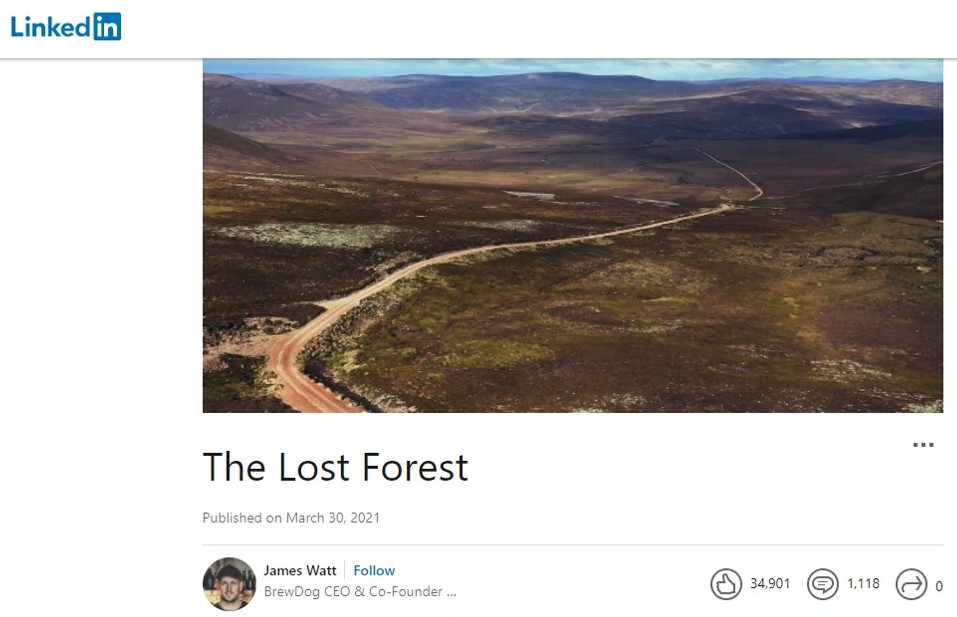
You can read BrewDog founder and CEO James Watt’s announcement, made in March 2021 on LinkedIn, here. Judging by the accompanying photograph, it’s not hard to see why they’ve called this The Lost Forest project:

The Kinrara Estate was being sold via estate agents Galbraith and it was promoted as having ‘considerable afforestation and potentially valuable carbon capture opportunity‘ and ‘great conservation potential‘ (see here).

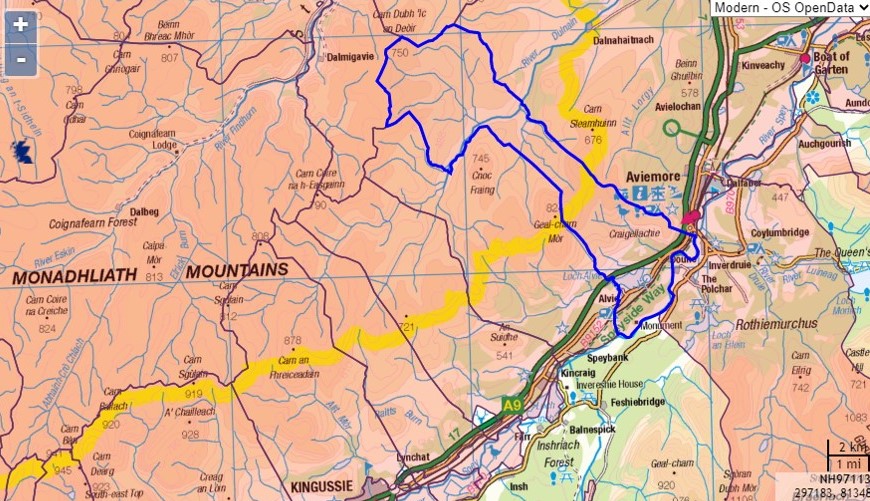
Here’s a map from Andy Wightman’s Who Owns Scotland website showing the estimated estate boundary (in blue, from 2002 data), with the southern part of the estate lying within the Cairngorms National Park close to Aviemore [Park boundary is in yellow] and the northern part extending into the Monadhliath Mountains.

Last week, the grouse shooting industry finally caught up with BrewDog’s progressive plans and guess what, it didn’t like them.

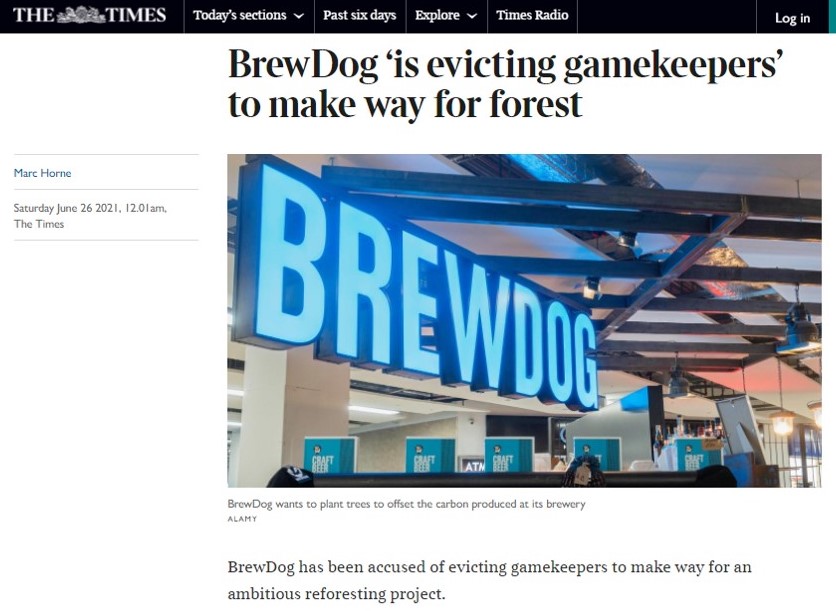
Right on cue, the hysteria button was pressed and social media has been rife with calls for a BrewDog boycott, personal abuse of its founders and a scaremongering headline in The Times that looked like this:

Unsurprisingly, the headline didn’t reflect the fact that as well as a significant ecological restoration programme on this former shooting estate, BrewDog intends to create many, many more jobs at the Lost Forest by creating ‘a hotel built from sustainable cabins, a campsite, a distillery, hiking and biking trails as well as kayaking on our beautiful loch’.

According to CEO James Watt’s LinkedIn article, ‘We want the Lost Forest to enable people to reconnect with nature and by doing so become far more cognisant of the impact that we, as humans, are having on our planet‘.

Who knows, maybe the two gamekeepers reportedly made redundant since the land purchase at Kinrara will find alternative employment opportunities at the Lost Forest that don’t involve shooting animals as a recreational ‘sport’. The world is moving on and grouse shooting is heading for the history books; even some industry supporters recognise this, as demonstrated by this fascinating recent article on the ShootingUK website.

For those more interested in conservation than amateur dramatics, you’ll probably be interested in having a look at the details of BrewDog’s ecological proposals for Kinrara. BrewDog has hired Scottish Woodlands Ltd as its forestry management company and as well as ecological surveys, a public consultation on the plans is also currently underway.

The following document forms part of that public consultation and the details show an impressive approach to sensitive restoration plans:

Poisoned golden eagle: Cairngorms National Park Authority refuses to publish correspondence with Invercauld Estate

In March this year, a golden eagle was found dead, next to a poisoned hare bait, on a grouse moor on Invercauld Estate in the Cairngorms National Park.

Toxicology results showed the eagle had been illegally poisoned with a banned pesticide. Police Scotland conducted a multi-agency search, under warrant, of various properties on Invercauld Estate in May 2021 (here) and issued an appeal for information on what they described as a ‘deliberate’ poisoning (here).

The Cairngorms National Park Authority issued a statement condemning the deliberate poisoning (here).

Invercauld Estate also issued a statement, supporting the police investigation and denying that the deliberately poisoned eagle was found on land managed for grouse shooting – even though, er, it seems that it was (see here and here).

[The deliberately poisoned golden eagle, next to the poisoned hare bait, on a grouse moor on Invercauld Estate, March 2021. Photo by RSPB Scotland]

The following week, the Cairngorms National Park Authority published a further statement, this time on behalf of the East Cairngorms Moorland Partnership (ECMP), a consortium of six estates, including Invercauld, supposedly working in partnership with the Park Authority since 2015 to deliver ‘coordinated and sustainable moorland management’.

The statement from ECMP (read in full here) confirmed that Invercauld Estate ‘had left the group‘. There was no indication whether Invercauld had been expelled or had resigned of its own accord or what process, if any, had been undertaken to reach a decision.

So I submitted an FoI to the Cairngorms National Park Authority to try and find out.

Here’s part of the response I received:

This response came as no surprise to me because the Cairngorms National Park Authority has form for covering up the consequences of alleged criminal behaviour on Invercauld Estate – e.g. see here, here and here. The Park’s Board also has a number of members with a clear association with Invercauld Estate – whether this had any bearing on the Park’s decision about what to release and what not to release can only be open to speculation, obviously, because the information is being withheld. Again.

Still, as long it’s being withheld to allow Police Scotland to ‘complete their investigation’, which of course the CNPA will know (or at least can predict) to be going absolutely nowhere, just like the other ~80+ raptor persecution crimes uncovered in the Cairngorms National Park since 2003 that, with a single exception, haven’t resulted in a prosecution.

Part of the material that the CNPA did release suggests that Invercauld Estate resigned and wasn’t pushed (see below) although without seeing the full correspondence between the estate and the CNPA I’d be wary of drawing any conclusion because it just doesn’t add up, given Invercauld’s protestations when the news first broke that this eagle had been found poisoned on that estate.

This is a copy of an email sent from the CNPA’s Chief Executive, Grant Moir, to the Board. It’s a bit difficult to read with such a tiny font so it’s transcribed below:

Dear Board Member

The East Cairngorms Moorland Partnership will shortly be putting out the attached statement following a meeting of the partnership yesterday. At the meeting the partnership heard from Invercauld estate and Invercauld estate tendered their resignation from the partnership. After a good discussion the partners agreed to the resignation and have all agreed to the wording of the attached statement. It was also clear from the meeting that the remaining members are determined to make the partnership work.

NatureScot have also released a statement today which indicates they are looking at general licence restrictions for Invercauld Estate.

Throughout I have been keeping the Convenor of the Board up to speed on the issues and I will update the board further on Friday if there is any further information.

All the best

Grant

Grant Moir, Chief Executive, Cairngorms National Park Authority

So what of the Police’s ongoing investigation in to this deliberately poisoned golden eagle? No further news (but I trust they’ll be asking the CNPA for copies of the unpublished correspondence between Invercauld and the Park Authority because apparently it’s relevant to the police investigation).

Will NatureScot decide to impose a General Licence restriction on Invercauld Estate? No news.

What of the future of the East Cairngorms Moorland Partnership? A recent blog addressing this very issue from Nick Kempe writing for ParkswatchScotland is well worth a read (here).

And what of the Scottish Government’s promise to get to work on drafting the terms and conditions of a grouse shooting licensing scheme, whereby estates can lose their licence if raptor persecution crimes continue? No further news.

23 more white-tailed eagles donated by Norway for release in Ireland

Phase two of the reintroduction of white-tailed eagles in the Irish Republic continued last week with the arrival of 23 young eaglets from Norway.

These young birds, collected under licence by the Norwegian Institute for Nature Research, arrived at Kerry Airport on a chartered flight on Friday and they’ll be looked after in specially-made flight pens until their release in to the wild in August.

After being driven to extinction in Ireland in the early 20th century, an ambitious reintroduction project began in 2007 as a collaborative effort between the National Parks and Wildlife Service in Ireland, Norwegian Institute for Nature Research in Norway, the Golden Eagle Trust in Ireland and a lot of volunteer farmers and supporters on the ground.

[Project Manager Dr Allan Mee with a young white-tailed eagle during phase one of the reintroduction]

100 young white-tailed eagles were released in the Killarney National Park during phase one between 2007 and 2011 and this has resulted in at least ten breeding pairs becoming established in Kerry, Galway, Clare, Tipperary and Cork producing at least 30 chicks between them.

However, a recent scientific review of the reintroduction project indicated the small population is still vulnerable to factors such as illegal poisoning and the breeding population was negatively impacted by Avian Influenza in 2018 and storm Hannah in 2019.

A decision was made to conduct supplementary releases over a period of three years to bolster the existing population. Ten eagles were reintroduced last year (see here), this latest batch of 23 new arrivals will be released this year and more are expected to be released next year.

It’s an interesting time for this species. With the on-going reintroduction project on the Isle of Wight attracting widespread support and interest, an apparent green-light to begin a reintroduction in Norfolk met with mixed support and antipathy, a lot of interest in a proposed reintroduction to Wales, on-going persecution issues in eastern Scotland and general hysteria generated by the National Farmers Union Scotland, the Scottish Gamekeepers Association and parts of the media about the perceived damage supposedly being caused by sea eagles in parts of western Scotland (more on that topic soon), it’s not clear to me how the white-tailed eagle will fare over the coming years.

If it’s still not even safe for one to fly over the Cairngorms National Park without becoming victim to a poisoned bait (e.g. see here) then we have to recognise there is still much work to do.

Spanish farmer fined & jailed for poisoning vultures

Once again, a Spanish court has imposed a significant penalty on an individual found guilty of deliberately poisoning birds of prey, according to an article on the Vulture Conservation Foundation website.

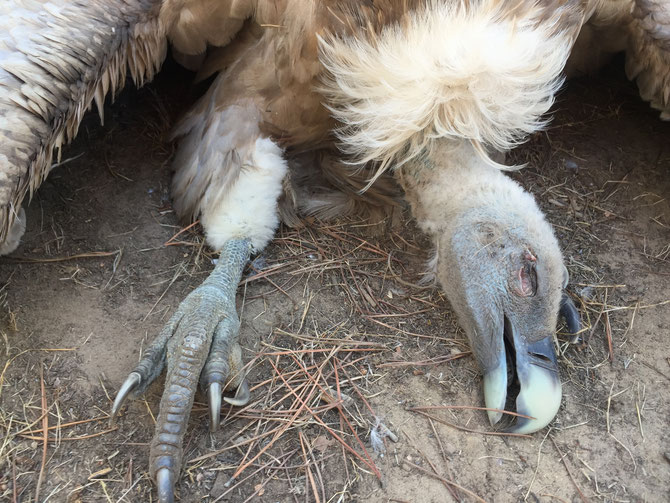
The article (here) says that in spring 2019 three dead griffon vultures were found on a sheep farm in the province of Cáceres. An investigation led to the discovery of dead sheep that had been sprayed with poisonous insecticide which the judge decided had been deliberately placed to poison the vultures.

 [One of the poisoned griffon vultures. Photo by Jovan Andevski]

Reporting this week, the Vulture Conservation Foundation states that the court sentenced the sheep farmer to 18 months in prison and ordered him to pay a daily fine of €3 for 21 months (totalling approximately €1,900) and a further fine of €18,000 to be paid to the General Directorate of Rural Environment of the Junta de Extremadura to compensate for each poisoned vulture (€6,000 per vulture).

An almost €20,000 fine and an 18-month custodial sentence is a significant penalty for raptor poisoning, and far, far more significant than anything we’ve ever seen in the UK, although with increased penalties now available in Scotland for this type of offence there is at least some potential for a strong response from the Scottish courts, as we’ve seen time and time again from the Spanish courts (e.g. see here, here, here, here, here and here) including massive fines, custodial sentences and extended hunting disqualifications.

Although the availability of strong penalties will be no deterrent if the chance of catching an offender is still marginal, which I’m afraid it is in the UK, and the raptor killers know this only too well. Spain has worked to overcome these difficulties by the use of specialist wildlife crime officers with the freedom to undertake unannounced spot checks on private land, with specialist search dogs, at any given time.

Can you imagine this happening on a grouse moor, with strong links to the royal family, inside the Cairngorms National Park? No, me neither, and this is what happens as a result.

Job vacancy – Wildlife crime campaigner/campaign manager

UK charity the Naturewatch Foundation is advertising for a wildlife crime campaigner / campaign manager, as follows:

Full-time or part-time permanent position.

Salary: Circa £27k per annum pro rata – depending on experience 

Location: Flexible – office in Cheltenham but can be largely remote working

Closing date: Monday 19th July 2021

Job Description

An exciting opportunity has arisen at Naturewatch Foundation to lead and shape compelling campaigns utilising a full range of communication channels and campaigning techniques.  

Will suit a confident, motivated and ambitious individual with a proven track record for delivering effective campaigns, ideally within the animal welfare sphere.

You will have proven experience of using policy, research, lobbying, public campaigning and media to influence the public, government and industry. 

Essential:

  • Some experience in campaigning, lobbying and project managing
  • Good communication skills – able to comfortably liaise with a wide range of people from supporters, journalists, to government officials
  • Working knowledge of campaigning tools as you will work with the Communications Coordinator and Marketing and Website Coordinator to create engaging content
  • Excellent written and verbal communication skills with experience in tailoring messages for different audiences
  • Experience in researching and writing evidence-based reports
  • Work with, and mentor, Campaigns Assistant to help shape your campaign projects
  • Ready to handle sensitive, sometimes distressing information regarding animal welfare
  • Ability to plan, prioritise, work under pressure and to deadlines
  • Willing and able to manage volunteers to help support you in your role from time to time
  • Hard working, motivated and with a can-do attitude
  • Happy to travel to office in central Cheltenham (frequency negotiable), plus willingness to attend meetings and presentations elsewhere as necessary
  • Sound knowledge of Microsoft Office applications
  • Commitment to the objectives of the charity

Desirable:

  • Knowledge of wildlife issues and enthusiasm for improving their lives
  • ​Fundraising experience

Apply:

Please send your CV, accompanied by a covering letter detailing relevant experience and skills, and stating why you want the position to: sarah@naturewatch.org

ENDS

Shot peregrine successfully rehabbed and released back to wild

In May this year an eight-year-old female peregrine was found injured in the grounds of Selby Abbey suffering from being shot with a shotgun (see here).

North Yorkshire Police appealed for information and the peregrine was treated by specialist vets at Battle Flatts before being taken in to the expert care of the remarkable Jean Thorpe at Ryedale Wildlife Rescue.

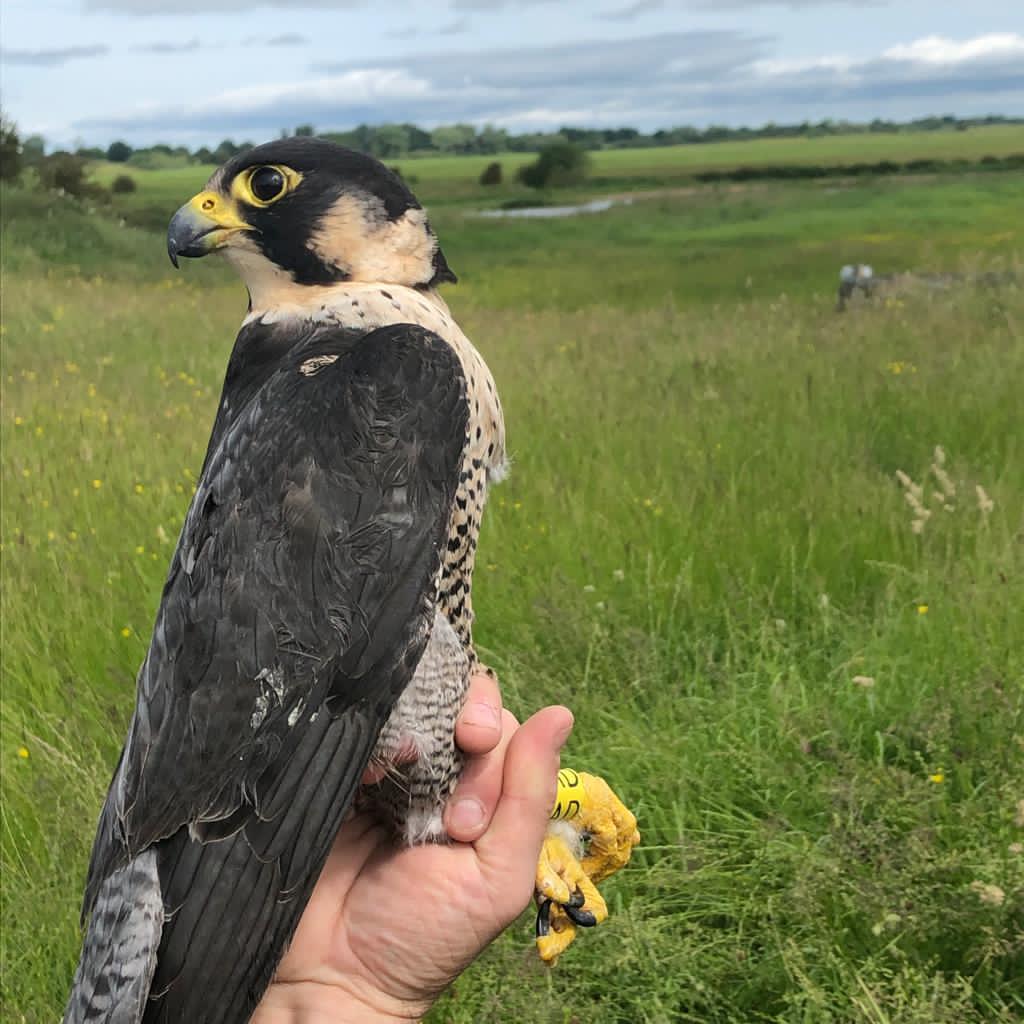
One month on, the peregrine has recovered and has been successfully released back in to the wild at the Lower Derwent Valley National Nature Reserve:

Massive kudos and thanks to Jean and to the vets at Battle Flatts who are dealing with these victims time and time again. Some of the birds’ injuries are too severe for any hope of recovery but every now and then this dedicated team gets a win, like this one. All credit to them.

North Yorkshire Police are still investigating the circumstances of this latest crime (injured peregrine found 7th May 2021). If you have any information about this incident please call North Yorkshire Police on 101 quoting ref: 12210119786, or if you wish to remain anonymous please call Crimestoppers on 0800 555 111.

Podcast: Interview with Police Scotland’s National Wildlife Crime Coordinator

Police Scotland has come a long way in recent years on how it tackles wildlife crime, and especially the seven national wildlife crime priorities, which of course includes raptor persecution.

The seven current national priorities are:

Badger persecution

Bat persecution

Raptor persecution

Convention on International Trade of Endangered Species (CITES)

Freshwater pearl mussels

Poaching (deer & fish) and hare coursing

Cyber-enabled wildlife crime

There are still some problems in some aspects of wildlife crime policing but there have been huge improvements in many areas since the publication of two damning Natural Justice reports in 2015 by Scottish Environment LINK (see here and here) and there are now some very determined and proactive officers in post.

One of those is Detective Sergeant William (Billy) Telford, Police Scotland’s National Wildlife Crime Coordinator. He was recently interviewed by Lisa Marley (who produced the award-winning documentary about the mass poisoning of 22 red kites & buzzards on the Black Isle in 2014) discussing Police Scotland’s Operation Wingspan, a year-long campaign to raise awareness about wildlife crime.

The hour-long podcast is hosted by Lisa as part of her series ‘Crimes Against Nature’ and you can listen to it here.

The conversation covers the national wildlife crime priorities and specifically on raptor persecution it includes a discussion about the on-going challenges faced by the police in securing sufficient evidence for a prosecution, alternative enforcement measures when a prosecution isn’t possible (e.g. working with NatureScot to impose General Licence restrictions), and new enforcement opportunities made available with the new increased penalties for certain offences (e.g. covert surveillance on private estates now being an option as some raptor persecution offences are now considered ‘serious’, as reflected by the new sentencing tariffs, thus allowing police officers to seek permission for covert surveillance where previously it was ruled inadmissible).

This podcast is well worth a listen.

Peregrine nest raided in Peak District National Park

Press release from Derbyshire Wildlife Trust (21 June 2021)

Peregrine nest raided in Upper Derwent Valley, Peak District

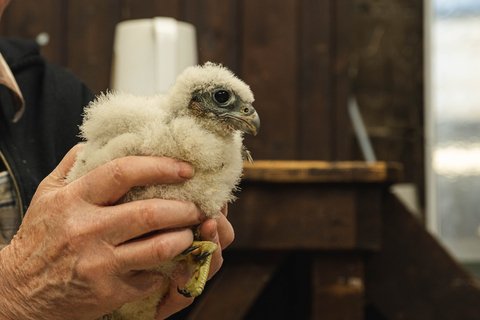
A nest with 3 young peregrines in it has been robbed in a remote part of the Peak District National Park on land owned by the Forestry Commission.

This is despite efforts by a number of organisations to step up their protection efforts at Peregrine nesting sites at risk across the Peak District this Spring.

Peregrines, along with their eggs and nests, are legally protected under the Wildlife & Countryside Act 1981. It is a criminal offence to intentionally or recklessly kill, injure or take a peregrine.

Derbyshire Rural Crime Team are investigating this crime and are appealing to anyone who has any information to contact them on 101 or to use Crimestoppers.

[Photo from Derbyshire Wildlife Trust]

Derbyshire Wildlife Trust and partners are shocked that one of our most iconic birds are still being targeted in this way by wildlife criminals.

Peregrines are an iconic part of the Peak District’s natural heritage and the theft of young peregrines jeopardises the recovery of this much persecuted species.

Tim Birch at Derbyshire Wildlife Trust said: “It is very sad that a peregrine nest with 3 young peregrines have been robbed. We all lose when this happens. Thousands of people visit the Peak District National Park every year to walk in stunning scenery and have the opportunity to watch these magnificent birds in the wild. Robbing this nest deprives people from being able to have the chance to see such a wonderful bird. We need to see tougher sentences that reflect the seriousness of this crime and to act as a deterrent.”

Mark Thomas, RSPB Head of Investigations UK, said: “Scientific data and crime reports show that raptor persecution is endemic in the Peak District National Park, particularly impacting iconic species like peregrine and goshawk: this is despite both the species and landscape having the fullest legal protection in the UK. These crimes have been statistically linked to land managed for driven grouse shooting. Furthermore, the site in question has suffered repeat incidents of raptor persecution on many previous occasions and only recently an adult peregrine was found poisoned close by. More has to be done as it is clear the initiatives in place are failing.”

Shona Morton, Planning and Environment Manager for the Forestry Commission said: “Forestry England’s woods are home to a wealth of important birdlife, including many birds of prey. Our ecologists and operational teams work hard to create and restore wildlife habitats and ensure birds nesting on our land are safeguarded during forestry activities. We are very upset to learn that this Peregrine pair have been robbed of their young on our land. We work closely with local volunteer groups and conservationists to locate new nests each year and monitor breeding success- crimes like this undermine everything we’re trying to achieve together. Sadly the Peak District remains a hot spot for raptor persecution and we would encourage anyone who sees suspicious activity on the public forest estate to alert us and contact the police. We will be collaborating with the police and our partners to identify and prosecute those responsible. We will continue our work with partners and neighbouring landowners to ensure birds of prey like Peregrines, Goshawk and Hen Harriers can regain their rightful place in the Peak District’s skies.”

The loss of these young birds is a huge blow to the work that is currently being undertaken to try and protect peregrines and ensure that they are allowed to prosper in the Peak District. In 2020 an adult male peregrine was found dead very close to the site that was recently robbed. Tests later proved that the bird had been poisoned. In 2019 young peregrines also disappeared from this site. Other nests are still being monitored across the Peak District at the moment to assess how Peregrines have fared this breeding season but numbers of breeding pairs in line with other years are far lower than expected from information already gathered.

 ENDS