
Earlier this month the Peak District Raptor Monitoring Group (PDMG) announced the suspicious disappearance of two male hen harriers, and the subsequent failure of two hen harrier nests each containing five eggs (see here).
[One of the abandoned hen harrier nests. Photo by PDRMG]

Both nests were situated on a grouse moor owned by the National Trust and leased to a tenant. The grouse moor isn’t currently being used for driven grouse shooting (the tenant is believed to be focusing his energy on another moor that he owns) but the nests were close to the National Trust’s boundary and the moor is adjacent to other, privately-owned and intensively managed driven grouse moors, many that have been at the centre of other raptor persecution investigations for a number of years in what is a well-known raptor persecution hotspot (e.g. see here).
The Peak District National Park Authority has issued a statement in response to this latest incident:
‘Responding to reports of the failure of two hen harrier nests following the disappearance of male hen harriers thought to be supporting the nests in the area, the Peak District National Park Authority said:
“We share the immense frustration and disappointment of the National Trust and all those involved in monitoring our birds of prey, that the opportunity for not one, but two potentially viable nests for the iconic hen harrier has been lost again in the Peak District this year. This is a species which is emblematic of our uplands and where their haunting and often enigmatic presence should be welcomed.
“The fact that successful nesting attempts for the hen harrier in the Peak District remains firmly in single figures across almost two decades, demonstrates the significant challenge that remains for all those working to see their return in a long-term and sustainable way – addressing both conservation needs and the potential impact of wildlife crime.
“We understand a police investigation is ongoing into the matter and stand ready to provide any support to this”‘.
The National Trust has a new General Manager in the Peak District, Craig Best, and his reaction to the suspicious disappearances of the two harriers was as follows:
“It’s deeply concerning to learn of the disappearance of two male hen harriers from the High Peak and subsequent abandoning of nests by the females. While the circumstances around this incident are not yet clear, it is indefensible that these beautiful birds still face persecution. The incident has been reported to the police and we’re working closely with statutory agencies and the RSPB to find out what happened.
We want to see a landscape that is full of wildlife, including birds of prey, and we work hard with a range of expert partners to create the right conditions for these species to thrive. Over the past few years we have seen several instances of successful hen harrier breeding in the Peak District“.
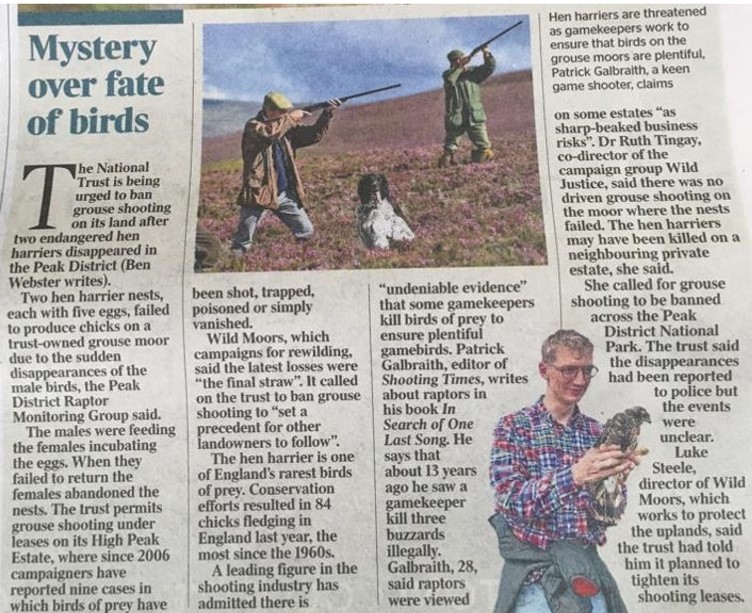
The disappearances attracted a lot of media attention, some of it accurate, some of it not so much, but it made local and national news and I was pleased to see that a couple of them had picked up on the fact that now 70 hen harriers are confirmed missing or illegally killed in the UK since 2018. Here’s some of the coverage in Sheffield Star, BBC News, and The Times, reproduced below:
There was also a feature on the BBC’s East Midlands Regional News, where BBC journalist Simon Hare interviewed Mike Price from the PDRMG – you can watch the video here:
The loss of two more hen harriers and their nests sparked a number of calls for the National Trust to ban driven grouse shooting on its land. I think that’s because many people assumed the harriers had been killed on the grouse moor where they were attempting to breed. The NT faced similar calls for a ban in 2016 when I posted footage of an armed gamekeeper who had been filmed crouching in the heather next to a decoy hen harrier on another NT-owned grouse moor in the Peak District National Park, presumably trying to entice a harrier to come in close so he could shoot it (see here).
That footage was so disturbing and the public reaction to it so strong, it prompted the National Trust to pull the shooting lease early and replace the shooting tenant with someone more conservation-focused, in what was a significant response at that time although some campaigners saw it as a lost opportunity to remove driven grouse shooting altogether (see here).
Since then, the NT has modified its tenancy agreements (e.g. see here), at least one new tenant has been and gone, and at least one current tenant is hosting a number of successfully breeding raptor species whilst moderately managing a driven grouse shoot (far less grouse shot last year compared to the thousands shot on some of the more intensively-managed moors). It has been reported recently that the NT has agreed to introduce even more modifications on its moors such as the removal of medicated grit, burning restrictions and the removal of traps and snares, although I haven’t yet seen a formal statement on this from the National Trust.
Some may argue that banning driven grouse shooting entirely from National Trust land is the only way forward, but some local raptor workers suggest the situation is a bit more nuanced than that and that just banning it on NT moors could actually lead to an increase in raptor persecution. They argue that as long as the NT has raptor-friendly shooting tenants, those tenants’ gamekeepers are acting as a sort of shield against gamekeepers from neighbouring, privately-owned estates from entering NT land and killing whatever they want. Of course, that doesn’t stop the raptors being killed if they fly from NT land on to neighbouring private estates to hunt, which is what many suspect has happened with these latest two ‘disappearances’.
It seems to me that the Peak District National Park Authority should be the organisation banning driven grouse shooting across the entire National Park. That would seem to be a far more effective prospect than a piecemeal approach by the National Trust, at least in terms of tackling the rampant raptor persecution taking place inside this National Park.
That’s not to say that the National Trust shouldn’t be banning driven grouse shooting, though. As we know, raptor persecution is only one of many environmentally-damaging issues associated with driven grouse shooting – burning, widespread and unregulated use of an environmentally toxic veterinary drug (medicated grit), and the lawful killing of thousands of native animals (e.g. foxes, stoats, weasels, corvids etc) to name just a few, all to create an artificial environment to maximise the production of red grouse for paying guests to shoot in the face for a bit of a laugh. That the NT still supports this management in what are supposed to be enlightened times, is quite remarkable.
However, if the National Trust has recently changed its policy, as has been reported, this could effectively lead to an end of driven grouse shooting on NT land without a formal ‘ban’ having to be introduced. But where will that leave the raptors trying to nest on NT land, still surrounded by privately-owned intensively-managed driven grouse moors?
Interesting times ahead in the Peak District National Park.



 Raptor Persecution UK