Buzzard & kestrel confirmed illegally poisoned in Derbyshire

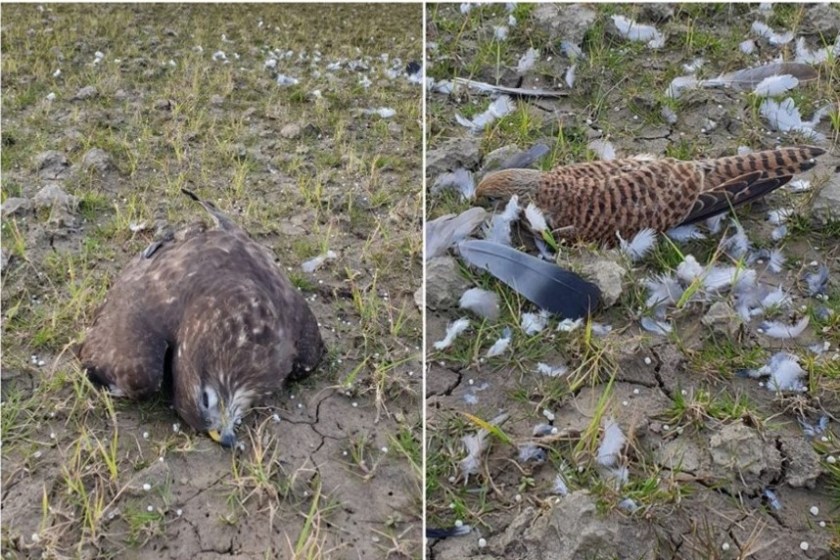
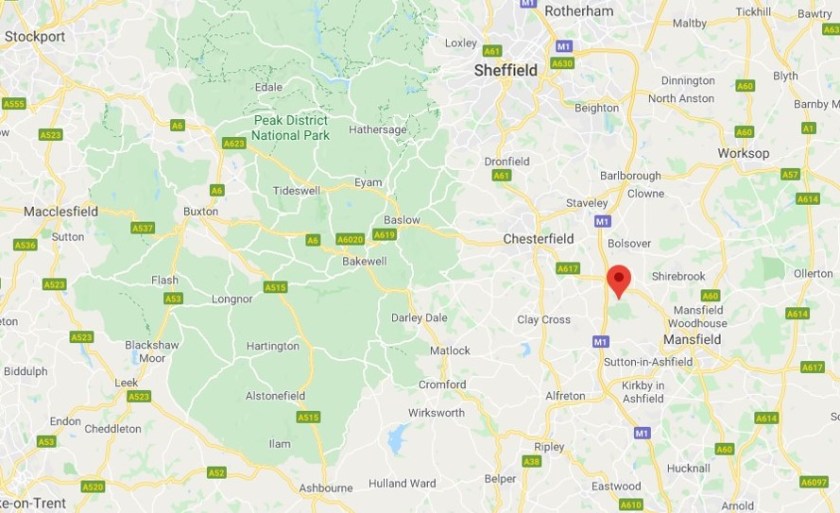
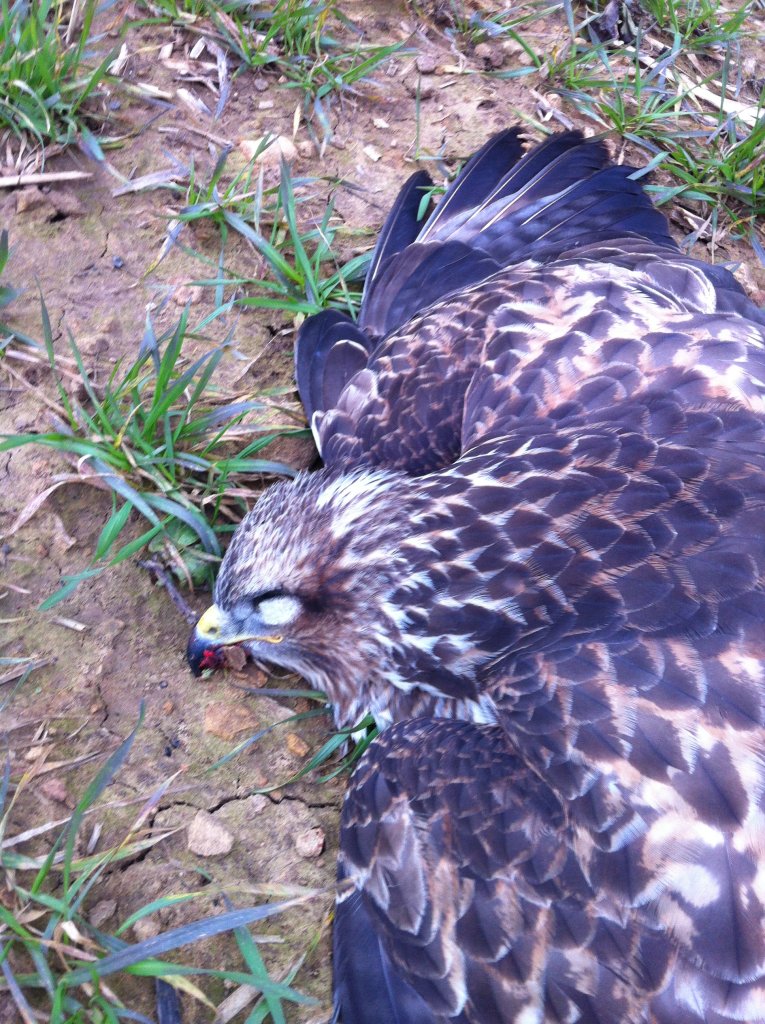
In March 2020, just after the start of lockdown, Derbyshire Constabulary reported the suspected poisoning of a kestrel and a buzzard, both found dead next to the remains of a pigeon at Ault Hucknall near Chesterfield (see here).

[Photo via Derbyshire Constabulary]

Samples were sent for toxicology analysis and last week the police received the findings. Both birds had been illegally poisoned with the banned pesticide Aldicarb.

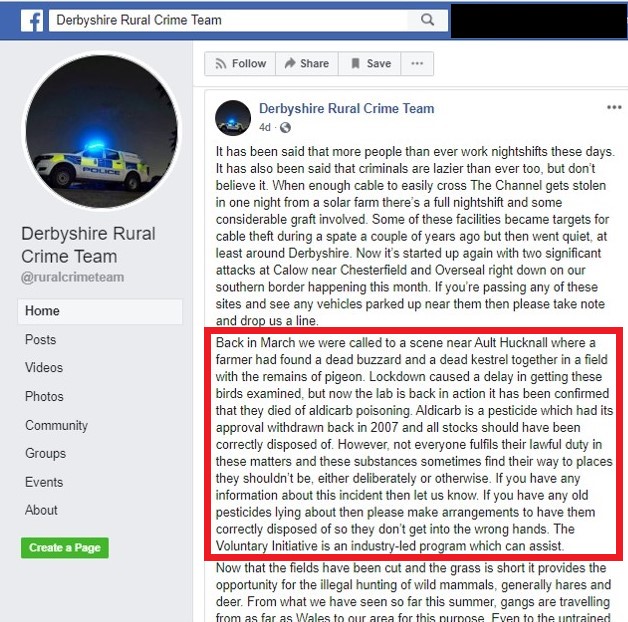
This news was published on the Rural Crime Team’s Facebook page (see below). We haven’t been able to find any further news reports, for e.g. on the Derbyshire Constabulary website or in the local press.

These latest illegal poisonings are not the first in this area. A total of six buzzards were also illegally poisoned in neighbouring Glapwell between 2015-2016 (2 x buzzards, March 2015; 1 x buzzard & pheasant bait, February 2016; 3 x buzzards & pheasant bait, March 2016). Alphachloralose was the poison used in those cases.

[Some of the poisoned buzzards and a pheasant bait found at Glapwell in 2016, photos via RSPB]

There is a record of those poisonings in the RSPB’s 2016 BirdCrime report (here) and a short video, here:

It is quite clear that somebody in this area has access to banned poisons and is not afraid to set out poisonous baits that could kill anyone unfortunate to come in to contact with them, let alone wildlife and domestic animals and pets.

Let’s hope we see a continued publicity drive from Derbyshire Constabulary – these crimes warrant maximum awareness and exposure.

UPDATE 15th March 2022: Multi-agency searches in raptor poisoning hotspot in Derbyshire (here)

Another huge penalty for raptor poisoning offence in Spain

There have been a number of raptor poisoning cases in the news recently, including the illegal killing of a white-tailed eagle found on a grouse moor inside the Cairngorms National Park in Scotland (here), the mass poisoning of 23 buzzards in a field in Co Cork, Ireland (here), the poisoning of four peregrines on Guernsey in the Channel Islands (here), the poisoning of a family’s pet dog, believed to have consumed a poisoned bait intended for birds of prey in Nidderdale, North Yorkshire (here), the poisoning of a buzzard found dead on a grouse moor in the North York Moors National Park (here), the poisoning of a buzzard in Nidderdale, North Yorkshire (here) and the suspected poisoning of numerous raptors in Derbyshire including three peregrines, two buzzards and one kestrel, all pending toxicology results (here). More on some of those suspected cases shortly.

The connecting feature of all these incidents is that, in all probability, the poisoners will evade justice.

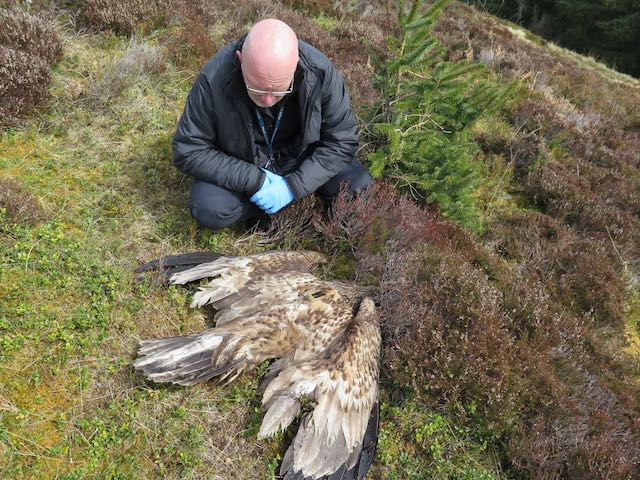
[Illegally poisoned sea eagle. Photo by Police Scotland]

It’s incredibly rare to secure a conviction for poisoning birds of prey in the UK, mainly due to the difficulty of securing sufficient evidence to link the crime to the actual individual who laid the bait. For example if the poisoned bait had been laid out on a large game shooting estate there could be numerous suspects (e.g. gamekeepers), who will all give ‘no comment’ interviews to the police, thus making it virtually impossible for the police to determine which one of them should be charged.

And even in a case where three golden eagles were found illegally poisoned on the same grouse moor, and an enormous stash of banned Carbofuran poison was found in the gamekeeper’s locked shed, reportedly to which only he had the key, he still wasn’t charged with killing those eagles, only for possession of the banned poison (see here).

There have been a few successful prosecutions for raptor poisoning over the years, but the subsequent penalties have been so utterly feeble they simply haven’t acted as a suitable deterrent for others (e.g. see here, here and here).

Meanwhile, over in Spain where tackling the illegal killing of birds of prey is taken seriously with, for example, the deployment of specialist poison detection dogs, resulting in massive fines, custodial sentences and extended hunting disqualifications for those convicted of laying poisoned baits (e.g. see here, here, here, here), another poisoner has just been sentenced this week.

According to these articles (here and here), an unnamed farmer has just been convicted of poisoning two red kites in Cabeza de Buey (Badajoz) in 2018 and has been ordered to pay a 20,000 EURO fine (the estimated value of the two red kites). He also received a two-year hunting disqualification.

Compare that response with what we’ve seen in Scotland this last week – an illegally poisoned white-tailed eagle, killed with a banned pesticide, found dead inside a National Park in an area where at least seven eagles have now been either illegally killed or have disappeared in suspicious circumstances.

There was a wholly inadequate response from a junior Environment Minister (here) followed by total silence from the Environment Cabinet Secretary and the First Minister, despite unprecedented public uproar urging action (see here and here).

Interesting, isn’t it?

4th peregrine confirmed poisoned on Guernsey & another raptor submitted for toxicology analysis

A couple of weeks ago Police on the island of Guernsey appealed for information (see here) after at least three peregrines had been found poisoned with ‘an unusual cocktail of banned pesticides’ in the previous 14 months and a fourth peregrine, found dead in June 2020, had been submitted for toxicology analysis which was delayed by Covid19.

Those toxicology results have now confirmed that the fourth peregrine was also poisoned by what have been described as ‘professional-use pesticides’ (see here). Another dead bird of prey (not identified in the local press), has been submitted for toxicology analysis after being found dead in July ‘under unusual circumstances’.

The names of the banned pesticides have not been revealed.

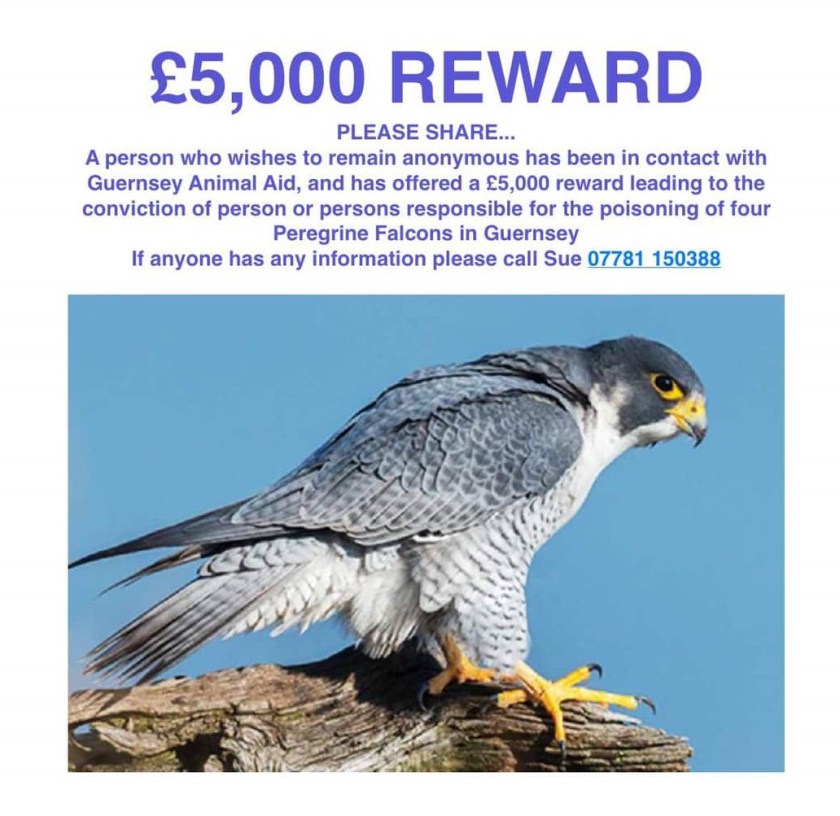
An anonymous donor has contacted Guernsey Animal Aid to put up a £5,000 reward for anyone who can provide information that leads to a conviction (see here).

Sue Vidamour from the charity said:

It’s a disgusting thing to do, to kill a beautiful animal like that for your own gain or for whatever reason is just outrageous. 

Maybe somebody out there knows who it is but is reluctant to say but humans being humans it may just tip the balance and they’ll give a name.” 

UPDATE 9th August 2020: £10,500 reward for info on four poisoned peregrines (here)

Dog poisoning confirmed in Nidderdale raptor persecution hotspot

In April during lockdown, two pet dogs became ill during a walk in Pateley Bridge in Nidderdale. One of them (Molly) subsequently died and the vet suspected poisoning.

[Molly (left) and Poppy, photo via North Yorkshire Police]

Samples were submitted for toxicology, although analysis was delayed due to Covid19. Meanwhile, North Yorkshire Police issued a warning notice (here) for local residents to take extra care, especially as illegal poisoned baits had been used in the area many times before, killing birds of prey, especially red kites (here).

Just a couple of weeks ago North Yorkshire Police, along with poisons experts from Natural England and persecution experts from RSPB, conducted high profile raids at several Nidderdale addresses as they continue to investigate ongoing poisoning crimes (see here).

The toxicology results confirmed that Molly had died after ingesting what has widely become known as the ‘Nidderdale Cocktail’ – a lethal combination of four pesticides (Bendiocarb, Chloralose, Isophenphos and Carbofuran) that has been identified in a number of raptor persecution poisoning crimes.

It’s interesting to note that this particular ‘cocktail’ isn’t restricted to use in Nidderdale; it has also been used on several estates elsewhere in England and Scotland. Wouldn’t it be fascinating to see whether there was a common link between these various estates, you know, something like a shared agent or perhaps a gamekeeper who’s worked on all the estates?

On Wednesday, North Yorkshire Police issued the following press release seeking more information about the poisoning of Molly:

Police appeal for information after dog dies from suspected pesticide abuse

Properties searched as investigation into poisoning continues

North Yorkshire Police is appealing for information as part of an ongoing investigation into the poisoning of two pet dogs, believed to be as a result of pesticide abuse.

On 23 April 2020, two spaniel dogs fell seriously ill immediately after a walk, with their owner, in the countryside near Pateley Bridge. The dogs were rushed to the vets and whilst one of the two recovered, the second was so severely ill that she did not survive.

The incident was reported to the police and local area searches conducted, as a well as a warning put out to other dog owners. Samples taken from the dog which died were submitted to the Wildlife Incident Investigation Scheme (WIIS) administered by Natural England and the results showed the presence of four pesticides. The dog had a significant quantity of Bendiocarb in its system, along with smaller quantities of Chloralose, Isofenphos and Carbofuran. The tests concluded that exposure to these pesticides most likely caused this dog’s death and the severe symptoms suffered by the second dog.

The same combination of four poisons have been found to cause the deaths of two red kites and a buzzard in Nidderdale since 2016, with other cases of poisoned birds of prey in the area also involving one or more of the chemicals involved.

North Yorkshire Police Inspector, Matt Hagen, explains:

The fact we have seen this same combination of chemicals, the ‘Nidderdale cocktail’ as it is sometimes known, also cause the death of birds of prey in this same location would indicate that the poisons have been deliberately left in a place where they could be found by wildlife and unfortunately in this case, domestic pets.

Pesticide abuse of any kind will not be tolerated and we are doing everything we can to try and find those responsible.”

Following receipt of the test results and acting on local intelligence North Yorkshire Police conducted searches at a number of properties in the area with assistance from Natural England and the RSPB.  Unfortunately none of these searches resulted in any further evidence as to how these poisons reached the two dogs or who may have been responsible for this suspected pesticide abuse so officers are now appealing for information from the public.

Mark Thomas, Head of Investigations at the RSPB, said:

Nidderdale is surrounded by grouse moors and sadly we know from experience, and from the government’s own data, that there is a strong correlation between raptor persecution and driven grouse shooting. Carbofuran is one of the most commonly-abused substances in the poisoning of birds of prey. It is a highly toxic, banned substance, putting wildlife, pets and people at risk. This is not the first time harmful substances have been found left out in the open and sadly it unlikely to be the last. This reckless and irresponsible behaviour, which had led to the death of a beloved family pet, cannot be allowed to continue.”

Whilst Chloralose is licenced for use in England in a low concentration as a rodenticide, Bendiocarb, Isofenphos and Carbofuran are all banned from use in the UK. None of these chemicals should ever be used in an environment where domestic animals and/or wildlife should come into contact with them.

Anyone misusing or abusing pesticides may be committing a variety of offences. If you come across an object, often an animal carcass, which you believe may be contaminated with a pesticide or other poisons, do not touch it. Take as many photos and details as you can and report this to the police as soon as possible.

Dog owners worried by this incident should take care to keep their dogs on a lead or within sight and under control at all times when taking them for a walk. Dogs should only be walked on public rights of way or other land where the owner has permission to be.

Anyone with any information which could help the police in this investigation should call 101, quoting reference: 12200068444 or if you wish to remain anonymous call Crimestoppers on 0800 555 111.

ENDS

The RSPB also published a blog about this case, which includes comments from Molly’s owners (see here).

There’s also good coverage in the Yorkshire Post (here).

Cairngorms National Park, Scotland: Where eagles are poisoned, trapped & shot

Here’s a new poster for the Cairngorms National Park, created by one of our blog readers (thank you) following the news (here) that yet another young eagle has been illegally killed, this time poisoned to death on a grouse moor in this so-called National Park.

You’ll be seeing a lot more of this image very shortly….watch this space.

Thank you to everyone who has written to the First Minister and Environment Cabinet Secretary expressing your disgust and urging immediate action following this latest poisoning incident. The public’s reaction has been phenomenal.

It’s not too late to add your voice. Here are the email addresses you’ll need:

To email Nicola Sturgeon, please use this address: firstminister@gov.scot

To email Roseanna Cunningham, please use this address: CabSecECCLR@gov.scot

Thank you.

Poisoned sea eagle: poor response from Cairngorms National Park Authority

You’d be forgiven for thinking that the Board of one of the world’s most famous national parks would have quite a lot to say if the headlines were full of the news of an illegally poisoned white-tailed eagle that had been found within the park’s boundary.

But apparently not.

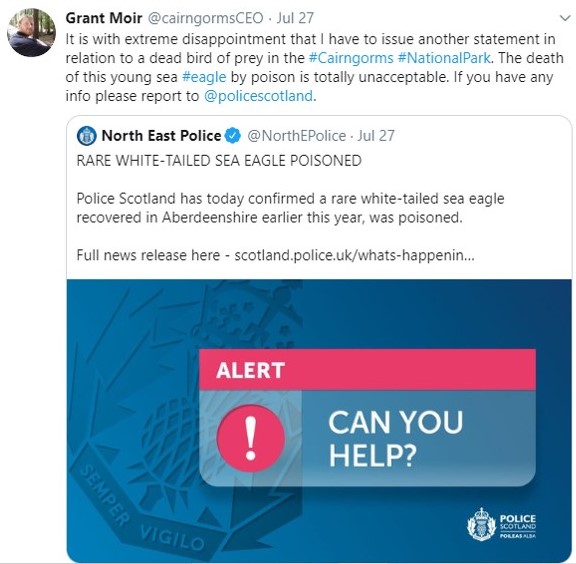
Grant Moir, Chief Executive of the Cairngorms National Park Authority (CNPA), managed to tweet this on the day the news broke:

It appears that the ‘statement’ to which Grant refers is nothing more than the one-liner that appears in his tweet:

The death of this young sea #eagle by poison is totally unacceptable. If you have any info please report to @policescotland“.

That’s it.

There’s nothing about this appalling crime on the CNPA’s news website:

Why the silence? The CNPA has published statements on previous raptor persecution incidents that have been uncovered in the National Park (e.g. see here, here, here, here, here, here) so why is this one any different? If anything, it’s even more high profile than the crimes that have gone before, which makes the CNPA’s reluctance to say anything all the more disappointing.

Perhaps it’s the influence of some of the current Board members? There are some very interesting individuals who undoubtedly would condemn this poisoning but whose strong links to the grouse-shooting industry might make them feel less inclined to want the CNPA to be shouting about it: Doug McAdam, previous CEO of Scottish Land & Estates and well known to us as what we’d describe as a raptor persecution denier (see here), Deirdre Falconer, who we’re told has a son who works as a gamekeeper on Invercauld Estate, and Geva Blackett, SNP councillor and previous Parliamentary Officer for the Scottish Gamekeepers Association and wife of the now retired Factor of Invercauld Estate. Although Geva seems to have her own problems at the moment and has reportedly been suspended from her role as the Board’s Deputy Convenor. But there are plenty of other Board members – why haven’t they been as motivated as ordinary members of the public have been to condemn this ongoing depravity?

The current silence is even more bizarre when you consider that a previous CNPA Convenor publicly acknowledged that illegal raptor persecution in the National Park was “a PR disaster” and asked the Scottish Government for help (here). Not that the CNPA has been helping itself that much, with its constant rounds of softly-softly so-called ‘partnership-working’ (see here).

How’s that working out for you, CNPA?

Here’s how well it’s working out. This map shows a number of raptor persecution incidents in and around the National Park between 2005-2018, including those recorded by the RSPB, incidents featured in the golden eagle satellite tag review, and other data in the public domain. The area of Strathdon, where the poisoned white-tailed eagle was found, is circled:

ILLEGAL RAPTOR PERSECUTION INCIDENTS CAIRNGORMS NATIONAL PARK

2002

Feb: 2 x poisoned buzzards (Carbofuran) + rabbit bait. Tomintoul (No prosecution)

Mar: 2 x poisoned buzzards (Carbofuran) + 2 rabbit baits. Cromdale (No prosecution)

2003

Apr: 3 x poisoned buzzards (Carbofuran) + 2 grey partridge baits. Kingussie (No prosecution)

Jun: Attempted shooting of a hen harrier. Crannoch (Successful prosecution)

2004

May: 1 x poisoned buzzard (Carbofuran). Cuaich (No prosecution)

Nov: 1 x poisoned red kite (Carbofuran). Cromdale (No prosecution)

Dec: 1 x poisoned buzzard (Carbofuran). Cromdale (No prosecution)

2005

Feb: 1 x poisoned buzzard (Carbofuran). Cromdale (No prosecution)

Feb: 1 x poisoned buzzard (Carbofuran). Cromdale (No prosecution)

Mar: 3 x poisoned buzzards, 1 x poisoned raven (Carbofuran). Crathie (No prosecution)

2006

Jan: 1 x poisoned raven (Carbofuran). Dulnain Bridge (No prosecution)

May: 1 x poisoned raven (Mevinphos). Grantown-on-Spey (No prosecution)

May: 1 x poisoned golden eagle (Carbofuran). Morven [corbett] (No prosecution)

May: 1 x poisoned raven + 1 x poisoned common gull (Aldicarb) + egg bait. Glenbuchat (No prosecution)

May: egg bait (Aldicarb). Glenbuchat, Strathdon (No prosecution)

Jun: 1 x poisoned golden eagle (Carbofuran). Glenfeshie (No prosecution)

2007

Jan: 1 x poisoned red kite (Carbofuran). Glenshee (No prosecution)

Apr: Illegally set spring trap. Grantown-on-Spey (No prosecution)

May: Pole trap. Grantown-on-Spey (No prosecution)

May: 1 x poisoned red kite (Carbofuran). Tomintoul (No prosecution)

May: Illegally set spring trap. Grantown-on-Spey (No prosecution)

Jun: 1 x poisoned buzzard (Carbofuran) + rabbit & hare baits. Grantown-on-Spey (No prosecution)

Jun: 1 x poisoned buzzard (Carbofuran) + rabbit bait. Grantown-on-Spey (No prosecution)

Jul: 1 x poisoned raven (Carbofuran). Ballater (No prosecution)

Sep: 1 x shot buzzard. Newtonmore (No prosecution)

Sep: 1 x shot buzzard. Grantown-on-Spey (No prosecution)

Dec: 1 x poisoned buzzard (Alphachloralose). Grantown-on-Spey (No prosecution)

Dec: 1 x poisoned buzzard (Carbofuran) + rabbit bait. Grantown-on-Spey (No prosecution)

2008

Jan: 1 x poisoned buzzard (Alphachloralose). Nr Grantown-on-Spey (No prosecution)

Mar: 1 x poisoned buzzard (Carbofuran). Nr Grantown-on-Spey (No prosecution)

Dec: 1 x poisoned buzzard (Alphachloralose). Nr Grantown-on-Spey (No prosecution)

2009

May: 2 x poisoned ravens (Mevinphos). Delnabo (No prosecution)

Jun: rabbit bait (Mevinphos). nr Tomintoul (No prosecution)

Jun: 1 x shot buzzard. Nr Strathdon (No prosecution)

Jun: 1 x illegal crow trap. Nr Tomintoul (No prosecution)

2010

Apr: Pole trap. Nr Dalwhinnie (No prosecution)

Jun: 1 x pole-trapped goshawk. Nr Dalwhinnie (No prosecution)

Jun: Illegally set spring trap on tree stump. Nr Dalwhinnie (No prosecution)

Sep: 2 x poisoned buzzards (Carbofuran) + rabbit bait. Glenlochy (No prosecution)

Oct: 2 x poisoned buzzards (Carbofuran) + rabbit bait. Nr Boat of Garten (No prosecution)

2011

Jan: 1 x shot buzzard. Nr Bridge of Brown (No prosecution)

Mar: 1 x poisoned golden eagle (Carbofuran). Glenbuchat (No prosecution)

Apr: 1 x poisoned buzzard (Carbofuran & Aldicarb). Nr Bridge of Brown (No prosecution)

May:  1 x poisoned buzzard (Carbofuran) + rabbit bait. Glenbuchat, Strathdon (No prosecution)

May: 1 x shot short-eared owl, found stuffed under rock. Glenbuchat, Strathdon (No prosecution)

Jun: 1 x shot peregrine. Pass of Ballater (No prosecution)

Aug: grouse bait (Aldicarb). Glenlochy (No prosecution)

Sep: Satellite-tagged golden eagle ‘disappears’. Nr Strathdon

Nov: Satellite-tagged golden eagle ‘disappears’. Nr Strathdon

2012

Apr: 1 x shot short-eared owl. Nr Grantown-on-Spey (No prosecution)

Apr: Peregrine nest site burnt out. Glenshee (No prosecution)

May: Buzzard nest shot out. Nr Ballater (No prosecution)

2013

Jan: White-tailed eagle nest tree felled. Invermark (No prosecution)

May: 1 x shot hen harrier. Glen Gairn (No prosecution)

May: Satellite-tagged golden eagle ‘disappears’. Glenbuchat, Strathdon

2014

Apr: Satellite-tagged white-tailed eagle ‘disappears’. Glenbuchat, Strathdon

May: Armed masked men shoot out a goshawk nest. Glen Nochty, Nr Strathdon (No prosecution)

2015

Sep: Satellite-tagged hen harrier ‘Lad’ found dead, suspected shot. Newtonmore (No prosecution)

2016

May: 1 x shot goshawk. Strathdon (No prosecution)

Jun: Illegally set spring traps. Invercauld (No prosecution)

Aug: Satellite-tagged hen harrier ‘Brian’ ‘disappears’. Kingussie

2017

Mar: Satellite-tagged golden eagle #338 ‘disappears’. Glenbuchat, Strathdon

Aug: Satellite-tagged hen harrier ‘Calluna’ ‘disappears’. Ballater

2018

May: Satellite-tagged white-tailed eagle Blue T ‘disappears’. Ballater

Aug: Satellite-tagged hen harrier ‘Athena’ ‘disappears’. Nr Grantown on Spey

Aug: Satellite-tagged hen harrier ‘Margot’ ‘disappears’. Nr Strathdon

Sept: Satellite-tagged hen harrier ‘Stelmaria’ ‘disappears’. Ballater

2019

April: Satellite-tagged hen harrier ‘Marci’ ‘disappears’. Nr Strathdon

April: Four geese poisoned and Carbofuran bait found on an estate nr Kingussie (no prosecution)

August: Golden eagle photographed with a spring trap dangling from its foot, nr Crathie, Deeside

September: Satellite-tagged hen harrier Wildland 1 ‘disappears’ on a grouse moor nr Dalnaspidal

September: Satellite-tagged hen harrier Wildland 2 ‘disappears’ on a grouse moor at Invercauld

2020

April: Satellite-tagged hen harrier Hoolie ‘disappears’ on grouse moor nr Newtonmore

April: Satellite-tagged hen harrier Marlin ‘disappears’ on grouse moor nr Strathdon

April: Satellite-tagged white-tailed eagle found illegally poisoned on grouse moor in Strathdon.

In addition to the above list, two recent scientific publications have documented the long-term decline of breeding peregrines on grouse moors in the eastern side of the National Park (see here) and the catastrophic decline of breeding hen harriers, also on grouse moors in the eastern side of the Park (see here).

Poisoned sea eagle: Chris Packham’s letter to Scottish Ministers

Public anger over the news that yet another bird of prey has been found illegally killed on a Scottish grouse moor – this time a white-tailed eagle found poisoned in the Cairngorms National Park – is showing no sign of subsiding (see here and click on the links to read some of the letters that have been sent to Scottish Ministers urging immediate action).

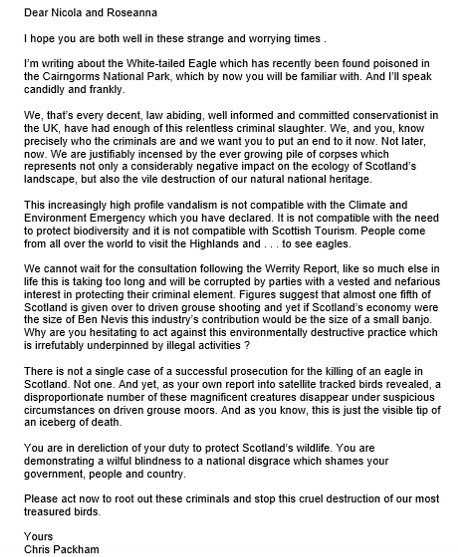
Chris Packham has now added his voice and has written to the First Minister Nicola Sturgeon and Environment Cabinet Secretary Roseanna Cunningham, as follows:

It’s not the first time Chris has spoken with Ministers about the ongoing persecution of eagles and other birds of prey on Scottish grouse moors.

In 2018 he had a long conversation with Roseanna Cunningham following the suspicious disappearance of one of our satellite-tagged golden eagles, ‘Fred’, who vanished just seven miles from the Scottish Parliament building in Edinburgh. You can watch the extended version of that conversation here:

Here we are, two years later, and what’s changed?

Absolutely nothing.

Except public anger has surged.

Thank you to everyone who has written to the First Minister and Environment Cabinet Secretary expressing your disgust and urging immediate action following this latest poisoning incident. The public’s reaction has been phenomenal.

Here are their email addresses for those who would still like to comment:

To email Nicola Sturgeon, please use this address: firstminister@gov.scot

To email Roseanna Cunningham, please use this address: CabSecECCLR@gov.scot

Thank you.

Poisoned sea eagle: Scottish Ministers under increasing pressure to act

There has been an unprecedented response from the general public to the news that a young white-tailed eagle has been found illegally poisoned on a grouse moor in the world-famous Cairngorms National Park (see here and here).

The Scottish Government published a pathetically inadequate tweet yesterday (here) designed to fob everyone off but actually generating even more fury at its continued wilful blindness and refusal to tackle this head on.

Public anger is palpable. Social media is still FULL of the death of this eagle, 48hrs after the news first broke, and hundreds of ordinary members of the public have been so incensed they’ve taken to writing emails to the very top of the pile, First Minister Nicola Sturgeon.

Here are some examples of those emails, here are some more, here are some more, here are some more, here are some more, and here and here are some more and another one here.

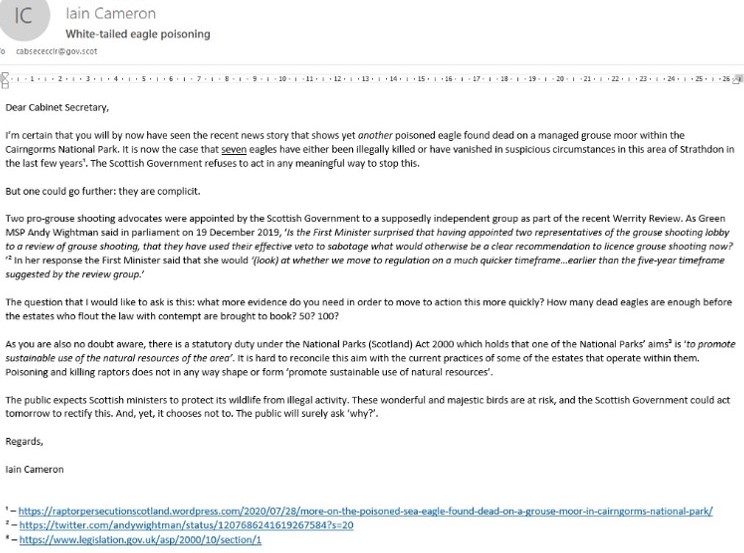
This one, from Iain Cameron (@theiaincameron) is a masterclass in reasoning:

But so far this one is my favourite (from anon):

Ladies, I know your inboxes are full and getting fuller so I will be brief;

Prompted by the recent poisoning of a white-tailed eagle in the Cairngorms National Park I note;

1) That none of the measures put in place to protect Scotland’s birds of prey seems to have any effect

2) No one has ever been convicted of killing an eagle in Scotland

3) Satellite-tagged eagles can be killed with impunity right up to the Edinburgh bypass

4) The Werritty Review’s outcome of a five year period of self-regulation is infuriating and futile

5) Your party appears not to have the stomach to take on serious, organised crime by landed interests in Scotland

6) Indeed your appointment of Richard Scott’s financial adviser Benny Higgins (a former colleague of mine) as an economic advisor suggests the opposite – that you regard these people as trustworthy or reputable in some way

7) Lots of people (including me) are extremely angry about your hand-wringing and inaction

8) I expect action from you. Driven grouse shooting is a moral disgrace, drives out productive land use, wrecks our uplands and depends on rampant criminality. It needs to be banned right now.

9) The Cairngorms National Park should either become an actual nation park with no sport shooting or it should come to an end. If it has no power to tackle this carnage there’s little point in it existing.

Thanks for reading.

ENDS

Thank you to all of you who have written to the First Minister (Nicola Sturgeon) and Environment Cabinet Secretary (Roseanna Cunningham) expressing your disgust and urging immediate action. It is clear that their inboxes have been deluged. Good, they need to be.

Here are their email addresses for those who would still like to comment:

To email Nicola Sturgeon, please use this address: firstminister@gov.scot

To email Roseanna Cunningham, please use this address: CabSecECCLR@gov.scot

Thank you.

UPDATE 29th July 2020: Poisoned sea eagle: Chris Packham’s letter to Scottish Ministers (here)

Poisoned sea eagle: strong response from Scottish Greens

In sharp contrast to the pathetically inadequate Scottish Government’s response (see here) to the news that a poisoned sea eagle has been found on a grouse moor in the Cairngorms National Park, the Scottish Greens’ response is spot on:

POISONING OF WHITE-TAILED EAGLE REVEALS NEED FOR REFORM

The revelation that a White-Tailed eagle found dead in the Cairngorms is found to have been poisoned shows the Scottish Government must go further to tackle wildlife crime around grouse moors, Scottish Green MSP Mark Ruskell has said.

Police Scotland have confirmed the satellite tracked bird had been poisoned with pesticide as they investigate the crime.

[A police officer retrieving the poisoned corpse from a grouse moor in the Cairngorms National Park. Photo by Police Scotland]

Greens environment spokesperson Mark Ruskell is the species champion for the White-Tailed eagle, also known as the sea eagle, of which there are only around 150 breeding pairs in Scotland.

This is a very serious crime against a species reintroduced into Scotland 40 years ago after it became extinct. Sadly, this is only the latest in a long list of raptors found near Scotland’s grouse moors and I’m afraid recent tweaks to wildlife crime maximum sentences fail to address the central problem around detection and prosecution of these crimes.

There needs to be real action to address this war against wildlife. Land managers need to get a grip of this, but we’ve seen from the reaction to the Scottish Greens win on protection for mountain hares that the driven grouse shooting industry is resistant to even the mildest of reforms.

It’s time for the Scottish Government to ignore vested interests and respond to the Werrity review with a commitment to shut grouse moors down. The stark reality is Scotland is monumentally failing to meet its obligations in the middle of a global nature emergency.

ENDS

Thank you to all of you who have written to the First Minister (Nicola Sturgeon) and Environment Cabinet Secretary (Roseanna Cunningham) expressing your disgust and urging immediate action. It is clear that their inboxes have been deluged. Good, they need to be.

Here are their email addresses for those who would still like to comment:

To email Nicola Sturgeon, please use this address: firstminister@gov.scot

To email Roseanna Cunningham, please use this address: CabSecECCLR@gov.scot

Thank you.

Poisoned sea eagle: inadequate response from Scottish Government

Further to Monday’s appalling news that a young white-tailed eagle has been found illegally poisoned on a grouse moor in the Cairngorms National Park (see here and here), the Scottish Government has responded.

Of sorts.

The official twitter channel of the Scottish Government, covering the environment and rural economy (@GreenerScotland) posted this at four minutes to five yesterday afternoon:

If the Scottish Government thinks that is an adequate response it’d better think again.

Superficially, it looks good, as is undoubtedly intended. A photo of a serious-looking Environment Minister and a statement expressing disgust and anger, ending with what looks to be a zero-tolerance policy for those who commit these atrocious crimes.

Job done. That’ll calm the baying public and stem the tsunami of angry emails heading for the First Minister’s inbox, right?

Sorry, but no, it won’t. Whichever civil servant put this together has not only seriously misjudged the mood but has also underestimated the public’s depth of anger about the illegal poisoning of this young eagle. Fobbing us off with a trite statement about custodial sentences for the guilty just isn’t going to cut it.

Why not? Well because we all know, that even though an increase in custodial sentences for wildlife crime is widely welcomed and long overdue, that no matter what the sentence, the chances of the culprit actually being caught is still disproportionately minuscule in comparison to the weight of the sentence.

In fact, there has never been a successful prosecution for the illegal killing of an eagle in Scotland. Ever. Even though scores of them have been found illegally shot, poisoned or trapped over the years, and scores more have ‘disappeared’ in suspicious circumstances (confirmed by a Government-commissioned report), not one single eagle-killer has ever been held to account.

Not one.

Why not? Because the evidence required to convict is almost impossible to attain. For example, ten years ago three golden eagles were found dead on a prestigious grouse-shooting estate in Sutherland. They were found within days of each other and all three had been poisoned with banned chemicals. The police raided the estate and found a stash of 10kg of Carbofuran (a banned pesticide) inside a locked shed. This was the biggest cache of carbofuran ever found in the UK and was described as being ‘enough to wipe out the entire Scottish golden eagle and red kite populations several times over’. They also found poisoned baits laid out on the hill. At least one of those eagles died with the poisoned bait still in its beak – that’s how potent and fast-acting some of these poisons can be.

An estate employee was charged and the case went to court. However, he was only convicted for having possession of the banned poison. He wasn’t even charged with poisoning those eagles simply because there was insufficient evidence to demonstrate that he had laid the bait that killed those eagles.

So when the Scottish Government tells us that the maximum sentence for poisoning an eagle has been increased to a five-year custodial sentence, in this context it’s totally meaningless because the poisoner will evade ever being brought to justice.

Now that’s not to say the increased penalties for wildlife crime are a waste of time – they most definitely are not and are a very welcome addition, but increased penalties alone just aren’t going to save the day here. The Scottish Government cannot continue to ignore the massive elephant in the room. That is, that the majority of these crimes against birds of prey are linked to the ‘sport’ of driven grouse shooting.

We know it, and the Scottish Government knows it.

This latest response from the Scottish Government bares strong similarities to a statement made last month about its intention to establish a ‘wildlife crime task force’ to assess whether increased powers for the SSPCA would be worthwhile (see here). What was (deliberately) missed out was the fact that the government had already spent the previous nine years cogitating this very issue! The announcement was even accompanied by the very same photograph of Minister Gougeon as used in yesterday’s announcement. The civil servants must think it adds gravitas.

Well, it doesn’t. And as we said last month, this is no reflection on the integrity and sincerity of Mairi Gougeon. Having met her several times and listened to her talk, there is absolutely no doubt that she finds these crimes as abhorrent as we all do. But she, and her fellow Cabinet Ministers and Secretaries, need to step up to the plate.

We don’t want banal memes or meaningless platitudes or pretence that this is all in hand. It isn’t and the image of that dead sea eagle should haunt every single member of the Scottish Government – they are allowing this depravity to continue.

Thank you to all of you who have written to the First Minister (Nicola Sturgeon) and Environment Cabinet Secretary (Roseanna Cunningham). It is clear that their inboxes have been deluged. Good, they need to be.

If you haven’t written yet, please consider doing so. Mark Avery has published his excellent letter (see here) for those wondering what to say.

Here are the email addresses of the relevant ministers:

To email Nicola Sturgeon, please use this address: firstminister@gov.scot

To email Roseanna Cunningham, please use this address: CabSecECCLR@gov.scot

Thank you.

UPDATE 29th July 2020: Poisoned sea eagle: strong response from Scottish Greens (here)