Blog

Serial egg thief Daniel Lingham convicted for third time

Press release from Norfolk Constabulary (20th February 2024):

Norfolk man illegally collected almost 3,000 eggs

A prolific egg collector has admitted illegally hoarding thousands of rare birds’ eggs in Norfolk.

Daniel Lingham, 71, of Newton St Faith, appeared at Norwich Magistrates Court on Tuesday 20 February 2024 where he pleaded guilty to five offences.

They were:

-Taking eggs from a non-schedule 1 wild bird namely a Nightjar on 9 June 2023 at Holt

-Possessing an egg or its parts of a non-schedule 1 wild bird – namely 2429 eggs on 25 July 2023

-Possessing an egg or its parts of a schedule 1 wild bird – namely 22 Schedule 1 bird eggs on July 2023

-Possessing articles capable of being used to identify and take eggs

-Breaching a Criminal Behaviour Order on 9 June 2023
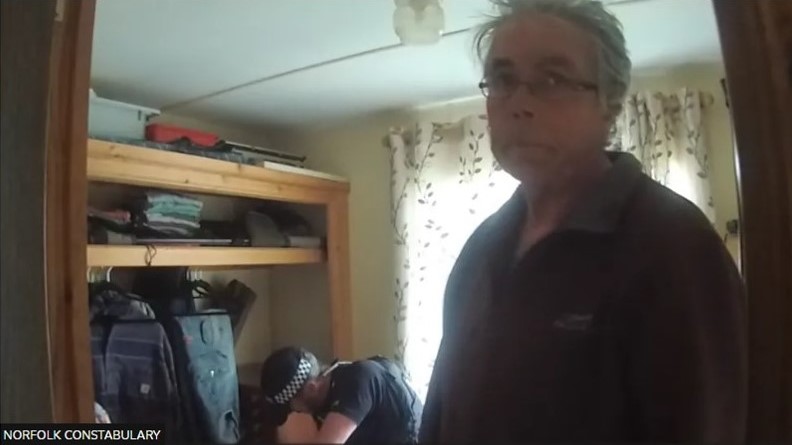
Lingham captured on police body camera whilst officers search his premises for stolen eggs

Lingham, who has two previous convictions for similar crimes, was captured on a wildlife trap camera on 9 June 2023 sealing two eggs from a Nightjar nest in Holt Lowes.

Investigators were shown the footage and were able to identify Lingham by his distinctive walking stick which is seen in shot.

A police search of his home on July 25 2023 subsequently revealed the extent of his hoard.

Within the property a total of 2995 eggs were found. A large collection was in his bedroom including some non-native species, alongside 2429 native birds’ eggs protected by the Wildlife and Countryside Act.

Of those 548 were from native birds on the amber list of birds of conservation concern and a further 546 were of the most serious concern on the red list including Linnet, Green Finch, Yellowhammer, House Sparrow and many more.

A further collection of eggs – which looked much newer – was found behind the bath panel including a box containing a pair of Nightjar eggs with a label ‘Nightjar 2, Holt Lowes June 9.’

Officers also found identifying books, binoculars, and an egg blowing kit.

In interview Lingham said all of the eggs, bar the Nightjar ones, had been taken before his previous conviction in 2018 –  although the way they were stored suggested otherwise.

He further claimed a collection on display in a cabinet in the bedroom had come from an Essex house clearance and while they were his he had not taken them himself from the wild.

He said he had been looking for adders and tiger beetles when he was “tempted” by the Nightjar eggs due to his egg collecting addiction, which was a mental health issue.

Lingham has previously been investigated and prosecuted.

In 2005 he was jailed for ten weeks after police found a collection of almost 4,000 eggs in his home.

Then in 2018 he was found to be in possession of over 5,000 eggs for which he was jailed for 18 weeks and handed a 10-year Criminal Behaviour Order aimed at stopping him from committing similar crimes in the future.

Under the CBO he is banned from entering Holt Lowes between 1 February and 1 October as well as many other sites across Norfolk and nationally – many of which appeared on place name labels among the boxes.

PC Chris Shelley  from the Op Randall Rural Crime Team thanked RSPB investigators for their huge support throughout the investigation and also the National Wildlife Crime Unit (NWCU).

He said: “Egg collecting should be a hobby that is confined to the history books having been made illegal in 1954. The illegal collecting of eggs is tackled every year under Operation Easter with forces and partner agencies nationally taking part in bringing those involved to justice, all overseen and facilitated by the NWCU.

Thankfully there are very few individuals now committing this crime but these few, including Lingham, cause a huge amount of harm to 1000s of birds including some of our most at risk species –  in this case Nightjar, Linnet, Yellow Hammer and House Sparrows to name just a few.

We would always encourage anyone who sees suspicious activity around bird nests in the coming months to report as much detail as possible using our online form or 999 if in progress.”

Tom Grose, RSPB Investigations Officer, said: “The scale of egg theft which Lingham has committed over the last 20 years is shocking. Sadly, his obsession with collecting wild birds’ eggs has ultimately resulted in thousands of breeding birds, which have invested huge amounts of energy into rearing young, to fail.

We’re relieved that this type of crime is now relatively rare in the UK, but this latest case has revealed that the breeding success of the Nightjar, a species of conservation concern, has again been targeted in Norfolk by Lingham’s illegal actions.

We’d like to thank Norfolk Police for an excellent investigation which has again led to Lingham’s prosecution.”

He will appear for sentencing on 3 May 2024.

ENDS

As mentioned in the press release, the last time Lingham was convicted (in 2018 for stealing Marsh harrier eggs, amongst many others, here) as well as a short custodial sentence he was also given a ten-year Criminal Behaviour Order (CBO) banning him from all Norfolk Nature Reserves for ten years.

According to the Sentencing Council, ‘a CBO is an order designed to tackle the most serious and persistent anti-social individuals where their behaviour has brought them before a criminal court’.

Lingham has clearly breached his CBO and the consequences of that could mean a lengthy custodial sentence depending on the court’s view of mitigating and aggravating factors (see here).

Let’s see what happens when he’s sentenced on 3rd May 2024.

Well done to Norfolk Constabulary’s Rural Wildlife Crime, the National Wildlife Crime Unit and the RSPB’s Investigations Team for getting a successful conviction.

Members of Norfolk Constabulary’s Rural Crime Team with part of Lingham’s illegal egg collection. Photo via Norfolk Constabulary

UPDATE 6 May 2024: Serial egg thief Daniel Lingham avoids custodial sentence (here)

New Agricultural Minister to take forward Wildlife Management & Muirburn Bill

The Scottish Parliament’s Rural Affairs & Islands Committee will continue its Stage 2 consideration of the Wildlife Management & Muirburn Bill this Wednesday and there will probably be a new Minister taking it forward.

For new readers, this is proposed new legislation to regulate grouse shooting and its associated management practices by way of licensing schemes, introduced because of the continued illegal persecution of birds of prey on many Scottish grouse moors.

A grouse shooting butt on a Scottish grouse moor. Photo: Ruth Tingay

So far the Bill has been ably led by Environment & Energy Minister Gillian Martin MSP but after a Cabinet mini-reshuffle earlier this month, it appears that Gillian Martin’s portfolio will no longer cover the Environment (her new title is now Minister for Energy, Just Transition and Fair Work).

Instead, this Bill will now be led by newly-appointed Agriculture & Connectivity Minister, Jim Fairlie MSP, whose relevant portfolio responsibilities include wildlife management and crime, animal health & welfare, and natural resources and peatland.

Strangely, the word ‘Environment’ now does not feature in the title of any Scottish Minister.

I say he’ll ‘probably’ be taking it forward at Wednesday’s session – but that all depends on whether the Scottish Parliament formally approves his appointment as a new Minister and whether an unelected bloke in a crown formally approves it too, all before Wednesday morning.

It’s not ideal to have this level of Ministerial disruption at Stage 2 of the Bill but the good news is that Jim Fairlie has been serving on the Rural Affairs & Islands Committee and so is fully conversant with the Bill’s detail. Perhaps most importantly, he also fundamentally understands why there’s a need for this particular Bill to be passed, as he demonstrated two weeks ago when responding to fellow Committee member Rachael Hamilton’s ridiculous pronouncement that “there’s no connection between raptor persecution and grouse moors” (see here for Jim Fairlie’s reaction).

Of course, now he’s a Minister, Jim Fairlie is no longer permitted to serve on any Committee and his name has been removed from the Committee list. Interestingly, SNP MSP Karen Adam’s name has also disappeared from the list. I don’t know why that is. It’ll be interesting to see who is brought in to replace these two SNP members.

It’ll also be interesting to see how Jim Fairlie steers this Bill as the leading Minister. It’s anticipated that like his predecessor, there won’t be many surprises and he’ll stick to the Government line and not accept many amendments unless they’re Government-backed, but let’s see.

The stage 2 scrutiny of the Bill must be completed by the Committee on Wednesday 21st February. However, as the pace was so slow at the last meeting (a meeting that had already been delayed for two weeks thanks to the Convenor), the Committee will now have to undertake two separate sessions to finish in time. The first session is expected to begin at 11am on Wednesday, after the Committee has considered some other business, and is expected to end at around 12.45pm. There will then be a further session on Wednesday evening, beginning at 6pm.

The morning session will begin by completing amendments on the Bill’s section on the use of wildlife traps (picking up where it left off during the first session two weeks ago) and will then move on to amendments relating to the issues of licensing grouse moor management (including increased powers for the SSPCA) and licensing muirburn. These issues are expected to be the most contentious because, if voted through, many of these licensing conditions will introduce a level of regulation that grouse moor managers simply aren’t used to, and won’t like having to adhere to. Conservationists will welcome the regulations that many of us consider to be necessary and long, long, long overdue.

Predictably, there are a number of amendments, mostly submitted by Conservative MSPs Edward Mountain, Rachael Hamilton and Stephen Kerr, that seek to weaken the Government’s proposed licencing conditions. They’re entitled to submit those, of course, and there are other amendments from the likes of Colin Smyth (Labour), John Mason (SNP) and Ariane Burgess (Greens) that seek to strengthen the terms of the licences. Here is the marshalled list that the Committee will debate on Wednesday:

To make any sense of these proposed amendments, you’ll need to refer to the numbered contents of the Bill as introduced:

As ever, these sessions can be watched live on Scottish Parliament TV and there’ll be an archive video and transcripts available after the sessions, which I’ll add here when available.

I’ll also try and write an overview of Wednesday’s proceedings once Stage 2 is complete. You can read my overview of what happened in the previous session here.

More scrutiny on its way for use of toxic medicated grit on Scottish grouse moors

Grouse moor managers have been using medicated grit for many years to prevent the natural cyclical population crashes in Red Grouse caused by the parasitic strongyle worm.

This natural regulation of the wild populations was inconvenient for those who seek to produce an artificially high number of birds for so-called ‘sport’ shooting so the use of medicated grit was introduced to prevent these population crashes.

However, aside from the questionable ethical issue of drugging wild birds for ‘sport’, questions have also been raised about the ineffectual regulation and monitoring of its use (see here for a blog I wrote about it way back in 2015).

Grit trays with marker posts can be seen on many moors managed for Red Grouse shooting. Photo: Ruth Tingay

The drug currently used in medicated grit is Flubendazole, and it’s toxic. So toxic in fact that there is a statutory requirement for grouse moor managers to remove the grit 28 days prior to shooting any Red Grouse to ensure that it doesn’t enter the human food chain. We know from previous enquiries that the UK agency responsible for monitoring this adherence to the law is pathetic, to say the least. We also know that this agency (the Veterinary Medicines Directorate) does not visit grouse moors to test grit piles to determine whether its medicated or not. Nobody’s checking, and the grouse moor managers will know this.

Well all that is about to change. Conservation campaign group Wild Justice has teamed up with the League Against Cruel Sports (Scotland) to fund the development of a novel lab test to detect the presence of Flubendazole on grit samples.

This novel test has now been trialled by the League Against Cruel Sports who collected grit samples from a number of moors across Scotland and their findings suggest widespread mis-use of the drug.

Here is a briefing note that details these findings:

Last week Wild Justice and the League Against Cruel Sports met with officials from the Scottish Government and NatureScot to discuss these findings and to ask for improved regulation.

Officials assured the campaigners that although the approval of medication to dose wild birds is a reserved issue to the Westminster Government, the use of medicated grit will be subject to greater regulation in Scotland under the new Codes of Practice being drawn up to support the Wildlife Management & Muirburn Bill.

This is an important step. Firstly, I’d heard rumours that some grouse shooting organisations who serve on the grouse moor Code of Practice working group had been trying to exclude the use of medicated grit from scrutiny and regulation. It’s good to hear that it most definitely will be included.

Secondly, it’s worth remembering that any breach of any of the Codes of Practice could result in an estate’s grouse shooting licence being revoked. Now, obviously it will depend on the detail of the Codes of Practice as to what will be deemed to be a code breach – the devil is always in the detail.

But those details should include a requirement for all medicated grit users to provide the regulator (NatureScot) with a copy of their veterinary prescription (currently unsighted); a requirement that the grit is not administered in a way that it can leach into the environment (currently, it can – see above briefing report); a requirement that when the medicated grit is withdrawn it is disposed of as toxic waste (currently, it isn’t); and a provision that allows NatureScot to randomly field test grit samples on grouse moors to ensure the medicated grit has been withdrawn within the statutory time limit (currently, nobody checks). The development of the novel lab test should help facilitate this.

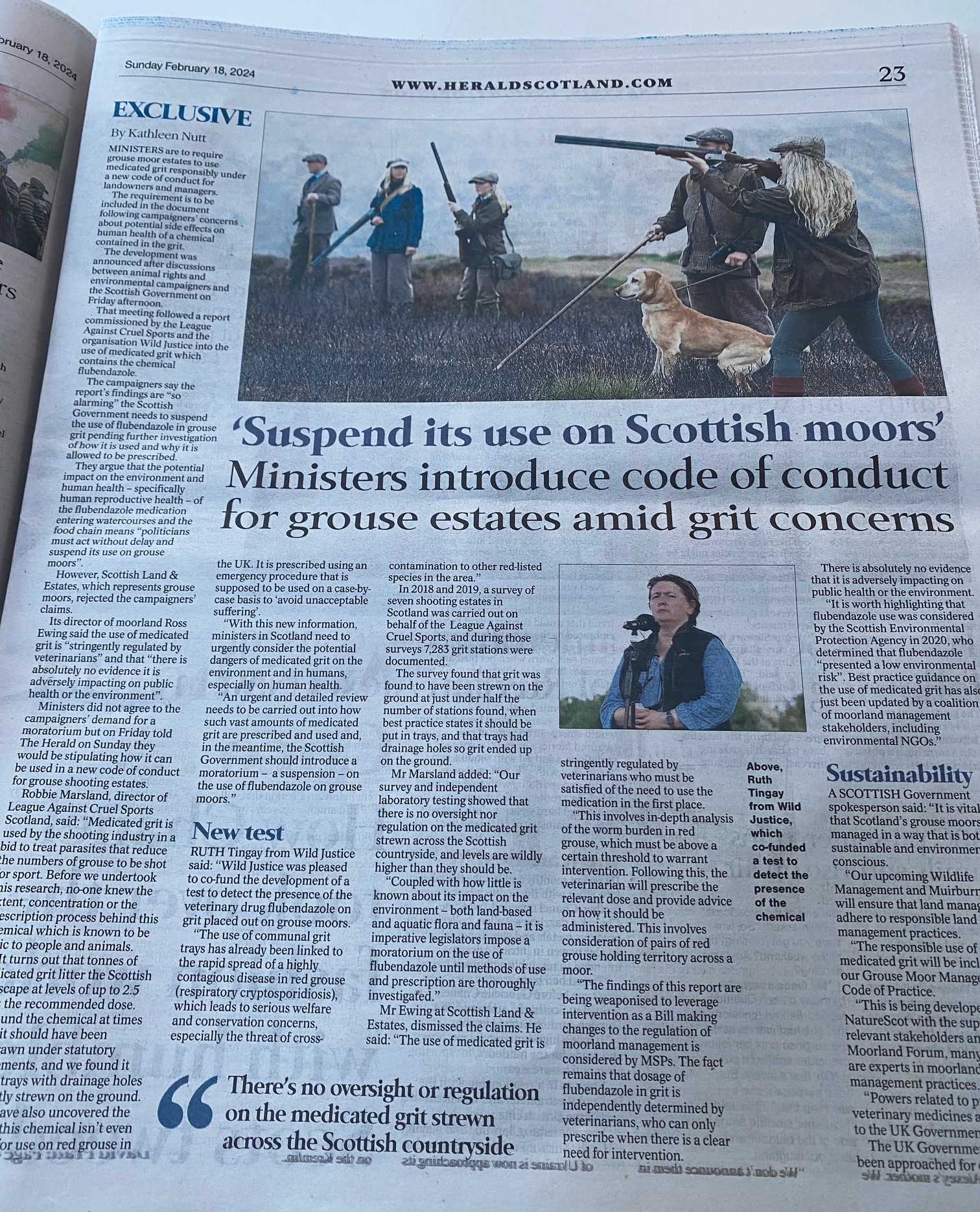
Some of you may have seen an exclusive in The Herald yesterday about this subject – it’s here, but behind a paywall.

Here’s a photo that someone sent to me of the hard copy, where most of the text is visible:

Yorkshire birder running half marathon to raise funds for raptor rehabber Jean Thorpe – please support him!

Yorkshire-based birder Mark Pearson is running a half-marathon on 28th April and is raising funds to help support the fantastic work of raptor rehabilitation legend Jean Thorpe, in Ryedale, North Yorkshire.

Raptor rehabber extraordinaire Jean Thorpe about to release a buzzard back to the wild. Photographer unknown.

If you’ve spent any time following this blog you’ll no doubt be familiar with Jean’s incredible work – many victims of raptor persecution have ended up under her expert care and she’s managed to get some of them back to full health and release them back the wild.

Mark is trying to raise £1,000 to support Jean’s work.

Come on, this should be do-able, surely?

The link to Mark’s fundraising page is here.

Many thanks.

Job opportunity: Events Assistant, Birds of Poole Harbour (Dorset)

The charity Birds of Poole Harbour (the fabulous team behind the Osprey Reintroduction Project, amongst many other things) is advertising for an Events Assistant to help them deliver a number of exciting public engagement projects this year.

This includes helping out on their brilliantly popular ‘bird cruise boats’ around the harbour, providing the public with an opportunity to see ospreys, white-tailed eagles, marsh harriers, peregrines and much, much more!

Looking for raptors (& other species!) on the Birds of Poole Harbour Bird Boat. Photo: Ruth Tingay

Here are the details of this fantastic job opportunity:

BIRDS OF POOLE HARBOUR EVENTS ASSISTANT

Birds of Poole Harbour is a Dorset-based charity with a local community focus, committed to conserving and interpreting the important birdlife in the Poole Harbour area. We deliver a range of exciting events and projects, and are looking for an enthusiastic Events Assistant to support our team in delivering our public engagement offer through the Spring and Summer of 2024.

Position: Events Assistant

Hours: 32 hours per week, 15th April – 15th September 2024. Due to the nature of our events, regular weekend and occasional early morning/evening working hours are required.

Salary: £8053.76 (FTE: £23,795.20 per annum)

Location: Poole and Wareham-based, with travel to events around Poole Harbour

Annual Leave: 9.5 days, inclusive of bank holidays

Essential Criteria:

  • Friendly and warm interpersonal style
  • Excellent verbal and written communication skills
  • Ability to work effectively as part of a busy team
  • Proactive and self-motivated attitude
  • Excellent bird identification skills

Desirable Skills and Experience:

  • Experience of working with volunteers
  • Experience of delivering events
  • Knowledge of local birding sites and conservation projects, including the Poole Harbour Osprey Reintroduction Project
  • Full driving licence and access to a vehicle

What you’ll be working on:

You’ll be helping our team to deliver an ambitious events schedule through the spring and summer, including our Carey Osprey Tours led in partnership with Careys Secret Garden, as well as our guided walks and cruises. This role will be well-suited to an aspiring and enthusiastic ornithologist with excellent communication skills and a good knowledge of British birds.

Full training will be provided and more detail on our project work and events can be found here: www.birdsofpooleharbour.co.ukPlease note that this position will be offered subject to the successful return of the nesting pair of Osprey to Careys Secret Garden, and that we will be unable to fulfil the role if they do not return.

If you would like to apply, please email our Operations Manager Laura at laura@birdsofpooleharbour.co.uk with a CV (2 pages maximum) and a PDF with answers to the following questions:

  • What attracted you to apply for this position? (200 words max)
  • Why do you believe you are well-suited for the role of Events Assistant at Birds of Poole Harbour? (500 words max)

Interviews commencing W/B 4th March with the option for online interviews available. Please note that the interview will involve a UK bird species identification test.

Closing date: 9am on 26th February 2024

If you have any questions or queries about the role or application process, please contact our Charity Manager Liv via liv@birdsofpooleharbour.co.uk. Birds of Poole Harbour are an equal opportunities employer and are happy to provide additional information or accommodations within our hiring practices to support applicants.

ENDS

SSPCA press release on conviction of part-time gamekeeper Timothy Hall & his son Lewis Hall for illegal laundering of Scottish peregrines

The SSPCA has issued the following press release in response to the recent conviction and sentencing of part-time gamekeeper Timothy Hall and his son, Lewis Hall, for the illegal laundering of Scottish peregrines which they were selling for high prices to buyers in the Middle East.

This press release contains details about the poor conditions provided by Timothy Hall for the raptors found at his address, and the subsequent return to the wild of the stolen peregrine chicks.

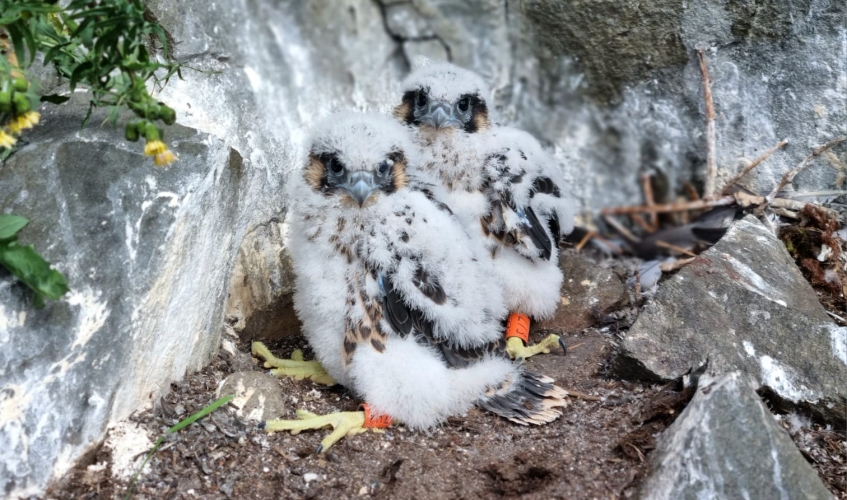
Young peregrines returned to the wild. Photo via SSPCA

Berwick men receive ban for illegally selling peregrine falcons

Timothy Hall previously pled guilty to the charges and was sentenced to a five-year ban from possessing or breeding birds of prey and 220 hours of community service at Jedburgh Sheriff Court today.

His son Lewis Hall was sentenced to 150 hours community service.

48-year-old Timothy Hall of Lamberton, Berwick Upon Tweed pled guilty in December to being responsible for nine birds of prey of various breeds.  Failing to ensure a suitable environment, allowing a build-up of faeces and urates, and not providing an appropriate supply of water for bathing or drinking and did thereby expose the birds to disease or injury. 

Lewis Hall, 23, of Fordyce Cottage, Duns, pled guilty to acquiring for commercial purposes, keeping for sale, and selling wild peregrine falcon chicks between 2020 and 2021.   

Scottish SPCA specialist investigator, Mark Rafferty, said, “These birds are a protected species and it is illegal to disturb their nests or illegally breed them.

During April 2021, information came to light that several Peregrine Falcon nesting sites around the Scottish Borders and East Lothian had seen thefts of eggs and chicks over a prolonged period of time.

We carried out a raid, alongside the Police National Wildlife Crime Unit (WECU), where we found a number of peregrine falcon chicks and a number of adult birds at Hall’s address in Berwick.

The entire housing/aviary situation was completely unsuitable in terms of size and design for the species being held in each unit. The lack of clean water, and failure to remove the excessive accumulation of faecal and animal tissue waste posed unacceptable health risks to the birds housed within.

None of the birds were presented with an environment where breeding was likely either naturally or artificial insemination.

Our team were able to take the peregrine falcon chicks to surrogate nests and monitor them from a distance.  Once they had developed fully they were able to return to the wild safely.

We are extremely disappointed at the sentencing result today. This was a specialised case which has taken years to appear in court.  Our team, along with the Police Wildlife Crime Unit and David Anderson, Raptor ecologist from the Scottish Raptor Study Group , worked hard to provide sufficient evidence and DNA testing to get a better result.

If anyone is concerned about an animal, they can contact our confidential animal helpline on 03000 999 999.”

ENDS

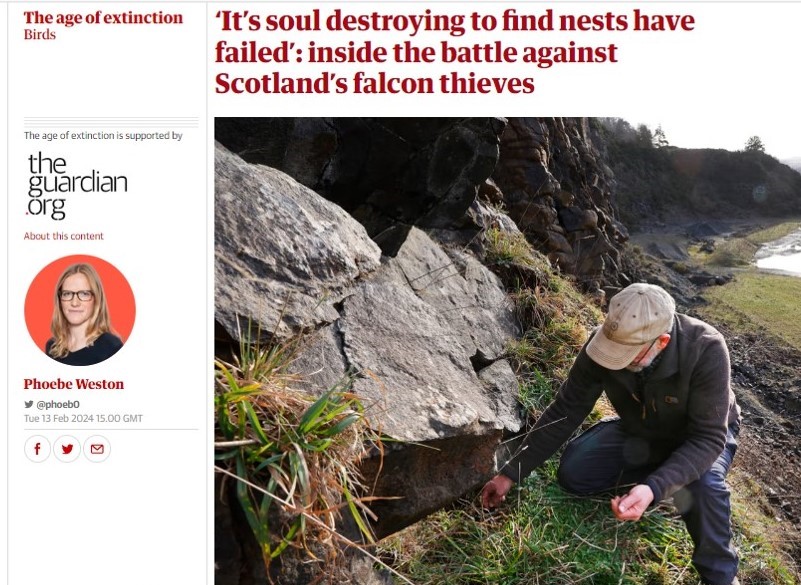
“It’s soul destroying to find nests have failed” – inside the battle against Scotland’s falcon thieves

There’s been a good deal of media interest and coverage about the recent prosecution, conviction and sentencing of part-time gamekeeper Timothy Hall and his son, Lewis Hall, for their role in the illegal laundering of wild Scottish peregrines which they sold for high prices to buyers in the Middle East (see here and here).

Most media outlets have simply summarised the press releases about Operation Tantallon issued by Police Scotland and the Crown Office, but the Guardian newspaper has published from a different angle, focusing on the work of Scottish Raptor Study Group (SRSG) member George Smith, whose 40 years of dedicated and detailed monitoring of peregrines in south Scotland helped bring the successful prosecution against Timothy and Lewis Hall.

Written by journalist Phoebe Weston, who is developing a reputation for in-depth coverage of raptor persecution crimes – e.g. her earlier three-part podcast on the illegal persecution of hen harriers on grouse moors (‘Killing the Skydancer‘) was excellent, her latest piece on the Hall peregrine case is well worth a read – see here.

It’s good to see George’s significant, long-term fieldwork receiving national attention – like so many other SRSG members, George undertakes this skilled (and licenced) work on an entirely voluntary basis but his hard-won data provide the Scottish Government and its agencies with vital detail about the distribution and abundance of raptors (in George’s case, peregrines) and help to inform long-term conservation policies.

I’m particularly pleased to see George’s work highlighted because he is one of a number of SRSG members who are repeatedly targeted online by a malicious group of individuals, some of them prominent members of the Scottish Gamekeepers Association, who deliberately and falsely accuse George and his colleagues of unlawful and negligent practices, all in a desperate bid to discredit the good name of the SRSG.

They base these vicious (and libellous) accusations on what they claim to be their concern for the raptor species being monitored/tagged.

I haven’t seen any of them comment on the successful prosecution of part-time gamekeeper Timothy Hall and his son, Lewis Hall, for their crimes against the same peregrines that George has dedicated 40 years of his life to protect.

Funny, that.

Job opportunity: Research Assistant, British Raptor Programme (Hawk Conservancy Trust)

The Hawk Conservancy Trust, a well-respected UK charity based in Hampshire, is looking for a part-time research assistant for its British Raptor Programme.

This is mainly a fieldwork position working on birds of prey and helping to manage a network of over 1,200 nest boxes for kestrels, barn owls, tawny owls and Little owls.

Full job description and application details below (closing date 20 Feb 2024):

Two red kites found poisoned in Essex – Police seize firearms & ‘other articles’ in raid

Essex Police’s Rural Engagement Team has been busy again.

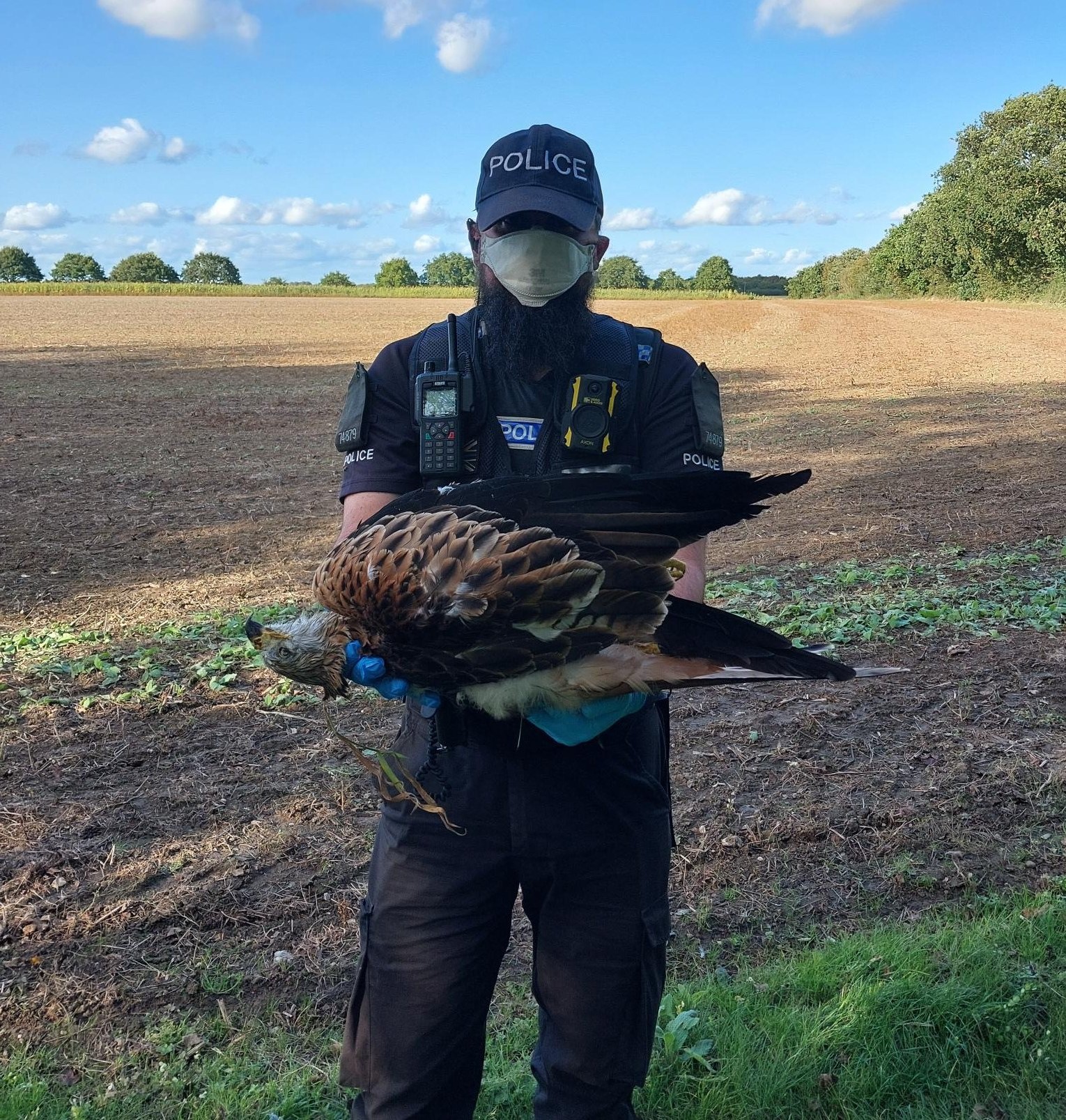
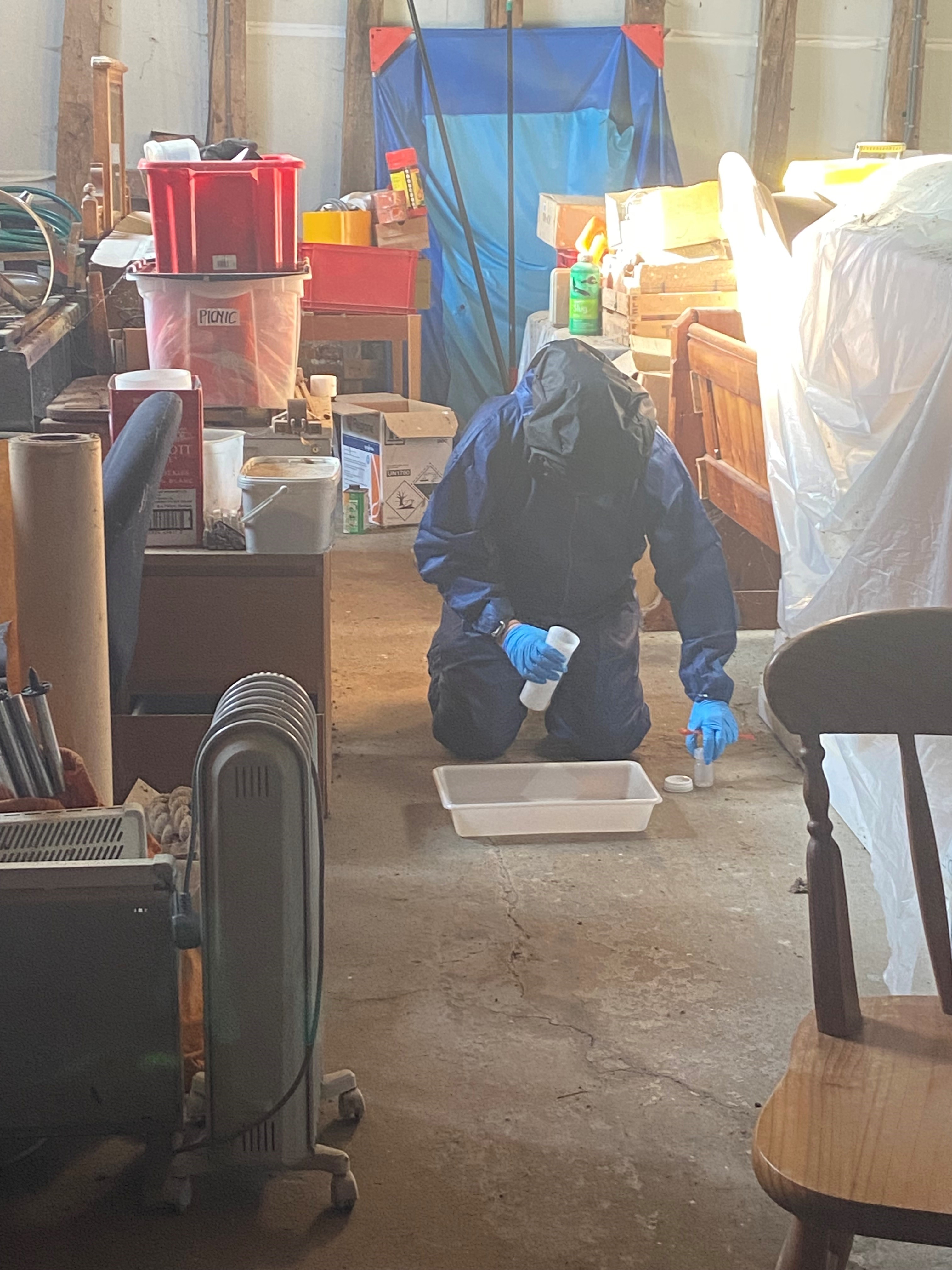
Yesterday, with assistance from other agencies including the National Wildlife Crime Unit and Natural England they searched a farm in the Colchester area after the discovery of two poisoned red kites. Firearms and ‘other articles’ were seized and the investigation is ongoing.

One of two poisoned red kites found. Photo: Essex Police

The county of Essex is becoming a real hotspot for bird of prey persecution.

Other raptor persecution crimes in recent years include the suspected shooting of a peregrine in January 2024 (here), the shooting of a buzzard in December 2023 (here), the shooting of another buzzard in January 2023 (here), the shooting of a red kite in September 2022 (here), the shooting of another red kite in November 2021 (here), another red kite found dead in suspicious circumstances in November 2021 (here), the shooting of another three buzzards in 2020, one in Dec (here), one in September (here) and one in June (here), and the suspected shooting of a Hobby in August 2020 (here).

Commentary on the staggeringly inadequate sentencing of Timothy & Lewis Hall, convicted for illegal laundering of wild peregrines in south Scotland

Further to this morning’s blog about the sentencing of part-time gamekeeper Timothy Hall, 48, and his son Lewis Hall, 23, who had previously pleaded guilty to multiple offences relating to the illegal laundering of wild peregrines stolen from nest sites across Scotland and then sold on under the guise of being legally captive-bred birds (see here), I want to write a few thoughts about this outcome.

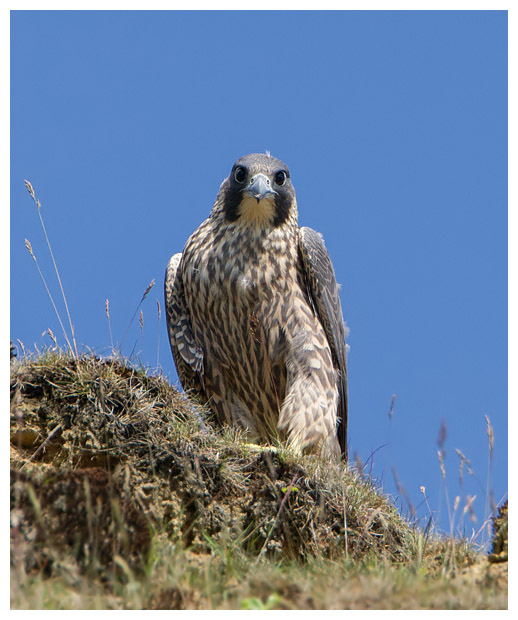
Juvenile peregrine, out in the wild where it belongs. Photo by Pete Walkden

There’s a lot to say about this case but I first want to acknowledge the multi-agency partnership working of all those involved in getting these criminals in to court. Beginning in May 2021, this investigation has been long-running, painstakingly meticulous and exceptionally diverse. The staggeringly inadequate sentences handed down today do not in any way reflect the dedicated and exemplary efforts of these agencies, all of whom deserve our appreciation and thanks.

Very well done to the Scottish Raptor Study Group (SRSG), Scottish SPCA, Police Scotland, National Wildlife Crime Unit (NWCU), Science and Advice for Scottish Agriculture (SASA) and the Animal Plant and Health Agency (APHA).

So, sentencing. We learned earlier today that Timothy Hall had been ordered to complete 220hrs of unpaid work over a period of 18 months and his son, Lewis Hall, 150hrs over a period of 15 months. They were both also banned from having birds of prey in their possession or under their control for a period of five years.

To say this is a disappointing sentence is a massive understatement. It’s not what any of us had expected, especially given that the presiding Sheriff, Peter Paterson, is no stranger to hearing wildlife crime cases (more on that below). It wasn’t as though this case was heard by an inexperienced and naïve member of the judiciary, nor that he wasn’t provided with extensive and compelling evidence about the scale of offending, which had been going on for several years and clearly met the standard of being serious and organised crime.

So why the staggeringly pathetic sentence, then?

I’m not going to try and justify it because I can’t. It’s even more inexplicable given the Sheriff’s track record. This is the Sheriff who presided over the notorious case against gamekeeper Alan Wilson in 2019, whose extensive wildlife crimes on the Longformacus Estate resulted only in an order to carry out 225hrs of unpaid work (and a 10-month curfew) – another monumentally inadequate sentence.

However, in that case Sheriff Paterson had acknowledged that Wilson’s offending warranted a custodial sentence but said that as the Wildlife & Countryside Act only allowed sentences of up to six months, and Scottish Ministers had recently introduced a presumption against jailing offenders for less than 12 months, he felt he had no choice but to impose a different sentence (here).

I argued against that logic (here), suggesting that because Wilson had been convicted of multiple offences, each carrying a maximum six month custodial penalty, a potential custodial sentence for all his offences would have exceeded the 12-month limit and so should have been imposed.

It wasn’t to be, but we consoled ourselves with the knowledge that increased penalties for wildlife crimes in Scotland were imminent (new legislation was enacted in Nov 2020), which elevated custodial sentences for certain wildlife crimes to five years in custody and unlimited fines, and so any future prosecutions would surely result in a tougher sentence, right?

Well apparently not.

There is some legitimate justification (although I don’t agree with it in this case) for Lewis Hall not to receive a custodial sentence. As of 26 January 2022 the Sentencing Young People guidelines in Scotland came into force, which argues that anyone under the age of 25 years should preferentially be given a rehabilitation order instead of a custodial sentence. However, and this is important, the guidelines state that the full range of sentencing options, including imprisonment, remains open to the court, but that a (shorter) custodial sentence should only be imposed on a young person when the court is satisfied that no other sentence is appropriate.

Given that Lewis Hall (23) was up to his neck in serious organised crime, receiving huge payments from the Middle East into his own bank account, for the sale of stolen peregrines (according to the evidence), what possible reason did Sheriff Paterson have for only imposing a sentence of 150hrs unpaid work?? It doesn’t make sense.

And as for Timothy Hall (48), I can’t see any reason whatsoever why he shouldn’t have received a custodial sentence. Under the Animals and Wildlife (Penalties, Protections and Powers) (Scotland) Act 2020, Timothy Hall’s offences, committed over a number of years, included crimes relating to Section 1 of the Wildlife & Countryside Act (Protection of wild birds, their nests & eggs) and Section 6 (Sale, possession etc of live or dead wild birds, eggs etc), both of which now attract penalties of up to five years imprisonment and significant fines. The Sheriff even agreed Hall’s crimes had passed the custodial threshold, so why only impose a sentence of 220hrs unpaid work??

It makes a total mockery of the court’s sentencing powers, of the Government’s will to crack down on wildlife crime, of the investigating agencies’ hard work, of the public’s desire to see wildlife criminals held to account and of effective deterrents put in place for other would-be criminals.

Sure, Lewis Hall is still facing action under the Proceeds of Crime legislation, and both he and his father face an ongoing investigation by HM Revenue & Customs for undeclared income (£41,164 according to COPFS), but that should have all been in addition to punishment under the wildlife crime legislation.

I just can’t comprehend how they got off so lightly. Compare and contrast with two other recent cases, where a falconer was fined over £7,000 for a minor admin error when selling legitimately captive-bred peregrines (here) and a drug addicted tree surgeon was given an eight-week custodial sentence for robbing eggs from a single peregrine nest (here).

Timothy Hall’s wife, a serving police officer whose not guilty pleas were accepted by the court in December 2023 (but has a reserved fraud charge hanging over her, see here), remains suspended from Police Scotland on full pay. I don’t know how long she’s been employed as a serving officer but the pay scale for a constable ranges from £30,039 on commencing service up to £48,237 for up to 11 years of service.

I don’t doubt the Hall family will be celebrating this evening.

Here’s Lewis Hall leaving court after sentencing, screen-grabbed from BBC Reporting Scotland this evening:

UPDATE 26 June 2024: Prosecutors seeking to recover £164,000 from Scottish peregrine launderer Lewis Hall (here)

UPDATE 10 October 2024: Scottish court orders convicted Peregrine launderer Lewis Hall to pay back thousands under Proceeds of Crime Act (here)

UPDATE 23 November 2024: Suzanne Hall, wife & mother of convicted peregrine launderers ‘no longer a serving police officer’ (here).