“I couldn’t let those words go to waste“, writes 15 year old Findlay Wilde.
If you want to know what he’s talking about, and how you can get involved, have a read of Finn’s blog HERE

“I couldn’t let those words go to waste“, writes 15 year old Findlay Wilde.
If you want to know what he’s talking about, and how you can get involved, have a read of Finn’s blog HERE

The Scottish Gamekeepers’ Association is today complaining about an alleged escalation in the vandalism of animal traps on shooting estates.
This supposed increase has been attributed to ‘activists’ and the SGA wants the law tightened up so that the alleged perpertrators can be prosecuted.
There’s widespread media coverage about it today e.g. in The National (here), The Times (here) and on the SGA website (here).
Photo of an allegedly vandalised trap (from The National)

This isn’t the first time we’ve heard such claims. Back in 2013 it was discussed during a Rural Affairs Parliamentary Committee meeting, when then Environment Minister Paul Wheelhouse acknowledged that trap tampering might be taking place but that there was no hard evidence to show how widespread the problem might be so at that time it was considered all conjecture.
In 2015 the issue was raised again by a Fife landowner and an article in the local press suggested that “Police Scotland is reporting a rise in the number of traps being tampered with“.
We challenged that claim by looking at the results of a year-long trap tampering study carried out across Scotland by BASC between April 2014 and March 2015. The results showed that the issue was not widespread at all, but seemed to centre on a handful of local areas.
Whether the problem has increased since then is hard to tell without independently collected data. The problem might have increased. It’s not hard to understand the motivation that might lead to someone damaging a trap. It might be on animal welfare grounds (someone might see a non-target species dead in a trap). It might be because someone can’t tell whether a trap is legally or illegally-set – it’s not always easy to judge. It might be because someone objects to predator control just to maximise a landowner’s profits. Or the motivation might simply be because so many cases of illegally-set traps rarely result in a prosecution, even when a known gamekeeper has been filmed setting an illegal trap. That doesn’t make trap vandalism ‘right’, we’re just saying it’s easy to understand why it might be happening.
Photo of a young red grouse killed by a lawfully-set trap (photo by RPUK)

It’s equally plausible to suggest that some gamekeepers may be deliberately vandalising one or two of their own traps and then reporting it to the police as the work of ‘activists’ in an attempt to smear those whose campaign to put game-shooting under political scrutiny is gaining such traction.
Whatever might be happening, it’s ironic that the SGA doesn’t make this much noise when cases of illegally-set traps on game-shooting estates are reported in the media.
It’s very hard (virtually impossible) for us to sympathise with the SGA when it remains silent (or concocts outlandish alternative explanations) about the on-going abuse and use of illegal traps, by gamekeepers, to target birds of prey on game-shooting estates.
Speaking of which, we’re still waiting for the findings of the SGA’s inquiries in to who set the illegal traps that were discovered on a grouse moor on Invercauld Estate last year.
Two days ago we blogged about how Natural England has delayed the release of information about the proposed reintroduction of hen harriers to southern England (see here).
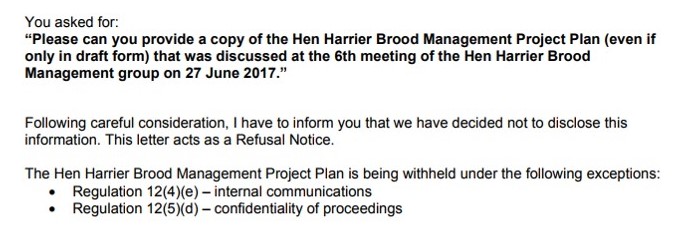
Today, we’re blogging about how Natural England has delayed the release of information about the proposed hen harrier brood meddling scheme.
Anyone seeing a pattern emerging here?
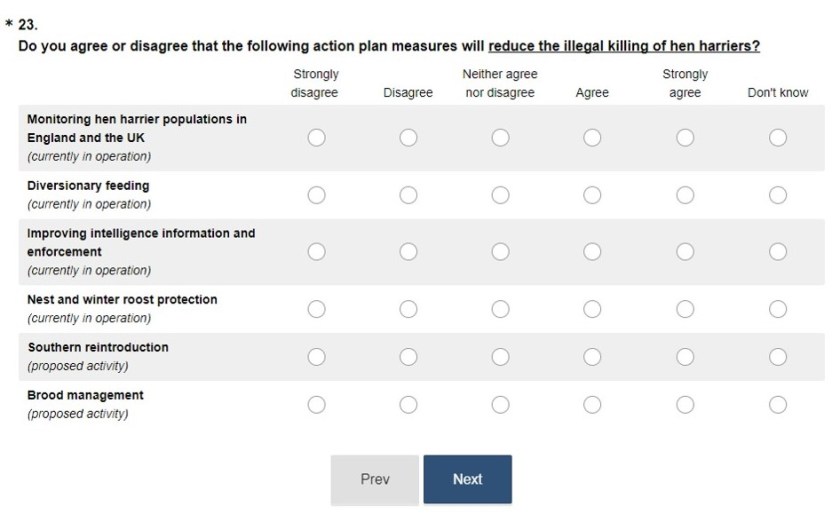
So, hen harrier brood meddling. As with the proposed southern reintroduction, brood meddling is one of six ‘action’ points of DEFRA’s Hen Harrier Inaction Plan, launched in January 2016.
As with everything-hen-harrier, Natural England has been reluctant to provide any information about the brood meddling scheme unless it’s been forced to do so under a series of FoI requests. Here’s what we’ve managed to drag out of them so far:
14 November 2016: Hen harrier brood management working group: what they’ve got planned (here)
15 November 2016: More brood meddling revelations (here)
16 November 2016: Brood meddling: the role of the International Centre for Birds of Prey (here)
22 November 2016: Brood meddling: the proposed social science study (here)

That information was released almost a year ago. Since then, despite repeated requests for information, Natural England has gone all secret squirrel and refused to tell us anything more about this highly controversial project.
In February 2017 we submitted another FoI asking for an update on brood meddling. NE responded in March 2017 telling us that the information was being withheld “as it would prejudice the process of determining the licence application and potentially the quality of that licence”. They also told us, “The discussions are confidential up until the point the licence application has been determined. Once this has happened then details of the licence are available to the public”.
We knew, from reading the minutes of an NE Board Meeting, that the brood meddling licence application (from Natural England to, er, Natural England!) had been submitted by March 2017. We didn’t understand how releasing more updates about the brood meddling scheme would “prejudice” the internal licensing process but nevertheless we gave NE the benefit of the doubt and didn’t submit another FoI for a few months.
At the end of May 2017 we submitted another FoI asking for an update on the brood meddling scheme. NE refused to provide any information because the brood meddling licence application was still being considered. NE said:
“‘The application you refer to is still being determined. I’m afraid that we do not have an estimate of when it will be”.
In early July 2017 we submitted another FoI asking for an update on the brood meddling scheme. NE refused to provide any information because the brood meddling licence application was still being considered. NE said:
“I can confirm that the licence application is still being determined and we do not have an estimate of when it will be“.
In early October 2017 we submitted another FoI asking for an update on the brood meddling scheme. NE has just responded with this:

Ah, right. Natural England is now saying it needs extra time to prepare its response “because of the complexity/voluminous nature of the request“. Are they taking the piss?! It’s only “voluminous” because NE has refused to release any information for almost a year!!
Mind you, NE’s interpretation of “voluminous” is probably very different to ours. Remember, this is the organisation that told us it couldn’t release information about the number of successful hen harrier breeding attempts in England in 2017 (n = 3) because apparently it needed a super computer to “quality assure and analyse” the data!
It’s fine. We’ve waited all year so what’s another month between friends? We can wait until the end of November and who knows, by then NE might have also responded to our requested Internal Review of its refusal to release hen harrier satellite tag data, and it might also have managed to tell us something (anything) about the latest ‘missing’ sat-tagged hen harrier that recently vanished on a grouse moor in the Yorkshire Dales National Park.
Humberside Police are appealing for information after the discovery of a dead sparrowhawk ‘with injuries consistent with being shot with a shotgun’.
It is suspected to have been killed on or around 16th October 2017 near to the quarry and Boyes Lane in Keyingham, East Yorkshire.
Anyone with information is asked to contact Humberside Police on 101, quoting ref # 175 17/10/17.

Two months ago we learned that Natural England could no longer use the long-held excuse of an impending PhD submission as reason to withhold hen harrier satellite tag data (see here) so we started to ask for the release of these 15-year-old data.
Many blog readers also took the time to contact Natural England about this (well done) and the following correspondence has been sent to us by blog reader Mike Whitehouse, detailing his exchange of views with Natural England. It’s well worth a read as an example of Natural England’s obstructive tactics and the subsequent exasperation felt by many of us.
The start point of this correspondence is shortly after Natural England released some (very) limited information, which told us how many sat tagged hen harriers were ‘missing, fate unknown’ (43 of 59 hen harriers sat tagged between 2007-2017) but, crucially, no details about the habitat types in which they’d disappeared or whether there was any suspicious geographical clustering of final tag signals.
Photo: a dead satellite-tagged hen harrier. A post-mortem revealed it had been shot.

Mike’s email to Natural England, dated 21 Sept 2017:
Good evening Natural England,
At last a smidgeon of data – limited but nonetheless welcome. Amazing what a bit of pressure can achieve isn’t it?
In your notes you say that “Hen Harriers currently breed on heather moorland in the uplands across the UK. Your patch is England and as you know full well there are no breeding Hen Harriers at all on the heather moorland in England that is reserved for grouse shooting.
There are hardly any breeding pairs anywhere in the rest of England. It is time for you to get a move on if you do not want to be reporting on exactly the same number of Hen Harriers in England as there are Dodos. Not a good advertisement for NE and all of its efforts and funding. This issue is becoming high profile and fence sitting is not going to be comfortable for you.
As you are aware there is pressure on you to give details showing the locations of the missing Hen Harriers so it is clear whether or not they disappeared in suspicious clusters in or around shooting moorland.
Just for the record, I have just spent the last 3 days in the northern Yorkshire Dales (Swaledale, Wensleydale and Arkengarthdale), I have traversed exactly the upper Heather Moorland that you refer to and I failed to see any raptors whatsoever in 3 days but several hundred Red Grouse mainly waiting on or around the roads and tracks.
How is the Hen Harrier Action Plan going and do you have any targets to see high numbers of Hen Harriers that you can report on?
I would apreciate a reply.
Mike
Natural England’s reply to Mike, dated 29 Sept 2017:

Mike’s reply to Natural England, dated 30 Sept 2017:
Thank you for your timely but disappointing response.
We are both aware that NE is just playing with words and that since NE started to tag Hen Harriers in 2002 they have been in terminal decline with just 3 successful nests in 2017. We have more spoonbills breeding in Yorkshire than we do Hen Harriers and that is despite the vast ranges of heather moorland available for Hen Harriers in our National Parks.
My last email to you was not intended as an FOI request although it was interpreted as such. Fine by me.
I would like to make a formal request for information on this occasion however.
Would you please let me know from your overall collected database since 2002 how many tags (both radio and satellite technology) stopped transmitting whilst:-
I look forward to hearing from you in a similarly timely fashion.
Regards, Mike
Natural England’s response to Mike, dated 20 Oct 2017:

[NB: We’ve cut NE’s response short to save space and because the rest of it is virtually identical to previous generic responses sent out by NE that we’ve already blogged about here].
Mike’s response to Natural England, dated 20 Oct 2017:
Dear Natural England,
Your response is absolutely bonkers and you know it is.
I have read your letter which by now, I assume, is a standard reply for anyone having the temerity to seek information from a public body such as yours. Some of us want to use the requested information constructively to help protect the Hen Harrier population in England. I wanted the information so that I could effectively lobby the 3 National Parks to get consolidated action to halt criminality on grouse moors. A laudable, if slightly ambitious aim.
You will of course be aware of the recent news from the Yorkshire Dales National Park regarding the missing/shot, but tagged, hen harrier. Time is not on their side. You are fiddling (quite literally), whilst Rome burns.
Let me challenge some of the nonsense in your reply:-
There are very many complex arguments. I think it is simple. If people with guns stopped shooting, poisoning and trapping Hen Harriers there would be more of them – there could hardly be less. I have been lucky to see Hen Harriers in the Yorkshire Dales National Park. I believe my family, their children and all visitors should have the chance or the right to this privilege. We, the general public, have rights too.
Mike
ENDS
It’s fascinating that Natural England is refusing to even release the fairly non-detailed info Mike requested about how many tagged hen harriers went ‘missing’ within the boundaries of those three National Parks. How does withholding that information ‘endanger hen harriers’? Answer – it doesn’t.
And actually, in its haste to just issue a blanket refusal, Natural England hasn’t realised that this information is already available in the limited info NE released earlier in October.
We’re not bothering to look at radio-tagged hen harriers because, as previously discussed, the technology was too poor to draw any reasonable conclusions. Instead, we’re just looking at satellite-tagged hen harriers (2007-2017).
With this in mind, here are the answers to Mike’s questions:
This doesn’t include information on the number of hen harriers that have been found dead (confirmed as illegally persecuted) within these three National Parks and neither does it include information about ‘missing’ hen harriers that were satellite-tagged by the RSPB.
Still, not to worry. Natural England reports that work on the Hen Harrier Inaction Plan is “progressing as expected“.
Yep, isn’t it just.
Cartoon by Gerard Hobley

One of the six action points in DEFRA’s Hen Harrier Inaction Plan is to ‘reintroduce’ hen harriers to southern England:

As regular blog readers will know, finding out information about this ‘let’s divert attention from illegal persecution on driven grouse moors’ scheme has been as difficult as finding breeding hen harriers on driven grouse moors. Natural England has been reluctant to share its plans with the general public and all the information we’ve gleaned so far has come from 11 months of submitting FoI requests.
Here’s what we know to date:
28 Nov 2016: Hen harrier reintroduction to southern England: an update (here)
3 Jan 2017: Hen harrier reintroduction to southern England: the feasibility/scoping report (here)
8 Jan 2017: Hen harrier reintroduction to southern England: the project group and their timeline (here)
9 Jan 2017: Hen harrier reintroduction to southern England: who’s funding it? (here)
9 Jan 2017: Hen harrier reintroduction to southern England: a bonkers proposal for Exmoor National Park (here)
12 Jan 2017: Hen harrier reintroduction to southern England: Wiltshire (here)
14 Feb 2017: Leaked email reveals Natural England’s views on Hen Harrier Action Plan (here)
23 Feb 2017: Hen harrier reintroduction to southern England: donor countries (here)
19 July 2017: Hen harrier reintroduction to southern England: new project manager appointed (here)
20 July 2017: Hen harrier reintroduction to southern England: Dartmoor as potential new release site (here)
20 July 2017: Hen harrier reintroduction to southern England: revised costs (here)
21 July 2017: Hen harrier reintroduction to southern England: project team visits France (here)
15 Aug 2017: Natural England Board making up justification for hen harrier southern reintroduction (here)
You’ll notice a four month gap in the above list (March/April/May/June 2017). This was because Natural England suddenly refused to release any further information, claiming it would “prejudice” the licensing process for the proposed brood meddling scheme. We challenged this, as the southern reintroduction project has nothing to do with the brood meddling scheme further north and so project details should be available for public scrutiny. Natural England had to agree and did release more information in July.
Photo of a hen harrier by Robin Newlin

In early October 2017, we submitted yet another FoI to ask for another update on the southern reintroduction project. Natural England has just replied, but instead of just sending through the relevant documents, we got this:
“We regret that we must extend the time limit for responding by a further 20 working days to 27 November 2017, because of the complexity/voluminous nature of the request“.
Blimey! The southern reintroduction team must have been very very very busy between July and Oct if Natural England views this request as ‘complex and voluminous’! If we were cynics, we might not believe Natural England and we might think that Natural England is just being deliberately obstructive because it doesn’t like the criticism it’s receiving from us, and from others, on its mishandling of all-things-hen-harrier.
Guess we’ll find out at the end of November whether our cynicism is justified or not, when the ‘complex and voluminous’ paperwork is released.
Earlier this month the Scottish Parliament’s Environment Committee met to discuss progress on the Scottish Raptor Study Group’s petition calling for licensing of all gamebird hunting.
The Committee agreed to write to Cabinet Secretary Roseanna Cunningham for a ‘detailed update’ on the proposals she announced back in May 2017, which included setting up an independently-led group to consider the environmental impact of grouse moor management techniques, and to recommend options for regulation, including licensing.
Since that announcement five months ago we’ve heard very little more about this, which is particularly disappointing given one of the proposals was to ‘Immediately review all available legal measures which could be used to target geographical areas of concern‘.
‘Immediate’ means occuring without delay. So has this immediate review of legal measures been completed? If not, why not? If yes, where is it?
In mid-September Roseanna Cunningham did tell the Scottish Parliament that “good progress is being made” on a number of the proposed measures and that she would “announce further details shortly“.
No further details have yet emerged.
The Environment Committee has now written to Roseanna for an update and has requested she responds by 10th November 2017.

Last week we blogged about a North Yorkshire Police search for a satellite-tagged hen harrier that had ‘disappeared’ on a grouse moor in the Yorkshire Dales National Park (see here).
We asked Natural England, on Twitter, when they would be making a statement about this. They didn’t respond.
So we emailed them. Here’s the response:
“All we can tell you at this stage is that this situation is the subject of a police investigation. We are assisting North Yorkshire Police and cannot comment further“.
Bizarrely, Natural England then sent another response a short time later:
“We have notified the police and other key stakeholders about a Hen Harrier that has stopped transmitting as we always do. We do not release proactive press statements unless we have evidence of a persecution [sic] and this is currently still an on-going investigation. Due to the transmission cycle of the tag we cannot be sure that the location of the last fix was where the tag actually stopped working. The tags only transmit for 10 hours in 58“.
Marvellous. So, no information about which hen harrier this is, where and when it was satellite-tagged, whether public funds had been used to pay for the tag, the date of the tag’s last transmission, and the name of the grouse moor where it ‘disappeared’.
It’s not clear why this information is being withheld. Understandably, if there was an impending police search, the information should not be made public so as not to jeopardise that search. But in this case, the police search had already taken place, which incidentally would have been a complete waste of time had the harrier been illegally killed on that grouse moor because, as per the NE protocol, Natural England had already sought the landowner’s permission for a police search to take place!
Photo of a police search on an unnamed grouse moor in the Yorkshire Dales National Park. Posted by North Yorks Police on Twitter, 15 Oct 2017.

Is there any other area of crime where the permission of a potential suspect is sought prior to a police search? “Oh, hi John, it’s the Police here. We have reason to believe your property is being used as a dealer’s crack den, mind if we pop round later this afternoon for a look? Would 2pm be convenient? Give you time to clear up and remove any potentially incriminating evidence before we get there”.
And what’s this about Natural England not releasing press statements “unless there’s evidence of a persecution” [sic]? That’s simply not true. Earlier this year Natural England issued a press statement about hen harrier Mick, another satellite-tagged hen harrier that ‘disappeared’ on a grouse moor in the Yorkshire Dales National Park (see here). There was no direct evidence of persecution in that case either, as Natural England lists Mick as ‘Missing, fate unknown’ in the long list of ‘missing’ sat-tagged hen harriers (44 of 59 now listed as ‘Missing, fate unknown’: that’s a massive 74.5%). It looks like Natural England is just making up its media protocol as it goes along.
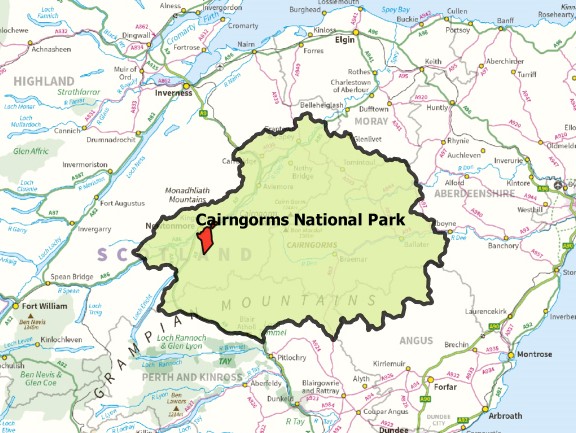
Now, compare and contrast Natural England’s current attitude to releasing information about ‘missing’ hen harriers with the RSPB’s approach. Here’s what the RSPB published when one of its satellite-tagged hen harriers, Calluna, ‘disappeared’ on a grouse moor in the Cairngorms National Park on 12th August this year.
Why isn’t Natural England being this transparent? Who is Natural England shielding? How is Natural England’s silence helping hen harrier conservation?
UPDATE:
16 November 2017: Hen harrier ‘missing’ on grouse moor in Yorkshire Dales National Park is ‘John’ – see here
There are a number of estates whose names crop up with depressing regularity on this blog, usually for all the wrong reasons.
Glen Tanar Estate isn’t one of them.
We have written about this estate over the years (e.g. here, here, here), as have others (e.g. here, here, here) but we’ve only ever had good things to say about its welcome approach to raptor conservation. Today’s blog follows that trend.
Glen Tanar sits on the eastern side of the Cairngorms National Park, an area that includes many intensively managed grouse moors and consequently is an area that continues to be plagued by illegal raptor persecution. This regional notoriety makes Glen Tanar’s positive attitude towards birds of prey even more remarkable.
[Estate boundary sourced from Andy Wightman’s Who Owns Scotland website]

Now, have a read of this blog recently written by Glen Tanar’s Wildlife Manager, Colin McClean, where he describes the grouse moor management at Glen Tanar. Colin’s approach should be a benchmark, not only for the other grouse-shooting estates within the Cairngorms National Park but for the entire UK grouse shooting industry.
We were particularly taken with his final paragraph:
“Big bags are not essential and most of our guests are happy to spend a day chatting to friends in beautiful surroundings while watching the dogs tirelessly work. Perhaps only 10-20 birds will be shot. But amidst the chat and the income, the debate surrounding grouse shooting rages on. Jobs and economy on one side, raptor persecution on the other. Political scrutiny is now intense. For me there is little political threat to grouse shooting provided the sector obeys the law of the land. There are far too many jobs involved for politicians to take action lightly. However obeying the law is a must and this remains a challenge for some. The recent review of satellite tagging of golden eagles shows an unambiguous pattern of regular disappearances above grouse moors when they rarely disappear over anywhere else. For me its not the RSPB or campaigners like Chris Packham or Mark Avery who threaten grouse shooting. They are just campaigning for the law to be obeyed. The threat to grouse shooting comes from those who refuse to abide by the law and continue to persecute raptors. If a ban ever does come about, then the responsibility for losing all the traditions, all the economy and all the jobs will lie entirely at their door“.
Last week we discovered that SNH had reported to the EU Commission in 2013 that the mountain hare was in ‘Favourable Conservation Status’ (see here).
This startling revelation was revealed after a Parliamentary question from Scottish Greens MSP Alison Johnstone. We wanted to know more detail about how SNH had made its assessment, and it seems we’re not the only ones. Alison has submitted a further Parliamentary question, as follows:
Question S5W-12001: Alison Johnstone, Lothian, Scottish Green Party, Date Lodged: 13/10/2017
To ask the Scottish Government, in light of the 2007 assessment regarding an ‘unfavourable/inadequate’ status, for what reason its 2013 Article 17 Habitats Regulations report to the EU Commission assessed the mountain hare population as “favourable”, and whether it will provide a breakdown of the (a) criteria it used and (b) the evidence it received.
Expected answer date 10/11/2017
Kudos to Alison Johnstone MSP!
The grouse-shooting industry has previously said that large scale culls no longer take place. Photographic evidence from the Cairngorms National Park in 2016 suggests otherwise.