Blog

Scottish Government under more pressure to protect mountain hares

RSPB press release:

MOUNTAIN HARE CULLS CONTINUE DESPITE A PERIOD OF “VOLUNTARY RESTRAINT” SAYS SCOTTISH WILDLIFE ORGANISATIONS

A coalition of ten environmental and outdoor organisations have repeated their appeal to the Scottish Government to introduce urgent safeguards for mountain hare populations.

The group (1) is asking for a temporary ban on all mountain hare culling on grouse moors until measures are put in place to ensure their numbers can remain at acceptable, sustainable levels.

The Scottish Government has a duty to maintain mountain hare populations in a state of good health, otherwise it may be in breach of its legally binding international obligations for this species. However, mountain hares are now routinely culled on a large scale across many grouse moors in Scotland (2).

In 2014, the coalition warned the Scottish Government that the ‘voluntary restraint’ that was claimed to be in place was unlikely to protect these mammals from wide-scale culls on grouse moors, including in the Cairngorms National Park.

Since then, there have been multiple reports of culls being carried out across the country – suggesting that voluntary restraint has been ignored. These culls are believed to be having a serious negative effect on hare populations. In some areas it has been shown that the culls are leading to severe population declines and potentially even local extinctions.

Duncan Orr-Ewing from RSPB Scotland, said: “The Scottish Government needs to do more to safeguard these iconic species of our upland areas. In 2014 we had serious concerns that the notion of voluntary restraint would be ignored by many in the grouse shooting industry and, with the evidence of culls continuing on many moors over the last three years, it seems that these fears have been well founded.

The start of the mountain hare season has already begun meaning hare populations will continue to be put at risk by unregulated culls that we believe, are resulting in localised disappearance of hare populations. We still do not know what impact these large scale culls are having on mountain hares’ wider conservation status and this could mean that the Scottish Government may be in breach of its legally binding international obligations for this species.

We trust that this issue will also be considered by the forthcoming independently led expert group, announced by the Cabinet Secretary for the Environment at the end of May 2017, which will be looking at how grouse moors can be managed sustainably and within the law.

Susan Davies, Director of Conservation, Scottish Wildlife Trust said: “Mountain hares are an iconic species that act as an indicator of the ecological health of our uplands, and seeing them gives much pleasure to hillwalkers and tourists alike.

“There has been continued and widespread culling throughout the period of voluntary restraint that was called for three years ago to allow research to be carried out. This suggests that some grouse moor managers have no concern for the long-term viability of mountain hare populations.

“We believe that grouse moor managers have a responsibility for this important native species. Lethal control should be halted until there is both accurate information on the number of hares culled, and the true effect of these culls on the health of the hare population is known.”

Alison Johnstone MSP said: “The mountain hare is a true icon of our upland areas and an important part of our natural heritage. The unnecessary and unregulated culling of mountain hares on intensive grouse moors across Scotland is damaging populations of this species beyond recovery. I have previously asked the Cabinet Secretary to ban these culls, at the very least in our National Parks and I support the call from these 10 organisations for the government to do more to safeguard populations of mountain hares and implement a moratorium on culls until work can be carried work to assure those concerned that any necessary mountain hare management can be sustainable.”

Notes for editors:

  1. The organisations which make up the coalition are: RSPB Scotland, Scottish Wildlife Trust, Scottish Raptor Study Group, Badenoch and Strathspey Conservation Group, Cairngorms Campaign, National Trust for Scotland, Royal Zoological Society of Scotland, Mammal Society, John Muir Trust and Mountaineering Scotland.
  2. Mountain hares are protected against unsustainable and indiscriminate killing by the European Union’s Habitats Directive. However, they are now routinely culled on a large scale on many grouse moors. This practice has developed relatively recently, in the belief that it protects red grouse against the tick-borne louping ill virus and so increases the surplus of grouse to be shot at the end of the summer, despite the lack of scientific evidence to support this claim.
  3. The mountain hare is Britain’s only native hare and plays a vital part of the complex ecosystem of Scotland’s uplands and moorlands, including acting as an important source of prey for golden eagles, one of Scotland’s most well-known birds.
  4. Mountain hares are understood to spread very slowly from one area to another, meaning culls may have significant detrimental impacts on local populations.
  5. In December 2014, Scottish Natural Heritage (SNH) along with other partners, announced the beginning of a three year study to trial methods of measuring mountain hare numbers to better inform their monitoring, how to assess their population status, and identify appropriate management measures. As part of this, SNH called for a voluntary restraint of large scale mountain hare culls on grouse moors.

ENDS

It’s great to see continued pressure being placed on the Scottish Government, and we’re especially pleased to see Mountaineering Scotland add its voice.

The Scottish Government (and it’s statutory conservation agency SNH) is exhibiting wilful blindness over this issue. There’s no other explanation for it. The Scottish Government has repeatedly said it does not support mass culls of mountain hares, and three years ago called on grouse moor managers to practice ‘voluntary restraint’ – a request that has been blatantly ignored by the grouse shooting industry, who have denied there is even a need for it (see here). And yet still the Scottish Government has not acted.

We’ve recently discovered that SNH has reported to the EU Commission that the mountain hare has favourable conservation status, despite strong scientific evidence (particularly from Dr Adam Watson) of local population declines. We are waiting for SNH to provide more detail of the scientific evidence it used to make this assessment because frankly, given the paucity of information on population size, we don’t understand how SNH was able to reach this conclusion.

The Scottish Government has committed to investigate the issue of mass hare culling on grouse moors, as part of the independent review of grouse moor management that was announced in May 2017. However, five months on we haven’t seen any sign of progress on this review – as far as we’re aware the panel hasn’t even been named, let alone the actual review getting underway.

Meanwhile, open season on mountain hares has come around again and we can expect to see more unregulated massacres taking place across many driven grouse moors, all in the name of ‘sport’.

Media coverage:

BBC news here

Mammal Society here

Scottish Gamekeepers Association here

Scottish Moorland Group here

Podcast interview with RPUK blogger Ruth Tingay

For anyone who might be curious….

This podcast was recorded last week (thanks to Charlie Moores, digital media producer at LUSH).

To listen, please click HERE

Scot Gov says mountain hare has favourable conservation status – but on what evidence?

Last month, Alison Johnstone MSP lodged a series of parliamentary questions relating to the conservation status of mountain hares (see here), including this one:

Question S5W-11180: Alison Johnstone, Lothian, Scotish Green Party. Date lodged: 8/9/2017.

To ask the Scottish Government what reports it has made to the EU Commission in the last 10 years regarding the population status of mountain hares, and what summary conclusions these included regarding the species’ health.

Dead mountain hares being transported on Farr Estate, Feb 2017 (photo by Pete Walkden)

As many of you will know, the mountain hare is listed on Annexe V of the EU Habitats Directive (1992), which requires member states to maintain this species in favourable conservation status. The Scottish Government has a legal obligation to report to the European Commission on the health of the mountain hare population.

The Scottish Government’s answer to Alison’s parliamentary question is surprising, to say the least:

So, although SNH (the Scottish Government’s statutory conservation advisor) has absolutely no idea what impact the mass culls have on the mountain hare population (because, unbelievably, there is no legal requirement for estates to provide cull return data to SNH outside the close season, and, there isn’t yet an agreed survey method for monitoring mountain hares), and given the on-going concerns about documented mountain hare declines (e.g. see here), the Scottish Government has told the European Commission that mountain hares have a favourable conservation status.

How on earth has SNH reached that conclusion?

What’s missing from this parliamentary answer is any of the required detail needed to understand SNH’s assessment of the mountain hare’s conservation status. For example, what criteria, exactly, did SNH use to assess each of the four parameters (range, population, habitat, and future prospect)? Presumably there’s a certain threshold that must be reached for each individual parameter before the mountain hare can be considered to be in ‘favourable conservation status’? What were those thresholds and what scientific evidence, exactly, did SNH use to determine whether those thresholds had been met?

The answers to Alison’s other parliamentary questions were as follows:

Yet another buzzard found shot in North Yorkshire

The reputation of North Yorkshire as a raptor persecution hotspot is well known. Here’s yet another victim to add to the long, long list….

This buzzard was found injured at Dunnington (a village to the east of York) on 29 September 2017. It was taken to the vets where an x-ray revealed shotgun pellets lodged in the bird’s head and wing. Based on the extent of its injuries, the bird was euthanised.

Anybody with information about this crime, please contact PC Jez Walmsley at Malton Police Station (Tel. 101).

Images courtesy of Jean Thorpe.

Peregrine found shot in Cambridge

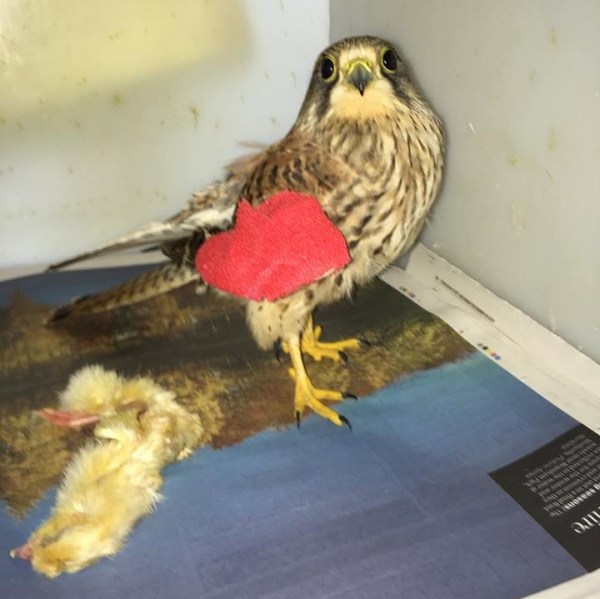
Police are appealing for information after the discovery of a shot peregrine on the outskirts of Cambridge.

The young bird was discovered injured on 18 September 2017 and was reported to the Raptor Foundation. A veterinary x-ray revealed a pellet from an air rifle lodged in its shoulder and a metal fragment also lodged in its wing, preventing the bird from flying. Vets believe the bird could have been shot up to 10-14 days earlier based on its low weight.

Information from the peregrine’s leg ring revealed this bird fledged from a nest on the outskirts of Cambridge earlier this year.

The peregrine is currently receiving expert care at the Raptor Foundation but it’s not yet known whether it will recover sufficiently to be released back to the wild.

PC Alun Bradshaw of Cambridgeshire Police is urging anyone with information to come forward. Tel 101 and use incident reference number CF0539270917.

Media coverage:

Cambridge Independent News here

BBC News here

RSPB Investigations blog here

ITV news here

The Natural England Hen Harrier satellite tag cover up: part 2

Last month we blogged about how Natural England is continuing to withhold information about the last known locations of 43 hen harriers that were satellite-tagged between 2007 – 2017 and that are listed by Natural England as ‘Missing, fate unknown’. Natural England’s explanation for what might have happened to these ‘missing’ hen harriers included a suggestion that they could have died on their backs, thus preventing the tag from transmitting further data. Unbelievably, Natural England did NOT suggest that illegal persecution on driven grouse moors might be a contributory factor in these disappearances (see here). This is plainly absurd. We know that Natural England acknowledges illegal persecution on driven grouse moors is the main cause of this species’ catastrophic decline, otherwise why instigate, as part of the Hen Harrier Action Plan, the controversial brood meddling scheme on, er driven grouse moors?

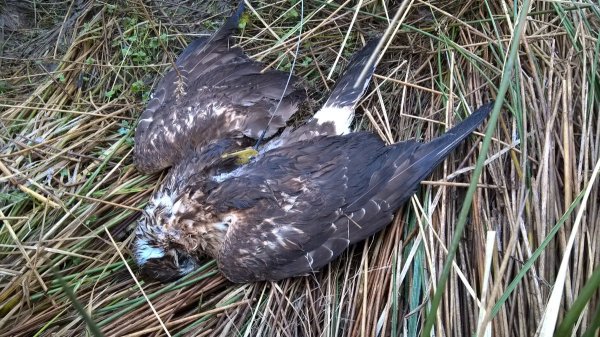
Photo: a dead, satellite-tagged hen harrier. A post-mortem revealed it had been shot.

We argued that Natural England has a duty to release this information as the tags (and their data) have been paid for by us, the tax-payers, as part of a 15-year study on hen harrier dispersal, a project for which the public has seen no meaningful output/results. We also argued that by continuing to withhold these data, Natural England is either being incompetent or being deliberately obstructive, or both. The intention is clearly to shield the criminals within the driven grouse shooting industry.

We suggested that at the very least, Natural England could publish a map showing the locations and habitat type of where these 43 ‘missing, fate unknown’ hen harriers went off the radar, at such a resolution that it wouldn’t compromise sensitive nest/roost site locations. By doing this, we might be able to detect some patterns to see whether these hen harriers disappeared at random locations across the landscape (which you’d expect if the birds had died on their backs of natural causes) or, rather like satellite-tagged golden eagles, they disappeared in suspicious clusters in certain grouse moor areas.

We encouraged blog readers to submit formal FoI requests to Natural England to ask for the release of these data. Many of you did – well done, and thank you. Over the last week or so, Natural England has been sending out a generic response to these requests, as follows:

Needless to say, we don’t accept this explanation.

Fist of all Natural England claims not to hold the maps. Eh? Are they trying to tell us that after 15 years of study, nobody, not even the PhD student that was supposed to be analysing these data (and who, we were told at various conferences over the years, was ‘on the verge’ of submitting his thesis), has ever bothered to map the last known locations of these ‘missing’ hen harriers?!! And even if that is the case (which seems highly implausible), all Natural England has to do to generate such a map is to input the location of the last known sat tag signals in to a simple GIS programme and voila! There’s the map! This would take an undergrad less than five minutes to complete.

Natural England then claims that the release of these data would ‘endanger hen harriers’. Er, these hen harriers are already dead (probably)! NE claims that the data would ‘compromise the locations of sensitive breeding and roosting sites’. Not if the data were released at such a low resolution that the actual sites couldn’t be identified.

Natural England then argues that the data are ‘intended to be used to collaborate with highly respected academics’ (and who might they be?) and that these academics need ‘a safe space to do the research’. Eh? How would releasing partial, low resolution data threaten the academics’ ‘safe space’ (whatever that may be)?

We could go on. However, let’s cut to the chase.

The bottom line is that we disagree with Natural England’s reasons for continuing to withhold the data and we intend to challenge them on it. The next step in this process is to complain to Natural England about this response and ask Natural England to undertake an ‘internal review’. Natural England then has a duty to ask another member of staff to review NE’s original response.

If the internal review results in the same decision (i.e. that NE will continue to withhold the data), then the next step after that will be to submit an official complaint to the Information Commissioner.

However, before we can complain to the Information Commissioner, we have to exhaust the official route of complaining to NE and asking for an internal review.

So, if you’ve received one of these letters (as above) from Natural England, we’d encourage you to write back to them and say you find NE’s original response unsatisfactory (and explain why), and ask for a formal internal review.

Thank you.

Raptor persecution in the Peak District National Park: last night’s programme

The BBC’s Inside Out programme last night featured an excellent piece on driven grouse shooting and its association with illegal raptor persecution in the Peak District National Park.

If you missed it, it’s available to watch on BBC iPlayer here for the next 29 days.

There were some great quotes, that we’ll record here for posterity:

Tim Birch (Derbyshire Wildlife Trust): “People love this place. And it is a national disgrace that we do not have the kind of birds of prey that should belong back in this landscape“.

Mistress of the understatement, Blanaid Denman (RSPB Skydancer Project): “Six years ago in 2011 there were four successful [hen harrier] nests in England. This year there were three. So I think it’s safe to say things are not going very well“.

Mark Avery (talking about driven grouse shooting): “More and more people are becoming aware of the problems and agitated about what’s happening in our National Parks“.

Andy Beer (Midlands Director, National Trust) talking about the NT’s advertisement for a new tenant on the Hope Woodlands & Park Hall Estate following the imminent removal of their current tenant:We won’t settle for a partner who we can’t have 100% confidence in. We haven’t been prescriptive in our tender about whether it should be driven grouse shooting or not, but certainly very intensive forms of land use are difficult to square with our outcomes, including increasing numbers of birds of prey“.

The current shooting tenant at Hope Woodlands & Park Hall Estate (believed to be Mark Osborne) apparently declined to comment about the removal of the shooting lease.

Steve Bloomfield (Director of Operations, BASC), talking about raptor persecution: “We’ve seen people that have broken the law. There’s always a minority in any profession that brings it in to disrepute, and we want to get rid of them from our profession“. Fine words, but what action, exactly, has BASC ever taken to oust the criminals from the grouse shooting industry? Perhaps if BASC spent more time focusing on that instead of campaigning with the Countryside Alliance to get Chris Packham silenced (e.g. here, here, here), or if the BASC Chairman (in his capacity as a lawyer) hadn’t defended the right of a gamekeeper to keep his firearms certificates even though the keeper was known to have placed poisons in an underground stash on a grouse moor (here), Steve Bloomfield’s statement might be more credible.

Surprisingly, the Moorland Association, which represents grouse moor owners, did not make an appearance in this film, but apparently told the BBC it “fully supports efforts to encourage numbers of hen harriers“. Really? Is this the same Moorland Association whose Director said last year,

If we let the hen harrier in, we will soon have nothing else. That is why we need this brood management plan“.

One other interviewee worthy of mention here was a chap called Ian Gregory, listed as ‘grouse shooting spokesman’. We don’t know if this is the same Ian Gregory as the Ian Gregory from You Forgot the Birds but judging by the poor quality of his comments in last night’s film, it may well be.

Commenting on footage of a Moscar Estate gamekeeper trying to release a badger from a snare by shooting at the snare, Ian Gregory said:

In these pictures we’re seeing a badger being released from a trap which was intended for foxes. Foxes are a nightmare for ground-nesting birds and that’s the reason that gamekeepers try to reduce the number of foxes that we have“.

Apart from revealing his woeful ignorance of ecological food webs, Ian Gregory forgot to mention that snares must never be set on runs where there is evidence of regular recent use by non-target species such as badgers, as they may be caught or injured by the snare. And, according to BASC’s Code of Best Practice, ‘Knowledge of the tracks, trails and signs of both target and non-target species [i.e. badgers] is essential. If you are not competent in identifying the tracks, trails and signs of non-target species, you must not set snares‘.

As an aside, it’s worth reading former Police Wildlife Crime Officer Alan Stewart’s blog about the CPS’s decision not to prosecute the Moscar Estate gamekeepers, here.

Ian Gregory had more unsubstantiated tosh to impart to the viewer. Talking about hen harriers, he said:

There is a problem about their populations in the UK. Some of that may be down to illegal activity but it’s also down to the pressure of human beings wanting more places for recreation, more countryside for recreation, more for their homes, so it’s not just a question of persecution, this is a much more complicated issue“.

Ah, so the demand for new housing on driven grouse moors is responsible for the catastophic decline of breeding hen harriers in England? And the scientific evidence for that claim is…..where, exactly? We had a look in the Conservation Framework for Hen Harriers which set out very clearly that illegal persecution was the biggest single factor affecting the hen harrier population’s chance of survival. Funnily enough, new housing estates being built on grouse moors didn’t feature.

All in all, this was an excellent film by the BBC’s Inside Out film and even more members of the public will now be aware of the disgraceful activities of the grouse shooting industry.

If you haven’t already done so, please consider signing this new e-petition calling for a ban on driven grouse shooting. PLEASE SIGN HERE.

Environment Committee to seek ‘detailed update’ on gamebird shoot licensing petition

As mentioned on yesterday’s blog (here), the Scottish Parliament’s Environment Committee met this morning and discussed progress on Logan Steele’s petition (on behalf of the Scottish Raptor Study Group) calling for the introduction of a licensing scheme for gamebird hunting.

The discussion was over in a flash and the Committee agreed to keep the petition open and write to the Scottish Government / Cabinet Secretary for a “detailed update” about the progress that has been made on the proposed package of measures announced by the Cabinet Secretary in May 2017, including the establishment of an independent group to look at the environmental impacts of grouse moor management.

Good. We’re all eager to hear about what progress has been made.

Well done, Environment Committee, for not letting this slip off the radar.

Ban driven grouse shooting – new petition launched!

Persistence is a beautiful thing….

Gavin Gamble has lodged a new epetition on the UK Government website calling for a ban on driven grouse shooting [in England]:

Gavin has also set up a website to provide further background reading on this issue – here

Mark Avery blogged about the imminent launch of this new petition last week, while the Westminster Petitions Committee was still checking that it met the required petition standards. His blog attracted a fair few comments and they’re well worth a read.

Gavin’s petition has now gone live and will be open until 2 April 2018 (assuming there isn’t another general election before then in which case the petition will be closed early).

PLEASE SIGN THE PETITION HERE

Gamebird shoot licensing: Environment Committee to review progress tomorrow

The Scottish Parliament’s Environment, Climate Change & Land Reform (ECCLR) Committee will meet tomorrow to discuss progress on the petition calling for the introduction of state-regulated licensing for gamebird hunting.

As you know, this petition was lodged with the Public Petitions Committee in the summer of 2016 by Logan Steele, on behalf of the Scottish Raptor Study Group (SRSG). The Petitions Committee took evidence in October 2016 from the SRSG and RSPB Scotland (see here) and then evidence from the Scottish Moorland Group and BASC in December 2016 (see here) before deciding to pass the petition to the Environment Committee for further consideration.

The Environment Committee first considered the petition in January 2017 (here) and then heard evidence from various organisations (SRSG, RSPB Scotland, SNH, SGA and SLE) in April 2017 (here).

On the basis of those evidence sessions, on 23 May 2017 the Environment Committee agreed to keep the petition open and to write to Environment Secretary Roseanna Cunningham (see letter here) to recommend that the Scottish Government explores the implementation of a licensing scheme for grouse moor shooting, much to the disappointment of the grouse shooting industry which doesn’t think licensing is necessary and basically just wants to maintain the status quo.

The following week, on 31 May 2017, the Environment Secretary announced a significant package of measures designed to protect raptors and to investigate the wider environmental and economic impacts of grouse moor management:

Since that announcement on 31 May 2017 we’ve heard very little more, although in mid-September Roseanna Cunningham told the Scottish Parliament that “good progress is being made” and that she will “announce further details shortly“.

Perhaps we’ll get an announcement this week? It’s good to see the Environment Committee isn’t letting this issue slide.

Tomorrow’s meeting will be available to watch live on Scottish Parliament TV (here) (Committee Room 1 from 10am) and we’ll post an archive of the video and the official transcript when available.

UPDATE 3 October 2017: Environment Committee to seek ‘detailed update’ on licensing petition (here)