Langholm community buy-out successfully doubles size of Tarras Valley Nature Reserve

Joint press release from the Langholm Initiative and Buccleuch (5th August 2022)

Community makes history as South Scotland’s biggest land buy-out gets over the line to double size of nature reserve

The South of Scotland’s largest community buyout is set to double in size having defied the odds and “achieved the impossible” for a second time in two years, following one of the most ambitious community fundraising campaigns ever seen. 

[Tarras Valley Nature Reserve being transformed from a knackered, privately-owned grouse moor. Photo by Ruth Tingay]
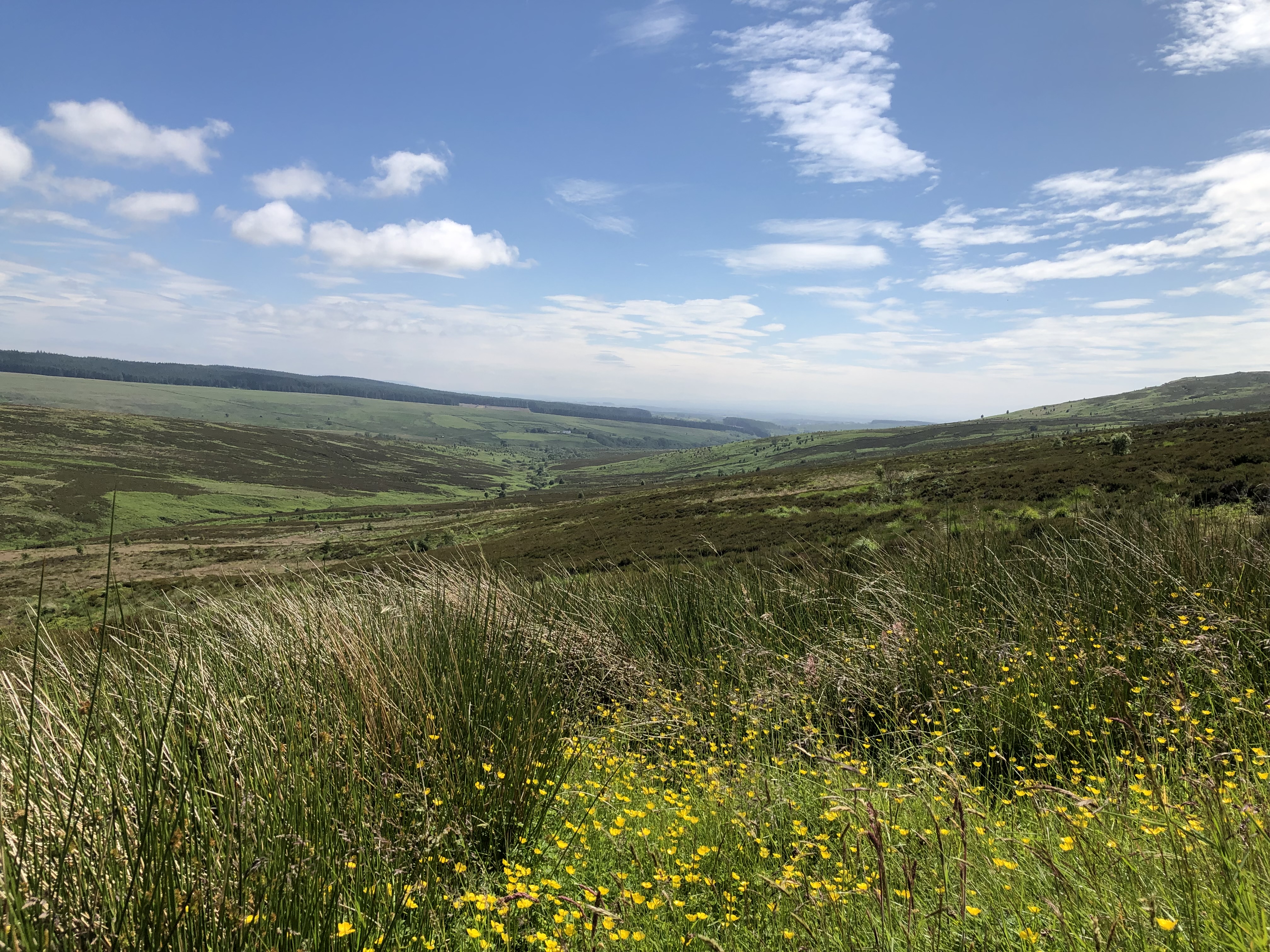
A historic agreement for 5,300 acres of land and three properties between The Langholm Initiative charity and Buccleuch will now go ahead, after the Dumfriesshire town of Langholm successfully reached its goal of £2.2m by the 31 July deadline. 

This will double the size of the Tarras Valley Nature Reserve, created last year after the buyout’s first stage raised £3.8m to purchase an initial 5,200 acres and six residential properties from Buccleuch. The reserve aims to help tackle the nature and climate crises, while boosting community regeneration.

Success for the buyout’s second stage was only confirmed as the deadline was reached. In the closing days, thousands of pounds continued to pour into the public crowdfunder. There were significant donations of £300,000 from Alex Gerko, Founder of algorithmic trading firm XTX Markets, £100,000 from Anne Reece of the Reece Foundation, and £50,000 from John Muir Trust. 

Jenny Barlow, Tarras Valley Nature Reserve’s Estate Manager, said: “We are so grateful to every single person who has backed this beacon of hope for people and planet – together we have achieved the impossible. It’s been a rollercoaster, but the generosity and unwavering support of so many wonderful donors and volunteers have got us over the line in the nick of time.

This is about a grassroots fightback against the climate emergency and biodiversity crisis, and helping to create a better future. We are doing something so special here, and our expanding reserve is an amazing opportunity for people to visit this part of the world and be inspired by the wonders of nature.

Benny Higgins, Executive Chairman of Buccleuch, said: “We are absolutely delighted for The Langholm Initiative and have been pleased to work with them and support their project every step of the way. This successful outcome is testament to what can be achieved by people working together constructively. 

When Buccleuch launched its community consultation on the proposed sale of 25,000 acres of land on Langholm Moor, we couldn’t know what the community’s aspirations would be. To see The Langholm Initiative grow the Tarras Valley Nature Reserve from the initial 5,200 acres to almost double that is fantastic, and we look forward to seeing the evolution of the project over the coming years.

On the reserve, globally important peatlands and ancient woods are to be restored, native woodlands expanded, and a haven ensured for wildlife including rare hen harriers. Community regeneration through a nature-based approach is a central aim, with six new jobs already created. Langholm was once a thriving textile centre, but the industry has declined in recent years.

[Thirteen hen harrier chicks fledged successfully on the moor this year. Two have been fitted with satellite tags by the RSPB thanks to a crowdfunding effort by the charity Hen Harrier Action]
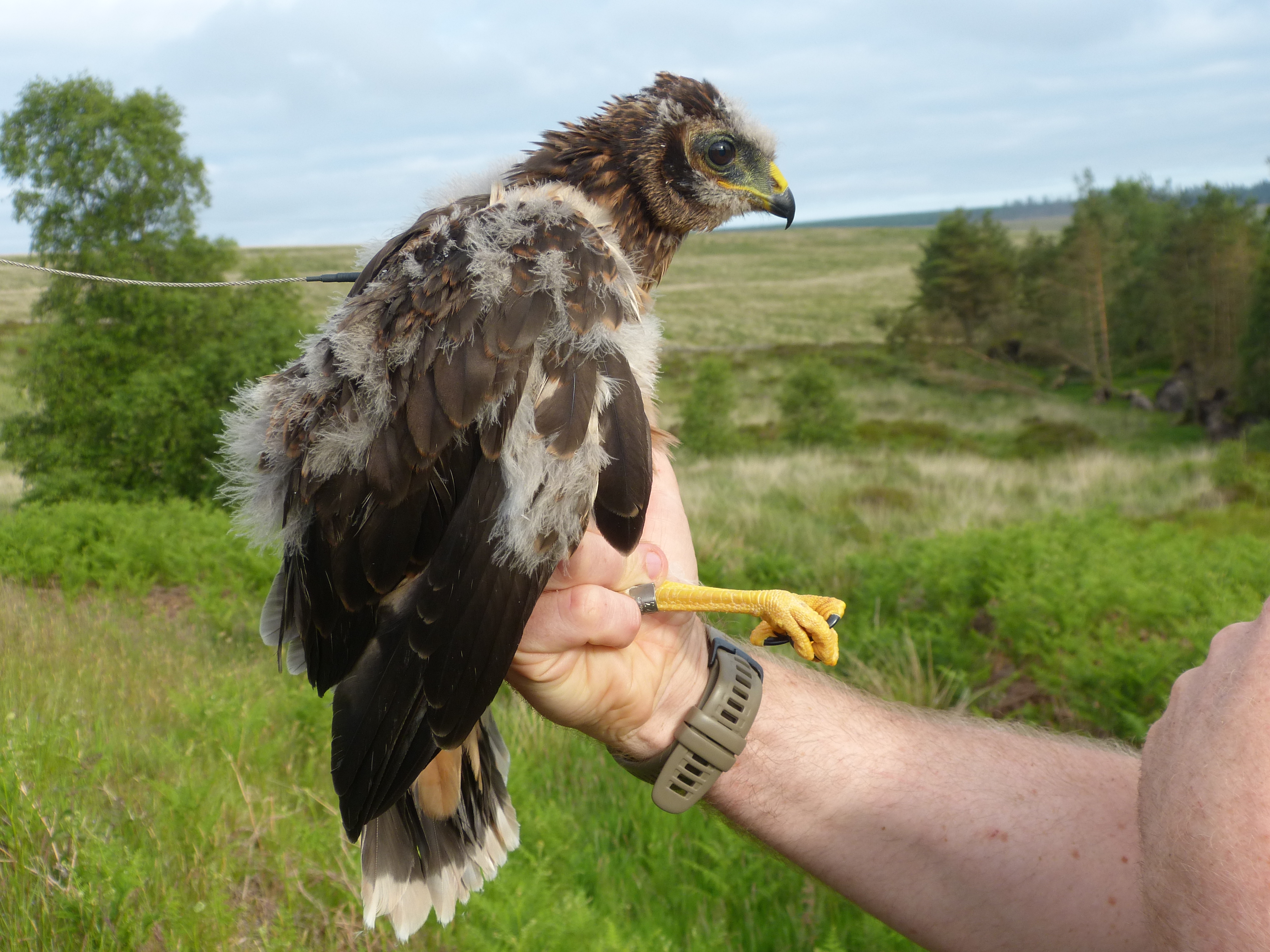
In June, the Scottish Land Fund awarded The Langholm Initiative £1 million towards the buyout, while an anonymous private donor made a donation of £500,000 at the appeal’s launch last October.

Nearly 3,000 people have donated to the crowdfunder since it launched nine months ago, taking it past its £200,000 stretch target to reach over £242,000. Tens of thousands of pounds poured in during the final weeks alone.

Margaret Pool, Trustee of The Langholm Initiative, said: “The generosity of so many people locally, nationally and worldwide has been amazing. Our heartfelt thanks go to every donor, supporter and volunteer who helped us overcome what so often felt like impossible odds. We are also very grateful to Buccleuch for their ongoing positive engagement, which was absolutely crucial.

Every single pound donated to the crowdfunder counted. Each donation kept this impossible dream alive, while major donors could see from the outpouring of support that this was an inspiring, serious project of hope.

This is a historic result for our community now and for future generations. We also hope our story will inspire other community-led nature recovery projects across Scotland and beyond. We know that communities can be powerful forces for positive change.

Buccleuch has supported the community bid, agreeing with The Langholm Initiative a fixed purchase price in 2019 and extending purchase deadlines to give more time for fundraising. The purchase will be legally finalised between the community and Buccleuch over the coming months.

Leading charities that have backed the buyout include Borders Forest Trust, John Muir Trust, Rewilding Britain, RSPB Scotland, Scottish Wildlife Trust, Trees for Life, and the Woodland Trust.

The Langholm Initiative was formed in 1994 as one of south Scotland’s first development trusts. It facilitates projects making a lasting difference to the local area and people. See langholminitiative.org.uk.

ENDS

This is brilliant news! Huge congratulations to the community buy-out team for an impressive fundraising-drive to support their vision for this land.

I have to say it’s more than galling to see Buccleuch trying to take some credit in all of this given the feudal history of this land (e.g. see here and here).

Nevertheless, I’m delighted that so many people have shared and supported this effort by the local community and that the buy-out has been completed (all bar the final paperwork).

Good riddance to Langholm Moor, a privately-owned grouse moor managed for the benefit of the privileged few and hello to the Tarras Valley Nature Reserve, publicly-owned and managed for the benefit of all people and wildlife.

Expert witness for the prosecution of gamekeeper Rhys Davies brands Millden Estate a “wildlife sink”

An expert witness whose evidence was used in the successful prosecution of gamekeeper Rhys Owen Davies has branded Millden Estate a “wildlife sink“, according to an article in The Daily Record.

Mammal ecologist Andy Riches provided an expert report for the Scottish SPCA based on a number of surveys and visits to Millden Estate.

His report summary reads as follows:

The ecology of this area of land has been driven out of balance by its management. The direct effects of this have been outlined above but there is an indirect effect as well. By reducing the numbers of ‘prey’ species the management greatly increases the risk to the game birds from ‘predatory’ species. In the absence of adequate natural prey game birds are the principal available source of food. Because much of the neighbouring land (including the Cairngorms National Park) is wildlife rich this estate acts as a ‘wildlife sink’. Population pressure and natural inquisitiveness encourages wildlife to try to explore this area. Those that make it in will rarely leave alive. Land mammals are mostly either successfully excluded by fencing or killed by trapping or shooting. Birds are the only group that can regularly successfully cross the fencing. They find an area with extremely limited prey apart from the game birds.
I can best describe this estate as a zoo with three compounds. Each one is excellently managed for the species it was intended to contain but to the total exclusion of everything else‘.

This summary will come as no surprise to anyone who has read the report I co-authored with Andy Wightman for the REVIVE coalition in 2018 about the increased intensity of grouse moor management in Scotland, a report in which Millden Estate featured. This increase in management intensity has occurred in the last decade or so because the so-called ‘success’ of a grouse moor (and its economic value) is measured by the number of red grouse shot each season (known as the ‘bag size’).

But as regular blog readers will know, in order to produce artificially-high densities of red grouse for shooting, other species on the moor are ruthlessly and systematically killed. Much of this killing is lawful.

The intensity of moorland management at Millden Estate was further exposed in another report by REVIVE, this one commissioned by the League Against Cruel Sports and published in 2020.

Hanged By the Feet Until Dead‘ was a report analysing the extent of lawful traps and snares that had been recorded during a field survey of a number of Scottish moorland estates between June 2018 and September 2019, including Millden Estate.

The findings on Millden Estate were damning.

This image shows the extent of the legal traps and snares across the estate and the table below documents the data produced from the field surveys:

There’s a good quote at the end of the ‘wildlife sink’ article in the Daily Record, provided by Robbie Marsland, Director of the League Against Cruel Sports (Scotland) and a partner in the REVIVE coalition:

The case of [Millden Estate gamekeeper] Rhys Davies is utterly appalling but if any positives can be drawn from it, it’s the scrutiny this estate and others will now be under, making the Scottish Government’s proposed licensing of grouse moors even more timely and necessary.

There’s also a quote from an unnamed spokesman for Millden Estate:

The estate does not condone or tolerate any illegal activity relating to the welfare of animals or wildlife. We were shocked to learn of all the allegations when they came to light“.

I’ll be blogging about this statement shortly.

Two others involved in animal fighting ring with Millden gamekeeper Rhys Owen Davies escaped jail

Further to the news that Rhys Owen Davies, 28, a gamekeeper employed by Millden Estate in the Angus Glens, has been jailed for sadistic animal cruelty crimes (see here and here), there has been quite a lot of comment about the perceived leniency of his sentence and questions about whether his dog-fighting associates are being prosecuted.

Although an eight-month custodial sentence, plus an £1800 fine for firearms offences and a 15-year ban on keeping or owning dogs does seem quite lenient given the depravity and cruelty of his crimes, Rhys Owen Davies has actually received the most severe punishment, so far, of those involved.

Two of his associates have already been convicted and sentenced:

Antony Holloway, 28, was given a 270-hour community payback order at Dumbarton Sheriff Court in June 2021 and banned from owning dogs for just four years – despite ­prosecutors and the Scottish SPCA seeking a lifetime ban. There’s an article about his conviction here (and no, I don’t know why his identify has been hidden).

Another criminal associate, Liam Taylor, was sentenced in November 2021 for his role in this particular gang with a pathetic 12-month supervision order and 240 hours of unpaid work. He was banned from keeping dogs for ten years.

Prosecutors are apparently considering cases against others identified in the appalling photographs found on Davies’ phone.

It seems that Davies received a custodial sentence principally because he was employed as a gamekeeper and Sheriff Reekie noted this as an “aggravating factor” because Davies would have known that what he was doing was illegal. Crown prosecutor Karon Rollo had made a point of emphasising this when Davies’ barrister tried to suggest that Davies was simply ‘naïve’.

So on balance, a custodial sentence in this case is a significant result, and full credit to the Scottish SPCA and Crown Office for securing it, although for many of us eight months is simply not enough.

The good news is that tougher penalties are now in place in Scotland for animal cruelty and wildlife crime. New legislation enacted in December 2020 (the Animals and Wildlife (Penalties, Protections and Powers) (Scotland) Act 2020), increased the maximum penalty for the most serious animal welfare and wildlife crimes (including badger baiting) to five years imprisonment and unlimited fines.

Depraved Millden Estate gamekeeper jailed – SSPCA statement

Further to the news that Rhys Owen Davies, 28, a gamekeeper employed by Millden Estate in the Angus Glens, has been jailed for sadistic animal cruelty crimes (see here and here), the Scottish SPCA who led this investigation has issued the following statement:

Former gamekeeper sentenced for animal fighting

A gamekeeper who indulged in sick animal fights has been sentenced to eight months in prison and a 15-year ban on owning or keeping animals.

Rhys Davies, 28, who now resides in Wales, was convicted at Forfar Sheriff Court today. Under the Animal Health and Welfare (Scotland) Act 2006, Davies was found guilty of causing unnecessary suffering to four dogs under his care and keeping or training dogs for the purposes of animal fights.

With support from Police Scotland, the Scottish SPCA executed a warrant at Turnabrae house on Millden Estate in Angus in October 2019, where Davies worked as a gamekeeper at the time.

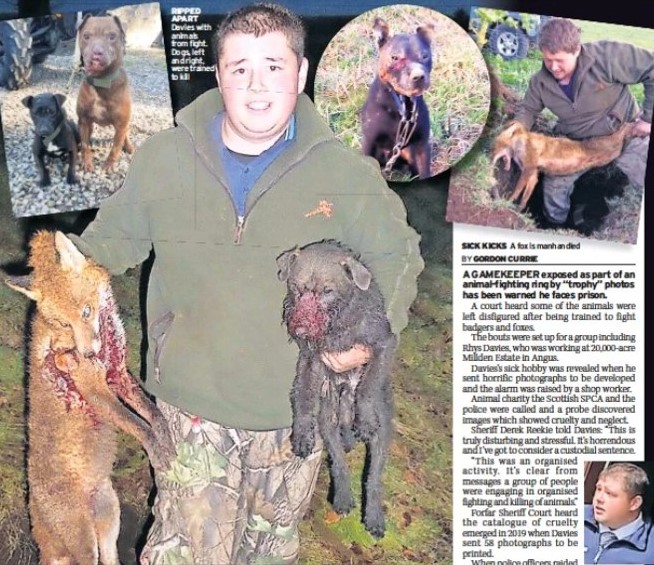
The Scottish SPCA’s special investigations unit (SIU) had received intel that Davies’ was heavily involved in using his dogs to fight and bait wild animals. Davies sent over 50 pictures featuring severely injured dogs and individuals posing with dead animals to be printed in May 2019. A member of staff at the company flagged these to the Scottish SPCA.

The SIU visited Davies’ address in October 2019, where eleven dogs were being kept in kennels and an outbuilding. A vet in attendance confirmed some of the dogs had fresh and historic injuries and disfigurement likely caused by fighting wild animals such as badgers and foxes. A collar inside the property tested positive for badger DNA.

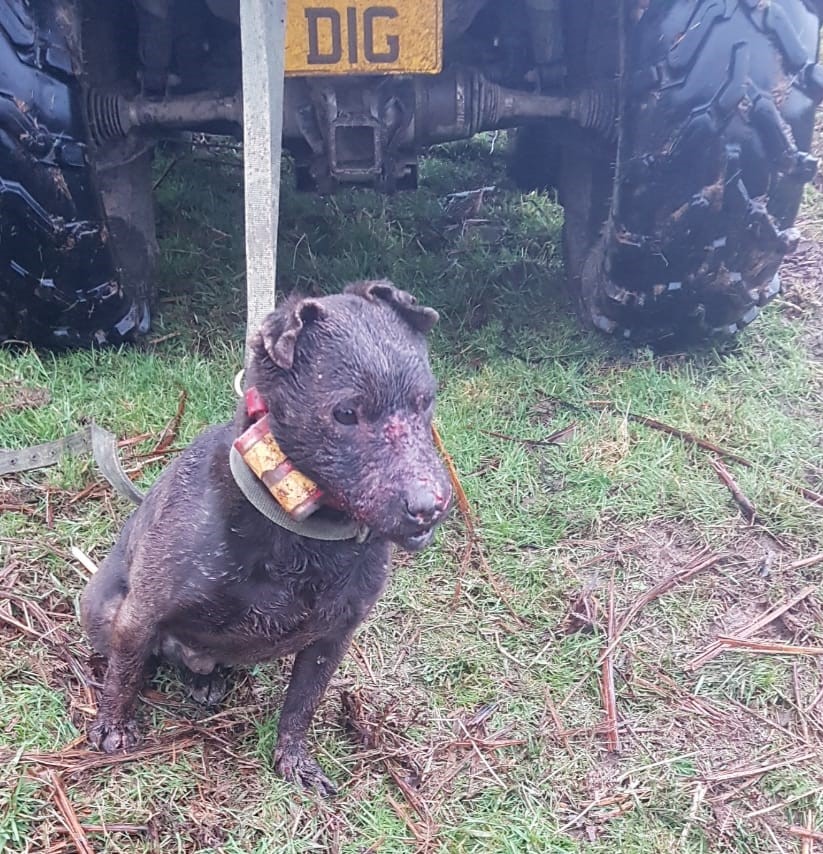
Patterdale terrier Lola had fresh injuries to her mouth and lower jaw. Pip, another Patterdale, had older scars across her muzzle, face and chest and a fresh wound still healing.

At the address, investigators found evidence to suggest Davies’ had attempted to treat injuries himself. This included syringes, staplers and prescription-only medication for animals. An analysis of Davies’ phone found messages where he discussed both the fights he was involved in and the attempts to treat the injuries his dogs had sustained from these.

Scottish SPCA chief superintendent Mike Flynn said: “All of the hallmarks of a person involved in animal fighting can be found in this case. This includes attempting to treat serious injuries without a vet, bragging to others about those injuries and trying to get ‘trophies’ such as photos as keepsakes of those fights.

“Our special investigations unit lead the way when it comes to taking on these organised, brutal groups involved in animal fights. This was an incredibly sophisticated investigation which made it plain as day the accused was guilty and helped to uncover a wider network of individuals involved in heinous animal fights.

“A custodial sentence sends a real message to anyone who wants to use dogs to bait and maim wildlife that they will be punished for it.

“Wildlife persecution is a scourge. No animal deserves to be subjected to any pain or suffering, let alone at the level Mr. Davies subjected his own dogs and wild animals to. Today, Mr. Davies has found that animal abuse is unacceptable and comes with major consequences.”

The Scottish SPCA investigates hundreds of reports of serious animal welfare issues such as animal fighting every year. Anyone with concerns or information on this issue can contact the charity’s free animal helpline in confidence on 03000 999 999.

ENDS

I’ll be blogging more about this case shortly…

Sparrowhawk shot and another suspected shot – Police & SSPCA investigate

Police Scotland and the Scottish SPCA have launched an investigation after the confirmed shooting of a sparrowhawk and the suspected shooting of another, found in the same area of Renfrewshire in April, one week apart.

The following article is from the Daily Record (dated 15th July 2022):

Two birds of prey ‘shot dead’ in Renfrewshire as probe launched.

Animal welfare chiefs say they suspect that two birds of prey have been shot dead in the space of a week.

The Scottish SPCA is working with Police Scotland as they look into the incidents after a firearm was confirmed as being used in one of the Sparrowhawk’s death.

One bird had to be put to sleep, while another was found dying with suspicious injuries which the SSPCA believe may be linked. A bird initially thought to have been stunned was found on Lochwinnoch Golf Course, Renfrewshire, on April 5 but its injuries were unsurvivable.

An undercover Scottish SPCA special investigations unit inspector said: “It was initially thought that the bird had been stunned but upon examination at the Scottish SPCA National Wildlife Rescue Centre in Fishcross, it was discovered that they had been shot.

This caused a catastrophic shoulder injury and sadly resulted in the bird having to be put to sleep.

Another member of the public also reported finding another sparrowhawk the week before, which was bleeding from the wing. Unfortunately, that bird died before help could be called for.

It is unknown if they had also been shot but it’s certainly very suspicious that two sparrowhawks with similar injuries were found in the same area only a week apart.

We are working closely with Police Scotland to establish the circumstances around the bird’s injuries due to the use of a firearm in the incident.

We would like to find out what happened to this sparrowhawk.

If anyone witnessed anything or has any information they feel may be relevant they can contact our confidential animal helpline on 03000 999 999 or Police Scotland on 101, quoting incident number KB01540722 of 5 April 2022.”

ENDS

Millden Estate gamekeeper jailed for sadistic animal cruelty – media coverage

Further to yesterday’s news that Rhys Owen Davies, 28, a gamekeeper employed by Millden Estate in the Angus Glens has been jailed for a series of sadistic animal cruelty offences (here), here is a statement issued by the Crown Office & Procurator Fiscal Service (COPFS):

Former gamekeeper jailed for animal fighting and gun offences

A 28-year-old man who kept and trained dogs for fighting has been sentenced to 210 days imprisonment, banned from keeping animals for 15 years and fined £1800 for firearms offences.

Rhys Davies, a former gamekeeper at Millden Estate near Glenesk, was sentenced at Forfar Sheriff Court today after pleading guilty to keeping five dogs for animal fighting from 24 April 2018 to 8 October 2019.  

Davies also pled guilty to causing unnecessary suffering to two dogs by failing to provide veterinary treatment and to breaching the conditions of his firearms licence by having unsecured firearms and ammunition in his home at Turnbrae House. 

The court heard that an employee of a photo print company contacted the Scottish SPCA with serious concerns about the welfare of several dogs pictured in an order for 58 images placed by Davies. 

Many of the dogs showed progressively more serious facial injuries over the period the images were taken and several males posing and digging into what looked like badger setts or fox dens. There were numerous images showing dead foxes.  

The Scottish SPCA identified them as ‘trophy’ photographs showing a group of males engaging in the organised fighting and killing of wild animals over an extended period.  

Davies was easily identifiable in many of the images. 

Inspectors from the Scottish SPCA and officers from Police Scotland went to Davies’ home in Brechin with a warrant on the morning of 8 October 2019.  

Police found a Benelli shotgun propped against a wall near the front door, two rifles were also found, a Tikka .243 rifle on the sofa and a CZ rifle in the hall cupboard next to the open gun cabinet. 

An assortment of ammunition, including 23 bullets in a pot on the floor, five in a carrier bag behind the front door and one on top of a bed were seized by police. 

Eleven dogs were found within kennels on the property. Five Patterdale Terrier dogs had obvious signs of injury.   

Two of the terriers, Lola and Tuck, had fresh injuries. Lola’s were to her mouth and lower jaw and Tuck had part of his lower face missing and fresh injuries which produced an obvious smell when near the dog. There were also healing wounds to his forelegs. 

All the dogs were taken to Scottish SPCA facilities for examination and treatment. 

Inspectors found equipment on the property linked to illegal animal fighting including, locator collars, medication, needles and syringes and a staple gun used to staple up injuries.  

Badger DNA was found on a red locator collar following forensic examination. 

Photobooks were recovered from the property like the print order placed by Davies. 

Davies was interviewed under caution and admitted that the dogs had not received veterinary treatment in the time that he had owned them. He denied using the dogs to fight or kill foxes or badgers and claimed they had sustained injury from legal ratting and foxing. 

Davies agreed to sign all the terrier dogs over to the Scottish SPCA for rehoming. 

The injured dogs were examined by specialist vets. Their expert opinion was that the dogs had been kept for the purposes of animal fighting and their injuries were sustained from face-to-face combat with badgers or foxes. 

Davies’ phone was seized during the search and images of him engaged in digging activities and the dogs with fresh wounds were found. There were also numerous conversations with associates referencing digging activities and sharing photographs showing dogs pulling badgers out of setts.  

A number of voice messages with associates were also found where they discussed digging with the dogs. In one message, Davies’ asks an individual about the size of photographs to print to make a digging album. Davies states, “And if I do get the knock for it at least everything’s all in the one place for them to find”. 

GPS location data from Davies’ phone also placed him in two rural locations on 21 September 2019 where he was found to have had a conversation with the same associate about meeting to bait and later that night his associate sent an image of Davies standing in a large whole holding one of the terrier dogs. 

Speaking after the sentencing, Karon Rollo, Head of the Wildlife and Environmental Crime Unit of COPFS said: 

“Animal fighting is a cruel illegal activity which causes terrible and unnecessary suffering to animals. 

  “The evidence clearly shows the scope of the involvement Rhys Davies had with an organised group that took pleasure in killing wild animals in such a wicked and inhumane manner. 

“I welcome the sentence and the granting of the order preventing him from keeping animals for 15 years. I would like to thank Police Scotland and the Scottish SPCA for their part in investigating and gathering evidence of these offences. 

“Hopefully this prosecution and the sentence will serve as a message to others who would cause such suffering that there are consequences and that they will be held to account for their actions and could also lose their liberty. 

“COPFS will continue to work to ensure those who participate in these barbaric practices are prosecuted and would encourage anyone who may have information on animal fighting to contact Police Scotland or the Scottish SPCA.” 

ENDS

Other media coverage:

Scottish SPCA here

STV News here

The Herald here

Daily Record here

The Guardian here

The Courier here

BBC News here

The Times here

I’ll be blogging further about this case over the next few days.

Millden Estate gamekeeper jailed for badger baiting crimes

BREAKING NEWS….

Scottish gamekeeper Rhys Owen Davies has been sentenced to eight months in prison for his depraved animal cruelty crimes committed whilst he was working on the Millden Estate in the Angus Glens.

He also received a £1800 fine for firearms offences and has been banned from owning or keeping animals for 15 years.

Davies, 28, was convicted in May this year for a series of animal cruelty offences related to badger and fox baiting between January 2018 and October 2019 (see here).

Unfortunately, Davies committed his disgusting crimes prior to the Scottish Government’s introduction of tougher penalties for animal cruelty and wildlife crime. That legislation, the Animals and Wildlife (Penalties, Protections and Powers) (Scotland) Act 2020, increased the maximum penalty for the most serious animal welfare and wildlife crimes (including badger baiting) to five years imprisonment and unlimited fines. However, it wasn’t enacted until November 2020. As Davies’ crimes were committed in 2019, the increased penalties cannot be applied retrospectively.

Nevertheless, a custodial sentence for Davies is still significant when so many other badger baiters have escaped with small fines or less, including Davies’ criminal mate Liam Taylor who was sentenced in November 2021 for his role in this particular gang with a pathetic 12-month supervision order and 240 hours of unpaid work. He was also banned from keeping dogs for ten years.

Some comments from Sheriff Derek Reekie today:

It is deeply disturbing, the horrific, cruel and senseless nature of the crime as well as the cruelty to your own dogs“,

and

Your text messages demonstrate your sickening enjoyment in what you were doing“,

and

Being a qualified gamekeeper is an aggravating factor which disputes claims of defence of naivety“,

and

You have not shown any real remorse“,

and

Your dogs were subjected to activities that were deliberate, cruel and horrific in nature“.

More on this tomorrow, including the implications for Millden Estate, but for now, a MASSIVE WELL DONE to the Scottish SPCA team who have more than demonstrated their commitment and ability to bring depraved wildlife crime criminals to court. Increased investigatory powers are a no-brainer.

Previous blogs on this case:

hereherehereherehereherehereherehere, here, here, here, here

UPDATE 2nd August 2022: Millden Estate gamekeeper jailed for sadistic animal cruelty – media coverage (here)

UPDATE 2nd August 2022: Depraved Millden Estate gamekeeper jailed – SSPCA statement (here)

UPDATE 2nd August 2022: Two others involved in animal fighting ring with Millden gamekeeper Rhys Owen Davies escaped jail (here)

UPDATE 3rd August 2022: Expert witness for the prosecution of gamekeeper Rhys Davies brands Millden Estate a ‘wildlife sink’ (here)

UPDATE 8th August 2022: Millden Estate: plausible deniability or wilful blindness to gamekeeper Rhys Owen Davies’ crimes? (here)

UPDATE 16th August 2022: Millden Estate’s sporting agent signatory to ‘best practice’ scheme! (here)

UPDATE 1st November 2022: Convicted Millden Estate gamekeeper Rhys Davies had ‘formed a close bond’ with another animal-fighting sadist (here)

‘Game over for UK shooting season as bird flu & Brexit take a heavy toll’ – new article in The Observer

There was an interesting article published in The Observer yesterday, reporting on extensive cancellations of pheasant and partridge shoots in the UK this year, as the game-shooting industry has failed in its attempts to circumvent biosecurity restrictions on the importation of gamebird eggs from France, in relation to a devastating outbreak of avian flu.

The article is well worth a read – here.

Of course, this only applies to pheasant and partridge shoots. Red grouse shoots are unaffected as they are not reliant on the importation of eggs/shooting stock.

No prosecution for shot raptors found on Millden Estate, Angus Glens

On 8th October 2019, the Scottish SPCA executed a search warrant with Police Scotland on various properties on Millden Estate in the Angus Glens looking for evidence of animal cruelty and animal fighting, including badger baiting, after 58 gruesome photographs were reportedly sent to a printing shop in England by a Millden Estate employee.

Millden Estate is known for its grouse shooting (having been described in a sales brochure in 2011 as being ‘The Holy Grail‘ of grouse moors and ‘One of the finest sporting estates in Scotland‘) The estate also hosts pheasant and partridge-shooting on its low ground.

Millden Estate has also been described as a ‘savage, stripped, blasted land‘ by author and photographer Chris Townsend (here).

Millden Estate gamekeepers, along with others in the Angus Glens, have previously been feted by senior politicians, including former Cabinet Secretary for Rural Affairs, Fergus Ewing MSP, former Minister Graeme Dey MSP, and by Prince Charles who was photographed with Millden keepers as he opened a tweed workshop in Beauly in 2019.

Millden Estate was also visited by Professor Werritty and his colleagues in 2018 during the review of grouse moor management; they visited the estate apparently to see an example of ‘best practice for managing grouse moors’.

The estate, one of a number in the Angus Glens, is also long- known amongst conservationists as a raptor persecution hotspot after the discovery of poisoned and shot buzzards in 2009 and 2011 (here), a poisoned golden eagle (Alma) in 2009 (here), and a satellite-tagged golden eagle seemingly caught in a spring trap and then apparently uplifted overnight and dumped on Deeside with two broken legs & left to die (here). Nobody has ever been prosecuted for any of these alleged offences and Millden Estate has denied any responsibility.

In October 2019 during the morning raid at Millden Estate the SSPCA did find evidence of animal fighting and cruelty, including badger baiting, and after two and a half years of protracted legal process, in May this year 28 year old gamekeeper Rhys Owen Davies was convicted of a number of animal cruelty, animal fighting, and firearms offences: (for previous blogs on this case see here, here, here, here, here, here, here, here, here, here, here). Davies is due to be sentenced on Monday.

Other evidence of alleged wildlife crime was also uncovered during that search of Millden Estate back in October 2019, including the discovery of a number of dead raptors wrapped in bags at at least three separate locations, apparently including at the residences of two estate employees.

Whilst the SSPCA led on the investigation into animal cruelty/animal fighting, Police Scotland led on the investigation into the dead raptors (because the SSPCA don’t, yet, have the powers to investigate cases where a wild animal is already dead – bonkers, I know – see here for the background on this).

I have spent the last two and a half years chasing Police Scotland about these dead raptors and asking for status updates on the investigation. I have to say I’ve been summarily unimpressed. The investigation has been conducted at a snail’s pace and communication has been dire. I understand that the dead raptors all underwent post mortems and it was determined they’d been shot. No information has been provided about the number of species involved (although it’s been reported that some were buzzards), nor the number of individuals confirmed to have been shot, although I know of at least three.

Earlier this week I asked the Crown Office & Procurator Fiscal Service (COPFS) about this case and whether it was progressing (i.e. has anyone been charged?). To its credit, the COPFS response was fast, but the case outcome familiarly frustrating:

The Procurator Fiscal received a report relating to a 28 year old male and incidents said to have occurred between 1 January 2019 and 8 October 2019. After careful consideration of the facts and circumstances of the case, including the available admissible evidence, the Procurator Fiscal decided that there should be no proceedings taken at this time. The Crown reserves the right to proceed in the future should further evidence become available‘.

I doubt we’ll ever be informed about the extent of the raptor persecution uncovered (even now, nearly three years after the raptor corpses were found, Police Scotland has failed to issue any press statement) and we’ll certainly not learn any more detail about why charges weren’t brought because the COPFS is not obliged to inform the public about its decision-making process. Apparently transparency doesn’t apply.

To be fair, a prosecution would depend on an individual suspect being identified but there are multiple employees at Millden Estate (16 were listed in the estate’s sales brochure in 2011) and a recent photo on social media suggests there are multiple gamekeepers (there’s a photo online showing 13 men dressed as gamekeepers in Millden Estate tweed at the start of the 2020 grouse season).

I think it’s fair to say that any employee could have the motivation, means and opportunity to commit wildlife crime – we now know that at least one of them, Rhys Owen Davies, was doing exactly that, apparently right under the noses of his colleagues and bosses on Millden Estate – but just having the motivation, means and opportunity isn’t sufficient evidence for a criminal prosecution. Having a carrier bag full of shot raptors at your house isn’t enough for a court of law to convict, although if there was a bag of dead raptors at my house I’m pretty sure I’d notice them and I’m pretty certain I’d have notified the police.

So where does that leave us? We await the sentencing of gamekeeper Rhys Owen Davies on Monday but I don’t expect any of us have high hopes for a fitting sentence.

Millden Estate must surely now qualify for a General Licence restriction, a monumentally ineffective sanction but the only thing left on the table until the Scottish Government pulls its finger out and introduces the licensing scheme it promised to develop in November 2020.

But even if the authorities do decide to impose a General Licence restriction on Millden Estate, that won’t curtail the estate’s ability to continue to host grouse, pheasant and partridge shoots. The estate, which is run through a series of companies and limited liability partnerships (LLPs), including one called Millden Sporting LLP, reported tangible assets in 2021 of £17.5 million.

That’s a lot of money, and with it comes a lot of influence.

UPDATE 30th August 2022: 3 shot buzzards found on Millden Estate – confirmation from Police Scotland (here)

Ian Blackford latest MP to embolden calls for a sea eagle cull

Ian Blackford MP (Scottish National Party) is the latest politician with a vested interest to whip up some anti-raptor rhetoric by accusing white-tailed eagles of “slaughtering” his lambs, emboldening those who have been calling for an eagle cull.

It follows recent outbursts from Conservative MP Chris Loder (here and here) and the SNP’s Angus MacNeil (here).

Blackford’s hysteria was published in the Sunday Times at the weekend, as follows:

With a wingspan of up to 2.5m, the majestic white-tailed eagle reintroduced to Britain from Norway is the country’s largest bird of prey.

But calls for a cull of the giant bird have grown after it was blamed for the deaths of lambs raised by Ian Blackford, the SNP Westminster leader.

Three of nearly 200 breeding pairs of the bird, also known as sea eagles, live near to the politician’s croft on the Isle of Skye, and are said to have killed up to ten of his 60 lambs in the past month.

It comes less than three years after a non-native mink killed his three-year-old ducks — named Mrs McGregor, Mrs Campbell, Mrs Morrison and Mrs McFarlane.

Last year conservationists failed in a bid to introduce 60 white-tailed eagles, likened to “flying barn doors”, to Norfolk after objections from landowners.

Blackford, who runs the smallholding with his wife, Anne, in the northwest of the island, watched from a distance recently during one of the attacks.

“Coming across a dead lamb slaughtered by an eagle it’s not a sight that you want to see. It’s an upsetting one,” he said.

“When all your efforts have gone into the lambing season, you take a pride in looking after your flock. To lose even a small number of lambs is soul destroying.”

Angus MacNeil, his neighbouring SNP MP in the Western Isles, favours a targeted cull of the eagles first reintroduced to Britain in the 1970s and again in the 1990s and early 2000s, with most in the Highlands.

Condemning “monoculture conservationists who cannot see beyond one species”, MacNeil said: “Sea eagles eat puffins and other small birds like Mars bars yet they’re heavily protected.

“A livestock law introduced last November says the owners of dogs that attack livestock can be fined £40,000 or sent to prison, but if you’re a conservationist protecting sea eagles who do the same, you’ll get a big desk in Edinburgh and a promotion.”

David Colthart, an Argyll hill farmer who represents National Farmers Union Scotland (NFUS) on a sea eagle stakeholder panel, suffered 135 unaccounted-for losses out of several hundred lambs last year.

There are four breeding pairs of sea eagles in his area and he says that lambs are an easy target for birds feeding their chicks.

“Many farmers and crofters have found the sea eagle reintroduction very challenging,” he said.

NatureScot, the public body responsible for Scotland’s natural heritage, has no plans to allow the killing of the magnificent birds, which emit a yelping cry which is made up of 15-30 short “yaps”.

It said: “We understand the concerns of farmers and crofters, and continue to work closely with them, and a range of stakeholders at the local and national level, to offer management support . . . and to trial management techniques which can help reduce these negative impacts.”

Ross Greer, the Scottish Greens MSP, said the return of sea eagles had been “a great success story”, with efforts by the government and conservation charities to help farmers mitigate their impact.

“If we’re to combat the nature and climate emergencies, then sustainable agriculture and nature restoration must learn to work together,” he said.

Meanwhile, Benedict Macdonald, the conservationist and television wildlife director, has made more calls for lynxes to return to Scotland. In a new book, Macdonald argues that the species, last seen about 1,300 years ago, would bring ecological and financial benefits by controlling deer and foxes. He also defends wild boar as critical to woodland wildlife as nature’s oldest rotational farmers, churning soil and encouraging plant growth.

NFUS is opposed to the reintroduction of lynxes, which has been previously proposed unsuccessfully for Kielder, an English village three miles from the Scottish border. It says they have been responsible for thousands of sheep deaths in Norway. “The Norwegians told us that to reintroduce predators into our country would be an absolute catastrophe,” Colthart said.

ENDS

I find it interesting that Blackford claimed ‘up to ten’ of his lambs had been ‘slaughtered’ by eagles – how many is ‘up to ten‘? Surely he can count? Or is it a case of him seeing a sea eagle consuming an already dead lamb and he’s assuming the eagle has killed it, rather than acknowledging that eagles will readily eat carrion?

If he’s quick, he can apply to join NatureScot’s Sea Eagle Management Scheme which offers support for adapting livestock management and for trialling prevention measures (see here). The closing date for support in 2023 is 31st July 2022.